By Ajit Krishna Dasa
Dear Bhakti Vikasa Swami,
Please accept my humble obeisances. All glories to Śrīla Prabhupāda.
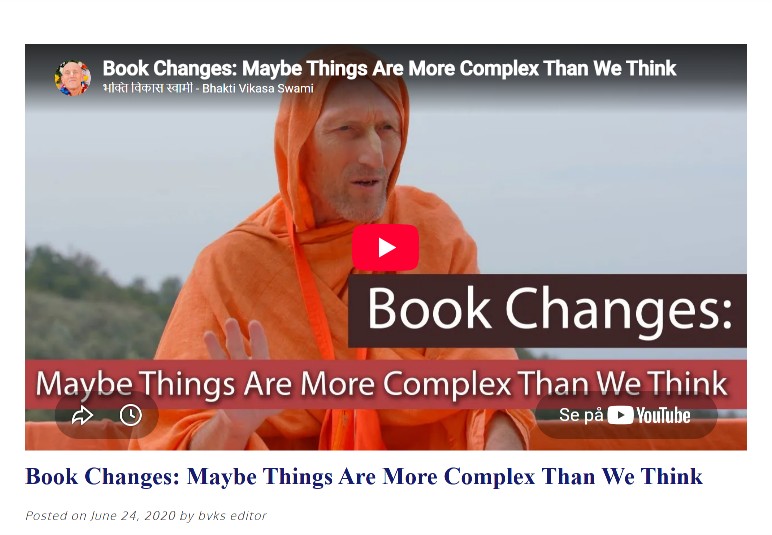
I am writing in response to your video, “Book Changes: Maybe Things Are More Complex Than We Think,” in which you discuss the posthumous change to Śrīla Prabhupāda’s original 1972 translation of Bhagavad-gītā 2.20:
“For the soul there is never birth nor death. Nor, having once been, does he ever cease to be.”
In the video, you argue that “having once been” gives the idea that the soul came into existence at some point. Since the soul is beginningless and unborn, you conclude that there are grounds for considering whether Śrīla Prabhupāda’s translation should have been changed.
I do not believe that you are deliberately misrepresenting the text. However, it appears that you have accepted the basic framing presented by Jayadvaita Swami without examining the English distinction carefully enough. The alleged error depends upon reading words into Śrīla Prabhupāda’s translation that are not actually there.
“Having once been” does not mean “having once come into being,” and it certainly does not mean “having once been created.” To be means to exist. To come into being means to begin to exist. To be created means to be caused to begin existing. These are different propositions.
In your presentation, you introduce the idea of beginning into the sentence and then treat that imported idea as though it were contained in Śrīla Prabhupāda’s translation. It is not.
Compatibility Is Not Implication
The words “having once been, does he ever cease to be” state that the soul never passes from existence into nonexistence. They do not state how, when or whether the soul began to exist.
Admittedly, the statement, if considered entirely by itself, is compatible with the Christian idea that the soul is created and thereafter exists eternally. But compatibility is not implication. A statement can be logically consistent with an idea without asserting, teaching or implying that idea.
For example, the sentence “If God exists, He exists eternally” does not say that God began to exist. In the same way, “Once existing, the soul never ceases to exist” does not say that the soul once failed to exist. The denial of future nonexistence does not imply previous nonexistence.
Your argument therefore depends upon confusing two different claims: that the soul never ceases to exist, and that the soul once began to exist. The first does not logically entail the second.
At most, the phrase “having once been,” when removed from the rest of the verse, leaves the question of the soul’s origin unstated. It does not answer that question by saying that the soul was created. Consequently, your claim that the original translation is “completely opposite” to Kṛṣṇa’s teaching is incorrect.
The Complete Verse Excludes That Interpretation
The full translation reads:
“For the soul there is never birth nor death. Nor, having once been, does he ever cease to be. He is unborn, eternal, ever-existing, undying and primeval.”
The soul is explicitly described as never born, unborn, eternal, ever-existing and primeval. No reasonable reading of the complete verse could lead to the conclusion that the soul was created.
The opening clause denies birth, the next clause denies that the soul ever ceases to exist, and the remaining clauses positively establish that he is unborn and eternal. The clauses explain one another.
The problem arises only when “having once been” is interpreted as though it said “having once come into being.” The conclusion then follows from the substituted wording, not from the wording Śrīla Prabhupāda actually published.
A More Explicit Alternative Is Not Necessarily a Correction
The revised edition says:
“He has not come into being, does not come into being, and will not come into being.”
That wording makes the denial of origination more explicit, and someone may prefer it as an independent translation. But a later wording being more explicit does not prove that the original wording was wrong.
To justify the change, it would first have to be demonstrated that “having once been” actually means or implies that the soul was created. It does not.
Your argument shows only that someone might misunderstand the phrase after separating it from its context and confusing existence with the beginning of existence. But the mere possibility of misunderstanding is not sufficient reason to rewrite an author’s work. Almost any sentence can be misunderstood when isolated or read carelessly.
Preserve the Original and Annotate Separately
Where a later scholar believes that a passage requires clarification, the original and authorized edition must remain exactly as it is. It must remain the principal, standard and prominently available edition, rather than being displaced by a posthumously reconstructed hybrid.
A separate academic annotated edition may also be produced according to the model Garuda Prabhu is developing. In such an edition, Śrīla Prabhupāda’s authorized text is reproduced verbatim, while textual variants, manuscript evidence, alternative translations, historical information and proposed clarifications are placed in clearly identified annotations or endnotes.
The distinction must remain unmistakable: Śrīla Prabhupāda’s words remain Śrīla Prabhupāda’s words, while the later scholar’s observations remain clearly identified as the later scholar’s observations.
An annotation to Bhagavad-gītā 2.20 could simply explain that “having once been” should not be understood as implying that the soul began to exist, since the complete verse explicitly describes the soul as never born, unborn, eternal and primeval. This gives the reader every supposedly necessary clarification without altering the original text.
That is transparent scholarship. Replacing the original wording and publishing the replacement under Śrīla Prabhupāda’s name is something entirely different.
The Decisive Issue Is Authority
Near the end of the video, you acknowledge that the controversy involves ethical, philosophical and theological questions, but say that you will not discuss them. Yet these are precisely the questions that determine whether anyone has the right to alter Śrīla Prabhupāda’s published books after his departure.
A linguistic argument might establish that another translation is possible or perhaps more explicit. It cannot establish authority to replace the published translation.
Your argument moves from “another wording may be clearer” to “there are grounds for changing Śrīla Prabhupāda’s book.” That conclusion does not follow unless one first assumes that a disciple may replace the ācārya’s published words whenever he believes he can express the intended meaning more clearly.
But that assumption is the very point under dispute.
I therefore respectfully ask you to reconsider the argument presented in your video. “Having once been” does not mean “having once come into being,” and it does not mean “having once been created.” The wording may be compatible, when viewed in isolation, with the belief that the soul was created, but compatibility is not implication. Moreover, the complete verse explicitly declares the soul to be never born, unborn, eternal and primeval.
There is therefore no philosophical error to correct. The difficulty arises only when a meaning not contained in the English is inserted into the sentence.
The original must remain original, exactly as Śrīla Prabhupāda gave and authorized it. Scholars may explain it, annotate it and document alternative renderings in a separately identified academic edition. What they should not do is insert their conclusions into Śrīla Prabhupāda’s text and then present the resulting hybrid as Bhagavad-gītā As It Is.
Your servant,
Ajit Krishna Dasa

You must be logged in to post a comment.