


Books and longer studies dealing with the editing, preservation, publication history, and presentation of Śrīla Prabhupāda’s works. Each title has its own page with background, context, and links to read or obtain the book.
Arsa-Prayoga publications
Krsna, The Blessed Lord
A focused case study of the posthumous replacement of “The Blessed Lord said” in Śrīla Prabhupāda’s Bhagavad-gītā As It Is. Drawing on Prabhupāda’s own usage before and after 1970, including evidence from his earlier writings and spoken words, the book argues that the expression was not an accidental remnant in need of correction. The example becomes a wider test case for editorial restraint, authorial intention, and posthumous revision.
Salt in the Caranamrta
A substantial collection of articles, letters, rebuttals, quotations, and debates from the early years of Arsa-Prayoga. The volume documents numerous changes to Śrīla Prabhupāda’s books while also developing the broader argument against unauthorized posthumous editing. Rather than treating each revision as an isolated curiosity, it asks what principles should govern the preservation of an ācārya’s published teachings and records an important period in the history of the controversy.
No Reply from BBTI
A documentary collection centered on questions raised with BBT International about changes to Śrīla Prabhupāda’s books. It brings together examples, arguments, correspondence, and evidence from the early Arsa-Prayoga campaign, showing what concerned devotees were asking and why issues of authorization and editorial method mattered. Read today, the book is also a historical record of the debate and of important questions that, in the author’s view, remained insufficiently answered.
Understanding Śrīla Prabhupāda’s Statements on Rape
A systematic study of one of Śrīla Prabhupāda’s most difficult published statements. The book examines his sexual ethic, his explicit definition and condemnation of rape, the guṇas, traditional Vaiṣṇava discussions of conditioned sexuality, and relevant modern research on dominance, coercive fantasy, physiological response, and consent. It concludes by asking how difficult passages should be handled after the author’s departure: preserved and carefully explained, or silently removed.
Related publications
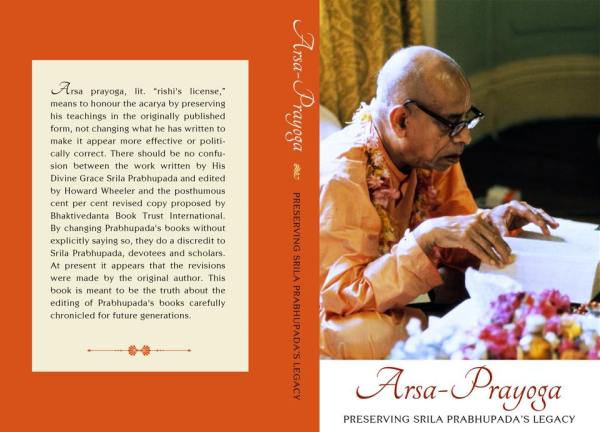
Arsa-Prayoga: Preserving Srila Prabhupada’s Legacy
A nearly 400-page compilation devoted to the controversy over changes to Śrīla Prabhupāda’s books. The volume presents the case for ārṣa-prayoga—respecting authoritative usage and preserving the ācārya’s published teachings rather than rewriting them to appear more effective, modern, or politically acceptable. It combines documentation, argument, and historical material intended to preserve the evidence for devotees and future researchers examining the development of the book-changes controversy.

Blazing Edits
Bhakta Torben Nielsen’s collection of essays examining changes to Śrīla Prabhupāda’s Bhagavad-gītā As It Is. Originally published as an ongoing series through the Sampradaya Sun and Arsa-Prayoga, the book works through concrete examples and asks whether particular revisions were necessary, whether they genuinely improved the text, and—more fundamentally—whether later editors possessed the authority to alter Śrīla Prabhupāda’s published work after his departure.
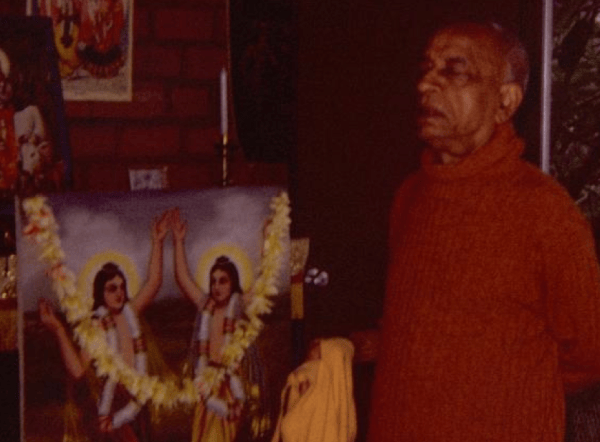
Srila Prabhupada: The Transcendental Art Master
Govinda Dasi recounts how Śrīla Prabhupāda instructed her and other young devotee artists in producing devotional paintings for his books and personally supervised their work. The account also addresses the later removal of many of those authorized paintings. For the preservation debate, the testimony broadens the question beyond wording alone: artwork and other elements explicitly guided or approved by the author can also form part of the historical presentation of his books.
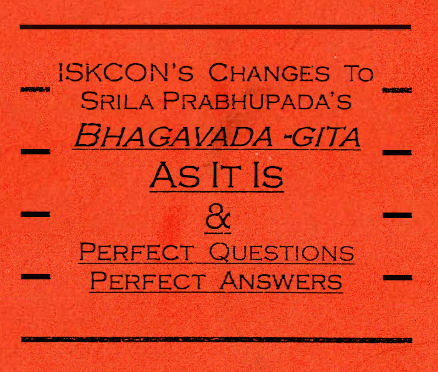
ISKCON’s Changes to Bhagavad-gita As It Is and Perfect Questions, Perfect Answers
Madhudvisa Dasa’s early book-length documentation of changes to Śrīla Prabhupāda’s Bhagavad-gītā As It Is and Perfect Questions, Perfect Answers. Produced in the typewriter era, it now has historical as well as argumentative value. The book records specific textual changes, correspondence, and evidence from an early stage of the controversy, demonstrating that objections to posthumous revision have a documented history extending well beyond the more recent debate.

