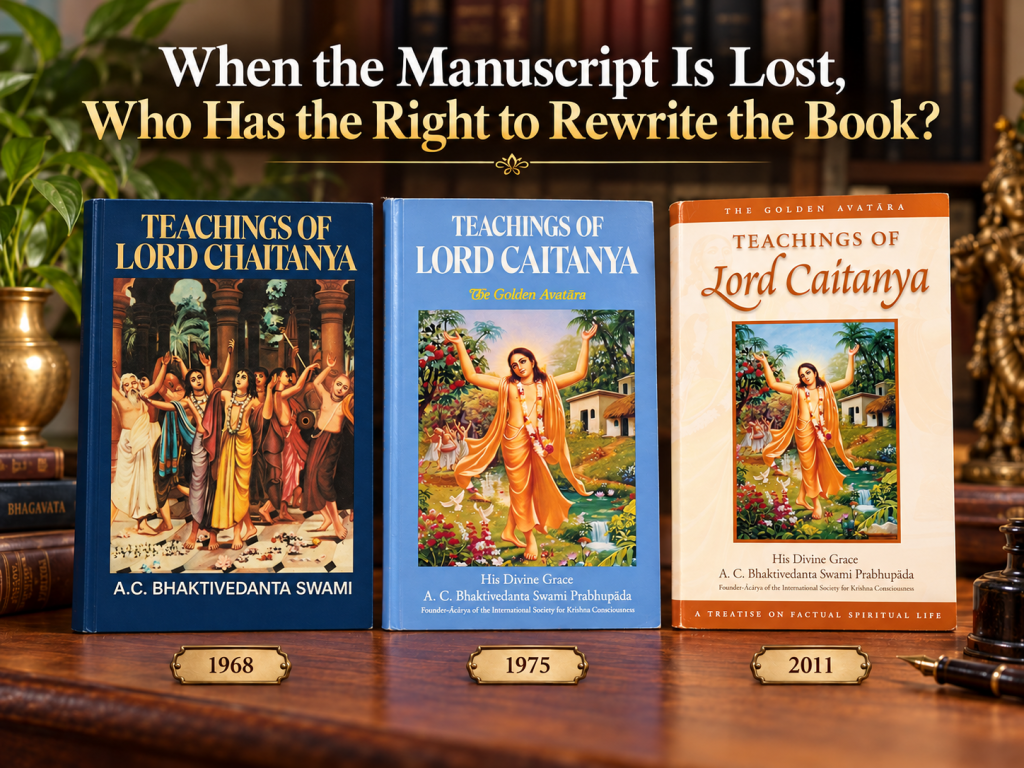
Sign the Petition – Save Srila Prabhupada’s Books

Devotees are waking up.

For decades, silent changes have been made to Śrīla Prabhupāda’s books!

BBT International has tried to justify the post-1977 changes by saying things like:

  • “We are restoring the books to Prabhupāda’s original manuscript.”
  • “We are making them closer to Prabhupāda.”
  • “We are only fixing grammar, commas, and capitalization.”
  • “We are simply correcting earlier editorial mistakes.”
  • “No unnecessary changes have been made.”

But when you actually examine the evidence, those claims don’t hold up. The documented changes show that BBT International has:

  • Deleted Srila Prabhupāda’s own chosen words, lines, and philosophical emphasis—even when those same lines do appear in the so-called “original manuscript.”
  • Added new words and sentences of their own, which, by definition, have no manuscript support and were never spoken, typed, or approved by Srila Prabhupāda.
  • Replaced Prabhupāda’s personal Sanskrit translations with reinterpretations that subtly change meaning and mood.
  • Introduced needless stylistic rewrites and sentence restructuring that sanitize his voice, shift tone, and move the books closer to a modern editorial product—and further away from the Founder-Ācārya.

No previous ācārya’s books were treated like this after their departure.
No tradition in the paramparā legitimizes post-samādhi revisions.
And no devotee can ignore this once they actually see the changes.

If Prabhupāda’s original words are sacred, then why are they being rewritten?

👉 If you care about preserving what Srila Prabhupāda actually gave us, add your name:

Sign the petition to protect the original books.

A movement that cannot preserve its founder’s words cannot preserve its future.
Make your voice count before someone else speaks for you.

Sign the petition – click the link here or click the picture below!

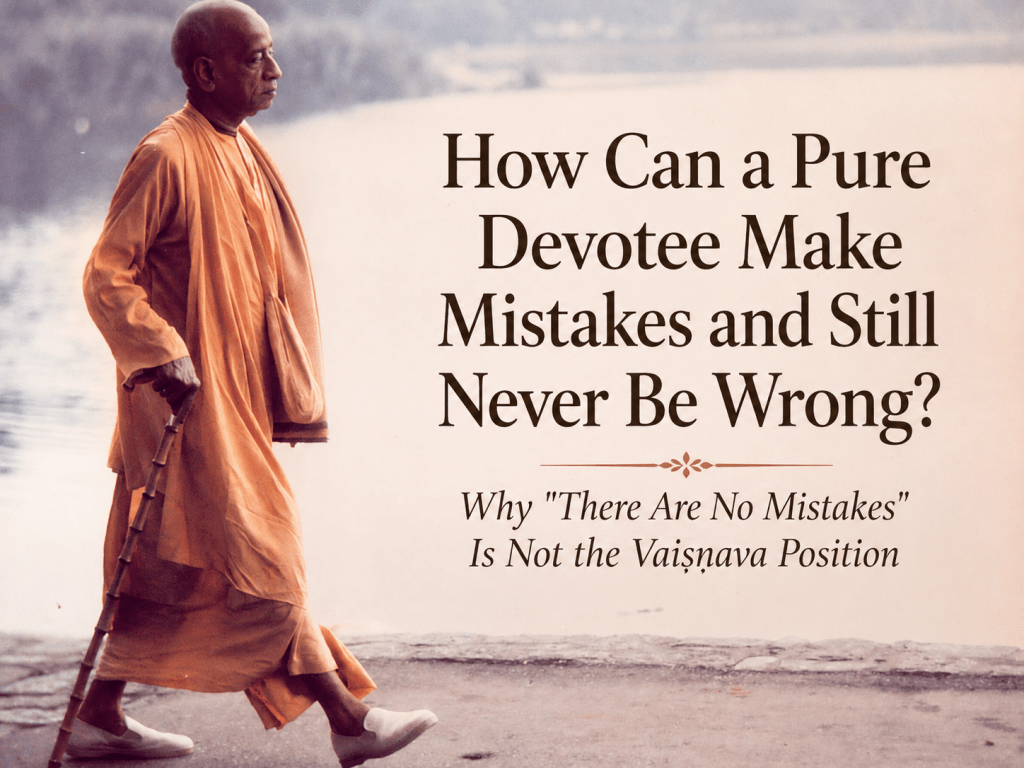
Was Srila Prabhupada Wrong When He Said Rupa and Sanatana Were “Exterminated”

By Ajit Krishna Dasa

In a lecture, Śrīla Prabhupāda says that Sanātana Gosvāmī and Rūpa Gosvāmī were “exterminated from society.” For some readers, this immediately creates a difficulty. Since “exterminate” is commonly associated with killing, it may appear that the word is being used incorrectly. On that basis, one may conclude that he must have meant something like “excommunicated.”

This reaction is understandable, but it rests on a quick assumption: that the modern, narrow meaning of a word is the only valid one. Before arriving at such a conclusion, a more careful approach is to give the speaker the benefit of the doubt and examine the context.

When we do so, the meaning becomes clear from Śrīla Prabhupāda’s own explanation:

“So this Sanātana Gosvāmī and Rūpa Gosvāmī… They were exterminated from the society. What is the extermination of society? He will never be invited.

Nobody will offer his daughter to their family… So if one is exterminated, oh, it is very difficult to get his daughter married. Nobody will accept. That was their condition.”

Here, A. C. Bhaktivedanta Swami Prabhupada defines the term himself. “Extermination” refers to complete social exclusion—loss of association, honor, and standing within society.

Moreover, the word itself supports this usage. Historically, “exterminate” means to drive out beyond a boundary—to remove completely. Only later did it acquire the more specific sense of physical destruction. The broader meaning therefore fully accommodates Śrīla Prabhupāda’s usage.

Seen in this light, the issue is not that the word is wrong, but that a modern assumption about its meaning is too limited.

A similar pattern can be observed in editorial decisions made by Jayadvaita Swami. In the purport to Bhagavad-gītā 13.1–2, the original 1972 edition reads:

“Sometimes we understand that I am happy, I am mad, I am a woman, I am a dog, I am a cat…”

In the posthumous edition, “mad” was replaced with “a man,” based on the judgment that the original wording was incorrect or nonsensical.

Yet when Śrīla Prabhupāda’s broader usage is considered, the phrase “I am happy, I am mad” is not only meaningful but philosophically precise. Throughout his teachings, happiness and madness function as contrasting epistemic states—clarity versus illusion. The conditioned soul identifies with both and mistakes them for the self. The original wording therefore fits the context of Chapter 13, which analyzes the distinction between the knower and the known, including mental conditions.

In both cases, the same tendency appears: a word is judged according to a narrow or immediate understanding, and a conclusion is drawn without sufficient attention to context, historical meaning, or the speaker’s own usage.

This highlights an important principle. Fidelity to Śrīla Prabhupāda’s words requires more than preserving the text. It requires a disciplined approach to interpretation. Before assuming error, we must give the benefit of the doubt, examine the context, and consider how he consistently uses language across his teachings.

If we fail to do so, we risk not only misunderstanding his words, but also attributing confusion or mistake to the ācārya where none exists.

To honor Śrīla Prabhupāda properly, we must therefore begin with humility in interpretation. By allowing his own explanations, his broader usage, and the historical range of language to guide our understanding, we remain faithful not only to his words, but to the meaning he intended to convey.

🎨 GRAND ANNOUNCEMENT 🎨THE FIRST ANNUAL “AS IT IS… BUT IMPROVED” DESIGN FESTIVAL

By the Change and Improve Committee

Even though we know Śrīla Prabhupāda said:

“And the covers, if possible, should always be the same for each respective book regardless of what language it may be printed in.”
(Letter to Jadurani, Bombay, January 3, 1975)

We are determined to demonstrate a higher level of understanding.

After all, when the spiritual master asks for water, he is obviously requesting milk.

And sometimes… a soy latte.

We therefore wish to show that we are not merely followers of instructions, but interpreters of deeper intentions. We aim to prove—through vibrant creativity—that we are fully qualified to adjust, refine, expand, reinterpret, and aesthetically upgrade that which was already completed.


📚 THE MISSION

Design as many distinct and innovative covers as possible for each of Śrīla Prabhupāda’s books.

Uniformity is appreciated… in principle.
Diversity is appreciated… in practice.


🎭 COMPETITION CATEGORIES

  • Golden Aura Supreme Edition
    (Minimum three halos per composition)
  • Modern Mindfulness Krishna™ Edition
    (Suitable for yoga studios and corporate retreats)
  • Epic Cinematic Bhagavad-gita Universe
    (If it doesn’t look like a movie poster, try again)
  • Children’s Joyful Vrindavan Cartoon Series
    (Smiling cows required, blinking optional)
  • Ultra-Minimalist “Spiritual but Not Religious” Edition
    (Preferably no one can tell what the book is about)
  • Heritage Classic-but-Updated-but-Still-Classic Edition
    (Subtle confusion is a plus)

🏆 JUDGING CRITERIA

Entries will be judged on:

  • Maximum departure from previous covers
  • Confidence in creative reinterpretation
  • Ability to attract entirely different audiences at once
  • Deep conviction that nothing essential has changed

Bonus points for:

  • Glow effects
  • Lens flares
  • A strong feeling that this version is finally the right one

🥇 SPECIAL AWARD

The “I Know Better Than I Heard” Trophy

Awarded to the participant who most convincingly demonstrates that:

Following instructions is good…
but improving them is better.


🧘‍♂️ PHILOSOPHICAL FOUNDATION

We humbly accept that the ācārya gave instructions.

We more humbly accept that those instructions may benefit from our refinement.

After all, tradition is living.
And living things… evolve.


📜 DISCLAIMER

Any resemblance between original instructions and current practices may be:

  • Coincidental
  • Contextual
  • Open to interpretation

🌍 FINAL WORD

Let every language have its own cover.
Let every temple have its own vision.
Let every designer express their realization.

Because truth is one…
but presentation is unlimited.


Submissions now open.
Clarity optional. Confidence required.

📬 Contact Information

Change & Improvement Committee
Chairman: Improveananda Dāsa
✉️ change@prabhupada.org

A Small Title Change with Larger Implications

Note on Title Formatting

The original title of this article distinguishes between Bhagavad-gītā and BHAGAVAD GĪTĀ. Due to the website’s automatic capitalization, this difference is not visible in the heading above. I have therefore used a simplified title there.

The actual title is:

Bhagavad-gītā As It Is or BHAGAVAD GĪTĀ AS IT IS? A Small Change with Larger Implications

By Ajit Krishna Dasa

The below is written with the help of both AI and my wife – both are adept in Sanskrit.

When comparing the original edition of Bhagavad-gītā As It Is with the posthumously edited edition, one detail on the cover stands out:

  • Original: Bhagavad-gītā As It Is
  • Edited: BHAGAVAD GĪTĀ AS IT IS

Both forms retain proper diacritics (gītā / GĪTĀ), indicating an intention to preserve correct Sanskrit pronunciation.

However, a structural change has taken place.

The Sanskrit Structure

The title Bhagavad-gītā is a compound (tatpuruṣa):

  • bhagavad — “of the Lord”
  • gītā — “song”

Together: “The Song of the Lord.”

In Sanskrit, this is a single semantic unit. The relationship between the parts is built into the compound.

The Original Presentation

In Bhagavad-gītā As It Is, the hyphen serves to preserve this structure:

  • It signals that the word is a compound
  • It maintains grammatical unity
  • It reflects a Sanskrit-informed standard of presentation

This is not merely stylistic. It is a faithful transliteration convention.

The Edited Presentation

In the edited version:

BHAGAVAD GĪTĀ AS IT IS

two things occur:

  1. The title is capitalized (a neutral typographical choice)
  2. The hyphen is removed

The removal of the hyphen results in:

  • the compound being visually split
  • the internal relationship no longer being indicated
  • a shift toward English formatting conventions

The diacritics remain, so pronunciation is preserved. But structure is not.

Does This Bring the Text Closer to Prabhupāda?

This is where the issue becomes more than typographical.

Śrīla Prabhupāda consistently emphasized careful and respectful handling of Sanskrit, including correct presentation of names and terms.

Within that context, the original form:

Bhagavad-gītā

reflects a more careful alignment with Sanskrit structure.

The edited form:

BHAGAVAD GĪTĀ

moves away from that structural precision.

So it is reasonable to say:

This change does not bring the presentation closer to Śrīla Prabhupāda’s standard, but slightly further from it.

What Does the Change Actually Signal?

Not incompetence. That’s a cheap shot.

What it more plausibly signals is:

  • a preference for modern publishing conventions
  • a move toward standardized, reader-friendly formatting
  • a subtle de-emphasis of Sanskrit structural precision

In other words, a shift in editorial priorities.

Why This Matters

On its own, this is a minor change. No philosophy is altered by a hyphen.

But in the broader discussion of:

  • original vs. edited editions
  • posthumous editorial authority
  • fidelity to the ācārya’s presentation

…even small changes become relevant indicators.

They show the direction in which editorial decisions are moving.

Conclusion

  • Bhagavad-gītā As It Is preserves both pronunciation and structure
  • BHAGAVAD GĪTĀ AS IT IS preserves pronunciation, but not structure

Therefore:

The original title is more faithful to Sanskrit and more aligned with the standard Śrīla Prabhupāda himself employed.

The difference is small.
But it is real. And it points in a clear direction.

Is an Evolving English Language an Argument for Changing Srila Prabhupada’s books?

By Ajit Krishna Dasa

It is often said: “Whatever BBT International is doing will eventually have to happen anyway. Language changes. English will evolve. Therefore, updating Śrīla Prabhupāda’s books is inevitable.”

This argument might sound reasonable on the surface. But when examined carefully, it collapses.

Yes, language changes. That is not controversial. The real question is not whether English evolves. The real question is this:

How does a serious tradition preserve the final, authorized words of its ācārya while also making them accessible to future generations?

Those are two different concerns. And they must not be confused.

First Principle: Authorial Finality

When an author publishes a final edition of his work, that edition becomes historically fixed. This is not sentimentality; it is basic literary integrity. We do not revise Shakespeare because English changed. We do not modernize Dostoevsky by altering his Russian text. We do not update Plato’s Greek.

Instead, we preserve the original and produce new translations or explanatory editions when necessary.

The typically used Bible analogy actually proves this point. When Christians “update” the Bible, they are not editing the Greek manuscripts. They produce new translations. The King James Version still exists. The Greek New Testament still exists. No one retroactively edits them.

Preservation and translation are not the same thing.

Second Principle: The Location of Authority

If posthumous revision becomes acceptable, something subtle but serious occurs. Authority shifts.

It is no longer simply “Śrīla Prabhupāda said.” It becomes, “Śrīla Prabhupāda said — as adjusted by later editors.

Even if intentions are sincere, the epistemic center moves from the ācārya to the editorial board.

That shift is not linguistic. It is structural.

Third Principle: The Alleged Problem of “Archaic English”

Let us be honest. Śrīla Prabhupāda’s English is not archaic. It is mid-20th century English with Sanskrit terminology. It is often clearer than modern academic theology.

The claim that future generations will need a “course in archaic English” is exaggerated rhetoric. People read Shakespeare in school. They read classical literature. They learn terms. Human beings are capable of intellectual effort.

Accessibility does not require alteration.

Fourth Principle: The Real Solution

If, at some distant point, English changes so radically that comprehension becomes genuinely difficult, the solution is straightforward and principled:

Produce a clearly labeled contemporary English rendering.

For example:

Bhagavad-gītā As It Is – Original Authorized Edition
Bhagavad-gītā As It Is – Contemporary English Rendering

Two distinct works. Transparent. No confusion. No silent revision. The original remains intact and available. The rendering serves as an aid, not a replacement.

This is exactly how translation into any other language works. We do not rewrite the Sanskrit. We translate it. The same logic applies here.

A Tradition That Preserves

Strong traditions preserve their sources. They do not continuously re-edit them according to the sensibilities of later generations.

Language change is inevitable. Editorial authority is not.

The real issue is not readability. The real issue is whether we maintain textual integrity and the clear, final authority of the ācārya.

If the movement flourishes, Śrīla Prabhupāda’s English may itself become devotional standard language, much like older Biblical English still shapes Christian liturgy today.

Language may evolve. But reverence, integrity, and discipline must remain.

And that is the standard by which this issue should be judged.

Podcast: Inside the Editing Controversy w/Dr Graham Schweig (Garuda Das) PhD

By Ajit Krishna Dasa

This episode is not a vague reflection on “textual integrity.” It is a direct and sustained argument against the post-1978 changes made to Śrīla Prabhupāda’s books by BBT International under the direction of Jayadvaita Swami.

The central claim is simple and uncompromising: no one has the moral, legal, or devotional authority to alter a departed author’s published work—especially when that author explicitly forbade such changes.

Before outlining the case, it is important to understand who is making it!

Graham M. Schweig (Garuda Dāsa) is not an internet critic or a casual observer. He holds two Master’s degrees and a PhD from Harvard University and has spent decades teaching religion and philosophy at the university level. He has published with major academic presses such as Oxford, Columbia, Princeton, Yale, and HarperCollins. He is a trained Sanskritist, theologian, and editor who has worked at the highest levels of academic publishing. Within Vaiṣṇava circles he is known not only as a scholar but as a long-time practitioner deeply committed to Śrīla Prabhupāda’s legacy. In other words, he understands both rigorous editorial standards and the theological weight of disciplic succession. When he says what has been done is “unacceptable” by scholarly standards and “transgressive” by devotional standards, that is not rhetoric. It is the judgment of someone qualified to evaluate both domains.

Now to the arguments.

First: Śrīla Prabhupāda’s own instructions.
In letters, conversations, and in his Macmillan contract, he stated that editing was for grammar and punctuation only—not for altering philosophy or style. In 1977 he repeatedly said, “Our books must remain as they are,” and “Whatever is done is done. No more.” He required that revisions be made only with the author’s permission. Once the author has departed, that permission is impossible. Therefore, posthumous revisions violate his expressed will.

Second: False assumption of authority.
Prabhupāda granted conservative, provisional authority to assist with copy-editing. BBT editors assumed open-ended authority to revise, harmonize, and “improve” content. That is a categorical shift—from servant to co-author.

Third: Editorial overreach.
Approximately 5,000 changes were made to Bhagavad-gītā As It Is alone. Around 77% of its verses were altered. In Śrīmad-Bhāgavatam the changes run into the tens of thousands. These include altering translations where no grammatical error existed, removing theological identifications, shifting meaning, and recasting concise, powerful prose into diluted language. These are interpretive interventions—not typo corrections.

Fourth: Insertion of the editor’s mind into the text.
A sentence was changed because it “didn’t make sense” to the editor. When it was shown that it did make philosophical sense, the issue remained: the books are now filtered through the editor’s conceptual limits.

Fifth: Lack of transparency.
Substantial changes were made without full disclosure. Scholarly standards require documentation. That was not provided.

Sixth: Legal maneuvering.
BBT International registered itself as “author” and listed Śrīla Prabhupāda as “worker for hire.” Whatever the legal strategy, the signal is disturbing.

The alternative presented is clear: preserve the original text and address issues through annotated editions. Rewriting the text is not service. It is substitution.

If we accept that Śrīla Prabhupāda’s books are divinely empowered and that he explicitly ordered “no more changes,” then the post-1978 revisions constitute a transgression—morally, legally, and theologically.

This is not emotionalism. It is fidelity.

Srila Prabhupada’s Lectures Now Shown with Post-Samādhi Edited Texts

By Ajit Krishna Dasa

Many devotees are unaware of what is currently happening on official BBT International websites that host Śrīla Prabhupāda’s lectures.

For example, in the following lecture:

https://prabhupadavani.org/transcriptions/760615bgdet/

Also available here:

https://vedabase.io/en/library/transcripts/760615bgdet/#bb379398

The original audio recording from the 1976 is presented together with verses and purports from the post-samadhi edited Bhagavad-gītā As It Is from 1983. No mention is made that the displayed text is not the edition that Śrīla Prabhupāda himself approved and used while physically present.

This is deeply problematic.

When Śrīla Prabhupāda lectured on Bhagavad-gītā or Śrīmad-Bhāgavatam, he spoke from specific printed editions. His explanations were tied to those exact words. His arguments, emphases, and language were connected to the books as they stood during his lifetime.

If a later, revised edition is silently placed under those lectures, an artificial alignment is created. It gives the impression that the text being displayed is the very same text from which he was speaking.

It is not.

Attentive listeners may notice discrepancies between the audio and the printed text. This naturally raises questions. Why does the lecture not perfectly match the displayed purport? Has something been altered? If so, by whom – and on what authority?

Such confusion weakens trust.

Śrīla Prabhupāda repeatedly emphasized that his books should not be changed. He warned that even small alterations could damage the integrity of the paramparā. The principle of arsa-prayoga teaches that the words of the ācārya are not to be “improved” by later hands.

Presenting post-samādhi revisions together with his lectures normalizes those revisions and obscures the historical record. It subtly trains readers to accept altered texts as the standard form of his teachings.

Devotees should be aware that this is happening.

The solution is to preserve and present only the editions approved by Śrīla Prabhupāda himself.

His words are complete. They do not require posthumous correction.

The “Rascal Editors” Conversation – Then and Now

Śrīla Prabhupāda on Unauthorized Editing and Post-Samādhi Changes

By Ajit Krishna Dasa

Discussions about post-samādhi editing of Śrīla Prabhupāda’s books often assume that the real problem began after 1977. But Śrīla Prabhupāda himself tells a different story. In the well-known “Rascal Editors” conversation dated June 22, 1977, in Vṛndāvana, he describes a situation already unfolding — one marked by unauthorized editing, loss of control, lack of accountability, and the impossibility of verification.

Far from being historically irrelevant, these remarks reveal a structural problem — one that makes post-samādhi editing not only questionable, but fundamentally illegitimate.

Editing Without Control — Already in 1977

Śrīla Prabhupāda states:

“It is starting. What can I do? […] They make changes, such changes… So how to check this? How to stop this?”

This is a critical admission. Prabhupāda is not predicting a future danger; he is describing a present reality. Editorial changes were already occurring, and he openly acknowledges that he lacks the practical ability to stop them.

This point alone carries enormous weight. If the author himself — alive, present, accessible, and formally in charge — could not effectively control editorial activity, then any claim that editorial control somehow improved after his departure is untenable. The conditions for restraint were already weakening; after samādhi, they could only deteriorate further.

The Defining Issue: Absence of Authority

Prabhupāda continues:

“…they are doing without any authority […] Very serious feature.”

Here the issue is precisely identified. The problem is not accidental error, linguistic awkwardness, or the need for stylistic polish. The problem is unauthorized action.

This distinction is crucial when discussing posthumous changes to Prabhupāda’s books. Appeals to “clarification,” “restoration,” or “philosophical consistency” are irrelevant if no authority exists to sanction such changes. In a Vaiṣṇava framework — especially under the principle of ārṣa-prayoga — authority does not arise from competence, intention, or institutional position. It must be explicitly granted.

Without authority, even a well-intended edit is illegitimate.

“Jayadvaita Is Good” — A Misused Argument

At this point, defenders of post-samādhi editing often introduce the following exchange:

Tamāla Kṛṣṇa: Your original work that you’re doing now, that is edited by Jayadvaita. That’s the first editing.
Prabhupāda: He is good.
Tamāla Kṛṣṇa: He is good. But then, after they print the books, they’re going over. So when they reprint…
Prabhupāda: So how to check this? How to stop this?
Tamāla Kṛṣṇa: They should not make any changes without consulting Jayadvaita.

From this, it is claimed that later editorial changes are justified because Jayadvaita Swami was trusted by Śrīla Prabhupāda.

This argument fails on several levels.

First, Prabhupāda’s approval of Jayadvaita was contextual and temporal. He approved Jayadvaita’s editing at that time, under his supervision, and within a defined scope. Nothing in this exchange grants blanket, indefinite, post-samādhi editorial authority.

Second, Prabhupāda himself explicitly rejected the idea that past approval guarantees present legitimacy. He repeatedly warned against exactly this kind of reasoning.

Śrīla Prabhupāda explains the logical fallacy involved:

“This is nagna-mātṛkā-nyāya. We change according to the circumstances. You cannot say that this must remain like this.”
(Morning Walk, May 5, 1973, Los Angeles)

In Nyāya logic, this fallacy assumes that because something was valid in the past, it must retain the same status indefinitely — regardless of changed circumstances. Prabhupāda explicitly rejected this mode of reasoning.

Trust Is Conditional — and Can Be Violated

Prabhupāda further clarifies that trust is never unconditional:

“I have given you charge… but you can misuse at any moment, because you have got independence. At that time your position is different.”
(Morning Walk, June 3, 1976, Los Angeles)

And he states even more plainly:

“Phalena paricīyate […] Present consideration is the judgement.”
(Morning Walk, October 8, 1972, Berkeley)

In other words, a person must be evaluated by present actions, not past reputation. Previous trust does not immunize later conduct.

This principle applies directly here. Whatever confidence Prabhupāda had in Jayadvaita’s editing during his presence cannot be mechanically transferred to a radically different situation: post-samādhi editing, without authorial oversight, involving substantive changes to published works.

Evidence of Breach: Changes in Style, Mood, and Philosophy

This is not a theoretical concern. Post-samādhi editions exhibit clear and documentable changes that go far beyond spelling or grammar. These include alterations to:

  • Śrīla Prabhupāda’s personally typewritten Sanskrit translations
  • Śrīla Prabhupāda’s spoken, forceful, non-academic style
  • the mood and devotional tone of passages
  • the philosophical framing and emphasis
  • the balance between direct instruction and interpretive explanation
  • and, in some cases, the theological perspective itself

Style, tone, and mood are not cosmetic. They are integral to meaning and pedagogy. To alter them without authority is to alter the work — and doing so after the author’s departure violates the trust placed in any editor.

Original manuscripts, first editions, and contemporaneous recordings therefore function only as witnesses to what Śrīla Prabhupāda authorized and published — not as licenses to revise his words post-samādhi.

Then and Now: Structural Parallels

The situation Prabhupāda describes in 1977 and the situation surrounding post-samādhi editing share the same defining features:

  • Editorial changes occurring without explicit authorization
  • Inability to verify or supervise those changes
  • Absence of a final, corrective authority
  • Institutional normalization of editorial discretion
  • Appeals to past trust rather than present evidence

The difference is not one of kind, but of degree. What was beginning in 1977 became entrenched after Prabhupāda’s departure.

The Unavoidable Conclusion

Śrīla Prabhupāda’s own words establish the following facts:

  1. Unauthorized editing was already occurring during his presence.
  2. He could not effectively stop it.
  3. He could not reliably check or verify it.
  4. He explicitly warned against relying on past trust as permanent validation.

From this, the conclusion follows with clarity:

Post-samādhi editing of Śrīla Prabhupāda’s books lacks authority, lacks verification, and reproduces precisely the dangers he himself identified.

That Jayadvaita Swami was trusted then does not settle the question now. Trust is conditional, circumstances change, and actions must be judged in the present.

Where authority is absent and trust has been objectively violated, restraint is not extremism — it is fidelity.

“Secret Wisdom” – Revisited (Bhagavad-gita 9.1)

By Ajit Krishna Dasa

Link to the Original Article:

https://arsaprayoga.com/2014/03/29/secret-wisdom-deleted-from-bhagavad-gita-as-it-is-bg-9-1/

Description

This article examines a significant philosophical and devotional change introduced into Bhagavad-gītā As It Is 9.1 in the posthumously edited edition by Jayadvaita Swami and the BBTI. In the authorized 1972 edition—and in Srila Prabhupada’s original manuscript/dictation—the verse described the Gītā’s teachings as “this most secret wisdom.” In the revised edition, this was changed to “this most confidential knowledge and realization.” The result is not a restoration of fidelity but a step away from Srila Prabhupada’s intended expression—without any authorization, necessity, or justification.

Type of change

Substitution — replacement of a spiritually and philosophically loaded phrase.

Category

Philosophical/Devotional change.

Commentary

Replaces a deep theological term with a weakened alternative

“Secret wisdom” conveys the classical Vaiṣṇava understanding of revealed, esoteric truth: sacred, hidden, spiritually potent, and only bestowed upon those qualified by devotion and purity.

The substitution—“confidential knowledge and realization”—shifts that meaning toward intellectualism and personal experience. “Knowledge” is shared, “realization” is internal, and “confidential” sounds like something selective but not necessarily mystical or transformative.

The change flattens the metaphysical and devotional gravity of the verse.

This is a devotional change.

A devotional change is an alteration that affects the text’s devotional feeling, focus, or relationship to Krishna, even if the new wording looks technically correct. It shifts the mood, tone, or spiritual orientation—replacing revelation with instruction, grace with technique, or divine agency with human effort. The vocabulary may remain respectable, but the bhakti-current is weakened, redirected, or interrupted.

What makes this edit worse: “secret wisdom” was Prabhupada’s own language

Far from correcting an accidental edit or misplaced phrase, this change removes a term that was present in both the 1972 edition and Srila Prabhupada’s original manuscript.

In other words:

  • Prabhupada dictated “secret wisdom.”
  • Prabhupada approved its use in the printed edition.
  • Jayadvaita Swami removed it after his physical departure.

This is not editing. This is altering Prabhupada’s own words.

Dismantles the revelatory mood of the Gītā

In the original, Krishna says:

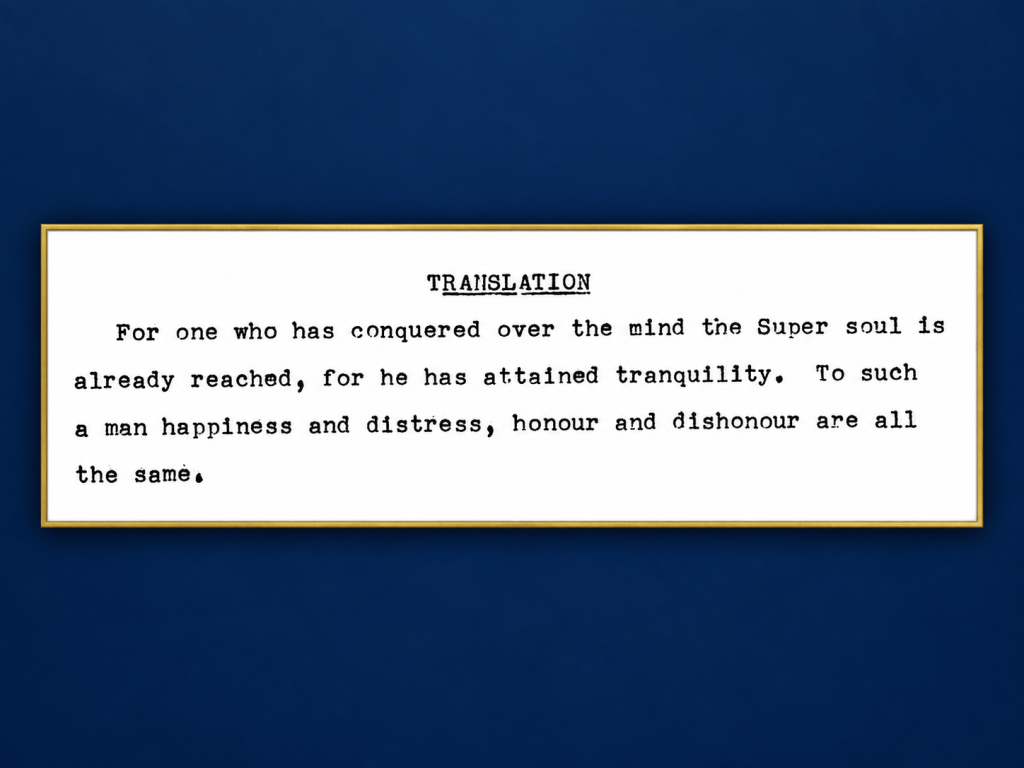
I shall impart to you this most secret wisdom…”

It is revelation, not merely instruction. Krishna is gifting hidden truth to His qualified devotee.
After the edit, that mood has shifted:

I shall impart to you this most confidential knowledge and realization…”

Knowledge and realization are things acquired, not revealed. This flips the devotional dynamic from grace to effort, from mystery to methodology.

Violates Arsa-Prayoga—and common sense

Arsa-Prayoga exists to protect the words of the ācārya, even if those words appear imperfect by modern standards. When a disciple changes what the guru actually said—especially after his departure—it is an act of editorial presumption, not service.

There is no scope for removing what Srila Prabhupada originally wrote and approved. Yet Jayadvaita Swami did just that—while claiming to be “bringing us closer” to Srila Prabhupada.

The irony writes itself.

The real issue

The problem is not simply about words. It is about authority.

When a disciple removes a phrase the guru himself composed, approved, and published—what else is being removed?

How many more spiritual treasures are quietly erased in the name of editorial “improvement”?

That is why devotees committed to preserving Bhagavad-gītā As It Is reject such posthumous editing—not out of sentimentality, but out of fidelity. We are not here to correct Srila Prabhupada.
We are here to hear him.

Jayadvaita Swami Makes a “Mad” Change – Revisited (Bhagavad-gita 13.1-2)

By Ajit Krishna Dasa (Denmark)

Bhagavad-gītā As It Is 13.1–2

Link to the Original Article

https://arsaprayoga.com/2014/09/26/jayadvaita-swami-makes-a-mad-change/

Description of the Change

In the purport to Bhagavad-gītā As It Is 13.1–2, the original and authorized 1972 edition reads:

“Sometimes we understand that I am happy, I am mad, I am a woman, I am a dog, I am a cat: these are the knowers.”

In the posthumous 1983 Bhagavad-gītā As It Is published by BBT International, this passage has been altered to:

“Sometimes we think, ‘I am happy,’ ‘I am a man,’ ‘I am a woman,’ ‘I am a dog,’ ‘I am a cat.’ These are the bodily designations of the knower.”

The word “mad” has been replaced with “a man”.

The available evidence, including the original manuscript, which is a transcription of Śrīla Prabhupāda’s spoken words, strongly supports “mad” as the original wording.

Type of Editorial Change

Substitution (Replacement)

One word has been removed and replaced with another, altering the wording of the text.

Category

Interpretive Editing (with philosophical implications)

The substitution reflects the editor’s interpretation of what the text should say, rather than what the available evidence suggests Śrīla Prabhupāda said or intended.

Commentary

Śrīla Prabhupāda frequently uses happiness and madness as philosophical opposites. These terms are not employed casually, but as indicators of epistemic condition.

Kṛṣṇa Himself establishes this polarity:

“The mode of goodness conditions one to happiness, passion to action, and ignorance to madness.”
Bhagavad-gītā 14.9

In Śrīla Prabhupāda’s teachings, happiness is associated with clarity, knowledge, and alignment with reality, whereas madness denotes illusion, ignorance, and misidentification. The conditioned soul falsely identifies with these states and takes them to be the self.

Thus, the original phrase “I am happy, I am mad” illustrates a key philosophical point: false identification with states of consciousness, not merely with bodily forms. This fits precisely with the subject matter of Chapter 13, which distinguishes the knower (kṣetrajña) from the known (kṣetra), including mental conditions.

By contrast, “man–woman” is a purely taxonomic distinction, comparable to up–down or left–right. It describes biological or social categories but carries little philosophical depth. It does not convey the contrast between knowledge and illusion that Śrīla Prabhupāda repeatedly emphasizes throughout his books, lectures, and conversations.

It is therefore significant that Jayadvaita Swami publicly dismissed the word “mad” as “straight-out nonsense” and denied that it could be the words of his spiritual master. This claim is not supported by the available manuscript evidence, nor by Śrīla Prabhupāda’s consistent and well-documented usage of the happy–mad polarity across his teachings.

Such a dismissal suggests more than a textual disagreement. It indicates a lack of holistic familiarity with Śrīla Prabhupāda’s philosophical language, combined with an editorial confidence that risks attributing error or incoherence to the ācārya himself. At minimum, it reflects interpretive overreach; at worst, it shows a willingness to override both evidence and tradition in favor of personal judgment, a posture that carries the risk of offense toward Śrīla Prabhupāda.

The original wording is grammatically sound, philosophically precise, consistent with Śrīla Prabhupāda’s teachings, and supported by the available manuscript evidence. The change was unnecessary and reflects editorial judgment rather than demonstrable error.

This is therefore a clear example of a philosophical change introduced through interpretive substitution in the posthumous, post-1977 BBT International editions of Bhagavad-gītā As It Is. It illustrates the broader pattern of posthumous book changes that alter how readers understand Śrīla Prabhupāda’s teachings.

Examples of how the “happy-mad” polarity is used by Śrīla Prabhupāda:

Just like a man — ordinarily we perceive — a gentleman, after working very hard, if he gets some bank balance and nice house, nice wife, and some children, he thinks, “I am very happy.” This is also maya. He thinks, “But I am happy.” What kind of maya? Pramattah tesam nidhanam pasyann api na pasyati. He is in maya, mad, illusion, pramatta. (Srimad-Bhagavatam 3.26.22, Bombay, December 31, 1974)

Don’t be very much happy when you are in happy condition of life; neither you become mad in miserable condition of life. (Srimad-Bhagavatam 3.26.47, Bombay, January 22, 1975)

You must have perfect knowledge. Then you’ll be happy. Then you’ll be peace. And if you are misguided, bewildered, mad, then how you can be happy? (Rotary Club Lecture, Ahmedabad, December 5, 1972)

So these are all mad condition. So when he turns to God… Service he must give. Nobody can say, “I’m not serving anybody.” That is not possible. You must be serving somebody. Just like you are serving government, he is serving some office, because service is our nature. So we are not happy because the service is misplaced. (Room Conversation and Interview with Ian Polsen — July 31, 1972, London)

Prabhupada: Even the father, mother is not crying. The mother’s baby dies. She cries, she becomes mad. But when the child gives up that childhood body, accept another body, she’s happy because she knows: “My son is there. (Room Conversation with Anna Conan Doyle, daughter-in-law of famous author, Sir Arthur Conan Doyle, August 10, 1973, Paris)

Pradyumna: It’s Canto Five, Chapter Five, verse number seven. “Even though one may be very learned and wise, he is mad if he does not understand that the endeavor for sense gratification is a useless waste of time. Being forgetful of his own interest, he tries to be happy in the material world, centering his interests around his home, which is based on sexual intercourse and which brings him all kinds of material miseries. In this way one is no better than a foolish animal.” (Room Conversation, February 16, 1977, Mayapur)

Because the mad son is loitering in the street without any information of the father, to bring him back before the father. That is the best. He will be happy. (Room Conversation, March 26, 1977, Bombay)

We are just like a criminal who has dirty things within his heart. He thinks, “If I get such-and-such thing, I’ll be happy.” And at the risk of his life he commits a crime. A burglar, a thief, knows that if he is captured by the police he’ll be punished, but still he goes and steals. Why? Nunam pramattah: he has become mad after sense gratification. (BTG, 1983, The Self And Its Bodies)