


By Ajit Krishna Dasa
What should we do when we discover an apparent mistake in Śrīla Prabhupāda’s Bhagavad-gītā As It Is? Should we correct it, especially when his original manuscript appears to support a different reading?
Bhagavad-gītā 1.36 presents an interesting case because the evidence strongly supports a Sanskrit reading that was restored in the posthumously revised edition. Yet we maintain that the original published edition should remain unchanged.
The reason is not that mistakes must be defended, nor that textual research should be discouraged. Rather, Śrīla Prabhupāda taught the traditional principle of ārṣa-prayoga: we should not presume to correct the words of the ācāryas according to our own scholarly judgments.
Two Readings of the Bhagavad-gītā
In Bhagavad-gītā 1.36, Arjuna expresses his reluctance to kill the sons of Dhṛtarāṣṭra and their associates. The relevant passage occurs in two Sanskrit readings:
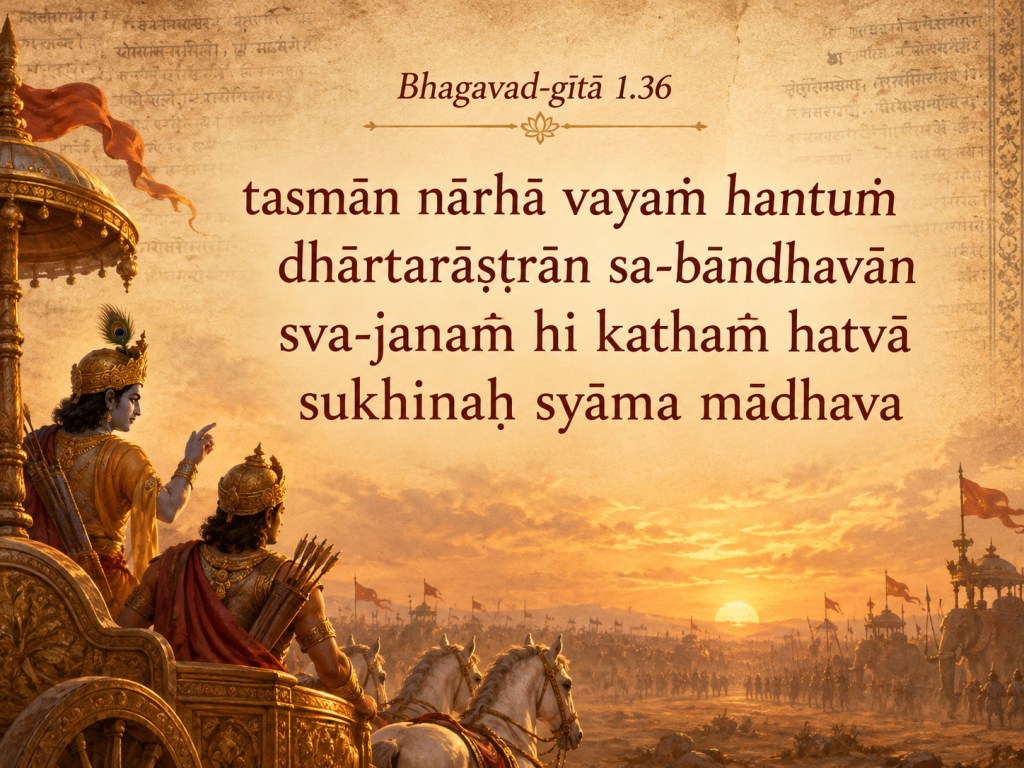
tasmān nārhā vayaṁ hantuṁ
dhārtarāṣṭrān sa-bāndhavān
And:
tasmān nārhā vayaṁ hantuṁ
dhārtarāṣṭrān sva-bāndhavān
The difference is small but meaningful. Sa-bāndhavān means “along with relatives or friends,” whereas sva-bāndhavān means “one’s own relatives or friends.”
Both readings are grammatically acceptable, and both are historically attested. A scholarly presentation prepared on the basis of the Mahābhārata critical edition, for example, prints sa-bāndhavān and records sva-bāndhavān as a textual variant. (That presentation numbers the passage as BG 1.37.)
This is important because we are not dealing with one correct Sanskrit expression and another that is simply wrong. We are dealing with a genuine variation in the transmission of the Bhagavad-gītā itself.
Which reading was originally spoken by Arjuna? We cannot establish that with absolute certainty from the evidence examined here. Textual scholars can weigh the surviving witnesses and prefer one reading, but the existence of two transmitted readings must be acknowledged.
What Did Śrīla Prabhupāda Write?
Fortunately, Prabhupāda’s original typewritten manuscript of Bhagavad-gītā 1.36 has survived. It reads sabandhavan, which he explains in his synonyms as:
“Sabandhavan = along with friends.”
His original English translation likewise reads:
“Therefore it is not deserving for us to kill the sons of Dhritarastra along with friends.”
The Sanskrit, synonyms, and translation agree. This provides strong evidence that sa-bāndhavān was the reading Prabhupāda intended when preparing his manuscript.
An interesting confirmation comes from the Gauḍīya Vaiṣṇava tradition. A 1932 Gauḍīya Maṭha edition containing Baladeva Vidyābhūṣaṇa’s Gītā-bhūṣaṇa and Bhaktivinoda Ṭhākura’s Bengali Vidvad-rañjana commentary also prints sa-bāndhavān. The accompanying Bengali explanation supports the same understanding.
Thus, Prabhupāda’s manuscript agrees with a reading found in an established Gauḍīya Vaiṣṇava edition predating his own. We have examined the relevant Bengali page, although we cannot establish that Prabhupāda consulted this particular edition.
Yet the 1972 Macmillan edition contains an inconsistency. Its Devanāgarī text and word-for-word section use sva-bāndhavān, while its Roman transliteration retains sa-bāndhavān. The word-for-word meaning remains “along with friends.”
Perhaps an early editor consulted another Bhagavad-gītā containing sva-bāndhavān and assumed that Prabhupāda’s Sanskrit needed correction. This is plausible, but we have no documentary evidence establishing precisely how the variant entered the published edition.
We should also acknowledge that Prabhupāda himself used sva-bāndhavān in a lecture delivered in London on July 26, 1973. This could indicate that he knew both readings, or simply that he followed the printed edition available at the time. We cannot determine which explanation is correct.
Nevertheless, the evidence for his original manuscript reading is strong.
Why Not Correct the Published Book?
The posthumously revised Bhagavad-gītā consistently uses sa-bāndhavān, thereby restoring the reading found in Prabhupāda’s manuscript. Jayādvaita Swami has explicitly identified this as a restoration.
We need not dispute that the manuscript supports his choice. The question is whether that evidence authorises a change to the edition published during Prabhupāda’s lifetime.
A manuscript and a published book represent different stages in the history of a work. The former tells us what the author wrote at a particular stage, while the latter records what was actually published. Differences between them deserve investigation, but the earlier wording does not automatically supersede the published text.
In this particular case, moreover, the published reading is not meaningless Sanskrit. It is an independently attested reading of the Bhagavad-gītā. We therefore have even less reason to regard its preservation as an intolerable textual defect.
But there is a more fundamental consideration.
The Principle of Ārṣa-prayoga
Śrīla Prabhupāda warned against the tendency to correct the writings of recognised spiritual authorities merely because someone believed he had discovered a mistake.
During a lecture in Vṛndāvana on March 31, 1976, he discussed apparent discrepancies in the writings of previous ācāryas and explained that such usages are accepted as ārṣa-prayoga. His instruction was unambiguous:
“It should remain as it is.”
In a conversation with Rādhā-vallabha Dāsa on February 27, 1977, Prabhupāda again opposed corrections arising from a disciple’s independent scholarly judgment. He explained that the authority’s work should be accepted even when someone perceives a mistake, invoking ārṣa-prayoga and warning against trying to become more learned than the authority.
Strictly speaking, an accidental printing discrepancy is not necessarily an ārṣa-prayoga of the ācārya himself. This distinction should not be concealed. Nevertheless, Prabhupāda’s broader instruction establishes an attitude of restraint toward correcting authoritative spiritual writings.
During his lifetime, Prabhupāda could examine a proposed correction and approve or reject it. He sometimes permitted editing and at other times emphatically prohibited it. His personal supervision provided the authority for such decisions.
After his departure, however, a later editor’s conviction that a correction would improve the text cannot simply replace the author’s approval. Even when the evidence for a particular reading is strong, the question of authority remains.
In the absence of clear authorisation for posthumous revision, our duty is to preserve the original published edition rather than reconstruct it according to our own understanding of what Prabhupāda should have written.
This does not require believing that every printed letter originated directly from Prabhupāda. Nor does it mean that printing errors become transcendental truths. It means respecting the integrity of the historical edition while allowing its textual history to be studied independently.
Why Not Explain the Difference Separately?
There is an obvious solution that respects both textual scholarship and ārṣa-prayoga: preserve the original edition and document apparent errors in a separate annotation.
For instance, a companion booklet to Bhagavad-gītā As It Is could contain the following note:
BG 1.36 — Textual Variant
The 1972 edition contains both sa-bāndhavān and sva-bāndhavān. Śrīla Prabhupāda’s original manuscript consistently reads sa-bāndhavān, explained as “along with friends.” A 1932 Gauḍīya Maṭha edition containing Bhaktivinoda Ṭhākura’s commentary also supports this reading. Both Sanskrit forms are historically attested, and Prabhupāda himself used sva-bāndhavān in a 1973 lecture. The discrepancy is documented here without altering the original published edition.
Such an annotation informs the reader without presuming authority to alter the author’s book. It allows the historical evidence to speak for itself.
The same approach could be applied to other disputed readings, apparent printing mistakes, or differences between Prabhupāda’s manuscripts and published works. An annotated reproduction or companion booklet could contain extensive research, with every addition clearly distinguished from Prabhupāda’s own text.
Furthermore, the annotations could be corrected or expanded as new evidence becomes available, without repeatedly revising the original publication.
This is not an argument against correction in every conceivable circumstance. It is an argument for keeping scholarly commentary separate from an authoritative historical text when the author has not authorised further changes.
Conclusion
Bhagavad-gītā 1.36 illustrates an important distinction. We have substantial evidence that Śrīla Prabhupāda originally wrote sa-bāndhavān, and we can acknowledge that the revised edition restores this manuscript reading. At the same time, sva-bāndhavān is a genuine Sanskrit variant, not an inherently incorrect expression.
More importantly, the existence of an apparent mistake does not automatically grant later editors authority to change a book published during the ācārya’s lifetime.
The principle of ārṣa-prayoga, as emphasised by Prabhupāda himself, teaches us restraint and respect in dealing with the words of spiritual authorities. We need not disregard textual evidence or suppress legitimate scholarly questions. We can investigate them thoroughly and present our findings separately.
Preserve the original books, document the evidence, and let readers understand the differences without altering the historical text.

