



By Ajit Krishna Dasa
What happens when an editor rewrites a spiritual master’s published teachings after his departure, even though the original manuscript is lost? A short passage from the introduction to Teachings of Lord Caitanya gives us a revealing case study.
The book first appeared in 1968. Hayagrīva Dāsa substantially revised it in 1974, during Śrīla Prabhupāda’s lifetime. Decades later, Draviḍa Dāsa prepared a third edition for the Bhaktivedanta Book Trust International, Inc. (BBT International, Inc.). Comparing the versions reveals omissions, restorations, and new qualifications—not merely corrected punctuation.
1. A Statement About Love of Kṛṣṇa Disappears
The original 1968 introduction, discussing material affection and the consequences of attachment, states:
Everything without love of Krishna leads downward.
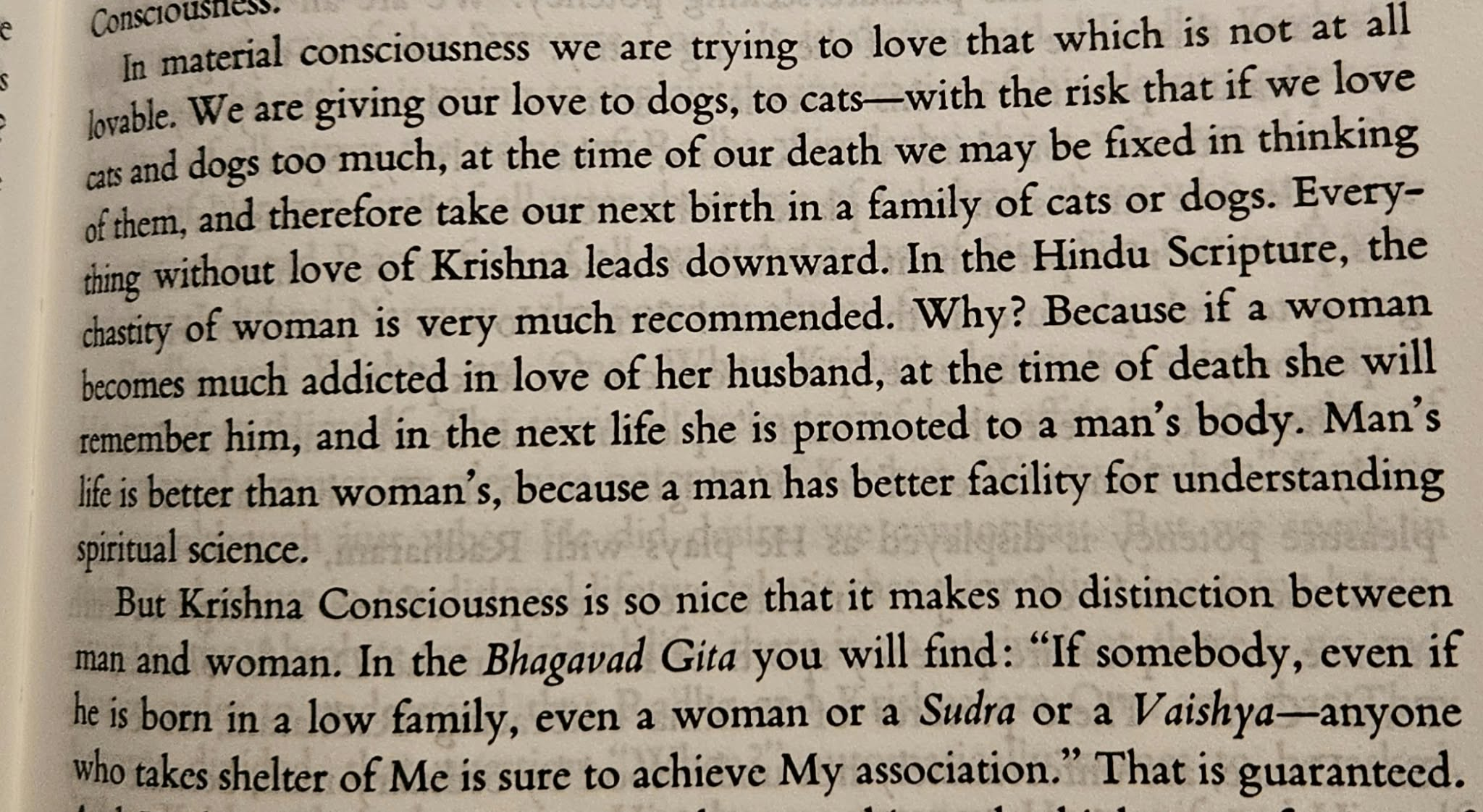
The original 1968 Teachings of Lord Caitanya. The sentence about love of Kṛṣṇa appears immediately after the example of dogs and cats.
In his 1974 revision, Hayagrīva preserved the teaching, although he recast the English:
Thus love that does not have Kṛṣṇa as its object leads downward.
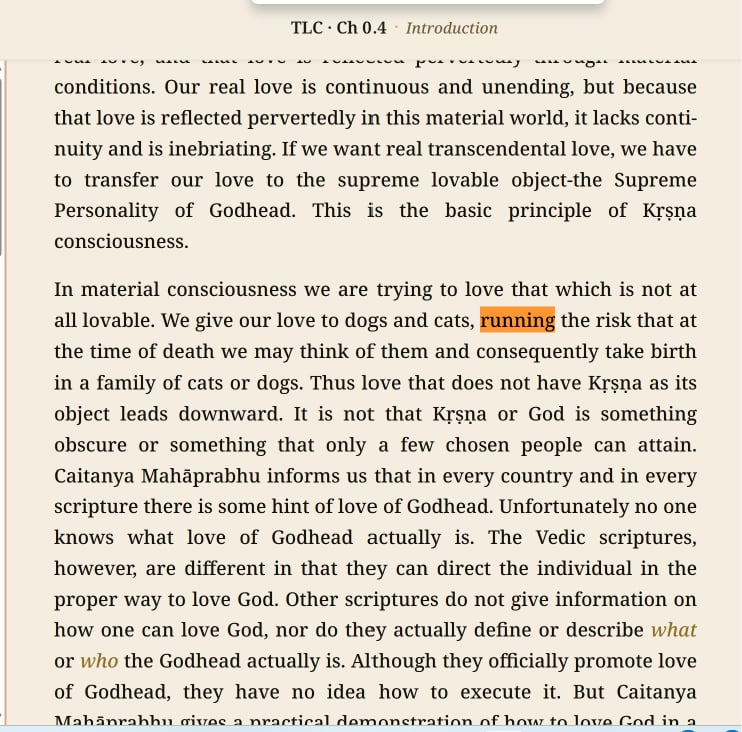
This formulation was also retained in the introduction to Śrī Caitanya-caritāmṛta published during Śrīla Prabhupāda’s lifetime. The current BBT International, Inc. edition of TLC, however, removes the sentence and instead says:
Our consciousness at the time of death determines our next life.
The replacement expresses an accepted principle concerning transmigration, but it does not express the same proposition. The earlier statement makes love of Kṛṣṇa decisive; the new one explains how consciousness determines one’s next birth. Why did a coherent theological statement, preserved through the lifetime revision, have to disappear?
2. The Controversial Statement About Women
The original text then gives a traditional explanation of why the chastity of women is recommended: a woman strongly attached to her husband may remember him at death and receive a man’s body in her next life. It continues in remarkably categorical language:
Man’s life is better than woman’s, because a man has better facility for understanding spiritual science.
Hayagrīva omitted this entire discussion from his 1974 revision. The posthumous edition restored it—but not in the original words:
Generally a man’s life is better than a woman’s because a man usually has better facilities for understanding the spiritual science.

The current BBT International, Inc. edition, as displayed on Vedabase.io. Note generally and usually, as well as the absence of the original sentence about love of Kṛṣṇa.
The two additions—“generally” and “usually”—matter. They transform the force of the assertion from a categorical statement into a qualified generalization. That may make the statement more defensible to some readers. But it is still an alteration of what appeared in the first published edition.
Other expressions were softened or polished as well. The original speaks of a woman becoming “much addicted in love of her husband”; the new text says “very much attached to her husband.” The original’s direct question, “Why? Because …”, has become a more formal explanation. No single alteration is necessarily a doctrinal reversal, but together they show unmistakable editorial intervention.
Could the motive have been to make the passage less objectionable to modern readers? Perhaps. But a comparison of texts cannot establish motive. The defensible point is more precise: the editors inserted qualifications that are absent from the original printed words.
3. Even the Quotation of Bhagavad-gītā 9.32 Changes
Immediately following the statement about women, the original introduction emphasizes that Kṛṣṇa consciousness makes no distinction between men and women in the possibility of attaining Kṛṣṇa. It paraphrases Bhagavad-gītā 9.32 with the words:
even a woman or a Sudra or a Vaishya
The new edition instead reads:
whether a woman, śūdra, vaiśya or someone of low birth
The fundamental teaching remains: everyone may take shelter of Kṛṣṇa. Nevertheless, the conspicuous “even a woman” is removed and the sentence reconstructed. In a discussion already modified by the addition of “generally” and “usually,” the change deserves attention. This is more than correcting spelling or supplying diacritics.
4. The Warning About Animals Was Also Edited
The original 1968 wording warns against loving cats and dogs too much, lest at death we become “fixed in thinking of them.” In Hayagrīva’s lifetime revision, the explicit qualification “too much” disappears and the description of being fixed in thought is reduced to the possibility of simply thinking of them. The newer edition substantially follows this softened wording.
We must distinguish this lifetime editorial change from the later posthumous ones. Hayagrīva’s revision raises questions of its own, but the BBT maintains that Śrīla Prabhupāda approved his editorial work. No such personal review could be obtained for a revision introduced after his departure.
5. What if the Original Manuscript Is Lost?
Here the documentary problem becomes serious. In its own note about the new edition, the BBT International, Inc. openly acknowledges that “the original manuscript is lost.” It states that the editors compared the two previous editions and sought greater fidelity to Śrīla Prabhupāda’s original words and intended meaning.
The introduction itself identifies its source as five morning lectures on Caitanya-caritāmṛta, delivered in New York on April 10–14, 1967. We have not found the recordings or an independent original transcript of these lectures in the publicly accessible archives examined. That is not proof that no such source survives elsewhere.
Certainly a clear typographical error can sometimes be identified without a manuscript. But the examples here are not obvious misspellings or nonsense readings. They involve intelligible theological claims, omissions, and the degree of force given to a controversial assertion. When the earliest source is inaccessible, what evidence can establish that an editor’s preferred wording is closer to what the author actually said?
BBT International, Inc. could reply that comparing existing editions is a legitimate form of editorial research, and that some changes restore material missing from Hayagrīva’s revision. That is true as far as it goes. It does not by itself demonstrate that every substitution or omission is a restoration, and it does not settle the independent question of who authorized posthumous alteration.
The Real Question Is Authority
Even if an editor sincerely believes that a revised sentence is clearer, better English, or a more precise expression of Vaiṣṇava philosophy, editorial preference is not the same thing as authorial authorization. The difference becomes particularly important when an author can no longer accept or reject proposed revisions.
There is nothing wrong with preserving variant readings, documenting suspected errors, or publishing scholarly annotations. Readers can examine the 1968 edition, Hayagrīva’s lifetime revision, and the posthumous edition side by side. What requires justification is replacing the published text and presenting the replacement as Śrīla Prabhupāda’s own work.
If both lifetime editions preserved the teaching that love without Kṛṣṇa as its object leads downward, and the original manuscript is lost, what justified deleting it? And what gave the posthumous editors the authority to do so?
Sources
Teachings of Lord Caitanya, original 1968 introduction; Hayagrīva’s revised introduction; current revised TLC introduction; BBT International, Inc. editorial note; textual materials for the introduction to Caitanya-caritāmṛta.


You must be logged in to post a comment.