


Arsa-Prayoga, Posthumous Editing, Editorial Authority and the Danger of Thinking One Knows Better Than the Guru
By Ajit Krishna Dasa
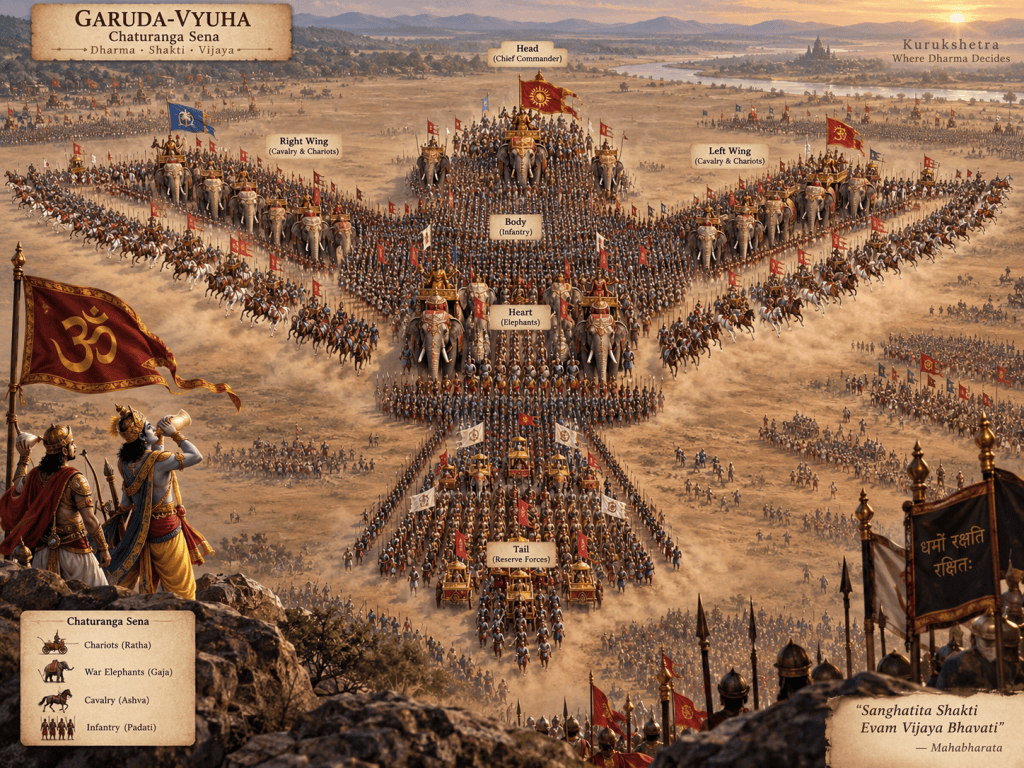
Sometimes a relatively small change can reveal a surprisingly large problem. The replacement of Srila Prabhupada’s expression “military phalanx” with “military formation” in connection with Bhagavad-gita As It Is 1.2 is one such example. There is no major philosophical deviation in the replacement itself, and “military formation” is perfectly understandable English. Precisely for that reason, however, this particular change deserves careful examination, because it allows us to isolate the principle behind the BBT book changes without becoming distracted by an argument over siddhanta.
Why was Srila Prabhupada’s expression rejected? Was “phalanx” incorrect English? Had Srila Prabhupada stopped using the word? Had he objected to it, or had he instructed his editors to replace it? The available evidence indicates none of these things. On the contrary, Srila Prabhupada repeatedly used “phalanx” in his books and lectures, including when speaking specifically about the military formations on the Battlefield of Kuruksetra.
The question therefore goes considerably deeper than whether “phalanx” or “military formation” sounds better to a modern editor. It concerns the relationship between disciple and guru, author and editor, authority and scholarship. At what point does an editor cease serving the words of his spiritual master and begin deciding what his spiritual master ought to have said?
Jayadvaita Swami Explains Why He Changed “Phalanx”
Jayadvaita Swami has explained his reasoning quite openly. In his discussion of Bhagavad-gita 1.2, he says that the old edition omitted the idea contained in vyudham. He then explains why, when supplying that idea in the revised edition, he did not retain Srila Prabhupada’s expression “military phalanx”:
“In the new edition, I revised ‘phalanx’ to ‘military formation’ because a phalanx (originally) is a particular type of formation peculiar to ancient Greek warfare. Greek columns on the Battlefield of Kuruksetra didn’t seem right.”
He then adds an important qualification:
“In retrospect: ‘Phalanx’ has come to refer to any military formation, so perhaps I should have been less picky.”
This explanation is remarkable because Jayadvaita Swami does not claim that Srila Prabhupada ordered the word changed, that the word is bad English, or even that its broader military meaning is incorrect. His objection was that “Greek columns on the Battlefield of Kuruksetra didn’t seem right,” after which he himself acknowledged that the English word had acquired the broader meaning of a military formation and that he might have been “less picky.” On Arsa-Prayoga, I have preserved this explanation and already pointed out the inconsistency with his retention of “phalanx” elsewhere in the revised Gita.
That phrase, “perhaps I should have been less picky,” deserves more attention than it usually receives. We are not talking about an editor correcting a misspelled word before an author’s book goes to press. We are talking about a disciple altering the published work of his departed spiritual master because one of the spiritual master’s own expressions did not seem quite right to him, and later acknowledging that the objection may simply have been excessive editorial pickiness.
The problem is therefore not merely the replacement of one noun. It is the criterion by which the replacement became permissible.
What Actually Happened in Bhagavad-gita 1.2?
An important textual distinction should be made clear. The running translation of Bhagavad-gita 1.2 in the complete 1972 Macmillan edition does not contain “military phalanx.” It says that Duryodhana looked over “the army gathered by the sons of Pandu.” The word-for-word section, however, renders vyudham as “arranged in military phalanx,” and Srila Prabhupada’s earlier manuscript also contains the expression “military phalanx.”
Jayadvaita Swami’s position is therefore that the published translation failed to convey an element contained in vyudham. Even if we grant that argument for the sake of discussion, something rather strange follows. Having decided after Srila Prabhupada’s departure to restore this allegedly missing element from the manuscript, Jayadvaita Swami did not restore Srila Prabhupada’s wording. He replaced “military phalanx” with his own preferred wording, “military formation.”
This creates an important problem for the often-repeated claim that the 1983 revision brought Bhagavad-gita As It Is “closer to Prabhupada.” The manuscript is treated as authoritative enough to reopen the lifetime-published translation, yet the actual wording of that manuscript ceases to be authoritative as soon as the posthumous editor finds another expression preferable.
The manuscript therefore provides the occasion for the change but does not control the change. At the decisive moment, the editor’s judgment controls it.
That is no longer simple restoration. It is posthumous editorial reconstruction.
Srila Prabhupada Himself Used “Military Phalanx” on Kuruksetra
The strongest evidence against the “Greek columns” objection comes from Srila Prabhupada himself. On July 9, 1973, while lecturing on the opening verses of Bhagavad-gita, he discussed Dhrstadyumna’s arrangement of the Pandava army and explained Duryodhana’s intention in drawing Dronacarya’s attention to it. Srila Prabhupada himself described what Dhrstadyumna had done as arranging a “military phalanx” in order to defeat Drona.
This is important because it removes the need to speculate about whether Srila Prabhupada considered “military phalanx” an inappropriate expression for Kuruksetra. He demonstrably did not. He spontaneously employed precisely that expression while explaining precisely that battlefield. Jayadvaita Swami’s concern that “Greek columns on the Battlefield of Kuruksetra didn’t seem right” therefore describes an association in Jayadvaita Swami’s mind, not an objection found in Srila Prabhupada’s usage.
An editor is of course entitled to have linguistic associations and stylistic preferences. The question is whether those private preferences confer jurisdiction over the published vocabulary of his departed spiritual master.
“Phalanx” Was Part of Srila Prabhupada’s Vocabulary
The London lecture is not an isolated example. In researching this article, I have been able to verify at least 33 occurrences of “phalanx” in Srila Prabhupada’s published works and recorded teachings, including at least 28 occurrences in book material and at least five in recorded lectures or conversations. I deliberately say “at least,” because this is a verified minimum rather than a claim that every surviving letter, article and transcript has been exhaustively machine-counted.
The word occurs in Bhagavad-gita As It Is, Srimad-Bhagavatam, Krsna Book, The Nectar of Devotion and Sri Caitanya-caritamrta. It is used for the armies of Kuruksetra, aksauhini divisions, Jarasandha’s forces and other organized military bodies. Srila Prabhupada also uses the word figuratively, as when Srimad-Bhagavatam 1.3.23 refers to “the first phalanx of plenary expansions.”
That First Canto example is especially interesting because Srila Prabhupada originally prepared and published the First Canto in India before ISKCON existed and before Hayagriva became his English editor. The word therefore cannot simply be dismissed as some peculiar expression introduced into Srila Prabhupada’s books by an American editor. Whatever its precise editorial history in individual later passages, it clearly formed part of the English vocabulary through which Srila Prabhupada presented his teachings.
Srila Prabhupada Heard “Phalanx” and Said It Was All Right
There is still more direct evidence. During a lecture on Srimad-Bhagavatam 1.8.48 in Los Angeles on May 10, 1973, Srila Prabhupada was discussing the military composition of an aksauhini. When devotees supplied the English word “phalanx,” Srila Prabhupada repeated it, after which the relevant definition from his book was read aloud. His response was: “So that’s all right.”
This should not be exaggerated into the claim that Srila Prabhupada thereby issued a formal command that the English word “phalanx” must never under any circumstances be altered. The evidence does not require such an argument. What the exchange demonstrates is simply that Srila Prabhupada heard the word used in precisely this military sense, understood its application, and expressed no dissatisfaction with it.
Only a few days later, he himself spoke of “one division of military phalanx,” and in other recorded discussions the word appears again. Taken together with his use of “military phalanx” for the Pandava army on Kuruksetra, this makes it exceedingly difficult to defend the idea that the word somehow represented an inappropriate Greek intrusion into Srila Prabhupada’s presentation.
The Greek Argument Confuses Etymology With Meaning
There is also a linguistic weakness in Jayadvaita Swami’s explanation. Phalanx unquestionably has a Greek origin, and the classical Greek phalanx was indeed a particular military formation. But words do not remain permanently restricted to their earliest historical referents. English is filled with words whose present semantic range extends far beyond their etymology.
“Phalanx” developed broader English senses, including a compact body of troops and, more generally, a closely organized body of persons or things. One can speak in English of a “phalanx of lawyers,” “a phalanx of reporters,” or “a phalanx of supporters” without suggesting that any of them are Macedonian infantrymen armed with sarissas. Jayadvaita Swami effectively concedes this when he acknowledges that “phalanx” had come to refer to any military formation.
The decisive fact, however, remains Srila Prabhupada’s own usage. Even if a modern editor happens to associate the word more narrowly with Greek history, that association cannot outweigh the fact that Srila Prabhupada himself repeatedly used the word in a wider sense.
The Double Standard Inside the Revised Bhagavad-gita
The reasoning becomes even more difficult to defend when we move only a few verses forward. In Bhagavad-gita 1.11, the revised edition itself still tells the warriors to stand at their strategic points of entrance “into the phalanx of the army.” Its purport likewise speaks about allowing an enemy to “break the phalanx,” while the purport to Bhagavad-gita 1.3 continues to use “military phalanx.” My original article pointed out precisely this contradiction.
If “phalanx” brings inappropriate Greek military imagery onto Kuruksetra in verse 1.2, then exactly the same objection ought to apply in verses 1.3 and 1.11. If it does not create that problem in those passages, however, there was no linguistic necessity to reject Srila Prabhupada’s “military phalanx” when reconstructing verse 1.2.
The inconsistency tells us something important. We are not observing the consistent application of a necessary linguistic rule. We are observing an editorial judgment applied in one place but not in closely parallel places.
This is where the issue moves beyond vocabulary and into editorial mentality.
Jayadvaita Swami’s Own Warning About the Mentality of an Editor
What makes this case especially revealing is that Jayadvaita Swami himself has articulated an excellent principle for judging it. In a 2009 presentation on arsa-prayoga, he said:
“Arsa-Prayoga is a very important principle. The editor should never have the mentality that he’s better than the author, that he has something more to contribute than the author does, that the author really doesn’t know what he is doing, but he knows what he is doing. That’s offensive! And that is…ruins everything! It is an offense to the acarya.”
Jayadvaita Swami then distinguished the sanctity of the acarya’s words from what he regarded as mistakes introduced by previous editors. Whatever one thinks about that second part of his argument, the first principle could hardly be stated more clearly. The editor must not place himself above the author or assume that his own superior knowledge entitles him to improve what the author has given. On Arsa-Prayoga.com, I have preserved both the transcription and my earlier discussion of this statement.
This is exactly why the “phalanx” example matters. We do not need to speculate about Jayadvaita Swami’s private spiritual condition, nor should we pretend that we can see into his heart. The issue is objective: what editorial posture is expressed by the decision itself?
Srila Prabhupada used “military phalanx.” His manuscript used “military phalanx.” His books repeatedly used “phalanx.” He used it while speaking about Kuruksetra. Yet after Srila Prabhupada was no longer physically present to approve or reject a change, his editor concluded that the expression did not seem right and substituted one that seemed better to him.
The structure of the act is therefore disturbingly close to the very editorial mentality Jayadvaita Swami says must be avoided: the author has used one expression, but the editor believes his own linguistic judgment can improve upon it.
That does not prove that Jayadvaita Swami consciously thought, “I am better than Srila Prabhupada.” Such a claim would be mind-reading and would weaken the argument. What can be said, however, is that the editorial method places the editor’s judgment in a position where it functions as superior to the author’s demonstrated usage. The distinction between psychological intention and editorial function is important, and the latter is enough to establish the problem.
“Those Changes That to Me Seemed Worthwhile”
An earlier statement from Jayadvaita Swami makes this issue still clearer. Describing his 1982 work on Bhagavad-gita As It Is, he wrote:
“Comparing each verse in the book with the text of the manuscript, I made only those changes that to me seemed worthwhile. I tried to be conservative and not make needless changes.”
The second sentence expresses an admirable goal, and in 1986 Jayadvaita Swami himself stated that Srila Prabhupada “staunchly opposed needless changes.” But the first sentence contains the critical words: “that to me seemed worthwhile.”
Every editor must exercise judgment, so the mere existence of editorial judgment is obviously not an offense. While the author is alive and has empowered an editor to perform a specific task, the editor must constantly make such judgments. The situation becomes fundamentally different, however, when the author has departed and the work being reconsidered is already a completed, published book.
Under those circumstances, “seemed worthwhile to me” can become the decisive criterion precisely because the author is no longer available to say no. The editor’s opinion ceases to be a proposal submitted to the author and becomes the final authority over the author’s text.
The “phalanx” change provides an almost laboratory-pure example. The editor thought his alternative worthwhile because the original expression suggested Greek warfare to him. Years later he acknowledged that perhaps he had been too picky. But the book had already been changed.
Jayadvaita Swami’s 1995 Statement Makes the Tension Still Greater
There is another statement from Jayadvaita Swami that belongs in this discussion. In a 1995 Vyasa-puja offering, twelve years after publication of the revised Gita, he praised Srila Prabhupada for perfectly transmitting the conclusions of the previous acaryas and then wrote:
“We therefore don’t need to add anything, subtract anything, or change anything. We need only faithfully serve Srila Prabhupada’s orders, and everything will be revealed.”
This statement is not necessarily a technical discussion of book editing, and it would be unfair to pretend that it is. Nevertheless, it expresses a conception of discipleship that is directly relevant to the present issue. The disciple’s task is not to augment the acarya from a supposed position of superior understanding, but to receive and faithfully serve what the acarya has transmitted.
The tension between that principle and posthumously replacing Srila Prabhupada’s perfectly legitimate expressions deserves serious reflection. In “phalanx,” the difficulty is particularly acute because no serious philosophical error, mistranscribed sentence or obvious typographical corruption needed rescuing. The change resulted from the later editor’s judgment that another expression would be better.
Srila Prabhupada Warned Against Becoming “More Learned Than the Authority”
Jayadvaita Swami’s warning about an editor thinking himself superior to the author closely resembles Srila Prabhupada’s own language. During the February 27, 1977 conversation concerning Jagannatha Dasa’s proposed corrections, Srila Prabhupada objected to the tendency to correct an authority and explained:
“The system is: whatever authority has done, even there is mistake, it should be accepted.”
After identifying this as arsa-prayoga, he continued:
“He should not become more learned than the authority. That is very bad habit.”
When Radhavallabha explained that Jagannatha wondered what he should think when he believed he saw a mistake, Srila Prabhupada replied with characteristic force that “he cannot see mistake. He is mistake.” The conversation is explicitly about editorial correction and therefore belongs directly in any serious discussion of the mentality with which a disciple approaches an authoritative text.
The important point is not that a disciple must switch off his intelligence or become incapable of recognizing a typographical anomaly. Srila Prabhupada himself found mistakes and had mistakes corrected. Rather, he repeatedly warned against the transition from serving authority with one’s learning to positioning one’s learning above the authority.
That distinction is exactly what is at stake in “phalanx.”
“Then the Policy Is Kill Guru and Be Killed Himself”
Srila Prabhupada sometimes described this danger in language considerably stronger than anything Jayadvaita Swami has used. In a letter to Dixit Dasa dated September 18, 1976, Srila Prabhupada warned that when some Western disciples began learning a little Sanskrit, they could develop a dangerous conception of their own scholarship:
“I am practically seeing that as soon as they begin to learn a little sanskrit immediately they feel that they have become more than their guru and then the policy is kill guru and be killed himself.”
This quotation needs to be used responsibly. Srila Prabhupada was not speaking about Jayadvaita Swami in this letter, and it would therefore be illegitimate to present the sentence as though it were a personal prophecy or direct condemnation of him. The relevance lies in the principle Srila Prabhupada identifies: acquired learning can tempt a disciple to reverse the proper hierarchy and imagine that he has progressed beyond the guru from whom his knowledge came.
Nor should “kill guru” here be reduced to crude literalism. Srila Prabhupada used the Bengali expression guru-mara-vidya elsewhere and explained what he meant. In a December 1973 morning walk, he described the mentality as learning from the guru and then effectively telling him, “Go away. I have now learned.” He compared it to climbing by a ladder and then throwing the ladder away.
His October 4, 1976 lecture on Srimad-Bhagavatam 1.7.44 is even more relevant. Discussing Arjuna’s debt to Dronacarya, Srila Prabhupada explained guru-mara-vidya as receiving knowledge by the guru’s grace and then, after becoming learned, considering oneself greater than the guru and ceasing to care for him. He called this mentality “demonic” and concluded that guru-mara-vidya should be avoided.
This gives us a much more precise understanding of the warning. “Killing the guru,” in this usage, means functionally eliminating the guru’s superior authority after having benefited from him. The disciple acquires expertise through service and instruction but eventually allows that expertise to become the standard by which the guru himself is judged.
That principle has obvious relevance to editing.
The Editor’s Expertise Must Remain Servant, Not Master
The difficulty is not scholarship. Srila Prabhupada wanted intelligent disciples and repeatedly engaged editors, Sanskrit scholars, scientists and educated men in his service. The problem arises when expertise changes jurisdiction.
An editor may know that phalanx comes from Greek. He may know more about contemporary American usage than the author. A Sanskritist may know the precise grammatical category of a Sanskrit term. A historian may discover an obscure textual variant. All of these forms of knowledge can serve the author and help readers understand him.
But none of them automatically confer the right to become the final judge of the author’s completed words.
This distinction is especially important in the guru-disciple relationship. The disciple is not forbidden to become highly learned; rather, whatever learning he acquires remains subordinate to the authority from whom he has received transcendental knowledge. Srila Prabhupada’s warning concerns the subtle change in consciousness by which knowledge that was acquired for service becomes a basis for independence.
In an editorial context, that change can occur almost invisibly. It does not require an editor to announce, “I am superior to my guru.” It is sufficient that his method gradually allows “I know what would be better here” to overrule “this is what my guru actually said.”
Maryada-Vyatikrama: Surpassing a Greater Personality
Srila Prabhupada addresses a closely related principle in his purport to Srimad-Bhagavatam 3.4.26. There he warns that even someone “well versed in the transcendental science” must avoid maryada-vyatikrama, which he defines as “impertinently surpassing a greater personality.” The warning is particularly interesting because competence is not presented as a protection against the danger; competence is precisely the context in which proper hierarchy must still be remembered.
This does not mean that every editorial disagreement automatically constitutes maryada-vyatikrama. Such a conclusion would again go beyond the evidence. It does mean, however, that Gaudiya Vaisnava ethics cannot treat expertise as a self-generating source of authority. Being able to improve something is not equivalent to possessing the right to improve it.
That distinction ought to govern the entire discussion of the BBT book changes.
Arsa-Prayoga Is Therefore More Than a Rule About “Mistakes”
The principle of arsa-prayoga is sometimes reduced to a debate over whether an acarya can make some externally identifiable mistake. That is too narrow. Srila Prabhupada’s explanations repeatedly concern the disciple’s posture toward authority.
He wrote that arsa-prayoga means that “there may be discrepancies but it is all right,” using Shakespeare’s unusual language as an example. In his 1976 Bhagavatam lecture, he said that apparent discrepancies in the comments of the acaryas are accepted as arsa-prayoga and “should remain as it is.” In 1977 he connected the same principle directly with the warning not to become “more learned than the authority.”
The “phalanx” example is therefore stronger than a conventional arsa-prayoga case, because we need not first establish that Srila Prabhupada made any mistake at all. “Phalanx” is valid English, its extended military meaning was established, Srila Prabhupada used it repeatedly, he used it specifically for Kuruksetra, and he heard it used in connection with an aksauhini and responded that it was all right.
If even such an expression is considered open to posthumous replacement, then the principle governing revision has moved considerably beyond the correction of demonstrable errors.
The BBT’s Own Style Guide Points Toward Restraint
There is an additional irony. The BBT Style Guide explicitly says that its standards are intended to apply to BBT publications henceforward and, except where indicated, are not supposed to be applied retroactively to Srila Prabhupada’s already published works. It even contains cases where modern editorial knowledge could support a different terminology but where Srila Prabhupada’s established usage is allowed to remain.
That is a sound editorial instinct. A later editor may explain that another word is technically preferable, historically more exact or botanically more precise. He does not therefore need to erase the original expression from the author’s completed book.
The same principle could easily have been applied to “phalanx.”
Posthumous Editing Changes the Ethical Situation
While an author is alive, editorial work involves a living chain of accountability. An editor may propose that “military formation” sounds better than “military phalanx,” and the author may accept the suggestion, reject it, modify it or tell the editor to leave the passage alone.
After the author’s death, that safeguard disappears.
This fact should make an editor more conservative, not less. The author can no longer reject the proposed improvement. Consequently, whenever evidence permits more than one plausible reconstruction, preservation should ordinarily take priority over editorial preference.
That principle becomes especially compelling when the work in question was not merely an unpublished manuscript abandoned at the author’s death. The complete Bhagavad-gita As It Is had been published in 1972, five years before Srila Prabhupada’s departure. He taught from it, quoted from it, distributed it and saw it spread throughout the world.
Earlier drafts remain valuable historical evidence, but they do not automatically supersede the lifetime-published text.
A Note Could Have Solved the Problem Without Changing Anything
Suppose Jayadvaita Swami was entirely correct that vyudham contains a nuance insufficiently represented in the 1972 running translation. Suppose further that readers ought to know that Srila Prabhupada’s earlier manuscript used “military phalanx.” Neither proposition requires altering the historical text.
An annotated edition could explain that vyudham refers to an army arranged in battle formation and that Srila Prabhupada’s earlier draft used “military phalanx.” A critical apparatus could display the manuscript, the 1972 published reading and the editor’s preferred reconstruction side by side. Readers would then possess more evidence rather than less, while nobody would have to place new wording under Srila Prabhupada’s name as though he himself had approved it.
This is why a two-edition solution remains so much more defensible than silently replacing the original. Preserve the lifetime-published edition intact for reading and distribution, while separately publishing an explicitly identified critical or annotated edition containing manuscripts, proposed corrections and editorial explanations.
Such a solution does not suppress scholarship. It gives scholarship more room while giving the historical text greater protection.
The Real Question Is Not Whether Jayadvaita Swami Is Intelligent
Nothing in this argument depends upon denying Jayadvaita Swami’s intelligence, English ability, editing experience or sincerity. In fact, focusing on those questions obscures the real issue. An editor may be highly competent and still exceed his authority.
The fundamental distinction is between competence and jurisdiction. “Military formation” may be good English. Jayadvaita Swami may have had a sophisticated reason for preferring it. He may even have believed sincerely that he was improving the reader’s understanding.
None of those facts answer the decisive question: who authorized him after Srila Prabhupada’s departure to replace Srila Prabhupada’s legitimate and repeatedly used expression on the basis that another expression seemed preferable?
That question becomes still more pointed when Jayadvaita Swami himself tells us that an editor must never develop the mentality that he knows better than the author, that such a mentality is offensive to the acarya and that it “ruins everything.”
“Perhaps I Should Have Been Less Picky” Reveals the Whole Problem
Jayadvaita Swami’s retrospective admission may therefore be the most revealing sentence in this entire case. In normal editing of a living author’s manuscript, being “too picky” is a minor occupational hazard. The author can reject the suggestion, and nothing more need happen.
In posthumous editing of the already published work of one’s guru, excessive pickiness has a different consequence. The guru is no longer physically present to say, “No. Leave my wording.”
The evidence surrounding “phalanx” is unusually strong. Srila Prabhupada’s manuscript used “military phalanx.” His published books repeatedly used “phalanx.” He personally used “military phalanx” when discussing Kuruksetra. He heard the term used in explaining an aksauhini and said it was all right. The English language permits precisely the broader usage in question, and the revised Bhagavad-gita itself retains “phalanx” elsewhere on the same battlefield.
Yet the expression was rejected in one passage because it did not seem right to the editor.
The episode is therefore much more than a curiosity about one old-fashioned English word. It illustrates what happens when the editor’s question changes from “What did Srila Prabhupada give us?” to “What wording do I think Srila Prabhupada ought to have given us?”
That is the precise boundary an editor of an acarya’s books should be afraid to cross.
Srila Prabhupada warned against becoming “more learned than the authority.” He warned that a disciple could learn something from his guru and then begin to think himself greater than the very person from whom the knowledge came. He called that mentality guru-mara-vidya. Jayadvaita Swami himself says that an editor must never think himself better than the author or imagine that he has something superior to contribute, because such a mentality is offensive to the acarya and “ruins everything.”
We do not need to accuse anyone of consciously harboring such thoughts. The more serious question is whether the editorial method itself has crossed that line.
In the case of “phalanx,” the evidence strongly suggests that it has.
The solution is not complicated. Preserve Srila Prabhupada’s original published books as he gave them, while making manuscripts, transcripts, genuine errors, alternative readings and scholarly corrections openly available in separately identified critical or annotated editions. In this way the editor remains genuinely useful without becoming the final arbiter of what the acarya should have said.
That is sound textual scholarship, ordinary editorial ethics and a natural application of arsa-prayoga. More importantly, it preserves the proper relationship between knowledge and service: our learning may help us understand the guru more deeply, but it should never become the instrument by which we quietly replace his voice with our own.

