


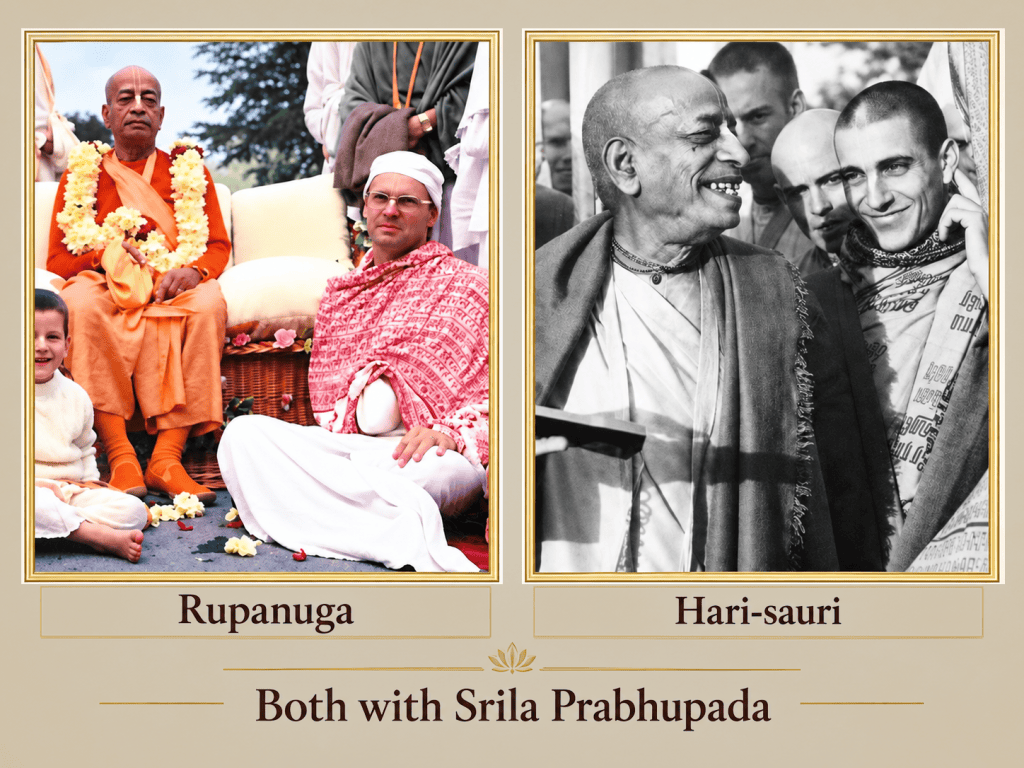
A Response to Hari-śauri Dāsa on the Posthumous Editing of Śrīla Prabhupāda’s Books
By Ajit Krishna Dasa
In 2008 Hari-śauri Dāsa wrote Good Science, Bad Science, a response to a paper by Rūpānuga Dāsa entitled A Scientific Method for Evaluating Editorial Changes to Srila Prabhupada’s Books. The purpose of Hari-śauri’s paper is to challenge Rūpānuga’s methodology and defend, in particular, the extensive revision of Bhagavad-gītā As It Is published after Śrīla Prabhupāda’s departure.[1]
Before examining that response, something should be said about Rūpānuga Prabhu himself. He was one of Śrīla Prabhupāda’s senior disciples and rendered substantial service in the early development of the Kṛṣṇa consciousness movement. Interestingly, Hari-śauri’s own article acknowledges this. He recalls Rūpānuga’s successful preaching in Buffalo and quotes Bhūrijana Prabhu’s description of that preaching as “unique and outstanding.” Rūpānuga taught an accredited Bhagavad-gītā course at the university, and a remarkable number of students subsequently became devotees and went on to render important service in Śrīla Prabhupāda’s movement.
Whatever one may think about every detail of Rūpānuga’s analysis, he deserves respect for taking seriously a question that reaches to the heart of Śrīla Prabhupāda’s literary legacy: by what authority may the published writings of the ācārya be altered after his departure? His paper was not merely an expression of personal dislike for a few editorial choices. It was an attempt to measure what had been done against Śrīla Prabhupāda’s own instructions concerning editing. That question remains unresolved, and despite the confidence of Hari-śauri’s response, Good Science, Bad Science never actually answers it.
The Prior Question
A striking feature of Hari-śauri’s paper is that it quickly leads the reader into a discussion of whether particular revisions are good or bad. Was a Sanskrit word mistranslated? Did Hayagrīva omit something? Does an older draft support Jayadvaita Swami’s later wording? Is one translation philosophically more precise than another? Were the original editors inexperienced? All of these questions may be worth investigating, but none of them is the first question that must be answered.
The first question is one of authority: where did Śrīla Prabhupāda authorize his disciples to continue altering his already published books after his departure? Until that question has been answered, demonstrating that a particular proposed correction is clever, accurate, useful, or even undeniably correct does not establish the right to insert it into Śrīla Prabhupāda’s book.
This distinction is simple but fundamental. Suppose a scholar discovers an obvious grammatical mistake in a book by a deceased author. The scholar may be completely correct about the mistake, but that does not make the scholar the author, nor does it automatically give him authority to rewrite the book and publish the altered text under the deceased author’s name. In the case of an ācārya the problem is more serious still, because the relationship is not merely between a dead author and a later copy editor. It is between disciple and spiritual master.
Rūpānuga begins his paper by citing an instruction Śrīla Prabhupāda gave him on February 17, 1970: “Our editing is to correct grammatical and spelling errors only, without interpolation of style or philosophy.” Rūpānuga then attempts to examine whether the later revisions remain within that boundary. Hari-śauri may challenge Rūpānuga’s interpretation of individual examples, show that some readings came from earlier drafts, or demonstrate that Hayagrīva sometimes made mistakes. None of that, however, removes the need to establish the authority under which a disciple in 1982 or 1983 could reopen a book completed, published, taught from, distributed, and accepted during Śrīla Prabhupāda’s lifetime.[2]
This is the missing premise running through Good Science, Bad Science. Hari-śauri spends considerable effort arguing that some revised readings are more literal, more accurate, or better supported by earlier source material. But none of those textual judgments establishes the authority to replace Śrīla Prabhupāda’s published wording after his departure.
No Explicit Authorization for Posthumous Editing
The historical record contains many instructions from Śrīla Prabhupāda about editing while he was physically present. He instructed editors to correct spelling, grammar, and Sanskrit; at times he approved specific changes, ordered particular corrections, expressed satisfaction with an editor, or severely criticized an editor. None of this is disputed. What has not been produced is an instruction saying that after his departure his disciples were to continue revising his already published books.
This absence is not merely an argument made by opponents of the revisions. Edith Best, writing in the 2024 scholarly volume Posthumous Editing of a Great Master’s Work, states that there is no direct and explicit instruction from Śrīla Prabhupāda regarding posthumous editing. She further notes that although ISKCON leaders discussed with Śrīla Prabhupāda how initiations would continue after his departure and how the unfinished Śrīmad-Bhāgavatam would be completed, there is no record of anyone asking him whether, how, or to what extent already published books should be revised after his death.[3]
That omission matters because Śrīla Prabhupāda knew his health was failing, and his disciples knew it as well. Practical arrangements concerning what would happen after his departure were discussed, yet no documented conversation has been produced in which anyone asks the obvious question: “Śrīla Prabhupāda, after you are no longer physically present, may we continue changing the published editions of your books?” If such authority is now claimed, the burden of proof lies with those claiming it.
It is not enough to say that Śrīla Prabhupāda never explicitly forbade Jayadvaita Swami from revising Bhagavad-gītā As It Is in 1983. One does not acquire authority over the ācārya’s words merely because the ācārya did not foresee and prohibit every future editorial action individually. The relevant question is positive: where was the authority given?
The July 1977 Correspondence Does Not Supply It
One of the strongest pieces of evidence invoked by defenders of continued editing is the correspondence following the famous June 22, 1977 “Rascal Editors” conversation. On July 22, Tamāla Kṛṣṇa Goswami wrote to Rāmeśvara concerning the procedure for dealing with mistakes: “Your suggestion that in the future any mistakes which are found can be reported to Satsvarupa Maharaja, Jayadvaita Prabhu, Radha Ballabha Prabhu, or yourself, and after sufficient investigation and confirmation these mistakes can be rectified is accepted.”
If the words “in the future” are isolated, it is easy to make them sound like a permanent charter extending indefinitely beyond Śrīla Prabhupāda’s departure. The surrounding context, however, does not establish that. In the very same letter Tamāla Kṛṣṇa says concerning corrections to the Fifth Canto planetary system that “whatever corrections are required to be made, we will get approved by His Divine Grace and then send them on to you.” He also writes that Śrīla Prabhupāda was satisfied that things were not being “unauthorizedly changed” while necessary corrections were being made.
Rāmeśvara’s own July 13 letter is equally instructive. Describing the procedure then being followed at the BBT, he writes that because Śrīla Prabhupāda had expressed displeasure with editors correcting his work, they had become extremely conservative and that clarifications were made only after consulting Śrīla Prabhupāda. The system being discussed therefore still contained an indispensable element: Śrīla Prabhupāda himself remained available as the final authority.
This is the operative environment in which the expression “in the future” was used. Śrīla Prabhupāda was alive and could be consulted, approve a correction, reject a correction, remove an editor, change the procedure, or explain what he meant. During his lifetime he did all of these things. Nothing in the July correspondence states that this supervisory structure would continue unchanged after the person supplying the final authority was no longer physically present.
To infer otherwise is to insert into the correspondence the very conclusion that needs to be proved. An instruction about how something is to proceed “in the future” ordinarily operates within the conditions in which the instruction is given unless there is evidence extending it beyond those conditions. If I authorize someone to make decisions on my behalf while requiring disputed matters to be brought to me, one cannot simply preserve the first half of the arrangement after my death and discard the second.
The 1977 correspondence therefore proves that Śrīla Prabhupāda allowed certain editing to continue while he was present. It does not prove that he authorized a permanent posthumous editorial institution with power to reopen his published works indefinitely. Nothing in the “Rascal Editors” discussion or the Rāmeśvara–Tamāla Kṛṣṇa correspondence demonstrates that the procedure may simply be extrapolated into a situation where Śrīla Prabhupāda is no longer physically present to approve or disapprove the work.[4]
What About “Whatever He Does Is Approved by Me”?
Another frequently cited statement must be dealt with directly. On September 7, 1976 Śrīla Prabhupāda wrote concerning Jayadvaita: “Concerning the editing of Jayadvaita Prabhu, whatever he does is approved by me. I have confidence in him.” This clearly establishes that at that time Śrīla Prabhupāda trusted Jayadvaita’s editorial work, and it is important evidence that should not be minimized.[5]
But what exactly does it prove? It proves that Śrīla Prabhupāda trusted Jayadvaita in September 1976 and approved his editing under the circumstances then existing. It does not state that Jayadvaita was being granted irrevocable editorial authority over Śrīla Prabhupāda’s writings for the remainder of his life, much less that such authority would survive Śrīla Prabhupāda’s departure and permit Jayadvaita years later to revise books already published during the author’s lifetime.
The difference between these claims is substantial. A statement of confidence in a disciple performing a particular service under the guru’s supervision is not the same thing as a permanent power of attorney extending beyond the guru’s physical presence. To transform “I have confidence in him” into such a posthumous mandate requires an additional premise, and that premise is nowhere stated.
This becomes especially clear when we look at the June 22, 1977 conversation itself. Tamāla Kṛṣṇa says that Śrīla Prabhupāda’s current original work is being edited by Jayadvaita, and Śrīla Prabhupāda replies that “he is good.” Tamāla Kṛṣṇa then distinguishes that first editing from later people “going over” the books after publication, and Śrīla Prabhupāda asks how this can be stopped. When Tamāla Kṛṣṇa suggests that changes should not be made without consulting Jayadvaita, Śrīla Prabhupāda complains that changes were being made “without any authority.”
The conversation certainly shows that Jayadvaita occupied a trusted position in 1977, but the whole discussion still takes place while Śrīla Prabhupāda is alive and exercising supreme authority over his own books. Neither “he is good” nor “I have confidence in him” says that after Śrīla Prabhupāda’s departure Jayadvaita may reopen Bhagavad-gītā As It Is and determine which published readings should be replaced.
The Problem Is Not Merely the Absence of Permission
A defender of the revisions might respond that Śrīla Prabhupāda never explicitly discussed posthumous editing because he considered the existing editorial authority obvious. His editors already had authority, the argument would run, and unless he revoked it there is no reason to assume that authority ceased at his departure. That argument at least addresses the real issue, but it immediately encounters a deeper problem: the case against posthumous revision does not rest merely on the absence of explicit permission. Śrīla Prabhupāda repeatedly taught a positive principle pointing in the opposite direction when dealing with the writings of spiritual authority: ārṣa-prayoga.
In a January 20, 1972 letter to Maṇḍalī Bhadra, Śrīla Prabhupāda explained that there may be discrepancies in the work of a great authority, but such discrepancies are accepted. He compared this to unusual usages found in Shakespeare: one does not assume the right to improve the authority simply because a later reader believes the language could be corrected. The principle becomes even clearer in a March 31, 1976 lecture, where Śrīla Prabhupāda speaks of discrepancies in the comments of different ācāryas and says that they are accepted as ārṣa-prayoga and “should remain as it is.”[6]
The point is not that Śrīla Prabhupāda opposed all editing while he was physically present. He obviously corrected his own work, authorized editors to make corrections, approved particular changes, and rejected others. The crucial distinction is that while the author is present, he remains the final authority over his own text. A different situation arises when disciples encounter what they believe to be a discrepancy after the authority is no longer physically available to decide whether the wording should be changed. On that question, Śrīla Prabhupāda’s general teaching does not point toward continuing editorial reconstruction. He does not say, “If you can demonstrate that the ācārya made a mistake, correct him.” He says that discrepancies in the work of authority are accepted as ārṣa-prayoga and “should remain as it is.”
This makes the argument stronger than a mere appeal to silence. It is not simply that no instruction authorizing posthumous revision has been produced; Śrīla Prabhupāda also taught a principle of restraint toward the writings of an ācārya. That principle creates a substantial burden for anyone who wishes to establish a contrary rule for Śrīla Prabhupāda’s own published books after his departure. If disciples are taught not to become correctors of the writings of spiritual authority merely because they perceive a discrepancy, one cannot simply assume that Śrīla Prabhupāda intended his own books to be treated differently.
The force of this principle becomes even clearer in a February 27, 1977 room conversation, where Śrīla Prabhupāda directly addresses the tendency to correct the work of authority and explains what ārṣa-prayoga requires in practice.
“Whatever Authority Has Done”
The February 27, 1977 room conversation makes this principle even more explicit. The immediate context concerned the republication of an authoritative work connected with Śrīla Prabhupāda’s own spiritual master, and Śrīla Prabhupāda objected strongly to the tendency to correct. When Rādhā-vallabha concludes, “So no corrections,” Śrīla Prabhupāda permits only the dividing of synonyms. He then criticizes the tendency to correct as “very bad” and states: “The system is: whatever authority has done, even there is mistake, it should be accepted.” He identifies this as ārṣa-prayoga and warns that one should not become “more learned than the authority.” Later in the same discussion he again concludes, “No corrections.”[7]
The context must, of course, be respected. This was not a conversation explicitly about whether the 1983 Bhagavad-gītā should exist, nor was Śrīla Prabhupāda asked the precise question, “What should we do with your published books after your departure?” But that limitation should not obscure what the conversation actually does establish. Śrīla Prabhupāda was articulating a general principle for dealing with the writings of spiritual authority: even when a disciple thinks he sees a mistake, he should not place himself above the authority and correct the text according to his own judgment. His stated principle is restraint.
Rāmeśvara Dāsa’s recollections in a 1979 interview point strikingly in the same direction. Rāmeśvara, who had been one of Śrīla Prabhupāda’s principal BBT managers and was directly involved in the publication of his books, recalled a discussion concerning the treatment of an ācārya’s work. When the question of incorrect grammar arose, he remembered Śrīla Prabhupāda’s answer as: “You cannot change one comma, not even a comma, not even a punctuation mark, that is the etiquette.” Rāmeśvara then explained the principle he understood Śrīla Prabhupāda to be teaching: “the etiquette in dealing with a great acarya’s books is that whatever he has done it’s eternal and it can never be changed.” He further said that he understood this as part of Śrīla Prabhupāda’s training of those who would eventually be entrusted with his own books.
Rāmeśvara’s account is retrospective testimony rather than a surviving direct recording of Śrīla Prabhupāda making that particular statement, so it should not be placed on exactly the same evidentiary level as the February 1977 conversation. Its importance is nevertheless considerable. It comes from one of the men responsible for Śrīla Prabhupāda’s publishing work, and the principle he remembered being taught corresponds closely with Śrīla Prabhupāda’s directly recorded statements on ārṣa-prayoga: do not become “more learned than the authority,” do not correct merely because something appears mistaken, and respect the work of the ācārya as it stands. Rāmeśvara also recalled Śrīla Prabhupāda insisting in connection with the Śrīmad-Bhāgavatam publishing standard that there should be no further changes, describing him as emphatic and insistent on the point.[8]
The argument, therefore, is stronger than merely saying that no explicit authorization for posthumous revision has been found. Śrīla Prabhupāda may never have been asked the exact hypothetical question of what should happen to his published books after his departure, but he did repeatedly teach a principle about how disciples should treat the writings of an ācārya. That principle points toward preservation rather than continuing correction. If Śrīla Prabhupāda intended his own published books to constitute an exception—so that after his departure his disciples should reopen them, adjudicate apparent mistakes, and substitute what they regarded as superior readings—one would expect clear evidence for such an exception.
Śrīla Prabhupāda’s Own Example
Śrīla Prabhupāda also demonstrated this principle in practice. An instructive case appears in Caitanya-caritāmṛta, Madhya 9, where Śrīla Bhaktisiddhānta Sarasvatī Ṭhākura points out an apparent error in Kṛṣṇadāsa Kavirāja Gosvāmī’s geographical description. Śrīla Prabhupāda does not silently alter Kṛṣṇadāsa Kavirāja’s text to make it conform to the correction. He leaves the text untouched and explains the issue in his purport.[9]
That is an important editorial model because it shows that acknowledging an apparent discrepancy does not require replacing the inherited text. The reader can be informed, an explanatory note can be supplied, and later scholarship can discuss the problem without pretending that the later editor has become the author.
This is essentially the solution many critics of the BBT International revisions have advocated for years. Preserve Śrīla Prabhupāda’s published books intact, and if later editors believe they have discovered errors, transcription problems, alternative manuscript readings, or historically interesting editorial decisions, place those matters in notes, appendices, critical editions, or separately identified annotated editions. Such a policy does not oppose scholarship; it distinguishes scholarship from rewriting.
Caitanya Mahāprabhu and Īśvara Purī
The Gauḍīya tradition supplies an even more striking precedent. In Caitanya-bhāgavata, Ādi-khaṇḍa 11.105–110, Īśvara Purī asks Nimai Paṇḍita—Śrī Caitanya Mahāprabhu Himself—to examine his book and correct its mistakes. This is particularly significant because it removes one obvious escape: Īśvara Purī is not dead and is himself asking for correction.
Yet Mahāprabhu refuses to approach the devotional work in a fault-finding spirit. He explains that Kṛṣṇa accepts the sentiment of His devotee and invokes the famous example of viṣṇāya and viṣṇave: one form may be grammatically improper and the other correct, yet Kṛṣṇa accepts the devotion. Mahāprabhu’s response culminates in the principle that one should not arrogantly search for faults in a pure devotee’s description of Kṛṣṇa.[10]
This does not mean Gauḍīya Vaiṣṇavas must intentionally print typographical errors, nor does it mean that Śrīla Prabhupāda was opposed to proofreading his own books. We know that he repeatedly ordered corrections during the publication process. The significance lies in the devotional disposition Mahāprabhu establishes toward the writings of a Vaiṣṇava authority: technical correctness is not the highest principle, and the later scholar does not stand over the devotional author as a superior intelligence whose duty is to perfect the author’s deficiencies.
That principle is remarkably close to Śrīla Prabhupāda’s own warning that one should not become “more learned than the authority.” The theological problem with posthumous editing therefore cannot be reduced to a dispute about English grammar; it concerns the proper relationship of the disciple to the words of the ācārya.
Two Different Situations Must Not Be Confused
Much of the confusion disappears once two very different situations are kept separate. During Śrīla Prabhupāda’s lifetime, editors worked under a living author. They could ask questions, and he could authorize changes, inspect them, order omitted passages restored, approve Jayadvaita’s editing, condemn another editor’s work, or simply tell them what he meant.
After November 14, 1977, that relationship changed in one decisive respect: the editor could no longer take a disputed alteration to Śrīla Prabhupāda and ask him whether he wanted it. That fact cannot be wished away by appealing to earlier trust, because the very mechanism by which uncertainty could be resolved had disappeared.
It also explains why the manuscript argument, which will be examined separately, cannot solve the authorization problem. Even if an earlier draft contains wording that appears superior, we still do not know whether Śrīla Prabhupāda wanted that earlier wording restored after the book had passed through editing, publication, use, teaching, and distribution during his lifetime. A manuscript can tell us what he wrote or dictated at an earlier stage; by itself it cannot tell us what he would have ordered years later.
That distinction becomes decisive once the author is no longer present. To treat an early draft as though it automatically reveals the ācārya’s final intention is to confuse textual history with authorial authorization.
The Burden of Proof Has Been Reversed
Hari-śauri’s paper repeatedly places Rūpānuga in the defendant’s chair. Can Rūpānuga prove that this change is wrong? Can he prove that the first editor was correct? Can he show that every revision altered philosophy? Did he examine enough verses? Did he examine the purports? Did he consult Jayadvaita Swami? Those may all be legitimate secondary questions, but they do not determine the fundamental burden of proof.
More fundamentally, the published books already existed, and Śrīla Prabhupāda accepted, used, distributed, and taught from them as his books. Later disciples changed them after his departure. The later editors therefore bear the burden of establishing the authority under which they acted. The critic does not first have to prove that every change is harmful; the editor first has to establish that he possesses the right to make the change at all.
This is why the argument “the new reading is better” cannot settle the matter. Perhaps a later reading is more literal, perhaps the published reading contains what appears to be a genuine mistake, perhaps the alternative wording appears in Śrīla Prabhupāda’s earliest surviving manuscript, and perhaps every Sanskrit scholar in the world would prefer it. None of those facts answers the prior question of whether Śrīla Prabhupāda authorized a disciple to replace the wording of his published book after his departure.
Hari-śauri’s article never produces that authorization. Without it, much of Good Science, Bad Science becomes an elaborate argument about whether certain alternative readings can be linguistically or textually preferred before establishing whether anyone possessed the authority to substitute them into Śrīla Prabhupāda’s published books. A later reading may be more literal, grammatically smoother, or better supported by an earlier manuscript, but those qualities do not legitimize the posthumous act of replacing the published wording. Nor can an earlier manuscript tell us, by itself, what Śrīla Prabhupāda wanted done to the book after his departure.
The next issue, therefore, is Hari-śauri’s central practical defense: the claim that the revised edition frequently restores Śrīla Prabhupāda’s “original” words and therefore brings the book “closer to Prabhupāda.” That argument must be examined carefully, because it confuses an earlier textual state with final authorial intention, overlooks numerous changes that actually move the text farther away from Śrīla Prabhupāda’s own wording, and cannot account for the large class of changes that correct nothing at all.
“Closer to Prabhupāda” — The Manuscript Argument, the Changes Hari-śauri Does Not Discuss, and the Problem of Needless Editing
Without first establishing a clear authorization for posthumous editing, Hari-śauri turns to what is probably the strongest practical argument for the revised Bhagavad-gītā As It Is: many of the changes, he says, restore wording found in earlier manuscripts and therefore bring the book closer to Śrīla Prabhupāda. This argument has considerable rhetorical force because some of the examples are genuine. There are places where the 1972 edition differs from an earlier draft, where the earlier wording is intelligible and philosophically sound, and where the 1983 edition returns toward that earlier wording. If this were the whole story, the phrase “closer to Prabhupāda” might appear compelling.
It is not the whole story. The manuscript argument contains two separate problems. First, even where the 1983 wording genuinely restores something from an earlier draft, the draft does not tell us that Śrīla Prabhupāda wanted that wording restored after publication. Second, there are many other changes in which the 1983 edition does not return to Śrīla Prabhupāda’s earlier wording at all. In some cases the manuscript and the 1972 edition agree, while the posthumous edition departs from both. Hari-śauri emphasizes the first category while giving the reader little sense of the second, and that asymmetry seriously weakens his general conclusion.
There Is No Single “Original Manuscript”
The expression “the original manuscript” can itself give a misleading impression, as though there were one pristine document containing Śrīla Prabhupāda’s exact intended Gītā and the posthumous editor simply compared the defective 1972 printing against this authoritative master copy. Jayadvaita Swami’s own explanation is much more complicated. For approximately the first five or six chapters, what he calls the “original manuscripts” are manuscripts apparently typed by Śrīla Prabhupāda himself. For the middle six chapters, they are original transcriptions of dictated tapes. For the final chapters, the earliest surviving sources are retyped manuscripts copied from transcriptions on which considerable editing had already occurred; the earlier transcriptions had apparently been lost. Jayadvaita therefore explicitly acknowledges that “original manuscripts” means different things in different parts of the book.[11]
This matters because Hari-śauri’s argument often sounds much simpler than the evidence actually permits. The editorial problem is not always “Prabhupāda wrote A, Hayagrīva corrupted it into B, and Jayadvaita restored A.” Sometimes we possess Śrīla Prabhupāda’s own typed wording. Sometimes we possess a transcription made by a disciple listening to a tape. Sometimes we possess a later retyping of something that had already passed through editorial hands. Jayadvaita himself has described the manuscript history as highly varied, with some documents unquestionably representing Śrīla Prabhupāda directly and others so heavily edited and retyped that it can be difficult to determine exactly what came from whom.
The word “original” therefore needs caution. An early textual witness is valuable evidence, but its chronological priority does not automatically establish its final authority.
Earlier Is Not the Same as Final
This is the basic problem with Hari-śauri’s use of manuscript evidence. A draft tells us that Śrīla Prabhupāda once wrote or dictated something. It does not, by itself, tell us what he ultimately wanted the published sentence to be after the text had passed through editing, discussion, correction, revision, typesetting, and publication.
Suppose Śrīla Prabhupāda originally dictates A. Hayagrīva edits it to B. The book is then published with B, and Śrīla Prabhupāda accepts, reads, lectures from, distributes, and refers people to that edition for years. After Śrīla Prabhupāda’s departure, an editor discovers A and prefers it. From the existence of A we may safely conclude that A once came from Śrīla Prabhupāda. We cannot safely conclude that Śrīla Prabhupāda wanted B replaced by A after his departure, because the very history between A and B is what has to be understood.
There are several possibilities. B may be an accidental corruption. B may be Hayagrīva’s improvement that Śrīla Prabhupāda never noticed. B may be an editorial formulation Śrīla Prabhupāda heard and accepted. B may embody a discussion between author and editor for which no written record survives. B may even have become preferable to Śrīla Prabhupāda after he first dictated A. Unless the history is documented, simply pointing to A cannot settle among these possibilities.
This is why “restoring the manuscript” and “restoring Prabhupāda” are not synonymous. The earlier text establishes provenance; it does not establish final intention. This is a standard textual distinction: working drafts precede a final publication, and an earlier draft does not automatically overrule a later published text after the author is no longer available to explain the intervening editorial decisions.
Śrīla Prabhupāda’s own preface to the complete Macmillan Gītā makes the chronology important. He explains that the earlier abridged publication had been cut short and that the complete edition was now being presented in the full form he had wanted, with Sanskrit, transliteration, synonyms, translations, and purports. The 1972 book is therefore not merely another rough witness standing beside earlier drafts; it is the completed publication that appeared under his authority.
None of this requires claiming that every word in the 1972 edition came directly from Śrīla Prabhupāda’s typewriter or that every editorial choice was personally discussed with him. The point is narrower and stronger: once an edited text has become the lifetime-published book, an earlier draft cannot simply be elevated above it without evidence that the author wanted the publication reversed.
Hari-śauri’s Evidence Runs in Only One Direction
This becomes especially important when evaluating Hari-śauri’s method. He selects examples where manuscript evidence can be used to explain or defend a later change and then employs these examples to undermine Rūpānuga’s broader criticism of the revision. But a fair test of the claim “closer to Prabhupāda” must look in both directions.
If the 1983 edition changes B back to A where A is found in Śrīla Prabhupāda’s manuscript, that may be cited as evidence of manuscript restoration. But what happens when the evidence has this form: manuscript A, 1972 edition A, revised edition C? In such a case the later editor has moved away from the very manuscript that is elsewhere invoked as his authority.
There is also a third pattern: manuscript A, 1972 edition B, revised edition C. Here the posthumous edition does not preserve the published form and does not restore the earlier one. It creates another editorial form.
A general claim that the revision takes us “closer to Prabhupāda” cannot be supported by presenting only examples from the first category. It requires accounting for all three.
The manuscript evidence reveals several patterns that this simple restoration narrative cannot explain. There are cases where the manuscript and the 1972 edition agree but the revised edition departs from both, cases where the revised edition introduces wording found in neither earlier textual state, cases where Śrīla Prabhupāda’s Sanskrit word-for-word meanings are themselves altered, and cases where sentence structures are rewritten without any demonstrated necessity.
The significance is methodological. Hari-śauri criticizes Rūpānuga for an allegedly incomplete investigation while himself drawing a broad conclusion from a favorable subset of the evidence. If incompleteness is fatal to Rūpānuga’s method, it cannot become harmless when the same limitation favors the revision.
A Clear Example: Bhagavad-gītā 9.19
Bhagavad-gītā 9.19 provides a particularly clean example because it avoids many of the complications involved in determining whether Hayagrīva misunderstood Śrīla Prabhupāda. In the manuscript, the synonyms for sat and asat are given as “being” and “non-being.” The 1972 edition retains essentially the same renderings: “being” and “nonbeing.” In the posthumously revised edition, these synonyms are replaced by “spirit” and “matter,” and the translation is adjusted accordingly.
Whatever philosophical argument may be made for associating sat with spirit and asat with matter in a broader Vedāntic context, that is not the issue here. The relevant textual fact is that the revised synonyms do not restore Śrīla Prabhupāda’s manuscript wording. The manuscript and the lifetime-published edition agree; the posthumous editor introduces something else.[12]
This example therefore cannot be defended by saying that a later editor merely removed Hayagrīva’s interpolation and returned to Śrīla Prabhupāda. The opposite has occurred. The later editor has overridden wording supported by both the earlier source and the published text.
This example is sufficient to disprove any simple formula according to which manuscript evidence explains the revision as a whole. Once such cases exist, each claim of manuscript restoration must be demonstrated individually, and the slogan ‘closer to Prabhupāda’ becomes a claim requiring proof rather than a description that can be assumed.
“Viṣṇu Form” Becomes “Viṣṇu Platform”
Bhagavad-gītā 2.61 gives another revealing example, particularly because Jayadvaita Swami later acknowledged the problem. The original manuscript and the 1972 edition contain the expression “Viṣṇu form.” In the revised edition this became “Viṣṇu platform.” The latter was not a restoration of Śrīla Prabhupāda’s manuscript but an editorial mistake introduced during the posthumous revision. Jayadvaita later explained that his impression had been that “platform” came from an original manuscript and acknowledged that the change must have been a mistake.[13]
One should give him credit for admitting the error. But the case raises a larger question about the method. A posthumous editor is presented as correcting the mistakes of earlier editors by consulting manuscripts, yet the posthumous editor is himself fallible, must choose among manuscripts of varying histories, and may introduce new mistakes while attempting to repair old ones.
This is precisely why the principle of caution matters. A living author can resolve uncertainty. A deceased author cannot. If the later editor is wrong, the error is now published under the author’s name and may itself require another correction in a future edition. The process can become recursive: correct the first editor, then correct the second editor, then correct the correction. At that point the supposedly stable text of the ācārya becomes a permanently open editorial project.
A Larger Pattern in the Word-for-Word Meanings
The problem is not confined to a handful of isolated sentences. A detailed comparison of the Sanskrit word-for-word meanings in the first chapter reported roughly 130 changes, 89 of which—approximately two thirds—were classified as cases in which the 1972 edition follows Śrīla Prabhupāda’s draft while the revised edition does not.
The exact categorization can of course be independently audited, and it should be. But even without relying upon the percentage as an unquestionable final statistic, the existence of the underlying examples creates a problem Hari-śauri does not address. If the manuscript is supposed to be the privileged key for recovering Śrīla Prabhupāda’s authentic wording, why are there numerous places where the posthumous revision moves away from it?
The issue becomes sharper because these are not merely Hayagrīva’s literary embellishments. They include the word-for-word Sanskrit apparatus attributed to Śrīla Prabhupāda’s own early work. A methodology cannot invoke the sanctity of the manuscript when it supports a revision and quietly subordinate the same manuscript when an editor prefers something else.
The “Phalanx” Example and Editorial Taste
Bhagavad-gītā 1.2 illustrates another category: a change produced not because the published wording is false, but because the later editor considers another expression stylistically preferable. Jayadvaita explains that the manuscript contained the concept of a military formation and that he did not like “phalanx” because of its specific association with ancient Greek warfare. He therefore chose “military formation.” Later, however, he acknowledged that ‘phalanx’ can also refer more broadly to a military formation and conceded that he may have been too picky.[14]
The difficulty becomes clearer when we notice that the revised edition itself retains “phalanx” elsewhere, including Bhagavad-gītā 1.11. The supposed lexical problem is therefore applied inconsistently.
More importantly, Jayadvaita’s own explanation reveals the nature of the decision. This is not the discovery of a transcription error like writing “trees” where the Sanskrit says “Pitṛs.” It is editorial judgment: this word sounds too Greek; that expression seems more appropriate; in retrospect perhaps the original objection was too picky.
There is nothing unusual about such judgments in ordinary editing. Editors make them constantly. But that is exactly the point. Once the defense shifts from “we are correcting unmistakable errors” to “I judged this expression stylistically unsuitable,” the scope of the claimed authority has expanded substantially.
The same passage contains another small but instructive revision: “began to speak” becomes simply “spoke.” Jayadvaita explains that “began to speak” is often unnecessary unless the speaker is subsequently interrupted or falls silent, and that later BBT International editing routinely trimmed such constructions. Again, perhaps an English editor prefers “spoke.” But “began to speak” is not an error in English, nor is removing it a restoration demanded by Vaiṣṇava philosophy. It is stylistic editing.
The question is therefore not whether “spoke” is acceptable. The question is why a disciple, after Śrīla Prabhupāda’s departure, should substitute his preferred prose style for wording that had already appeared in Śrīla Prabhupāda’s published book.
Needless Changes Are Not a Minor Side Issue
This point is especially damaging because it can be established without first resolving the entire argument over posthumous authorization. Jayadvaita Swami himself wrote in 1986 that Śrīla Prabhupāda “staunchly opposed needless changes.” In his 1982 letter to senior devotees, written while preparing the revision, he similarly stated that he had tried to be conservative and not make needless changes.[15]
We may therefore grant, purely for argument, the entire pro-revision premise. Suppose posthumous editing was permitted. Suppose real transcription errors may be corrected. Suppose accidentally omitted material may be restored from reliable manuscripts. Suppose the editor may correct grammar where the intended meaning is beyond dispute. Even after granting all of this, needless changes still fail by the editors’ own stated standard.
This creates a dilemma for Hari-śauri’s defense. If posthumous revision as such was not authorized, the needless change fails for the fundamental reason discussed earlier. If a narrowly corrective authority somehow existed, the needless change still exceeds it because nothing needed correction.
The category therefore deserves much more attention than Hari-śauri gives it. A change does not become harmless merely because it leaves the philosophy substantially intact. If Śrīla Prabhupāda did not want needless alterations, then a needless alteration violates his editorial standard even when the resulting sentence remains philosophically orthodox.
This is why the recurring question “Does this particular change significantly alter the philosophy?” can itself be misleading. It quietly assumes that an alteration is legitimate unless a critic proves doctrinal damage. But if the governing instruction is not to make needless changes, then the burden runs the other way. The editor must show why the change was needed.
Why Counting Matters
Hari-śauri also treats Rūpānuga’s counting methodology as though numerical extent tells us very little unless every change is first categorized according to seriousness. There is a valid point hidden here: a punctuation change and a major philosophical alteration are not equivalent. A raw count cannot tell us how consequential each item is.
But that does not make counting unimportant. Rūpānuga’s underlying objection concerns extensive posthumous alteration. If the premise is that Śrīla Prabhupāda’s published book should not have been reopened without clear authority, then the number of interventions tells us how far the later editors departed from textual preservation.
The count used in Rūpānuga’s analysis, and later discussed in the 2024 scholarly literature, found that 521 of the 700 verse translations contained deletions, insertions, or rearrangements. Significantly, that count did not include mere spelling and punctuation corrections. Whatever one thinks of the exact methodology, this is not a statistic generated by counting every corrected comma as though it were a theological revolution.[16]
The number does not prove that 521 translations contain philosophical errors. Rūpānuga does not need it to prove that. It demonstrates the scale of the textual intervention.
This distinction is straightforward. Categories answer the question, “What kinds of changes were made?” Counting answers the question, “How extensively was the published text altered?” Both questions matter. To insist that the second becomes meaningless unless it answers the first is to confuse two different measurements.
Indeed, if Hari-śauri wishes to argue that Rūpānuga’s percentage sounds alarming only because many changes are harmless, the correct response is not to dismiss counting. It is to produce a complete classification. How many are unambiguous typographical corrections? How many restore accidentally omitted text? How many return to an earlier manuscript? How many depart from the manuscript? How many involve style? How many alter the synonyms? How many introduce wording found nowhere in the earlier sources? How many were actually ordered or approved by Śrīla Prabhupāda? That would be genuinely scientific.
Selecting several revisions for which textual arguments can be made and then using them to neutralize a count covering hundreds of altered translations does not provide such a classification.
The Comma Is Not Trivial
At this point defenders sometimes retreat to the smallest imaginable case: surely no reasonable person objects to correcting a comma. The example is useful precisely because it appears absurdly trivial. If opposition to posthumous editing requires preserving an obviously misplaced comma, critics can easily be portrayed as fanatics who value mechanical textual fossilization over meaning.
But the objection to the comma is not based upon the physical size of the punctuation mark. It concerns the principle by which the editor acquires authority to alter the text.
If an editor says that he may change a comma ‘for clarity,’ he has appealed to a principle: clarity permits alteration. If that principle is accepted, it does not logically apply only to commas. It can be invoked wherever the editor believes a phrase, sentence, translation, or explanation would become clearer through revision. If the principle is grammatical correctness, the same expansion occurs wherever the editor judges the grammar defective. If the principle is fidelity to the Sanskrit, it applies wherever the editor believes the English could be made more literal. The question therefore becomes not whether the first alteration is tiny, but where the boundary of the principle lies.
This is the Pandora’s-box problem. The first correction establishes jurisdiction. Once jurisdiction is conceded, the controversy shifts from “May the disciple change the ācārya’s published book?” to “How much may he change it?” The supposedly harmless comma is therefore conceptually important because it can become the precedent for an entire editorial philosophy.
Someone may reply that sensible editors can draw reasonable limits. But where do those limits come from? “Only obvious errors” immediately generates another question: obvious to whom? “Only grammar” raises the question of whether unusual grammar is an error, an accepted idiom, an editorial choice, or ārṣa-prayoga. “Only where the manuscript is clear” fails when several manuscripts exist or when the published version differs from an earlier draft. “Only where the meaning is unchanged” presupposes that the later editor is qualified to decide exactly which shades of meaning matter.
Without a boundary supplied by Śrīla Prabhupāda, each limit ultimately rests upon the posthumous editor’s judgment.
The practical history of the revision shows why this concern is not imaginary. The process did not stop with typographical errors. It extended to vocabulary, syntax, punctuation, synonyms, translations, purports, style, and choices among competing textual witnesses.
The slippery slope here is not the fallacy in which one merely imagines increasingly dramatic consequences without showing a mechanism. The mechanism is the generalization of the editorial principle itself. Once “my judgment tells me this would be clearer or more correct” is sufficient grounds for alteration, the same form of reasoning can be invoked at progressively more consequential levels.
Obvious Errors Do Not Authorize Everything Else
The same logical issue can be seen in the well-known “planet of trees” error. In one published passage, a reference to the Pitṛs—the forefathers—appeared as “the planet of trees.” This is precisely the kind of obvious mistake defenders of posthumous editing naturally point to: virtually no one disputes that something went wrong in transmission. For the defender of revision, such an example is especially powerful because refusing to correct it can easily be made to appear irrational.
But even if the error is conceded completely, it does not establish a general posthumous editorial mandate. One obvious error proves that one obvious error exists. It does not prove that every departure from an earlier draft is another error, that every stylistic difference should be regularized, or that a later editor can reliably reconstruct what Śrīla Prabhupāda would have preferred in hundreds of disputed cases.
This is precisely the danger of using an unquestionable mistake as the precedent for a much broader editorial authority. The editor begins with something everyone agrees is wrong, then proceeds to what seems misleading, awkward, insufficiently literal, or stylistically inferior, until the distinction between correction and reconstruction becomes increasingly difficult to maintain.
The ārṣa-prayoga solution avoids this expansion without requiring anyone to pretend that “trees” is the correct meaning of pitṝn. The discrepancy can be openly identified. A note can explain the Sanskrit. An errata list, appendix, or annotated edition can record the correction. What is rejected is the assumption that discovering an error automatically confers authority on the later editor to alter the published text.
This distinction is vital because the strongest opposition to posthumous editing does not depend upon claiming that the 1972 book contains no humanly recognizable mistakes. It can acknowledge mistakes without granting jurisdiction to rewrite the original edition.
“Closer to Prabhupāda” Must Be Demonstrated, Not Announced
Once the full range of evidence is considered, the phrase “closer to Prabhupāda” becomes far less straightforward than Hari-śauri’s argument suggests. Some changes do indeed move a sentence toward an earlier manuscript, and some are aimed at genuine mistakes in the published text. Other changes depart from both the manuscript and the lifetime-published text. Some alter wording for stylistic reasons. Some were later admitted to be mistakes in the posthumous editing itself. Some are simply unnecessary.
Comparisons of the manuscript, the 1972 edition, and the revised edition reveal numerous changes that move the Gītā farther from Śrīla Prabhupāda’s earlier wording rather than closer to it. The same problem extends beyond the translations to purports and Sanskrit synonyms.
A fair description must therefore distinguish between at least two propositions. The modest proposition is that some 1983 changes restore wording found in earlier Śrīla Prabhupāda sources. That is demonstrably true. The sweeping proposition is that the 1983 edition as a whole is thereby “closer to Prabhupāda.” That does not follow without a comprehensive accounting of the changes that move in the opposite direction.
Hari-śauri does not provide that accounting. Instead, he rebukes Rūpānuga for an incomplete study while using a selective group of favorable examples to support an even broader conclusion. The methodological imbalance is difficult to miss once the contrary evidence is placed beside his examples.
A central problem mentioned earlier also remains untouched. Even if Hari-śauri could prove that every single 1983 change moved the wording closer to an earlier manuscript, he would still have to prove that Śrīla Prabhupāda wanted his lifetime-published book posthumously returned to those earlier textual states. He does not prove that. Once we add the many cases where the revision does not even restore the earlier wording, the defense becomes weaker still.
The next step is therefore to examine several of Hari-śauri’s strongest concrete examples rather than the general theory. Bhagavad-gītā 2.20 is especially revealing because Hari-śauri presents it as an obvious philosophical error in the 1972 edition, yet the alleged error is created by assigning the English sentence a meaning that it simply does not have. Other examples likewise show how easily a posthumous editor’s interpretation of what “must have been meant” can become the justification for replacing what Śrīla Prabhupāda actually published.
Testing Hari-śauri’s Examples — and the Rhetoric Surrounding Them
The previous sections have established the premise from which the individual examples must be judged. The question is not whether a posthumous editor can occasionally produce wording that is more literal, grammatically smoother, or closer to an earlier manuscript. The question is whether Śrīla Prabhupāda authorized his disciples to alter his already published books after his departure. If that authority was never given, then no textual argument by itself legitimizes the act of replacing the published wording. A later reading may be linguistically plausible, may reproduce an earlier draft, or may identify what appears to be a genuine mistake, but none of those facts turns an unauthorized posthumous alteration into an authorized one.
This distinction is important when examining Hari-śauri’s examples because he repeatedly moves from a limited textual observation to a much larger conclusion. He may show that an earlier manuscript contains a particular wording and that the 1983 edition returns toward it; from there he proceeds as though the legitimacy of the alteration has been established. It has not. At most, the textual history has been clarified. A missing question mentioned earlier remains exactly where it was: who authorized a disciple, after Śrīla Prabhupāda’s departure, to replace the lifetime-published text?
Hari-śauri’s example from Bhagavad-gītā 1.32–35 illustrates the distinction. He objects to Rūpānuga’s criticism of the change from “though I may survive” to language concerning Arjuna being killed, noting that the relevant Sanskrit ghnataḥ concerns being killed and that earlier source material supports that idea. He also points out that the 1972 translation omits a Sanskrit line that appears in the revised edition. These observations may correct or supplement Rūpānuga’s description of the textual history, but they do not prove that the posthumous alteration itself was legitimate. Hari-śauri has shown, at most, that another reading has strong textual support. He has still not shown that Śrīla Prabhupāda authorized anyone to substitute it into his published book after his departure.
The same principle applies to material that disappeared during the original editing process and was later found in earlier manuscripts. Such discoveries are historically important and should be documented. They may belong in a critical edition, an appendix, textual notes, or a separately identified annotated edition. What they do not do automatically is confer upon the discoverer the right to alter the edition Śrīla Prabhupāda published and used during his lifetime. The distinction between discovering an earlier textual state and possessing authority to replace the later published state is precisely what Hari-śauri’s argument repeatedly fails to maintain.
Bhagavad-gītā 2.20: Manufacturing an Error
Bhagavad-gītā 2.20 is particularly important because Hari-śauri presents it not merely as a return toward an earlier manuscript but as the correction of a serious philosophical mistake. His account of the 1982 GBC review describes Jayadvaita Swami drawing attention to the 1972 translation and arguing that part of it teaches something resembling a Christian doctrine of a soul that comes into existence and thereafter lives forever. Hari-śauri says that, although he was attached to the familiar wording, he eventually accepted that it was “clearly an error.”
The 1972 translation reads:
“For the soul there is never birth nor death. Nor, having once been, does he ever cease to be. He is unborn, eternal, ever-existing, undying and primeval. He is not slain when the body is slain.”
The posthumously revised edition reads:
“For the soul there is neither birth nor death at any time. He has not come into being, does not come into being, and will not come into being. He is unborn, eternal, ever-existing and primeval. He is not slain when the body is slain.”
The accusation against the 1972 edition centers upon the sentence, “Nor, having once been, does he ever cease to be.” Jayadvaita Swami’s later explanation says that Christian philosophers believe God creates the soul and that, once created, the soul continues forever; he therefore associates the phrase “having once been” with that idea. Hari-śauri states the argument even more categorically, saying that the sentence means the soul “comes into being at a certain point” and thereafter exists eternally. But the sentence simply does not say that.
“Having once been” does not mean “having once been created,” “having begun to exist,” or “having come into existence for the first time.” It presupposes existence and says that existence does not subsequently cease. The statement concerns continuity of being, not the origin of being. From the proposition “having once been, he never ceases to be,” one can infer continued existence; one cannot infer that there was a prior time at which the soul did not exist.
This point does not depend upon rescuing the sentence through its context. Even in isolation, the English expression does not contain the creationist proposition attributed to it. The context simply confirms the meaning beyond reasonable doubt. The sentence immediately before says, “For the soul there is never birth nor death,” while the sentence immediately after calls the soul “unborn, eternal, ever-existing, undying and primeval.” The supposed Christian doctrine therefore has to be imported into a sentence that does not state it and placed inside a passage that expressly denies it several times.
The point can be made in simple logical terms. From “X, having once been, does not cease to be,” one may infer that X continues to exist. One cannot infer that X began to exist at the moment referred to. That conclusion would require an additional premise that is simply not present in the sentence. Hari-śauri’s argument therefore mistakes something the sentence could perhaps be made compatible with under an externally supplied interpretation for something the sentence itself actually asserts.
There is a further irony in the BBT International defense. The 1972 word-for-word already renders bhūtvā as ‘came into being,’ while the revised word-for-word renders it as ‘having come into being.’ If ‘having once been’ supposedly implies temporal creation merely because of its wording, these word-for-word renderings would seem at least as capable of being made to sound that way when isolated from context. This does not mean that either word-for-word rendering is philosophically defective; it shows that Hari-śauri’s semantic objection to ‘having once been’ cannot bear the weight placed upon it.
Nor does the posthumous change merely replace the supposedly defective words. “There is never birth nor death” becomes “there is neither birth nor death at any time,” while the word “undying” disappears from the published sequence “unborn, eternal, ever-existing, undying and primeval.” These additional alterations are not required by the alleged problem with “having once been.” The example therefore does not present a simple picture in which one demonstrably false philosophical statement was removed and nothing else was touched.
Hari-śauri further emphasizes that the revised wording stands closer to Śrīla Prabhupāda’s earlier manuscript. That historical fact should be acknowledged. The manuscript contains wording to the effect that the soul does not come into being and will not cease to be, and the revised edition follows that form more closely than the 1972 translation does. Yet this establishes only that an earlier textual state existed. It does not show that the 1972 sentence was philosophically mistaken, and it certainly does not establish that Śrīla Prabhupāda wanted the lifetime-published wording replaced after his departure.
Hari-śauri also attempts to strengthen the case by noting that Hayagrīva’s wording resembles that of S. Radhakrishnan. Yet in the same paper Hari-śauri quotes Hayagrīva’s account in which Śrīla Prabhupāda told him that he could use verse translations from elsewhere and that there was “no harm” in doing so, since the Sanskrit remained available and Śrīla Prabhupāda regarded his Vaiṣṇava purports as the essential contribution. If that testimony is accepted, the fact that a phrase resembles another translator cannot itself establish that the phrase is unacceptable. Its meaning must be judged on its own merits, and in this case the alleged philosophical defect simply is not present.
Bhagavad-gītā 2.20 therefore reveals something more serious than disagreement over literary taste. A perfectly coherent English sentence was declared philosophically wrong because an editor assigned to it a meaning it does not contain, and that alleged error then became part of the justification for rewriting Śrīla Prabhupāda’s published translation after his departure. Even if someone personally prefers the wording of the earlier manuscript, the posthumous substitution remains unauthorized according to the premise established earlier in this text. The example does not establish the right to edit; it demonstrates how easily an editor’s interpretation of what is supposedly wrong can become the basis for changing what the ācārya actually published.[17]
The Manuscript Does Not Settle the Question
The deeper lesson from Bhagavad-gītā 2.20 applies throughout Hari-śauri’s paper. Hari-śauri repeatedly presents the existence of an earlier manuscript reading as though it settles the controversy. In his summary of the manuscript evidence, he explains that the first chapters rely on early typed manuscripts, the middle chapters on transcriptions, and the final chapters on later retyped manuscripts. He then concludes from selected examples that the revised text brings the book back toward Śrīla Prabhupāda’s original words.
But that conclusion depends upon equating “earlier” with “authoritatively final.” As shown earlier, those are not the same category. An early manuscript can establish what Śrīla Prabhupāda wrote or dictated at an earlier stage. It cannot by itself tell us whether he wanted the later published form reversed after his departure.
This is especially important because the revision does not consistently return to the manuscript anyway. Comparisons of the manuscript, the 1972 edition, and the revised edition reveal cases where Śrīla Prabhupāda’s own wording, present both in an early source and in the 1972 edition, is altered in the posthumous edition. They also reveal new wording found in neither earlier textual state, alterations to Sanskrit synonyms, and needless syntactical changes. Once those categories are admitted, “closer to Prabhupāda” cannot function as a general description of the revision. It becomes a claim that must be tested change by change, while the prior problem of authorization remains unresolved in every case.
The Same-Editor Argument
Hari-śauri also argues that there is something inconsistent about Rūpānuga criticizing Hayagrīva’s work in the 1974 Teachings of Lord Caitanya while defending the 1972 Bhagavad-gītā As It Is, since Hayagrīva edited both books. Hari-śauri suggests that if Rūpānuga’s criticisms of the later Teachings of Lord Caitanya are accepted, then the same editor who supposedly distorted one work is being treated as though he faithfully preserved another.
The argument does not hold. Editorial acts are evaluated according to what was done in each case, not according to whether the editor has been classified once and for all as “good” or “bad.” Hayagrīva could follow Śrīla Prabhupāda closely in one passage and overstep in another. He could make an excellent stylistic decision on one page and an unacceptable deletion on the next. The fact that the same person edited two works does not logically make criticism of one editorial decision incompatible with preservation of another published edition.
Hari-śauri himself relies upon exactly this kind of distinction. He praises Hayagrīva’s abilities and important service but then recounts the incident in which Hayagrīva removed Śrīla Prabhupāda’s statement from Easy Journey to Other Planets, provoking Śrīla Prabhupāda’s strong displeasure and an instruction that the passage be restored. Hari-śauri therefore accepts that Hayagrīva’s editing must be assessed case by case. Rūpānuga is entitled to the same method.
More importantly, Hayagrīva’s fallibility does not create Jayadvaita Swami’s posthumous authority. Showing that the first editor made an unauthorized deletion while Śrīla Prabhupāda was alive proves that Hayagrīva could overstep. It does not follow that another disciple, after Śrīla Prabhupāda’s departure, acquired a general right to reopen the published books and decide which passages required correction. That conclusion needs an independent authorization, and none has been produced.
GBC Review Does Not Become Śrīla Prabhupāda’s Approval
Hari-śauri also emphasizes that the proposed revisions were not made entirely in private. There was a formal process of consultation and institutional approval. The BBT International’s later account states that a GBC-appointed board met for several days in Detroit and “refined or approved changes,” while Jayadvaita Swami circulated to ISKCON leaders a list of all the proposed changes to the translations before publication.
The surviving accounts, however, are not fully consistent concerning how thorough the review actually was. Hari-śauri says that a committee of six was formed and that he personally spent “a month or more going over every edit” to the translations. Rāmeśvara Dāsa later remembered a five-member GBC/BBT committee and gave a substantially less impressive account of its work. He wrote that his own “great failure as a trustee” was that he had not carefully read every proposed change but had relied upon the endorsements of others. He said that he reviewed only selected examples and that other members later admitted to him that their own review had been cursory. Most strikingly, he stated that no one on the committee had even asked to see all the changes and called it “overtly misleading” to suggest that ISKCON’s leaders had carried out a careful review.
These accounts may reflect different stages or overlapping groups in the approval process, but they do not support a simple, uncontested picture in which the GBC collectively performed an exhaustive verification of the revision. What can safely be said is that consultation took place, proposed translation changes were circulated, and the revised edition received institutional endorsement. How thoroughly the responsible leaders actually examined the changes is disputed even by men who participated in the process.[18]
Even if the review had been exhaustive, however, the fundamental question would remain unchanged. A committee of disciples can demonstrate institutional consultation, collective deliberation, and sincerity; it cannot supply retrospectively an instruction from Śrīla Prabhupāda that has never been found. The GBC may decide what ISKCON will publish, and BBT International trustees may decide what the BBT International will print, but neither institutional approval nor the thoroughness of the review establishes that Śrīla Prabhupāda authorized his already published books to be altered after his departure.
A Standard Applied Unequally
One of the most striking weaknesses in Good Science, Bad Science is the unequal methodological standard Hari-śauri applies to Rūpānuga and to himself. Hari-śauri repeatedly objects that Rūpānuga’s study is preliminary, that it covers only some verse translations, that it leaves aside the purports, and that it does not sufficiently consult the earlier source material. Hari-śauri therefore accuses the study of presenting a skewed picture.
A warning against overgeneralization from incomplete evidence is reasonable. Rūpānuga himself called his work preliminary, and wherever he draws a conclusion broader than the evidence permits, that conclusion should be narrowed. But Hari-śauri does not then subject his own conclusion to the same standard.
After examining only selected examples, Hari-śauri explicitly says that he will not go through all of Rūpānuga’s cases because the response would become too technically weighted. He nevertheless proceeds to say that Rūpānuga has the matter “backwards,” that the complained-of changes bring the book closer to Śrīla Prabhupāda’s original words, and ultimately that the 1983 edition is “far, far better” than the 1972 edition.
The asymmetry is difficult to miss. Rūpānuga’s incomplete examination is used to disqualify his larger judgment, while Hari-śauri’s incomplete examination is considered sufficient to support an even larger judgment. If comprehensive investigation is required before one may criticize the posthumous revision, the same requirement must apply before one declares it superior.
This is especially significant in light of the material Hari-śauri does not examine. As previously documented, there are many changes that do not restore Śrīla Prabhupāda’s manuscript, many that move away from wording supported by both manuscript and published edition, and many that are unnecessary even according to the editors’ own stated standards. The textual evidence includes deletion of Śrīla Prabhupāda’s own wording, addition of new wording absent from the earlier sources, alteration of Sanskrit word-for-word meanings in portions supported by early manuscripts, and needless changes of syntax. Hari-śauri’s favorable examples therefore cannot establish the character of the revision as a whole.
“Real Scholars,” “Looking Like an Ass,” and Social Position
The tone of the article changes markedly near the end. Hari-śauri criticizes Rūpānuga for not consulting Jayadvaita Swami before publication and then claims that “real scholars and scientists” submit work to peer review before publishing, adding that the system also keeps an author from “looking like an ass.” Hari-śauri then refers to Rūpānuga’s “sustained isolation from the main stream of devotees” and says it is difficult to imagine a qualified scholar or serious scientist advising him to publish the paper.
These remarks do not establish anything about the truth or falsity of Rūpānuga’s arguments. Consulting Jayadvaita Swami before publication might have been courteous and could have supplied additional information, but criticism is not invalid because the person being criticized was not first asked for permission or comment. Nor does scholarly peer review mean submitting one’s criticism to its subject before one is allowed to publish it.
Hari-śauri’s invocation of Rūpānuga’s “isolation from the mainstream” is even less relevant. A proposition does not become false because its author stands outside an institutional center, any more than it becomes true because its author holds an influential position inside that center. The appeal subtly shifts attention from evidence to social location.
This matters because the opening of Hari-śauri’s paper has already prepared the reader for such a shift. Hari-śauri begins with an anecdote about another senior godbrother who strongly opposed the book changes despite admitting that he had not studied them. He then contrasts such emotional opposition with the prospect of a discussion based upon “real knowledge.” The anecdote may be entirely true, but it proves nothing about Rūpānuga, who had in fact attempted a detailed textual comparison. Its rhetorical effect is to associate resistance to the changes with ignorance and emotion before Rūpānuga’s argument has even been examined.
This is a form of poisoning the well, although a subtle one. Hari-śauri does not simply say that Rūpānuga is ignorant. Instead, the reader is introduced first to the stereotype of the uninformed emotional critic and is later told that Rūpānuga’s paper appeals to emotion, that he is isolated from the mainstream, and that serious scholars would presumably have stopped him from publishing. The accumulation of these remarks creates a social and psychological case against the critic that is separate from the textual case.
From an Editorial Dispute to a Question of Devotional Character
Hari-śauri’s conclusion goes further by shifting the discussion into explicitly devotional territory. He warns against devotees joining an emotional “don’t change Prabhupāda’s books!” movement without sufficient study and says that such criticism creates “an aura of doubt” around Śrīla Prabhupāda’s books and encourages a “fault-finding mentality.” The implication is serious in a Vaiṣṇava community because fault-finding is not merely an intellectual weakness but a spiritual danger.
Yet the charge again changes the subject. Rūpānuga is not searching Śrīla Prabhupāda’s books for faults; he is examining what disciples did to Śrīla Prabhupāda’s books after his departure. Those are categorically different activities.
Indeed, the very premise of the criticism is that the words of Śrīla Prabhupāda should not be subordinated to the later judgment of disciples. To investigate whether an editor changed the ācārya’s published words without authorization is not to find fault with the ācārya; it is to ask whether the editor respected the limits of his service.
Hari-śauri’s rhetoric is therefore capable of placing the critic in a devotional double bind. If one questions the changes, one risks being portrayed as emotional, isolated, pseudo-scientific, or fault-finding. If one remains silent, the institutional editorial decision stands uncontested. This raises the social cost of dissent without increasing the evidential strength of the defense.
A genuinely rational discussion must separate these issues. Jayadvaita Swami’s sincerity is not in question simply because one rejects his authority to make the changes. Hari-śauri’s devotion is not in question because his argument is criticized. Likewise, Rūpānuga’s spiritual standing does not determine whether his textual comparisons are correct. The relevant questions remain textual, historical, logical, and theological.
An Irony in Hari-śauri’s Appeal to Imperfect Literature
There is a notable irony near the conclusion of Good Science, Bad Science. Hari-śauri concedes that mistakes are inevitable and quotes Śrīmad-Bhāgavatam 1.5.11, with Śrīla Prabhupāda’s explanation that transcendental literature glorifying the Lord is spiritually potent even when irregularly composed. Hari-śauri uses this to encourage reasonable tolerance toward human imperfection in the publishing process.
But the principle cuts directly against the assumption that literary imperfection necessarily requires posthumous correction. If transcendental literature does not lose its value because of irregular composition, then the discovery of an awkward expression, unconventional grammar, or even an identifiable error does not by itself create a theological necessity to alter the published text.
This is closely related to the ārṣa-prayoga principle discussed earlier. Śrīla Prabhupāda explicitly taught that discrepancies in the writings of authorities may remain and that one should not become “more learned than the authority.” The fact that literature can remain transcendental despite irregularities therefore supports restraint at least as naturally as it supports continued editorial intervention.
Hari-śauri cannot have it both ways. If imperfections are tolerable because transcendental literature remains potent, then the urgency to posthumously perfect the ācārya’s published language diminishes. If, on the other hand, every identifiable imperfection must be corrected for the sake of accuracy, then the text becomes permanently open to every future editor who discovers another supposed improvement. That is precisely the Pandora’s box previously discussed.
What Hari-śauri Actually Shows
Once Hari-śauri’s stronger claims are separated from his actual evidence, his paper proves considerably less than its rhetoric suggests. It shows that Hayagrīva was fallible, that material was sometimes omitted during the original editing process, that some early manuscript readings differ from the 1972 publication, that certain 1983 readings stand closer to those earlier textual states, and that some of Rūpānuga’s descriptions of particular changes were incomplete or mistaken. It also shows that Jayadvaita Swami’s revision received institutional endorsement and at least some review by senior devotees rather than being undertaken entirely in isolation.
None of those facts legitimizes posthumous alteration under the premise established in this article. A more literal reading remains an unauthorized posthumous substitution unless authority to make it can be shown. A manuscript restoration remains an unauthorized posthumous substitution unless authority to make it can be shown. The correction of an apparent error remains an unauthorized posthumous substitution unless authority to make it can be shown. Institutional review does not change this because institutional authority and the author’s authority are not identical.
There is therefore no need for critics of the 1983 edition to prove that every new wording is linguistically worse than the old wording. That would accept the wrong burden of proof. Nor is there any need to deny that earlier editors made mistakes. The question is whether Śrīla Prabhupāda authorized his disciples, after his departure, to replace the published wording whenever they judged another reading preferable. No such instruction has been produced.
At the same time, Hari-śauri’s defense becomes weaker when one examines what the posthumous revision actually contains. The changes were not confined to indisputable typographical mistakes or to the mechanical restoration of accidentally omitted passages. Comparisons of the manuscripts, the 1972 edition, and the revised edition reveal unnecessary changes, alterations that move away from earlier manuscript wording, additions not found in Śrīla Prabhupāda’s earlier text, and editorial changes to syntax and Sanskrit word-for-word meanings. Even if one were to assume posthumous correction for the sake of argument, these broader interventions would still expose the inadequacy of the claim that the revised edition is simply a restoration of Śrīla Prabhupāda’s original words.
The Question Hari-śauri Never Answers
The central weakness of Good Science, Bad Science can therefore be stated precisely. Hari-śauri repeatedly answers questions about textual quality while leaving the prior question of editorial jurisdiction unresolved. He shows that one reading may stand closer to a manuscript and treats this as a reason to replace the published reading. He shows that Hayagrīva made mistakes and treats this as support for later correction. He shows that senior devotees reviewed the revisions and treats this as evidence that the resulting edition should be trusted. In each case a premise is missing between the evidence and the conclusion.
The missing premise is authorization. Without it, the argument never reaches the conclusion Hari-śauri wants. Better Sanskrit does not confer authority, better English does not confer authority, a manuscript does not confer authority, a GBC committee does not confer authority, and the discovery of a mistake does not confer authority. Nor is the historical record merely silent. As shown above, Śrīla Prabhupāda repeatedly articulated a principle of restraint toward the writings of authority: discrepancies may be accepted as ārṣa-prayoga, the disciple should not become ‘more learned than the authority,’ and in the February 1977 discussion he repeatedly concluded, ‘No corrections.’ Rāmeśvara’s later recollections point in the same direction. The problem for the posthumous-revision position is therefore not merely an absence of permission; it is that the positive evidence we do possess points toward preservation.
This is why the conservative solution remains the most coherent. Śrīla Prabhupāda’s lifetime-published books should remain intact, while earlier manuscripts, genuine textual errors, alternative readings, omitted material, and disagreements over translation can all be documented openly in scholarly notes, appendices, errata lists, or separately identified critical and annotated editions. Nothing need be hidden, and scholarship need not be suppressed. What need not happen is that the lifetime-published text be replaced in ordinary circulation by a posthumously revised edition presented under Śrīla Prabhupāda’s authorship without clearly separating the later editorial contribution from the text he published during his lifetime.
Such a policy distinguishes preservation from scholarship rather than setting them against each other. It permits unlimited investigation while maintaining a clear boundary around the ācārya’s published work, and most importantly it avoids claiming an authority for which no explicit mandate has been produced.
Rūpānuga’s paper was preliminary, and some of his individual textual observations can be corrected or refined. That does not invalidate the fundamental question he raised. On the contrary, after examining Hari-śauri’s response, the question becomes even more pressing because Hari-śauri’s strongest examples still cannot answer it: by what authority were Śrīla Prabhupāda’s completed and published books altered after his departure? Good Science, Bad Science never tells us.
Sources and Notes
[1] Hari-śauri Dāsa, Good Science, Bad Science: A Response to Rūpānuga Prabhu’s Paper (2008), PDF hosted at sivaramaswami.com. The target paper is Rūpānuga Dāsa, A Scientific Method for Evaluating Editorial Changes to Srila Prabhupada’s Books.
[2] Śrīla Prabhupāda, letter to Rūpānuga Dāsa, February 17, 1970: “Our editing is to correct grammatical and spelling errors only, without interpolation of style or philosophy.”
[3] Edith Best (Urmilā-Devī Dāsī), “The Posthumous Editing of the Books of A. C. Bhaktivedanta Swami Prabhupāda,” in Graham M. Schweig, ed., Posthumous Editing of a Great Master’s Work: Special Focus on the Writings of A. C. Bhaktivedanta Swami Prabhupāda (Lexington Books, 2024), pp. 33–34. Best states that “there is no direct and explicit instruction from Śrīla Prabhupāda regarding posthumous editing of his books” and notes the absence of any recorded discussion specifying whether or how already-published books should be edited after his departure.
[4] Tamāla Kṛṣṇa Goswami to Rāmeśvara Dāsa, July 22, 1977. The letter accepts a procedure for investigating and confirming future mistakes, but in the same letter Tamāla Kṛṣṇa says concerning Fifth Canto corrections that “we will get [them] approved by His Divine Grace.” See also Rāmeśvara Dāsa to Tamāla Kṛṣṇa Goswami, July 13, 1977, describing the BBT’s conservative practice of consulting Śrīla Prabhupāda before making clarifications.
[5] Śrīla Prabhupāda, letter to Rādhā-vallabha Dāsa, September 7, 1976: “Concerning the editing of Jayadvaita Prabhu, whatever he does is approved by me. I have confidence in him.” The same letter also instructs: “You must consult with me on such matters. Do not manufacture anything.”
[6] Śrīla Prabhupāda, letter to Maṇḍalī Bhadra, January 20, 1972: “Arsa-prayoga means there may be discrepancies but it is all right.” See also Śrīmad-Bhāgavatam lecture, Vṛndāvana, March 31, 1976, where he says that discrepancies in the comments of ācāryas are accepted as ārṣa-prayoga and “should remain as it is.”
[7] Room Conversation, Māyāpur, February 27, 1977. Śrīla Prabhupāda states: “The system is: whatever authority has done, even there is mistake, it should be accepted. Ārṣa-prayoga.… He should not become more learned than the authority,” and repeatedly concludes, “No corrections.”
[8] Rāmeśvara Dāsa, 1979 interview. Rāmeśvara recalls Śrīla Prabhupāda saying concerning an ācārya’s book: “You cannot change one comma, not even a comma, not even a punctuation mark, that is the etiquette,” and explains that he understood this as instruction on “the etiquette in dealing with a great acarya’s books.” In the same interview he recalls Śrīla Prabhupāda insisting concerning the Śrīmad-Bhāgavatam publishing standard that “there can never be any more changes.” This is retrospective testimony rather than a surviving recording of those particular statements.
[9] Śrī Caitanya-caritāmṛta, Madhya 9.74 and 9.358, purport. In the purport to 9.358, Śrīla Prabhupāda reports Śrīla Bhaktisiddhānta Sarasvatī Ṭhākura’s conclusion that the earlier reference to Śiyālī-bhairavī is geographically mistaken and that the place was Śrī Bhū-varāha. Śrīla Prabhupāda nevertheless leaves the text of 9.74 unchanged and explains the discrepancy separately.
[10] Vṛndāvana Dāsa Ṭhākura, Śrī Caitanya-bhāgavata, Ādi-khaṇḍa 11.105–110. Īśvara Purī asks Nimai Paṇḍita to examine his book and correct faults; Mahāprabhu declines the fault-finding role and gives the example of viṣṇāya and viṣṇave, stressing that Kṛṣṇa accepts the devotee’s sentiment.
[11] See Jayadvaita Swami’s account of the surviving source materials for Bhagavad-gītā As It Is and BBT International, Responsible Publishing. The surviving materials are not uniform: some portions are manuscripts apparently typed by Śrīla Prabhupāda, some are original transcriptions of dictation, and later portions survive only in retyped and already-edited manuscripts.
[12] Compare the surviving manuscript, the 1972 Macmillan edition, and the revised BBT edition at Bhagavad-gītā 9.19. The manuscript gives sat—“being,” asat—“non-being”; the 1972 edition retains essentially the same synonyms, “being” and “nonbeing”; the revised edition substitutes “spirit” and “matter.”
[13] Jayadvaita Swami later acknowledged that changing “Viṣṇu form” to “Viṣṇu platform” at Bhagavad-gītā 2.61 was an editorial error. Both the surviving earlier source and the 1972 edition support “Viṣṇu form.” See his published explanations of the Gītā revisions at BBTedit.com.
[14] Jayadvaita Swami, “Bhagavad-gita Revisions Explained,” BBTedit.com, discussion of Bhagavad-gītā 1.2. He later wrote: “In retrospect: ‘Phalanx’ has come to refer to any military formation, so perhaps I should have been less picky.” The revised edition nevertheless retains “phalanx” at Bhagavad-gītā 1.11.
[15] Jayadvaita Swami, letter to senior devotees, October 25, 1982: “I tried to be conservative and not make needless changes.” See also his 1986 letter to Amogha Lila: “Śrīla Prabhupāda staunchly opposed needless changes.”
[16] Rūpānuga Dāsa, A Scientific Method for Evaluating Editorial Changes to Srila Prabhupada’s Books. His preliminary comparison reported that 521 of the 700 verse translations contained deletions, insertions, or rearrangements; verses changed only for spelling, punctuation, or capitalization were treated separately. See also the discussion in Graham M. Schweig, ed., Posthumous Editing of a Great Master’s Work (Lexington Books, 2024).
[17] Compare A. C. Bhaktivedanta Swami Prabhupāda, Bhagavad-gītā As It Is (Macmillan, 1972), 2.20, with the posthumously revised BBT edition. The 1972 translation reads, “Nor, having once been, does he ever cease to be”; the revised translation replaces this with “He has not come into being, does not come into being, and will not come into being.” The 1972 word-for-word gives bhūtvā as “came into being,” while the revised word-for-word gives “having come into being.” Hari-śauri’s Good Science, Bad Science presents the 1972 wording as implying that the soul comes into being at a point in time; the present article disputes that semantic claim.
[18] On the 1982 review, compare BBT International, Responsible Publishing; Hari-śauri Dāsa, Good Science, Bad Science; and Rāmeśvara Dāsa’s 2013 statement on the approval process. Responsible Publishing says a GBC-appointed board met in Detroit and that proposed translation changes were circulated; Hari-śauri recalls a six-man committee and says he spent “a month or more going over every edit” to the translations; Rāmeśvara later recalled a five-member committee, said his own review was limited, and reported that others later admitted only cursory review. The existence of consultation is clear; its thoroughness is disputed.

