


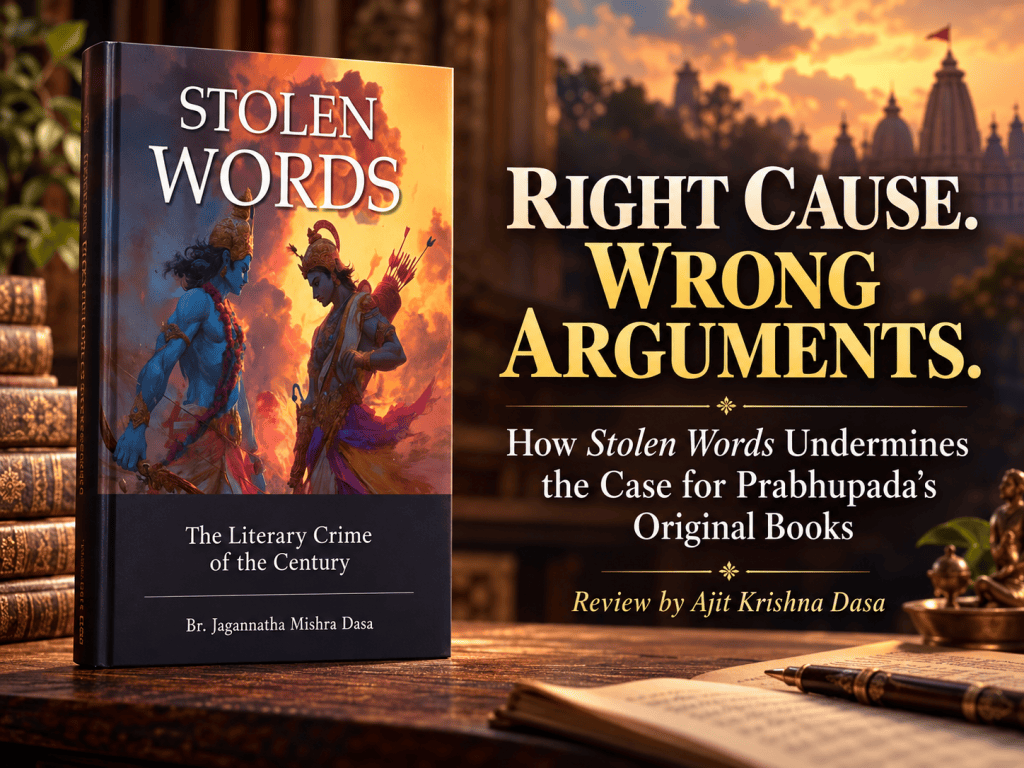
Jagannath Misra is right to oppose the changes. But many of his central arguments are false, unsupported, or self-defeating.
By Ajit Krishna Dasa
I am opposed to the posthumous changes made to Srila Prabhupada’s books. I have written about this subject for many years, and I consider the preservation of his original books extremely important. This is precisely why I find Jagannath Misra’s Stolen Words so problematic.
The problem is not that the author opposes the changes. On that central point we agree. The problem is that he repeatedly weakens a very strong case by adding exaggerated claims, unsupported psychology, fictional evidence, questionable historical assertions, and philosophical conclusions that sometimes collapse when compared with Srila Prabhupada’s own words.
This matters. BBTI and Jayadvaita Swami have for decades tried to present the posthumous editing as a responsible restoration of Srila Prabhupada’s words. Their presentation has itself been highly selective. They have emphasized examples where a change can be shown to restore material from an earlier draft, while giving far less attention to the many cases where the revised edition moves away from the drafts, changes perfectly good wording, adds new wording, deletes Srila Prabhupada’s wording, or simply produces a third version different from both the draft and the authorized edition. Our own examination of Chapter One, for example, found that 65.92% of the changes to the Sanskrit synonyms were cases where the 1972 edition followed Srila Prabhupada’s draft but the later edition changed away from it.
There are therefore plenty of real examples showing that “closer to the manuscript” does not accurately describe the posthumous revision as a whole. BBTI’s public defence has largely been advocacy based on selected favorable examples, not a neutral presentation of the complete evidence.
But if we are going to criticize BBTI for selective evidence, exaggeration and misleading presentation, we cannot permit ourselves to use the same methods. Stolen Words unfortunately does exactly that.
The book changes are already serious enough
For readers new to this controversy, the basic issue is quite simple.
The complete edition of Bhagavad-gita As It Is was published by Macmillan in 1972 while Srila Prabhupada was still physically present. He accepted it as his book, lectured from it, quoted it, distributed it and praised its success. After his departure in 1977, Jayadvaita Swami extensively re-edited it, and the new version appeared in 1983.
The scale was enormous. A verse-by-verse comparison found that 541 of the Gita’s 700 verse translations—77%—were changed. In 21 verses only spelling, punctuation or capitalization changed, while in 520 verses words were removed, inserted or rearranged.
That statistic proves extensive revision. It does not prove that 77% of the Gita was philosophically corrupted. It does not prove that every alteration pushes the reader toward another theology. And it certainly does not prove that two different spiritual paths have been created.
We do not need such claims.
The basic issue is already serious: what authority did disciples have to re-edit their spiritual master’s completed and published book after his departure, especially when he could no longer approve or reject their corrections? And why was the original edition not simply preserved as the standard edition, with any proposed corrections placed in footnotes or in a separate scholarly annotated edition?
That is the ground on which the argument should stand.
“Srila Prabhupada’s last words”
Very early in Stolen Words, Jagannath Misra tells the reader that Srila Prabhupada’s final recorded words were:
“I have no desire.”
For a devotee already familiar with the history, one may understand what this refers to. For a new reader, however, the natural impression is completely different.
When someone says, “These were his last words,” we normally imagine a person lying at the point of death, intentionally delivering one final statement immediately before passing away—something like a final message to his followers.
That is not what happened here.
On the morning of November 14, 1977, Srila Prabhupada’s Ayurvedic physician asked whether he wanted some juice or whether there was anything he desired. Srila Prabhupada replied in Hindi, meri kuch iccha nahin—“I have no desire.” These appear to have been the last words he was recorded as speaking. But he did not leave his body at that moment. He remained silent for many hours afterward while the devotees performed kirtana and passed away that evening.
So yes, they may technically have been his last recorded spoken words. But they were an answer to a practical question from his physician, not a deliberately announced final testament.
Why this statement is even introduced in a book about posthumous editing is unclear. But removing the question and presenting only the answer gives the words a dramatic significance they did not originally have. It is a small example, but it introduces a pattern found throughout the book: a real fact is presented in such a way that the reader is led toward a much larger conclusion than the evidence warrants.
Did Srila Prabhupada personally scrutinize every word?
Jagannath Misra also paints a picture of the 1972 Gita as though Srila Prabhupada personally scrutinized every page, every verse and every word, correcting every error with almost obsessive precision.
There is no need to say this, and the evidence does not support such an absolute claim.
Srila Prabhupada was certainly deeply involved in his books. He worked closely with Hayagriva, answered editorial questions, sometimes supplied translations, corrected manuscripts and blueprints, read from the finished books and accepted the final result.
But even Jayadvaita Swami’s own history of the editing admits that Srila Prabhupada saw edited manuscripts or prepress material for some books but not for most. It also describes extensive work performed by editors and transcribers.
The history of the Gita is also more complicated than Stolen Words suggests. Srila Prabhupada sometimes personally supplied the translation. At other times Hayagriva worked from existing translations. In the December 1969 discussion about preparing the complete Gita, Srila Prabhupada told Hayagriva that he could follow the Macmillan translations, while the Sanskrit material could be added afterward.
Thus the romantic picture of Srila Prabhupada sitting with every verse, repeatedly chanting the Sanskrit, then personally producing the transliteration, every synonym, the translation and finally the purport as a fixed procedure simply does not describe the actual production history.
Pradyumna was not writing the English translations, but he did work on the Sanskrit side of the book. Hayagriva and Rayarama were major English editors. Different sections passed through different hands and different processes.
None of this reduces the authority of the 1972 edition.
That is the important point Jagannath Misra seems to miss. We do not have to prove that Srila Prabhupada personally inspected every comma for the completed book to be authoritative. Authors work with editors. The authority lies in the completed edition produced under the author’s supervision and published and accepted during his lifetime.
A book does not become an eternally revisable draft merely because its author did not personally proofread every letter.
The so-called “original manuscript” is actually draft material
This is also where the terminology becomes important.
BBTI often refers to “the original manuscript” as though there were one pristine original text from which the 1972 edition somehow wandered and to which Jayadvaita Swami later restored it.
That picture is misleading.
What BBTI calls the “original manuscripts” consists of different kinds of pre-publication material from different periods—personally typed drafts in some chapters, transcriptions of dictation in others, and retyped manuscripts that had already undergone editing elsewhere. There is no single uniform “original manuscript” representing the final form Srila Prabhupada intended to publish.
These materials are drafts and working documents.
That does not make them unimportant. They can be extremely useful for understanding where wording came from, identifying transcription errors, or determining what Srila Prabhupada originally dictated or typed. But a draft is not the same thing as a completed book.
This distinction is elementary in publishing. An author may write something in an early draft, work with an editor, accept a different formulation, and finally publish that version. One cannot wait until the author dies, retrieve the earlier draft and automatically declare the earlier wording more authoritative than the finished edition.
The 1972 edition had passed through the editing process and had become the published work. Even Srila Prabhupada’s own preface describes the complete edition as the presentation of his “original manuscript” in its full form. The earlier working papers had already served their purpose.
This becomes especially important when evaluating Stolen Words, because Jagannath Misra sometimes attacks wording found in the revised edition as though it represents a philosophically corrupt invention of the later editors—when the wording is actually found in Srila Prabhupada’s own drafts, or elsewhere in his teachings.
“The Blessed Lord” versus “The Supreme Personality of Godhead”
One of the central psychological theories of Stolen Words concerns the change from:
“The Blessed Lord said”
to:
“The Supreme Personality of Godhead said.”
Jagannath Misra argues that “The Blessed Lord” produces warmth, intimacy and personal relationship, while “The Supreme Personality of Godhead” produces formality, hierarchy and theological distance.
But consider the obvious problem.
“The Supreme Personality of Godhead” is one of the most characteristic expressions Srila Prabhupada ever used.
A computerized count of the searchable 1972 Bhagavad-gita As It Is gives approximately 340 occurrences of “Supreme Personality of Godhead,” compared with only 25 occurrences of “Blessed Lord.” “The Blessed Lord said” itself appears 22 times.
In other words, the supposedly cold, formal and distancing phrase appears more than thirteen times as often as “Blessed Lord” in the original Gita itself. Srila Prabhupada repeatedly uses “the Supreme Personality of Godhead” while describing the most intimate forms of bhakti, surrender, love, mercy and personal relationship with Krishna.
So what are we supposed to conclude? That Srila Prabhupada was constantly creating theological distance from Krishna in his own book?
Of course not.
The posthumous change from “The Blessed Lord” should not have been made. The lifetime-published wording should remain. But Jagannath Misra’s psychological theory about why the replacement is spiritually harmful is plainly contradicted by Srila Prabhupada’s own vocabulary.
This is one of the problems running throughout Stolen Words: the author confuses two entirely separate questions.
Was the posthumous editor authorized to make the change?
And:
Is the new wording philosophically wrong?
The answer to the first may be no while the answer to the second is also no.
“Forgotten soul” and “forgetful soul”
The treatment of Bhagavad-gita 2.13 is perhaps the clearest example.
In the 1972 purport, Srila Prabhupada says:
“Arjuna, who is a forgotten soul deluded by maya…”
The posthumous edition changes this to:
“Arjuna, who is a forgetful soul deluded by maya…”
The early draft also has “forgotten soul.” Therefore the change is particularly unnecessary: the draft and the authorized edition agree.
Jagannath Misra could simply have stopped there. He would have had a perfectly good example.
Instead, he constructs an entire psychology around one adjective.
According to his argument, “forgotten soul” means the soul is lost and dependent on Krishna’s mercy, whereas “forgetful soul” places responsibility on the living entity and encourages a mentality of self-improvement and personal effort. From this he eventually develops two classes of devotees: readers of the original edition supposedly pray for grace and mercy, while readers of the revised edition talk about what they themselves can accomplish.
There is no evidence for this.
Worse, Srila Prabhupada himself constantly says that the living entity is forgetful, has forgotten Krishna, has forgotten his eternal relationship with Krishna, and must revive that forgotten relationship. The original 1972 Gita contains precisely this language.
Therefore “forgetful soul” cannot possibly represent some alien philosophy opposed to Srila Prabhupada.
Again, this does not justify changing the wording. “Forgotten soul” was the published wording and should remain.
But to move from that real editorial objection to a theory that one word creates a grace- centered devotee while another creates a self-reliant devotee is an extraordinary leap for which Jagannath Misra offers no serious evidence.
When Jagannath Misra condemns Srila Prabhupada’s own language
An even clearer example concerns “worship” and “service.”
In Bhagavad-gita 10.10 the 1972 edition reads:
“To those who are constantly devoted and worship Me with love…”
The later edition reads:
“To those who are constantly devoted to serving Me with love…”
Jagannath Misra presents “worship” as warm, romantic and intimate, while “service” is said to suggest employment, duty and institutional subordination.
But Srila Prabhupada himself explicitly rejects this contrast.
In the original purport to Bhagavad-gita 6.47 he explains that bhaj refers specifically to loving service and that the English word “worship” does not fully express the same meaning. He writes that “service with love and faith is especially meant for the Supreme Personality of Godhead.”
And the draft of Bhagavad-gita 6.47—the page reproduced above—has:
“rendering transcendental loving service unto Me.”
The published 1972 edition reads:
“worshiping Me in transcendental loving service.”
The later edition reads:
“renders transcendental loving service to Me.”
So the concept Jagannath Misra treats as spiritually colder was not invented by Jayadvaita Swami. Srila Prabhupada himself wrote “rendering transcendental loving service unto Me” in his draft. The 1972 edition itself is full of the language of rendering service, loving service and devotional service.
This is a fatal problem for Jagannath Misra’s argument.
We may say that the wording in 10.10 should never have been changed. I agree. An earlier Arsa-Prayoga article called the changes to 10.8–11 simply “needless,” which is a much stronger and more defensible criticism.
But we cannot honestly say that “serving Me with love” expresses a spiritually inferior theology when Srila Prabhupada himself repeatedly teaches precisely that.
If the new wording comes directly from Srila Prabhupada’s own language, then it may be unauthorized in that location, but it cannot be condemned as philosophically alien to Srila Prabhupada.
That distinction alone invalidates a significant portion of Stolen Words.
Language does influence consciousness—but not in the way claimed
Here I do agree with Jagannath Misra on one broader principle: words leave impressions in the consciousness of the reader.
I would go further. Posthumous editing of the acarya’s books does carry a spiritual contamination. But I do not see evidence for Jagannath Misra’s theory that the revised Gita has created a new spiritual path of “theologians,” while the original produces “mystics,” or that one edition teaches grace and the other teaches personal effort.
The deeper contamination is much more straightforward.
Every time we normalize the principle that a disciple may take the completed words of his departed guru and improve them according to his own judgment, we normalize a mentality:
“I know better than my guru.”
“I can correct my guru.”
That is the dangerous impression.
Indeed, even Jayadvaita Swami has acknowledged the principle that an editor must never think himself more intelligent than the author or imagine that he has something superior to contribute. The controversy is precisely over whether the posthumous editing has crossed that line.
This influence does not require a theory that “service” neurologically creates institutional employees while “worship” creates lovers of God. It is built into the act itself. If generation after generation of devotees are taught that the acarya’s published words can be rewritten whenever later scholars believe they can improve them, then a relationship of submission to the guru is gradually replaced by a relationship in which the disciple sits in judgment over the guru’s published work.
That is a real spiritual problem.
Fiction is not evidence
Another serious weakness of Stolen Words is its reliance on fictionalized or composite characters.
The author openly tells us that characters and dialogue have been fictionalized. Yet these invented characters repeatedly experience exactly the psychological results his theory predicts. Devotees reading the original become more mystical and grace- oriented. Readers of the revision become more academic and method-oriented. Scholars discover remarkable patterns. Temple communities supposedly develop different cultures depending on which edition they use.
But a fictional character cannot confirm an argument.
If I write a novel in which ten devotees read the original Gita and become pure devotees, while ten readers of the revised edition become dry scholars, I have demonstrated nothing except my ability to write the story that way.
Nor does invoking neuroscience solve the problem. General research showing that words influence thought does not prove that “Blessed Lord” activates intimacy while “Supreme Personality of Godhead” activates hierarchy, or that “forgotten” creates dependence on mercy while “forgetful” creates self-reliance.
For claims of that kind, Jagannath Misra would need real comparative research involving real readers, defined variables, actual interviews or surveys, and some attempt to exclude the enormous number of other factors affecting devotional culture.
He provides nothing remotely like that.
The book repeatedly does the same thing: it begins with a real textual change, assigns opposite emotional meanings to the two expressions, appeals generally to psychology or neuroscience, creates fictional readers who experience exactly the predicted effect, and then treats this fictional narrative as confirmation that two spiritual cultures have been created.
That is circular reasoning presented as research.
We do not need to imitate BBTI’s weak methods
There is an irony here.
One of my long-standing criticisms of BBTI and Jayadvaita Swami is that their defence of the revised edition has been selective. Readers are shown impressive examples where words omitted by early editors were restored from a draft or transcription. These examples are then used to create the impression that the revised edition as a whole is simply “closer to Prabhupada.”
But this narrative leaves out a very large body of contrary evidence.
There are changes where the 1972 edition follows the draft and the later edition moves away from it. There are changes not supported by the draft. There are new formulations, deleted sentences, stylistic rewritings and unnecessary rearrangements. The published BBTI material itself openly selects “interesting, instructive and controversial” examples rather than giving devotees a complete neutral audit of the entire revision.
The scholarly volume Posthumous Editing of a Great Master’s Work likewise notes that there were no written BBT guidelines governing the posthumous editing and identifies numerous categories of editorial intervention beyond simple correction of objective errors.
So there is no shortage of serious material with which to challenge the BBTI narrative.
Why then undermine that case with claims that are easily disproved?
If we accuse Jayadvaita Swami of cherry-picking evidence, we cannot cherry-pick ourselves. If we accuse BBTI of presenting an advocacy narrative as neutral history, we cannot answer them with another advocacy narrative that ignores inconvenient facts. If we object when their evidence is insufficient, then our own evidence must withstand the same standard.
Conclusion
Stolen Words has the right enemy but too often uses the wrong weapons.
Jagannath Misra correctly recognizes that Srila Prabhupada’s books have been extensively changed after his departure and that devotees have a right to know what
happened. He is also right that the original Gita should not have been silently displaced by a posthumously revised text presented under the same author and title.
But from there the book repeatedly goes too far.
Srila Prabhupada did not personally scrutinize and approve every surviving word and mistake in the manner Jagannath Misra suggests. The pre-publication manuscripts are drafts and working documents, not automatically more authoritative than the completed 1972 book. “The Supreme Personality of Godhead” cannot reasonably be condemned as spiritually cold when Srila Prabhupada uses the phrase hundreds of times in the original Gita. “Forgetful soul” cannot be made into an alien philosophy when Srila Prabhupada constantly speaks of the living entity forgetting Krishna. “Service” cannot be condemned as inferior to “worship” when Srila Prabhupada himself explicitly says that bhaj means loving service and uses precisely that wording in his own draft. Fictional devotees, anonymous composite scholars and imagined temple cultures cannot demonstrate the psychological effects the author claims.
These are not minor problems. They strike at the method by which much of the book’s central thesis is constructed.
And the tragedy is that none of this is necessary.
There are real posthumous changes that move the text farther away from Srila Prabhupada. There are needless changes. There are changes unsupported by the drafts. There are cases where wording found both in the draft and the 1972 edition was nevertheless altered. There are serious questions about authorization, transparency, editorial protocol and the refusal to preserve the original edition as the standard book. BBTI and Jayadvaita Swami have presented selected evidence in support of their narrative while failing to give devotees an equally prominent account of evidence pointing in the opposite direction.
That is more than enough to debate.
We do not protect Srila Prabhupada by exaggerating the case. We do not defend his words by making claims about them that are not true. And we certainly do not strengthen opposition to the book changes by giving BBTI defenders weak arguments they can easily knock down and then use to ridicule the rest of us.
The original books deserve better than that.
Our position should be simple, strong and difficult to evade: Srila Prabhupada’s completed and published books should remain exactly as he left them. If scholars wish to propose corrections, alternate readings or explanations, let them do so openly in a separately identified annotated edition, where every change is documented and the editor is named.
But the original must remain original.
Not because every comma is materially perfect. Not because every alternative wording contains false philosophy. Not because reading one adjective rather than another somehow creates a new religion.
It must remain original because a disciple does not posthumously rewrite his guru’s completed work.
That principle is strong enough. We should not weaken it with arguments that are not.

