


Revised edition: October 2, 2026
About the Book
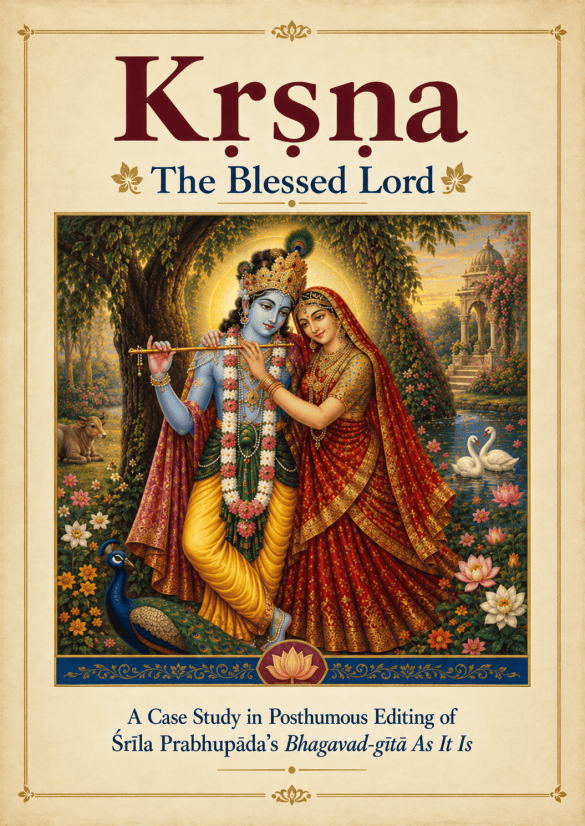
This short book examines one specific change in Śrīla Prabhupāda’s Bhagavad-gītā As It Is: the replacement of “The Blessed Lord said” with “The Supreme Personality of Godhead said” as the translation of śrī-bhagavān uvāca.
At first glance, this may seem like a minor issue. After all, no follower of Śrīla Prabhupāda should object to identifying Kṛṣṇa as the Supreme Personality of Godhead. That is the very foundation of his presentation of Bhagavad-gītā. The real question is not whether “The Supreme Personality of Godhead said” is true. It is true. The question is whether later editors were authorized to remove “The Blessed Lord said” from Śrīla Prabhupāda’s published book after his departure. This book argues that they were not.
Using this one phrase as a case study, the book examines the larger principles involved in the posthumous editing of Śrīla Prabhupāda’s books: authorial approval, manuscript evidence, the distinction between annotation and alteration, the different functions of word-for-word meanings and verse translations, Śrīla Prabhupāda’s own use of the word “blessed,” the Gauḍīya devotional English of The Harmonist, and the Vaiṣṇava principle of ārṣa-prayoga.
The argument is simple: evidence may justify explanation, but that explanation belongs in a separate annotated edition clearly identified as such. It does not automatically justify replacing the published words of the ācārya in the body of the original text.
The book is therefore not merely about one phrase. It concerns the integrity of Śrīla Prabhupāda’s published books and the principle that his original texts should be preserved as he gave them.
This book is therefore not merely about one phrase. It is about the integrity of Śrīla Prabhupāda’s published books, and about the principle that his original texts should be preserved as he gave them. Download for free as PDF or EPUB.
Correction to the Previous Edition
An earlier version of this book published 15. Sep. 2026 incorrectly treated an English rendering of Śrīmad-Bhāgavatam 11.17.27 in the 1969 Back to Godhead republication as though it had appeared in Abhay Charan Das’s original 1936 “Sree Vyas Puja Homage” in The Harmonist. I had been directed to the 1936 address but had not yet located the original issue, and I relied upon what I believed to be a faithful reproduction of the original text.
Examination of the original publication shows that the sentence beginning “One should understand the spiritual master to be as good as I am,” including the words “said the Blessed Lord,” was not part of the 1936 address. The original prints the Sanskrit verse and then continues, “that is, the Acharya has been identified with Godhead Himself.” The English rendering containing “said the Blessed Lord” appears in the 1969 Back to Godhead republication and was retained in the 1975 republication entitled “The Universal Teacher.”
The book has therefore been corrected throughout. The revised edition also distinguishes the prose address, “Sree Vyas Puja Homage,” from Abhay Charan Das’s signed poem “Sree Vyas Puja Offering,” which immediately precedes it in The Harmonist. The poem genuinely contains the words “Blessed than heaven, sweeter than May” and remains valid evidence of his own devotional use of “blessed.”
This correction narrows one part of the historical argument, but it does not alter the book’s central conclusion. The direct evidence remains: Śrīla Prabhupāda heard, used, and positively explained “The Blessed Lord” before and after 1970; he authorized his editors to follow the Macmillan translations; and in his published purport to Śrī Caitanya-caritāmṛta, Madhya 6.132, he explicitly states that śrī-bhagavān uvāca may be rendered “the Supreme Personality of Godhead said” or “the Blessed Lord said,” adding that “the Blessed Lord is the Supreme Person.”
I regret the error. The purpose of the revised edition is not to conceal it, but to correct it precisely and to distinguish clearly between what the surviving sources establish and what they do not establish.
Download: PDF | EPUB


You must be logged in to post a comment.