


By Ajit Krishna Dasa
In Bhagavad-gita 3.27, Srila Prabhupada’s manuscript reads:
“The bewildered spirit-soul under the influence of the three modes of material nature, thinks himself as the doer of activities, which are done by Nature.”
The authorized 1968 and 1972 editions preserve the same sentence and meaning, with normal English polishing:
“The bewildered spirit soul, under the influence of the three modes of material nature, thinks himself to be the doer of activities, which are in actuality carried out by nature.”
After Srila Prabhupada’s departure, Jayadvaita Swami changed the translation to:
“The spirit soul bewildered by the influence of false ego thinks himself the doer of activities, which are in actuality carried out by the three modes of material nature.”
This was not the correction of a typographical error. Nor was it a restoration of Srila Prabhupada’s manuscript. The sentence was substantially rewritten.
Jayadvaita Swami replaced:
“The bewildered spirit soul”
with:
“The spirit soul bewildered by the influence of false ego.”
He removed:
“under the influence of the three modes of material nature”
from its position describing the conditioned soul and moved “the three modes of material nature” to the end of the sentence as the agents carrying out the activities.
He also replaced:
“carried out by nature”
with:
“carried out by the three modes of material nature.”
Thus the wording, grammatical structure and distribution of ideas were all changed.
It may be argued that the revised version follows the Sanskrit grammar more literally. But this only explains why Jayadvaita Swami preferred his new translation. It does not make his translation Srila Prabhupada’s translation.
THE TRANSLATION WAS REPEATEDLY READ TO SRILA PRABHUPADA
The evidence does not stop with the manuscript and the published editions. The original translation was repeatedly read aloud in Srila Prabhupada’s presence, and he explained it without objecting to its wording.
During a Bhagavad-gita lecture in Los Angeles on December 30, 1968, Tamala Krishna read:
“The bewildered spirit soul, under the influence of the three modes of material nature, thinks himself to be the doer of activities which are in actuality carried out by nature.”
He then read the purport, including:
“The person in material consciousness is convinced by false ego that he is the doer of everything.”
Thus “false ego” was not absent from Srila Prabhupada’s explanation. It was clearly presented in the purport, while the translation retained the wording Srila Prabhupada had given.
In Melbourne on July 2, 1974, Caru again read the original translation:
“The bewildered spirit soul, under the influence of the three modes of material nature, thinks himself to be the doer of activities, which are in actuality carried out by nature.”
Srila Prabhupada immediately explained:
“Nature. Nature is giving us different body. I am the spirit soul. Because I have accepted natural…, material nature’s protection, I am getting different types of body.”
Far from correcting the translation, Srila Prabhupada emphasized precisely its wording:
“Nature. Nature is giving us different body.”
In Perth on May 13, 1975, Amogha read:
“The bewildered spirit soul, under the influence of the three modes of material nature, thinks himself to be the doer of activities, which are in actuality carried out by nature.”
Srila Prabhupada replied:
“Yes. He is pulled by the ear by the nature, ‘You rascal, you have associated with this quality. You do this. You must accept this body.’”
He then asked:
“What is the purport I have given?”
Again, Srila Prabhupada accepted the translation and proceeded to explain how nature controls the conditioned living entity.
At Laguna Beach on July 26, 1975, Srila Prabhupada personally asked for the verse:
“Find out this verse. Prakrteh kriyamanani gunaih karmani sarva… Who can read very distinctly?”
Satsvarupa then read:
“The bewildered spirit soul, under the influence of the three modes of material nature, thinks himself to be the doer of activities, which are in actuality carried out by nature.”
Srila Prabhupada said:
“Purport.”
The purport explained that the person in material consciousness is convinced by false ego that he is the doer of everything.
Thus the original translation and the explanation involving false ego stood together perfectly well. Srila Prabhupada did not need the translation rewritten to make the point clear.
We therefore have Srila Prabhupada’s manuscript, the authorized 1968 edition, the authorized 1972 edition, and several occasions on which the verse was read aloud before him and explained by him.
At no point did Srila Prabhupada say that the translation was wrong or needed to be rewritten.
A LITTLE SANSKRIT
Srila Prabhupada also gave a severe warning about disciples who acquire some Sanskrit knowledge and then begin to think themselves superior to their spiritual master:
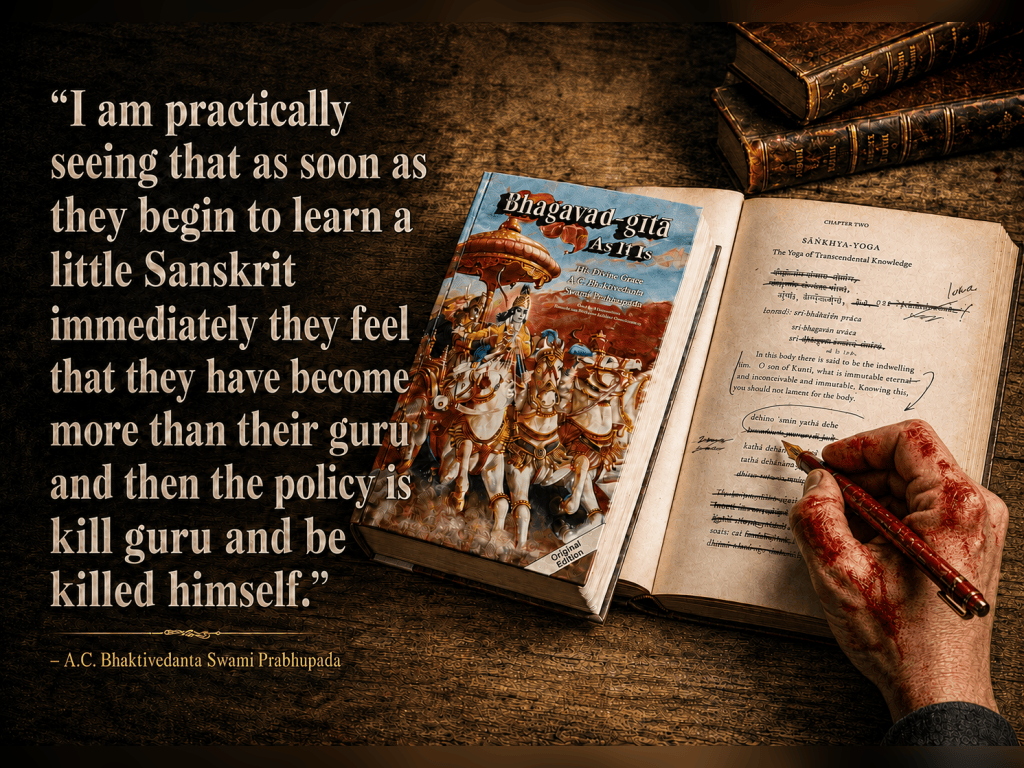
“I am also practically finding that if any of our students artificially try to become scholars by associating with unwanted persons they become victimized, for a little learning is dangerous, especially for the Westerners. I am practically seeing that as soon as they begin to learn a little Sanskrit immediately they feel that they have become more than their guru and then the policy is kill guru and be killed himself.”
Letter to Dixit, September 18, 1976.
The problem is not the study of Sanskrit. Srila Prabhupada encouraged proper study. The problem begins when a disciple’s limited scholarship gives him the confidence to stand above the guru’s work, judge it defective and replace it with something he considers better.
That is what happened here.
Jayadvaita Swami did not restore Srila Prabhupada’s manuscript. He replaced Srila Prabhupada’s authorized translation with a posthumous retranslation that he considered more grammatically precise.
It is difficult to see this as anything other than an attempt to improve, correct and present something supposedly better than what Srila Prabhupada gave.
Worse still, the new sentence is published under Srila Prabhupada’s name. The ordinary reader is not told:
“This translation was rewritten by Jayadvaita Swami after Srila Prabhupada’s departure.”
Instead, it is presented as though Srila Prabhupada wrote it.
That is dishonest.
WHAT DO WE ACTUALLY WANT?
Followers of Srila Prabhupada must make up their minds.
Do we want the Bhagavad-gita Srila Prabhupada actually gave us?
Or do we want something later editors consider clearer, more accurate and effectively “better than Srila Prabhupada”?
We cannot honestly pretend that these are the same thing.
Anyone is free to produce another translation of Bhagavad-gita. Jayadvaita Swami may publish his preferred rendering, explain why he considers it superior and place his own name on the book.
But he should not replace Srila Prabhupada’s authorized translation and publish the replacement as though Srila Prabhupada wrote it.
If someone wants a “better” Bhagavad-gita, let him write or read another one.
Srila Prabhupada’s Bhagavad-gita should remain Srila Prabhupada’s Bhagavad-gita.
THE “KILL GURU” MENTALITY
Srila Prabhupada warned that when a disciple learns “a little Sanskrit” and begins to think himself greater than his guru, the result is the mentality of “kill guru and be killed himself.”
The revised Bhagavad-gita is infested with that mentality.
Again and again, the editor places his own judgment above Srila Prabhupada’s authorized words, removes what Srila Prabhupada gave, and substitutes what he considers clearer, more accurate or better.
Books do not merely transmit information. They also train the reader in a way of thinking.
When devotees are taught to accept such posthumous rewriting as faithful service, they are gradually taught the same principle: that Srila Prabhupada’s words are not final, that his books may be judged from below, and that a disciple may improve the acarya whenever he believes he knows better.
In that sense, the revised Bhagavad-gita does not merely arise from the “kill guru” mentality. It contaminates its readers with the same mentality by normalizing it and presenting it as service to Srila Prabhupada.
Followers of Srila Prabhupada must therefore decide what they actually want: Srila Prabhupada’s Bhagavad-gita, or an editor’s supposedly improved replacement published under Srila Prabhupada’s name.
If we want Srila Prabhupada, then we must accept what Srila Prabhupada gave.

