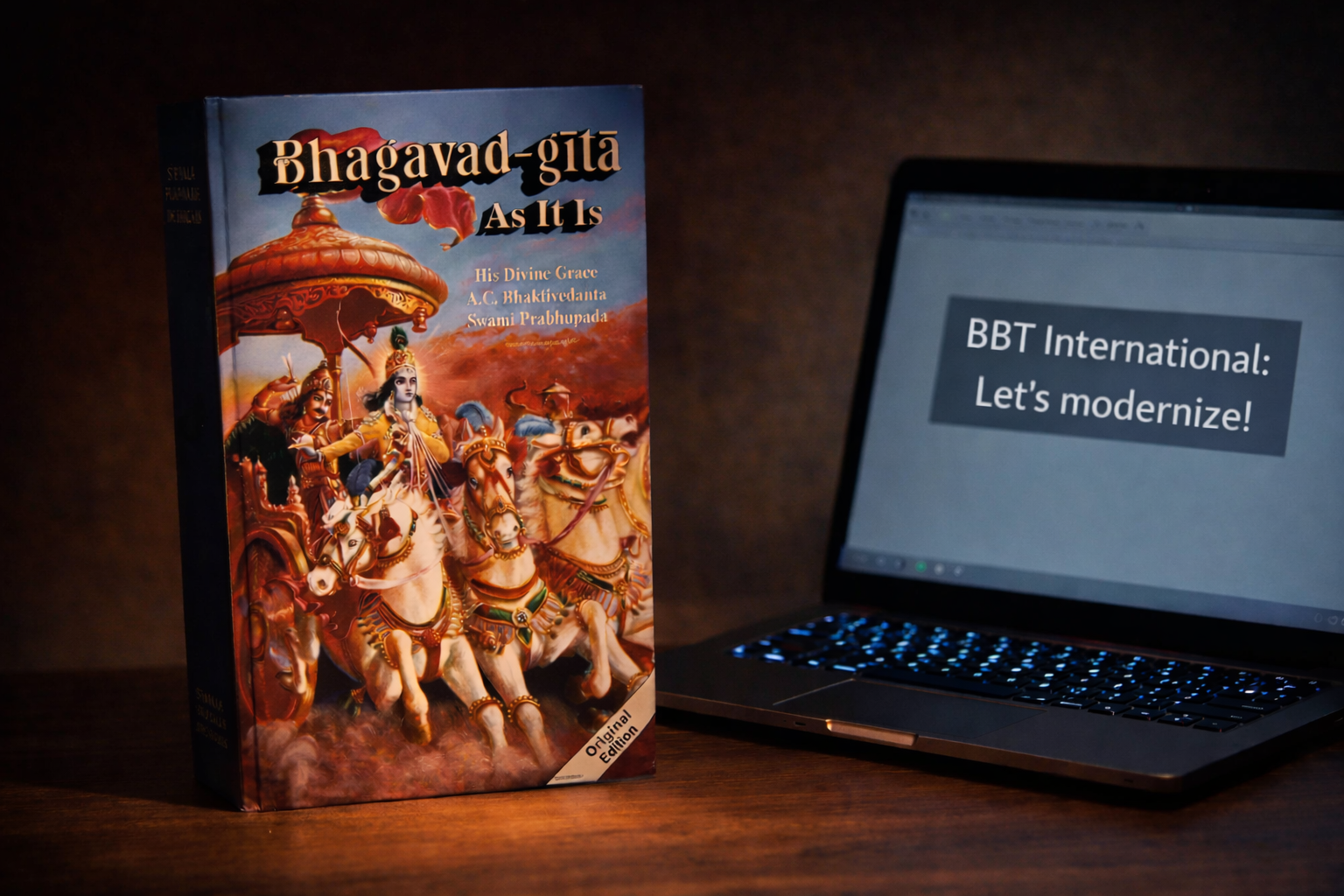
Is an Evolving English Language an Argument for Changing Srila Prabhupada’s books?

By Ajit Krishna Dasa

It is often said: “Whatever BBT International is doing will eventually have to happen anyway. Language changes. English will evolve. Therefore, updating Śrīla Prabhupāda’s books is inevitable.”

This argument might sound reasonable on the surface. But when examined carefully, it collapses.

Yes, language changes. That is not controversial. The real question is not whether English evolves. The real question is this:

How does a serious tradition preserve the final, authorized words of its ācārya while also making them accessible to future generations?

Those are two different concerns. And they must not be confused.

First Principle: Authorial Finality

When an author publishes a final edition of his work, that edition becomes historically fixed. This is not sentimentality; it is basic literary integrity. We do not revise Shakespeare because English changed. We do not modernize Dostoevsky by altering his Russian text. We do not update Plato’s Greek.

Instead, we preserve the original and produce new translations or explanatory editions when necessary.

The typically used Bible analogy actually proves this point. When Christians “update” the Bible, they are not editing the Greek manuscripts. They produce new translations. The King James Version still exists. The Greek New Testament still exists. No one retroactively edits them.

Preservation and translation are not the same thing.

Second Principle: The Location of Authority

If posthumous revision becomes acceptable, something subtle but serious occurs. Authority shifts.

It is no longer simply “Śrīla Prabhupāda said.” It becomes, “Śrīla Prabhupāda said — as adjusted by later editors.

Even if intentions are sincere, the epistemic center moves from the ācārya to the editorial board.

That shift is not linguistic. It is structural.

Third Principle: The Alleged Problem of “Archaic English”

Let us be honest. Śrīla Prabhupāda’s English is not archaic. It is mid-20th century English with Sanskrit terminology. It is often clearer than modern academic theology.

The claim that future generations will need a “course in archaic English” is exaggerated rhetoric. People read Shakespeare in school. They read classical literature. They learn terms. Human beings are capable of intellectual effort.

Accessibility does not require alteration.

Fourth Principle: The Real Solution

If, at some distant point, English changes so radically that comprehension becomes genuinely difficult, the solution is straightforward and principled:

Produce a clearly labeled contemporary English rendering.

For example:

Bhagavad-gītā As It Is – Original Authorized Edition
Bhagavad-gītā As It Is – Contemporary English Rendering

Two distinct works. Transparent. No confusion. No silent revision. The original remains intact and available. The rendering serves as an aid, not a replacement.

This is exactly how translation into any other language works. We do not rewrite the Sanskrit. We translate it. The same logic applies here.

A Tradition That Preserves

Strong traditions preserve their sources. They do not continuously re-edit them according to the sensibilities of later generations.

Language change is inevitable. Editorial authority is not.

The real issue is not readability. The real issue is whether we maintain textual integrity and the clear, final authority of the ācārya.

If the movement flourishes, Śrīla Prabhupāda’s English may itself become devotional standard language, much like older Biblical English still shapes Christian liturgy today.

Language may evolve. But reverence, integrity, and discipline must remain.

And that is the standard by which this issue should be judged.
Podcast: Inside the Editing Controversy w/Dr Graham Schweig (Garuda Das) PhD

By Ajit Krishna Dasa

This episode is not a vague reflection on “textual integrity.” It is a direct and sustained argument against the post-1978 changes made to Śrīla Prabhupāda’s books by BBT International under the direction of Jayadvaita Swami.

The central claim is simple and uncompromising: no one has the moral, legal, or devotional authority to alter a departed author’s published work—especially when that author explicitly forbade such changes.

Before outlining the case, it is important to understand who is making it!

Graham M. Schweig (Garuda Dāsa) is not an internet critic or a casual observer. He holds two Master’s degrees and a PhD from Harvard University and has spent decades teaching religion and philosophy at the university level. He has published with major academic presses such as Oxford, Columbia, Princeton, Yale, and HarperCollins. He is a trained Sanskritist, theologian, and editor who has worked at the highest levels of academic publishing. Within Vaiṣṇava circles he is known not only as a scholar but as a long-time practitioner deeply committed to Śrīla Prabhupāda’s legacy. In other words, he understands both rigorous editorial standards and the theological weight of disciplic succession. When he says what has been done is “unacceptable” by scholarly standards and “transgressive” by devotional standards, that is not rhetoric. It is the judgment of someone qualified to evaluate both domains.

Now to the arguments.

First: Śrīla Prabhupāda’s own instructions.
In letters, conversations, and in his Macmillan contract, he stated that editing was for grammar and punctuation only—not for altering philosophy or style. In 1977 he repeatedly said, “Our books must remain as they are,” and “Whatever is done is done. No more.” He required that revisions be made only with the author’s permission. Once the author has departed, that permission is impossible. Therefore, posthumous revisions violate his expressed will.

Second: False assumption of authority.
Prabhupāda granted conservative, provisional authority to assist with copy-editing. BBT editors assumed open-ended authority to revise, harmonize, and “improve” content. That is a categorical shift—from servant to co-author.

Third: Editorial overreach.
Approximately 5,000 changes were made to Bhagavad-gītā As It Is alone. Around 77% of its verses were altered. In Śrīmad-Bhāgavatam the changes run into the tens of thousands. These include altering translations where no grammatical error existed, removing theological identifications, shifting meaning, and recasting concise, powerful prose into diluted language. These are interpretive interventions—not typo corrections.

Fourth: Insertion of the editor’s mind into the text.
A sentence was changed because it “didn’t make sense” to the editor. When it was shown that it did make philosophical sense, the issue remained: the books are now filtered through the editor’s conceptual limits.

Fifth: Lack of transparency.
Substantial changes were made without full disclosure. Scholarly standards require documentation. That was not provided.

Sixth: Legal maneuvering.
BBT International registered itself as “author” and listed Śrīla Prabhupāda as “worker for hire.” Whatever the legal strategy, the signal is disturbing.

The alternative presented is clear: preserve the original text and address issues through annotated editions. Rewriting the text is not service. It is substitution.

If we accept that Śrīla Prabhupāda’s books are divinely empowered and that he explicitly ordered “no more changes,” then the post-1978 revisions constitute a transgression—morally, legally, and theologically.

This is not emotionalism. It is fidelity.

Srila Prabhupada’s Lectures Now Shown with Post-Samādhi Edited Texts

By Ajit Krishna Dasa

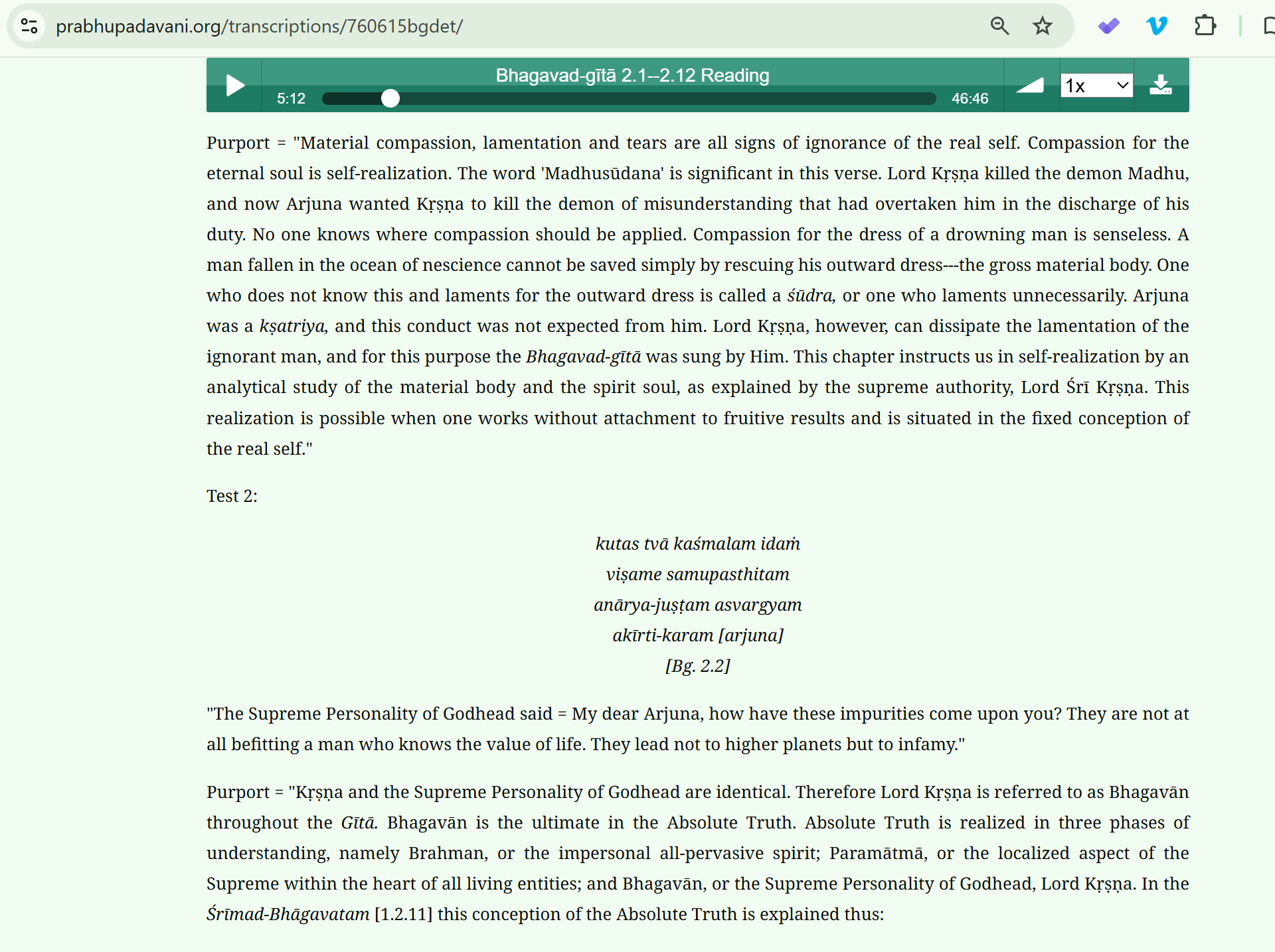
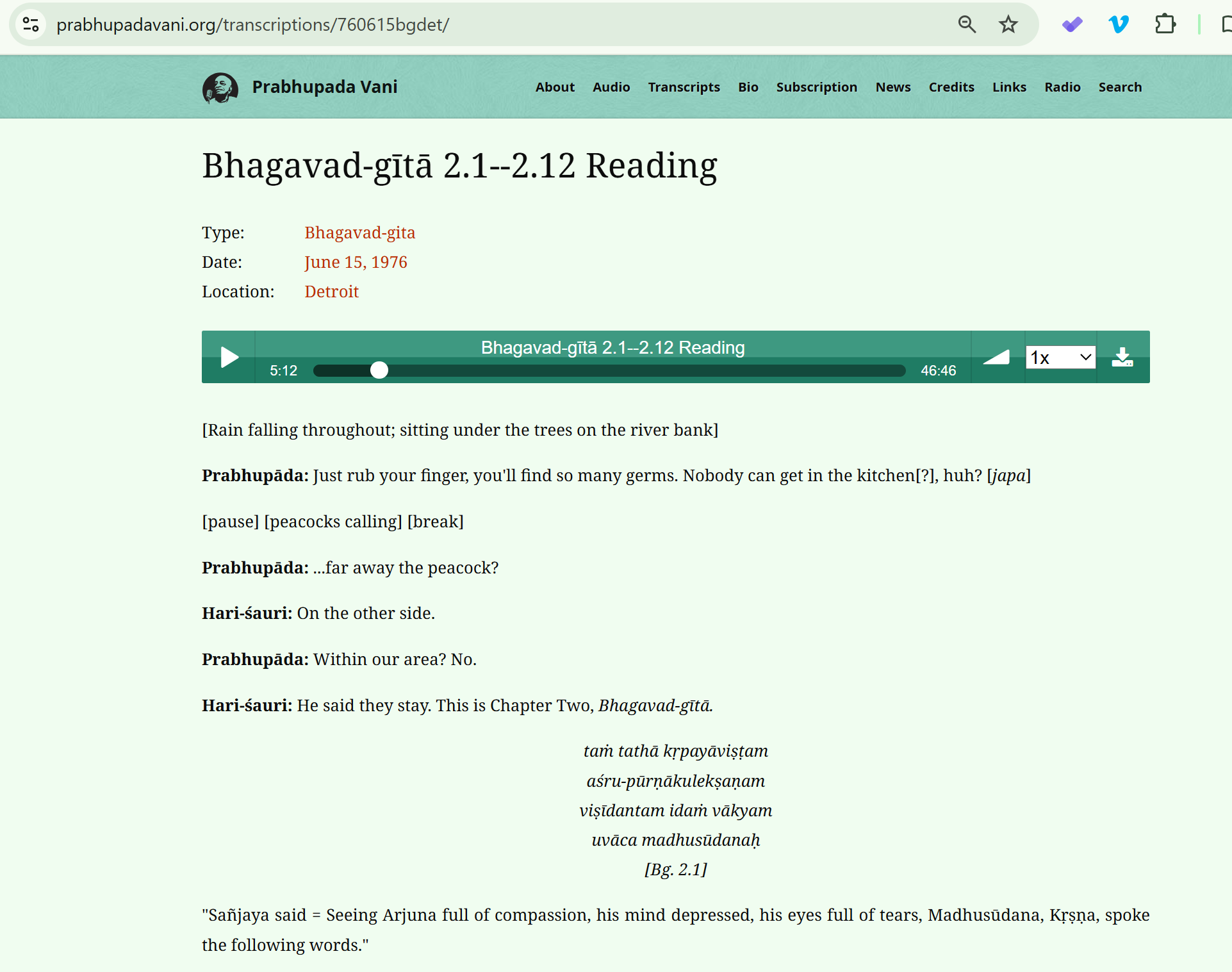
Many devotees are unaware of what is currently happening on official BBT International websites that host Śrīla Prabhupāda’s lectures.

For example, in the following lecture:

https://prabhupadavani.org/transcriptions/760615bgdet/

Also available here:

https://vedabase.io/en/library/transcripts/760615bgdet/#bb379398

The original audio recording from the 1976 is presented together with verses and purports from the post-samadhi edited Bhagavad-gītā As It Is from 1983. No mention is made that the displayed text is not the edition that Śrīla Prabhupāda himself approved and used while physically present.

This is deeply problematic.

When Śrīla Prabhupāda lectured on Bhagavad-gītā or Śrīmad-Bhāgavatam, he spoke from specific printed editions. His explanations were tied to those exact words. His arguments, emphases, and language were connected to the books as they stood during his lifetime.

If a later, revised edition is silently placed under those lectures, an artificial alignment is created. It gives the impression that the text being displayed is the very same text from which he was speaking.

It is not.

Attentive listeners may notice discrepancies between the audio and the printed text. This naturally raises questions. Why does the lecture not perfectly match the displayed purport? Has something been altered? If so, by whom – and on what authority?

Such confusion weakens trust.

Śrīla Prabhupāda repeatedly emphasized that his books should not be changed. He warned that even small alterations could damage the integrity of the paramparā. The principle of arsa-prayoga teaches that the words of the ācārya are not to be “improved” by later hands.

Presenting post-samādhi revisions together with his lectures normalizes those revisions and obscures the historical record. It subtly trains readers to accept altered texts as the standard form of his teachings.

Devotees should be aware that this is happening.

The solution is to preserve and present only the editions approved by Śrīla Prabhupāda himself.

His words are complete. They do not require posthumous correction.