Question to Jayadvaita Swami: What would Prabhupada say to you?

Help us by “liking” and “sharing” this post!
This letter was sent to Jayadvaita Swami the 6th Dec. 2013:

Dear Jayadvaita Swami! Dandavat pranam! Jaya Srila Prabhupada!

Some weeks have passed since our last e-mail exchange. I hope  you are in the process of answering the questions I linked to in my first two e-mails to you? Otherwise they are here:

E-mail 1: https://arsaprayoga.wordpress.com/2013/10/23/letter-to-jayadvaita-swami-23rd-oct-2013/

E-mail 2: https://arsaprayoga.wordpress.com/2013/10/28/e-mail-exchange-between-jayadvaita-swami-and-ajit-krishna-dasa/

These are questions that thousands of devotee’s around the world would like to see answered as soon as possible.

While awaiting your promised answers, I am constantly researching the changes made to Prabhupada’s books. Recently I saw this video posted on BBT International’s website:

Direct link: https://www.youtube.com/watch?v=IlqbnzzL_28

In the video you say:

”I went back and re-edited especially the translations in the first canto. Especially the first perhaps three chapters where I thought their were a lot of short comings. And I typed up all the translations – after I finished all the work, I typed up all the translations in one manuscript and put them in an envelope, and Prabhupada was coming to New York where I was at the time. Prabhupada came, and I put all the translations in an envelope, and I wrote a cover letter explaning what I have done, and asking him whether it was okay. And then I brought it up to Prabhupada’s quarters at 55th Street in New York–the New York temple—with the idea that I would leave them with his secretary and come back later. But Prabhupada was right there, and so he…I offered obeisances, and he had me, you know: ”What do you do in here?” ”What have you come for?” Not in those words, but, you know, he inquired was I was doing. And I explained that I had come to deliver this. So Prabhupada had me start reading right in his presence. And I began, I read the first verse, the second verse, the third verse. I went through a few verses, and Prabhupada stopped me. Prabhupada was listening very carefully, he stopped me. ”So what you have done?” And I said: ”Well, Srila Prabhupada, I have edited to try to bring it closer to what you originally said.” Prabhupada said: ”What I have said?” I said: ”Yes, Srila Prabhupada!” Then Prabhupada: ”Then it is alright!”, and that was it. ”Then it is alright!” ”What I have said?”, ”Then it is alright!”

 A few points about this story:

1. Your story is merely anecdotal evidence which is considered a rather unreliable and dubious support of a  claim. No one is really able to investigate the truthvalue of your story. To use anecdotal evidence as the foundation for changing the books that are supposed to guide mankind the next ten thousands years will surely create doubt about the authority of the changed books.

As Srila Prabhupada said about such stories:

“Just like in our ISKCON there are so many false things: “Prabhupada said this, Prabhupada said that.””
(Srila Prabhupada Letter, 7/11/1972)

“They misunderstand me. Unless it is there from me in writing, there are so many things that “Prabhupada said.”” (Srila Prabhupada Letter, 2/9/1975)

And as you yourself say:

“If Srila Prabhupada didn’t clearly and definitely say it, and if it first came up after 1977 whatever it is, don’t trust it. Rule of Thumb.” (Diksa-Diksa, Where the Rtvik People are Wrong,  p. 85, Jayadvaita Swami)

You started circulating your story after the book changing controversy started, and there is no evidence to support that it is true. Therefore, “…don’t trust it. Rule of Thumb.”

Skærmbillede 2013-12-06 kl. 20.59.15

2. You seem to conclude that since Prabhupada approved the verses that you brought him, then he also approved that you could change all his books using the same method – even after his disappearance. But this is an unwarranted extrapolation, because you extrapolate far beyond the range of available data, namely from one single instance of editing to more or less all future instances of editing. But from your story no justification for such an extrapolation can be found. The only conclusion to be deduced (if your anecdote is at all true) is that what you did to the very specific verses you brought Prabhupada was okay.  No more, no less.

3. If your anecdote is true, then Prabhupada told you that if you had made the text closer to what Prabhupada originally said, then it was okay.

However, in my previous e-mails to you I have referred to articles where it is clearly documented that you have:

  • Deleted many of Prabhupada’s own chosen words and sentences (even those also found in his ”original manuscript”)
  • Added your own words and sentences (which means they are also not to be found in the ”original manuscript”)
  • Changed Prabhupada’s own personally typewritten sanskrit translations.

The article ”The Duty of the Finger” demonstrates all these types of changes made to Prabhupada’s Bhagavad-gita As It Is:

https://arsaprayoga.wordpress.com/2013/10/24/enjoying-the-self-within-or-the-duty-of-the-finger-bg-4-38/

Now, I think most devotees around the world would like to know what you think Prabhupada would have said if you had told him:

”Well, Srila Prabhupada, in my editing I have deleted some of your own chosen words and sentences! And I have also invented some completely new words and sentences and put them in where I felt they would do a good job! And since we at the BBT are now ”accomplished sanskrit scholars” we have gone through some of your own typewritten sanskrit translations and changed them.”

What do you, honestly, think Prabhupada would have answered? Then try to extrapolate that answer to the changes you have made to Prabhupada’s Bhagavad-gita As It Is.

Your servant, Ajit Krishna Dasa

Prabhupada: “It is not the ornamentation, it is the ecstasy.”

Help us by “liking” and”sharing” this post!”

From “Srila Prabhupada and His Disciples in Germany” (emphasis by Arsa Prayoga staff):

sp-disciples-germany

“On September 9th, Asoka-kumara and I arrived in Los Angeles. Asoka-kumara came along to transcribe and compose the translations, but unfortunately he could not use the BBT typesetting equipment immediately. Special fonts for German, with diacritic marks for the Sanskrit transliteration, had to be ordered, and that took a couple of months.

“Dr. Wolf, a friendly gentleman in his late sixties, was glad to have us there. He was fluent in six languages, and he was eager to help us to bring the translation of Prabhupada’s books up to a more academically acceptable level. But his involvement turned out to be a double-edged sword. He had many valuable suggestions to improve the style, but his vision was flawed by mundane considerations. He found many of Srila Prabhupada’s original English expressions objectionable and wanted to change them in the German edition. For example, he felt it was simply unacceptable to compare Krsna’s legs to elephant trunks.

“In the following weeks, we had several heated discussions, and when Dr. Wolf saw that I was not prepared to change Prabhupada’s words just because a description didn’t fit his conception, he began to question Prabhupada’s position. Having fled Nazi Germany, he felt that our vision of Prabhupada’s authority was dangerously similar to the inflated image of Hitler in the 1930s. Finally he stopped coming. But he sent me a letter explaining his stand on the way our books should be presented. He mailed a copy to Prabhupada, who replied to him as follows.”

I beg to acknowledge receipt of a copy of a letter sent to Sriman Vedavyasa dated January 14,1976.

Mundane books are written by imperfect persons. Everyone has his own theory, which means he is imperfect. The Srimad-Bhagavatam says if there is a real presentation of spiritual understanding, then, even if it is presented in broken language, it is accepted by high, saintly persons, because it glorifies the Supreme Person. On the other hand, if literature is highly metaphorically composed, if it does not glorify the Lord, it is compared to a place inhabited by the crows.

Actually, if some literature doesn’t carry any real knowledge, what is the use of ornamental language? We are not interested in presenting ornamental language.

In India the system is that people go to see the Jagannatha Deity. The Deity is not very beautiful from the artistic point of view, but still people attend by the thousands. That sentiment is required. Similarly with our kirtana we are only using drums and karatalas but people come to the point of ecstasy. It is not the ornamentation, it is the ecstasy. This ecstasy is awakened by sravanam kirtanam by devotees. I hope this makes everything clear.”

The actual letter from Srila Prabhupada:

Letter to: Dr. Wolf

Mayapur
29 January, 1976
76-01-29
Los Angeles
My dear Dr. Wolf,
Please accept my blessings. I beg to acknowledge receipt of a copy of a letter sent to Sriman Vedavyasa dated January 14, 1976.
Mundane books are written by imperfect persons. Everyone has his own theory, which means he is imperfect. The Srimad-Bhagavatam says if there is a real presentation of spiritual understanding, then even if it is presented i broken language, it is accepted by high, saintly persons, because it glorifies the Supreme Person. On the other hand, if literature is highly metaphorically composed, if it does not glorify the Lord, it is compared to a place inhabited by the crows.
Actually, if some literature doesn’t carry any real knowledge, what is the use of ornamental language? We are not interested in presenting ornamental language.
In India the system is that people go to see the Jagannatha Deity. The Deity is not very beautiful from the artistic point of view, but still people attend by the thousands. That sentiment is required. Similarly with our kirtana we are only using drums and karatalas, but people come to the point of ecstasy. It is not the ornamentation, it is the ecstasy. This ecstasy is awakened by sravanam kirtanam by devotees. I hope this makes everything clear.
Hoping this meets you well.
Your ever well-wisher,
A.C. Bhaktivedanta Swami
ACBS/tkg

Everyone will welcome Srimad-Bhagavatam, even though presented with so many faults (SB 1.5.11)

Help us by “liking” and “sharing” this post!

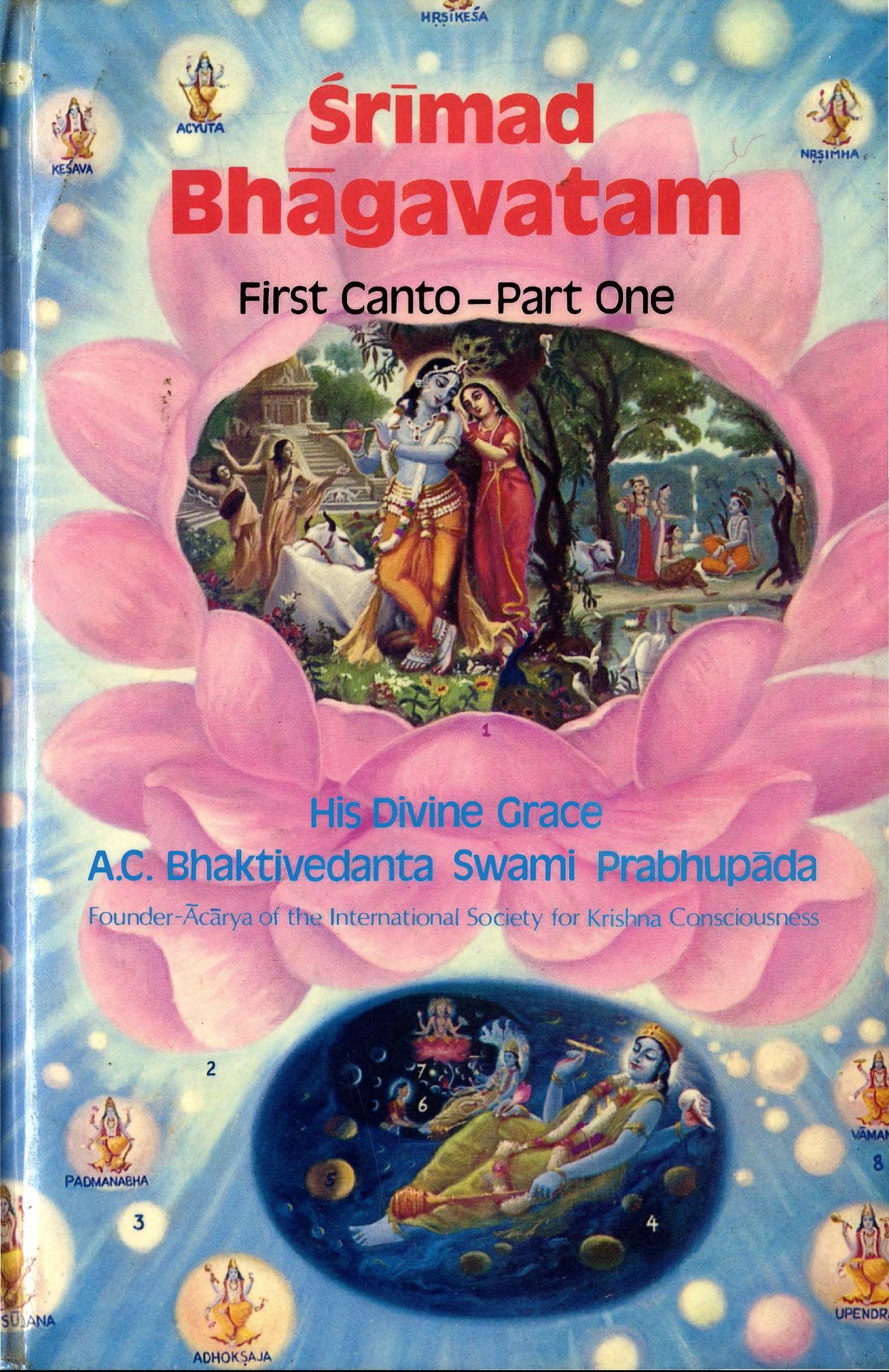
1972-original-srimad-bhagavatam-cover

tad-vāg-visargo janatāgha-viplavo
yasmin prati-ślokam abaddhavaty api
nāmāny anantasya yaśo ‘ṅkitāni yat
śṛṇvanti gāyanti gṛṇanti sādhavaḥ

SYNONYMS

tat—that; vāk—vocabulary; visargaḥ—creation; janatā—the people in general; agha—sins; viplavaḥ—revolutionary; yasmin—in which; prati-ślokam—each and every stanza; abaddhavati—irregularly composed; api—in spite of; nāmāni—transcendental names, etc.; anantasya—of the unlimited Lord; yaśaḥ—glories; aṅkitāni—depicted; yat—what; śṛṇvanti—do hear; gāyanti—do sing; gṛṇanti—do accept; sādhavaḥ—the purified men who are honest.

TRANSLATION

On the other hand, that literature which is full of descriptions of the transcendental glories of the name, fame, forms, pastimes, etc., of the unlimited Supreme Lord is a different creation, full of transcendental words directed toward bringing about a revolution in the impious lives of this world’s misdirected civilization. Such transcendental literatures, even though imperfectly composed, are heard, sung and accepted by purified men who are thoroughly honest.

PURPORT

It is a qualification of the great thinkers to pick up the best even from the worst. It is said that the intelligent man should pick up nectar from a stock of poison, should accept gold even from a filthy place, should accept a good and qualified wife even from an obscure family and should accept a good lesson even from a man or from a teacher who comes from the untouchables. These are some of the ethical instructions for everyone in every place without exception. But a saint is far above the level of an ordinary man. He is always absorbed in glorifying the Supreme Lord because by broadcasting the holy name and fame of the Supreme Lord, the polluted atmosphere of the world will change, and as a result of propagating the transcendental literatures like Śrīmad-Bhāgavatam, people will become sane in their transactions. While preparing this commentation on this particular stanza of Śrīmad-Bhāgavatam we have a crisis before us. Our neighboring friend China has attacked the border of India with a militaristic spirit. We have practically no business in the political field, yet we see that previously there were both China and India, and they both lived peacefully for centuries without ill feeling. The reason is that they lived those days in an atmosphere of God consciousness, and every country, over the surface of the world, was God-fearing, pure-hearted and simple, and there was no question of political diplomacy. There is no cause of quarrel between the two countries China and India over land which is not very suitable for habitation, and certainly there is no cause for fighting on this issue. But due to the age of quarrel, Kali, which we have discussed, there is always a chance of quarrel on slight provocation. This is due not to the issue in question, but to the polluted atmosphere of this age: systematically there is propaganda by a section of people to stop glorification of the name and fame of the Supreme Lord. Therefore, there is a great need for disseminating the message of Śrīmad-Bhāgavatam all over the world. It is the duty of every responsible Indian to broadcast the transcendental message of Śrīmad-Bhāgavatam throughout the world to do all the supermost good as well as to bring about the desired peace in the world. Because India has failed in her duty by neglecting this responsible work, there is so much quarrel and trouble all over the world. We are confident that if the transcendental message of Śrīmad-Bhāgavatam is received only by the leading men of the world, certainly there will be a change of heart, and naturally the people in general will follow them. The mass of people in general are tools in the hands of the modern politicians and leaders of the people. If there is a change of heart of the leaders only, certainly there will be a radical change in the atmosphere of the world. We know that our honest attempt to present this great literature conveying transcendental messages for reviving the God consciousness of the people in general and respiritualizing the world atmosphere is fraught with many difficulties. Our presenting this matter in adequate language, especially a foreign language, will certainly fail, and there will be so many literary discrepancies despite our honest attempt to present it in the proper way. But we are sure that with all our faults in this connection the seriousness of the subject matter will be taken into consideration, and the leaders of society will still accept this due to its being an honest attempt to glorify the Almighty God. When there is fire in a house, the inmates of the house go out to get help from the neighbors who may be foreigners, and yet without knowing the language the victims of the fire express themselves, and the neighbors understand the need, even though not expressed in the same language. The same spirit of cooperation is needed to broadcast this transcendental message of the Śrīmad-Bhāgavatam throughout the polluted atmosphere of the world. After all, it is a technical science of spiritual values, and thus we are concerned with the techniques and not with the language. If the techniques of this great literature are understood by the people of the world, there will be success.

When there are too many materialistic activities by the people in general all over the world, there is no wonder that a person or a nation attacks another person or nation on slight provocation. That is the rule of this age of Kali or quarrel. The atmosphere is already polluted with corruption of all description, and everyone knows it well. There are so many unwanted literatures full of materialistic ideas of sense gratification. In many countries there are bodies appointed by the state to detect and censor obscene literature. This means that neither the government nor the responsible leaders of the public want such literature, yet it is in the marketplace because the people want it for sense gratification. The people in general want to read (that is a natural instinct), but because their minds are polluted they want such literatures. Under the circumstances, transcendental literature like Śrīmad-Bhāgavatam will not only diminish the activities of the corrupt mind of the people in general, but also it will supply food for their hankering after reading some interesting literature. In the beginning they may not like it because one suffering from jaundice is reluctant to take sugar candy, but we should know that sugar candy is the only remedy for jaundice. Similarly, let there be systematic propaganda for popularizing reading of the Bhagavad-gītā and the Śrīmad-Bhāgavatam, which will act like sugar candy for the jaundicelike condition of sense gratification. When men have a taste for this literature, the other literatures, which are catering poison to society, will then automatically cease.

We are sure, therefore, that everyone in human society will welcome Śrīmad-Bhāgavatam, even though it is now presented with so many faults, for it is recommended by Śrī Nārada, who has very kindly appeared in this chapter. (Source: http://prabhupadabooks.com/sb/1/5/11)

Jayadvaita Swami ignores Prabhupada’s instructions to avoid controversy

“Help us by “liking” and “sharing” this post!”

Jayadvaita Swami finds himself as the main character in one of most controversial dramas in ISKCON, namely the posthumous editing of Prabhupada’s books.

But…

Regarding Jayadvaita it is good for him to avoid controversy.” (Letter to Ramesvara, Bombay, 25 November, 1974)

And on a morning walk where Jayadvaita Swami and others were talking with Prabhupada about publishing matters that could cause controversy amongst devotees:

 “As soon as there is some controversy, avoid it.” (Morning Walk, April 10, 1976, Vrndavana)

Back-To-Godhead-Jayadvaita-Swami

Taking these instructions into consideration, the question arises:”Why is Jayadvaita Swami still deeply involved in this controversy?” He is actively debating the issue, writing articles, making videos, giving seminars and continuing his work of re-writing Srila Prabhupada’s Bhagavad-gita As It Is.

“The duty of the finger” (Bg. 4.38)

Help us by “liking” and “sharing” this post!

This article was sent to the BBT International through their website (http://www.bbtedit.com/contact) and to Jayadvaita Swami’s personal e-mails (jswami@pamho.net and jayadvaita.swami@pamho.net) the 24th Oct. 2013. We asked them to comment on the points raised.

So far we have not received any reply.

1383179_412872895502777_881195929_n

By Bhakta Torben and Ajit Krishna Dasa

Srila Prabhupada’s Bhagavad-gita 4.38, original 1972 edition:

Skærmbillede 2013-10-24 kl. 14.27.12

Jayadvaita Swami’s version (BBT International, 1983 edition):

Skærmbillede 2013-10-24 kl. 14.28.19

The sentence,

“And one who has achieved this enjoys the self within himself in due course of time.”

is changed to:

“And one who has become accomplished in the practice of devotional service enjoys this knowledge within himself in due course of time.”

This change is both needless and alters the meaning.

It is NEEDLESS because Prabhupada has not asked for it.

It alters the meaning, as the words “enjoys the self” is erased and replaced with “enjoys this knowledge”.

And the words “has achieved this” are substituted with “has become accomplished in the practise of devotional service”.

Furthermore the words “are culminated” in the end of the purport are NEEDLESSLY changed to “culminate”.

So there are NEEDLESS changes BOTH in the translation and in the purport.

Usually all this is explained away with something from the “original manuscript”. But on BBT International’s website we find no information about this change.

The “original manuscript” sounds like this:

Skærmbillede 2013-10-24 kl. 11.27.55

So AGAIN the “original manuscript” is seen to be closer to the 1972 original Bhagavad-gita than Jayadvaita Maharaj’s version.

On top of that, in the word-for-word translation the word “na – never” is changed to “na – nothing” and “svayam-itself” is changed to “svayam-himself”. Prabhupada personally did ALL the type-writing for the first six chapters of the so called “original manuscript”. In the “original manuscript” Prabhupada’s translation of “na” was “never” (Na-never) and his translation of “svayam” was “itself” (svayam-itself):

Skærmbillede 2013-10-24 kl. 14.13.44

So BBT International have CHANGED PRABHUPADA’S SANSKRIT TRANSLATION as it was PERSONALLY WRITTEN BY HIM, on his type writer. Prabhupada was very concerned with better knowing disciples that had become “learned” in sanskrit:

“…a little learning is dangerous, especially for the Westerners. I am practically seeing that as soon as they begin to learn a little Sanskrit immediately they feel that they have become more than their guru and then the policy is kill guru and be killed himself.” (from a letter to Dixit das on 18 Sep 1976)

Prabhupada gave this lecture from Bg. 4.38 and did not mention anything about changing anything:

Madhudvisa: Verse thirty-eight: “In this world there is nothing so sublime and pure as transcendental knowledge. Such knowledge is the mature fruit of all mysticism and one who achieved this enjoys the self within himself in due course of time [Bg. 4.38].”

Prabhupada: Yes. Knowledge: “I am part and parcel of Krishna, or God. My duty as part and parcel is to serve Krishna.” Just like this finger is the part and parcel of my body. The duty of the part and parcel is to serve.
(Bhagavad-gita 4.34-39, Los Angeles, January 12, 1969)

Gita Cover-Up or Buyer Beware!

Help us by sharing and liking this post!

By Rupanuga Dasa (ACBSP) (Posted from the Sampradaya Sun)

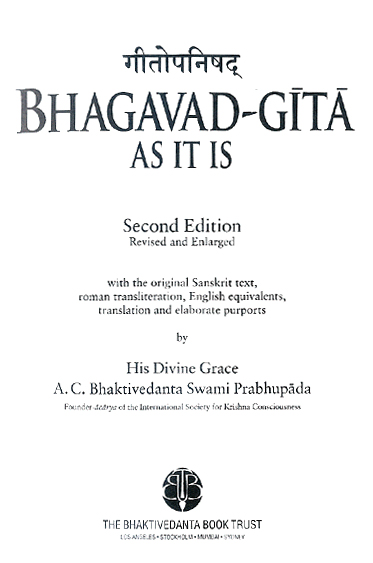
Interested parties should be made aware that the BBT editors of Srila Prabhupada’s Bhagavad-gita As It Is have continued editing their own new (2010) paperback edition of their 1983 “revised and enlarged” version. They have removed the notice “Revised and Enlarged” from the face page and left only “Second Edition.” The phrase “with the original Sanskrit text, Roman transliteration, English equivalents, translation and elaborate purports” has been omitted. So now, after all the omissions, the face page reads simply “Bhagavad-Gita As It Is, Second Edition, by His Divine Grace A.C. Bhaktivedanta Swami Prabhupada.”

Consequently, there is no indication for the prospective buyer that the book is actually a revised version of the original; rather it is made to appear to be simply a re-printing of the original—by the same author! The BBT editors, remaining incognito, continue to plagiarize Srila Prabhupada’s name and fame to lend credibility to their in fact re-written version of the Bhagavad-Gita As It Is, originally designated as the “Complete Edition” by Srila Prabhupada himself.

On the back cover, once again the editors omit an important phrase in the description of Srila Prabhupada as “the leading exponent of the science of Krsna consciousness in the West and the world’s most distinguished teacher of Vedic religion and thought…” And they add a curious sentence in conclusion, which really reflects their own clandestine position: “Thus, unlike other editions of the Gita, his conveys Lord Krsna’s profound message as it is—without the slightest taint of adulteration or personally motivated change.” This is so reminiscent of that well-known story of the man on the second floor of his house hearing a noise downstairs and calling out, “Who’s there?” revealing the actual position, a voice from below answers emphatically, “Oh, I’m not stealing! I’m not stealing!”

Or the time when devotees told Srila Prabhupada about a newspaper article claiming that a space probe to Mars had sent back photographic images that so closely resembled the terrain in Arizona. Srila Prabhupada said the scientists involved were themselves in Arizona, simply revealing their own minds, reflecting their surroundings.

Similarly, these editors, perhaps smarting from unending legitimate criticism, have inadvertently revealed their own position: “Oh no, we have edited responsibly, without the slightest taint of adulteration or personally motivated change!” But they continue to commit what Srila Prabhupada described in the purport Srimad Bhagavatam 3.4.26:

“Although one may be well versed in transcendental science, one should be careful about the offense of maryada-vyatikrama, impertinently surpassing a greater personality.”

The impertinence knows no bounds, because BBT editing has become a co-authoring of Srila Prabhupada’s books. Buyer beware! Milk still looks like milk even when containing poison.

bcdebat-long2009 Hardback

gita102010 Paperback

Where Angels Fear to Tread

Help us by liking and sharing this post!

By Rupanuga Dasa (ACBSP) (Originally posted on the Sampradaya Sun)

bg_not_equal

The editors of the 1983 revised Gita did not believe that they actually interpolated philosophy or style.* Their idea was to improve both translations and purports by transposing and clarifying portions of old manuscripts, etc. existing prior to the one finally submitted to Macmillan in 1972. Truly, many of the grammatical, spelling, format and historical inaccuracies corrected in the revision would have been approved by Srila Prabhupada himself had he been consulted.

Be that as it may, Srila Prabhupada never instructed anyone to use a procedure of re-visiting and researching old manuscripts or dictations to revise future printings of his first editions. On the other hand, recordings made from 1972 until 1977, six years, demonstrate how Srila Prabhupada often personally read excerpts from the Gita in classes, room conversations, engagements, etc. Many times he also instructed devotees present to read aloud as he listened. There is no evidence indicating that he ordered extensive revisions for the next printing. As the current chief editor wrote; “To my knowledge, Srila Prabhupada never asked us to re-edit the book.” (Letter to Amogha Lila, July, 1986 ).

Interestingly enough, none of the scholars, educators, professors and other reviewers of the Gita called for it either. From 1972 until 1983 we don’t find requests from professionals for a revision to a higher standard. Nor do we hear any demand from devotees in general for such a thorough revision. In fact, the editors state in “A Note About the Second Edition” found in the BBT revised editions: “Yet their effort to publish Srila Prabhupada’s work was a success, and the Bhagavad-gita As It Is has become the standard edition for scholars and devotees around the world.” Still, after eleven years of documented success, the Gita was extensively re-worked. Why? What is the reason?

The editors continue their explanation: “For this second edition, however, Srila Prabhupada’s disciples had the benefit of having worked with his books for the last fifteen years. The English editors were familiar with his philosophy and language, and the Sanskrit editors were by now accomplished scholars. And now they were able to see their way through perplexities in the manuscript by consulting the same Sanskrit commentaries Srila Prabhupada consulted when writing Bhagavad-gita As It Is. The result is a work of even greater richness and authenticity… In places the translations, though already correct, have been revised to come closer to the original Sanskrit and Srila Prabhupada’s original dictations…”

The editors are claiming the benefit of 15 years work, which would mean 1968 until 1983, the year of the revision. However, the value of those benefits is uncertain, because in June, 1977 Srila Prabhupada severely chastised the editors for changes to his Isopanisad and Bhagavatam. He described the editors as rascals (a term he usually reserved for atheists, material scientists and politicians), and called them “dangerous” at least six times in ten minutes of discussion. Just five months before his disappearance, Srila Prabhupada made this a major issue for the Society.

The same basic issue came up in 1983 and has continued more or less for the last 25 years. But for us, now, who will decide who is right and who is wrong? One side says “responsible editing,” the other says “irresponsible, unauthorized, etc.” But who is right and who is wrong? Who will decide?

So now we must come to the point of reason. Is it reasonable to conclude that just five or six years after deserving that 1977 chastisement, editors could have emerged as “accomplished scholars” -by 1983? One editor escaped chastisement. Still, isn’t six years a short time for everyone to turn up as “accomplished scholars?” But even if all the editors had been studying Sanskrit for 30 years by 1983, is it plausible that such editors could be able to dive into the superexcellent depths of Sanskrit revelation, and come up with an understanding of it’s complexities—the same complexities-understood by previous acaryas? Was this the prerogative of such disciples, that they could be “able to see their way through perplexities in the manuscript by consulting the same Sanskrit commentaries Srila Prabhupada consulted when writing the Bhagavad-gita As It Is? Is it possible?

And further, “In places the translations, though already correct, have been revised to come closer to the original Sanskrit…” Here the implication is that the editors in 1983, whoever they were, thought they could interpret the original Sanskrit texts comparatively as well as Srila Prabhupada himself, or at least well enough to put their new realizations in his book under his name. And, that they could understand the same complexities understood by previous acaryas (presumably Sridhar Swami et. al.) simply by using the same Sanskrit commentaries Srila Prabhupada used. Is this credible? Is it reasonable to conclude that such editors were capable of producing “a work of even greater richness and authenticity?” Or that translations “already correct” could have been revised to even more correctness by them? Was all this perfection really possible by 1983?

May be, if they had received authorizations and blessings from Srila Prabhupada in 1977 before he disappeared, but that didn’t happen. It is known from that recorded conversation of June, 1977, that when Tamal Krsna suggested to Srila Prabhupada Jayadvaita check any changes before reprinting, Srila Prabhupada countered: “But they are doing without any authority!” In other words, no need for Jayadvaita to become an inspector of changes because nobody was authorized to make such changes in the first place! Tamal had already said to Srila Prabhupada: “Your original work that you’re doing now, that is edited by Jayadvaita. That’s the first editing.” Srila Prabhupada had answered, “He is good.” So Srila Prabhupada, in the midst of all the turmoil, made it clear that he was satisfied with Jayadvaita’s work. Yet a “first editing” is entirely different from re-editing an already finished or printed work, which is what the others were doing. Srila Prabhupada never authorized anyone, including Jayadvaita or Pradyumna to do that with the Bhagavad-gita then or in the future.

The extent of Srila Prabhupada’s disappointment in this matter can not be underestimated. He said, after being informed of the changes in the Isopanisad, “I know what these rascals are doing. What can be done? How they can be relied on?” And later, “It is starting. What can I do? These cannot…These rascals cannot be educated. Dangerous. Little learning, dangerous…What can I do? Ultimate it goes for editorial…”

In the 3rd Canto (3.4.26), Srila Prabhupada writes, “Although one may be well versed in transcendental science, one should be careful about the offense of maryada-vyatikrama, or impertinently surpassing a greater personality. According to scriptural injunction one should be very careful of transgressing the law of maryada-vyatikrama because by so doing one loses his duration of life, his opulence, fame and piety and the blessings of all the world. To be well versed in the transcendental science necessitates awareness of the techniques of spiritual science.”

At this point the significant question emerges: Has maryada-vyatikrama, impertinently surpassing a greater personality, occurred in the process of editing and reprinting Srila Prabhupada’s books? It certainly had by 1977, according to the momentous June 22nd room conversation about changes to the Isopanisad and Srimad Bhagavatam. Six years later, considering the exaggerated claims in the “Note About the Second Edition” and the extreme content-editing of the text, it appears to have occurred again in the 1983 “Revised and Enlarged” version of the Bhagavad-gita As It Is. Vaisnava etiquette demands that Srila Prabhupada’s disciples, grand-disciples, et. al. always think themselves fools in front of Srila Prabhupada. But, unfortunately, sometimes some of them forget that, and dare to rush in where angels fear to tread.

* “Our editing is to correct grammar and spelling errors only, without interpolation of style or philosophy.” (Srila Prabhupada, 02/17/70)

The Change Disease and Windows to the Spiritual Sky

Help us by sharing and liking this post!

Skærmbillede 2013-10-11 kl. 10.00.12

44 deleted color plates

By Rupanuga Dasa (originally posted on the Sampradaya Sun)

When Srila Prabhupada signed the final version of the Macmillan contract for his Complete Edition of the Bhagavad-gita As It Is published in 1972, it included certain additions he made in the following section of that contract:

Competitive Material
XII. During the term of this agreement the Author shall not publish or permit the publication of any material written in whole or in part by him that is derived from or competitive to the Work or the rights herein granted without the prior written consent of the publisher. [Then Srila Prabhupada added]: except for Back-to-Godhead Magazine, and any present or future works using the Work as reference, as well as the 48 pages of illustrations for which the Author reserves the right to publish for any purpose he may determine.

Srila Prabhupada made other notations also, including his right as Author to translate into foreign languages if the publisher failed to do so within 18 months. He then signed as the Author. The contract was dated March 6, 1972 and countersigned by the ISKCON representative, “Rupanuga das Adhikary”.

That new Gita was to prove big and heavy and only so many could be crammed into a bookbag, but people were to become immediately attracted to the gorgeous, colorful paintings; besides, where could they find such a book with so many color illustrations, and for how much? It was Srila Prabhupada’s transcendent genius to conceive of such a way to reveal to people the deepest philosophy and the highest truths comprehensible to human beings. No other volume of supposed philosophical content could compare to that Gita, decorated as it was with paintings allowing a view of the Spiritual Sky. Along with Prasadam, those paintings were Srila Prabhupada’s secret weapons.

Continue reading

A very “insignificant” change (Bg. 2.35)

Help us by “liking” and “sharing” this post!

From “the original manuscript”:

Skærmbillede 2013-10-10 kl. 11.42.42

From the original, approved and authorized 1972 edition of Bhagavad-gita As It Is:

Skærmbillede 2013-10-10 kl. 12.49.59

BBT International’s 1983 edition of Bhagavad-gita As It Is:

“The great generals who have highly esteemed your name and fame will think that you have left the battlefield out of fear only, and thus they will consider you insignificant.” (Bg. 2.35)

Prabhupada and his editor, Hayagriva Prabhu, worked together on the “original manuscript” and the end result was “coward” instead of “fig”. But somehow the BBT International decided to replace “coward” with “insignificant”.

On the BBT International’s website we do not find any information about this change and why it was made. This is a significant point because Jayadvaita Swami have now published up through the 8th chapter what is claimed to be a detailed justification of all his changes. But somehow he has left this one out when going through the changes in the second chapter. Why?

In the word-for-word translation to Bg. 2.35 Prabhupada translates the word “laghavam” as “decreased in value”. But nowhere does Prabhupada translate “laghavam” as “insignificant”. When searching the Vedabase Folio we find nowhere in Prabhupada’s books, lectures, conversations, letters where he refers to Arjuna as being “insignificant” in the context of Bg. 2.35 – or any other context. So how is changing “coward” to “insignificant” going back to “the original manuscript”? And in which way is it “closer to Prabhupada”?

We also find that nowhere does Prabhupada use the word “fig” about Arjuna. But we do find plenty of places where he uses the word “coward” about Arjuna in relation to his decision not to fight, and we find lectures on Bg. 2.35 where Prabhupada didn’t object to the use of the word “coward”, and lectures where he actually reinforces the use of the word “coward” by repeating it:

Devotee: 35: “The great generals who have highly esteemed your name and fame will think that you have left the battlefield out of fear only, and thus they will consider you a coward [Bg. 2.35].” 36: “Your enemies will…”
Prabhupada: A ksatriya… It is the custom of the ksatriya that if they are wounded on the back side, he is considered a coward, but if he is wounded on the chest, he is accepted as real ksatriya. That means he has fought face to face. That is the injunction of military art in Vedic injunction. (Lecture on Bhagavad-gita 2.27-38, Los Angeles, December 11, 1968)

This particular lecture is from 1968. Prabhupada had at least three years to demand “coward” changed in the 1972 Complete Edition. He didn’t.

Pradyumna: (leads chanting, etc.)
Translation: “The great generals who have highly esteemed your name and fame will think that you have left the battlefield out of fear only, and thus they will consider you a coward.”
Prabhupada:
bhayad ranad uparatam
mamsyante tvam maha-rathah
yesam ca tvam bahu
bhutva yasyasi laghavam

…and Prabhupada continues the lecture without objecting to anything. (Bhagavad-gita 2.33-35, London, September 3, 1973)

Here are some other places where Prabhupada uses the word “coward” about Arjuna:

“When Arjuna wanted to become a nonviolent coward on the Battlefield of Kuruksetra, he was severely chastised by Lord Krsna.” (SB 1.9.26)

“So on the whole, Arjuna is illusioned — illusioned in the sense that he is forgetting his duty. He is a ksatriya, his duty is to fight; never mind the opposite party, even he is son, a ksatriya will not hesitate to kill his son even if he is inimical. Similarly, the son, if the father is inimical, he would not hesitate to kill his father. This is the stringent duty of the ksatriyas, no consideration. A ksatriya cannot consider like that. Therefore Krsna said, klaibyam: “You don’t be coward. Why you are becoming coward?” These topics are going on. Later on, Krsna will give him real spiritual instruction. This is… Ordinary talks are going on between the friend and the friend.” (Bhagavad-gita 2.4-5, London, August 5, 1973)

“My case is very serious. My duty is to fight, but I do not like to fight. Some affection, some family relationship, is deterring me to fight, making me coward. So therefore it is a very complex position. And I find that You can make a solution of this complex position. I therefore accept You as my spiritual master. And I fall down under Your lotus feet as Your disciple.” Sadhi mam prapannam. “I am surrendered. Now You kindly protect the surrendered soul.” (Bhagavad-gita 2.13, Hyderabad, November 19, 1972)

(See the Vedabase Folio for more examples)

Two arguments defeated

Some argue that “coward” and “insignificant” means practically the same in the context of Bg. 2.35, so what’s the deal? It is an insignificant change, they argue. But this makes the change needless, so why change? Jayadvaita Swami wrote:

“As you know, and as we kept in mind while doing the work, Srila Prabhupada staunchly opposed needless changes.” (Jayadvaita Swami’s Letter to Amogha Lila 1986)

Besides this obvious point the two words do not at all mean the same. The words “fig” and “coward” are both used in a derogatory meaning by Prabhupada whereas the word “insignificant” is much more neutral. Logically speaking a coward doesn’t need to be insignificant, and an insignificant person need not be a coward. So the two words can’t be synonymous.

I’ve heard a devotee claim that calling someone a “fig” is outdated, and that the BBT International decided to find a better word with a similar meaning. This is of course already defeated with the arguments against going back to the so called “original manuscript”, and the fact that “fig” and “insignificant” are far from synonymous. But additionally it would mean that the BBT International would have a double standard since they have kept the sentence “On the other hand, the forces of the Pandavas are limited, being protected by a less experienced general, Bhima, who is like a fig in the presence of Bhisma.” (Bg. 1.10 purport, the 1983 BBT International edition).

So is this really an “insignificant” change? You decide!

Jayadvaita Swami admits mistake in his editing (Bg. 2.61 purport)

Help us by “liking” and “sharing” this post

Bhagavad-gita 2.61 purport

The original manuscript (personally typed by Srila Prabhupada):

Skærmbillede 2013-10-09 kl. 12.14.48

The original, approved and authorized 1972 edition of Bhagavad-gita As It Is:

Skærmbillede 2013-10-09 kl. 12.23.19

Then something strange happens in the BBT Internationals 1983 edition:

“The Yoga sutra also prescribes meditation on Visnu, and not meditation on the void. The so-called yogis who meditate on something which is not on the Visnu platform simply waste their time in a vain search after some phantasmagoria. We have to be Krsna conscious…” (Bg. 2.61 purport)

As we can see BBT International has changed “Visnu form” to “Visnu platform”. This change has no basis in the so called original manuscript. Jayadvaita Swami admits on the BBT International website that he made a mistake here:

Skærmbillede 2013-10-09 kl. 10.36.49

Jayadvaita Swami writes here that he doesn’t know how the error came about. But in a Youtube video from the same website he says something else:

From the video:

“My impression was that we had that from an original manuscript. I couldn’t find the original manuscript. And the manuscripts that we have say platform, so I said “Alright, platform.” But must have been our mistake.”

So all of a sudden Jayadvaita Swami remembers what happened: a real good story of several “manuscripts”, and the real original manuscript missing.

So we have different manuscripts, and we have Jayadvaita Swami changing on the basis of his “impressions” (clearly not a recognized source of knowledge and clearly not the standard method used by editors). Jayadvaita Swami thinks that if we are missing what he has told the world is the “original manuscript”, then we just take one of the other available manuscripts, and if we happen to make a mistake, then we just reverse it next time. What is the problem?

Is this the way we to honor sacred books and help them stay authoritative in the eyes of the people of the world?

From the video:

“If someone find mistakes in our work and the work done later – reverse it! It is not sacred. It is not that Hayagriva’s mistakes were sacred and mine, mine aren’t – or my mistakes, or his mistake weren’t sacred and mine are…”

So Jayadvaita Swami is fallible, and he is able to admit his mistake in regard to “Visnu platform”. But why, then, will he not admit all the other mistakes he has made? Devotees have been documenting his mistakes for years, but he will not admit them. Why?

In the last part of the video Jayadvaita Swami says that we should apply a principle of being “as close to Prabhupada as possible.” And this is true. But what is closest to Prabhupada – is it his many earlier drafts or the final book he himself completed together with his editors and which he approved, published, called the “Complete Edition” and “Definitive Edition” and read, lectured from and distributed for years without asking for more than 2-3 mistakes corrected?

Why will Jayadvaita Swami not admit that his biggest mistake is that he bases his editing on the mistaken idea that we can change the final, approved book back to its earlier drafts (of which there are many)?

And why will he not admit that it is logically impossible to correct ALL mistakes in Prabhupada’s books without violating the arsa-prayoga principle of not correcting the acarya? A principle Prabhupada demanded that we follow.

Being close to Prabhupada can be done by honoring the arsa-prayoga principle and accepting Prabhupada’s book as he accepted them himself.