This episode is not a vague reflection on “textual integrity.” It is a direct and sustained argument against the post-1978 changes made to Śrīla Prabhupāda’s books by BBT International under the direction of Jayadvaita Swami.
The central claim is simple and uncompromising: no one has the moral, legal, or devotional authority to alter a departed author’s published work—especially when that author explicitly forbade such changes.
Before outlining the case, it is important to understand who is making it!
Graham M. Schweig (Garuda Dāsa) is not an internet critic or a casual observer. He holds two Master’s degrees and a PhD from Harvard University and has spent decades teaching religion and philosophy at the university level. He has published with major academic presses such as Oxford, Columbia, Princeton, Yale, and HarperCollins. He is a trained Sanskritist, theologian, and editor who has worked at the highest levels of academic publishing. Within Vaiṣṇava circles he is known not only as a scholar but as a long-time practitioner deeply committed to Śrīla Prabhupāda’s legacy. In other words, he understands both rigorous editorial standards and the theological weight of disciplic succession. When he says what has been done is “unacceptable” by scholarly standards and “transgressive” by devotional standards, that is not rhetoric. It is the judgment of someone qualified to evaluate both domains.
Now to the arguments.
First: Śrīla Prabhupāda’s own instructions. In letters, conversations, and in his Macmillan contract, he stated that editing was for grammar and punctuation only—not for altering philosophy or style. In 1977 he repeatedly said, “Our books must remain as they are,” and “Whatever is done is done. No more.” He required that revisions be made only with the author’s permission. Once the author has departed, that permission is impossible. Therefore, posthumous revisions violate his expressed will.
Second: False assumption of authority. Prabhupāda granted conservative, provisional authority to assist with copy-editing. BBT editors assumed open-ended authority to revise, harmonize, and “improve” content. That is a categorical shift—from servant to co-author.
Third: Editorial overreach. Approximately 5,000 changes were made to Bhagavad-gītā As It Is alone. Around 77% of its verses were altered. In Śrīmad-Bhāgavatam the changes run into the tens of thousands. These include altering translations where no grammatical error existed, removing theological identifications, shifting meaning, and recasting concise, powerful prose into diluted language. These are interpretive interventions—not typo corrections.
Fourth: Insertion of the editor’s mind into the text. A sentence was changed because it “didn’t make sense” to the editor. When it was shown that it did make philosophical sense, the issue remained: the books are now filtered through the editor’s conceptual limits.
Fifth: Lack of transparency. Substantial changes were made without full disclosure. Scholarly standards require documentation. That was not provided.
Sixth: Legal maneuvering. BBT International registered itself as “author” and listed Śrīla Prabhupāda as “worker for hire.” Whatever the legal strategy, the signal is disturbing.
The alternative presented is clear: preserve the original text and address issues through annotated editions. Rewriting the text is not service. It is substitution.
If we accept that Śrīla Prabhupāda’s books are divinely empowered and that he explicitly ordered “no more changes,” then the post-1978 revisions constitute a transgression—morally, legally, and theologically.
Śrīla Prabhupāda on Unauthorized Editing and Post-Samādhi Changes
By Ajit Krishna Dasa
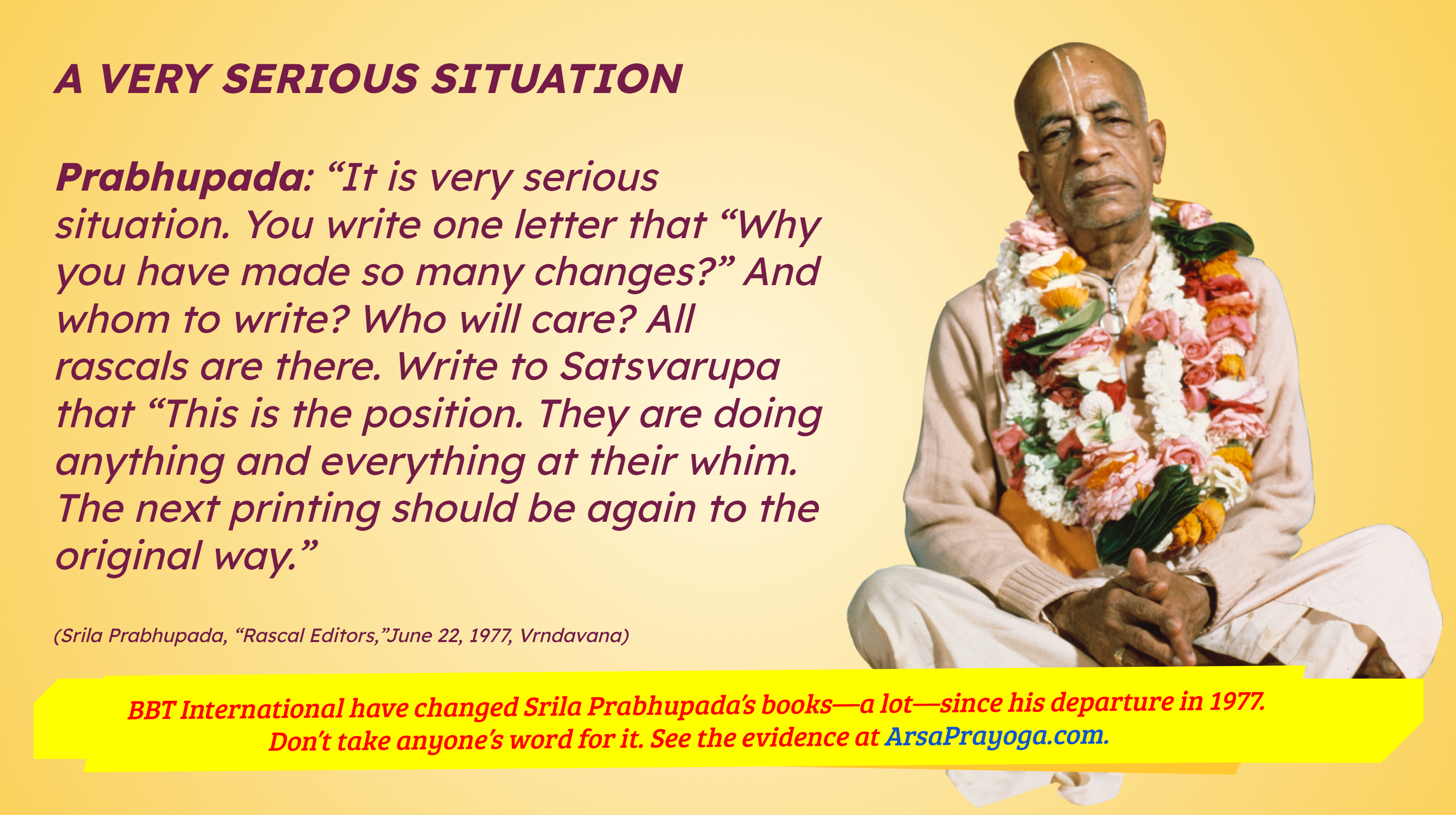
Discussions about post-samādhi editing of Śrīla Prabhupāda’s books often assume that the real problem began after 1977. But Śrīla Prabhupāda himself tells a different story. In the well-known “Rascal Editors” conversation dated June 22, 1977, in Vṛndāvana, he describes a situation already unfolding — one marked by unauthorized editing, loss of control, lack of accountability, and the impossibility of verification.
Far from being historically irrelevant, these remarks reveal a structural problem — one that makes post-samādhi editing not only questionable, but fundamentally illegitimate.
Editing Without Control — Already in 1977
Śrīla Prabhupāda states:
“It is starting. What can I do? […] They make changes, such changes… So how to check this? How to stop this?”
This is a critical admission. Prabhupāda is not predicting a future danger; he is describing a present reality. Editorial changes were already occurring, and he openly acknowledges that he lacks the practical ability to stop them.
This point alone carries enormous weight. If the author himself — alive, present, accessible, and formally in charge — could not effectively control editorial activity, then any claim that editorial control somehow improved after his departure is untenable. The conditions for restraint were already weakening; after samādhi, they could only deteriorate further.
The Defining Issue: Absence of Authority
Prabhupāda continues:
“…they are doing without any authority […] Very serious feature.”
Here the issue is precisely identified. The problem is not accidental error, linguistic awkwardness, or the need for stylistic polish. The problem is unauthorized action.
This distinction is crucial when discussing posthumous changes to Prabhupāda’s books. Appeals to “clarification,” “restoration,” or “philosophical consistency” are irrelevant if no authority exists to sanction such changes. In a Vaiṣṇava framework — especially under the principle of ārṣa-prayoga — authority does not arise from competence, intention, or institutional position. It must be explicitly granted.
Without authority, even a well-intended edit is illegitimate.
“Jayadvaita Is Good” — A Misused Argument
At this point, defenders of post-samādhi editing often introduce the following exchange:
Tamāla Kṛṣṇa: Your original work that you’re doing now, that is edited by Jayadvaita. That’s the first editing. Prabhupāda: He is good. Tamāla Kṛṣṇa: He is good. But then, after they print the books, they’re going over. So when they reprint… Prabhupāda: So how to check this? How to stop this? Tamāla Kṛṣṇa: They should not make any changes without consulting Jayadvaita.
From this, it is claimed that later editorial changes are justified because Jayadvaita Swami was trusted by Śrīla Prabhupāda.
This argument fails on several levels.
First, Prabhupāda’s approval of Jayadvaita was contextual and temporal. He approved Jayadvaita’s editing at that time, under his supervision, and within a defined scope. Nothing in this exchange grants blanket, indefinite, post-samādhi editorial authority.
Second, Prabhupāda himself explicitly rejected the idea that past approval guarantees present legitimacy. He repeatedly warned against exactly this kind of reasoning.
Śrīla Prabhupāda explains the logical fallacy involved:
“This is nagna-mātṛkā-nyāya. We change according to the circumstances. You cannot say that this must remain like this.” (Morning Walk, May 5, 1973, Los Angeles)
In Nyāya logic, this fallacy assumes that because something was valid in the past, it must retain the same status indefinitely — regardless of changed circumstances. Prabhupāda explicitly rejected this mode of reasoning.
Trust Is Conditional — and Can Be Violated
Prabhupāda further clarifies that trust is never unconditional:
“I have given you charge… but you can misuse at any moment, because you have got independence. At that time your position is different.” (Morning Walk, June 3, 1976, Los Angeles)
And he states even more plainly:
“Phalena paricīyate […] Present consideration is the judgement.” (Morning Walk, October 8, 1972, Berkeley)
In other words, a person must be evaluated by present actions, not past reputation. Previous trust does not immunize later conduct.
This principle applies directly here. Whatever confidence Prabhupāda had in Jayadvaita’s editing during his presence cannot be mechanically transferred to a radically different situation: post-samādhi editing, without authorial oversight, involving substantive changes to published works.
Evidence of Breach: Changes in Style, Mood, and Philosophy
This is not a theoretical concern. Post-samādhi editions exhibit clear and documentable changes that go far beyond spelling or grammar. These include alterations to:
the balance between direct instruction and interpretive explanation
and, in some cases, the theological perspective itself
Style, tone, and mood are not cosmetic. They are integral to meaning and pedagogy. To alter them without authority is to alter the work — and doing so after the author’s departure violates the trust placed in any editor.
Original manuscripts, first editions, and contemporaneous recordings therefore function only as witnesses to what Śrīla Prabhupāda authorized and published — not as licenses to revise his words post-samādhi.
Then and Now: Structural Parallels
The situation Prabhupāda describes in 1977 and the situation surrounding post-samādhi editing share the same defining features:
Editorial changes occurring without explicit authorization
Inability to verify or supervise those changes
Absence of a final, corrective authority
Institutional normalization of editorial discretion
Appeals to past trust rather than present evidence
The difference is not one of kind, but of degree. What was beginning in 1977 became entrenched after Prabhupāda’s departure.
The Unavoidable Conclusion
Śrīla Prabhupāda’s own words establish the following facts:
Unauthorized editing was already occurring during his presence.
He could not effectively stop it.
He could not reliably check or verify it.
He explicitly warned against relying on past trust as permanent validation.
From this, the conclusion follows with clarity:
Post-samādhi editing of Śrīla Prabhupāda’s books lacks authority, lacks verification, and reproduces precisely the dangers he himself identified.
That Jayadvaita Swami was trusted then does not settle the question now. Trust is conditional, circumstances change, and actions must be judged in the present.
Where authority is absent and trust has been objectively violated, restraint is not extremism — it is fidelity.
For anyone studying ISKCON history, the integrity of Śrīla Prabhupāda’s original books, the principle of ārṣa-prayoga, or the ongoing debate about BBT International’s post-samādhi editing, there is no clearer example of the underlying problem than the quiet shift found in the Bhagavad-gītā As It Is. Two descriptions of Śrīla Prabhupāda — one from the original edition, one from the newer BBTI edition — reveal two completely different theologies. This is not merely linguistic preference. It is a redefinition of Prabhupāda’s authority, status, and position in the guru-paramparā.
Anyone familiar with the editing controversies surrounding the changed Gītā knows this issue is not about grammar. It is about revelation.
The Original Description: Śrīla Prabhupāda as a Divinely Empowered Ācārya
“HIS DIVINE GRACE A.C. BHAKTIVEDANTA SWAMI PRABHUPĀDA, the leading exponent of the science of Kṛṣṇa consciousness in the West and the world’s most distinguished teacher of Vedic religion and thought is the author of Śrīmad-Bhāgavatam, Kṛṣṇa and many other versions of Vedic literature. He is a fully self-realized devotee of Lord Kṛṣṇa and is the latest disciple in a succession that originally began with Kṛṣṇa Himself. He is the founder and spiritual master of the International Society for Krishna Consciousness which now has centers in major cities throughout the world.” (From the backcover of the original and authorized Bhagavad-gita As It Is, 1972-1977)
The original Bhagavad-gītā As It Is presents Śrīla Prabhupāda according to classical Vaiṣṇava siddhānta. Nothing is minimized. Nothing is secularized. His identity is stated as the tradition itself understands it:
• He is the leading exponent of Kṛṣṇa consciousness. • He is the most distinguished teacher of Vedic religion and thought. • He is a fully self-realized devotee of Lord Kṛṣṇa. • He stands in an unbroken guru-paramparā beginning with Kṛṣṇa Himself. • He is the founder and spiritual master of ISKCON. • His writings are Vedic revelation — śabda-brahma — not ordinary literature. • His authority is divine, not academic.
This description fits perfectly with Prabhupāda’s own statements and the strict understanding of ārṣa-prayoga: when an empowered ācārya speaks, the words are final. You do not alter them, interpret them “for modern audiences,” or adjust them posthumously. His authority derives from Kṛṣṇa — not from a publishing institution.
The New BBTI Description: From Divine Authority to Academic Respectability
“His Divine Grace A. C. Bhaktivedanta Swami Prabhupāda was a teacher in the disciplic line from Kṛṣṇa (the speaker of the Gītā) and was an exemplar in bhakti-yoga, the yoga of devotional mysticism. His translation and commentary are guided by a lifetime of scholarship and enriched by the realizations of a mature practitioner.” (From the backcover of the posthumously edited Bhagavad-gita As It Is)
The revised description in the BBT International edition removes the transcendence. It removes the divine empowerment. It removes guru-paramparā. It removes the ontology of revelation. And it replaces them with the vocabulary of secular Religious Studies departments.
• Prabhupāda becomes a “teacher,” not an empowered master. • His realizations become “experience” rather than self-realization. • His authority becomes “scholarship” rather than śakti. • His mission becomes “devotional mysticism” rather than a divine commission. • His position in the disciplic succession is omitted altogether. • His books are framed as scholarly works, not revealed scripture.
This is the language academics use to describe a respected religious figure. It is not the language used to describe a mahā-bhāgavata delivering Kṛṣṇa’s message unchanged.
The change is intentional, ideological, and foundational.
Why This Change Is a Philosophical Change — Not a Stylistic One
It may look like the back-cover text was simply “updated,” but the shift is far deeper. In Vaiṣṇava theology, the way an ācārya is described is not marketing — it is philosophy. Changing that description changes the conceptual foundations of revelation, authority, and paramparā.
Here is why the newer BBTI description constitutes a genuine philosophical shift:
• The original text affirms Prabhupāda as a self-realized, divinely empowered ācārya standing in a guru-paramparā beginning with Kṛṣṇa. This is core Vaiṣṇava siddhānta.
• The newer text removes all transcendental claims and replaces them with the vocabulary of academic religious studies: teacher, practitioner, exemplar, scholar. This reframing is ideological, not neutral.
• When divine empowerment is replaced by “scholarship,” the source of authority is relocated—from Kṛṣṇa and paramparā to human effort, experience, and education. That is a direct shift in epistemology.
• The original presentation makes Prabhupāda’s books śabda-brahma—untouchable, uneditable, preserved by ārṣa-prayoga.
• The new presentation makes his books appear to be religious literature written by a competent teacher—therefore open to “correction,” “improvement,” and posthumous editing.
• How you describe the guru governs how you treat his words. Reduce him from an empowered ācārya to a spiritual author, and the editorial boundaries disappear.
• Redefining Prabhupāda’s ontological position automatically redefines the ontological status of his books. This is the very heart of philosophy—not of style.
The shift from “empowered ācārya delivering divine revelation” to “scholarly teacher presenting devotional mysticism” is not cosmetic. It is a change in philosophy. And such disobedient philosophical changes form the groundwork for most of what the BBT International has done to Prabhupāda’s books since 1978.
Why the Shift Happened: The Institutional Motives Behind the New Description
These changes do not emerge from nowhere. They serve specific institutional incentives inside BBTI and the modern ISKCON structure. When you examine the newer description, the motives become obvious:
Secular respectability Kṛṣṇa consciousness must appear “safe” to academics, journalists, and interfaith circles. Divine claims are removed. Authority is softened. The ācārya becomes an acceptable subject of Religious Studies rather than a representative of God.
Institutional flexibility If Prabhupāda is framed as a scholar, then the institution replaces him as the ongoing authority. Once his transcendence is removed, reinterpretation and doctrinal adjustment become easy. Editorial intervention becomes normal.
Legal and social safety Absolute guru claims make institutions nervous. Removing transcendence reduces risk — legal, social, and political.
Justifying textual alteration If Prabhupāda is merely a scholar, editors become co-scholars. Posthumous editing becomes an “academic duty.” “Fixing,” “refining,” and “modernizing” the Gītā becomes justified.
Every one of these motives requires the same thing: a quiet lowering of Śrīla Prabhupāda’s divine identity.
The Weberian Pattern: How Institutions Tame Their Founders
Max Weber described exactly what happens after a charismatic spiritual founder departs. The patterns are precise:
• The founder is reinterpreted as a historical figure. • Absolute authority is replaced by bureaucratic authority. • Revelation becomes “tradition.” • Radical spiritual demands are softened for institutional comfort. • Doctrines are edited to fit new cultural expectations. • The living spiritual fire becomes the institution’s heritage instead of its guiding force.
This is not speculation. This is exactly what unfolded in ISKCON after 1977 — and the rewritten Gītā description is one of the clearest examples.
How the New Description Enables Posthumous Editing
Once Prabhupāda is reframed as a respected “teacher” rather than a divinely empowered ācārya, everything changes:
• His books appear to be literature, rather than revelation. • Literature can be edited, updated, and modernized. • Editors become authoritative intermediaries. • ārṣa-prayoga is discarded as outdated superstition. • Post-samādhi editing is normalized. • Authority shifts from the guru to the institution.
The new Gītā description is the theological justification for the changed Gītā — and for every other altered text.
The Consequence: Two Descriptions, Two Theologies
These two descriptions of Śrīla Prabhupāda represent two incompatible worldviews.
• The original description safeguards the purity of Prabhupāda’s teachings. • The newer description prepares the ground for reinterpretation and revision.
• The original affirms revelation. • The new one reduces revelation to scholarship.
• The original protects the guru-paramparā. • The new one replaces it with institutional authority.
• The original makes posthumous editing unthinkable. • The new one makes it inevitable.
This shift is not a detail. It is the philosophical foundation of the entire posthumous editing project.
This article explores how changing the chapter title “Sankhya-yoga” to “Dhyāna-yoga” in Bhagavad-gita As It Is alters the reader’s perception of Srila Prabhupada’s intention — not because “Dhyāna-yoga” is inherently wrong or historically invalid, but because Prabhupada had a purpose in not using that more common title. The issue, therefore, is not academic accuracy, but fidelity to the ācārya’s personal voice — a core principle of Arsa-Prayoga, especially in the context of posthumous editing by BBTI.
Type of change
Substitution — one term from the Vedic tradition replaced by another, equally authentic, but conveying a different emphasis.
Category
Philosophical change.
Commentary
Not a question of “right” or “wrong” — but of honoring intention
Many commentaries throughout Vaiṣṇava history title Chapter 6 as “Dhyāna-yoga.” This is not a mistake. But Srila Prabhupada chose not to use this more common title. Instead, he used “Sankhya-yoga” consistently in his lectures, manuscripts, and published edition of Bhagavad-gita As It Is. That choice is not random — it reflects a pedagogical and theological strategy. When BBTI editors later replaced it with “Dhyāna-yoga,” the question is not whether their choice could be justified in a vacuum, but whether it should override Prabhupada’s own.
Srila Prabhupada’s framing is the governing standard
Prabhupada repeatedly emphasized that his edition of the Gītā was not merely another translation, but the definitive presentation of the Bhagavad-gita “as it is.” To alter his chosen structure — even in a title — is to alter the interpretive lens he intentionally set. This is where Arsa-Prayoga becomes relevant: the principle that once the ācārya has spoken, his presentation stands. Posthumous editing, however well-meaning, must not replace the spiritual intuition of the empowered teacher with the academic preferences of his disciples or followers — whether they be Jayadvaita Swami, Dravida Dasa, or any future editor.
Why “Sankhya-yoga” rather than “Dhyāna-yoga”?
Prabhupada’s use of “Sankhya-yoga” emphasizes that meditation is not an isolated practice, but flows from knowledge — specifically, the discrimination between matter and spirit. By choosing “Sankhya-yoga,” he was teaching that yogic practice is incomplete without philosophical realization and ultimately Kṛṣṇa consciousness. He may also have been signaling a departure from modern, technique-focused interpretations of yoga that are divorced from devotion — a trend evident even in the 1970s which has only grown stronger since.
The editorial risk: erasing Prabhupada’s corrective
Changing the title to “Dhyāna-yoga” removes that corrective emphasis and defaults back to the format familiar from other editions. This is exactly what makes the change problematic. If Prabhupada was deliberately shifting the focus — away from impersonal or secular yoga narratives and toward theistic Sankhya — then the editorial change undoes his work. This is not a disagreement with previous ācāryas. It is a disagreement with editing the ācārya after his departure.
The issue, therefore, is not whether “Dhyāna-yoga” is a legitimate title in the wider tradition, but whether BBTI has the right to retroactively override Srila Prabhupada’s intentional wording in Bhagavad-gita As It Is. A single change in a chapter title may seem small, but it signals a larger trend: the subtle reshaping of Prabhupada’s work through posthumous editing instead of paramparā.
That is why this matters — not because of a word, but because of the principle.


 Arsa-Prayoga
You must be logged in to post a comment.