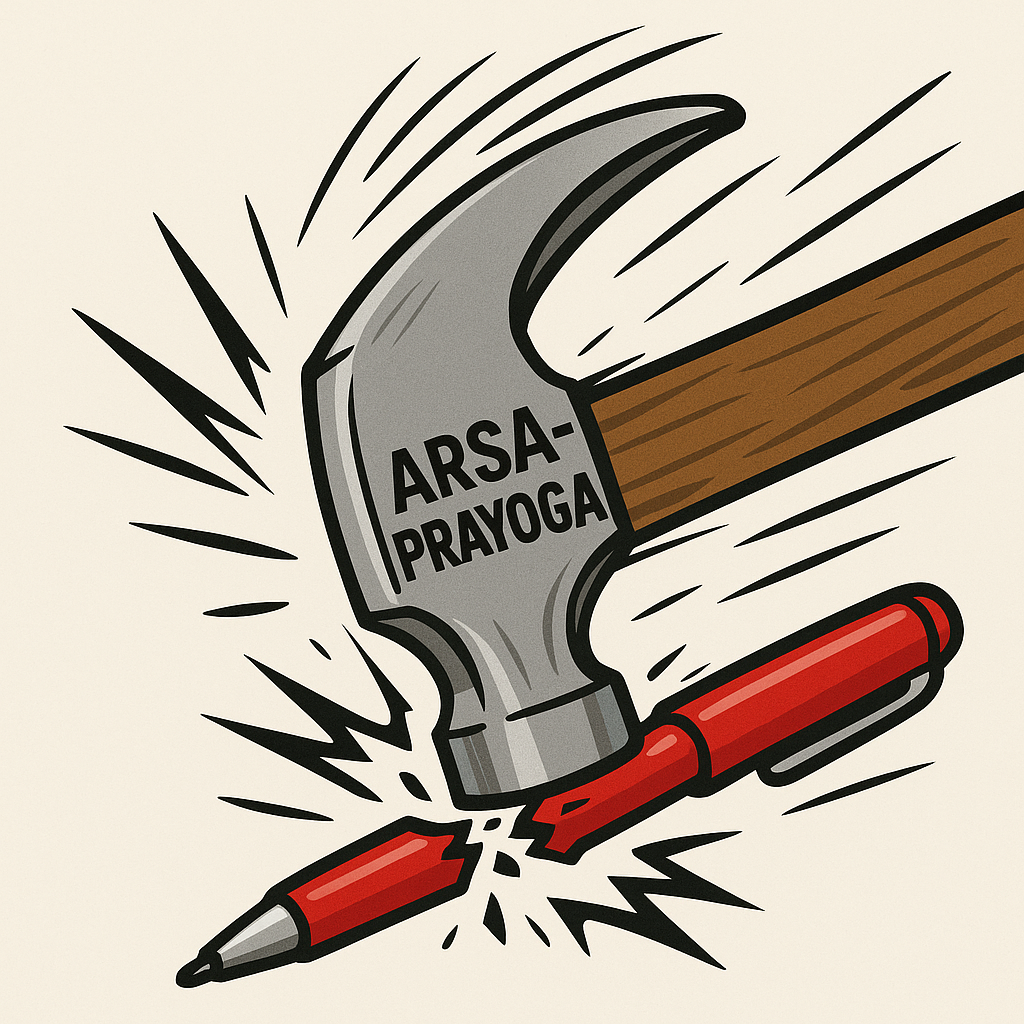
Why One Conversation Cannot Rewrite the Gītā: A Case Study in Misusing Prabhupāda’s Words

By Ajit Krishna Dasa

A devotee recently pointed to the following excerpt from a 1973 conversation and argued that, based on this alone, Bhagavad-gītā 18.66 should be “corrected” to replace the word religion with “occupation”:

Prabhupāda: Now, Kṛṣṇa says, sarva-dharmān parityajya [Bg. 18.66].
Satish Kumar: Yes.
Prabhupāda: Now, dharma means occupation. Dharma is not translated as “religion.”
Satish Kumar: No, no.
Prabhupāda: This is wrong translation. Dharma means occupation.
Satish Kumar: Activity?
Prabhupāda: Activity, occupation.
(Conversation, London, July 30, 1973)

Before rushing to “fix” the book, a few points need to be made—especially in light of arsa-prayoga, the principle that the words of the ācārya are not to be tampered with after his departure:

  1. No instruction, and thus no authorization, was given to change the verse. Srila Prabhupada often spoke freely and loosely in conversation, but he gave direct, literal instructions for book changes while present. Here, he did not.
  2. Srila Prabhupada himself frequently translated dharma as “religion.” This is not a one-off occurrence—it appears hundreds of times in his books and lectures. Are we now to “correct” them all? On what authority?
  3. He heard the verse read aloud repeatedly and never objected. This is decisive. He personally approved the printed Gītā, lectured from it, and signed off on it as finished work.
  4. What happens when we find other places where Prabhupada gives different meanings or emphases? Language is fluid, and Srila Prabhupada tailored his wording to context and audience. Selectively mining conversations to override the final, published work is not fidelity—it’s revisionism.
  5. This is exactly how “The Blessed Lord” was removed by Jayadvaita Swami and the BBTI from later editions. Even though Srila Prabhupada accepted that phrase while alive, and even used it himself, editors saw one conversation where he expressed a reservation—and used that as a pretext to delete it from the entire book.

If this logic is allowed, what will be next?

This is the fatal pattern: use a stray comment in a private conversation to overrule the public, authorized book. It weaponizes Prabhupada’s own words against his finished legacy. That is the opposite of arsa-prayoga. That is how the books slowly stop being his.

Bhagavad-gītā As It Is — Change of Cover Art

By Ajit Krishna Dasa

Bhagavad-gītā As It Is — Change of Cover Art

Description

The original Bhagavad-gītā As It Is, published during Śrīla Prabhupāda’s lifetime, features Krishna and Arjuna in the midst of the Kurukṣetra battlefield. Krishna, serene yet commanding, drives the chariot; Arjuna, bow in hand, reaches for an arrow, ready to act. The scene is dynamic, radiant, and filled with purpose. It embodies the Gītā’s central message — divine action under Krishna’s direction.

In contrast, the later BBT International cover replaces this vivid scene with a sepia-toned, static composition. Krishna and Arjuna sit quietly, the battlefield emptied of movement and power. The tone is reflective rather than transcendental, subdued rather than triumphant.

Type of change

Visual substitution — replacement of the original dynamic battlefield scene with a subdued, neutral reinterpretation.

Category

Philosophical change.

Commentary

The original cover: divine engagement and fearless surrender

Śrīla Prabhupāda’s approved cover proclaims the philosophy of the Gītā through imagery. Arjuna acts under Krishna’s order — his bow raised, but his heart surrendered. This is yoga in motion — not escapism, but spiritual courage.

The colors are rich, the composition alive. The scene radiates energy and conviction. It declares that Krishna consciousness is not an abstraction but a living call to act under divine direction. Śrīla Prabhupāda’s purpose was to awaken the world, and the cover reflects that sense of urgency and truth.

The viewer can feel the śakti — the divine energy of the moment when the soul, guided by Krishna, takes up its duty. This was not designed as decoration; it was preaching in paint.

The new cover: aesthetic calm and philosophical retreat

The later BBT International design strips that vitality away. Krishna and Arjuna now appear passive, framed in a gentle sepia hue. The dynamic exchange of surrender and command is replaced with composure and stillness. The mood has shifted from revelation and spiritual revolution to respectability.

This change did not happen by accident. The likely reason was discomfort — the fear that Arjuna with a drawn bow might look too “militant,” that the world might see the Gītā as a book of conflict. To avoid misunderstanding, they drained the image of its conviction. But by doing so, they did exactly what Prabhupāda warned against: they compromised the message to fit modern taste.

The result is art that pleases the world but fails to challenge it. The battlefield has become a conversation; surrender has become suggestion.

The original showed Krishna leading; the new shows Krishna posing. The first commands reverence; the second invites indifference.

From message to impression

The original cover invited readers into Krishna’s presence. The new one invites them into neutrality. The first preaches; the second performs. The first says, “Here is God leading His devotee.” The second says, “Here is a peaceful scene from an ancient text.”

This is not refinement — it is retreat. The battlefield of the soul has been turned into a soft philosophical setting, safe for polite society but stripped of its divine tension.

When sacred power is replaced by compositional balance, the Gītā stops being a living revelation and becomes a cultural artifact.

Conclusion

Śrīla Prabhupāda’s original cover was both spiritually bold and visually beautiful — suitable for any setting because it carried truth without apology. The replacement, though visually refined, removes the transcendental urgency and courage that the Gītā was meant to awaken.

To replace revelation with restraint is not service but revision.
And that quiet reduction — the removal of vitality, immediacy, and surrender — is the violation of the principle of arsa-prayoga.

Image Notes:

Left — Original 1972 cover approved by Śrīla Prabhupāda. Krishna and Arjuna in divine motion on the battlefield of Kurukṣetra, embodying surrender and duty under Krishna’s order.

Right — Later BBT International edition. A static, sepia reinterpretation that replaces transcendental engagement with polite serenity.