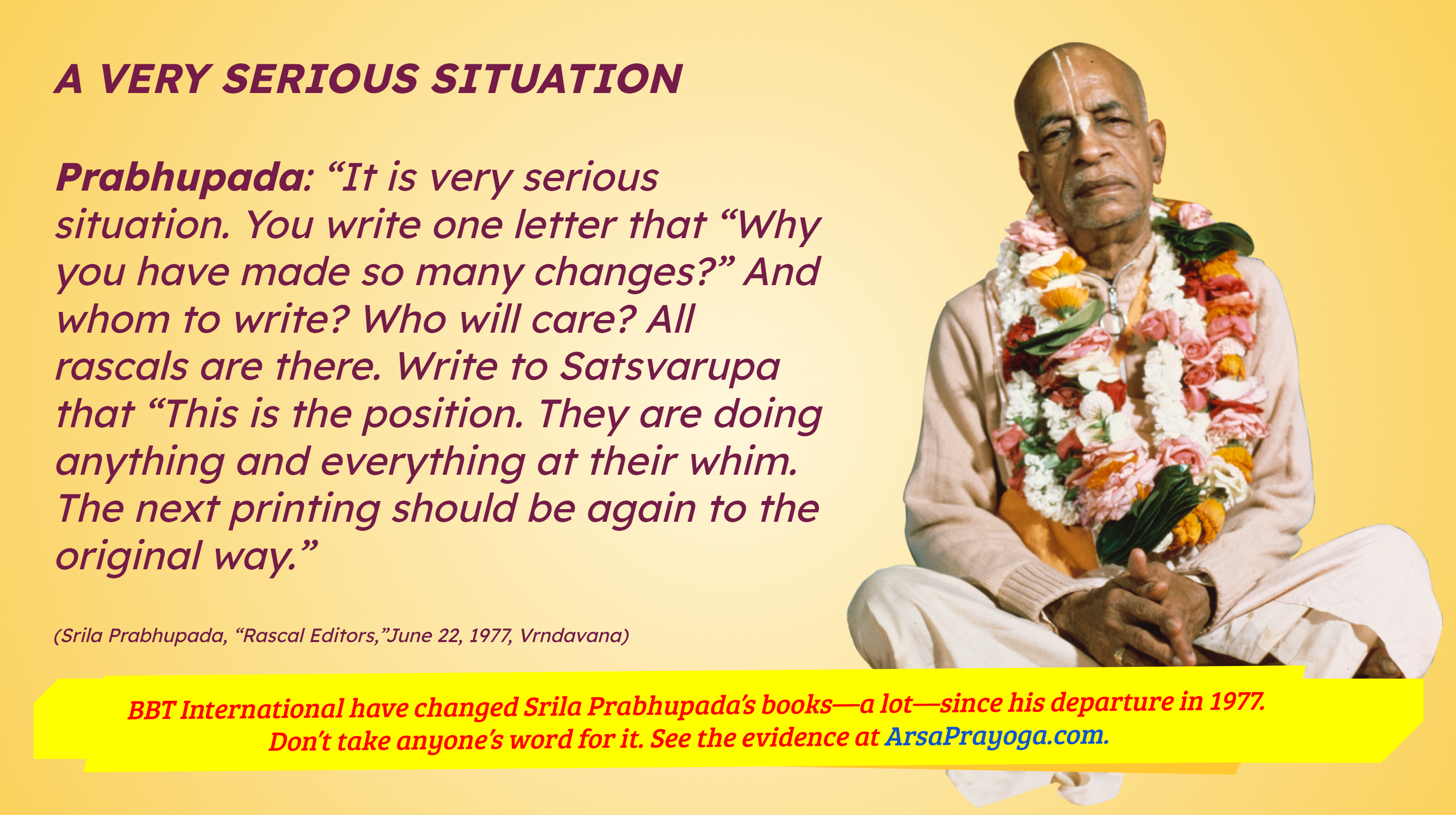
Jayadvaita Swami Makes a “Mad” Change – Revisited (Bhagavad-gita 13.1-2)

By Ajit Krishna Dasa (Denmark)

Bhagavad-gītā As It Is 13.1–2

Link to the Original Article

https://arsaprayoga.com/2014/09/26/jayadvaita-swami-makes-a-mad-change/

Description of the Change

In the purport to Bhagavad-gītā As It Is 13.1–2, the original and authorized 1972 edition reads:

“Sometimes we understand that I am happy, I am mad, I am a woman, I am a dog, I am a cat: these are the knowers.”

In the posthumous 1983 Bhagavad-gītā As It Is published by BBT International, this passage has been altered to:

“Sometimes we think, ‘I am happy,’ ‘I am a man,’ ‘I am a woman,’ ‘I am a dog,’ ‘I am a cat.’ These are the bodily designations of the knower.”

The word “mad” has been replaced with “a man”.

The available evidence, including the original manuscript, which is a transcription of Śrīla Prabhupāda’s spoken words, strongly supports “mad” as the original wording.

Type of Editorial Change

Substitution (Replacement)

One word has been removed and replaced with another, altering the wording of the text.

Category

Interpretive Editing (with philosophical implications)

The substitution reflects the editor’s interpretation of what the text should say, rather than what the available evidence suggests Śrīla Prabhupāda said or intended.

Commentary

Śrīla Prabhupāda frequently uses happiness and madness as philosophical opposites. These terms are not employed casually, but as indicators of epistemic condition.

Kṛṣṇa Himself establishes this polarity:

“The mode of goodness conditions one to happiness, passion to action, and ignorance to madness.”
Bhagavad-gītā 14.9

In Śrīla Prabhupāda’s teachings, happiness is associated with clarity, knowledge, and alignment with reality, whereas madness denotes illusion, ignorance, and misidentification. The conditioned soul falsely identifies with these states and takes them to be the self.

Thus, the original phrase “I am happy, I am mad” illustrates a key philosophical point: false identification with states of consciousness, not merely with bodily forms. This fits precisely with the subject matter of Chapter 13, which distinguishes the knower (kṣetrajña) from the known (kṣetra), including mental conditions.

By contrast, “man–woman” is a purely taxonomic distinction, comparable to up–down or left–right. It describes biological or social categories but carries little philosophical depth. It does not convey the contrast between knowledge and illusion that Śrīla Prabhupāda repeatedly emphasizes throughout his books, lectures, and conversations.

It is therefore significant that Jayadvaita Swami publicly dismissed the word “mad” as “straight-out nonsense” and denied that it could be the words of his spiritual master. This claim is not supported by the available manuscript evidence, nor by Śrīla Prabhupāda’s consistent and well-documented usage of the happy–mad polarity across his teachings.

Such a dismissal suggests more than a textual disagreement. It indicates a lack of holistic familiarity with Śrīla Prabhupāda’s philosophical language, combined with an editorial confidence that risks attributing error or incoherence to the ācārya himself. At minimum, it reflects interpretive overreach; at worst, it shows a willingness to override both evidence and tradition in favor of personal judgment, a posture that carries the risk of offense toward Śrīla Prabhupāda.

The original wording is grammatically sound, philosophically precise, consistent with Śrīla Prabhupāda’s teachings, and supported by the available manuscript evidence. The change was unnecessary and reflects editorial judgment rather than demonstrable error.

This is therefore a clear example of a philosophical change introduced through interpretive substitution in the posthumous, post-1977 BBT International editions of Bhagavad-gītā As It Is. It illustrates the broader pattern of posthumous book changes that alter how readers understand Śrīla Prabhupāda’s teachings.

Examples of how the “happy-mad” polarity is used by Śrīla Prabhupāda:

Just like a man — ordinarily we perceive — a gentleman, after working very hard, if he gets some bank balance and nice house, nice wife, and some children, he thinks, “I am very happy.” This is also maya. He thinks, “But I am happy.” What kind of maya? Pramattah tesam nidhanam pasyann api na pasyati. He is in maya, mad, illusion, pramatta. (Srimad-Bhagavatam 3.26.22, Bombay, December 31, 1974)

Don’t be very much happy when you are in happy condition of life; neither you become mad in miserable condition of life. (Srimad-Bhagavatam 3.26.47, Bombay, January 22, 1975)

You must have perfect knowledge. Then you’ll be happy. Then you’ll be peace. And if you are misguided, bewildered, mad, then how you can be happy? (Rotary Club Lecture, Ahmedabad, December 5, 1972)

So these are all mad condition. So when he turns to God… Service he must give. Nobody can say, “I’m not serving anybody.” That is not possible. You must be serving somebody. Just like you are serving government, he is serving some office, because service is our nature. So we are not happy because the service is misplaced. (Room Conversation and Interview with Ian Polsen — July 31, 1972, London)

Prabhupada: Even the father, mother is not crying. The mother’s baby dies. She cries, she becomes mad. But when the child gives up that childhood body, accept another body, she’s happy because she knows: “My son is there. (Room Conversation with Anna Conan Doyle, daughter-in-law of famous author, Sir Arthur Conan Doyle, August 10, 1973, Paris)

Pradyumna: It’s Canto Five, Chapter Five, verse number seven. “Even though one may be very learned and wise, he is mad if he does not understand that the endeavor for sense gratification is a useless waste of time. Being forgetful of his own interest, he tries to be happy in the material world, centering his interests around his home, which is based on sexual intercourse and which brings him all kinds of material miseries. In this way one is no better than a foolish animal.” (Room Conversation, February 16, 1977, Mayapur)

Because the mad son is loitering in the street without any information of the father, to bring him back before the father. That is the best. He will be happy. (Room Conversation, March 26, 1977, Bombay)

We are just like a criminal who has dirty things within his heart. He thinks, “If I get such-and-such thing, I’ll be happy.” And at the risk of his life he commits a crime. A burglar, a thief, knows that if he is captured by the police he’ll be punished, but still he goes and steals. Why? Nunam pramattah: he has become mad after sense gratification. (BTG, 1983, The Self And Its Bodies)

Feel Free – Give And Take – Revisited (Bg. 9.19)

By Ajit Krishna Dasa

Original article can be found in Bhakta Torben’s ebook Blazing Edits:

Description

In Srila Prabhupāda’s manuscript/draft for Bhagavad-gita As It Is 9.19, the dictated synonyms read:

sat — being
asat — non-being.

These exact synonyms also appear in the pre-samādhi editions, the authorized edition personally approved by Prabhupāda:

sat — being
asat — nonbeing.

These match the literal Sanskrit dictionary meanings: sat = being, existent; asat = non-being, nonexistent. In the posthumous BBT International edition, Jayadvaita Swami replaces these with

sat — spirit
asat — matter

—and adjusts the translation accordingly.

These substitutions do not appear in the manuscript, do not appear in the 1972 edition, and do not correspond to the literal Sanskrit.

Type of Change

Substitution. Jayadvaita Swami removes Srila Prabhupāda’s original synonyms (“being / non-being”) and replaces them with new synonyms (“spirit / matter”), a shift unsupported by any Prabhupāda source.

Category

Philosophical Alteration. This BBT International posthumous edit replaces Srila Prabhupāda’s specific translation choice for this verse with an alternative meaning he did not use here. Although sat and asat can carry broader philosophical associations in other contexts, Prabhupāda translated them in Bg 9.19 as “being / non-being.” Changing that to “spirit / matter” imposes an editor’s reinterpretation onto a verse where Prabhupāda had already given the exact meaning he intended.

Commentary

It is true that Srila Prabhupāda sometimes uses sat in a general philosophical sense to describe the eternal (spirit) and asat to describe the temporary (matter). However, this broader theological association does not justify altering his specific translation in a specific verse.

In Bhagavad-gita 9.19, Prabhupāda deliberately translated sat and asat as “being” and “non-being,” and this is confirmed by all available evidence:

1) Manuscript: Prabhupāda dictated sat = being, asat = non-being.
2) 1972 Edition: Prabhupāda published sat = being, asat = nonbeing.
3) Sanskrit Dictionary: sat = being, asat = non-being (as primary meanings).

The synonyms introduced by Jayadvaita Swami (“spirit” and “matter”) appear in none of these sources. They are not restorations of Prabhupāda’s work; they are editorial reinterpretations imposed onto the synonyms and translation after Prabhupāda’s departure.

Because the original wording is fully preserved in both the manuscript and the authorized 1972 edition, changing it does not take us “closer to Śrīla Prabhupāda,” as is the claim to fame of BBT International and Jayadvaita Swami—it takes the Bhagavad-gītā As It Is further away from Śrīla Prabhupāda’s own translation and intended meaning.

Even if “spirit” and “matter” are philosophically relevant within the broader framework of the Bhagavad-gita, Srila Prabhupāda did not use those terms to translate sat and asat in this verse.

Under the ārṣa-prayoga principle, the ācārya’s documented wording—especially when supported by both manuscript and pre-samādhi edition—is final and cannot be replaced with an editor’s inferred meaning.

The BBT International version thus represents an unauthorized posthumous substitution, shifting the verse away from Srila Prabhupāda’s own translation choice.

Jayadvaita Swami Condemns His Own Edits: A Case Study in Needless Change

By Ajit Krishna Dasa

Jayadvaita Swami wrote in 1986:

“As you know, and as we kept in mind while doing the work, Śrīla Prabhupāda staunchly opposed needless changes.” (Jayadvaita Swami, Letter to Amogha Lila, 1986)

This statement is correct. Śrīla Prabhupāda did staunchly oppose needless changes — and this principle is the foundation of ārṣa-prayoga, the principle that the words of a pure devotee are not to be altered by conditioned editors.

The following example — pointed out to us by Bhakta Torben Nielsen in his ebook Blazing Edits — illustrates the issue perfectly.

We look at a posthumous edit introduced by BBT International (BBTI) in the 1983 revised Bhagavad-gita As It Is, specifically 18.2, purport.

Original (Prabhupāda-approved pre-samadhi edition):

There are many prescriptions
of methods
for performing sacrifice
for some particular purpose
in the Vedic literatures.

Posthumously edited (BBTI edition):

In the Vedic literature
there are many prescriptions
of methods
for performing sacrifice
for some particular purpose.

This is not a correction.
This is not a clarification.
This is not a doctrinal improvement.

It is simply a relocation of one phrase — a stylistic reshuffling that has no philosophical or grammatical necessity whatsoever.

What problem did this edit solve?

None.

Was the original incorrect, unclear, or misleading?

No.

Did Srila Prabhupada ever request this change?

No.

Did BBTI give a reason for it?

No.

According to Jayadvaita Swami’s own standard — “Prabhupāda opposed needless changes” — this is precisely the kind of change Śrīla Prabhupāda would not have approved.

The contradiction is unavoidable:

  1. Jayadvaita Swami says unnecessary edits violate Prabhupāda’s wishes.
  2. Jayadvaita Swami then makes an unnecessary posthumous edit.

That is why this small change becomes a perfect diagnostic tool. It shows that once editors begin altering Srila Prabhupada’s books based on personal preference or literary style, the entire principle of ārṣa prayoga has already been abandoned.

Why This Matters for Bhagavad-gita As It Is

The 1972 first edition was personally approved, lectured from, distributed, and trusted by Śrīla Prabhupāda. The 1983 posthumously edited edition by BBTI was not.

When even a harmless sentence — one that Prabhupāda accepted and used — is needlessly altered, it proves the deeper issue:

Posthumous editing inevitably leads to editorial overreach, because the standard has shifted from “transmit exactly” to “improve according to taste.”

And once that door opens, the rest of the book becomes vulnerable.

It all starts with edits exactly like this.

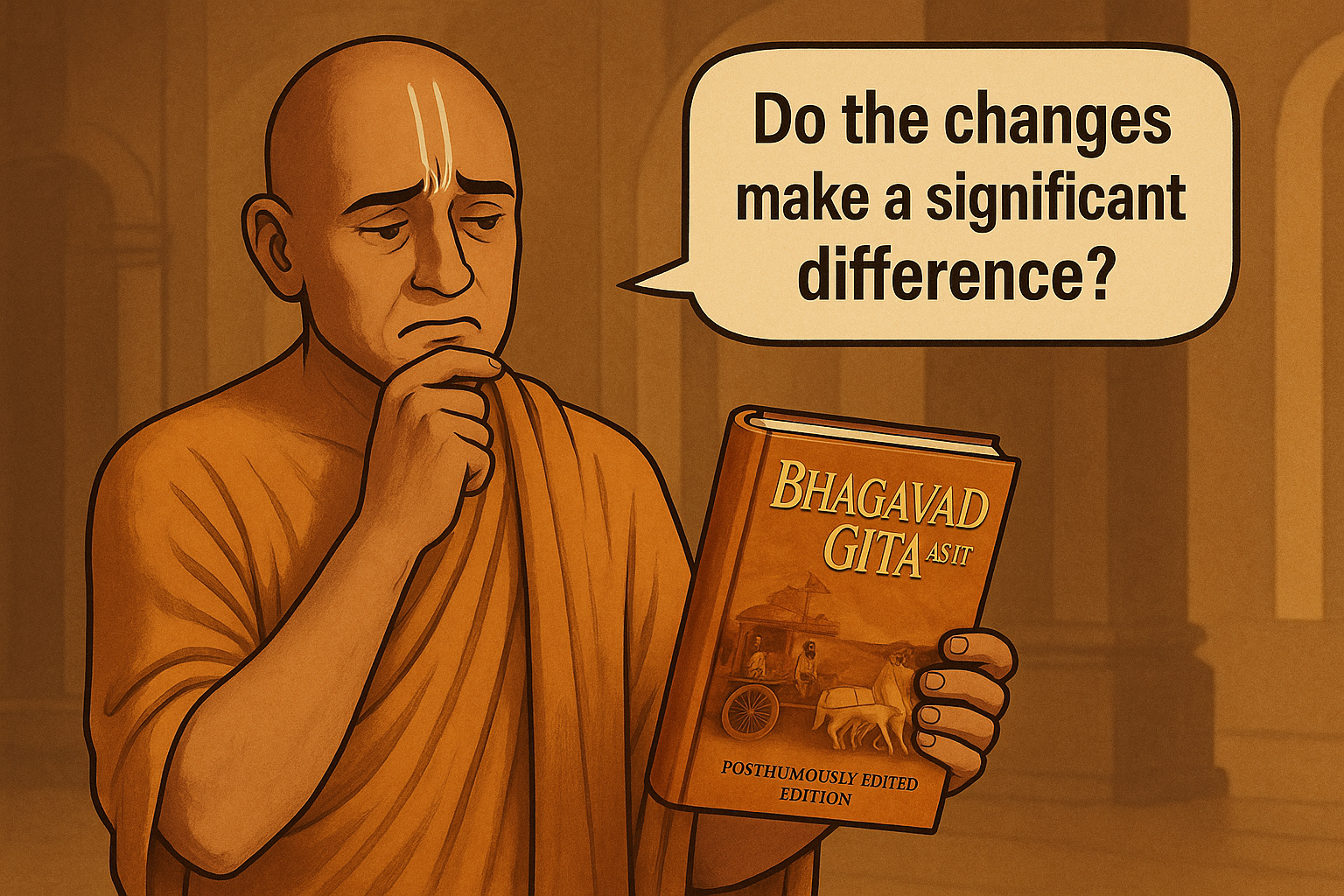
Why “Do the Changes Make a Significant Difference?” Is the Wrong Question

By Ajit Krishna Dasa

The question “Do the changes make a significant difference to the message?” sounds fair—but it completely misses the point. It assumes that the legitimacy of changing a pure devotee’s words depends on how much the meaning seems to change. That assumption itself is false.

The issue is not how much the message shifts. The issue is that anyone dared to shift it at all. Śrīla Prabhupāda’s books are not ordinary literature subject to posthumous editing or so-called editorial refinement by the Bhaktivedanta Book Trust International (BBT International) or its post-samādhi editors like Jayadvaita Swami. They are śabda-brahma—the sound incarnation of divine truth transmitted through an authorized ācārya. Once such an ācārya leaves this world, his words are final. No conditioned soul is authorized to adjust them, no matter how “minor” the adjustment may appear.

Even a single substituted synonym or rearranged phrase presumes editorial superiority over one who spoke under Kṛṣṇa’s direct guidance. That is why the ārṣa-prayoga principle exists: the words of the ācārya are sacred and must remain untouched. It protects the integrity of Śrīla Prabhupāda’s original books from unauthorized changes made after his departure.

Moreover, the idea of “significant difference” is itself deceptive. Many edits that look small actually do change meaning—altering theological emphasis, philosophical precision, or Śrīla Prabhupāda’s characteristic tone. But even if some do not, the very act of judging “significance” replaces revelation with speculation. It invites endless tampering under the same excuse, which has already been seen in the posthumously edited Bhagavad-gita As It Is.

There is also a deeper layer. Words don’t only convey meaning—they frame it. They shape how readers approach and internalize the message. Changing phrasing, order, or rhythm changes the lens through which the reader perceives the philosophy. Just as altering the cover of Bhagavad-gita As It Is reframes a reader’s expectations before opening the book, altering the language inside silently redefines how one enters the message itself.

Śrīla Prabhupāda’s English was an extension of his bhāva—his spiritual mood. His rhythm, simplicity, and repetition carried power far beyond grammar. To “polish” that expression is to polish away the teacher’s presence. Even if the words remain similar, the śraddhā-bindu—the drop of faith that transmits realization—fades.

So the real problem is not merely what has changed, but that the frame of reception—the channel connecting the reader to the guru—has been tampered with. Once that link is altered, the spiritual potency no longer flows in the same pure way.

That is why the question, “Do the changes make a significant difference?” is misplaced. The real question is:

Who gave anyone the right to touch even one word of a self-realized ācārya’s books after his departure?

Jayadvaita Swami’s Posthumous “Should Not” Edit – A Change in the Philosophy of Bhagavad-gītā (Bg. 13.1–2)

By Ajit Krishna Dasa

Description

In the purport to Śrīla Prabhupāda’s Bhagavad-gītā 13.1–2, a single missing word completely reverses the meaning of the text.

1972 Unabridged Edition (Collier-Macmillan, First Printing):

“Now, the person who identifies himself with this body is called kṣetrajña, the knower of the field.”

This wording wrongly defines the kṣetrajña—the knower of the field—as one who identifies with the body. When this error was read aloud in Paris in 1973, Śrīla Prabhupāda immediately caught it and corrected it personally.

He said:

“Who does not identify, it should be.”

“This should be corrected immediately.”

His instruction was clear and recorded. But in Jayadvaita Swami’s posthumously edited BBT International edition the sentence was changed to read:

“Now, the person, who should not identify himself with the body, is called kṣetra-jña, the knower of the field.”

This new version does not follow Śrīla Prabhupāda’s direct correction.

Type of Change

Substitution and Doctrinal Editing

The phrase “should not identify” replaces Śrīla Prabhupāda’s exact correction “does not identify.” This change substitutes a normative instruction for a descriptive definition, thereby altering the philosophical meaning of the Bhagavad-gītā purport.

Category

Doctrinal Error

The BBT International wording, “should not identify,” gives an entirely different philosophical conclusion.

Śrīla Prabhupāda’s version, “does not identify,” distinguishes the self-realized soul from the conditioned soul. Only those who do not identify with the body are kṣetrajña, the true knowers of the field.

By contrast, “should not identify” applies to all human beings, since everyone should not identify with the body. It therefore implies that even the ignorant, body-conscious person is “called kṣetrajña.”

This transforms a definition of realization into a moral exhortation—and thus changes the philosophy of the Bhagavad-gītā itself.

The result is a posthumous doctrinal alteration that stands in direct contradiction to Śrīla Prabhupāda’s explicit instruction.

It takes us not “Closer to Śrīla Prabhupāda“, as the BBT International catchphrase goes, but further away from him.

Commentary

Śrīla Prabhupāda’s recorded conversation (Paris, August 11, 1973) leaves no room for interpretation:

Prabhupāda: “It is wrongly written… Who does not identify, it should be… This should be corrected immediately… One must know that ‘I am not this body.’ That is knowledge. That is knower.”

The meaning is self-evident: The kṣetrajña is the person who knows he is not the body.

To say “should not identify” is not simply a weaker phrase—it collapses the distinction between knowledge and ignorance. It tells everyone what they ought to do, instead of describing who actually is the knower.

This is not a stylistic difference; it is a philosophical change.

In fairness, the same missing “not” appears in the original typed manuscript, which was a transcription of Śrīla Prabhupāda’s dictation. The error may have originated with the typist, not the early editors.

But after 11th August 1973 that was no longer relevant. When Śrīla Prabhupāda himself discovered the error and issued a correction, the matter was settled permanently.

Once the ācārya speaks, his words are final. No posthumous editorial interpretation can override them.

This is precisely the purpose of the Arsa-prayoga principle: the words of the ācārya are sacred and must not be changed by later editors, regardless of intention or perceived improvement.

As Śrīla Prabhupāda said that day:

“If you identify with body, how you know it? Oh, it is a very great mistake.”

The BBT International version preserves that mistake—only in a subtler form.

The correct version, as ordered by Śrīla Prabhupāda, reads:

“Now, the person who does not identify himself with this body is called kṣetrajña, the knower of the field.”

This is not just the right grammar. It is the right philosophy.

Note

This case perfectly illustrates why the Arsa-prayoga principle must be upheld in all dealings with Śrīla Prabhupāda’s books. Even small “clarifications” made after the author’s disappearance can become posthumous doctrinal changes that distort meaning and misrepresent the ācārya’s philosophy.

The correction ordered by Śrīla Prabhupāda was explicit and recorded. Jayadvaita Swami and BBT International had no mandate to modify or reinterpret it.

This single word—does not—marks the difference between ignorance and realization, illusion and knowledge. And when we protect Śrīla Prabhupāda’s exact words, we are not only defending language. We are defending truth itself.

The List That Doesn’t Exist! Or?

By Ajit Krishna Dasa

We’re told by Ramesvara Dasa that Srila Prabhupada personally approved a list of edits to his Bhagavad-gita As It Is. I have no problem accepting that. I even believe Ramesvara Dasa when he says he saw it. It would be wonderful to have the list!

But here’s the reality: the list seems to have vanished. No one has it. No one can show it. And without the list in hand, no one can prove what was on it, what was approved, or what wasn’t.

Even if several devotees from BBT or ISKCON saw it 40 or 50 years ago, memory is not a reliable basis for editing the books of an acharya. No one alive today can recall every detail with perfect accuracy after so many years. And even if they could, we would still be left with no way to verify it.

Let’s grant the strongest possible version of the argument and say the list absolutely existed and listed real, Prabhupada-approved changes. Then what? Without the list in our hands today, we cannot distinguish between:

– The changes Srila Prabhupada personally approved,
– The changes made later by editors after his departure, and
– The mistakes he deliberately left in.

That distinction is essential. Because if we start “fixing” or “restoring” the text without knowing which changes were authorized, we immediately run into a crisis: removing even one change could erase something Srila Prabhupada wanted kept. Leaving in even one change could preserve an unauthorized edit made after his departure. We can’t know who we’re obeying, and who we’re overriding.

So even if the list was seen by some devotees long ago, the fact that it cannot be produced today means that it cannot serve as a valid basis for altering Srila Prabhupada’s books. At this point, anyone making changes is operating on guesswork. And guesswork with the words of a pure devotee is not service. It is tampering.

Until the list is actually produced — not merely remembered or rumored — the only safe and faithful policy is:

-No posthumous edits.
-No guessing.
-No tampering with what we cannot verify.

Otherwise, we’re effectively trusting editors (Jayadvaita Swami and Dravida Dasa) more than Srila Prabhupada himself. That is not loyalty. That is deviation.

Until the list is in our hands, there is no debate. Either we preserve Srila Prabhupada’s books as he left them, or we risk rewriting him based on somebody’s memory from 1977. The choice should be obvious.

Krishna – No Longer the Perfection of Yoga – Revisited

By Ajit Krishna Dasa

Arsa-Prayoga.com – Revisited is the title of an upcoming ebook that continues the work begun here on arsaprayoga.com. It re-examines the changes made to Śrīla Prabhupāda’s original books from new angles and explains why each alteration is significant.

Each example will also be posted here on arsaprayoga.com.

Today we are revisiting:

Krishna – No Longer the Perfection of Yoga

Description

The original cover of The Perfection of Yoga, published during Śrīla Prabhupāda’s presence, depicts Lord Krishna instructing Arjuna on the battlefield of Kurukṣetra. The newer version replaces this sacred scene with a modern, abstract image: a silhouetted yoga figure against a cosmic background, accompanied by planetary symbols and a hummingbird.

Type of change

Visual substitution — replacement of the original painting with a completely different concept.

Category

Philosophical change.

Commentary

The original cover: revelation and surrender

The first edition’s painting is not just devotional art — it is theology in color. It captures the divine dialogue of the Bhagavad-gītā: the Supreme Lord imparting transcendental knowledge to the bewildered soul. Krishna’s gesture expresses both compassion and authority, while Arjuna’s posture shows humility and surrender.

This image teaches before one even opens the book. It tells the reader: “Here is yoga in its highest form — the union between the soul and Krishna through surrender and service.” The visual message aligns perfectly with Śrīla Prabhupāda’s text, where yoga culminates not in physical postures or impersonal meditation, but in bhakti-yoga, devotion to the Supreme Personality of Godhead.

The new cover: abstraction and self-centered spirituality

The new cover shifts the entire philosophical mood. The central figure is no longer Arjuna receiving revelation but a lone silhouette performing an asana — an emblem of modern yoga culture. The background, with its planets, abstract lights, and hovering bird, suggests cosmic energy and mysticism rather than divine personality.

The focus has moved from Krishna to the individual practitioner. The very idea of “perfection” is reframed — from surrender to the Supreme to self-realization through posture and mental discipline. The new imagery reflects the psychology of self-help and the commercial yoga industry rather than the theology of bhakti.

The consequence: from tattva to marketing

This shift is not cosmetic. It mirrors the broader editorial problem: once Krishna is removed from the center — visually or textually — everything else changes. The meaning of yoga becomes sentimental and speculative.

Where the original cover anchored the reader in tattva (spiritual truth), the new one drifts toward māyā-vāda aesthetics — the impersonal mood of “energy,” “light,” and “universal consciousness.” It exchanges humility for abstraction, devotion for design.

Śrīla Prabhupāda’s original books were meant to preach, not to conform. The old cover declared the eternal truth of Krishna consciousness; the new one markets a diluted idea of spirituality.

In short: the original cover preaches; the new cover advertises.

And that change — from revelation to representation, from śabda-pramāṇa (divine authority) to manuṣya-pramāṇa (human taste) — is the violating of the principle of arsa-prayoga.