Jayadvaita Swami Condemns His Own Edits: A Case Study in Needless Change

By Ajit Krishna Dasa

Jayadvaita Swami wrote in 1986:

“As you know, and as we kept in mind while doing the work, Śrīla Prabhupāda staunchly opposed needless changes.” (Jayadvaita Swami, Letter to Amogha Lila, 1986)

This statement is correct. Śrīla Prabhupāda did staunchly oppose needless changes — and this principle is the foundation of ārṣa-prayoga, the principle that the words of a pure devotee are not to be altered by conditioned editors.

The following example — pointed out to us by Bhakta Torben Nielsen in his ebook Blazing Edits — illustrates the issue perfectly.

We look at a posthumous edit introduced by BBT International (BBTI) in the 1983 revised Bhagavad-gita As It Is, specifically 18.2, purport.

Original (Prabhupāda-approved pre-samadhi edition):

There are many prescriptions
of methods
for performing sacrifice
for some particular purpose
in the Vedic literatures.

Posthumously edited (BBTI edition):

In the Vedic literature
there are many prescriptions
of methods
for performing sacrifice
for some particular purpose.

This is not a correction.
This is not a clarification.
This is not a doctrinal improvement.

It is simply a relocation of one phrase — a stylistic reshuffling that has no philosophical or grammatical necessity whatsoever.

What problem did this edit solve?

None.

Was the original incorrect, unclear, or misleading?

No.

Did Srila Prabhupada ever request this change?

No.

Did BBTI give a reason for it?

No.

According to Jayadvaita Swami’s own standard — “Prabhupāda opposed needless changes” — this is precisely the kind of change Śrīla Prabhupāda would not have approved.

The contradiction is unavoidable:

  1. Jayadvaita Swami says unnecessary edits violate Prabhupāda’s wishes.
  2. Jayadvaita Swami then makes an unnecessary posthumous edit.

That is why this small change becomes a perfect diagnostic tool. It shows that once editors begin altering Srila Prabhupada’s books based on personal preference or literary style, the entire principle of ārṣa prayoga has already been abandoned.

Why This Matters for Bhagavad-gita As It Is

The 1972 first edition was personally approved, lectured from, distributed, and trusted by Śrīla Prabhupāda. The 1983 posthumously edited edition by BBTI was not.

When even a harmless sentence — one that Prabhupāda accepted and used — is needlessly altered, it proves the deeper issue:

Posthumous editing inevitably leads to editorial overreach, because the standard has shifted from “transmit exactly” to “improve according to taste.”

And once that door opens, the rest of the book becomes vulnerable.

It all starts with edits exactly like this.

Why “Do the Changes Make a Significant Difference?” Is the Wrong Question

By Ajit Krishna Dasa

The question “Do the changes make a significant difference to the message?” sounds fair—but it completely misses the point. It assumes that the legitimacy of changing a pure devotee’s words depends on how much the meaning seems to change. That assumption itself is false.

The issue is not how much the message shifts. The issue is that anyone dared to shift it at all. Śrīla Prabhupāda’s books are not ordinary literature subject to posthumous editing or so-called editorial refinement by the Bhaktivedanta Book Trust International (BBT International) or its post-samādhi editors like Jayadvaita Swami. They are śabda-brahma—the sound incarnation of divine truth transmitted through an authorized ācārya. Once such an ācārya leaves this world, his words are final. No conditioned soul is authorized to adjust them, no matter how “minor” the adjustment may appear.

Even a single substituted synonym or rearranged phrase presumes editorial superiority over one who spoke under Kṛṣṇa’s direct guidance. That is why the ārṣa-prayoga principle exists: the words of the ācārya are sacred and must remain untouched. It protects the integrity of Śrīla Prabhupāda’s original books from unauthorized changes made after his departure.

Moreover, the idea of “significant difference” is itself deceptive. Many edits that look small actually do change meaning—altering theological emphasis, philosophical precision, or Śrīla Prabhupāda’s characteristic tone. But even if some do not, the very act of judging “significance” replaces revelation with speculation. It invites endless tampering under the same excuse, which has already been seen in the posthumously edited Bhagavad-gita As It Is.

There is also a deeper layer. Words don’t only convey meaning—they frame it. They shape how readers approach and internalize the message. Changing phrasing, order, or rhythm changes the lens through which the reader perceives the philosophy. Just as altering the cover of Bhagavad-gita As It Is reframes a reader’s expectations before opening the book, altering the language inside silently redefines how one enters the message itself.

Śrīla Prabhupāda’s English was an extension of his bhāva—his spiritual mood. His rhythm, simplicity, and repetition carried power far beyond grammar. To “polish” that expression is to polish away the teacher’s presence. Even if the words remain similar, the śraddhā-bindu—the drop of faith that transmits realization—fades.

So the real problem is not merely what has changed, but that the frame of reception—the channel connecting the reader to the guru—has been tampered with. Once that link is altered, the spiritual potency no longer flows in the same pure way.

That is why the question, “Do the changes make a significant difference?” is misplaced. The real question is:

Who gave anyone the right to touch even one word of a self-realized ācārya’s books after his departure?

Malati Devi Dasi: “One shouldn’t change. You can write your own.”

By Ajit Krishna Dasa

8 November 2025 — Bhaktivedanta Manor, UK

During a class at the Bhaktivedanta Manor, Malati Devi Dasi recounted a well-known episode from Śrī Caitanya-caritāmṛta where Lord Caitanya Mahāprabhu corrected a single-word alteration made by Sarvabhauma Bhaṭṭācārya, the renowned scholar of Jagannātha Purī.

After becoming a devotee, Sarvabhauma was so overwhelmed with joy that he modified the word “mukti-pade” in Śrīmad-Bhāgavatam 10.14.8, replacing it with “bhakti-pade.” Although his intention was devotional, Mahāprabhu corrected him, explaining that “mukti-pade” is already a beautiful name of Kṛṣṇa, and śāstra must not be altered based on sentiment or preference.

Malati Devi Dasi drew a direct parallel to modern tendencies to edit sacred texts:

“Nowadays we also have people who like to change words from the holy scriptures, and some of us don’t appreciate it very much. … Śrīla Prabhupāda commented, ‘Write your own.’ In other words, one shouldn’t change. You can write your own.”

Her words are especially significant in light of the Arsa-Prayoga principle, which holds that the words of the ācārya are sacred and should not be edited or “improved” posthumously – like it has been done by Jayadvaita Swami, Dravida Dasa and the BBTI. Just as Mahāprabhu upheld the integrity of the original Bhāgavatam verse, devotees today are called to preserve Śrīla Prabhupāda’s books – like his Bhagavad-gita As It Is – exactly as he approved them — without revision or re-interpretation.

Three Key Points to Note

  1. Malati Devi Dasi’s Personal Stance
    While Malati Devi spoke strongly against altering śāstra or works of ācāryas, it is not entirely clear what her full position is regarding the specific changes made to Śrīla Prabhupāda’s books. We respectfully invite her to elaborate further — especially given her stature as one of Śrīla Prabhupāda’s earliest and most respected disciples.
  2. The Arsa-Prayoga Principle
    This sacred principle — “Do not correct the ācārya” — has historically been recognized throughout the Vaiṣṇava tradition. Śrīla Prabhupāda himself invoked this principle when arguing against revising earlier editions of Bhagavad-gītā and Bhāgavatam by other commentators. “Write your own,” he said. Changing the master’s work, even with good intentions, severs the disciplic link by overlaying the disciple’s mind over the guru’s words.
  3. The Lesson from Sarvabhauma Bhaṭṭācārya
    Sarvabhauma’s change of one word was born of devotion, but Mahāprabhu still corrected it. If the Lord Himself did not approve of devotional word-swapping, what to speak of posthumous textual reconstruction by conditioned disciples decades later? The story demonstrates that no matter how exalted the editor or emotional the inspiration, śāstra and ācārya-vāṇī are not ours to adjust.

The full transcription, audio and video excerpt from Malati Devi Dasi’s class will be included below for reference.

If nothing else, the class was a timely reminder that great caution — and deep humility — is required when dealing with the words of the Lord and His pure devotee.

Video:

Audio:

https://drive.google.com/file/d/1KkVZgvY94F6IgLG0dOlYsC_aTGslC2kn/view?usp=drive_link

Full transcription (made with AI):

“So Mahaprabhu said, today I have been transported beyond the three worlds and I’ve been taken to Vaikuntha. All my desires have been fulfilled simply because Sarvabhauma has developed faith in Mahaprasad. And as a result of this, his attitude, Sarvabhauma’s attitude has also changed. And his conversion, it was like a conversion on that day. So he recited a verse of the Bhagavatam, and in that verse, in his newfound ecstasy and realizations, he changed one word. So I think nowadays we also have, we also have people that like to change words from the holy scriptures, and we don’t appreciate, some of us don’t appreciate it very much. So he altered one word. So the verse is well-known, 10.14.8 [Malati recites the Sanskrit], and here’s what he changed. So in the original version, it’s not bhakti-pade. And the verse in English, one who lives his life while joyfully seeing everything as your compassion, meaning the Lord’s compassion, so one who lives his life while joyfully seeing everything as your compassion, even as he experiences adverse conditions arriving from his past deeds, and constantly, nonetheless, constantly pays obeisances to you with his mind, words, and body, is certain to inherit a place at your lotus feet, the object of all devotion. So the original word was mukti-pade, and he changed that mukti-pade to bhakti-pade. And Mahaprabhu explained that there’s no need to change the words of mukti-pade, the source of liberation. It’s a epithet for Krishna. And Vasudeva answered, you’re quite correct to say that the words mukti-pade refer to Krishna, but the word mukti was used customarily in the sense of impersonal liberation, and thus it didn’t bring the same great pleasure as the word bhakti. So that, you know, for somebody who’s maybe not quite as astute, that may ring a bell. Yeah, that’s right. But that’s not how you approach a shastra, and particularly if your books are coming to you from jagat guru Srila Prabhupada, one should be very circumspect. So the other, when the other scholars in Puri heard that Sarvabhauma Bhattacharya had been converted to devotion to Krishna, because he’d been, you know, he’d been an impersonalist. And when they heard about this conversion to Krishna, then all of them took shelter of Caitanya Mahaprabhu. You know, like our verse from the Gita, that whatever the great man does, the common man will follow. He was a great man, he was a much revered and respected personality, and now he was joining the cult of Chaitanya Mahaprabhu. And so they also followed, just like by getting the Beatles to chant Hare Krishna, by getting George in particular, it affected generations. Even to this day, people come across, oh, George Harrison chanted Hare Krishna, and they see the Krishna book with his signature, and immediately they’re attracted. But regards to changing the original text of the Shastra, Srila Prabhupada commented, write your own. In other words, one shouldn’t change. You can write your own.”

The Poison of “Correction”

By Ajit Krishna Dasa

Even if the Hare Krishna mantra is chanted with imperfect pronunciation, when it is offered from the heart of a sincere devotee, it fully manifests its spiritual potency. The Lord accepts devotion, not technical precision. When the same mantra is spoken by one without devotion, even if every syllable is perfectly pronounced, it remains spiritually barren.

In the same way, a text, like Bhagavad-gita As It Is, that contains some mistakes but is written by a pure devotee is infinitely more valuable than a text polished and faultless yet composed by a non-devotee or a devotee still bound by the modes of nature, like Jayadvaita Swami. The words of a pure devotee are not of this world—they carry realization, faith, and the power to awaken dormant love of God. Even a text with mistakes written by an imperfect devotee with good intentions is incomparably more beneficial than one written without mistakes by a person bereft of devotion. The measure of truth is bhakti, not grammatical or academic refinement.

Those, like Jayadvaita Swami, Dravida Dasa and the whole BBTI, who cannot grasp this principle and imagine themselves fit to posthumously “correct” Srila Prabhupada’s books expose the arrogance of their own contamination. By inserting their so-called improvements—corrections, additions, alterations, deletions—they violate the arsa-prayoga principle and impose their conditioned, offensive mentality upon the pure devotee’s work and upon the hearts of all who read it. Even when their changes are materially correct, they are spiritually poisonous, for they spring from pride and disbelief. The transcendental mistakes of a pure devotee like Srila Prabhupada are divinely sanctioned; to tamper with them is to challenge the authority of the Lord Himself.

Therefore, to protect the integrity of the transcendental message, Srila Prabhupada’s words must be preserved exactly as he gave them—untouched, unaltered, and undefiled by the ambition of the faithless.

From Dhyana to Sankhya: Prabhupada’s Vision for Chapter 6

By Ajit Krishna Dasa

Srila Prabhupada’s decision to title Chapter 6 of the Bhagavad Gita As It Is “Sankhya Yoga” stands as a distinctive and deliberate choice, diverging from the more common “Dhyana Yoga” favored by traditional acharyas, modern scholars, and Western translators. This title, unique in the history of widely recognized Gita commentaries, reflects his mission to present the text through the lens of Gaudiya Vaishnavism while reintroducing the theistic Sankhya philosophy of Kapila Muni, the divine son of Devahuti from the Srimad Bhagavatam. Far from a mere editorial quirk, Prabhupada’s naming can be seen as a strategic reclamation of the term “Sankhya,” serving as an implicit attack on the atheistic Sankhya school and aligning the chapter’s teachings with Krishna consciousness. This choice makes sense when viewed through the philosophical content of Chapter 6, its integration of Sankhya and Yoga, and Prabhupada’s broader purpose of countering materialistic philosophies.

Philosophical Foundations: Theistic Sankhya and Its Contrast with Atheism

Sankhya philosophy, one of the six classical schools of Indian thought, fundamentally distinguishes between purusha (the eternal, conscious soul) and prakriti (temporary, unconscious matter), aiming for liberation through analytical knowledge. However, two versions of Sankhya exist: the atheistic, classical Sankhya, often attributed to a sage Kapila, which denies a supreme God and posits multiple purushas liberated through intellectual discernment alone, and the theistic Sankhya of Kapila Muni, an incarnation of Vishnu, as detailed in Srimad Bhagavatam (Canto 3, Chapters 24–33). The latter integrates this dualistic framework with devotion to Krishna, the Supreme Purusha, as the source and controller of all existence.

Srila Prabhupada consistently champions the theistic Sankhya of the Bhagavatam’s Kapila, critiquing the atheistic version as incomplete. In his purport to Gita 2.39, he describes Sankhya as the analytical study of soul and matter but ties it to Krishna’s authority, while in Srimad Bhagavatam 1.2.30, he credits Kapila (the Vishnu avatar) with creating Sankhya to dispel material illusion, implying the atheistic school is a corruption. By titling Chapter 6 “Sankhya Yoga,” Prabhupada reclaims the term from its godless connotation, positioning it as a Krishna-centric science of self-realization. This choice serves as an attack on atheistic Sankhya by asserting that true Sankhya—unlike its materialistic distortion—culminates in devotion to the Supreme Personality of Godhead, not mere intellectual isolation.

Chapter 6’s Content: A Blend of Sankhya Philosophy and Yogic Practice

Chapter 6 of the Gita, while renowned for its meditative instructions (e.g., 6.11–14: sitting steadily, focusing on the self or Krishna), contains philosophical elements that resonate with Sankhya, justifying Prabhupada’s title. Verses like 6.5–6 (“One must deliver himself with the help of his mind… the mind is the friend or enemy”) echo Sankhya’s view of the mind as a product of prakriti that binds or liberates the purusha depending on its mastery. Similarly, 6.1–4 emphasize detachment from sense objects and fruitive results, mirroring Sankhya’s goal of disentangling the soul from material nature. The description of the yogi’s transcendent state in 6.20–23—realizing the self’s distinction from matter through “transcendental senses”—further aligns with Sankhya’s liberation through discriminative knowledge.

Prabhupada’s “Sankhya Yoga” title broadens the chapter’s scope beyond meditation (dhyana) to include this analytical foundation, reflecting the theistic Sankhya of Kapila, where understanding the soul’s eternality leads to Krishna (Srimad Bhagavatam 3.25.18). Unlike “Dhyana Yoga,” which narrows the focus to meditative practice, “Sankhya Yoga” encapsulates the integration of knowledge (Sankhya) and discipline (Yoga), culminating in devotion (6.47: “The highest yogi thinks of Me constantly”). By highlighting these Sankhya elements, Prabhupada challenges atheistic Sankhya’s endpoint—self-isolation without God—replacing it with a theistic synthesis that directs the practitioner to Krishna, thus undermining the atheistic school’s philosophical legitimacy.

Historical Context: Sankhya and Yoga’s Traditional Connection

The tendency in Indian tradition to connect Sankhya and Yoga as complementary systems supports Prabhupada’s titling. Historically, Sankhya provides the metaphysical blueprint (distinguishing purusha from prakriti), while Yoga, particularly Patanjali’s Ashtanga Yoga, offers the practical path, with dhyana (meditation, the seventh limb) as a key stage. The Gita itself reflects this synergy: Chapter 2 introduces Sankhya’s analytical wisdom (2.39), and Chapter 6 blends it with yogic practice. Prabhupada’s “Sankhya Yoga” title leverages this tradition, but adapts it to Vaishnavism by rooting it in Kapila’s theistic Sankhya, not the atheistic version that Patanjali’s Yoga partially accommodates (via Ishvara, Yoga Sutras 1.23).

This historical pairing bolsters Prabhupada’s attack on atheistic Sankhya. By invoking “Sankhya” in a yogic context, he reasserts its original spiritual purpose—lost in the godless classical school—and aligns it with the Gita’s theistic narrative, where Krishna is the ultimate goal (Gita 15.17–18). This reclamation serves as a polemic, subtly exposing atheistic Sankhya’s inadequacy compared to its devotional counterpart.

Prabhupada’s Strategic Intent: Attacking Atheistic Sankhya and Inspiring Exploration of the Bhagavatam

Prabhupada’s mission was to counter materialistic and impersonal philosophies, including atheistic Sankhya, which he saw as a distortion of Vedic truth. His critiques in purports—e.g., dismissing atheistic Sankhya as “dry speculation” (Gita 7.4, purport)—reveal his intent to restore its theistic essence. Naming Chapter 6 “Sankhya Yoga” is a deliberate strike against this distortion for several reasons:

  1. Reclamation of Terminology: By using “Sankhya,” a term familiar to scholars and practitioners, Prabhupada confronts its atheistic association head-on. He redefines it through Kapila’s lens, where analytical knowledge serves bhakti, not godless liberation, thus challenging the classical school’s authority.
  2. Philosophical Superiority: The chapter’s content—integrating self-realization with devotion—demonstrates that theistic Sankhya surpasses atheistic Sankhya. Verses like 6.29–30 (“He who sees Me everywhere”) elevate Sankhya’s dualism into a Krishna-centric unity, exposing the atheistic version’s limitation in stopping at individual purusha without recognizing the Supreme Purusha.
  3. Educational Polemic: Prabhupada’s global audience included Westerners and Indians influenced by secular interpretations of Sankhya. Titling Chapter 6 “Sankhya Yoga” educates them that true Sankhya aligns with Krishna consciousness, countering scholarly narratives equating Sankhya with atheism and reinforcing the Gita’s theistic intent “as it is.”
  4. Parampara’s Authority: By tying the title to Kapila of the Bhagavatam, Prabhupada roots it in disciplic succession, contrasting it with speculative atheistic Sankhya. This asserts the Vedic authenticity of his interpretation, undermining the classical school’s standalone credibility.
  5. Inspiring Engagement with the Srimad Bhagavatam: Beyond attacking atheistic Sankhya, Prabhupada’s use of “Sankhya Yoga” also aimed to inspire readers to explore the Srimad Bhagavatam, which he considered the “ripe fruit of the Vedic tree” (Srimad Bhagavatam 1.1.3, purport) and the ultimate scripture for Krishna consciousness. By linking Chapter 6 to Kapila’s theistic Sankhya—detailed in Bhagavatam Canto 3, Chapters 24–33—he creates a bridge to this text, where Kapila’s teachings expand on the Gita’s principles with a devotional focus (e.g., Bhagavatam 3.25.18). In purports like Gita 6.13–14, he references Kapila’s meditation on Vishnu (Bhagavatam 3.28.8–11), subtly encouraging readers to delve into the Bhagavatam for a deeper understanding of both Kapila’s Sankhya but also of the Srimad-Bhagavatam itself. For his audience—many unfamiliar with this scripture—the title “Sankhya Yoga” plants a seed of curiosity about Kapila’s full discourse, reinforcing the Bhagavatam’s role as the natural next step after the Gita and enhancing his mission to elevate global devotion through the parampara’s treasures.

Uniqueness and Justification

No major traditional acharya (e.g., Shankaracharya, Ramanujacharya, Madhvacharya) or modern translator (e.g., Sivananda, Chinmayananda) titles Chapter 6 “Sankhya Yoga”—they typically use “Dhyana Yoga” or variants, reserving “Sankhya Yoga” for Chapter 2. Prabhupada’s divergence is a bold innovation, justified by Chapter 6’s Sankhya-like elements and his mission. While “Dhyana Yoga” fits the chapter’s meditative focus, “Sankhya Yoga” captures its broader philosophical depth, aligning with his view of Kapila’s system as both knowledge and practice directed toward Krishna.

Conclusion: A Sensible and Strategic Choice

Srila Prabhupada’s “Sankhya Yoga” title for Chapter 6 makes profound sense as a reflection of its content—merging Sankhya’s analytical insights with Yoga’s meditative discipline—and his intent to advance Gaudiya Vaishnavism. It serves as a strategic attack on atheistic Sankhya by reintroducing Kapila’s theistic version, challenging its godless conclusions, and redirecting its principles toward Krishna. This choice not only highlights the chapter’s philosophical richness but also fulfills Prabhupada’s mission to present the Gita as a devotional text, countering materialistic distortions and establishing Krishna consciousness as the ultimate synthesis of Vedic wisdom. In this light, “Sankhya Yoga” is not just a title—it’s a declaration of theistic triumph over atheism, rooted in scripture and tradition.

For a definitive proof that Srila Prabhupada wanted Chapter Six of his Bhagavad-gita As It Is to be named Sankhya-Yoga, please see this article.

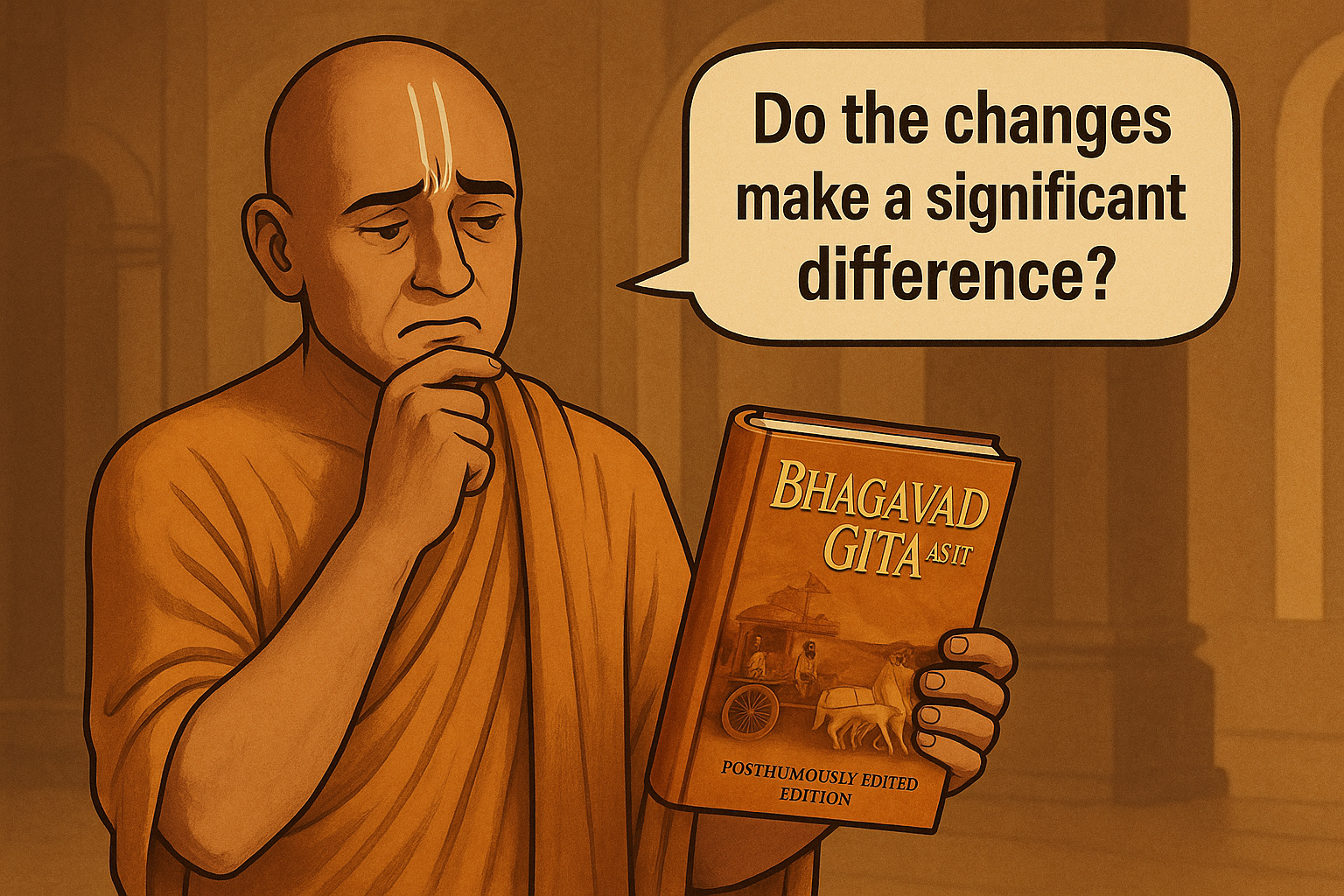
PROBLEM OF THE BBT EDITING SUMMARIZED

“The problem of the Bhaktivedanta Book Trust (BBT) editing can be summarized fairly well with four concise points:

(1) False Assumption of Authority: where Prabhupada only granted conservative, provisional authority, the BBT editors assumed unrestricted, open-ended authority.

(2) Editorial Overreach: where Prabhupāda requested only simple copyediting and correction of obvious mistakes, the BBT editors took great liberties in revising, omitting, and even attempting to correct the author’s content.

(3) Noncompliance with Scholarly Standards: where Prabhupada requested scholarly editorial standards, the BBT editors misapplied scholarly textual methods and employed arbitrary and inconsistent editing practices.

(4) Editorial Changes without Transparency: where devotional and scholarly editorial standards compelled full transparency, the extent of editorial changes by the BBT editors are undisclosed in the author’s works.”

Reference:

Posthumous Editing of A Great Master’s Work – Special Focus on the Writings of A. C. Bhaktivedanta Swami Prabhupada, Edited by Graham M. Schweig, 2024, Lexington Books, Introduction, p. 3-4)