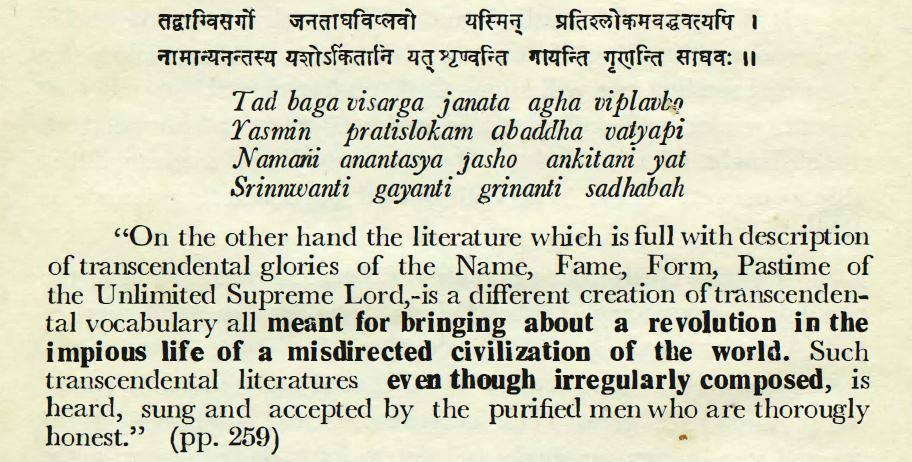
Prabhupada: “There is a verse in Srimad-Bhagavatam that a book or poetry in which the Holy Name of Krishna is depicted, such language is revolutionary in the matter of purifying the material atmosphere. Even though such literature is presented in broken language or grammatical inconsistency or rhetorical irregularity, still, those who are saintly persons adore such literature. They hear such literature, and chant it and adore it, simply because the Supreme Lord is being glorified in this literature. In other words, we are not meant for presenting any literary masterpieces, but we have to inform people that there is a fire of maya which is burning the very vitality of all living entities, and they should guard against the indefatigable onslaught of material existence. That should be our motto.” (Letter to Krsna dasa — Los Angeles 13 February, 1969)
Author Archives: Ajit Krishna Dasa
Jayadvaita Swami admits there is no authorization
Vyapaka Dasa: “Do you have explicit instructions from Srila Prabhupada authorizing you to make post-samadhi changes to his books?”
Jayadvaita Swami: “No.” (Published e-mail correspondence between Jayadvaita Swami og Vyapaka Dasa)
Govinda Dasi: “…Jayadvaita Maharaja has said that Srila Prabhupada did not specifically give him the permission to…”
Jayadvaita Swami: “I never got an explicit word from Srila Prabhupada to do this work at an explicit time.” (Conversation between Govinda Dasi and Jayadvaita Swami about the posthumous changes to Prabhupada’s Bhagavad-gita, Honolulu on Jan 19, 2003)
“To my knowledge, Srila Prabhupada never asked us to re-edit the book.” (Jayadvaita Swami’s Letter to Amogha Lila 1986)
“Dear Yasodanandana Prabhu,
Please accept my humble obeisances. All glories to Srila Prabhupada!
In answer to your questions, I don’t have any original tape recording of any kind of Srila Prabhupada authorizing the editorial changes in the Gita. And despite scouring the GBC resolutions from 1979-83, I found no reference to the Bhagavad-gita whatsover. It seems the assignment of Jayadvaita Swami to perform that task was unpublished–at least I couldn’t find it in the GBC resolutions made widely available.
Hoping this meets you well, I remain
Your servant,
Dravida dasa [Editor for the BBT(I)]” (Letter from Dravida Dasa to Yasodanandana Dasa, Date: Wed, 24 Apr 1996 09:45:12 -0700)
So both Jayadvaita Swami and Dravida Dasa, who are the leading editors for the BBT International admit there is no instruction from Prabhupada to edit his Bhagavad-gita As It Is (or any other of his books).
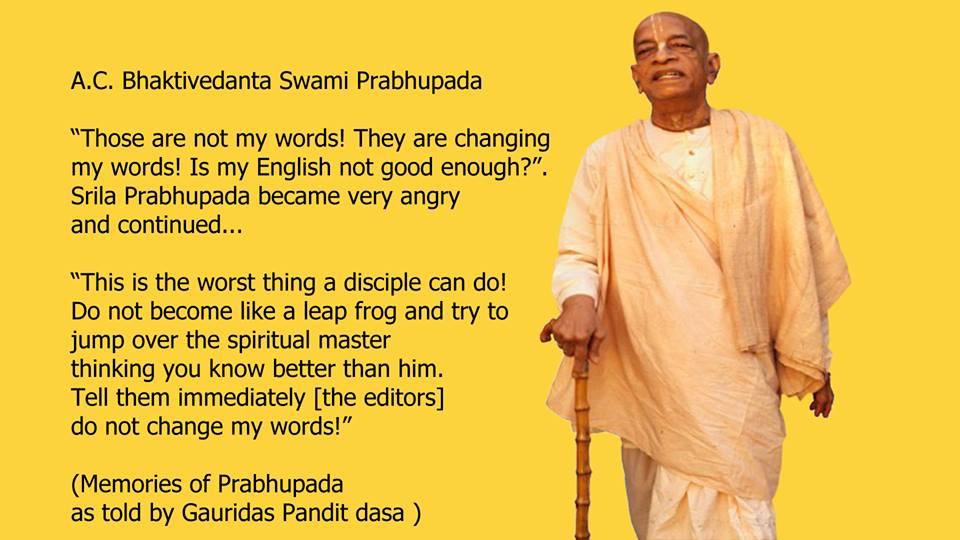
The worst thing a disciple can do
Caitanya Mahaprabhu on editing the work of a vaisnava
Ishvara Puri also met Gadadhar Pandit and was pleased when he saw the depth of his renunciation. He started to affectionately give him lessons from Sri-Krsna-lilamrta, a book of his own composition. Nimai would also come daily to Gopinath Acharya’s house to visit Ishvara Puri while he was teaching Gadadhar and offer him His obeisances. One day, Ishvara Puripada asked Nimai to correct any mistakes that were in his book. Nimai answered:
Anyone who finds any fault with a devotee’s description of Krishna is a sinner. If a devotee writes a poem, no matter how poorly he does it, it will certainly contain his love for Krishna. A fool says ‘visnaya’ while a scholar knows the correct form is ‘visnave’, but Krishna accepts the sentiment in either case. If anyone sees a fault in this, the fault is his, for Krishna is pleased with anything the pure devotee says. You too describe the Lord with words of love, so what arrogant person would dare criticize anything that you have written? (Chaitanya Bhagavata 1.11.105-110)
We should note carefully that even if mistakes that normally only fools make are in such works, they should not be corrected. If one sees any fault in such so called mistakes, the fault is his.
When Nimai Pandita (Sri Caitanya Mahaprabhu) said the above, he was actually referring to these verses from Sri Narada Pancaratra:
“Gaņeśa prayed: A foolish person chants, visnāya namaḥ whereas a learned person chants, vişnave namaḥ. However, the meaning and results of both are the same.”
“A person glorifies the Lord according to the knowledge he has received from the bestower of knowledge, Lord Hari.”
“Actually, Lord Janārdana accepts only the love and devotion that are offered to Him by the devotee.”
“The Supreme Personality of Godhead is beyond the influence of karma. Therefore, who can properly glorify Him? Still, it is everyone’s duty to worship the Lord, offer prayers to Him, bow down to Him and remember Him, according to one’s capacity.”
“According to their particular intelligence and ability, all devotees and non-devotees should glorify and worship the Supreme Lord, and chant His holy names.”
“Kartikeya prayed: You are the Supreme Lord and the indwelling Supersoul of all living beings. It is only from You that the living entities get the necessary intelligence to carry out their activities. People glorify You according to their understanding and saintly persons do not deride their inevitable shortcomings.”
About the Arsa-Prayoga Blog
The term “Arsa-Prayoga” means we should not correct the transcendental mistakes sometimes made by the acaryas. We can only correct if the acarya explicitly orders us to do so. And even then we should be very cautious and reluctant.
What does arsha-prayoga mean?
Prabhupada explains:
If one is too big, there is no mistake. Arsa-prayoga means there may be discrepancies but it is all right. Just like Shakespeare, sometimes there are odd usages of language, but he is accepted as authority. I have explained all these things in my Preface to First Canto. (Letter to Mandali Bhadra, Jaipur 20 January, 1972)


You must be logged in to post a comment.