One of the thousands of things that Jayadvaita Swami changed in the Bhagavad-gita As It is was the term “The Blessed Lord”.
There are some misconceptions about this term in the society of devotees. Even some native English speaking devotees believe that the term refers to a scenario where the Lord is being blessed (endowed) with a certain thing or attribute by one of his devotees.
Based on this misconception they consider the term “The Blessed Lord” as it is used in the Bhagavad-gita As It Is to be mistaken, and thus they support Jayadvaita Swami’s change to “The Supreme Personality of Godhead”.
I am quite amazed that native English speakers are not aware that the term “The Blessed Lord” or “to bless the Lord” means something completely different. I am also amazed to see how they criticise the term “The Blessed Lord” without bothering to look for it’s meaning in a dictionary or online.
Let us help them:
And
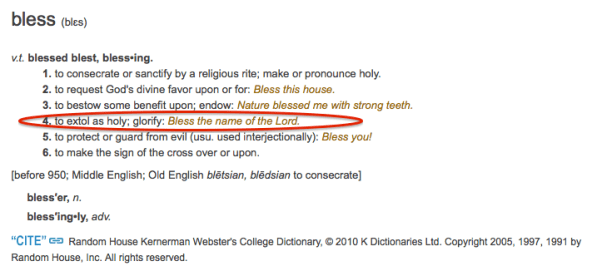
To learn more about how the term is used we need to nothing more than search the internet. There are loads of answers. In Christianity is perfectly normal to say “The Blessed Lord” and “Bless the Lord” in the sense of praising, glorifying and honoring God.
Here is something from an article that makes the point clear:
“There are two main things that we do when we bless the Lord. The first is synonymous with giving thanks and praise. Some translations actually say, “Give thanks to the Lord,” where others say, “Bless the Lord.” So, blessing the Lord is praising Him and giving thanks to Him—for blessing us! The other thing we do when we bless the Lord is to proclaim Him blessed. Here I think I’ll have to make a distinction between “blessed” and “blessed.” For clarity’s sake, this distinction is between “blessed” and “blest”—though I don’t really like that newfangled form of the word—the former in two syllables and the latter in one. The former is a state of being, the latter a consequence of something have been done or given to someone.
When we call God blessed, we are saying something about who God is.He is blessed, which is a synonym for “holy.” Blessed is God, the Father of our Lord Jesus Christ! The Byzantine Divine Liturgy always opens with the glorious and magnificent “Blessed is the Kingdom of the Father and of the Son and of the Holy Spirit, both now and forever and unto ages of ages!” When we speak of God as the recipient of our blessings (praises and thanksgivings), then He is blest. May the Lord be forever blest! Sometimes both meanings can apply simultaneously.When Our Lady said, “All generations shall call me blessed,” it means both that all generations acknowledge her holiness and that all generations acknowledge that she has been uniquely blest by God.”
When Jayadvaita Swami made the change from “The Blessed Lord” to “The Supreme Personality of Godhead” he did not used the above mentioned misconception as a justification. Perhaps he knew there was nothing wrong with the term. He attempted to justify his change in another way. His attempted justification will be the subject matter of an upcoming article.
Srila Prabhupada frequently uses the terms “regulative principles” and “regulated principles” in his teachings.
But Jayadvaita Swami claims that “regulated principles” is a nonsense use of words. He calls it “obviously erroneous” and “a term that makes no sense” (Link).
He says it should always be “regulative principles”, and thus Jayadvaita Swami is in the process of changing all “regulated principles” into “regulative principles” in Srila Prabhupada’s books.
But there are two good reason to think Jayadvaita Swami is wrong:
First Reason
Srila Prabhupada explains just how spiritual principles are regulated, namely by the spiritual master:
“In the neophyte stage of devotion one must follow all the principles, regulated by the authority of the spiritual master.”
So “regulated principles” means principles regulated by a superior authority.
I do not know why this makes no sense to Jayadvaita Swami. It seems so obvious!
Let us take a simple example:
Chanting is a principle. Srila Prabhupada regulated that principle: Minimum 16 rounds per day.
Simple for the simple.
Second Reason
“Regulated principles” is a quite common term. Just take a look at google:
And a few more:
So!
Again!
Jayadvaita Swami’s “justifications” for changing “regulated principles” are just plain wrong.
Srila Prabhupada has regulated principles for the editing of his books. Jayadvaita Swami should learn them.
“As the text of Bhagavad-gita continuously changes, in Srila Prabhupada’s As It Is edition, from original to unoriginal to unrecognizable, the rest of his books similarly change into new editions after his death. A self-deceived editor is not bewildered by such a change.“
In defence of Jayadvaita Swami’s editing of the Bhagavad-gita As It Is BBT International write on their website:
And in the conversation where Srila Prabhupada complained so strongly about “rascals editors,” Srila Prabhupada said about Jayadvaita, “He is good.”
And:
Of course, regarding Jayadvaita Swami, the BBT’s chief editor, Srila Prabhupada wrote, “Concerning the editing of Jayadvaita Prabhu, whatever he does is approved by me. I have confidence in him. (letter to Radhavallabha, 7 September 1976)
But it is a logical fallacy to claim that a thing must possess the same characteristics now as it did in the past.
In Nyaya this fallacy is called Nagna-Matrika-Nyaya / The Logic of the Naked Mother. Srila Prabhupada explains:
This is nagna-matrka-nyaya. We change according to the circumstances. You cannot say that this must remain like this. (Morning Walk, May 5, 1973, Los Angeles)
Srila Prabhupada knew things could change, and he would never commit such a logical fallacy. He explains:
Prabhupada: I have given you charge of this BBT, millions of dollars you are dealing, but it is not for your misuse. As soon as you misuse, that is your responsibility.
Ramesvara: Yes, but he says but still, you’ll know that I’m going to misuse it.
Prabhupada: No. That Krsna knows, when something charge is given. But because you are independent, I know that “Ramesvara is very good boy; let him be in charge.” But you can misuse at any moment, because you have got independence. You can misuse at any moment. At that time your position is different. (Morning Walk — June 3, 1976, Los Angeles)
And here he clearly says that we must evaluate a person based on the present situation:
Prabhupāda: So phalena paricīyate.You have to consider the case, suppose a man was very good now he has stolen something still he is a good man? Present consideration is the judgement… There is a Bengali proverb that seven generations before my forefathers used to eat ghee, ghee butter so still I got this smell.
Devotee (1): Hm.
Prabhupāda: Seven generations before my forefathers used to eat ghee so therefore that smell is still there in my house. Is that very good argument? (Morning Walk – October 8, 1972, Berkeley)
Previously we have dealt with BBT International’s argument here and here.
BBT International’s “Jayadvaita-Swami-is-good-argument” has thus been show to be logically invalid. In other words, it is not enough to say that at one point in time Srila Prabhupada liked Jayadvaita Swami’s editing. We need more. We need to know the present situation.
On top of that we have a few e-books out, documenting that Jayadvaita Swami has transgressed the instructions given by Srila Prabhupada. Please take a look at them:
This below e-mail was sent to Sivarama Swami through the e-mail address (asksrs@gmail.com) provided on this website. I hope that the devotees in charge of receiving the e-mails will forward the e-mail to Maharaja. In the meantime I will look for another e-mail address of his.
I wanted to send the below e-mail to Bir Krishna Goswami personally. But the e-mail on his website is not working. I am now looking for another e-mail address, and any help in this regard is welcomed. But since the letter is an open letter I am posting it here on Arsa-Prayoga and hope that Maharaja will see it.
Here it is:
—-
Dear Bir Krishna Goswami. Dandavat pranama. Jaya Srila Prabhupada.
I would like to apologize if answering this letter becomes a burden on your many other responsibilities.
Recently I heard a Q&A session with you, and I have a few points that I would very much like to hear your opinion about. Instead of writing here I have attached my letter to you to this e-mail. Alternatively you can also see it here:
“…but instead of using their higher intelligence to cultivate God consciousness, so-called intelligent men misuse their intelligence to produce many unnecessary and unwanted things.”
Older BBTI Edition:
“…but instead of using his higher intelligence to cultivate God consciousness, so-called intelligent menmisuse their intelligence to produce many unnecessary and unwanted things.”
Newest BBTI Edition:
“…but instead of using their higher intelligence to cultivate God consciousness, so-called intelligent men misuse their intelligence to produce many unnecessary and unwanted things.”
Are you looking for a job? BBTI has the perfect job for you who like to correct corrections. This is an example of what you will do – 8 hours a day, 5 days a week:
Nectar of Instruction, Text One, Purport:
Original 1975 BBT Edition:
“As for the agitations of the flickering mind, they are divided into two divisions.”
An older edition from BBTI:
“As for the agitations of the bickering mind, they are divided into two divisions.”
BBTI’s newest edition:
“As for the agitations of the flickering mind, they are divided into two divisions.”
As you can see it seems that the mind of the editor was, after all, flickering. Just like in this example your job will be to correct all such corrections. Do not worry. You will be guaranteed work until you reach the age of retirement. And the job is well paid.
Jayadvaita Swami has come under a lot of fire for saying that we cannot chant “Jaya Srila Prabhupada” while singing Gurvastakam:
(Watch from 14:30 and 10 minutes further)
[Unfortunately the video has been removed]
Sura Prabhu gave a lecture in the Los Angeles temple where he heavily criticized Jayadvaita Swami’s points:
(Watch from minute 12 and the rest of the video)
Svavasa Prabhu also gave his views on the matter here:
Gaura Dasa (who usually supports the book changes) wrote this on Facebook:
“HH Jayadvaita Swami’s Views On Singing Srila Prabhupada’s Pranams During Mangal Arati Has Created A Great Deal Of Controversy
A video is circulating online [that we will not share on Arsa-Prayoga] that Punya Das prabhu brought to my attention the other day that was disturbing him. Obviously the video itself is horribly offensive and filled with Vaisnava aparadha comments against Jayadvaita Swami – but unfortunately the real comments expressed by Jayadvaita swami are also still there and are still wrong and still also offensive.
He has stated that the Samsara Prayers are not the Founder Acarya Song and discourages the idea of singing Srila Prabhupada’s pranams or name during Mangal arati.
Jayadvaita Swami’s example and understanding of mangal Arotike in the 1960s doesn’t apply to the way Srila Prabhupada established standards for his worldwide ISKCON. Starting with the acquisition of New Dwaraka as his world headquarters Srila Prabhupada had leaders fly into LA for 1-2 weeks to be trained in new permanent standards for arotike, for the morning program, for Deity worship, for morning and evening class which included chanting Sanskrit, etc. The kirtans always included chanting the pranam prayers and Jaya Prabhupada. I simply have no words to express how obvious this is. To preach that the standard should not include these pranam prayers and that the chant “Jaya Prabhupada” shouldn’t be part of mangal arotike during the samsara prayers is offensive and completely against the foundational position of the founder- acarya.
When his Godbrothers tried to minimize his position, Srila Prabhupada empathized even more the importance of his pranam mantras. His Divine Grace was very concerned about his name appearing in his books, on the BBT building, on letterhead, etc. This is central and essential to not having his teachings marginalized. How Jayadvaita doesn’t understand this is bewildering and I can only attribute it to his being covered by the illusory energy.
Whoever Pranatha Prabhu is, he is really not understanding how deeply important this is to the eternal position of our founder-acarya.
The overwhelming comments show how disturbed devotees are, even those who strongly support Jayadvaita.
I don’t know what else to say when to me something is so obvious.
It feels like trying to explain how book distribution was Srila Prabhupada’s only solace to a devotee who doesn’t believe in book distribution.
Prananatha’s cooment indicates a lack of understanding our Founder Acaray’s position :
Prananatha Das Paul Tuffery : I just watched the entire video, start to end. I don’t see where he is saying anything against what was established by Srila Prabhupada. What is the fuss about? He gave numerous examples of how Srila Prabhupada wanted kirtan to be performed including how Srila Prabhupada would stop kirtan if he was unhappy with it. So, the precedent as established by Srila Prabhupada, should be followed. Otherwise, how are we glorifying him?
A devotee wrote:
For those who have’t seen the video or don’t want to see it, I typed it out:
[Jayadvaita Swami speaking]
Basically, morning: Samsara dava, Sri Krsna Caitanya, Hare Krsna, nothing else. Evening: Gaura Artik, Sri Krsna Caitanya, Hare Krsna, nothing else, pretty clear.
A devotee is asking whether after Samsara dava we should chant Prabhupada pranams mantra. Interesting question. When Prabhupada chanted it in the morning, he chanted Samasara dava, Sri Krsna Caitanya, Hare Krsna, nothing else. He didn’t chant the pranams mantra to his guru maharaj.
Now, if I suggest that we shouldn’t chant Prabhupadas pranams mantra, there’ll be a revolution. But actually it’s not nessecary. It’s not what he did and we don’t have to.Samsara dava, Sri Krsna Caitanya, Hare Krsna, nothing else.
So, when someone who’s not Prabhupadas direct disciple, begins by offering pranam mantra to Prabhupada, my hearing takes a beating. I think: ’What’s wrong with this person?!”
But at least: don’t start with Prabhupada pranams mantra. You’re totally contrary to the tradition, if you do that.
The next thing that disturbs me, sometimes we hear, right in the middle of Samasara dava ‘jaya Prabhupada, Jaya’…
[Note from myself: as a matter of fact, he actually does say that (every time that he says it) in a ridiculing manner, swaying his hands in a ‘funny’ way, pulling a face]
What the hell is that?! Samsara dava is not the Prabhupada song! It’s the guru song… which doesn’t mean the founder acharya of ISKCON. Samsara dava is not the Prabhupada song.
And therefore it even disturbs me when, you know, they finish the… dhyāyam stuvaḿs tasya yaśas tri-sandhyaḿvande guroḥ śrī-caraṇāravindam.. ‘jaya Prabhupada jaya’… as again if it was the Prabhupada song.
If you want to think of Prabhupada during that song, that’s fine, but it’s not… What if somebody else is thinking of his guru? God forbid! Then you’ve spoiled his meditation. Because you’re thinking it’s the Prabhupada song.
You don’t need to chant ‘Jaya Prabhupada’ at any point.
Samsara dava, Sri Krsna Caitanya, Hare Krsna, nothing else.
And.. alright, I won’t buck the system. After Samsara dava, AFTER Samsara dava, Prabhupada pranams. And if you left them out, you will not be wrong. You’ll be institutionally wrong, but you’ll not be philosophically wrong, because Prabhupada said Samsara dava, Sri Krsna Caitanya, Hare Krsna, nothing else.
That’s what he did and if that’s what you do, you’re no worse than he was. And he was perfect.
So again, I am no campaigning to edit it out of the program, but keep it at that, if you would. Or, to put it in another way, I would be happy if you would keep it at that.”
Ajit Krishna Dasa’s concluding comment:
Let us hope that the ISKCON leaders comes to understand that Jayadvaita Swami has had this mentality all the time, also when editing Srila Prabhupada’s books. He even said that “there are warts” on Srila Prabhupada’s original books.
You must be logged in to post a comment.