Feel Free – Give And Take – Revisited (Bg. 9.19)

By Ajit Krishna Dasa

Original article can be found in Bhakta Torben’s ebook Blazing Edits:

Description

In Srila Prabhupāda’s manuscript/draft for Bhagavad-gita As It Is 9.19, the dictated synonyms read:

sat — being
asat — non-being.

These exact synonyms also appear in the pre-samādhi editions, the authorized edition personally approved by Prabhupāda:

sat — being
asat — nonbeing.

These match the literal Sanskrit dictionary meanings: sat = being, existent; asat = non-being, nonexistent. In the posthumous BBT International edition, Jayadvaita Swami replaces these with

sat — spirit
asat — matter

—and adjusts the translation accordingly.

These substitutions do not appear in the manuscript, do not appear in the 1972 edition, and do not correspond to the literal Sanskrit.

Type of Change

Substitution. Jayadvaita Swami removes Srila Prabhupāda’s original synonyms (“being / non-being”) and replaces them with new synonyms (“spirit / matter”), a shift unsupported by any Prabhupāda source.

Category

Philosophical Alteration. This BBT International posthumous edit replaces Srila Prabhupāda’s specific translation choice for this verse with an alternative meaning he did not use here. Although sat and asat can carry broader philosophical associations in other contexts, Prabhupāda translated them in Bg 9.19 as “being / non-being.” Changing that to “spirit / matter” imposes an editor’s reinterpretation onto a verse where Prabhupāda had already given the exact meaning he intended.

Commentary

It is true that Srila Prabhupāda sometimes uses sat in a general philosophical sense to describe the eternal (spirit) and asat to describe the temporary (matter). However, this broader theological association does not justify altering his specific translation in a specific verse.

In Bhagavad-gita 9.19, Prabhupāda deliberately translated sat and asat as “being” and “non-being,” and this is confirmed by all available evidence:

1) Manuscript: Prabhupāda dictated sat = being, asat = non-being.
2) 1972 Edition: Prabhupāda published sat = being, asat = nonbeing.
3) Sanskrit Dictionary: sat = being, asat = non-being (as primary meanings).

The synonyms introduced by Jayadvaita Swami (“spirit” and “matter”) appear in none of these sources. They are not restorations of Prabhupāda’s work; they are editorial reinterpretations imposed onto the synonyms and translation after Prabhupāda’s departure.

Because the original wording is fully preserved in both the manuscript and the authorized 1972 edition, changing it does not take us “closer to Śrīla Prabhupāda,” as is the claim to fame of BBT International and Jayadvaita Swami—it takes the Bhagavad-gītā As It Is further away from Śrīla Prabhupāda’s own translation and intended meaning.

Even if “spirit” and “matter” are philosophically relevant within the broader framework of the Bhagavad-gita, Srila Prabhupāda did not use those terms to translate sat and asat in this verse.

Under the ārṣa-prayoga principle, the ācārya’s documented wording—especially when supported by both manuscript and pre-samādhi edition—is final and cannot be replaced with an editor’s inferred meaning.

The BBT International version thus represents an unauthorized posthumous substitution, shifting the verse away from Srila Prabhupāda’s own translation choice.

More Than Most – Revisited (Bg. 18.63)

By Ajit Krishna Dasa

When Bhakta Torben first published More Than Most in his ebook Blazing Edits, he exposed one of the clearest examples of how posthumous editing can distort Śrīla Prabhupāda’s intended meaning. His analysis of Bhagavad-gītā 18.63 was sharp, direct, and rooted in the ārṣa-prayoga principle. What follows is a revisiting of that same verse — not to replace his contribution, but to expand it. With additional evidence, deeper linguistic analysis, and Śrīla Prabhupāda’s own spoken confirmation of the original translation, we can now see even more clearly the magnitude of the philosophical shift introduced by the BBT International editor Jayadvaita Swami. This article stands in continuity with Bhakta Torben’s work and in appreciation of his service.

Description

Śrīla Prabhupāda’s manuscript (draft):
“Thus I have explained to you the most confidential of all knowledge. Deliberate on this fully, and then do what you wish to do.”

Original and Authorized Pre-Samadhi Edition:
Same wording.

Jayadvaita Swami / BBT International posthumous edition:
“Thus I have explained to you knowledge still more confidential. Deliberate on this fully, and then do what you wish to do.”

Here the ācārya’s chosen expression — “the most confidential of all knowledge” — has been replaced with a weaker comparative phrase that Śrīla Prabhupāda never authorized. Jayadvaita Swami and BBT International assured us that their edits would bring us “Closer to Śrīla Prabhupāda.” This edit does the opposite.

Type of Change

Substitution (Replacement) — replacing the ācārya’s established wording with a new formulation after his disappearance.

Category

Philosophical Change — because it alters the meaning, force, and doctrinal weight of the verse in one of the most climactic moments of the Bhagavad-gītā.

Śrīla Prabhupāda Confirms the Original Translation (Full Lecture Quote)

When the 1972 translation was read aloud to Śrīla Prabhupāda, he accepted it immediately and began teaching from it without hesitation. Even more striking, he strengthened it by using the pure Sanskrit superlative guhyatamam in his explanation.

Hari-śauri:

iti te jñānam ākhyātaṁ
guhyād guhyataraṁ mayā
vimṛśyaitad aśeṣeṇa
yathecchasi tathā kuru


“Thus I have explained to you the most confidential of all knowledge. Deliberate on this fully, and then do what you wish to do.”

Prabhupāda: “So it is your business. ‘You deliberate on all the points I have told you. Now if you like, you surrender unto Me. If you don’t like, you do whatever you like.’ Yathecchasi tathā kuru. This is God. He doesn’t touch on your liberty. He gives you the right information. Now you… Idaṁ te jñānam? Iti te jñānam.”

Hari-śauri: “Iti te jñānam ākhyātam.”

Prabhupāda: “Ākhyātam.”

Hari-śauri: “Guhyād guhyataraṁ mayā.”

Prabhupāda: “Guhyād guhyataraṁ mayā.”

Hari-śauri: “Vimṛśyaitad.”

Prabhupāda: “Vimṛśya — ‘Now you think over it.’ You consider, make your deliberation, and then you do whatever you like. Iti te jñānam ākhyātam — ‘I’ve explained to you all kinds of different types of knowledge, and ultimately, guhyatamam, the most confidential knowledge I’ve spoken to you, that you surrender to Me.’”

This is decisive. Śrīla Prabhupāda accepts the translation exactly as printed in 1972 and then upgrades the comparative to the superlative. The posthumous edit does the opposite.

A Note on the Synonyms

It is true that Śrīla Prabhupāda uses the literal phrase “still more confidential” in the synonyms for guhyataram. But the Synonyms in Prabhupāda’s books serve as literal Sanskrit glosses, not as the final doctrinal expression of the verse. Prabhupāda routinely departs from the synonyms when giving the English Translation, because the Translation is where he presents the siddhānta — the intended philosophical meaning. In Bhagavad-gītā 18.63, Prabhupāda deliberately chose “the most confidential of all knowledge” for the Translation, and in his lecture he further strengthened that sense by using the pure superlative guhyatamam. The doctrinal meaning is therefore the superlative, not the comparative. The presence of “still more confidential” in the synonyms cannot justify altering Śrīla Prabhupāda’s authorized translation.

Commentary

The Sanskrit phrase guhyād guhyataraṁ is grammatically comparative (“more confidential”), but in the context of the Gītā it clearly expresses a final, culminating revelation. Śrīla Prabhupāda captures this meaning with precision by translating it as “the most confidential of all knowledge.”

This phrase appears in:

– the manuscript
– the 1972 Bhagavad-gītā As It Is
– Śrīla Prabhupāda’s lectures
– his consistent theological vocabulary

The BBT International posthumous edit — “knowledge still more confidential” — collapses that force.

-It downgrades the meaning, turning a climax into a comparative.
-It contradicts Śrīla Prabhupāda’s own explanation, where he uses the superlative guhyatamam.
-It breaks Prabhupāda’s established vocabulary (“most confidential” is a fixed Prabhupādan term).
-It corrects nothing and weakens much.
-It violates the Arsa-prayoga principle by overriding an ācārya’s chosen wording after his departure.

This is a philosophical change, not merely an adjustment of English.

Conclusion

Śrīla Prabhupāda’s translation of Bhagavad-gītā 18.63 is clear, intentional, and confirmed by his own spoken commentary. The posthumous BBT International edit by Jayadvaita Swami replaces that clarity with a weaker, unauthorized formulation that is directly contradicted in his lecture.

This is not refinement. It is distortion.

When Śrīla Prabhupāda has already spoken, the matter is finished.

Jayadvaita Swami Condemns His Own Edits: A Case Study in Needless Change

By Ajit Krishna Dasa

Jayadvaita Swami wrote in 1986:

“As you know, and as we kept in mind while doing the work, Śrīla Prabhupāda staunchly opposed needless changes.” (Jayadvaita Swami, Letter to Amogha Lila, 1986)

This statement is correct. Śrīla Prabhupāda did staunchly oppose needless changes — and this principle is the foundation of ārṣa-prayoga, the principle that the words of a pure devotee are not to be altered by conditioned editors.

The following example — pointed out to us by Bhakta Torben Nielsen in his ebook Blazing Edits — illustrates the issue perfectly.

We look at a posthumous edit introduced by BBT International (BBTI) in the 1983 revised Bhagavad-gita As It Is, specifically 18.2, purport.

Original (Prabhupāda-approved pre-samadhi edition):

There are many prescriptions
of methods
for performing sacrifice
for some particular purpose
in the Vedic literatures.

Posthumously edited (BBTI edition):

In the Vedic literature
there are many prescriptions
of methods
for performing sacrifice
for some particular purpose.

This is not a correction.
This is not a clarification.
This is not a doctrinal improvement.

It is simply a relocation of one phrase — a stylistic reshuffling that has no philosophical or grammatical necessity whatsoever.

What problem did this edit solve?

None.

Was the original incorrect, unclear, or misleading?

No.

Did Srila Prabhupada ever request this change?

No.

Did BBTI give a reason for it?

No.

According to Jayadvaita Swami’s own standard — “Prabhupāda opposed needless changes” — this is precisely the kind of change Śrīla Prabhupāda would not have approved.

The contradiction is unavoidable:

  1. Jayadvaita Swami says unnecessary edits violate Prabhupāda’s wishes.
  2. Jayadvaita Swami then makes an unnecessary posthumous edit.

That is why this small change becomes a perfect diagnostic tool. It shows that once editors begin altering Srila Prabhupada’s books based on personal preference or literary style, the entire principle of ārṣa prayoga has already been abandoned.

Why This Matters for Bhagavad-gita As It Is

The 1972 first edition was personally approved, lectured from, distributed, and trusted by Śrīla Prabhupāda. The 1983 posthumously edited edition by BBTI was not.

When even a harmless sentence — one that Prabhupāda accepted and used — is needlessly altered, it proves the deeper issue:

Posthumous editing inevitably leads to editorial overreach, because the standard has shifted from “transmit exactly” to “improve according to taste.”

And once that door opens, the rest of the book becomes vulnerable.

It all starts with edits exactly like this.

Small Word, Big Difference – Revisited

By Ajit Krishna Dasa

Arsa-Prayoga.com – Revisited is the title of an upcoming ebook that continues the work begun here on arsaprayoga.com. It re-examines the changes made to Śrīla Prabhupāda’s original books from new angles and explains why each alteration is significant.

Each example will also be posted here on arsaprayoga.com.

Today we are revisiting:

Small Word, Big Difference

https://arsaprayoga.com/2014/08/12/small-word-big-difference/

Description

The article shows how a small change in a purport—from “done by Krishna” to “done for Krishna”—creates a profound shift in meaning. Though it appears minor, this substitution alters the philosophical substance of the text.

Type of change

Substitution — a single preposition replaced.

Category

Philosophical change.

Commentary

Alters causal agency / the relationship between Krishna and activity

The difference between “by Krishna” and “for Krishna” is not stylistic. It changes who is acting and whose will is primary. “Done by Krishna” means that Krishna is the direct actor, the cause behind all action. “Done for Krishna” reverses the flow, implying that the devotee acts and offers the result. That is not the same truth; it replaces divine agency with human initiative.

Changes nuance of surrender / devotional theology

In the original wording, the devotee is fully dependent. He is the instrument, Krishna the mover. This is the essence of śaraṇāgati—to see Krishna as the doer in all things. The edited phrase softens that surrender. It suggests the devotee’s independent action performed on Krishna’s behalf rather than through Krishna’s will. The theology of dependence becomes a theology of contribution.

Moves from metaphysical fact to interpretive sentiment

“Done by Krishna” is an ontological statement: it describes reality as it is. “Done for Krishna” is a moral sentiment: it describes how we wish to act. This subtle shift turns realization into interpretation, revelation into advice.

A single preposition has thus transformed the meaning, the mood, and the philosophy. It is not grammar; it is theology.

From Dhyana to Sankhya: Prabhupada’s Vision for Chapter 6

By Ajit Krishna Dasa

Srila Prabhupada’s decision to title Chapter 6 of the Bhagavad Gita As It Is “Sankhya Yoga” stands as a distinctive and deliberate choice, diverging from the more common “Dhyana Yoga” favored by traditional acharyas, modern scholars, and Western translators. This title, unique in the history of widely recognized Gita commentaries, reflects his mission to present the text through the lens of Gaudiya Vaishnavism while reintroducing the theistic Sankhya philosophy of Kapila Muni, the divine son of Devahuti from the Srimad Bhagavatam. Far from a mere editorial quirk, Prabhupada’s naming can be seen as a strategic reclamation of the term “Sankhya,” serving as an implicit attack on the atheistic Sankhya school and aligning the chapter’s teachings with Krishna consciousness. This choice makes sense when viewed through the philosophical content of Chapter 6, its integration of Sankhya and Yoga, and Prabhupada’s broader purpose of countering materialistic philosophies.

Philosophical Foundations: Theistic Sankhya and Its Contrast with Atheism

Sankhya philosophy, one of the six classical schools of Indian thought, fundamentally distinguishes between purusha (the eternal, conscious soul) and prakriti (temporary, unconscious matter), aiming for liberation through analytical knowledge. However, two versions of Sankhya exist: the atheistic, classical Sankhya, often attributed to a sage Kapila, which denies a supreme God and posits multiple purushas liberated through intellectual discernment alone, and the theistic Sankhya of Kapila Muni, an incarnation of Vishnu, as detailed in Srimad Bhagavatam (Canto 3, Chapters 24–33). The latter integrates this dualistic framework with devotion to Krishna, the Supreme Purusha, as the source and controller of all existence.

Srila Prabhupada consistently champions the theistic Sankhya of the Bhagavatam’s Kapila, critiquing the atheistic version as incomplete. In his purport to Gita 2.39, he describes Sankhya as the analytical study of soul and matter but ties it to Krishna’s authority, while in Srimad Bhagavatam 1.2.30, he credits Kapila (the Vishnu avatar) with creating Sankhya to dispel material illusion, implying the atheistic school is a corruption. By titling Chapter 6 “Sankhya Yoga,” Prabhupada reclaims the term from its godless connotation, positioning it as a Krishna-centric science of self-realization. This choice serves as an attack on atheistic Sankhya by asserting that true Sankhya—unlike its materialistic distortion—culminates in devotion to the Supreme Personality of Godhead, not mere intellectual isolation.

Chapter 6’s Content: A Blend of Sankhya Philosophy and Yogic Practice

Chapter 6 of the Gita, while renowned for its meditative instructions (e.g., 6.11–14: sitting steadily, focusing on the self or Krishna), contains philosophical elements that resonate with Sankhya, justifying Prabhupada’s title. Verses like 6.5–6 (“One must deliver himself with the help of his mind… the mind is the friend or enemy”) echo Sankhya’s view of the mind as a product of prakriti that binds or liberates the purusha depending on its mastery. Similarly, 6.1–4 emphasize detachment from sense objects and fruitive results, mirroring Sankhya’s goal of disentangling the soul from material nature. The description of the yogi’s transcendent state in 6.20–23—realizing the self’s distinction from matter through “transcendental senses”—further aligns with Sankhya’s liberation through discriminative knowledge.

Prabhupada’s “Sankhya Yoga” title broadens the chapter’s scope beyond meditation (dhyana) to include this analytical foundation, reflecting the theistic Sankhya of Kapila, where understanding the soul’s eternality leads to Krishna (Srimad Bhagavatam 3.25.18). Unlike “Dhyana Yoga,” which narrows the focus to meditative practice, “Sankhya Yoga” encapsulates the integration of knowledge (Sankhya) and discipline (Yoga), culminating in devotion (6.47: “The highest yogi thinks of Me constantly”). By highlighting these Sankhya elements, Prabhupada challenges atheistic Sankhya’s endpoint—self-isolation without God—replacing it with a theistic synthesis that directs the practitioner to Krishna, thus undermining the atheistic school’s philosophical legitimacy.

Historical Context: Sankhya and Yoga’s Traditional Connection

The tendency in Indian tradition to connect Sankhya and Yoga as complementary systems supports Prabhupada’s titling. Historically, Sankhya provides the metaphysical blueprint (distinguishing purusha from prakriti), while Yoga, particularly Patanjali’s Ashtanga Yoga, offers the practical path, with dhyana (meditation, the seventh limb) as a key stage. The Gita itself reflects this synergy: Chapter 2 introduces Sankhya’s analytical wisdom (2.39), and Chapter 6 blends it with yogic practice. Prabhupada’s “Sankhya Yoga” title leverages this tradition, but adapts it to Vaishnavism by rooting it in Kapila’s theistic Sankhya, not the atheistic version that Patanjali’s Yoga partially accommodates (via Ishvara, Yoga Sutras 1.23).

This historical pairing bolsters Prabhupada’s attack on atheistic Sankhya. By invoking “Sankhya” in a yogic context, he reasserts its original spiritual purpose—lost in the godless classical school—and aligns it with the Gita’s theistic narrative, where Krishna is the ultimate goal (Gita 15.17–18). This reclamation serves as a polemic, subtly exposing atheistic Sankhya’s inadequacy compared to its devotional counterpart.

Prabhupada’s Strategic Intent: Attacking Atheistic Sankhya and Inspiring Exploration of the Bhagavatam

Prabhupada’s mission was to counter materialistic and impersonal philosophies, including atheistic Sankhya, which he saw as a distortion of Vedic truth. His critiques in purports—e.g., dismissing atheistic Sankhya as “dry speculation” (Gita 7.4, purport)—reveal his intent to restore its theistic essence. Naming Chapter 6 “Sankhya Yoga” is a deliberate strike against this distortion for several reasons:

  1. Reclamation of Terminology: By using “Sankhya,” a term familiar to scholars and practitioners, Prabhupada confronts its atheistic association head-on. He redefines it through Kapila’s lens, where analytical knowledge serves bhakti, not godless liberation, thus challenging the classical school’s authority.
  2. Philosophical Superiority: The chapter’s content—integrating self-realization with devotion—demonstrates that theistic Sankhya surpasses atheistic Sankhya. Verses like 6.29–30 (“He who sees Me everywhere”) elevate Sankhya’s dualism into a Krishna-centric unity, exposing the atheistic version’s limitation in stopping at individual purusha without recognizing the Supreme Purusha.
  3. Educational Polemic: Prabhupada’s global audience included Westerners and Indians influenced by secular interpretations of Sankhya. Titling Chapter 6 “Sankhya Yoga” educates them that true Sankhya aligns with Krishna consciousness, countering scholarly narratives equating Sankhya with atheism and reinforcing the Gita’s theistic intent “as it is.”
  4. Parampara’s Authority: By tying the title to Kapila of the Bhagavatam, Prabhupada roots it in disciplic succession, contrasting it with speculative atheistic Sankhya. This asserts the Vedic authenticity of his interpretation, undermining the classical school’s standalone credibility.
  5. Inspiring Engagement with the Srimad Bhagavatam: Beyond attacking atheistic Sankhya, Prabhupada’s use of “Sankhya Yoga” also aimed to inspire readers to explore the Srimad Bhagavatam, which he considered the “ripe fruit of the Vedic tree” (Srimad Bhagavatam 1.1.3, purport) and the ultimate scripture for Krishna consciousness. By linking Chapter 6 to Kapila’s theistic Sankhya—detailed in Bhagavatam Canto 3, Chapters 24–33—he creates a bridge to this text, where Kapila’s teachings expand on the Gita’s principles with a devotional focus (e.g., Bhagavatam 3.25.18). In purports like Gita 6.13–14, he references Kapila’s meditation on Vishnu (Bhagavatam 3.28.8–11), subtly encouraging readers to delve into the Bhagavatam for a deeper understanding of both Kapila’s Sankhya but also of the Srimad-Bhagavatam itself. For his audience—many unfamiliar with this scripture—the title “Sankhya Yoga” plants a seed of curiosity about Kapila’s full discourse, reinforcing the Bhagavatam’s role as the natural next step after the Gita and enhancing his mission to elevate global devotion through the parampara’s treasures.

Uniqueness and Justification

No major traditional acharya (e.g., Shankaracharya, Ramanujacharya, Madhvacharya) or modern translator (e.g., Sivananda, Chinmayananda) titles Chapter 6 “Sankhya Yoga”—they typically use “Dhyana Yoga” or variants, reserving “Sankhya Yoga” for Chapter 2. Prabhupada’s divergence is a bold innovation, justified by Chapter 6’s Sankhya-like elements and his mission. While “Dhyana Yoga” fits the chapter’s meditative focus, “Sankhya Yoga” captures its broader philosophical depth, aligning with his view of Kapila’s system as both knowledge and practice directed toward Krishna.

Conclusion: A Sensible and Strategic Choice

Srila Prabhupada’s “Sankhya Yoga” title for Chapter 6 makes profound sense as a reflection of its content—merging Sankhya’s analytical insights with Yoga’s meditative discipline—and his intent to advance Gaudiya Vaishnavism. It serves as a strategic attack on atheistic Sankhya by reintroducing Kapila’s theistic version, challenging its godless conclusions, and redirecting its principles toward Krishna. This choice not only highlights the chapter’s philosophical richness but also fulfills Prabhupada’s mission to present the Gita as a devotional text, countering materialistic distortions and establishing Krishna consciousness as the ultimate synthesis of Vedic wisdom. In this light, “Sankhya Yoga” is not just a title—it’s a declaration of theistic triumph over atheism, rooted in scripture and tradition.

For a definitive proof that Srila Prabhupada wanted Chapter Six of his Bhagavad-gita As It Is to be named Sankhya-Yoga, please see this article.

New Video Series on the Book Changes

We are gradually producing videos on the book changes. Check our playlist at Youtube, and remember to subscribe for new videos.

Kindly share the videos on social media – especially on Facebook.

Thanks for watching and helping Srila Prabhupada.

Book Changes – Playlist

Is Jayadvaita Swami Still Good? (The Logic of the Naked Mother)

logical-fallacy-1

In defence of Jayadvaita Swami’s editing of the Bhagavad-gita As It Is BBT International write on their website:

And in the conversation where Srila Prabhupada complained so strongly about “rascals editors,” Srila Prabhupada said about Jayadvaita, “He is good.”

And:

Of course, regarding Jayadvaita Swami, the BBT’s chief editor, Srila Prabhupada wrote, “Concerning the editing of Jayadvaita Prabhu, whatever he does is approved by me. I have confidence in him. (letter to Radhavallabha, 7 September 1976)

But it is a logical fallacy to claim that a thing must possess the same characteristics now as it did in the past.

In Nyaya this fallacy is called Nagna-Matrika-Nyaya / The Logic of the Naked Mother. Srila Prabhupada explains:

This is nagna-matrka-nyaya. We change according to the circumstances. You cannot say that this must remain like this. (Morning Walk, May 5, 1973, Los Angeles)

Srila Prabhupada knew things could change, and he would never commit such a logical fallacy. He explains:

Prabhupada: I have given you charge of this BBT, millions of dollars you are dealing, but it is not for your misuse. As soon as you misuse, that is your responsibility.
Ramesvara: Yes, but he says but still, you’ll know that I’m going to misuse it.
Prabhupada: No. That Krsna knows, when something charge is given. But because you are independent, I know that “Ramesvara is very good boy; let him be in charge.” But you can misuse at any moment, because you have got independence. You can misuse at any moment. At that time your position is different. (Morning Walk — June 3, 1976, Los Angeles)

And here he clearly says that we must evaluate a person based on the present situation:

Prabhupāda: So phalena paricīyate. You have to consider the case, suppose a man was very good now he has stolen something still he is a good man? Present consideration is the judgement… There is a Bengali proverb that seven generations before my forefathers used to eat ghee, ghee butter so still I got this smell.
Devotee (1): Hm.

Prabhupāda: Seven generations before my forefathers used to eat ghee so therefore that smell is still there in my house. Is that very good argument? (Morning Walk – October 8, 1972, Berkeley)

Previously we have dealt with BBT International’s argument here and here.

BBT International’s “Jayadvaita-Swami-is-good-argument” has thus been show to be logically invalid. In other words, it is not enough to say that at one point in time Srila Prabhupada liked Jayadvaita Swami’s editing. We need more. We need to know the present situation.

On top of that we have a few e-books out, documenting that Jayadvaita Swami has transgressed the instructions given by Srila Prabhupada. Please take a look at them:

No Reply from BBTI

Blazing Edits

Arsa-Prayoga – Preserving Srila Prabhupada’s Legacy

The BBT International and Jayadvaita Swami need to address the points presented in these books instead of relying on faulty logic.

Open Letter to Sivarama Swami

Screen Shot 2015-11-13 at 19.52.49

This below e-mail was sent to Sivarama Swami through the e-mail address (asksrs@gmail.com) provided on this website. I hope that the devotees in charge of receiving the e-mails will forward the e-mail to Maharaja. In the meantime I will look for another e-mail address of his.

Dear Sivarama Swami. Dandavat pranama. Jaya Srila Prabhupada.

I apologize if answering this letter becomes a burden on your many other responsibilities.

Recently I heard a podcast from your website where you respond to a few questions about the changes made to Srila Prabhupada’s books.

I have a few comments and points I find important in relation to your response, and I hope you will find the time to answer each of them.

This is an open letter, so it will also be posted online.

The letter is attached to this e-mail, but you can also find it here:

Open Letter to Sivarama Swami

Thank you very much.​
Your servant,
Ajit Krishna Dasa

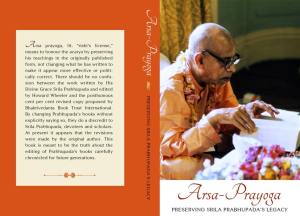
E-BOOK: Arsa-Prayoga: Preserving Srila Prabhupada’s Legacy

Almost 400 pages about the changes made to Srila Prabhupada’s books.

Arsa-Prayoga Book

Click picture to visit website

From the back cover:

“Arsa prayoga, lit. “rishi’s license,” means to honour the acarya by preserving his teachings in the originally published form, not changing what he has written to make it appear more effective or politically correct. There should be no confusion between the work written by His Divine Grace Srila Prabhupada and edited by Howard Wheeler and the posthumous cent per cent revised copy proposed by Bhaktivedanta Book Trust International. By changing Prabhupada’s books without explicitly saying so, they do a discredit to Srila Prabhupada, devotees and scholars. At present it appears that the revisions were made by the original author. This book is meant to be the truth about the editing of Prabhupada’s books carefully chronicled for future generations.”

Get the book on Amazon.

E-BOOK: Blazing Edits

blazing-edits

Click to download the book

Aug 20, 2015 — CANADA (SUN) —  We invite you to download a copy of Blazing Edits, an e-book collection of segments written by Bhakta Torben Nielsen on the topic of the changes to Srila Prabhupada’s Bhagavad-gita As It Is. This series has been an ongoing publication on Sampradaya Sun and www.arsaprayoga.com.

This e-book was made in a cooperative effort by Bhakta Torben Nielsen (Author), Bhakta Max Køngerskov (Design and Layout), Ajit Krishna dasa (Idea), and the Sampradaya Sun (Publisher). The book will periodically be updated with new segments.

DOWNLOAD LATEST VERSION

Blazing Edits (16 okt. 2015)

Who Is Bhakta Torben?

Bhakta Torben Nielsen, a devotee from Denmark associated with the Hare Krishna movement, is known for his outspoken stance on various issues within ISKCON, particularly the changes made to Srila Prabhupada’s books after his passing.

His critiques have focused on what he sees as deviations from the original teachings and intentions of Prabhupada, ISKCON’s founder. In his view, the editorial alterations—such as revisions and edits to Prabhupada’s texts—compromise the authenticity of the teachings and pose a serious concern for the integrity of the movement.

Nielsen’s writings delve into the nature and extent of these changes, raising questions about their justification and impact. For him, the issue is not merely about preserving the original words on the page; it is a matter of safeguarding the spiritual legacy that Srila Prabhupada intended to leave behind.

The controversy over book changes reflects broader systemic issues within ISKCON, such as centralized authority and fidelity to the founder’s instructions. These concerns, along with others about the governance and direction of ISKCON, were extensively explored in Nielsen’s many articles.

Later he had his work compiled into the above eBook titled Blazing Edits, which addresses the controversial changes made to Srila Prabhupada’s books and advocates for preserving the original teachings without alteration. Through this work, Nielsen aims to shed light on what he and other concerned devotees see as a crucial challenge facing the Hare Krishna movement: the need to preserve Prabhupada’s teachings in their authentic form.

Note on Bhakta Torben Nielsen

Bhakta Torben was originally initiated by Harikesha Swami. When Harikesha later fell from his position, Torben chose to reject him as his guru and discontinued using the spiritual name he had received. This decision reflects Torben’s lifelong commitment to sincerity, integrity, and fidelity to Śrīla Prabhupāda above institutional considerations.