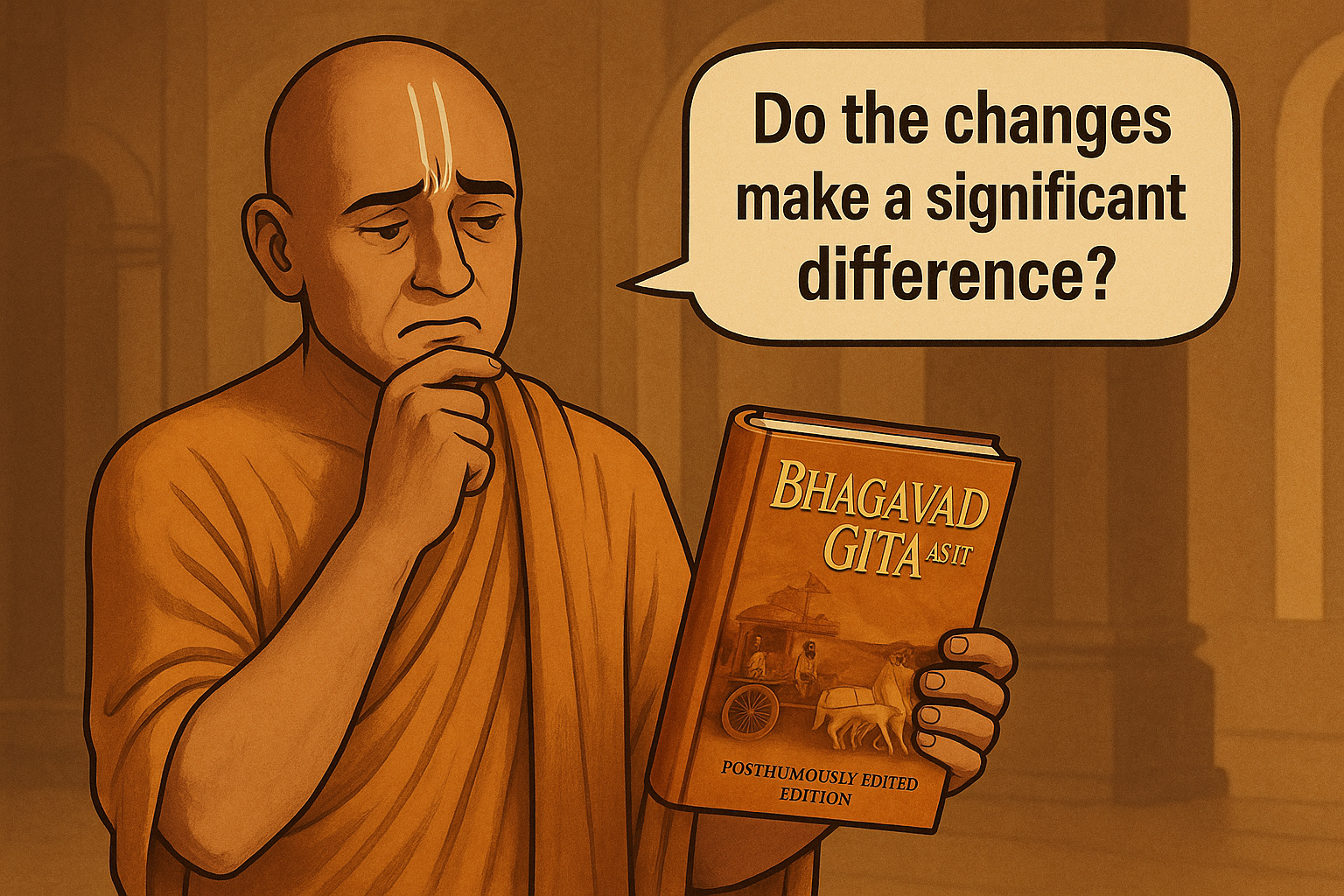
“The question “Do the changes make a significant difference to the message?” sounds fair—but it completely misses the point. It assumes that the legitimacy of changing a pure devotee’s words depends on how much the meaning seems to change. That assumption itself is false.”
Category Archives: Examples of changes
More Than Most – Revisited (Bg. 18.63)

By Ajit Krishna Dasa
When Bhakta Torben first published More Than Most in his ebook Blazing Edits, he exposed one of the clearest examples of how posthumous editing can distort Śrīla Prabhupāda’s intended meaning. His analysis of Bhagavad-gītā 18.63 was sharp, direct, and rooted in the ārṣa-prayoga principle. What follows is a revisiting of that same verse — not to replace his contribution, but to expand it. With additional evidence, deeper linguistic analysis, and Śrīla Prabhupāda’s own spoken confirmation of the original translation, we can now see even more clearly the magnitude of the philosophical shift introduced by the BBT International editor Jayadvaita Swami. This article stands in continuity with Bhakta Torben’s work and in appreciation of his service.
Description
Śrīla Prabhupāda’s manuscript (draft):
“Thus I have explained to you the most confidential of all knowledge. Deliberate on this fully, and then do what you wish to do.”
Original and Authorized Pre-Samadhi Edition:
Same wording.
Jayadvaita Swami / BBT International posthumous edition:
“Thus I have explained to you knowledge still more confidential. Deliberate on this fully, and then do what you wish to do.”
Here the ācārya’s chosen expression — “the most confidential of all knowledge” — has been replaced with a weaker comparative phrase that Śrīla Prabhupāda never authorized. Jayadvaita Swami and BBT International assured us that their edits would bring us “Closer to Śrīla Prabhupāda.” This edit does the opposite.
Type of Change
Substitution (Replacement) — replacing the ācārya’s established wording with a new formulation after his disappearance.
Category
Philosophical Change — because it alters the meaning, force, and doctrinal weight of the verse in one of the most climactic moments of the Bhagavad-gītā.
Śrīla Prabhupāda Confirms the Original Translation (Full Lecture Quote)
When the 1972 translation was read aloud to Śrīla Prabhupāda, he accepted it immediately and began teaching from it without hesitation. Even more striking, he strengthened it by using the pure Sanskrit superlative guhyatamam in his explanation.
Hari-śauri:
iti te jñānam ākhyātaṁ
guhyād guhyataraṁ mayā
vimṛśyaitad aśeṣeṇa
yathecchasi tathā kuru
“Thus I have explained to you the most confidential of all knowledge. Deliberate on this fully, and then do what you wish to do.”Prabhupāda: “So it is your business. ‘You deliberate on all the points I have told you. Now if you like, you surrender unto Me. If you don’t like, you do whatever you like.’ Yathecchasi tathā kuru. This is God. He doesn’t touch on your liberty. He gives you the right information. Now you… Idaṁ te jñānam? Iti te jñānam.”
Hari-śauri: “Iti te jñānam ākhyātam.”
Prabhupāda: “Ākhyātam.”
Hari-śauri: “Guhyād guhyataraṁ mayā.”
Prabhupāda: “Guhyād guhyataraṁ mayā.”
Hari-śauri: “Vimṛśyaitad.”
Prabhupāda: “Vimṛśya — ‘Now you think over it.’ You consider, make your deliberation, and then you do whatever you like. Iti te jñānam ākhyātam — ‘I’ve explained to you all kinds of different types of knowledge, and ultimately, guhyatamam, the most confidential knowledge I’ve spoken to you, that you surrender to Me.’”
This is decisive. Śrīla Prabhupāda accepts the translation exactly as printed in 1972 and then upgrades the comparative to the superlative. The posthumous edit does the opposite.
A Note on the Synonyms
It is true that Śrīla Prabhupāda uses the literal phrase “still more confidential” in the synonyms for guhyataram. But the Synonyms in Prabhupāda’s books serve as literal Sanskrit glosses, not as the final doctrinal expression of the verse. Prabhupāda routinely departs from the synonyms when giving the English Translation, because the Translation is where he presents the siddhānta — the intended philosophical meaning. In Bhagavad-gītā 18.63, Prabhupāda deliberately chose “the most confidential of all knowledge” for the Translation, and in his lecture he further strengthened that sense by using the pure superlative guhyatamam. The doctrinal meaning is therefore the superlative, not the comparative. The presence of “still more confidential” in the synonyms cannot justify altering Śrīla Prabhupāda’s authorized translation.
Commentary
The Sanskrit phrase guhyād guhyataraṁ is grammatically comparative (“more confidential”), but in the context of the Gītā it clearly expresses a final, culminating revelation. Śrīla Prabhupāda captures this meaning with precision by translating it as “the most confidential of all knowledge.”
This phrase appears in:
– the manuscript
– the 1972 Bhagavad-gītā As It Is
– Śrīla Prabhupāda’s lectures
– his consistent theological vocabulary
The BBT International posthumous edit — “knowledge still more confidential” — collapses that force.
-It downgrades the meaning, turning a climax into a comparative.
-It contradicts Śrīla Prabhupāda’s own explanation, where he uses the superlative guhyatamam.
-It breaks Prabhupāda’s established vocabulary (“most confidential” is a fixed Prabhupādan term).
-It corrects nothing and weakens much.
-It violates the Arsa-prayoga principle by overriding an ācārya’s chosen wording after his departure.
This is a philosophical change, not merely an adjustment of English.
Conclusion
Śrīla Prabhupāda’s translation of Bhagavad-gītā 18.63 is clear, intentional, and confirmed by his own spoken commentary. The posthumous BBT International edit by Jayadvaita Swami replaces that clarity with a weaker, unauthorized formulation that is directly contradicted in his lecture.
This is not refinement. It is distortion.
When Śrīla Prabhupāda has already spoken, the matter is finished.
Jayadvaita Swami Condemns His Own Edits: A Case Study in Needless Change

By Ajit Krishna Dasa
Jayadvaita Swami wrote in 1986:
“As you know, and as we kept in mind while doing the work, Śrīla Prabhupāda staunchly opposed needless changes.” (Jayadvaita Swami, Letter to Amogha Lila, 1986)
This statement is correct. Śrīla Prabhupāda did staunchly oppose needless changes — and this principle is the foundation of ārṣa-prayoga, the principle that the words of a pure devotee are not to be altered by conditioned editors.
The following example — pointed out to us by Bhakta Torben Nielsen in his ebook Blazing Edits — illustrates the issue perfectly.
We look at a posthumous edit introduced by BBT International (BBTI) in the 1983 revised Bhagavad-gita As It Is, specifically 18.2, purport.
Original (Prabhupāda-approved pre-samadhi edition):
“There are many prescriptions
of methods
for performing sacrifice
for some particular purpose
in the Vedic literatures.”
Posthumously edited (BBTI edition):
“In the Vedic literature
there are many prescriptions
of methods
for performing sacrifice
for some particular purpose.”
This is not a correction.
This is not a clarification.
This is not a doctrinal improvement.
It is simply a relocation of one phrase — a stylistic reshuffling that has no philosophical or grammatical necessity whatsoever.
What problem did this edit solve?
None.
Was the original incorrect, unclear, or misleading?
No.
Did Srila Prabhupada ever request this change?
No.
Did BBTI give a reason for it?
No.
According to Jayadvaita Swami’s own standard — “Prabhupāda opposed needless changes” — this is precisely the kind of change Śrīla Prabhupāda would not have approved.
The contradiction is unavoidable:
- Jayadvaita Swami says unnecessary edits violate Prabhupāda’s wishes.
- Jayadvaita Swami then makes an unnecessary posthumous edit.
That is why this small change becomes a perfect diagnostic tool. It shows that once editors begin altering Srila Prabhupada’s books based on personal preference or literary style, the entire principle of ārṣa prayoga has already been abandoned.
Why This Matters for Bhagavad-gita As It Is
The 1972 first edition was personally approved, lectured from, distributed, and trusted by Śrīla Prabhupāda. The 1983 posthumously edited edition by BBTI was not.
When even a harmless sentence — one that Prabhupāda accepted and used — is needlessly altered, it proves the deeper issue:
Posthumous editing inevitably leads to editorial overreach, because the standard has shifted from “transmit exactly” to “improve according to taste.”
And once that door opens, the rest of the book becomes vulnerable.
It all starts with edits exactly like this.
Why “Do the Changes Make a Significant Difference?” Is the Wrong Question
By Ajit Krishna Dasa
The question “Do the changes make a significant difference to the message?” sounds fair—but it completely misses the point. It assumes that the legitimacy of changing a pure devotee’s words depends on how much the meaning seems to change. That assumption itself is false.
The issue is not how much the message shifts. The issue is that anyone dared to shift it at all. Śrīla Prabhupāda’s books are not ordinary literature subject to posthumous editing or so-called editorial refinement by the Bhaktivedanta Book Trust International (BBT International) or its post-samādhi editors like Jayadvaita Swami. They are śabda-brahma—the sound incarnation of divine truth transmitted through an authorized ācārya. Once such an ācārya leaves this world, his words are final. No conditioned soul is authorized to adjust them, no matter how “minor” the adjustment may appear.
Even a single substituted synonym or rearranged phrase presumes editorial superiority over one who spoke under Kṛṣṇa’s direct guidance. That is why the ārṣa-prayoga principle exists: the words of the ācārya are sacred and must remain untouched. It protects the integrity of Śrīla Prabhupāda’s original books from unauthorized changes made after his departure.
Moreover, the idea of “significant difference” is itself deceptive. Many edits that look small actually do change meaning—altering theological emphasis, philosophical precision, or Śrīla Prabhupāda’s characteristic tone. But even if some do not, the very act of judging “significance” replaces revelation with speculation. It invites endless tampering under the same excuse, which has already been seen in the posthumously edited Bhagavad-gita As It Is.
There is also a deeper layer. Words don’t only convey meaning—they frame it. They shape how readers approach and internalize the message. Changing phrasing, order, or rhythm changes the lens through which the reader perceives the philosophy. Just as altering the cover of Bhagavad-gita As It Is reframes a reader’s expectations before opening the book, altering the language inside silently redefines how one enters the message itself.
Śrīla Prabhupāda’s English was an extension of his bhāva—his spiritual mood. His rhythm, simplicity, and repetition carried power far beyond grammar. To “polish” that expression is to polish away the teacher’s presence. Even if the words remain similar, the śraddhā-bindu—the drop of faith that transmits realization—fades.
So the real problem is not merely what has changed, but that the frame of reception—the channel connecting the reader to the guru—has been tampered with. Once that link is altered, the spiritual potency no longer flows in the same pure way.
That is why the question, “Do the changes make a significant difference?” is misplaced. The real question is:
Who gave anyone the right to touch even one word of a self-realized ācārya’s books after his departure?
Does “Having Once Been” Imply Creation? A Closer Look at Bhagavad-gītā 2.20

By Ajit Krishna Dasa
The Verse in Question
Bhagavad-gita As It Is 2.20 (1972 authorized edition):
na jāyate mriyate vā kadācin nāyaṁ bhūtvā bhavitā vā na bhūyaḥ
“For the soul there is never birth nor death. Nor, having once been, does he ever cease to be.” (Bhagavad-gītā 2.20)
In his posthumously edited edition of Śrīla Prabhupāda’s Bhagavad-gītā As It Is, Jayadvaita Swami altered the translation of this verse, claiming that Śrīla Prabhupāda’s original wording — “Nor, having once been, does he ever cease to be” — wrongly suggests that the soul was created. He presented this change as a clarification meant to align more closely with Vaiṣṇava philosophy. Yet when the verse is examined carefully, both linguistically and philosophically, that justification collapses entirely.
Continue readingJayadvaita Swami’s Posthumous “Should Not” Edit – A Change in the Philosophy of Bhagavad-gītā (Bg. 13.1–2)

By Ajit Krishna Dasa
Description
In the purport to Śrīla Prabhupāda’s Bhagavad-gītā 13.1–2, a single missing word completely reverses the meaning of the text.
1972 Unabridged Edition (Collier-Macmillan, First Printing):
“Now, the person who identifies himself with this body is called kṣetrajña, the knower of the field.”
This wording wrongly defines the kṣetrajña—the knower of the field—as one who identifies with the body. When this error was read aloud in Paris in 1973, Śrīla Prabhupāda immediately caught it and corrected it personally.
He said:
“Who does not identify, it should be.”
…
“This should be corrected immediately.”
His instruction was clear and recorded. But in Jayadvaita Swami’s posthumously edited BBT International edition the sentence was changed to read:
“Now, the person, who should not identify himself with the body, is called kṣetra-jña, the knower of the field.”
This new version does not follow Śrīla Prabhupāda’s direct correction.
Type of Change
Substitution and Doctrinal Editing
The phrase “should not identify” replaces Śrīla Prabhupāda’s exact correction “does not identify.” This change substitutes a normative instruction for a descriptive definition, thereby altering the philosophical meaning of the Bhagavad-gītā purport.
Category
Doctrinal Error
The BBT International wording, “should not identify,” gives an entirely different philosophical conclusion.
Śrīla Prabhupāda’s version, “does not identify,” distinguishes the self-realized soul from the conditioned soul. Only those who do not identify with the body are kṣetrajña, the true knowers of the field.
By contrast, “should not identify” applies to all human beings, since everyone should not identify with the body. It therefore implies that even the ignorant, body-conscious person is “called kṣetrajña.”
This transforms a definition of realization into a moral exhortation—and thus changes the philosophy of the Bhagavad-gītā itself.
The result is a posthumous doctrinal alteration that stands in direct contradiction to Śrīla Prabhupāda’s explicit instruction.
It takes us not “Closer to Śrīla Prabhupāda“, as the BBT International catchphrase goes, but further away from him.
Commentary
Śrīla Prabhupāda’s recorded conversation (Paris, August 11, 1973) leaves no room for interpretation:
Prabhupāda: “It is wrongly written… Who does not identify, it should be… This should be corrected immediately… One must know that ‘I am not this body.’ That is knowledge. That is knower.”
The meaning is self-evident: The kṣetrajña is the person who knows he is not the body.
To say “should not identify” is not simply a weaker phrase—it collapses the distinction between knowledge and ignorance. It tells everyone what they ought to do, instead of describing who actually is the knower.
This is not a stylistic difference; it is a philosophical change.
In fairness, the same missing “not” appears in the original typed manuscript, which was a transcription of Śrīla Prabhupāda’s dictation. The error may have originated with the typist, not the early editors.
But after 11th August 1973 that was no longer relevant. When Śrīla Prabhupāda himself discovered the error and issued a correction, the matter was settled permanently.
Once the ācārya speaks, his words are final. No posthumous editorial interpretation can override them.
This is precisely the purpose of the Arsa-prayoga principle: the words of the ācārya are sacred and must not be changed by later editors, regardless of intention or perceived improvement.
As Śrīla Prabhupāda said that day:
“If you identify with body, how you know it? Oh, it is a very great mistake.”
The BBT International version preserves that mistake—only in a subtler form.
The correct version, as ordered by Śrīla Prabhupāda, reads:
“Now, the person who does not identify himself with this body is called kṣetrajña, the knower of the field.”
This is not just the right grammar. It is the right philosophy.
Note
This case perfectly illustrates why the Arsa-prayoga principle must be upheld in all dealings with Śrīla Prabhupāda’s books. Even small “clarifications” made after the author’s disappearance can become posthumous doctrinal changes that distort meaning and misrepresent the ācārya’s philosophy.
The correction ordered by Śrīla Prabhupāda was explicit and recorded. Jayadvaita Swami and BBT International had no mandate to modify or reinterpret it.
This single word—does not—marks the difference between ignorance and realization, illusion and knowledge. And when we protect Śrīla Prabhupāda’s exact words, we are not only defending language. We are defending truth itself.
Malati Devi Dasi: “One shouldn’t change. You can write your own.”
By Ajit Krishna Dasa
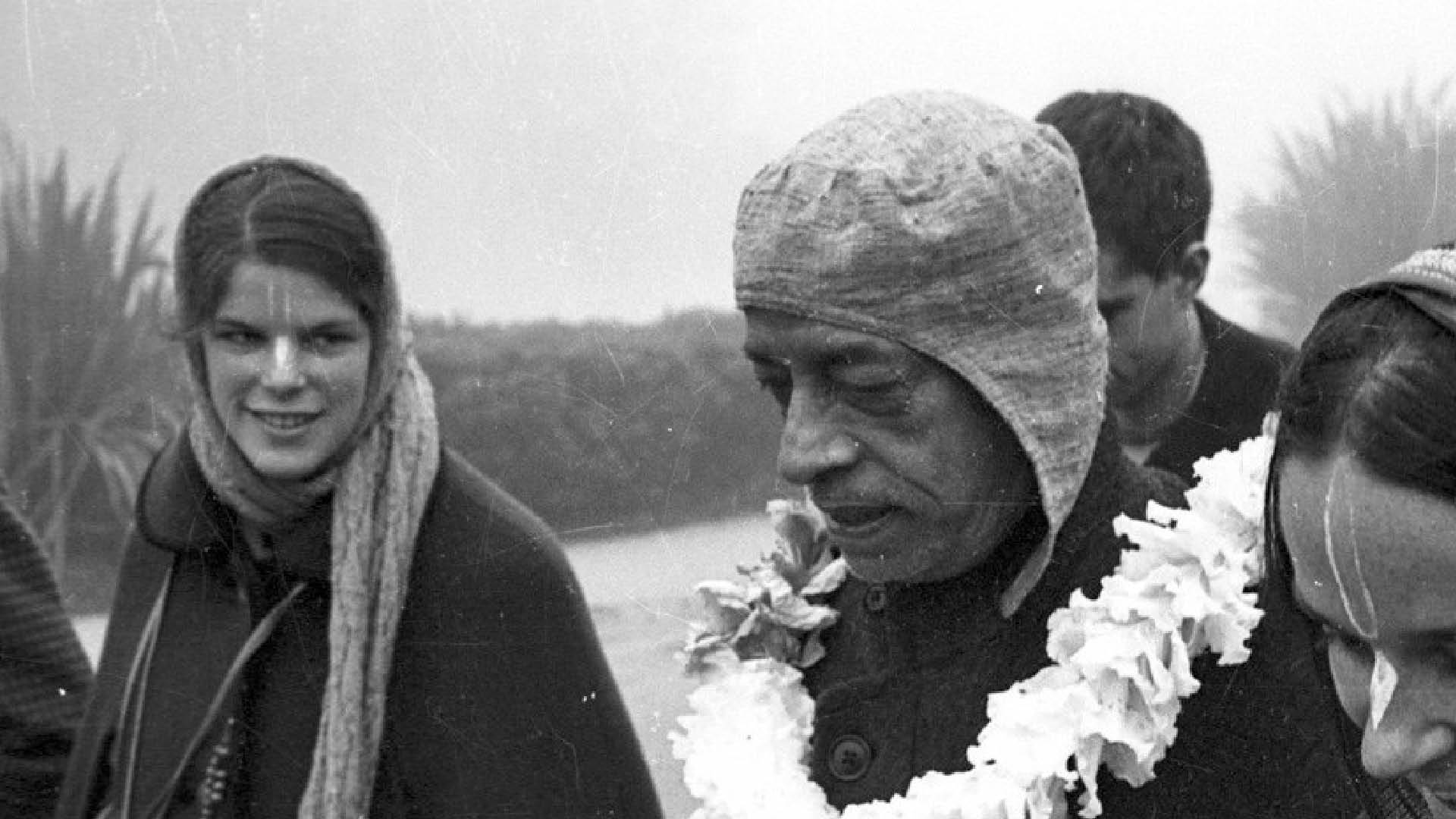
8 November 2025 — Bhaktivedanta Manor, UK
During a class at the Bhaktivedanta Manor, Malati Devi Dasi recounted a well-known episode from Śrī Caitanya-caritāmṛta where Lord Caitanya Mahāprabhu corrected a single-word alteration made by Sarvabhauma Bhaṭṭācārya, the renowned scholar of Jagannātha Purī.
After becoming a devotee, Sarvabhauma was so overwhelmed with joy that he modified the word “mukti-pade” in Śrīmad-Bhāgavatam 10.14.8, replacing it with “bhakti-pade.” Although his intention was devotional, Mahāprabhu corrected him, explaining that “mukti-pade” is already a beautiful name of Kṛṣṇa, and śāstra must not be altered based on sentiment or preference.
Malati Devi Dasi drew a direct parallel to modern tendencies to edit sacred texts:
“Nowadays we also have people who like to change words from the holy scriptures, and some of us don’t appreciate it very much. … Śrīla Prabhupāda commented, ‘Write your own.’ In other words, one shouldn’t change. You can write your own.”
Her words are especially significant in light of the Arsa-Prayoga principle, which holds that the words of the ācārya are sacred and should not be edited or “improved” posthumously – like it has been done by Jayadvaita Swami, Dravida Dasa and the BBTI. Just as Mahāprabhu upheld the integrity of the original Bhāgavatam verse, devotees today are called to preserve Śrīla Prabhupāda’s books – like his Bhagavad-gita As It Is – exactly as he approved them — without revision or re-interpretation.
Three Key Points to Note
- Malati Devi Dasi’s Personal Stance
While Malati Devi spoke strongly against altering śāstra or works of ācāryas, it is not entirely clear what her full position is regarding the specific changes made to Śrīla Prabhupāda’s books. We respectfully invite her to elaborate further — especially given her stature as one of Śrīla Prabhupāda’s earliest and most respected disciples. - The Arsa-Prayoga Principle
This sacred principle — “Do not correct the ācārya” — has historically been recognized throughout the Vaiṣṇava tradition. Śrīla Prabhupāda himself invoked this principle when arguing against revising earlier editions of Bhagavad-gītā and Bhāgavatam by other commentators. “Write your own,” he said. Changing the master’s work, even with good intentions, severs the disciplic link by overlaying the disciple’s mind over the guru’s words. - The Lesson from Sarvabhauma Bhaṭṭācārya
Sarvabhauma’s change of one word was born of devotion, but Mahāprabhu still corrected it. If the Lord Himself did not approve of devotional word-swapping, what to speak of posthumous textual reconstruction by conditioned disciples decades later? The story demonstrates that no matter how exalted the editor or emotional the inspiration, śāstra and ācārya-vāṇī are not ours to adjust.
The full transcription, audio and video excerpt from Malati Devi Dasi’s class will be included below for reference.
If nothing else, the class was a timely reminder that great caution — and deep humility — is required when dealing with the words of the Lord and His pure devotee.
Video:
Audio:
https://drive.google.com/file/d/1KkVZgvY94F6IgLG0dOlYsC_aTGslC2kn/view?usp=drive_link
Full transcription (made with AI):
“So Mahaprabhu said, today I have been transported beyond the three worlds and I’ve been taken to Vaikuntha. All my desires have been fulfilled simply because Sarvabhauma has developed faith in Mahaprasad. And as a result of this, his attitude, Sarvabhauma’s attitude has also changed. And his conversion, it was like a conversion on that day. So he recited a verse of the Bhagavatam, and in that verse, in his newfound ecstasy and realizations, he changed one word. So I think nowadays we also have, we also have people that like to change words from the holy scriptures, and we don’t appreciate, some of us don’t appreciate it very much. So he altered one word. So the verse is well-known, 10.14.8 [Malati recites the Sanskrit], and here’s what he changed. So in the original version, it’s not bhakti-pade. And the verse in English, one who lives his life while joyfully seeing everything as your compassion, meaning the Lord’s compassion, so one who lives his life while joyfully seeing everything as your compassion, even as he experiences adverse conditions arriving from his past deeds, and constantly, nonetheless, constantly pays obeisances to you with his mind, words, and body, is certain to inherit a place at your lotus feet, the object of all devotion. So the original word was mukti-pade, and he changed that mukti-pade to bhakti-pade. And Mahaprabhu explained that there’s no need to change the words of mukti-pade, the source of liberation. It’s a epithet for Krishna. And Vasudeva answered, you’re quite correct to say that the words mukti-pade refer to Krishna, but the word mukti was used customarily in the sense of impersonal liberation, and thus it didn’t bring the same great pleasure as the word bhakti. So that, you know, for somebody who’s maybe not quite as astute, that may ring a bell. Yeah, that’s right. But that’s not how you approach a shastra, and particularly if your books are coming to you from jagat guru Srila Prabhupada, one should be very circumspect. So the other, when the other scholars in Puri heard that Sarvabhauma Bhattacharya had been converted to devotion to Krishna, because he’d been, you know, he’d been an impersonalist. And when they heard about this conversion to Krishna, then all of them took shelter of Caitanya Mahaprabhu. You know, like our verse from the Gita, that whatever the great man does, the common man will follow. He was a great man, he was a much revered and respected personality, and now he was joining the cult of Chaitanya Mahaprabhu. And so they also followed, just like by getting the Beatles to chant Hare Krishna, by getting George in particular, it affected generations. Even to this day, people come across, oh, George Harrison chanted Hare Krishna, and they see the Krishna book with his signature, and immediately they’re attracted. But regards to changing the original text of the Shastra, Srila Prabhupada commented, write your own. In other words, one shouldn’t change. You can write your own.”
Lord Ramacandra Removed – Revisited

By Ajit Krishna Dasa
Link to original Arsa-Prayoga article:
https://arsaprayoga.com/2013/09/12/lord-ramacandra-removed-from-bhagavad-gita-as-it-is-10-31/
Description
This article examines Jayadvaita Swami’s deletion of the line “Lord Ramacandra, of the Ramayana, an incarnation of Krishna, is the mightiest of warriors” from the purport to Bhagavad-gītā As It Is 10.31 in posthumous printings by the Bhaktivedanta Book Trust International (BBTI). While the line was almost certainly inserted by one of Srila Prabhupada’s editors, it was later affirmed by Srila Prabhupada himself in recorded conversation. Once that acceptance is confirmed, the matter is settled — and the later deletion is revealed as a breach of paramparā, not a restoration of accuracy.
Type of change
Deletion — removal of a complete sentence from the published purport.
Category
Philosophical/Devotional change.
Commentary
The editor added it — and Srila Prabhupada accepted it
We do not have evidence that Srila Prabhupada personally wrote the line naming “Lord Ramacandra” in the 10.31 purport. The wording almost certainly came from an editor working under his supervision — and that is fine. Prabhupada relied on editors to help prepare many purports.
The crucial point is this:
Srila Prabhupada heard the exact purport, which included the reference to Lord Ramacandra, and explicitly accepted it as correct in a conversation quoted in the article. He repeated the same identification in his own voice.
Once that happened, the sentence became authorized. No one has the right to remove it after his departure.
Prabhupada confirmed the meaning of “Rama” here as Ramacandra
In a recorded discussion, Srila Prabhupada used this exact verse (10.31) as an example of how Lord Ramacandra is mentioned in the Gītā. He did not say, “This was an editorial invention.” He accepted it.
And even though the term “Rama” also can refer to Parasurama or Balarama, Prabhupada confirmed Ramacandra as one of the valid referents in this specific context of the Gita. That is enough to fix it into the purport permanently.
There is no scope to overrule the ācārya’s final approval
Posthumous editing is sometimes defended on the basis that “Prabhupada didn’t write this line himself.” But in Krishna consciousness, the test is not authorship — it is acceptance.
Once the ācārya approves and uses a sentence, it belongs to him. The disciple may not later argue: “But that wasn’t his original phrasing.” That is editorial hubris disguised as scholarship.
The deletion erases a confirmed Vaiṣṇava possibility
By removing the reference to Lord Ramacandra, BBTI did not just “restore ambiguity” — they erased part of Srila Prabhupada’s own explanation.
Srila Prabhupada made it clear: “Rama” can include several incarnations of the Lord, but also includes Lord Ramacandra in the context of this verse — a point he heard in the purport, accepted, and personally repeated.
The purport, as originally printed, reflected that full Vaiṣṇava understanding. After the deletion, it no longer does.
So the issue is not that the edited version is “uncertain” — but that it is incomplete. It no longer reflects the full range of meaning as accepted by Srila Prabhupada himself.
Removing what Prabhupada approved doesn’t improve accuracy.
It reduces fidelity.
Why this is not negotiable
Even if the line was originally added by an editor, Srila Prabhupada approved it, used it, and confirmed its meaning in his own voice. That turns an editorial suggestion into an ācārya-sanctioned teaching. Removing it is not just a mistake in publishing. It is a mistake in disciplic succession.
The Arsa-Prayoga principle is simple: You do not remove what the spiritual master has accepted. Once he confirms it, it becomes sacred.
The deletion of Lord Ramacandra’s name is not the editing of a “mistake.” It is the undoing of Prabhupada’s acceptance — and that is the real error.
Frivolous Change of Chapter-Heading – Revisited

By Ajit Krishna Dasa
Link to original Arsa-Prayoga article:
https://arsaprayoga.com/2013/10/24/enjoying-the-self-within-or-the-duty-of-the-finger-bg-4-38/
Description
This article explores how changing the chapter title “Sankhya-yoga” to “Dhyāna-yoga” in Bhagavad-gita As It Is alters the reader’s perception of Srila Prabhupada’s intention — not because “Dhyāna-yoga” is inherently wrong or historically invalid, but because Prabhupada had a purpose in not using that more common title. The issue, therefore, is not academic accuracy, but fidelity to the ācārya’s personal voice — a core principle of Arsa-Prayoga, especially in the context of posthumous editing by BBTI.
Type of change
Substitution — one term from the Vedic tradition replaced by another, equally authentic, but conveying a different emphasis.
Category
Philosophical change.
Commentary
Not a question of “right” or “wrong” — but of honoring intention
Many commentaries throughout Vaiṣṇava history title Chapter 6 as “Dhyāna-yoga.” This is not a mistake. But Srila Prabhupada chose not to use this more common title. Instead, he used “Sankhya-yoga” consistently in his lectures, manuscripts, and published edition of Bhagavad-gita As It Is.
That choice is not random — it reflects a pedagogical and theological strategy. When BBTI editors later replaced it with “Dhyāna-yoga,” the question is not whether their choice could be justified in a vacuum, but whether it should override Prabhupada’s own.
Srila Prabhupada’s framing is the governing standard
Prabhupada repeatedly emphasized that his edition of the Gītā was not merely another translation, but the definitive presentation of the Bhagavad-gita “as it is.” To alter his chosen structure — even in a title — is to alter the interpretive lens he intentionally set.
This is where Arsa-Prayoga becomes relevant: the principle that once the ācārya has spoken, his presentation stands. Posthumous editing, however well-meaning, must not replace the spiritual intuition of the empowered teacher with the academic preferences of his disciples or followers — whether they be Jayadvaita Swami, Dravida Dasa, or any future editor.
Why “Sankhya-yoga” rather than “Dhyāna-yoga”?
Prabhupada’s use of “Sankhya-yoga” emphasizes that meditation is not an isolated practice, but flows from knowledge — specifically, the discrimination between matter and spirit.
By choosing “Sankhya-yoga,” he was teaching that yogic practice is incomplete without philosophical realization and ultimately Kṛṣṇa consciousness. He may also have been signaling a departure from modern, technique-focused interpretations of yoga that are divorced from devotion — a trend evident even in the 1970s which has only grown stronger since.
The editorial risk: erasing Prabhupada’s corrective
Changing the title to “Dhyāna-yoga” removes that corrective emphasis and defaults back to the format familiar from other editions. This is exactly what makes the change problematic. If Prabhupada was deliberately shifting the focus — away from impersonal or secular yoga narratives and toward theistic Sankhya — then the editorial change undoes his work.
This is not a disagreement with previous ācāryas. It is a disagreement with editing the ācārya after his departure.
The issue, therefore, is not whether “Dhyāna-yoga” is a legitimate title in the wider tradition, but whether BBTI has the right to retroactively override Srila Prabhupada’s intentional wording in Bhagavad-gita As It Is. A single change in a chapter title may seem small, but it signals a larger trend: the subtle reshaping of Prabhupada’s work through posthumous editing instead of paramparā.
That is why this matters — not because of a word, but because of the principle.
Why One Conversation Cannot Rewrite the Gītā: A Case Study in Misusing Prabhupāda’s Words

By Ajit Krishna Dasa
A devotee recently pointed to the following excerpt from a 1973 conversation and argued that, based on this alone, Bhagavad-gītā 18.66 should be “corrected” to replace the word religion with “occupation”:
Prabhupāda: Now, Kṛṣṇa says, sarva-dharmān parityajya [Bg. 18.66].
Satish Kumar: Yes.
Prabhupāda: Now, dharma means occupation. Dharma is not translated as “religion.”
Satish Kumar: No, no.
Prabhupāda: This is wrong translation. Dharma means occupation.
Satish Kumar: Activity?
Prabhupāda: Activity, occupation.
(Conversation, London, July 30, 1973)
Before rushing to “fix” the book, a few points need to be made—especially in light of arsa-prayoga, the principle that the words of the ācārya are not to be tampered with after his departure:
- No instruction, and thus no authorization, was given to change the verse. Srila Prabhupada often spoke freely and loosely in conversation, but he gave direct, literal instructions for book changes while present. Here, he did not.
- Srila Prabhupada himself frequently translated dharma as “religion.” This is not a one-off occurrence—it appears hundreds of times in his books and lectures. Are we now to “correct” them all? On what authority?
- He heard the verse read aloud repeatedly and never objected. This is decisive. He personally approved the printed Gītā, lectured from it, and signed off on it as finished work.
- What happens when we find other places where Prabhupada gives different meanings or emphases? Language is fluid, and Srila Prabhupada tailored his wording to context and audience. Selectively mining conversations to override the final, published work is not fidelity—it’s revisionism.
- This is exactly how “The Blessed Lord” was removed by Jayadvaita Swami and the BBTI from later editions. Even though Srila Prabhupada accepted that phrase while alive, and even used it himself, editors saw one conversation where he expressed a reservation—and used that as a pretext to delete it from the entire book.
If this logic is allowed, what will be next?
This is the fatal pattern: use a stray comment in a private conversation to overrule the public, authorized book. It weaponizes Prabhupada’s own words against his finished legacy. That is the opposite of arsa-prayoga. That is how the books slowly stop being his.
 Arsa-Prayoga
You must be logged in to post a comment.