New Video Series on the Book Changes

We are gradually producing videos on the book changes. Check our playlist at Youtube, and remember to subscribe for new videos.

Kindly share the videos on social media – especially on Facebook.

Thanks for watching and helping Srila Prabhupada.

Book Changes – Playlist

Harikesh Swami – Next Acarya After Srila Prabhupada?

By Ajit Krishna Dasa

Danish Bhagavad-gita As It Is Anno 1984:

13346308_10154338447350962_9033715945169577503_o

BBT International approved this change! Perhaps even Jayadvaita Swami?

Later the devotees had to rip out this page. Embarrasing! Shows the extent of the zonal “acarya’s” ambitions, and the self-deception of their followers.

“Blessed Lord” Means the Lord is Praiseworthy

By Ajit Krishna Dasa

One of the thousands of things that Jayadvaita Swami changed in the Bhagavad-gita As It is was the term “The Blessed Lord”.

There are some misconceptions about this term in the society of devotees. Even some native English speaking devotees believe that the term refers to a scenario where the Lord is being blessed (endowed) with a certain thing or attribute by one of his devotees.

Based on this misconception they consider the term “The Blessed Lord” as it is used in the Bhagavad-gita As It Is to be mistaken, and thus they support Jayadvaita Swami’s change to “The Supreme Personality of Godhead”.

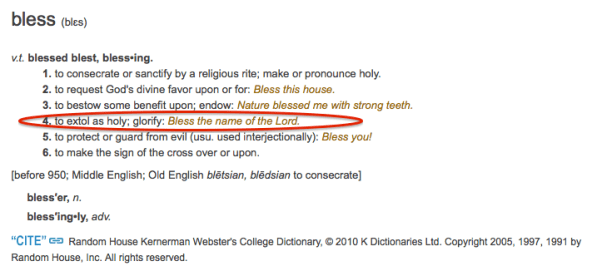
I am quite amazed that native English speakers are not aware that the term “The Blessed Lord” or “to bless the Lord” means something completely different. I am also amazed to see how they criticise the term “The Blessed Lord” without bothering to look for it’s meaning in a dictionary or online.

Let us help them:

Screen Shot 2016-04-28 at 14.28.42

And

Screen Shot 2016-04-28 at 14.42.44

To learn more about how the term is used we need to nothing more than search the internet. There are loads of answers. In Christianity is perfectly normal to say “The Blessed Lord” and “Bless the Lord” in the sense of praising, glorifying and honoring God.

Here is something from an article that makes the point clear:

“There are two main things that we do when we bless the Lord.  The first is synonymous with giving thanks and praise.  Some translations actually say, “Give thanks to the Lord,” where others say, “Bless the Lord.”  So, blessing the Lord is praising Him and giving thanks to Him—for blessing us!  The other thing we do when we bless the Lord is to proclaim Him blessed.  Here I think I’ll have to make a distinction between “blessed” and “blessed.”  For clarity’s sake, this distinction is between “blessed” and “blest”—though I don’t really like that newfangled form of the word—the former in two syllables and the latter in one.  The former is a state of being, the latter a consequence of something have been done or given to someone.

When we call God blessed, we are saying something about who God is.He is blessed, which is a synonym for “holy.”  Blessed is God, the Father of our Lord Jesus Christ!  The Byzantine Divine Liturgy always opens with the glorious and magnificent “Blessed is the Kingdom of the Father and of the Son and of the Holy Spirit, both now and forever and unto ages of ages!” When we speak of God as the recipient of our blessings (praises and thanksgivings), then He is blest.  May the Lord be forever blest!  Sometimes both meanings can apply simultaneously.When Our Lady said, “All generations shall call me blessed,” it means both that all generations acknowledge her holiness and that all generations acknowledge that she has been uniquely blest by God.”

When Jayadvaita Swami made the change from “The Blessed Lord” to “The Supreme Personality of Godhead” he did not used the above mentioned misconception as a justification. Perhaps he knew there was nothing wrong with the term. He attempted to justify his change in another way. His attempted justification will be the subject matter of an upcoming article.

Salt in the Caranamrta (e-book)


Screen Shot 2016-04-10 at 15.24.13

Hare Krishna!

I have just made an e-book consisting of most of my articles, letters, rebuttals, quotes, debates etc. from arsaprayoga.com.

Here it is:

Salt in the Caranamrita (04-10-2016-19-40)

You will always be able to find the latest version in the e-book section of arsaprayoga.com.

Spread the word.

Your servant, Ajit Krishna Dasa

Regulated Principles Regulated (Bg. 12.12)

By Ajit Krishna Dasa

Srila Prabhupada frequently uses the terms “regulative principles” and “regulated principles” in his teachings.

But Jayadvaita Swami claims that “regulated principles” is a nonsense use of words. He calls it “obviously erroneous” and “a term that makes no sense” (Link).

He says it should always be “regulative principles”, and thus Jayadvaita Swami is in the process of changing all “regulated principles” into “regulative principles” in Srila Prabhupada’s books.

But there are two good reason to think Jayadvaita Swami is wrong:

First Reason

Srila Prabhupada explains just how spiritual principles are regulated, namely by the spiritual master:

“In the neophyte stage of devotion one must follow all the principles, regulated by the authority of the spiritual master.”

So “regulated principles” means principles regulated by a superior authority.

I do not know why this makes no sense to Jayadvaita Swami. It seems so obvious!

Let us take a simple example:

Chanting is a principle. Srila Prabhupada regulated that principle: Minimum 16 rounds per day.

Simple for the simple.

Second Reason

“Regulated principles” is a quite common term. Just take a look at google:

Screen Shot 2016-03-24 at 01.26.14

And a few more:

Screen Shot 2016-03-24 at 01.12.14Screen Shot 2016-03-24 at 01.12.53Screen Shot 2016-03-24 at 01.13.11Screen Shot 2016-03-24 at 01.13.33Screen Shot 2016-03-24 at 01.13.54

So!

Again!

Jayadvaita Swami’s “justifications” for changing “regulated principles” are just plain wrong.

Srila Prabhupada has regulated principles for the editing of his books. Jayadvaita Swami should learn them.

Open Letter to Sivarama Swami

Screen Shot 2015-11-13 at 19.52.49

This below e-mail was sent to Sivarama Swami through the e-mail address (asksrs@gmail.com) provided on this website. I hope that the devotees in charge of receiving the e-mails will forward the e-mail to Maharaja. In the meantime I will look for another e-mail address of his.

Dear Sivarama Swami. Dandavat pranama. Jaya Srila Prabhupada.

I apologize if answering this letter becomes a burden on your many other responsibilities.

Recently I heard a podcast from your website where you respond to a few questions about the changes made to Srila Prabhupada’s books.

I have a few comments and points I find important in relation to your response, and I hope you will find the time to answer each of them.

This is an open letter, so it will also be posted online.

The letter is attached to this e-mail, but you can also find it here:

Open Letter to Sivarama Swami

Thank you very much.​
Your servant,
Ajit Krishna Dasa

Srila Prabhupada’s Higher Intelligence

Screen Shot 2015-09-24 at 15.55.13

By Ajit Krishna Dasa

Nectar of Instruction, Text Two, Purport.

Original and Authorized 1975 Edition:

“…but instead of using their higher intelligence to cultivate God consciousness, so-called intelligent men misuse their intelligence to produce many unnecessary and unwanted things.”

Older BBTI Edition:

“…but instead of using his higher intelligence to cultivate God consciousness, so-called intelligent men misuse their intelligence to produce many unnecessary and unwanted things.”

Newest BBTI Edition:

“…but instead of using their higher intelligence to cultivate God consciousness, so-called intelligent men misuse their intelligence to produce many unnecessary and unwanted things.”

Oops.

Correcting Corrections – Future BBT job?

Screen Shot 2015-09-23 at 19.19.21

By Ajit Krishna Dasa

Are you looking for a job? BBTI has the perfect job for you who like to correct corrections. This is an example of what you will do  – 8 hours a day, 5 days a week:

Nectar of Instruction, Text One, Purport:

Original 1975 BBT Edition:​

“As for the agitations of the flickering mind, they are divided into two divisions.”

An older edition from BBTI:

“As for the agitations of the bickering mind, they are divided into two divisions.”

BBTI’s newest edition:

“As for the agitations of the flickering mind, they are divided into two divisions.”

As you can see it seems that the mind of the editor was, after all, flickering. Just like in this example your job will be to correct all such corrections. Do not worry. You will be guaranteed work until you reach the age of retirement. And the job is well paid.

E-BOOK: Arsa-Prayoga: Preserving Srila Prabhupada’s Legacy

Almost 400 pages about the changes made to Srila Prabhupada’s books.

Arsa-Prayoga Book

Click picture to visit website

From the back cover:

“Arsa prayoga, lit. “rishi’s license,” means to honour the acarya by preserving his teachings in the originally published form, not changing what he has written to make it appear more effective or politically correct. There should be no confusion between the work written by His Divine Grace Srila Prabhupada and edited by Howard Wheeler and the posthumous cent per cent revised copy proposed by Bhaktivedanta Book Trust International. By changing Prabhupada’s books without explicitly saying so, they do a discredit to Srila Prabhupada, devotees and scholars. At present it appears that the revisions were made by the original author. This book is meant to be the truth about the editing of Prabhupada’s books carefully chronicled for future generations.”

Get the book on Amazon.

E-BOOK: Blazing Edits

blazing-edits

Click to download the book

Aug 20, 2015 — CANADA (SUN) —  We invite you to download a copy of Blazing Edits, an e-book collection of segments written by Bhakta Torben Nielsen on the topic of the changes to Srila Prabhupada’s Bhagavad-gita As It Is. This series has been an ongoing publication on Sampradaya Sun and www.arsaprayoga.com.

This e-book was made in a cooperative effort by Bhakta Torben Nielsen (Author), Bhakta Max Køngerskov (Design and Layout), Ajit Krishna dasa (Idea), and the Sampradaya Sun (Publisher). The book will periodically be updated with new segments.

DOWNLOAD LATEST VERSION

Blazing Edits (16 okt. 2015)

Who Is Bhakta Torben?

Bhakta Torben Nielsen, a devotee from Denmark associated with the Hare Krishna movement, is known for his outspoken stance on various issues within ISKCON, particularly the changes made to Srila Prabhupada’s books after his passing.

His critiques have focused on what he sees as deviations from the original teachings and intentions of Prabhupada, ISKCON’s founder. In his view, the editorial alterations—such as revisions and edits to Prabhupada’s texts—compromise the authenticity of the teachings and pose a serious concern for the integrity of the movement.

Nielsen’s writings delve into the nature and extent of these changes, raising questions about their justification and impact. For him, the issue is not merely about preserving the original words on the page; it is a matter of safeguarding the spiritual legacy that Srila Prabhupada intended to leave behind.

The controversy over book changes reflects broader systemic issues within ISKCON, such as centralized authority and fidelity to the founder’s instructions. These concerns, along with others about the governance and direction of ISKCON, were extensively explored in Nielsen’s many articles.

Later he had his work compiled into the above eBook titled Blazing Edits, which addresses the controversial changes made to Srila Prabhupada’s books and advocates for preserving the original teachings without alteration. Through this work, Nielsen aims to shed light on what he and other concerned devotees see as a crucial challenge facing the Hare Krishna movement: the need to preserve Prabhupada’s teachings in their authentic form.

Note on Bhakta Torben Nielsen

Bhakta Torben was originally initiated by Harikesha Swami. When Harikesha later fell from his position, Torben chose to reject him as his guru and discontinued using the spiritual name he had received. This decision reflects Torben’s lifelong commitment to sincerity, integrity, and fidelity to Śrīla Prabhupāda above institutional considerations.