The Poison of “Correction”

By Ajit Krishna Dasa

Even if the Hare Krishna mantra is chanted with imperfect pronunciation, when it is offered from the heart of a sincere devotee, it fully manifests its spiritual potency. The Lord accepts devotion, not technical precision. When the same mantra is spoken by one without devotion, even if every syllable is perfectly pronounced, it remains spiritually barren.

In the same way, a text, like Bhagavad-gita As It Is, that contains some mistakes but is written by a pure devotee is infinitely more valuable than a text polished and faultless yet composed by a non-devotee or a devotee still bound by the modes of nature, like Jayadvaita Swami. The words of a pure devotee are not of this world—they carry realization, faith, and the power to awaken dormant love of God. Even a text with mistakes written by an imperfect devotee with good intentions is incomparably more beneficial than one written without mistakes by a person bereft of devotion. The measure of truth is bhakti, not grammatical or academic refinement.

Those, like Jayadvaita Swami, Dravida Dasa and the whole BBTI, who cannot grasp this principle and imagine themselves fit to posthumously “correct” Srila Prabhupada’s books expose the arrogance of their own contamination. By inserting their so-called improvements—corrections, additions, alterations, deletions—they violate the arsa-prayoga principle and impose their conditioned, offensive mentality upon the pure devotee’s work and upon the hearts of all who read it. Even when their changes are materially correct, they are spiritually poisonous, for they spring from pride and disbelief. The transcendental mistakes of a pure devotee like Srila Prabhupada are divinely sanctioned; to tamper with them is to challenge the authority of the Lord Himself.

Therefore, to protect the integrity of the transcendental message, Srila Prabhupada’s words must be preserved exactly as he gave them—untouched, unaltered, and undefiled by the ambition of the faithless.

Small Word, Big Difference – Revisited

By Ajit Krishna Dasa

Arsa-Prayoga.com – Revisited is the title of an upcoming ebook that continues the work begun here on arsaprayoga.com. It re-examines the changes made to Śrīla Prabhupāda’s original books from new angles and explains why each alteration is significant.

Each example will also be posted here on arsaprayoga.com.

Today we are revisiting:

Small Word, Big Difference

https://arsaprayoga.com/2014/08/12/small-word-big-difference/

Description

The article shows how a small change in a purport—from “done by Krishna” to “done for Krishna”—creates a profound shift in meaning. Though it appears minor, this substitution alters the philosophical substance of the text.

Type of change

Substitution — a single preposition replaced.

Category

Philosophical change.

Commentary

Alters causal agency / the relationship between Krishna and activity

The difference between “by Krishna” and “for Krishna” is not stylistic. It changes who is acting and whose will is primary. “Done by Krishna” means that Krishna is the direct actor, the cause behind all action. “Done for Krishna” reverses the flow, implying that the devotee acts and offers the result. That is not the same truth; it replaces divine agency with human initiative.

Changes nuance of surrender / devotional theology

In the original wording, the devotee is fully dependent. He is the instrument, Krishna the mover. This is the essence of śaraṇāgati—to see Krishna as the doer in all things. The edited phrase softens that surrender. It suggests the devotee’s independent action performed on Krishna’s behalf rather than through Krishna’s will. The theology of dependence becomes a theology of contribution.

Moves from metaphysical fact to interpretive sentiment

“Done by Krishna” is an ontological statement: it describes reality as it is. “Done for Krishna” is a moral sentiment: it describes how we wish to act. This subtle shift turns realization into interpretation, revelation into advice.

A single preposition has thus transformed the meaning, the mood, and the philosophy. It is not grammar; it is theology.

From Dhyana to Sankhya: Prabhupada’s Vision for Chapter 6

By Ajit Krishna Dasa

Srila Prabhupada’s decision to title Chapter 6 of the Bhagavad Gita As It Is “Sankhya Yoga” stands as a distinctive and deliberate choice, diverging from the more common “Dhyana Yoga” favored by traditional acharyas, modern scholars, and Western translators. This title, unique in the history of widely recognized Gita commentaries, reflects his mission to present the text through the lens of Gaudiya Vaishnavism while reintroducing the theistic Sankhya philosophy of Kapila Muni, the divine son of Devahuti from the Srimad Bhagavatam. Far from a mere editorial quirk, Prabhupada’s naming can be seen as a strategic reclamation of the term “Sankhya,” serving as an implicit attack on the atheistic Sankhya school and aligning the chapter’s teachings with Krishna consciousness. This choice makes sense when viewed through the philosophical content of Chapter 6, its integration of Sankhya and Yoga, and Prabhupada’s broader purpose of countering materialistic philosophies.

Philosophical Foundations: Theistic Sankhya and Its Contrast with Atheism

Sankhya philosophy, one of the six classical schools of Indian thought, fundamentally distinguishes between purusha (the eternal, conscious soul) and prakriti (temporary, unconscious matter), aiming for liberation through analytical knowledge. However, two versions of Sankhya exist: the atheistic, classical Sankhya, often attributed to a sage Kapila, which denies a supreme God and posits multiple purushas liberated through intellectual discernment alone, and the theistic Sankhya of Kapila Muni, an incarnation of Vishnu, as detailed in Srimad Bhagavatam (Canto 3, Chapters 24–33). The latter integrates this dualistic framework with devotion to Krishna, the Supreme Purusha, as the source and controller of all existence.

Srila Prabhupada consistently champions the theistic Sankhya of the Bhagavatam’s Kapila, critiquing the atheistic version as incomplete. In his purport to Gita 2.39, he describes Sankhya as the analytical study of soul and matter but ties it to Krishna’s authority, while in Srimad Bhagavatam 1.2.30, he credits Kapila (the Vishnu avatar) with creating Sankhya to dispel material illusion, implying the atheistic school is a corruption. By titling Chapter 6 “Sankhya Yoga,” Prabhupada reclaims the term from its godless connotation, positioning it as a Krishna-centric science of self-realization. This choice serves as an attack on atheistic Sankhya by asserting that true Sankhya—unlike its materialistic distortion—culminates in devotion to the Supreme Personality of Godhead, not mere intellectual isolation.

Chapter 6’s Content: A Blend of Sankhya Philosophy and Yogic Practice

Chapter 6 of the Gita, while renowned for its meditative instructions (e.g., 6.11–14: sitting steadily, focusing on the self or Krishna), contains philosophical elements that resonate with Sankhya, justifying Prabhupada’s title. Verses like 6.5–6 (“One must deliver himself with the help of his mind… the mind is the friend or enemy”) echo Sankhya’s view of the mind as a product of prakriti that binds or liberates the purusha depending on its mastery. Similarly, 6.1–4 emphasize detachment from sense objects and fruitive results, mirroring Sankhya’s goal of disentangling the soul from material nature. The description of the yogi’s transcendent state in 6.20–23—realizing the self’s distinction from matter through “transcendental senses”—further aligns with Sankhya’s liberation through discriminative knowledge.

Prabhupada’s “Sankhya Yoga” title broadens the chapter’s scope beyond meditation (dhyana) to include this analytical foundation, reflecting the theistic Sankhya of Kapila, where understanding the soul’s eternality leads to Krishna (Srimad Bhagavatam 3.25.18). Unlike “Dhyana Yoga,” which narrows the focus to meditative practice, “Sankhya Yoga” encapsulates the integration of knowledge (Sankhya) and discipline (Yoga), culminating in devotion (6.47: “The highest yogi thinks of Me constantly”). By highlighting these Sankhya elements, Prabhupada challenges atheistic Sankhya’s endpoint—self-isolation without God—replacing it with a theistic synthesis that directs the practitioner to Krishna, thus undermining the atheistic school’s philosophical legitimacy.

Historical Context: Sankhya and Yoga’s Traditional Connection

The tendency in Indian tradition to connect Sankhya and Yoga as complementary systems supports Prabhupada’s titling. Historically, Sankhya provides the metaphysical blueprint (distinguishing purusha from prakriti), while Yoga, particularly Patanjali’s Ashtanga Yoga, offers the practical path, with dhyana (meditation, the seventh limb) as a key stage. The Gita itself reflects this synergy: Chapter 2 introduces Sankhya’s analytical wisdom (2.39), and Chapter 6 blends it with yogic practice. Prabhupada’s “Sankhya Yoga” title leverages this tradition, but adapts it to Vaishnavism by rooting it in Kapila’s theistic Sankhya, not the atheistic version that Patanjali’s Yoga partially accommodates (via Ishvara, Yoga Sutras 1.23).

This historical pairing bolsters Prabhupada’s attack on atheistic Sankhya. By invoking “Sankhya” in a yogic context, he reasserts its original spiritual purpose—lost in the godless classical school—and aligns it with the Gita’s theistic narrative, where Krishna is the ultimate goal (Gita 15.17–18). This reclamation serves as a polemic, subtly exposing atheistic Sankhya’s inadequacy compared to its devotional counterpart.

Prabhupada’s Strategic Intent: Attacking Atheistic Sankhya and Inspiring Exploration of the Bhagavatam

Prabhupada’s mission was to counter materialistic and impersonal philosophies, including atheistic Sankhya, which he saw as a distortion of Vedic truth. His critiques in purports—e.g., dismissing atheistic Sankhya as “dry speculation” (Gita 7.4, purport)—reveal his intent to restore its theistic essence. Naming Chapter 6 “Sankhya Yoga” is a deliberate strike against this distortion for several reasons:

  1. Reclamation of Terminology: By using “Sankhya,” a term familiar to scholars and practitioners, Prabhupada confronts its atheistic association head-on. He redefines it through Kapila’s lens, where analytical knowledge serves bhakti, not godless liberation, thus challenging the classical school’s authority.
  2. Philosophical Superiority: The chapter’s content—integrating self-realization with devotion—demonstrates that theistic Sankhya surpasses atheistic Sankhya. Verses like 6.29–30 (“He who sees Me everywhere”) elevate Sankhya’s dualism into a Krishna-centric unity, exposing the atheistic version’s limitation in stopping at individual purusha without recognizing the Supreme Purusha.
  3. Educational Polemic: Prabhupada’s global audience included Westerners and Indians influenced by secular interpretations of Sankhya. Titling Chapter 6 “Sankhya Yoga” educates them that true Sankhya aligns with Krishna consciousness, countering scholarly narratives equating Sankhya with atheism and reinforcing the Gita’s theistic intent “as it is.”
  4. Parampara’s Authority: By tying the title to Kapila of the Bhagavatam, Prabhupada roots it in disciplic succession, contrasting it with speculative atheistic Sankhya. This asserts the Vedic authenticity of his interpretation, undermining the classical school’s standalone credibility.
  5. Inspiring Engagement with the Srimad Bhagavatam: Beyond attacking atheistic Sankhya, Prabhupada’s use of “Sankhya Yoga” also aimed to inspire readers to explore the Srimad Bhagavatam, which he considered the “ripe fruit of the Vedic tree” (Srimad Bhagavatam 1.1.3, purport) and the ultimate scripture for Krishna consciousness. By linking Chapter 6 to Kapila’s theistic Sankhya—detailed in Bhagavatam Canto 3, Chapters 24–33—he creates a bridge to this text, where Kapila’s teachings expand on the Gita’s principles with a devotional focus (e.g., Bhagavatam 3.25.18). In purports like Gita 6.13–14, he references Kapila’s meditation on Vishnu (Bhagavatam 3.28.8–11), subtly encouraging readers to delve into the Bhagavatam for a deeper understanding of both Kapila’s Sankhya but also of the Srimad-Bhagavatam itself. For his audience—many unfamiliar with this scripture—the title “Sankhya Yoga” plants a seed of curiosity about Kapila’s full discourse, reinforcing the Bhagavatam’s role as the natural next step after the Gita and enhancing his mission to elevate global devotion through the parampara’s treasures.

Uniqueness and Justification

No major traditional acharya (e.g., Shankaracharya, Ramanujacharya, Madhvacharya) or modern translator (e.g., Sivananda, Chinmayananda) titles Chapter 6 “Sankhya Yoga”—they typically use “Dhyana Yoga” or variants, reserving “Sankhya Yoga” for Chapter 2. Prabhupada’s divergence is a bold innovation, justified by Chapter 6’s Sankhya-like elements and his mission. While “Dhyana Yoga” fits the chapter’s meditative focus, “Sankhya Yoga” captures its broader philosophical depth, aligning with his view of Kapila’s system as both knowledge and practice directed toward Krishna.

Conclusion: A Sensible and Strategic Choice

Srila Prabhupada’s “Sankhya Yoga” title for Chapter 6 makes profound sense as a reflection of its content—merging Sankhya’s analytical insights with Yoga’s meditative discipline—and his intent to advance Gaudiya Vaishnavism. It serves as a strategic attack on atheistic Sankhya by reintroducing Kapila’s theistic version, challenging its godless conclusions, and redirecting its principles toward Krishna. This choice not only highlights the chapter’s philosophical richness but also fulfills Prabhupada’s mission to present the Gita as a devotional text, countering materialistic distortions and establishing Krishna consciousness as the ultimate synthesis of Vedic wisdom. In this light, “Sankhya Yoga” is not just a title—it’s a declaration of theistic triumph over atheism, rooted in scripture and tradition.

For a definitive proof that Srila Prabhupada wanted Chapter Six of his Bhagavad-gita As It Is to be named Sankhya-Yoga, please see this article.
Satsvarupa Dasa Goswami’s Public Statement about Bhagavad-gita As It Is

By Garuda Dasa (Graham M. Schweig)

Someone alerted me to this publically available statement that Satsvarupa Das Goswami wrote:

Bhagavad-gita Editing”

“I received a letter from a disciple who told me he prefers reading the first edition of the Bhagavad-gita edited by Hayagriva. He thinks there are too many changes in the second edition edited by Jayadvaita. But I do not agree with this point of view. Jayadvaita and Dravida published a booklet, Responsible Publishing. There they demonstrated the many omissions Hayagriva made from Prabhupada’s original manuscripts. Jayadvaita restored the original material by Prabhupada and did responsible editing of his English. Prabhupada had implicit faith in Jayadvaita Maharaja and kept him as his editor for Srimad-Bhagavatam. He said that Jayadvaita’s editing should not be changed. Now Garuda Prabhu has written an entire book championing the editing version of Hayagriva and criticizing the second edition edited by Jayadvaita. I do not agree with Garuda Prabhu on this topic. My followers should feel confident to read the second edition published by the BBT, edited by Jayadvaita Maharaja, and not the earlier edition done by Hayagriva.”

Several interest points I’d like you to consider:

The first edition of the Bhagavad-gītā As It Is was authored by Śrīla Prabhupāda. It is not the Hayagriva edition. There were others besides Hayagravia who worked on it at the time, including Jayadvaita.

Whether one finds Prabhupāda’s authorized authored edition or the second heavily revised (corrupted) edition preferable or not is beside the point. Which one did Prabhupāda actually author and authorize for sure? The answer is obvious. Which one is questionable? The answer is obvious.

Satsvarupa says he does not agree with Garuda Prabhu on the topic of posthumous editing if it means correcting Jayadvaita’s work. On what basis? He’s read Dravida’s and Jayadvaita’s rationalization for editing, but he’s never read a word of my work on the subject. His decision is not being made from a rational mind but out of loyalty to Jayadvaita. Moreover, is Satsvarupa being loyal to Prabhupāda?

Satsvarupa says, “Now Garuda Prabhu has written an entire book championing the editing version of Hayagriva.” First of all, there is no “editing version of Hayagriva.” Secondly, I’ve not written an entire book “championing” anything. But I hope I’m always championing Prabhupāda himself. Is that so distasteful to Satsvaraupa?

Isn’t Satsvarupa making a foregone conclusion here by telling his followers to read Jayadvaita’s edition? But he says more . . . he’s telling his followers NOT to read Prabhupāda’s original authorized edition! And calling it the “earlier edition done by Hayagriva”! Does he foget that Hayagriva, Jayadvaita, and others worked UNDER Prabhupāda? Does he not realize that Dravida and Jayadvaita have been working OVER Prabhupāda since his departure?

Just throwing these points out to all of you.

Tomorrow is Vyāsa Pūjā for our beloved Śrīla Prabhupāda, the original world teacher of Krishna bhakti. How can we honor him in the best way? By following his instructions, instructions not filtered through the limited brains of Jayadvaita, Satsvarupa, Dravida, mine, or anyone else’s. Let us not try to better Prabhupāda as Jayadviata has been attempting to do. Let us try to better ourselves in our relationship wtih Prabhupāda!

On this Vyāsa Pūjā, let us all receive the gifts Prabhupāda has given us graciously, and reciprocate Prabhupāda’s loving gifts by preserving, absorbing, and sharing his teachings.

Dāso ‘smi premni,

Garuḍa Dāsa

BBT International Cutting in Srila Prabhupada’s Lectures

There is an error in the below video:

I thought the lecture was from 1976, but in fact it is from 1975. The 1976 edition of the First Canto of Srimad-Bhagavatam was, obviously, not printed in 1975, and thus we now know with 100% certainty that BBT International inserted the wrong text in the transcript.

They cut out the audio read from First Canto 1.7.7 1972, and then in the transcript they inserted the text from First Canto 1976.

No Objection

By Ajit Krishna Dasa

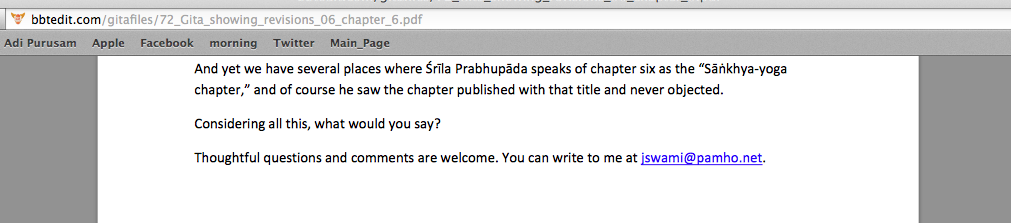
Jayadvaita Swami admits that it constitutes evidence against making a change if Srila Prabhupada read and/or lectured from a translation or purport without objecting to it:

Screen Shot 2018-02-10 at 13.05.46

“And yet we have several places where Śrīla Prabhupāda speaks of chapter six as the “Sāṅkhya-yoga chapter,” and of course he saw the chapter published with that title and never objected.”

The above quote is from Jayadvaita Swami’s annotated scans: Chapter Six from J. Swami’s edited copy of the 1972 edition. This is a chapter from the copy of the 1972 edition of Bhagavad-gītā As It Is on which Jayādvaita Swami marked the revisions for the edition of 1983.

Direct link to the annotated scans of Chapter Six (look for the headline “About sankhya”):

http://bbtedit.com/gitafiles/72_Gita_showing_revisions_06_chapter_6.pdf

JAYADVAITA SWAMI – SELF-APPOINTED GHOSTWRITER

By Ajit Krishna Dasa

Definition:

“ghostwriter
ˈɡəʊstrʌɪtə/
noun
a person whose job it is to write material for someone else who is the named author.

However, the difference between the usual ghostwriter and Jayadvaita Swami is that the latter is forcing his service upon the author (Srila Prabhupada), after the author’s demise.

We got rid of the eleven self-appointed zonal “gurus”. But we still have Jayadvaita Swami who, as the self-appointed ghostwriter, is forcing his editing on Srila Prabhupada. Srila Prabhupada has no say in this regard. He is simply being forced to accept the ghostwritten material of Jayadvaita Swami.

And so is everyone else.

Hare Krishna!

Screen Shot 2017-04-13 at 21.27.05

“Blessed Lord” Means the Lord is Praiseworthy

By Ajit Krishna Dasa

One of the thousands of things that Jayadvaita Swami changed in the Bhagavad-gita As It is was the term “The Blessed Lord”.

There are some misconceptions about this term in the society of devotees. Even some native English speaking devotees believe that the term refers to a scenario where the Lord is being blessed (endowed) with a certain thing or attribute by one of his devotees.

Based on this misconception they consider the term “The Blessed Lord” as it is used in the Bhagavad-gita As It Is to be mistaken, and thus they support Jayadvaita Swami’s change to “The Supreme Personality of Godhead”.

I am quite amazed that native English speakers are not aware that the term “The Blessed Lord” or “to bless the Lord” means something completely different. I am also amazed to see how they criticise the term “The Blessed Lord” without bothering to look for it’s meaning in a dictionary or online.

Let us help them:

Screen Shot 2016-04-28 at 14.28.42

And

Screen Shot 2016-04-28 at 14.42.44

To learn more about how the term is used we need to nothing more than search the internet. There are loads of answers. In Christianity is perfectly normal to say “The Blessed Lord” and “Bless the Lord” in the sense of praising, glorifying and honoring God.

Here is something from an article that makes the point clear:

“There are two main things that we do when we bless the Lord.  The first is synonymous with giving thanks and praise.  Some translations actually say, “Give thanks to the Lord,” where others say, “Bless the Lord.”  So, blessing the Lord is praising Him and giving thanks to Him—for blessing us!  The other thing we do when we bless the Lord is to proclaim Him blessed.  Here I think I’ll have to make a distinction between “blessed” and “blessed.”  For clarity’s sake, this distinction is between “blessed” and “blest”—though I don’t really like that newfangled form of the word—the former in two syllables and the latter in one.  The former is a state of being, the latter a consequence of something have been done or given to someone.

When we call God blessed, we are saying something about who God is.He is blessed, which is a synonym for “holy.”  Blessed is God, the Father of our Lord Jesus Christ!  The Byzantine Divine Liturgy always opens with the glorious and magnificent “Blessed is the Kingdom of the Father and of the Son and of the Holy Spirit, both now and forever and unto ages of ages!” When we speak of God as the recipient of our blessings (praises and thanksgivings), then He is blest.  May the Lord be forever blest!  Sometimes both meanings can apply simultaneously.When Our Lady said, “All generations shall call me blessed,” it means both that all generations acknowledge her holiness and that all generations acknowledge that she has been uniquely blest by God.”

When Jayadvaita Swami made the change from “The Blessed Lord” to “The Supreme Personality of Godhead” he did not used the above mentioned misconception as a justification. Perhaps he knew there was nothing wrong with the term. He attempted to justify his change in another way. His attempted justification will be the subject matter of an upcoming article.

Regulated Principles Regulated (Bg. 12.12)

By Ajit Krishna Dasa

Srila Prabhupada frequently uses the terms “regulative principles” and “regulated principles” in his teachings.

But Jayadvaita Swami claims that “regulated principles” is a nonsense use of words. He calls it “obviously erroneous” and “a term that makes no sense” (Link).

He says it should always be “regulative principles”, and thus Jayadvaita Swami is in the process of changing all “regulated principles” into “regulative principles” in Srila Prabhupada’s books.

But there are two good reason to think Jayadvaita Swami is wrong:

First Reason

Srila Prabhupada explains just how spiritual principles are regulated, namely by the spiritual master:

“In the neophyte stage of devotion one must follow all the principles, regulated by the authority of the spiritual master.”

So “regulated principles” means principles regulated by a superior authority.

I do not know why this makes no sense to Jayadvaita Swami. It seems so obvious!

Let us take a simple example:

Chanting is a principle. Srila Prabhupada regulated that principle: Minimum 16 rounds per day.

Simple for the simple.

Second Reason

“Regulated principles” is a quite common term. Just take a look at google:

Screen Shot 2016-03-24 at 01.26.14

And a few more:

Screen Shot 2016-03-24 at 01.12.14Screen Shot 2016-03-24 at 01.12.53Screen Shot 2016-03-24 at 01.13.11Screen Shot 2016-03-24 at 01.13.33Screen Shot 2016-03-24 at 01.13.54

So!

Again!

Jayadvaita Swami’s “justifications” for changing “regulated principles” are just plain wrong.

Srila Prabhupada has regulated principles for the editing of his books. Jayadvaita Swami should learn them.

Deluded Editor Not Bewildered

Screen Shot 2016-01-23 at 05.07.33

By Ajit Krishna Dasa​

Bhagavad-gita Jas It Is, Ch. 2, Text 13:

“As the text of Bhagavad-gita continuously changes, in Srila Prabhupada’s As It Is edition, from original to unoriginal to unrecognizable, the rest of his books similarly change into new editions after his death. A self-deceived editor is not bewildered by such a change.“