“As the text of Bhagavad-gita continuously changes, in Srila Prabhupada’s As It Is edition, from original to unoriginal to unrecognizable, the rest of his books similarly change into new editions after his death. A self-deceived editor is not bewildered by such a change.“
In defence of Jayadvaita Swami’s editing of the Bhagavad-gita As It Is BBT International write on their website:
And in the conversation where Srila Prabhupada complained so strongly about “rascals editors,” Srila Prabhupada said about Jayadvaita, “He is good.”
And:
Of course, regarding Jayadvaita Swami, the BBT’s chief editor, Srila Prabhupada wrote, “Concerning the editing of Jayadvaita Prabhu, whatever he does is approved by me. I have confidence in him. (letter to Radhavallabha, 7 September 1976)
But it is a logical fallacy to claim that a thing must possess the same characteristics now as it did in the past.
In Nyaya this fallacy is called Nagna-Matrika-Nyaya / The Logic of the Naked Mother. Srila Prabhupada explains:
This is nagna-matrka-nyaya. We change according to the circumstances. You cannot say that this must remain like this. (Morning Walk, May 5, 1973, Los Angeles)
Srila Prabhupada knew things could change, and he would never commit such a logical fallacy. He explains:
Prabhupada: I have given you charge of this BBT, millions of dollars you are dealing, but it is not for your misuse. As soon as you misuse, that is your responsibility.
Ramesvara: Yes, but he says but still, you’ll know that I’m going to misuse it.
Prabhupada: No. That Krsna knows, when something charge is given. But because you are independent, I know that “Ramesvara is very good boy; let him be in charge.” But you can misuse at any moment, because you have got independence. You can misuse at any moment. At that time your position is different. (Morning Walk — June 3, 1976, Los Angeles)
And here he clearly says that we must evaluate a person based on the present situation:
Prabhupāda: So phalena paricīyate.You have to consider the case, suppose a man was very good now he has stolen something still he is a good man? Present consideration is the judgement… There is a Bengali proverb that seven generations before my forefathers used to eat ghee, ghee butter so still I got this smell.
Devotee (1): Hm.
Prabhupāda: Seven generations before my forefathers used to eat ghee so therefore that smell is still there in my house. Is that very good argument? (Morning Walk – October 8, 1972, Berkeley)
Previously we have dealt with BBT International’s argument here and here.
BBT International’s “Jayadvaita-Swami-is-good-argument” has thus been show to be logically invalid. In other words, it is not enough to say that at one point in time Srila Prabhupada liked Jayadvaita Swami’s editing. We need more. We need to know the present situation.
On top of that we have a few e-books out, documenting that Jayadvaita Swami has transgressed the instructions given by Srila Prabhupada. Please take a look at them:
This below e-mail was sent to Sivarama Swami through the e-mail address (asksrs@gmail.com) provided on this website. I hope that the devotees in charge of receiving the e-mails will forward the e-mail to Maharaja. In the meantime I will look for another e-mail address of his.
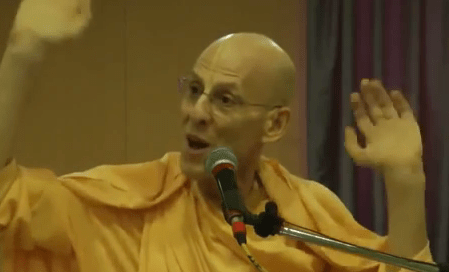
Jayadvaita Swami has come under a lot of fire for saying that we cannot chant “Jaya Srila Prabhupada” while singing Gurvastakam:
(Watch from 14:30 and 10 minutes further)
[Unfortunately the video has been removed]
Sura Prabhu gave a lecture in the Los Angeles temple where he heavily criticized Jayadvaita Swami’s points:
(Watch from minute 12 and the rest of the video)
Svavasa Prabhu also gave his views on the matter here:
Gaura Dasa [who used to support the book changes, but later changed his mind] wrote this on Facebook:
“HH Jayadvaita Swami’s Views On Singing Srila Prabhupada’s Pranams During Mangal Arati Has Created A Great Deal Of Controversy
A video is circulating online [that we will not share on Arsa-Prayoga] that Punya Das prabhu brought to my attention the other day that was disturbing him. Obviously the video itself is horribly offensive and filled with Vaisnava aparadha comments against Jayadvaita Swami – but unfortunately the real comments expressed by Jayadvaita swami are also still there and are still wrong and still also offensive.
He has stated that the Samsara Prayers are not the Founder Acarya Song and discourages the idea of singing Srila Prabhupada’s pranams or name during Mangal arati.
Jayadvaita Swami’s example and understanding of mangal Arotike in the 1960s doesn’t apply to the way Srila Prabhupada established standards for his worldwide ISKCON. Starting with the acquisition of New Dwaraka as his world headquarters Srila Prabhupada had leaders fly into LA for 1-2 weeks to be trained in new permanent standards for arotike, for the morning program, for Deity worship, for morning and evening class which included chanting Sanskrit, etc. The kirtans always included chanting the pranam prayers and Jaya Prabhupada. I simply have no words to express how obvious this is. To preach that the standard should not include these pranam prayers and that the chant “Jaya Prabhupada” shouldn’t be part of mangal arotike during the samsara prayers is offensive and completely against the foundational position of the founder- acarya.
When his Godbrothers tried to minimize his position, Srila Prabhupada empathized even more the importance of his pranam mantras. His Divine Grace was very concerned about his name appearing in his books, on the BBT building, on letterhead, etc. This is central and essential to not having his teachings marginalized. How Jayadvaita doesn’t understand this is bewildering and I can only attribute it to his being covered by the illusory energy.
Whoever Pranatha Prabhu is, he is really not understanding how deeply important this is to the eternal position of our founder-acarya.
The overwhelming comments show how disturbed devotees are, even those who strongly support Jayadvaita.
I don’t know what else to say when to me something is so obvious.
It feels like trying to explain how book distribution was Srila Prabhupada’s only solace to a devotee who doesn’t believe in book distribution.
Prananatha’s cooment indicates a lack of understanding our Founder Acaray’s position :
Prananatha Das Paul Tuffery : I just watched the entire video, start to end. I don’t see where he is saying anything against what was established by Srila Prabhupada. What is the fuss about? He gave numerous examples of how Srila Prabhupada wanted kirtan to be performed including how Srila Prabhupada would stop kirtan if he was unhappy with it. So, the precedent as established by Srila Prabhupada, should be followed. Otherwise, how are we glorifying him?
A devotee wrote:
For those who have’t seen the video or don’t want to see it, I typed it out:
[Jayadvaita Swami speaking]
Basically, morning: Samsara dava, Sri Krsna Caitanya, Hare Krsna, nothing else. Evening: Gaura Artik, Sri Krsna Caitanya, Hare Krsna, nothing else, pretty clear.
A devotee is asking whether after Samsara dava we should chant Prabhupada pranams mantra. Interesting question. When Prabhupada chanted it in the morning, he chanted Samasara dava, Sri Krsna Caitanya, Hare Krsna, nothing else. He didn’t chant the pranams mantra to his guru maharaj.
Now, if I suggest that we shouldn’t chant Prabhupadas pranams mantra, there’ll be a revolution. But actually it’s not nessecary. It’s not what he did and we don’t have to.Samsara dava, Sri Krsna Caitanya, Hare Krsna, nothing else.
So, when someone who’s not Prabhupadas direct disciple, begins by offering pranam mantra to Prabhupada, my hearing takes a beating. I think: ’What’s wrong with this person?!”
But at least: don’t start with Prabhupada pranams mantra. You’re totally contrary to the tradition, if you do that.
The next thing that disturbs me, sometimes we hear, right in the middle of Samasara dava ‘jaya Prabhupada, Jaya’…
[Note from myself: as a matter of fact, he actually does say that (every time that he says it) in a ridiculing manner, swaying his hands in a ‘funny’ way, pulling a face]
What the hell is that?! Samsara dava is not the Prabhupada song! It’s the guru song… which doesn’t mean the founder acharya of ISKCON. Samsara dava is not the Prabhupada song.
And therefore it even disturbs me when, you know, they finish the… dhyāyam stuvaḿs tasya yaśas tri-sandhyaḿvande guroḥ śrī-caraṇāravindam.. ‘jaya Prabhupada jaya’… as again if it was the Prabhupada song.
If you want to think of Prabhupada during that song, that’s fine, but it’s not… What if somebody else is thinking of his guru? God forbid! Then you’ve spoiled his meditation. Because you’re thinking it’s the Prabhupada song.
You don’t need to chant ‘Jaya Prabhupada’ at any point.
Samsara dava, Sri Krsna Caitanya, Hare Krsna, nothing else.
And.. alright, I won’t buck the system. After Samsara dava, AFTER Samsara dava, Prabhupada pranams. And if you left them out, you will not be wrong. You’ll be institutionally wrong, but you’ll not be philosophically wrong, because Prabhupada said Samsara dava, Sri Krsna Caitanya, Hare Krsna, nothing else.
That’s what he did and if that’s what you do, you’re no worse than he was. And he was perfect.
So again, I am no campaigning to edit it out of the program, but keep it at that, if you would. Or, to put it in another way, I would be happy if you would keep it at that.”
Ajit Krishna Dasa’s concluding comment:
Let us hope that the ISKCON leaders comes to understand that Jayadvaita Swami has had this mentality all the time, also when editing Srila Prabhupada’s books. He even said that “there are warts” on Srila Prabhupada’s original books.
Almost 400 pages about the changes made to Srila Prabhupada’s books.
Click picture to visit website
From the back cover:
“Arsa prayoga, lit. “rishi’s license,” means to honour the acarya by preserving his teachings in the originally published form, not changing what he has written to make it appear more effective or politically correct. There should be no confusion between the work written by His Divine Grace Srila Prabhupada and edited by Howard Wheeler and the posthumous cent per cent revised copy proposed by Bhaktivedanta Book Trust International. By changing Prabhupada’s books without explicitly saying so, they do a discredit to Srila Prabhupada, devotees and scholars. At present it appears that the revisions were made by the original author. This book is meant to be the truth about the editing of Prabhupada’s books carefully chronicled for future generations.”
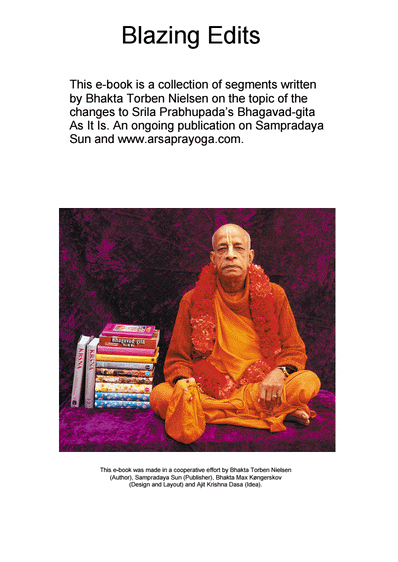
Aug 20, 2015 — CANADA (SUN) — We invite you to download a copy of Blazing Edits, an e-book collection of segments written by Bhakta Torben Nielsen on the topic of the changes to Srila Prabhupada’s Bhagavad-gita As It Is. This series has been an ongoing publication on Sampradaya Sun and www.arsaprayoga.com.
This e-book was made in a cooperative effort by Bhakta Torben Nielsen (Author), Bhakta Max Køngerskov (Design and Layout), Ajit Krishna dasa (Idea), and the Sampradaya Sun (Publisher). The book will periodically be updated with new segments.
Bhakta Torben Nielsen, a devotee from Denmark associated with the Hare Krishna movement, is known for his outspoken stance on various issues within ISKCON, particularly the changes made to Srila Prabhupada’s books after his passing.
His critiques have focused on what he sees as deviations from the original teachings and intentions of Prabhupada, ISKCON’s founder. In his view, the editorial alterations—such as revisions and edits to Prabhupada’s texts—compromise the authenticity of the teachings and pose a serious concern for the integrity of the movement.
Nielsen’s writings delve into the nature and extent of these changes, raising questions about their justification and impact. For him, the issue is not merely about preserving the original words on the page; it is a matter of safeguarding the spiritual legacy that Srila Prabhupada intended to leave behind.
The controversy over book changes reflects broader systemic issues within ISKCON, such as centralized authority and fidelity to the founder’s instructions. These concerns, along with others about the governance and direction of ISKCON, were extensively explored in Nielsen’s many articles.
Later he had his work compiled into the above eBook titled Blazing Edits, which addresses the controversial changes made to Srila Prabhupada’s books and advocates for preserving the original teachings without alteration. Through this work, Nielsen aims to shed light on what he and other concerned devotees see as a crucial challenge facing the Hare Krishna movement: the need to preserve Prabhupada’s teachings in their authentic form.
Note on Bhakta Torben Nielsen
Bhakta Torben was originally initiated by Harikesha Swami. When Harikesha later fell from his position, Torben chose to reject him as his guru and discontinued using the spiritual name he had received. This decision reflects Torben’s lifelong commitment to sincerity, integrity, and fidelity to Śrīla Prabhupāda above institutional considerations.
ISKCON’s Changes to Srila Prabhupada’s Bhagavad-gita As It Is and Perfect Questions, Perfect Answers (by Madhudvisa Dasa).
Perhaps the first book on the book changes. So old it was made with a typewriter. Definitely of both present day and historical value. It contains a lot of good evidence against the changes, good arguments and historical documentation (like mails).
“The Blessed Lord said: There is a banyan treewhich has its roots upward and its branches down and whose leaves are the Vedic hymns. One who knows this tree is the knower of the Vedas.”
The draft a.k.a. “the original manuscript”:
“The Supreme Lord said: It is said that there is a banyan treewhich has its roots upward and its branches down; and the Vedic hymns are its leaves. One who knows this tree is the knower of the Vedas.”
Uauthorized 1983 edition:
“The Supreme Personality of Godhead said: It is said that there is an imperishable banyan treethat has its roots upward and its branches down and whose leaves are the Vedic hymns. One who knows this tree is the knower of the Vedas.”
From lectures:
Pradyumna: (Translation:) “The Blessed Lord said: There is a banyan tree which has its roots upward and its branches down and whose leaves are the Vedic hymns. One who knows this tree is the knower of the Vedas.”
Prabhupada: So this is the description of Vedic literature. Vedais ca sarvair aham eva vedyah [Bg. 15.15]. That will be described. (Srila Prabhupada, Lecture, See Spiritual Identity Everywhere,
73/10/28 Bombay, Bhagavad-gita 15.1)
Nitai dasa: Translation: The Blessed Lord said: There is a banyan tree which has its roots upward and its branches down and whose leaves are the Vedic hymns. One who knows this tree is the knower of the Vedas.
Purport: After the discussion of the importance of bhakti-yoga, one may question, “What about the Vedas?” (Srila Prabhupada, Lecture, The Purpose of Vedic Study 74/02/26 Calcutta, Bhagavad-gita 15.1)
2) He decides to change “The Blessed Lord”. Here he could have chosen to use Srila Prabhupada’s words from the draft’ translation of Bg. 15.1 which reads “The Supreme Lord said”, but he chose instead to go to the English synonyms and use “The Supreme Personality of Godhead”.
3) Next he decides to add “It is said”. This he took from the drafts’ translation of Bg. 15.1.
4) Then he decides to add an adjective to “banyan tree”. He could have gone back to the English synonyms and used the word “eternal”. But instead he took a trip to the drafts’ purport where he for some reason chose the word “imperishable” over the word “indestructible” which is also in the purport. NOTE: The word “imperishable” is omitted from the purport of both the original 1972 edition and the 1983 edition which makes his choice even more strange.
5) He then changes “which” to “that” even though “which” was both found in the draft and was grammatically perfectly fine. In other words, he found the word “that” not in the English synonyms, not in the translation and not in the purport. But in his own mind.
Hundreds of changes to Srila Prabhupada’s Gita have been documented online. And we see Jayadvaita Swami again and again randomly chose words sometimes from the manuscripts’ translations, sometimes from the English synonyms, sometimes from the purport and sometimes from his own mind.
For the most part it is very hard to find any objective and identifiable criteria for his changes. Especially for changes such as those above. And there are hundreds, if not thousands, of such changes in the Gita alone.
vāñchā-kalpatarubhyaś ca kṛpā-sindhubhya eva ca
patitānāṁ pāvanebhyo vaiṣṇavebhyo namo namaḥ
“I offer my respectful obeisances unto all the Vaiṣṇava devotees of the Lord who can fulfill the desires of everyone, just like desire trees, and who are full of compassion for the fallen souls.”
JAS It Is:
vāñchā-kalpa-tarubhyaś ca
kṛpā-sindhubhya eva ca
patitānāṁ pāvanebhyo
vaiṣṇavebhyo namo namaḥ
“I offer my respectful obeisances unto all the Vaiṣṇava devotees of the Lord. They can fulfill the desires of everyone, just like desire trees, and they are full of compassion for the fallen souls.”
“That Supersoul is perceived by some through meditation, by some through the cultivation of knowledge, and by others through working without fruitive desire.”
Manuscript:
“That Supersoul is perceived by some through meditation, and by some through the cultivation of knowledge, and by others through working without fruitive desire.”
JAS It Is:
“Some perceive the Supersoul within themselves through meditation, others through the cultivation of knowledge, and still others through working without fruitive desires.”
The original 1972 standard and the so-called manuscript are completely identical. And well articulated. Still the ‘JAS It Is’ model chooses a different phrasing.
As seen many times before.
Here are some important words from the principal editor to Srila Prabhupada’ s books after His Divine Grace’ s departure. On the policy of editing:
“‘Arsa-Prayoga’ is a very important principle. The editor should never have the mentality that he is better than the author, that he has something more to contribute than the author does, that the author really doesn’t know what he is doing, but he knows what he is doing. That’ s offensive and that ruins everything. It is an offense to the acarya. The idea however that this sort of sanctity that the authors’ s has, or that the words of the author has, have, somehow extends to the mistakes of the editors is weird. It is an offense to correct the mistakes of previous editors! Are they acaryas? Are they paramahamsas? Are they infallible? They are wonderful devotees, they did wonderful service, but they made mistakes. Understandable.”
We advise the reader to ponder the gap between theoretical intent and actual action. This example is by far not an isolated case.





 Arsa-Prayoga
You must be logged in to post a comment.