Small Word, Big Difference – Revisited

By Ajit Krishna Dasa

Arsa-Prayoga.com – Revisited is the title of an upcoming ebook that continues the work begun here on arsaprayoga.com. It re-examines the changes made to Śrīla Prabhupāda’s original books from new angles and explains why each alteration is significant.

Each example will also be posted here on arsaprayoga.com.

Today we are revisiting:

Small Word, Big Difference

https://arsaprayoga.com/2014/08/12/small-word-big-difference/

Description

The article shows how a small change in a purport—from “done by Krishna” to “done for Krishna”—creates a profound shift in meaning. Though it appears minor, this substitution alters the philosophical substance of the text.

Type of change

Substitution — a single preposition replaced.

Category

Philosophical change.

Commentary

Alters causal agency / the relationship between Krishna and activity

The difference between “by Krishna” and “for Krishna” is not stylistic. It changes who is acting and whose will is primary. “Done by Krishna” means that Krishna is the direct actor, the cause behind all action. “Done for Krishna” reverses the flow, implying that the devotee acts and offers the result. That is not the same truth; it replaces divine agency with human initiative.

Changes nuance of surrender / devotional theology

In the original wording, the devotee is fully dependent. He is the instrument, Krishna the mover. This is the essence of śaraṇāgati—to see Krishna as the doer in all things. The edited phrase softens that surrender. It suggests the devotee’s independent action performed on Krishna’s behalf rather than through Krishna’s will. The theology of dependence becomes a theology of contribution.

Moves from metaphysical fact to interpretive sentiment

“Done by Krishna” is an ontological statement: it describes reality as it is. “Done for Krishna” is a moral sentiment: it describes how we wish to act. This subtle shift turns realization into interpretation, revelation into advice.

A single preposition has thus transformed the meaning, the mood, and the philosophy. It is not grammar; it is theology.

From Dhyana to Sankhya: Prabhupada’s Vision for Chapter 6

By Ajit Krishna Dasa

Srila Prabhupada’s decision to title Chapter 6 of the Bhagavad Gita As It Is “Sankhya Yoga” stands as a distinctive and deliberate choice, diverging from the more common “Dhyana Yoga” favored by traditional acharyas, modern scholars, and Western translators. This title, unique in the history of widely recognized Gita commentaries, reflects his mission to present the text through the lens of Gaudiya Vaishnavism while reintroducing the theistic Sankhya philosophy of Kapila Muni, the divine son of Devahuti from the Srimad Bhagavatam. Far from a mere editorial quirk, Prabhupada’s naming can be seen as a strategic reclamation of the term “Sankhya,” serving as an implicit attack on the atheistic Sankhya school and aligning the chapter’s teachings with Krishna consciousness. This choice makes sense when viewed through the philosophical content of Chapter 6, its integration of Sankhya and Yoga, and Prabhupada’s broader purpose of countering materialistic philosophies.

Philosophical Foundations: Theistic Sankhya and Its Contrast with Atheism

Sankhya philosophy, one of the six classical schools of Indian thought, fundamentally distinguishes between purusha (the eternal, conscious soul) and prakriti (temporary, unconscious matter), aiming for liberation through analytical knowledge. However, two versions of Sankhya exist: the atheistic, classical Sankhya, often attributed to a sage Kapila, which denies a supreme God and posits multiple purushas liberated through intellectual discernment alone, and the theistic Sankhya of Kapila Muni, an incarnation of Vishnu, as detailed in Srimad Bhagavatam (Canto 3, Chapters 24–33). The latter integrates this dualistic framework with devotion to Krishna, the Supreme Purusha, as the source and controller of all existence.

Srila Prabhupada consistently champions the theistic Sankhya of the Bhagavatam’s Kapila, critiquing the atheistic version as incomplete. In his purport to Gita 2.39, he describes Sankhya as the analytical study of soul and matter but ties it to Krishna’s authority, while in Srimad Bhagavatam 1.2.30, he credits Kapila (the Vishnu avatar) with creating Sankhya to dispel material illusion, implying the atheistic school is a corruption. By titling Chapter 6 “Sankhya Yoga,” Prabhupada reclaims the term from its godless connotation, positioning it as a Krishna-centric science of self-realization. This choice serves as an attack on atheistic Sankhya by asserting that true Sankhya—unlike its materialistic distortion—culminates in devotion to the Supreme Personality of Godhead, not mere intellectual isolation.

Chapter 6’s Content: A Blend of Sankhya Philosophy and Yogic Practice

Chapter 6 of the Gita, while renowned for its meditative instructions (e.g., 6.11–14: sitting steadily, focusing on the self or Krishna), contains philosophical elements that resonate with Sankhya, justifying Prabhupada’s title. Verses like 6.5–6 (“One must deliver himself with the help of his mind… the mind is the friend or enemy”) echo Sankhya’s view of the mind as a product of prakriti that binds or liberates the purusha depending on its mastery. Similarly, 6.1–4 emphasize detachment from sense objects and fruitive results, mirroring Sankhya’s goal of disentangling the soul from material nature. The description of the yogi’s transcendent state in 6.20–23—realizing the self’s distinction from matter through “transcendental senses”—further aligns with Sankhya’s liberation through discriminative knowledge.

Prabhupada’s “Sankhya Yoga” title broadens the chapter’s scope beyond meditation (dhyana) to include this analytical foundation, reflecting the theistic Sankhya of Kapila, where understanding the soul’s eternality leads to Krishna (Srimad Bhagavatam 3.25.18). Unlike “Dhyana Yoga,” which narrows the focus to meditative practice, “Sankhya Yoga” encapsulates the integration of knowledge (Sankhya) and discipline (Yoga), culminating in devotion (6.47: “The highest yogi thinks of Me constantly”). By highlighting these Sankhya elements, Prabhupada challenges atheistic Sankhya’s endpoint—self-isolation without God—replacing it with a theistic synthesis that directs the practitioner to Krishna, thus undermining the atheistic school’s philosophical legitimacy.

Historical Context: Sankhya and Yoga’s Traditional Connection

The tendency in Indian tradition to connect Sankhya and Yoga as complementary systems supports Prabhupada’s titling. Historically, Sankhya provides the metaphysical blueprint (distinguishing purusha from prakriti), while Yoga, particularly Patanjali’s Ashtanga Yoga, offers the practical path, with dhyana (meditation, the seventh limb) as a key stage. The Gita itself reflects this synergy: Chapter 2 introduces Sankhya’s analytical wisdom (2.39), and Chapter 6 blends it with yogic practice. Prabhupada’s “Sankhya Yoga” title leverages this tradition, but adapts it to Vaishnavism by rooting it in Kapila’s theistic Sankhya, not the atheistic version that Patanjali’s Yoga partially accommodates (via Ishvara, Yoga Sutras 1.23).

This historical pairing bolsters Prabhupada’s attack on atheistic Sankhya. By invoking “Sankhya” in a yogic context, he reasserts its original spiritual purpose—lost in the godless classical school—and aligns it with the Gita’s theistic narrative, where Krishna is the ultimate goal (Gita 15.17–18). This reclamation serves as a polemic, subtly exposing atheistic Sankhya’s inadequacy compared to its devotional counterpart.

Prabhupada’s Strategic Intent: Attacking Atheistic Sankhya and Inspiring Exploration of the Bhagavatam

Prabhupada’s mission was to counter materialistic and impersonal philosophies, including atheistic Sankhya, which he saw as a distortion of Vedic truth. His critiques in purports—e.g., dismissing atheistic Sankhya as “dry speculation” (Gita 7.4, purport)—reveal his intent to restore its theistic essence. Naming Chapter 6 “Sankhya Yoga” is a deliberate strike against this distortion for several reasons:

  1. Reclamation of Terminology: By using “Sankhya,” a term familiar to scholars and practitioners, Prabhupada confronts its atheistic association head-on. He redefines it through Kapila’s lens, where analytical knowledge serves bhakti, not godless liberation, thus challenging the classical school’s authority.
  2. Philosophical Superiority: The chapter’s content—integrating self-realization with devotion—demonstrates that theistic Sankhya surpasses atheistic Sankhya. Verses like 6.29–30 (“He who sees Me everywhere”) elevate Sankhya’s dualism into a Krishna-centric unity, exposing the atheistic version’s limitation in stopping at individual purusha without recognizing the Supreme Purusha.
  3. Educational Polemic: Prabhupada’s global audience included Westerners and Indians influenced by secular interpretations of Sankhya. Titling Chapter 6 “Sankhya Yoga” educates them that true Sankhya aligns with Krishna consciousness, countering scholarly narratives equating Sankhya with atheism and reinforcing the Gita’s theistic intent “as it is.”
  4. Parampara’s Authority: By tying the title to Kapila of the Bhagavatam, Prabhupada roots it in disciplic succession, contrasting it with speculative atheistic Sankhya. This asserts the Vedic authenticity of his interpretation, undermining the classical school’s standalone credibility.
  5. Inspiring Engagement with the Srimad Bhagavatam: Beyond attacking atheistic Sankhya, Prabhupada’s use of “Sankhya Yoga” also aimed to inspire readers to explore the Srimad Bhagavatam, which he considered the “ripe fruit of the Vedic tree” (Srimad Bhagavatam 1.1.3, purport) and the ultimate scripture for Krishna consciousness. By linking Chapter 6 to Kapila’s theistic Sankhya—detailed in Bhagavatam Canto 3, Chapters 24–33—he creates a bridge to this text, where Kapila’s teachings expand on the Gita’s principles with a devotional focus (e.g., Bhagavatam 3.25.18). In purports like Gita 6.13–14, he references Kapila’s meditation on Vishnu (Bhagavatam 3.28.8–11), subtly encouraging readers to delve into the Bhagavatam for a deeper understanding of both Kapila’s Sankhya but also of the Srimad-Bhagavatam itself. For his audience—many unfamiliar with this scripture—the title “Sankhya Yoga” plants a seed of curiosity about Kapila’s full discourse, reinforcing the Bhagavatam’s role as the natural next step after the Gita and enhancing his mission to elevate global devotion through the parampara’s treasures.

Uniqueness and Justification

No major traditional acharya (e.g., Shankaracharya, Ramanujacharya, Madhvacharya) or modern translator (e.g., Sivananda, Chinmayananda) titles Chapter 6 “Sankhya Yoga”—they typically use “Dhyana Yoga” or variants, reserving “Sankhya Yoga” for Chapter 2. Prabhupada’s divergence is a bold innovation, justified by Chapter 6’s Sankhya-like elements and his mission. While “Dhyana Yoga” fits the chapter’s meditative focus, “Sankhya Yoga” captures its broader philosophical depth, aligning with his view of Kapila’s system as both knowledge and practice directed toward Krishna.

Conclusion: A Sensible and Strategic Choice

Srila Prabhupada’s “Sankhya Yoga” title for Chapter 6 makes profound sense as a reflection of its content—merging Sankhya’s analytical insights with Yoga’s meditative discipline—and his intent to advance Gaudiya Vaishnavism. It serves as a strategic attack on atheistic Sankhya by reintroducing Kapila’s theistic version, challenging its godless conclusions, and redirecting its principles toward Krishna. This choice not only highlights the chapter’s philosophical richness but also fulfills Prabhupada’s mission to present the Gita as a devotional text, countering materialistic distortions and establishing Krishna consciousness as the ultimate synthesis of Vedic wisdom. In this light, “Sankhya Yoga” is not just a title—it’s a declaration of theistic triumph over atheism, rooted in scripture and tradition.

For a definitive proof that Srila Prabhupada wanted Chapter Six of his Bhagavad-gita As It Is to be named Sankhya-Yoga, please see this article.

PROBLEM OF THE BBT EDITING SUMMARIZED

“The problem of the Bhaktivedanta Book Trust (BBT) editing can be summarized fairly well with four concise points:

(1) False Assumption of Authority: where Prabhupada only granted conservative, provisional authority, the BBT editors assumed unrestricted, open-ended authority.

(2) Editorial Overreach: where Prabhupāda requested only simple copyediting and correction of obvious mistakes, the BBT editors took great liberties in revising, omitting, and even attempting to correct the author’s content.

(3) Noncompliance with Scholarly Standards: where Prabhupada requested scholarly editorial standards, the BBT editors misapplied scholarly textual methods and employed arbitrary and inconsistent editing practices.

(4) Editorial Changes without Transparency: where devotional and scholarly editorial standards compelled full transparency, the extent of editorial changes by the BBT editors are undisclosed in the author’s works.”

Reference:

Posthumous Editing of A Great Master’s Work – Special Focus on the Writings of A. C. Bhaktivedanta Swami Prabhupada, Edited by Graham M. Schweig, 2024, Lexington Books, Introduction, p. 3-4)

Open Letter to Sivarama Swami

Screen Shot 2015-11-13 at 19.52.49

This below e-mail was sent to Sivarama Swami through the e-mail address (asksrs@gmail.com) provided on this website. I hope that the devotees in charge of receiving the e-mails will forward the e-mail to Maharaja. In the meantime I will look for another e-mail address of his.

Dear Sivarama Swami. Dandavat pranama. Jaya Srila Prabhupada.

I apologize if answering this letter becomes a burden on your many other responsibilities.

Recently I heard a podcast from your website where you respond to a few questions about the changes made to Srila Prabhupada’s books.

I have a few comments and points I find important in relation to your response, and I hope you will find the time to answer each of them.

This is an open letter, so it will also be posted online.

The letter is attached to this e-mail, but you can also find it here:

Open Letter to Sivarama Swami

Thank you very much.​
Your servant,
Ajit Krishna Dasa

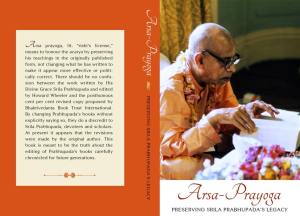
E-BOOK: Arsa-Prayoga: Preserving Srila Prabhupada’s Legacy

Almost 400 pages about the changes made to Srila Prabhupada’s books.

Arsa-Prayoga Book

Click picture to visit website

From the back cover:

“Arsa prayoga, lit. “rishi’s license,” means to honour the acarya by preserving his teachings in the originally published form, not changing what he has written to make it appear more effective or politically correct. There should be no confusion between the work written by His Divine Grace Srila Prabhupada and edited by Howard Wheeler and the posthumous cent per cent revised copy proposed by Bhaktivedanta Book Trust International. By changing Prabhupada’s books without explicitly saying so, they do a discredit to Srila Prabhupada, devotees and scholars. At present it appears that the revisions were made by the original author. This book is meant to be the truth about the editing of Prabhupada’s books carefully chronicled for future generations.”

Get the book on Amazon.

E-BOOK: Blazing Edits

blazing-edits

Click to download the book

Aug 20, 2015 — CANADA (SUN) —  We invite you to download a copy of Blazing Edits, an e-book collection of segments written by Bhakta Torben Nielsen on the topic of the changes to Srila Prabhupada’s Bhagavad-gita As It Is. This series has been an ongoing publication on Sampradaya Sun and www.arsaprayoga.com.

This e-book was made in a cooperative effort by Bhakta Torben Nielsen (Author), Bhakta Max Køngerskov (Design and Layout), Ajit Krishna dasa (Idea), and the Sampradaya Sun (Publisher). The book will periodically be updated with new segments.

DOWNLOAD LATEST VERSION

Blazing Edits (16 okt. 2015)

Who Is Bhakta Torben?

Bhakta Torben Nielsen, a devotee from Denmark associated with the Hare Krishna movement, is known for his outspoken stance on various issues within ISKCON, particularly the changes made to Srila Prabhupada’s books after his passing.

His critiques have focused on what he sees as deviations from the original teachings and intentions of Prabhupada, ISKCON’s founder. In his view, the editorial alterations—such as revisions and edits to Prabhupada’s texts—compromise the authenticity of the teachings and pose a serious concern for the integrity of the movement.

Nielsen’s writings delve into the nature and extent of these changes, raising questions about their justification and impact. For him, the issue is not merely about preserving the original words on the page; it is a matter of safeguarding the spiritual legacy that Srila Prabhupada intended to leave behind.

The controversy over book changes reflects broader systemic issues within ISKCON, such as centralized authority and fidelity to the founder’s instructions. These concerns, along with others about the governance and direction of ISKCON, were extensively explored in Nielsen’s many articles.

Later he had his work compiled into the above eBook titled Blazing Edits, which addresses the controversial changes made to Srila Prabhupada’s books and advocates for preserving the original teachings without alteration. Through this work, Nielsen aims to shed light on what he and other concerned devotees see as a crucial challenge facing the Hare Krishna movement: the need to preserve Prabhupada’s teachings in their authentic form.

Note on Bhakta Torben Nielsen

Bhakta Torben was originally initiated by Harikesha Swami. When Harikesha later fell from his position, Torben chose to reject him as his guru and discontinued using the spiritual name he had received. This decision reflects Torben’s lifelong commitment to sincerity, integrity, and fidelity to Śrīla Prabhupāda above institutional considerations.

“Enter Blazing” – Jayadvaita Swami Commits a Grammatical Error (Bg. 11.28)

universal-formThe Universal Form

Bhakta Torben Nielsen recently made me aware of this change to Bg. 11.28:

Original and authorized 1972-edition:

“As the rivers flow into the sea, so all these great warriors enter Your blazing mouths and perish.”

BBT International’s edited 1983 edition:

“As the many waves of the rivers flow into the ocean, so do all these great warriors enter blazing into Your mouths.”

So-called original manuscript:

There is no verse for 11.28 as the page is missing. But verse 30 mentions the words “blazing mouths”.

This is a very interesting change, because it is of a grammatical nature:

  • In Srila Prabhupada’s original 1972 edition the adjective “blazing” describes the plural noun “mouths”.
  • In BBT International’s 1983 edition the adjective “blazing” describes the plural noun “warriors”.

So which translation is grammatically correct – Srila Prabhupada’s or Jayadvaita Swami’s?

The context

Here we have the verses from Bg. 11.28-30 (original edition):

“As the rivers flow into the sea, so all these great warriors enter Your blazing mouths and perish.” (Bg. 11.28)

“I see all people rushing with full speed into Your mouths as moths dash into a blazing fire.” (Bg. 11.29)

“O Visnu, I see You devouring all people in Your flaming mouths and covering the universe with Your immeasurable rays. Scorching the worlds, You are manifest.” (Bg. 11.30)

We see that Srila Prabhupada describes the mouths of the universal form as “blazing” (Bg. 11.28) and “flaming” (Bg. 11.30), and compares them to a “blazing fire” (Bg. 11.29). There is no “original manuscript” available for Bg. 11.28-29, but the “original manuscript” for Bg. 11.30 also says “blazing mouths”, as mentioned above.

Screen Shot 2015-03-13 at 11.49.21

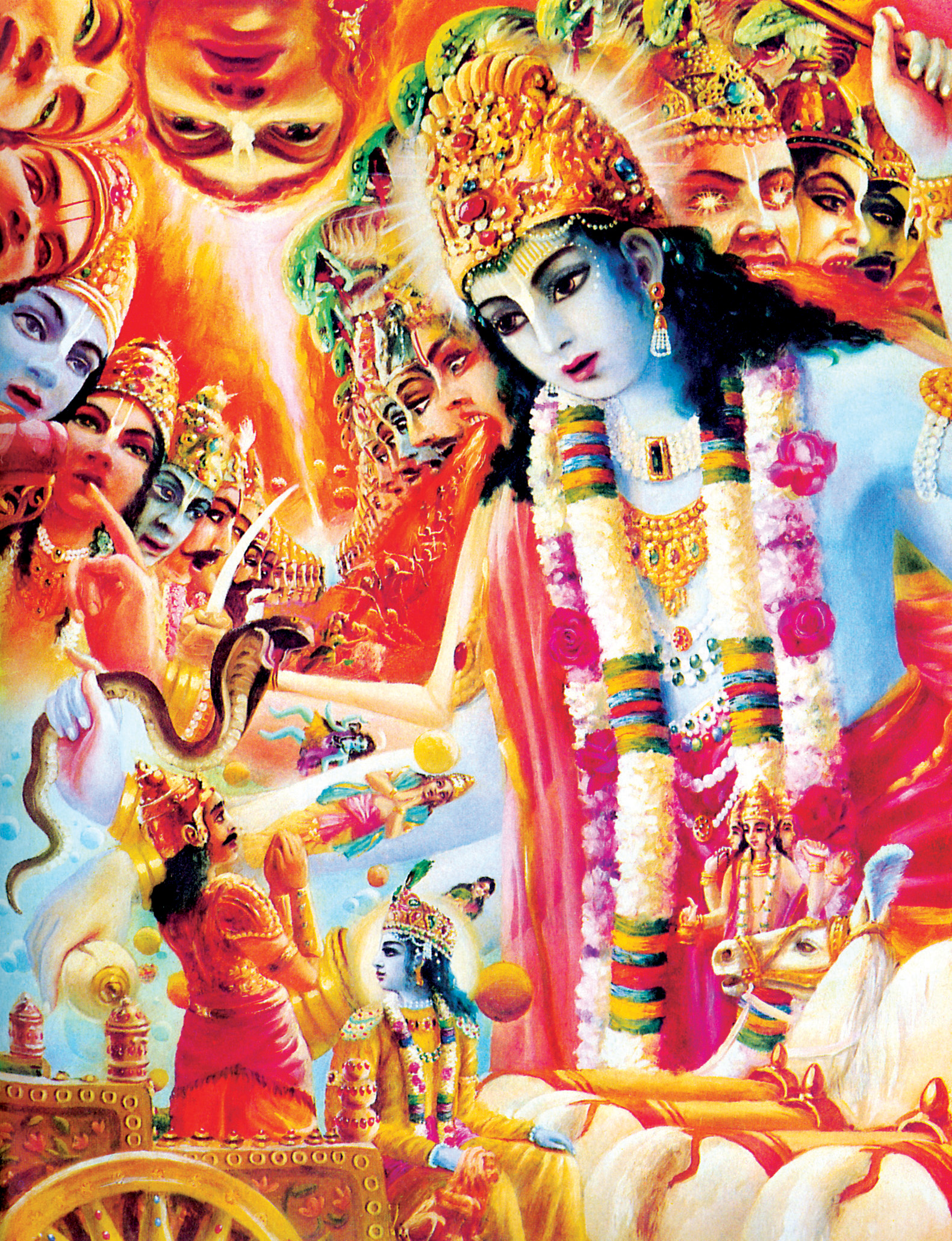
Plate 31

The painting above this article is Plate 31 from the Bhagavad-gita As It Is. Just like all other paintings in the book it was approved by Srila Prabhupada. On the painting we clearly see that the warriors are entering into the blazing mouths of The Universal Form – just like we are told that they are in the Bg. 11.28, 1972 edition.

Srila Prabhupada’s desire

Based on the above, there is no doubt at all that Srila Prabhupada wanted to use the adjective “blazing” to describe the mouths of the universal form. He never meant to say that the great warriors were “blazing”.

What does the previous acaryas say about Bg. 11.28? (as translated on bhagavad-gita.org)

Sridhara Swami’s commentary:

“As unlimited currents of water helplessly flow in innumerable rivers and are propelled from multiple channels into the ocean, the mighty warriors of the Kaurava and Pandava armies are seen to be helplessly propelled into the flaming, gnashing mouths of the visvarupa or divine universal form of Lord Krishna.” ()

Kesava Kasmiri’s commentary:

“How helplessly do the mighty warriors of the Kaurava and Pandava armies enter into the flaming mouths of Lord Krishna’s visvarupa or divine universal form? As helplessly as unlimited currents of water from innumerable rivers are propelled into entering the ocean.”

In his translations of Visvanath Cakravarti Thakura and Baladeva Vidyabhusana’s Bhagavad-gita commentaries Bhanu Swami also translates Bg. 11.28 as follows:

“As many swift currents of rivers flow towards the sea, so these heroes of the world enter Your flaming mouths.”

The sanskrit

Gaura Krishna Dasa, a student of sanskrit, sent me the following analysis of the sanskrit grammar:

Regarding the change in the translation of Bhagavad gita 11.28.

The word “abhivijvalanti” is in the 1972 edition taken as what in grammar is called a verbal adjective or a participle. A participle is basically a derivative from a verb but belonging in the group of adjectives. This particular participle is a participle in present tense, active voice for parasmaipada verbs. It is in neuter gender, plural number and in the accusative case which clearly indicates that it relates to “vaktraani” which is also in neuter gender, plural number and accusative case.

Sridhara Swami, Visvanath Cakravati Thakur and Baladeva Vidyabhusana have the same grammatical conclusion of this word as a participle and therefore in relation to “vaktraani” attributively, “blazing mouths”.

The “anti” ending in “abhivijvalanti” could preliminarily appear as a finite verb 3rd person in the plural number and present tense related to “nara-loka-viira” (the kings of human society), but this conclusion is in the least very strange. It would, if accepted, be a distortion of historical facts and it must be concluded faulty because this sentense already has a finite verb namely “visanti” meaning entering. So if we for the sake of example maintain “abhivijvalanti” as a finite verb, as it is done in the 1983 edition it would translate “as the many waves of the rivers flow into the ocean, so all these great warriors enter and blaze your mouth”, since “abhivijvalanti” can also not be taken as an adverb describing “visanti” attributively.

Conclusion:

“abhivijvalanti” must be taken as a participle – as done by the previous acaryas and the original 1972 edition – and not a verb as done in the 1983 edition.

Conclusion

The evidence against Jayadvaita Swami’s change is overwhelming:

1. Srila Prabhupada is very clear in his original Gita and his manuscripts – the mouths are blazing. Not the warriors.

2. Srila Prabhupada follows the previous acaryas who says that the mouths are blazing (flaming, gnashing).

3 The painting depicting this event (Plate 31 in the Bhagavad-gita As It Is) shows that it is the mouths of The Universal Form that are blazing.

4. According to sanskrit grammer it is the “mouths” that are “blazing”. Not the “warriors”.

Even if both translations could be correct (which they cannot), there would still be no justification – based on the above analysis – to change Srila Prabhupada’s translation of the verse.

It would not be possible to do this without overriding his own editorial decisions and thus violating the arsa-prayoga principle.

Please see additional evidence here.

Bhaktisiddhanta Sarasvati: “Consider only the spirit”

Bhaktisiddhanta Sarasvati Thakura Maharaja, Sree Sajjani-Toshani, The Harmonist, June 1927, No.1:

“The kind indulgence of the reader is solicited to overlook shortcomings inseparable from the employment of a foreign language and consider only the spirit irrespective of the defective garb in which she might be clothed”

the-harmonist

The Holy Name Will Destroy the Book Changers

caitanya-bhagavata

CAITANYA BHAGAVATA, ADI 11.105-110:

TEXT 105

prabhu bole, — “bhakta-vakya krsnera varnana
ihate ye dosa dekhe, se-i ‘papi’ jana

TRANSLATION

“The Lord replied, “Whoever finds fault in a devotee’s description of Lord Krsna is a sinful person.”

TEXT 106

bhaktera kavitva ye-te-mate kene naya
sarvatha krsnera priti tahate niscaya

TRANSLATION

“Krsna is certainly pleased with His devotee’s poetry, even though it is imperfectly composed.”

TEXT 107

murkha bole ‘visnaya’, ‘visnave’ bole dhira
dui vakya parigraha kare krsna vira

TRANSLATION

“An uneducated person may chant visnaya, while a sober person will chant the proper form, visnave, but the Supreme Lord Krsna will accept both forms when they are chanted with devotion.”

COMMENTARY

“To Lord Krishna, a pandita expert in correct language and someone ignorant of correct language are both equal. Of the two, Krishna bestows more mercy on the one who has more enthusiasm for the service of Krishna. Krishna, the omniscient Supersoul of every living entity, is not guilty of the fault of partiality. So-called learned persons who are devoid of devotion proudly consider themselves learned as they reveal their foolishness by pointing out faults in the transcendental language of the pure devotees. The Supreme Lord and master of Sarasvati confirms the foolishness of the so-called learned offenders who are envious of the devotees at every step. Thus their pride of learning is diminished. Due to the absence of realization in the Absolute Truth, Shri Krishna Chaitanya, they belch forth mundane knowledge of sense enjoyment. This is the cause of their disease and falldown.”

TEXT 108

murkho vadati visnaya dhiro vadati visnave
ubhayos tu samam punyam bhava-grahi janardanah

TRANSLATION

“At the time of offering obeisances to Lord Visnu, a foolish person chants visnaya namah (this is improper due to faulty grammar) and a learned person chants visnave namah (this is the correct form). But both achieve equal piety by their offering of obeisances, because Lord Sri Janardana sees the sentiment of the living being, in other words, He sees the degree of devotion, or in other words, He awards the result accordingly (He does not see one’s foolishness or intelligence).”

TEXT 109

ihate ye dosa dekhe, tahara se dosa
bhaktera varnana-matra krsnera santosa

TRANSLATION

“One who finds fault with a devotee is himself at fault, for a devotee’s descriptions are meant only for the pleasure of Krsna.”

TEXT 110

ataeva tomara se premera varnana
ihate dusibeka kon sahasika jana?”

TRANSLATION

“Therefore who will dare find fault with your devotional descriptions of Krsna’s pastimes?”

CAITANYA BHAGAVATA, MADHYA, 19.209:

ye amara dasera sakrt ninda kare
mora nama kalpa-taru samhare tahare

“My wish-fulfilling holy names destroy one who blasphemes My servant.”

FROM THE COMMENTARY:

“So if gross materialists engage with pride in activities like censuring, blaspheming, and abusing the devotees from the material point of view and through mundane considerations, then the Supreme Lord destroys them.”

Note the word “censuring”. When BBT International deletes Srila Prabhupada own chosen words and sentences, then they are in effect censuring Srila Prabhupada.

(The purports are by Srila Bhaktisiddhanta Sarasvati Thakura Maharaja, translated by Bhumipati Dasa)

NOT CLOSER TO SRILA PRABHUPADA (BG 8.18: MERGED?)

Screen Shot 2015-02-07 at 16.47.24

MERGED?

BY: BHAKTA TORBEN

Feb 03, 2015 — DENMARK (SUN) —

Bhagavad-gita As It Is, 8.18

Authorized Original 1972: 

“When Brahma’s day is manifest, this multitude of living entities comes into being, and at the arrival of Brahma’s night they are all annihilated.”

Science of Self-realization, page 225: 

“When Brahma’s day is manifest, this multitude of living entities comes into being, and at the arrival of Brahma’s night they are all annihilated.”

JAS It Is: 

“At the beginning of Brahmā’s day, all living entities become manifest from the unmanifest state, and thereafter, when the night falls, they are merged into the unmanifest again.”

Manuscript: 

“On the manifest of the Brahma´s day, all living entities, they come into being and when there is arrival of night of Brahma everything becomes annihilated.”

Srila Prabhupada preached heavily against the mayavada concept of ‘merging’. For SURE he did not use the ‘merge’ word in this verse.

A few points from Arsa-Prayoga:

1. Science of Self-Realization was published after the departure of Srila Prabhupada. But it was made on his order. Bhagavad-gita 8.18 was, however, published in Beyond Birth and Death (published while Srila Prabhupada was here) and a Back to Godhead magazine from 1974.

2. Actually Srila Prabhupada used the word “merge” in his original and authorized Gita (like in 2.54). So the most important point here is that Jayadvaita Swami has added words (like merged, manifest, unmanifest, state, falls etc.) to Bg. 8.18 which Srila Prabhupada did not intend to be in Bg. 8.18. Jayadvaita Swami is therefore not telling the truth when he claims he has made the Gita “more faithful to Srila Prabhupada” or “closer to Prabhupada”.

Jayadvaita Swami has made a new translation of the Gita and published it in Srila Prabhupada’a name.

Srila Prabhupada preached heavily against the mayavada concept of `merging´. For SURE he did not use the `merge´ word in this verse.