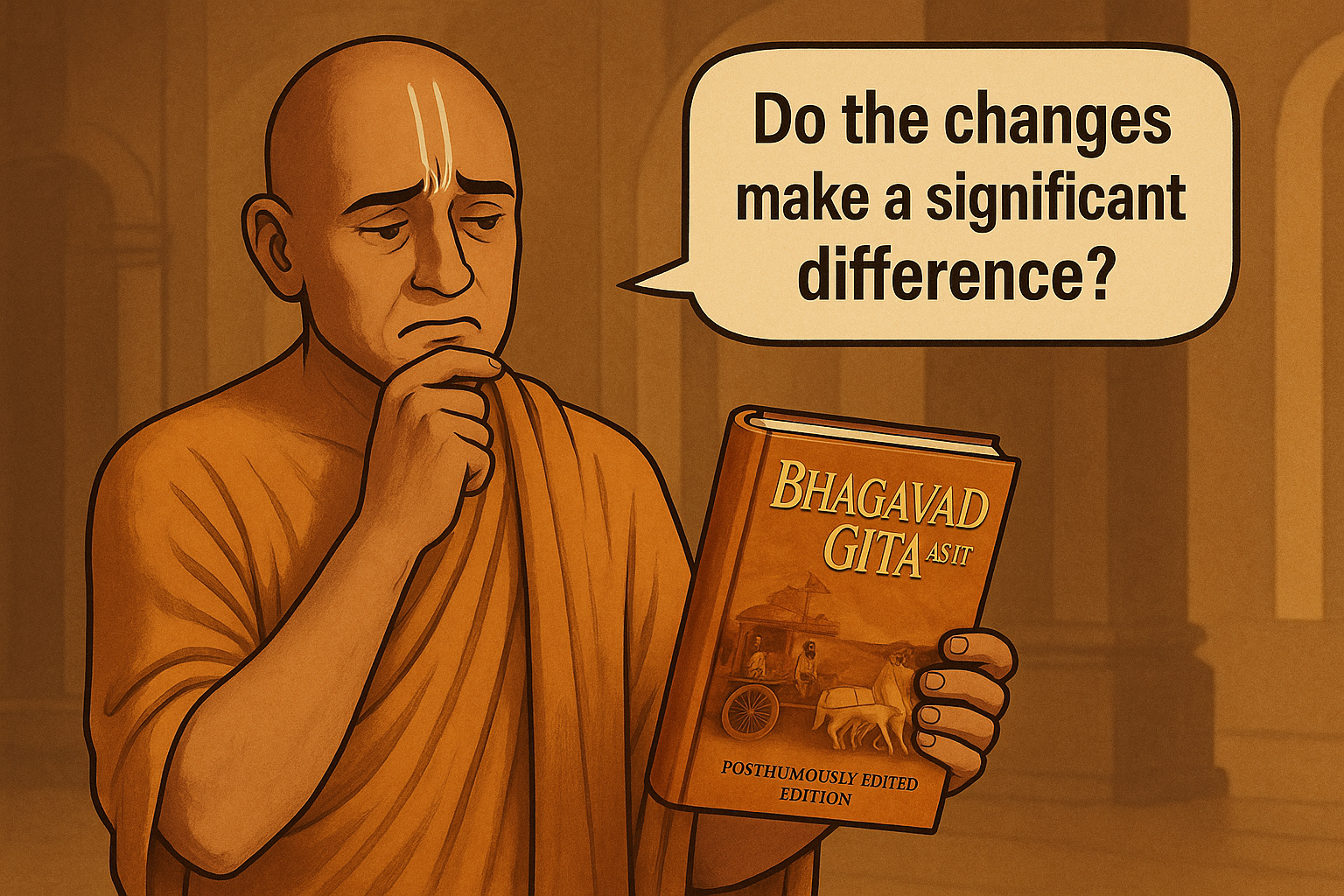
Bhagavad-gita As It Is 2.20 (1972 authorized edition):
na jāyate mriyate vā kadācin nāyaṁ bhūtvā bhavitā vā na bhūyaḥ “He is never born, nor does he ever die. Nor, having once been, does he ever cease to be.” (Bhagavad-gītā 2.20)
In his posthumously edited edition of Śrīla Prabhupāda’s Bhagavad-gītā As It Is, Jayadvaita Swami altered the translation of this verse, claiming that Śrīla Prabhupāda’s original wording — “Nor, having once been, does he ever cease to be” — wrongly suggests that the soul was created. He presented this change as a clarification meant to align more closely with Vaiṣṇava philosophy. Yet when the verse is examined carefully, both linguistically and philosophically, that justification collapses entirely.
During a class at the Bhaktivedanta Manor, Malati Devi Dasi recounted a well-known episode from Śrī Caitanya-caritāmṛta where Lord Caitanya Mahāprabhu corrected a single-word alteration made by Sarvabhauma Bhaṭṭācārya, the renowned scholar of Jagannātha Purī.
After becoming a devotee, Sarvabhauma was so overwhelmed with joy that he modified the word “mukti-pade” in Śrīmad-Bhāgavatam 10.14.8, replacing it with “bhakti-pade.” Although his intention was devotional, Mahāprabhu corrected him, explaining that “mukti-pade” is already a beautiful name of Kṛṣṇa, and śāstra must not be altered based on sentiment or preference.
Malati Devi Dasi drew a direct parallel to modern tendencies to edit sacred texts:
“Nowadays we also have people who like to change words from the holy scriptures, and some of us don’t appreciate it very much. … Śrīla Prabhupāda commented, ‘Write your own.’ In other words, one shouldn’t change. You can write your own.”
Her words are especially significant in light of the Arsa-Prayoga principle, which holds that the words of the ācārya are sacred and should not be edited or “improved” posthumously – like it has been done by Jayadvaita Swami, Dravida Dasa and the BBTI. Just as Mahāprabhu upheld the integrity of the original Bhāgavatam verse, devotees today are called to preserve Śrīla Prabhupāda’s books – like his Bhagavad-gita As It Is – exactly as he approved them — without revision or re-interpretation.
Three Key Points to Note
Malati Devi Dasi’s Personal Stance While Malati Devi spoke strongly against altering śāstra or works of ācāryas, it is not entirely clear what her full position is regarding the specific changes made to Śrīla Prabhupāda’s books. We respectfully invite her to elaborate further — especially given her stature as one of Śrīla Prabhupāda’s earliest and most respected disciples.
The Arsa-Prayoga Principle This sacred principle — “Do not correct the ācārya” — has historically been recognized throughout the Vaiṣṇava tradition. Śrīla Prabhupāda himself invoked this principle when arguing against revising earlier editions of Bhagavad-gītā and Bhāgavatam by other commentators. “Write your own,” he said. Changing the master’s work, even with good intentions, severs the disciplic link by overlaying the disciple’s mind over the guru’s words.
The Lesson from Sarvabhauma Bhaṭṭācārya Sarvabhauma’s change of one word was born of devotion, but Mahāprabhu still corrected it. If the Lord Himself did not approve of devotional word-swapping, what to speak of posthumous textual reconstruction by conditioned disciples decades later? The story demonstrates that no matter how exalted the editor or emotional the inspiration, śāstra and ācārya-vāṇī are not ours to adjust.
The full transcription, audio and video excerpt from Malati Devi Dasi’s class will be included below for reference.
If nothing else, the class was a timely reminder that great caution — and deep humility — is required when dealing with the words of the Lord and His pure devotee.
“So Mahaprabhu said, today I have been transported beyond the three worlds and I’ve been taken to Vaikuntha. All my desires have been fulfilled simply because Sarvabhauma has developed faith in Mahaprasad. And as a result of this, his attitude, Sarvabhauma’s attitude has also changed. And his conversion, it was like a conversion on that day. So he recited a verse of the Bhagavatam, and in that verse, in his newfound ecstasy and realizations, he changed one word. So I think nowadays we also have, we also have people that like to change words from the holy scriptures, and we don’t appreciate, some of us don’t appreciate it very much. So he altered one word. So the verse is well-known, 10.14.8 [Malati recites the Sanskrit], and here’s what he changed. So in the original version, it’s not bhakti-pade. And the verse in English, one who lives his life while joyfully seeing everything as your compassion, meaning the Lord’s compassion, so one who lives his life while joyfully seeing everything as your compassion, even as he experiences adverse conditions arriving from his past deeds, and constantly, nonetheless, constantly pays obeisances to you with his mind, words, and body, is certain to inherit a place at your lotus feet, the object of all devotion. So the original word was mukti-pade, and he changed that mukti-pade to bhakti-pade. And Mahaprabhu explained that there’s no need to change the words of mukti-pade, the source of liberation. It’s a epithet for Krishna. And Vasudeva answered, you’re quite correct to say that the words mukti-pade refer to Krishna, but the word mukti was used customarily in the sense of impersonal liberation, and thus it didn’t bring the same great pleasure as the word bhakti. So that, you know, for somebody who’s maybe not quite as astute, that may ring a bell. Yeah, that’s right. But that’s not how you approach a shastra, and particularly if your books are coming to you from jagat guru Srila Prabhupada, one should be very circumspect. So the other, when the other scholars in Puri heard that Sarvabhauma Bhattacharya had been converted to devotion to Krishna, because he’d been, you know, he’d been an impersonalist. And when they heard about this conversion to Krishna, then all of them took shelter of Caitanya Mahaprabhu. You know, like our verse from the Gita, that whatever the great man does, the common man will follow. He was a great man, he was a much revered and respected personality, and now he was joining the cult of Chaitanya Mahaprabhu. And so they also followed, just like by getting the Beatles to chant Hare Krishna, by getting George in particular, it affected generations. Even to this day, people come across, oh, George Harrison chanted Hare Krishna, and they see the Krishna book with his signature, and immediately they’re attracted. But regards to changing the original text of the Shastra, Srila Prabhupada commented, write your own. In other words, one shouldn’t change. You can write your own.”
This article examines Jayadvaita Swami’s deletion of the line “Lord Ramacandra, of the Ramayana, an incarnation of Krishna, is the mightiest of warriors” from the purport to Bhagavad-gītā As It Is 10.31 in posthumous printings by the Bhaktivedanta Book Trust International (BBTI). While the line was almost certainly inserted by one of Srila Prabhupada’s editors, it was later affirmed by Srila Prabhupada himself in recorded conversation. Once that acceptance is confirmed, the matter is settled — and the later deletion is revealed as a breach of paramparā, not a restoration of accuracy.
Type of change
Deletion — removal of a complete sentence from the published purport.
Category
Philosophical/Devotional change.
Commentary
The editor added it — and Srila Prabhupada accepted it
We do not have evidence that Srila Prabhupada personally wrote the line naming “Lord Ramacandra” in the 10.31 purport. The wording almost certainly came from an editor working under his supervision — and that is fine. Prabhupada relied on editors to help prepare many purports.
The crucial point is this:
Srila Prabhupada heard the exact purport, which included the reference to Lord Ramacandra, and explicitly accepted it as correct in a conversation quoted in the article. He repeated the same identification in his own voice.
Once that happened, the sentence became authorized. No one has the right to remove it after his departure.
Prabhupada confirmed the meaning of “Rama” here as Ramacandra
In a recorded discussion, Srila Prabhupada used this exact verse (10.31) as an example of how Lord Ramacandra is mentioned in the Gītā. He did not say, “This was an editorial invention.” He accepted it. And even though the term “Rama” also can refer to Parasurama or Balarama, Prabhupada confirmed Ramacandra as one of the valid referents in this specific context of the Gita. That is enough to fix it into the purport permanently.
There is no scope to overrule the ācārya’s final approval
Posthumous editing is sometimes defended on the basis that “Prabhupada didn’t write this line himself.” But in Krishna consciousness, the test is not authorship — it is acceptance.
Once the ācārya approves and uses a sentence, it belongs to him. The disciple may not later argue: “But that wasn’t his original phrasing.” That is editorial hubris disguised as scholarship.
The deletion erases a confirmed Vaiṣṇava possibility
By removing the reference to Lord Ramacandra, BBTI did not just “restore ambiguity” — they erased part of Srila Prabhupada’s own explanation.
Srila Prabhupada made it clear: “Rama” can include several incarnations of the Lord, but also includes Lord Ramacandra in the context of this verse — a point he heard in the purport, accepted, and personally repeated.
The purport, as originally printed, reflected that full Vaiṣṇava understanding. After the deletion, it no longer does.
So the issue is not that the edited version is “uncertain” — but that it is incomplete. It no longer reflects the full range of meaning as accepted by Srila Prabhupada himself.
Removing what Prabhupada approved doesn’t improve accuracy. It reduces fidelity.
Why this is not negotiable
Even if the line was originally added by an editor, Srila Prabhupada approved it, used it, and confirmed its meaning in his own voice. That turns an editorial suggestion into an ācārya-sanctioned teaching. Removing it is not just a mistake in publishing. It is a mistake in disciplic succession.
The Arsa-Prayoga principle is simple: You do not remove what the spiritual master has accepted. Once he confirms it, it becomes sacred.
The deletion of Lord Ramacandra’s name is not the editing of a “mistake.” It is the undoing of Prabhupada’s acceptance — and that is the real error.
We’re told by Ramesvara Dasa that Srila Prabhupada personally approved a list of edits to his Bhagavad-gita As It Is. I have no problem accepting that. I even believe Ramesvara Dasa when he says he saw it. It would be wonderful to have the list!
But here’s the reality: the list seems to have vanished. No one has it. No one can show it. And without the list in hand, no one can prove what was on it, what was approved, or what wasn’t.
Even if several devotees from BBT or ISKCON saw it 40 or 50 years ago, memory is not a reliable basis for editing the books of an acharya. No one alive today can recall every detail with perfect accuracy after so many years. And even if they could, we would still be left with no way to verify it.
Let’s grant the strongest possible version of the argument and say the list absolutely existed and listed real, Prabhupada-approved changes. Then what? Without the list in our hands today, we cannot distinguish between:
– The changes Srila Prabhupada personally approved, – The changes made later by editors after his departure, and – The mistakes he deliberately left in.
That distinction is essential. Because if we start “fixing” or “restoring” the text without knowing which changes were authorized, we immediately run into a crisis: removing even one change could erase something Srila Prabhupada wanted kept. Leaving in even one change could preserve an unauthorized edit made after his departure. We can’t know who we’re obeying, and who we’re overriding.
So even if the list was seen by some devotees long ago, the fact that it cannot be produced today means that it cannot serve as a valid basis for altering Srila Prabhupada’s books. At this point, anyone making changes is operating on guesswork. And guesswork with the words of a pure devotee is not service. It is tampering.
Until the list is actually produced — not merely remembered or rumored — the only safe and faithful policy is:
-No posthumous edits. -No guessing. -No tampering with what we cannot verify.
Otherwise, we’re effectively trusting editors (Jayadvaita Swami and Dravida Dasa) more than Srila Prabhupada himself. That is not loyalty. That is deviation.
Until the list is in our hands, there is no debate. Either we preserve Srila Prabhupada’s books as he left them, or we risk rewriting him based on somebody’s memory from 1977. The choice should be obvious.
A devotee recently pointed to the following excerpt from a 1973 conversation and argued that, based on this alone, Bhagavad-gītā 18.66 should be “corrected” to replace the word religion with “occupation”:
Prabhupāda: Now, Kṛṣṇa says, sarva-dharmān parityajya [Bg. 18.66]. Satish Kumar: Yes. Prabhupāda: Now, dharma means occupation. Dharma is not translated as “religion.” Satish Kumar: No, no. Prabhupāda: This is wrong translation. Dharma means occupation. Satish Kumar: Activity? Prabhupāda: Activity, occupation. (Conversation, London, July 30, 1973)
Before rushing to “fix” the book, a few points need to be made—especially in light of arsa-prayoga, the principle that the words of the ācārya are not to be tampered with after his departure:
No instruction, and thus no authorization, was given to change the verse. Srila Prabhupada often spoke freely and loosely in conversation, but he gave direct, literal instructions for book changes while present. Here, he did not.
Srila Prabhupada himself frequently translated dharma as “religion.” This is not a one-off occurrence—it appears hundreds of times in his books and lectures. Are we now to “correct” them all? On what authority?
He heard the verse read aloud repeatedly and never objected. This is decisive. He personally approved the printed Gītā, lectured from it, and signed off on it as finished work.
What happens when we find other places where Prabhupada gives different meanings or emphases? Language is fluid, and Srila Prabhupada tailored his wording to context and audience. Selectively mining conversations to override the final, published work is not fidelity—it’s revisionism.
This is exactly how “The Blessed Lord” was removed by Jayadvaita Swami and the BBTI from later editions. Even though Srila Prabhupada accepted that phrase while alive, and even used it himself, editors saw one conversation where he expressed a reservation—and used that as a pretext to delete it from the entire book.
If this logic is allowed, what will be next?
This is the fatal pattern: use a stray comment in a private conversation to overrule the public, authorized book. It weaponizes Prabhupada’s own words against his finished legacy. That is the opposite of arsa-prayoga. That is how the books slowly stop being his.
I met Hayagriva’s son in front of the Doughnut Plant perhaps ten years ago when I was working there as the treasurer and accountant. I asked him what his father had to say about the recent changes being made to Srila Prabhupada’s books. He said, “My father told me, ‘If I made all those changes to his Bhagavad-gita, he would have cut off my head.'”
We know Hayagriva presented many editing suggestions to Srila Prabhupada. He was being directed by His Divine Grace. How could another editor come along without knowing what edits to the manuscript Srila Prabhupada had specifically approved when working with Hayagriva? To think that by returning to the original manuscript and reversing what Srila Prabhupada had approved puts the modern editor in a precarious position of having likely negated and overruled the intentions of Krishna’s pure devotee. It is like a razor’s edge. If you are not cautious, you can get a bloody cheek, or much worse.
Sometimes devotees laugh at those who object to “minor edits” in Śrīla Prabhupāda’s books. They say, “Come on — only fanatics would object to correcting a comma, a typo, or a small grammar mistake!” And many accept that reasoning without much thought, assuming that those who resist changes must simply be sentimental or stubborn.
But this attitude hides a serious misunderstanding. It assumes that changing a small detail is harmless, and that the only people who care are extremists. In reality, the issue is not about commas or spelling at all — it’s about who has the right to adjust the words of the spiritual master.
Once we say, “We can change a word for clarity,” we have already accepted the principle that human judgment can improve what was spoken by the pure devotee. And if that principle is accepted once, it can be applied again and again — not just to commas, but to sentences, meanings, and even philosophy. The logic that allows one small change can justify any change.
To call those who resist such logic “fanatics” is easy, but it misses the point entirely. Their concern is not over grammar — it is over preserving the disciplic succession intact. The words of the ācārya are sacred sound vibrations, not material literature to be polished according to our taste.
What follows will show — step by step — how even the smallest editorial correction rests on a principle that, once accepted, opens the door to an endless chain of justifications. What begins as “just a comma” can quietly become the rewriting of revelation itself.
To see this clearly, we must put emotion aside and follow the logic wherever it leads — beginning with the simple question, “Why change a comma?”
The Logical Skeleton of the “Comma Correction” Problem
Let’s define the argument formally and trace the logic step by step.
1. The Act
An editor proposes to change a comma in Śrīla Prabhupāda’s text.
Let’s denote:
A: the act of editing (in this case, a comma correction)
P: the principle or justification offered for editing
2. The Principle (P)
When asked “Why make this change?”, the editor must appeal to some underlying principle. Examples might include:
P₁: To make the text clearer.
P₂: To make it grammatically correct.
P₃: To make it more acceptable to scholars.
P₄: To make it easier for modern readers to understand.
Each of these is a normative principle — a rule about how and why editing is justified.
3. The Universalizability Test
A principle, once invoked, cannot rationally be restricted to one case unless there is an additional principle that limits it.
So, if we accept P₁: “We may change the text to make it clearer,” then that principle must logically apply to all cases where the editor believes clarity could be improved.
This is the universalization of P₁. It follows from the principle of consistency — that identical reasons must yield identical permissions in identical types of cases.
4. The Problem of Subjectivity
Now, terms like “clarity,” “correctness,” and “scholarly acceptance” are subjective when judged by material standards. There exists no empirical or linguistic rule by which such clarity can be objectively verified in spiritual literature.
The only true standard of clarity is the revealed principle that transcendental sound must be preserved exactly as spoken by the realized soul. Therefore, applying P₁ or P₂ based on academic or personal judgment replaces revealed authority with subjective interpretation.
That judgment is fallible, culturally conditioned, and limited by material perspective.
So: P₁ ⇒ subjective authority replaces divine authority.
5. Slippery Slope Formalized
We can now model the chain of reasoning:
Accept A₁: “Change comma for clarity.”
This implies acceptance of P₁: “We may change anything that increases clarity.”
By universalizability, P₁ applies to any word, sentence, or concept.
The editor, being the judge of clarity, now possesses implicit interpretive authority.
The distinction between “editor” and “author” dissolves in principle.
Therefore: A₁ ⇒ authorization of all Aₙ justified by the same principle.
This is the essence of the slippery slope — not a mere rhetorical trope, but a logical entailment: once the normative justification for one action applies equally to more consequential actions, those actions are justified in principle unless an independent limiting condition is introduced.
6. The Limiting Condition Problem
To halt the slope, one must introduce a limiting condition — a new premise L that restricts P₁. For example: L: “We may only edit commas, but not words.”
However, L itself must be justified by a new principle Pᴸ. If Pᴸ lacks independent justification, it is arbitrary. And arbitrary limits collapse under rational scrutiny.
Thus, unless one can show a non-arbitrary, divinely sanctioned, epistemically objective boundary between “permissible correction” and “impermissible alteration,” the permission to change anything for clarity logically includes permission to change everything for clarity.
7. The Transcendental Counterprinciple
The only consistent way to avoid the slope is to affirm an opposite axiom:
P* : The author’s words are inviolable, as they carry transcendental authority.
Here, clarity is not improved by editing the text, but by purifying the reader’s consciousness. This inverts the premise entirely: instead of adjusting revelation to fit human comprehension, the human must adjust his comprehension to fit revelation.
8. Conclusion
The argument against even a “comma correction” is not fanaticism — it is philosophical consistency. Because once you accept a humanly defined justification for altering revealed speech, you’ve imported a subjective epistemology into a domain that claims divine origin. That is not editing — it’s epistemic rebellion disguised as scholarship.
The Comma Argument — Explained Simply
If the above explanation felt a little technical, here is the same argument expressed in simpler terms. And if you already understood everything written above, you don’t need to read this — but it may still help you explain it to others.
1. What Begins as Small
An editor wishes to correct what seems like a small detail in Śrīla Prabhupāda’s book — perhaps a misplaced comma or a minor grammar issue. It sounds harmless, almost helpful.
2. The Justification
When asked why, the editor replies: “To make it clearer,” or “To make it grammatically correct,” or “To make it more respectable to scholars,” or “To help modern readers understand.” This reason — whatever it is — becomes the principle that justifies the change.
3. The Law of Consistency
But once a principle is accepted, it cannot logically apply only once. If we can change one comma for the sake of clarity, then that same rule allows changes to any word, sentence, or idea — whenever an editor feels it will improve clarity. The permission extends to all similar cases.
4. The Real Issue: Whose Standard?
Words like “clarity,” “correctness,” and “modern understanding” are not absolute. They depend on culture, education, and opinion. So, if we rely on these human measures, then human judgment becomes the standard. That means divine revelation is being adjusted according to the limitations of the editor. Yet śāstra gives a higher rule: the words of the realized soul are perfect as they are. Our duty is to understand them through humility and service, not revision.
5. How the Slope Works
Once the principle of editing is accepted, it can be used again and again. First a comma, then a phrase, then a whole sentence — each change defended by the same reasoning: “It’s clearer now.” This is not a paranoid fear; it’s the logical consequence of the principle itself.
6. The Futile Attempt to Draw a Line
Someone might say, “We will only correct minor things.” But that limit has no real foundation. If we may change for clarity, then anything can be changed if it seems unclear. Any stopping point is arbitrary — a line drawn in sand. Unless there is a divinely given boundary, the permission to change one thing is permission to change everything.
7. The Only Consistent Principle
There is only one safe and consistent position: The words of the ācārya must remain exactly as they are. We do not make transcendental sound more “perfect” — it is already perfect. Our task is not to edit the message, but to purify the heart so that we can hear it properly.
8. The True Meaning of Faithfulness
To reject editing is not fanaticism — it is fidelity. It means accepting that revelation stands above our judgment. Once human reasoning is allowed to “improve” divine sound, the message ceases to be revelation and becomes interpretation. That is how “fixing a comma” slowly becomes rewriting the words of a pure devotee.
Arsa-Prayoga.com – Revisited is the title of an upcoming ebook that continues the work begun here on arsaprayoga.com. It re-examines the changes made to Śrīla Prabhupāda’s original books from new angles and explains why each alteration is significant.
Each example will also be posted here on arsaprayoga.com.
The original cover of The Perfection of Yoga, published during Śrīla Prabhupāda’s presence, depicts Lord Krishna instructing Arjuna on the battlefield of Kurukṣetra. The newer version replaces this sacred scene with a modern, abstract image: a silhouetted yoga figure against a cosmic background, accompanied by planetary symbols and a hummingbird.
Type of change
Visual substitution — replacement of the original painting with a completely different concept.
Category
Philosophical change.
Commentary
The original cover: revelation and surrender
The first edition’s painting is not just devotional art — it is theology in color. It captures the divine dialogue of the Bhagavad-gītā: the Supreme Lord imparting transcendental knowledge to the bewildered soul. Krishna’s gesture expresses both compassion and authority, while Arjuna’s posture shows humility and surrender.
This image teaches before one even opens the book. It tells the reader: “Here is yoga in its highest form — the union between the soul and Krishna through surrender and service.” The visual message aligns perfectly with Śrīla Prabhupāda’s text, where yoga culminates not in physical postures or impersonal meditation, but in bhakti-yoga, devotion to the Supreme Personality of Godhead.
The new cover: abstraction and self-centered spirituality
The new cover shifts the entire philosophical mood. The central figure is no longer Arjuna receiving revelation but a lone silhouette performing an asana — an emblem of modern yoga culture. The background, with its planets, abstract lights, and hovering bird, suggests cosmic energy and mysticism rather than divine personality.
The focus has moved from Krishna to the individual practitioner. The very idea of “perfection” is reframed — from surrender to the Supreme to self-realization through posture and mental discipline. The new imagery reflects the psychology of self-help and the commercial yoga industry rather than the theology of bhakti.
The consequence: from tattva to marketing
This shift is not cosmetic. It mirrors the broader editorial problem: once Krishna is removed from the center — visually or textually — everything else changes. The meaning of yoga becomes sentimental and speculative.
Where the original cover anchored the reader in tattva (spiritual truth), the new one drifts toward māyā-vāda aesthetics — the impersonal mood of “energy,” “light,” and “universal consciousness.” It exchanges humility for abstraction, devotion for design.
Śrīla Prabhupāda’s original books were meant to preach, not to conform. The old cover declared the eternal truth of Krishna consciousness; the new one markets a diluted idea of spirituality.
In short: the original cover preaches; the new cover advertises.
And that change — from revelation to representation, from śabda-pramāṇa (divine authority) to manuṣya-pramāṇa (human taste) — is the violating of the principle of arsa-prayoga.
Arsa-Prayoga.com – Revisited is the title of an upcoming ebook that continues the work begun here on arsaprayoga.com. It re-examines the changes made to Śrīla Prabhupāda’s original books from new angles and explains why each alteration is significant.
Each example will also be posted here on arsaprayoga.com.
The article examines a major change in Śrīmad-Bhāgavatam 1.16.12, purport, where a large portion of Śrīla Prabhupāda’s original text was deleted and replaced with a much shorter version. In the original Delhi edition, personally typewritten by Śrīla Prabhupāda, the purport included a vivid cosmological description explaining how each planet is “an island in the airy ocean of outer space.” The later BBT-International edition removes most of this section, leaving only a brief mention of Bhārata-varṣa and the Mahābhārata’s description.
Since the Delhi edition was typed by Śrīla Prabhupāda himself, there is no earlier draft that could justify this change. The deletion therefore cannot be called a “restoration.” It is a posthumous editorial removal of material personally written and approved by the author.
Type of change
Deletion and condensation — a large section of original text removed and shortened.
Category
Philosophical change.
Commentary
Deletion and condensation
This is not a correction of typographical error. Substantial text has been eliminated, changing both the content and scope of the purport. Such reduction is not preservation but revision.
Loss of cosmological detail and mood
The removed section presents the Vedic conception of the universe, describing planets as islands in the airy ocean of space. This imagery expresses both philosophical meaning and devotional beauty. Its removal flattens the text, leaving a stripped-down version that weakens the reader’s sense of Vedic cosmology and spiritual wonder.
Interpretive interference
By removing this material, the editor decided which aspects of Śrīla Prabhupāda’s exposition were “essential” and which were not. That decision cannot be editorial—it is interpretive. It transfers authority from revelation to human judgment, from transmission to management.
Modern palatability
It seems likely that the editor considered Prabhupāda’s cosmological explanation too unusual or “unscientific” for modern readers and shortened it to make the purport more acceptable. This turns faithfulness into adaptation. Instead of preserving Śrīla Prabhupāda’s transcendental message, the text is reshaped to suit secular taste.
The result is not merely a shorter purport, but a reorientation of meaning: the Bhāgavatam’s bold transcendental cosmology is softened into something modern minds can tolerate. What was revelation becomes explanation.
Śrīla Prabhupāda’s original books were never meant to be adjusted for comfort. Their strength lies in direct transmission of transcendental knowledge, unbent by modern prejudice. Editing them to “help” the reader understand does not illuminate the message—it dims it. In this change, the editor crosses the line from preservation to modification, from śabda-pramāṇa (divine authority) to manuṣya-pramāṇa (human opinion).
Arsa-Prayoga.com – Revisited is the title of an upcoming ebook that continues the work begun here on arsaprayoga.com. It re-examines the changes made to Śrīla Prabhupāda’s original books from new angles and explains why each alteration is significant.
Each example will also be posted here on arsaprayoga.com.
The article shows how a small change in a purport—from “done by Krishna” to “done for Krishna”—creates a profound shift in meaning. Though it appears minor, this substitution alters the philosophical substance of the text.
Type of change Substitution — a single preposition replaced.
Category Philosophical change.
Commentary
Alters causal agency / the relationship between Krishna and activity The difference between “by Krishna” and “for Krishna” is not stylistic. It changes who is acting and whose will is primary. “Done by Krishna” means that Krishna is the direct actor, the cause behind all action. “Done for Krishna” reverses the flow, implying that the devotee acts and offers the result. That is not the same truth; it replaces divine agency with human initiative.
Changes nuance of surrender / devotional theology In the original wording, the devotee is fully dependent. He is the instrument, Krishna the mover. This is the essence of śaraṇāgati—to see Krishna as the doer in all things. The edited phrase softens that surrender. It suggests the devotee’s independent action performed on Krishna’s behalf rather than through Krishna’s will. The theology of dependence becomes a theology of contribution.
Moves from metaphysical fact to interpretive sentiment “Done by Krishna” is an ontological statement: it describes reality as it is. “Done for Krishna” is a moral sentiment: it describes how we wish to act. This subtle shift turns realization into interpretation, revelation into advice.
A single preposition has thus transformed the meaning, the mood, and the philosophy. It is not grammar; it is theology.
You must be logged in to post a comment.