
By Ajit Krishna Dasa
For anyone studying ISKCON history, the integrity of Śrīla Prabhupāda’s original books, the principle of ārṣa-prayoga, or the ongoing debate about BBT International’s post-samādhi editing, there is no clearer example of the underlying problem than the quiet shift found in the Bhagavad-gītā As It Is. Two descriptions of Śrīla Prabhupāda — one from the original edition, one from the newer BBTI edition — reveal two completely different theologies. This is not merely linguistic preference. It is a redefinition of Prabhupāda’s authority, status, and position in the guru-paramparā.
Anyone familiar with the editing controversies surrounding the changed Gītā knows this issue is not about grammar. It is about revelation.
The Original Description: Śrīla Prabhupāda as a Divinely Empowered Ācārya
“HIS DIVINE GRACE A.C. BHAKTIVEDANTA SWAMI PRABHUPĀDA, the leading exponent of the science of Kṛṣṇa consciousness in the West and the world’s most distinguished teacher of Vedic religion and thought is the author of Śrīmad-Bhāgavatam, Kṛṣṇa and many other versions of Vedic literature. He is a fully self-realized devotee of Lord Kṛṣṇa and is the latest disciple in a succession that originally began with Kṛṣṇa Himself. He is the founder and spiritual master of the International Society for Krishna Consciousness which now has centers in major cities throughout the world.” (From the backcover of the original and authorized Bhagavad-gita As It Is, 1972-1977)
The original Bhagavad-gītā As It Is presents Śrīla Prabhupāda according to classical Vaiṣṇava siddhānta. Nothing is minimized. Nothing is secularized. His identity is stated as the tradition itself understands it:
• He is the leading exponent of Kṛṣṇa consciousness.
• He is the most distinguished teacher of Vedic religion and thought.
• He is a fully self-realized devotee of Lord Kṛṣṇa.
• He stands in an unbroken guru-paramparā beginning with Kṛṣṇa Himself.
• He is the founder and spiritual master of ISKCON.
• His writings are Vedic revelation — śabda-brahma — not ordinary literature.
• His authority is divine, not academic.
This description fits perfectly with Prabhupāda’s own statements and the strict understanding of ārṣa-prayoga: when an empowered ācārya speaks, the words are final. You do not alter them, interpret them “for modern audiences,” or adjust them posthumously. His authority derives from Kṛṣṇa — not from a publishing institution.
The New BBTI Description: From Divine Authority to Academic Respectability
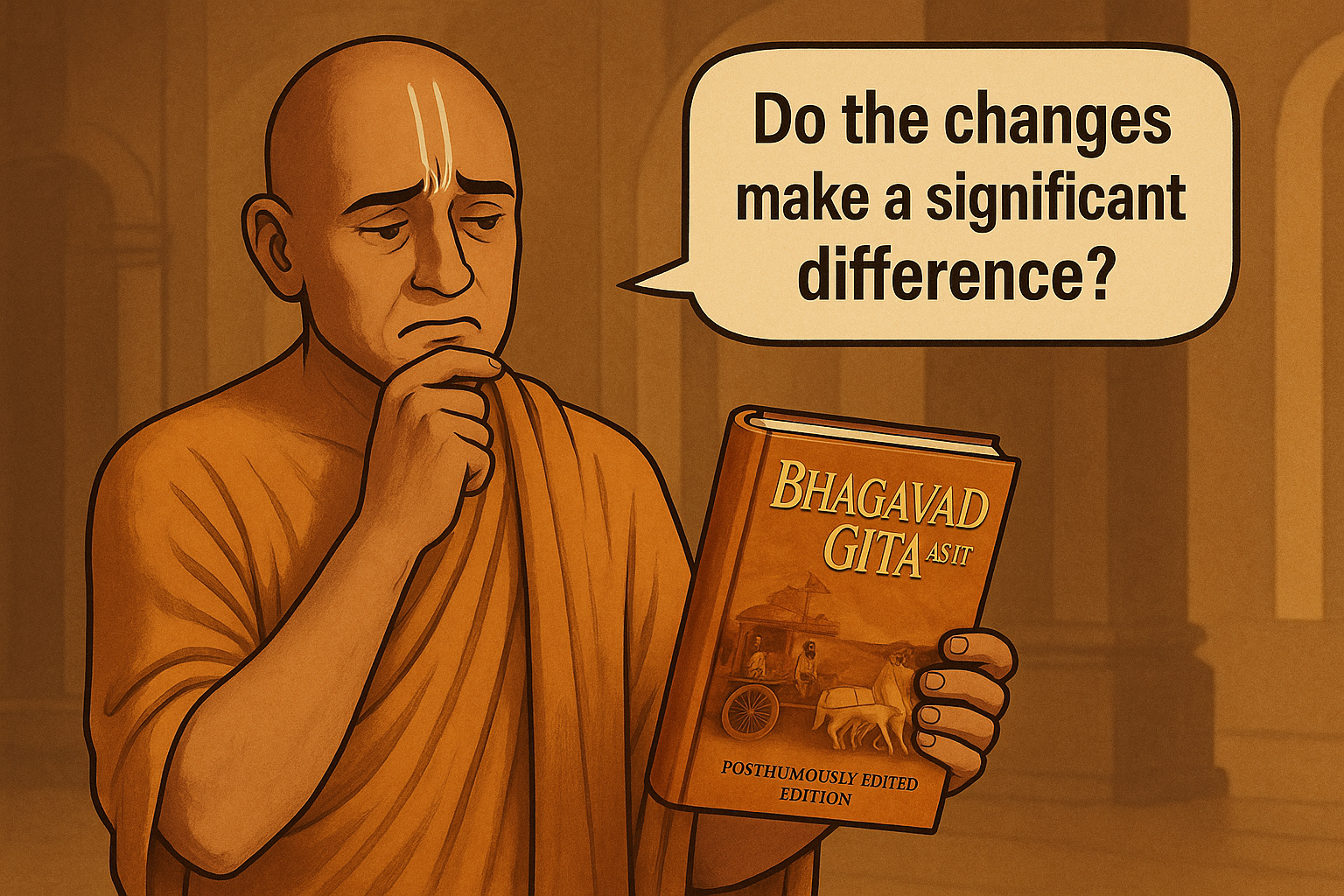
“His Divine Grace A. C. Bhaktivedanta Swami Prabhupāda was a teacher in the disciplic line from Kṛṣṇa (the speaker of the Gītā) and was an exemplar in bhakti-yoga, the yoga of devotional mysticism. His translation and commentary are guided by a lifetime of scholarship and enriched by the realizations of a mature practitioner.” (From the backcover of the posthumously edited Bhagavad-gita As It Is)
The revised description in the BBT International edition removes the transcendence. It removes the divine empowerment. It removes guru-paramparā. It removes the ontology of revelation. And it replaces them with the vocabulary of secular Religious Studies departments.
• Prabhupāda becomes a “teacher,” not an empowered master.
• His realizations become “experience” rather than self-realization.
• His authority becomes “scholarship” rather than śakti.
• His mission becomes “devotional mysticism” rather than a divine commission.
• His position in the disciplic succession is omitted altogether.
• His books are framed as scholarly works, not revealed scripture.
This is the language academics use to describe a respected religious figure. It is not the language used to describe a mahā-bhāgavata delivering Kṛṣṇa’s message unchanged.
The change is intentional, ideological, and foundational.
Why This Change Is a Philosophical Change — Not a Stylistic One
It may look like the back-cover text was simply “updated,” but the shift is far deeper. In Vaiṣṇava theology, the way an ācārya is described is not marketing — it is philosophy. Changing that description changes the conceptual foundations of revelation, authority, and paramparā.
Here is why the newer BBTI description constitutes a genuine philosophical shift:
• The original text affirms Prabhupāda as a self-realized, divinely empowered ācārya standing in a guru-paramparā beginning with Kṛṣṇa. This is core Vaiṣṇava siddhānta.
• The newer text removes all transcendental claims and replaces them with the vocabulary of academic religious studies: teacher, practitioner, exemplar, scholar. This reframing is ideological, not neutral.
• When divine empowerment is replaced by “scholarship,” the source of authority is relocated—from Kṛṣṇa and paramparā to human effort, experience, and education. That is a direct shift in epistemology.
• The original presentation makes Prabhupāda’s books śabda-brahma—untouchable, uneditable, preserved by ārṣa-prayoga.
• The new presentation makes his books appear to be religious literature written by a competent teacher—therefore open to “correction,” “improvement,” and posthumous editing.
• How you describe the guru governs how you treat his words. Reduce him from an empowered ācārya to a spiritual author, and the editorial boundaries disappear.
• Redefining Prabhupāda’s ontological position automatically redefines the ontological status of his books. This is the very heart of philosophy—not of style.
The shift from “empowered ācārya delivering divine revelation” to “scholarly teacher presenting devotional mysticism” is not cosmetic. It is a change in philosophy. And such disobedient philosophical changes form the groundwork for most of what the BBT International has done to Prabhupāda’s books since 1978.
Why the Shift Happened: The Institutional Motives Behind the New Description
These changes do not emerge from nowhere. They serve specific institutional incentives inside BBTI and the modern ISKCON structure. When you examine the newer description, the motives become obvious:
Secular respectability
Kṛṣṇa consciousness must appear “safe” to academics, journalists, and interfaith circles. Divine claims are removed. Authority is softened. The ācārya becomes an acceptable subject of Religious Studies rather than a representative of God.
Institutional flexibility
If Prabhupāda is framed as a scholar, then the institution replaces him as the ongoing authority. Once his transcendence is removed, reinterpretation and doctrinal adjustment become easy. Editorial intervention becomes normal.
Legal and social safety
Absolute guru claims make institutions nervous. Removing transcendence reduces risk — legal, social, and political.
Justifying textual alteration
If Prabhupāda is merely a scholar, editors become co-scholars. Posthumous editing becomes an “academic duty.” “Fixing,” “refining,” and “modernizing” the Gītā becomes justified.
Every one of these motives requires the same thing: a quiet lowering of Śrīla Prabhupāda’s divine identity.
The Weberian Pattern: How Institutions Tame Their Founders
Max Weber described exactly what happens after a charismatic spiritual founder departs. The patterns are precise:
• The founder is reinterpreted as a historical figure.
• Absolute authority is replaced by bureaucratic authority.
• Revelation becomes “tradition.”
• Radical spiritual demands are softened for institutional comfort.
• Doctrines are edited to fit new cultural expectations.
• The living spiritual fire becomes the institution’s heritage instead of its guiding force.
This is not speculation. This is exactly what unfolded in ISKCON after 1977 — and the rewritten Gītā description is one of the clearest examples.
How the New Description Enables Posthumous Editing
Once Prabhupāda is reframed as a respected “teacher” rather than a divinely empowered ācārya, everything changes:
• His books appear to be literature, rather than revelation.
• Literature can be edited, updated, and modernized.
• Editors become authoritative intermediaries.
• ārṣa-prayoga is discarded as outdated superstition.
• Post-samādhi editing is normalized.
• Authority shifts from the guru to the institution.
The new Gītā description is the theological justification for the changed Gītā — and for every other altered text.
The Consequence: Two Descriptions, Two Theologies
These two descriptions of Śrīla Prabhupāda represent two incompatible worldviews.
• The original description safeguards the purity of Prabhupāda’s teachings.
• The newer description prepares the ground for reinterpretation and revision.
• The original affirms revelation.
• The new one reduces revelation to scholarship.
• The original protects the guru-paramparā.
• The new one replaces it with institutional authority.
• The original makes posthumous editing unthinkable.
• The new one makes it inevitable.
This shift is not a detail. It is the philosophical foundation of the entire posthumous editing project.




 Arsa-Prayoga
You must be logged in to post a comment.