From Dhyana to Sankhya: Prabhupada’s Vision for Chapter 6

By Ajit Krishna Dasa

Srila Prabhupada’s decision to title Chapter 6 of the Bhagavad Gita As It Is “Sankhya Yoga” stands as a distinctive and deliberate choice, diverging from the more common “Dhyana Yoga” favored by traditional acharyas, modern scholars, and Western translators. This title, unique in the history of widely recognized Gita commentaries, reflects his mission to present the text through the lens of Gaudiya Vaishnavism while reintroducing the theistic Sankhya philosophy of Kapila Muni, the divine son of Devahuti from the Srimad Bhagavatam. Far from a mere editorial quirk, Prabhupada’s naming can be seen as a strategic reclamation of the term “Sankhya,” serving as an implicit attack on the atheistic Sankhya school and aligning the chapter’s teachings with Krishna consciousness. This choice makes sense when viewed through the philosophical content of Chapter 6, its integration of Sankhya and Yoga, and Prabhupada’s broader purpose of countering materialistic philosophies.

Philosophical Foundations: Theistic Sankhya and Its Contrast with Atheism

Sankhya philosophy, one of the six classical schools of Indian thought, fundamentally distinguishes between purusha (the eternal, conscious soul) and prakriti (temporary, unconscious matter), aiming for liberation through analytical knowledge. However, two versions of Sankhya exist: the atheistic, classical Sankhya, often attributed to a sage Kapila, which denies a supreme God and posits multiple purushas liberated through intellectual discernment alone, and the theistic Sankhya of Kapila Muni, an incarnation of Vishnu, as detailed in Srimad Bhagavatam (Canto 3, Chapters 24–33). The latter integrates this dualistic framework with devotion to Krishna, the Supreme Purusha, as the source and controller of all existence.

Srila Prabhupada consistently champions the theistic Sankhya of the Bhagavatam’s Kapila, critiquing the atheistic version as incomplete. In his purport to Gita 2.39, he describes Sankhya as the analytical study of soul and matter but ties it to Krishna’s authority, while in Srimad Bhagavatam 1.2.30, he credits Kapila (the Vishnu avatar) with creating Sankhya to dispel material illusion, implying the atheistic school is a corruption. By titling Chapter 6 “Sankhya Yoga,” Prabhupada reclaims the term from its godless connotation, positioning it as a Krishna-centric science of self-realization. This choice serves as an attack on atheistic Sankhya by asserting that true Sankhya—unlike its materialistic distortion—culminates in devotion to the Supreme Personality of Godhead, not mere intellectual isolation.

Chapter 6’s Content: A Blend of Sankhya Philosophy and Yogic Practice

Chapter 6 of the Gita, while renowned for its meditative instructions (e.g., 6.11–14: sitting steadily, focusing on the self or Krishna), contains philosophical elements that resonate with Sankhya, justifying Prabhupada’s title. Verses like 6.5–6 (“One must deliver himself with the help of his mind… the mind is the friend or enemy”) echo Sankhya’s view of the mind as a product of prakriti that binds or liberates the purusha depending on its mastery. Similarly, 6.1–4 emphasize detachment from sense objects and fruitive results, mirroring Sankhya’s goal of disentangling the soul from material nature. The description of the yogi’s transcendent state in 6.20–23—realizing the self’s distinction from matter through “transcendental senses”—further aligns with Sankhya’s liberation through discriminative knowledge.

Prabhupada’s “Sankhya Yoga” title broadens the chapter’s scope beyond meditation (dhyana) to include this analytical foundation, reflecting the theistic Sankhya of Kapila, where understanding the soul’s eternality leads to Krishna (Srimad Bhagavatam 3.25.18). Unlike “Dhyana Yoga,” which narrows the focus to meditative practice, “Sankhya Yoga” encapsulates the integration of knowledge (Sankhya) and discipline (Yoga), culminating in devotion (6.47: “The highest yogi thinks of Me constantly”). By highlighting these Sankhya elements, Prabhupada challenges atheistic Sankhya’s endpoint—self-isolation without God—replacing it with a theistic synthesis that directs the practitioner to Krishna, thus undermining the atheistic school’s philosophical legitimacy.

Historical Context: Sankhya and Yoga’s Traditional Connection

The tendency in Indian tradition to connect Sankhya and Yoga as complementary systems supports Prabhupada’s titling. Historically, Sankhya provides the metaphysical blueprint (distinguishing purusha from prakriti), while Yoga, particularly Patanjali’s Ashtanga Yoga, offers the practical path, with dhyana (meditation, the seventh limb) as a key stage. The Gita itself reflects this synergy: Chapter 2 introduces Sankhya’s analytical wisdom (2.39), and Chapter 6 blends it with yogic practice. Prabhupada’s “Sankhya Yoga” title leverages this tradition, but adapts it to Vaishnavism by rooting it in Kapila’s theistic Sankhya, not the atheistic version that Patanjali’s Yoga partially accommodates (via Ishvara, Yoga Sutras 1.23).

This historical pairing bolsters Prabhupada’s attack on atheistic Sankhya. By invoking “Sankhya” in a yogic context, he reasserts its original spiritual purpose—lost in the godless classical school—and aligns it with the Gita’s theistic narrative, where Krishna is the ultimate goal (Gita 15.17–18). This reclamation serves as a polemic, subtly exposing atheistic Sankhya’s inadequacy compared to its devotional counterpart.

Prabhupada’s Strategic Intent: Attacking Atheistic Sankhya and Inspiring Exploration of the Bhagavatam

Prabhupada’s mission was to counter materialistic and impersonal philosophies, including atheistic Sankhya, which he saw as a distortion of Vedic truth. His critiques in purports—e.g., dismissing atheistic Sankhya as “dry speculation” (Gita 7.4, purport)—reveal his intent to restore its theistic essence. Naming Chapter 6 “Sankhya Yoga” is a deliberate strike against this distortion for several reasons:

  1. Reclamation of Terminology: By using “Sankhya,” a term familiar to scholars and practitioners, Prabhupada confronts its atheistic association head-on. He redefines it through Kapila’s lens, where analytical knowledge serves bhakti, not godless liberation, thus challenging the classical school’s authority.
  2. Philosophical Superiority: The chapter’s content—integrating self-realization with devotion—demonstrates that theistic Sankhya surpasses atheistic Sankhya. Verses like 6.29–30 (“He who sees Me everywhere”) elevate Sankhya’s dualism into a Krishna-centric unity, exposing the atheistic version’s limitation in stopping at individual purusha without recognizing the Supreme Purusha.
  3. Educational Polemic: Prabhupada’s global audience included Westerners and Indians influenced by secular interpretations of Sankhya. Titling Chapter 6 “Sankhya Yoga” educates them that true Sankhya aligns with Krishna consciousness, countering scholarly narratives equating Sankhya with atheism and reinforcing the Gita’s theistic intent “as it is.”
  4. Parampara’s Authority: By tying the title to Kapila of the Bhagavatam, Prabhupada roots it in disciplic succession, contrasting it with speculative atheistic Sankhya. This asserts the Vedic authenticity of his interpretation, undermining the classical school’s standalone credibility.
  5. Inspiring Engagement with the Srimad Bhagavatam: Beyond attacking atheistic Sankhya, Prabhupada’s use of “Sankhya Yoga” also aimed to inspire readers to explore the Srimad Bhagavatam, which he considered the “ripe fruit of the Vedic tree” (Srimad Bhagavatam 1.1.3, purport) and the ultimate scripture for Krishna consciousness. By linking Chapter 6 to Kapila’s theistic Sankhya—detailed in Bhagavatam Canto 3, Chapters 24–33—he creates a bridge to this text, where Kapila’s teachings expand on the Gita’s principles with a devotional focus (e.g., Bhagavatam 3.25.18). In purports like Gita 6.13–14, he references Kapila’s meditation on Vishnu (Bhagavatam 3.28.8–11), subtly encouraging readers to delve into the Bhagavatam for a deeper understanding of both Kapila’s Sankhya but also of the Srimad-Bhagavatam itself. For his audience—many unfamiliar with this scripture—the title “Sankhya Yoga” plants a seed of curiosity about Kapila’s full discourse, reinforcing the Bhagavatam’s role as the natural next step after the Gita and enhancing his mission to elevate global devotion through the parampara’s treasures.

Uniqueness and Justification

No major traditional acharya (e.g., Shankaracharya, Ramanujacharya, Madhvacharya) or modern translator (e.g., Sivananda, Chinmayananda) titles Chapter 6 “Sankhya Yoga”—they typically use “Dhyana Yoga” or variants, reserving “Sankhya Yoga” for Chapter 2. Prabhupada’s divergence is a bold innovation, justified by Chapter 6’s Sankhya-like elements and his mission. While “Dhyana Yoga” fits the chapter’s meditative focus, “Sankhya Yoga” captures its broader philosophical depth, aligning with his view of Kapila’s system as both knowledge and practice directed toward Krishna.

Conclusion: A Sensible and Strategic Choice

Srila Prabhupada’s “Sankhya Yoga” title for Chapter 6 makes profound sense as a reflection of its content—merging Sankhya’s analytical insights with Yoga’s meditative discipline—and his intent to advance Gaudiya Vaishnavism. It serves as a strategic attack on atheistic Sankhya by reintroducing Kapila’s theistic version, challenging its godless conclusions, and redirecting its principles toward Krishna. This choice not only highlights the chapter’s philosophical richness but also fulfills Prabhupada’s mission to present the Gita as a devotional text, countering materialistic distortions and establishing Krishna consciousness as the ultimate synthesis of Vedic wisdom. In this light, “Sankhya Yoga” is not just a title—it’s a declaration of theistic triumph over atheism, rooted in scripture and tradition.

For a definitive proof that Srila Prabhupada wanted Chapter Six of his Bhagavad-gita As It Is to be named Sankhya-Yoga, please see this article.

No Objection

By Ajit Krishna Dasa

Jayadvaita Swami admits that it constitutes evidence against making a change if Srila Prabhupada read and/or lectured from a translation or purport without objecting to it:

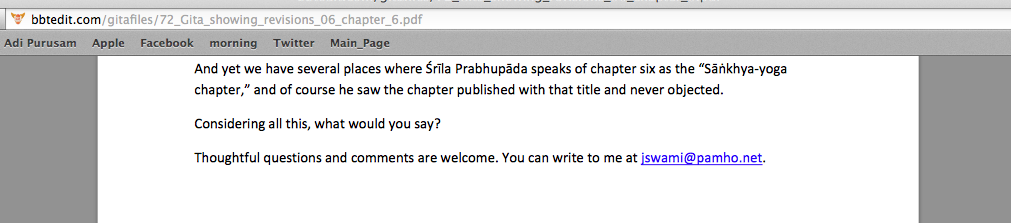
Screen Shot 2018-02-10 at 13.05.46

“And yet we have several places where Śrīla Prabhupāda speaks of chapter six as the “Sāṅkhya-yoga chapter,” and of course he saw the chapter published with that title and never objected.”

The above quote is from Jayadvaita Swami’s annotated scans: Chapter Six from J. Swami’s edited copy of the 1972 edition. This is a chapter from the copy of the 1972 edition of Bhagavad-gītā As It Is on which Jayādvaita Swami marked the revisions for the edition of 1983.

Direct link to the annotated scans of Chapter Six (look for the headline “About sankhya”):

http://bbtedit.com/gitafiles/72_Gita_showing_revisions_06_chapter_6.pdf

JAYADVAITA SWAMI – SELF-APPOINTED GHOSTWRITER

By Ajit Krishna Dasa

Definition:

“ghostwriter
ˈɡəʊstrʌɪtə/
noun
a person whose job it is to write material for someone else who is the named author.

However, the difference between the usual ghostwriter and Jayadvaita Swami is that the latter is forcing his service upon the author (Srila Prabhupada), after the author’s demise.

We got rid of the eleven self-appointed zonal “gurus”. But we still have Jayadvaita Swami who, as the self-appointed ghostwriter, is forcing his editing on Srila Prabhupada. Srila Prabhupada has no say in this regard. He is simply being forced to accept the ghostwritten material of Jayadvaita Swami.

And so is everyone else.

Hare Krishna!

Screen Shot 2017-04-13 at 21.27.05

Regulated Principles Regulated (Bg. 12.12)

By Ajit Krishna Dasa

Srila Prabhupada frequently uses the terms “regulative principles” and “regulated principles” in his teachings.

But Jayadvaita Swami claims that “regulated principles” is a nonsense use of words. He calls it “obviously erroneous” and “a term that makes no sense” (Link).

He says it should always be “regulative principles”, and thus Jayadvaita Swami is in the process of changing all “regulated principles” into “regulative principles” in Srila Prabhupada’s books.

But there are two good reason to think Jayadvaita Swami is wrong:

First Reason

Srila Prabhupada explains just how spiritual principles are regulated, namely by the spiritual master:

“In the neophyte stage of devotion one must follow all the principles, regulated by the authority of the spiritual master.”

So “regulated principles” means principles regulated by a superior authority.

I do not know why this makes no sense to Jayadvaita Swami. It seems so obvious!

Let us take a simple example:

Chanting is a principle. Srila Prabhupada regulated that principle: Minimum 16 rounds per day.

Simple for the simple.

Second Reason

“Regulated principles” is a quite common term. Just take a look at google:

Screen Shot 2016-03-24 at 01.26.14

And a few more:

Screen Shot 2016-03-24 at 01.12.14Screen Shot 2016-03-24 at 01.12.53Screen Shot 2016-03-24 at 01.13.11Screen Shot 2016-03-24 at 01.13.33Screen Shot 2016-03-24 at 01.13.54

So!

Again!

Jayadvaita Swami’s “justifications” for changing “regulated principles” are just plain wrong.

Srila Prabhupada has regulated principles for the editing of his books. Jayadvaita Swami should learn them.

Deluded Editor Not Bewildered

Screen Shot 2016-01-23 at 05.07.33

By Ajit Krishna Dasa​

Bhagavad-gita Jas It Is, Ch. 2, Text 13:

“As the text of Bhagavad-gita continuously changes, in Srila Prabhupada’s As It Is edition, from original to unoriginal to unrecognizable, the rest of his books similarly change into new editions after his death. A self-deceived editor is not bewildered by such a change.“

Open Letter to Bir Krishna Goswami

Screen Shot 2015-10-30 at 22.32.34

I wanted to send the below e-mail to Bir Krishna Goswami personally. But the e-mail on his website is not working. I am now looking for another e-mail address, and any help in this regard is welcomed. But since the letter is an open letter I am posting it here on Arsa-Prayoga and hope that Maharaja will see it.

Here it is:

—-

Dear Bir Krishna Goswami. Dandavat pranama. Jaya Srila Prabhupada.

I would like to apologize if answering this letter becomes a burden on your many other responsibilities.

Recently I heard a Q&A session with you, and I have a few points that I would very much like to hear your opinion about. Instead of writing here I have attached my letter to you to this e-mail. Alternatively​ you can also see it here:

Open Letter to Bir Krishna Goswami

​Thank you very much.​
Your servant,
Ajit Krishna Dasa

Jayadvaita Swami: “We Can’t Chant “Jaya Prabhupada” during Gurvastakam.”

Jayadvaita Swami has come under a lot of fire for saying that we cannot chant “Jaya Srila Prabhupada” while singing Gurvastakam:

(Watch from 14:30 and 10 minutes further)

[Unfortunately the video has been removed]

Sura Prabhu gave a lecture in the Los Angeles temple where he heavily criticized Jayadvaita Swami’s points:

(Watch from minute 12 and the rest of the video)

Svavasa Prabhu also gave his views on the matter here:

Gaura Dasa (who usually supports the book changes) wrote this on Facebook:

“HH Jayadvaita Swami’s Views On Singing Srila Prabhupada’s Pranams During Mangal Arati Has Created A Great Deal Of Controversy

A video is circulating online [that we will not share on Arsa-Prayoga] that Punya Das prabhu brought to my attention the other day that was disturbing him. Obviously the video itself is horribly offensive and filled with Vaisnava aparadha comments against Jayadvaita Swami – but unfortunately the real comments expressed by Jayadvaita swami are also still there and are still wrong and still also offensive.

He has stated that the Samsara Prayers are not the Founder Acarya Song and discourages the idea of singing Srila Prabhupada’s pranams or name during Mangal arati.

Jayadvaita Swami’s example and understanding of mangal Arotike in the 1960s doesn’t apply to the way Srila Prabhupada established standards for his worldwide ISKCON. Starting with the acquisition of New Dwaraka as his world headquarters Srila Prabhupada had leaders fly into LA for 1-2 weeks to be trained in new permanent standards for arotike, for the morning program, for Deity worship, for morning and evening class which included chanting Sanskrit, etc. The kirtans always included chanting the pranam prayers and Jaya Prabhupada. I simply have no words to express how obvious this is. To preach that the standard should not include these pranam prayers and that the chant “Jaya Prabhupada” shouldn’t be part of mangal arotike during the samsara prayers is offensive and completely against the foundational position of the founder- acarya.

When his Godbrothers tried to minimize his position, Srila Prabhupada empathized even more the importance of his pranam mantras. His Divine Grace was very concerned about his name appearing in his books, on the BBT building, on letterhead, etc. This is central and essential to not having his teachings marginalized. How Jayadvaita doesn’t understand this is bewildering and I can only attribute it to his being covered by the illusory energy.

Whoever Pranatha Prabhu is, he is really not understanding how deeply important this is to the eternal position of our founder-acarya.

The overwhelming comments show how disturbed devotees are, even those who strongly support Jayadvaita.

I don’t know what else to say when to me something is so obvious.

It feels like trying to explain how book distribution was Srila Prabhupada’s only solace to a devotee who doesn’t believe in book distribution.

Prananatha’s cooment indicates a lack of understanding our Founder Acaray’s position :

Prananatha Das Paul Tuffery : I just watched the entire video, start to end. I don’t see where he is saying anything against what was established by Srila Prabhupada. What is the fuss about? He gave numerous examples of how Srila Prabhupada wanted kirtan to be performed including how Srila Prabhupada would stop kirtan if he was unhappy with it. So, the precedent as established by Srila Prabhupada, should be followed. Otherwise, how are we glorifying him?

A devotee wrote:

For those who have’t seen the video or don’t want to see it, I typed it out:

[Jayadvaita Swami speaking]

Basically, morning: Samsara dava, Sri Krsna Caitanya, Hare Krsna, nothing else. Evening: Gaura Artik, Sri Krsna Caitanya, Hare Krsna, nothing else, pretty clear.

A devotee is asking whether after Samsara dava we should chant Prabhupada pranams mantra. Interesting question. When Prabhupada chanted it in the morning, he chanted Samasara dava, Sri Krsna Caitanya, Hare Krsna, nothing else. He didn’t chant the pranams mantra to his guru maharaj.

Now, if I suggest that we shouldn’t chant Prabhupadas pranams mantra, there’ll be a revolution. But actually it’s not nessecary. It’s not what he did and we don’t have to.Samsara dava, Sri Krsna Caitanya, Hare Krsna, nothing else.

So, when someone who’s not Prabhupadas direct disciple, begins by offering pranam mantra to Prabhupada, my hearing takes a beating. I think: ’What’s wrong with this person?!”

But at least: don’t start with Prabhupada pranams mantra. You’re totally contrary to the tradition, if you do that.

The next thing that disturbs me, sometimes we hear, right in the middle of Samasara dava ‘jaya Prabhupada, Jaya’…

[Note from myself: as a matter of fact, he actually does say that (every time that he says it) in a ridiculing manner, swaying his hands in a ‘funny’ way, pulling a face]

What the hell is that?! Samsara dava is not the Prabhupada song! It’s the guru song… which doesn’t mean the founder acharya of ISKCON. Samsara dava is not the Prabhupada song.

And therefore it even disturbs me when, you know, they finish the… dhyāyam stuvaḿs tasya yaśas tri-sandhyaḿvande guroḥ śrī-caraṇāravindam.. ‘jaya Prabhupada jaya’… as again if it was the Prabhupada song.

If you want to think of Prabhupada during that song, that’s fine, but it’s not… What if somebody else is thinking of his guru? God forbid! Then you’ve spoiled his meditation. Because you’re thinking it’s the Prabhupada song.

You don’t need to chant ‘Jaya Prabhupada’ at any point.

Samsara dava, Sri Krsna Caitanya, Hare Krsna, nothing else.

And.. alright, I won’t buck the system. After Samsara dava, AFTER Samsara dava, Prabhupada pranams. And if you left them out, you will not be wrong. You’ll be institutionally wrong, but you’ll not be philosophically wrong, because Prabhupada said Samsara dava, Sri Krsna Caitanya, Hare Krsna, nothing else.

That’s what he did and if that’s what you do, you’re no worse than he was. And he was perfect.

So again, I am no campaigning to edit it out of the program, but keep it at that, if you would. Or, to put it in another way, I would be happy if you would keep it at that.”

Ajit Krishna Dasa’s concluding comment:

Let us hope that the ISKCON leaders comes to understand that Jayadvaita Swami has had this mentality all the time, also when editing Srila Prabhupada’s books. He even said that “there are warts” on Srila Prabhupada’s original books.

E-Book: ISKCON’s Changes to Srila Prabhupada’s Bg. and PQPA

Click to download the book

Click to download the book

ISKCON’s Changes to Srila Prabhupada’s Bhagavad-gita As It Is and Perfect Questions, Perfect Answers (by Madhudvisa Dasa).

Perhaps the first book on the book changes. So old it was made with a typewriter. Definitely of both present day and historical value. It contains a lot of good evidence against the changes, good arguments and historical documentation (like mails).

Download the book here: ISKCON’s Changes to Srila Prabhupada’s Bhagavad-gita As It Is and Perfect Questions, Perfect Answers (by Madhudvisa Dasa).

Imperishable Add-on Edit (Bg. 15.1)

Plate 35 of the 1972 Edition of Bhagavad-gita As It Is.  This painting is not to be found in the 1983 Edition of the Bhagavad-gita As It Is.

Plate 35 of the 1972 Edition of Bhagavad-gita As It Is.
Not to be found in the 1983 Edition.

By Ajit Krishna Dasa

Bhagavad-gita As It Is, 15.1

Original and authorised 1972 edition:

The Blessed Lord said: There is a banyan tree which has its roots upward and its branches down and whose leaves are the Vedic hymns. One who knows this tree is the knower of the Vedas.”

The draft a.k.a. “the original manuscript”:

The Supreme Lord said: It is said that there is a banyan tree which has its roots upward and its branches down; and the Vedic hymns are its leaves. One who knows this tree is the knower of the Vedas.”

Uauthorized 1983 edition:

The Supreme Personality of Godhead said: It is said that there is an imperishable banyan tree that has its roots upward and its branches down and whose leaves are the Vedic hymns. One who knows this tree is the knower of the Vedas.”

From lectures:

Pradyumna: (Translation:) “The Blessed Lord said: There is a banyan tree which has its roots upward and its branches down and whose leaves are the Vedic hymns. One who knows this tree is the knower of the Vedas.”

Prabhupada: So this is the description of Vedic literature. Vedais ca sarvair aham eva vedyah [Bg. 15.15]. That will be described. (Srila Prabhupada, Lecture, See Spiritual Identity Everywhere,
73/10/28 Bombay, Bhagavad-gita 15.1)

Nitai dasa: Translation: The Blessed Lord said: There is a banyan tree which has its roots upward and its branches down and whose leaves are the Vedic hymns. One who knows this tree is the knower of the Vedas.

Purport: After the discussion of the importance of bhakti-yoga, one may question, “What about the Vedas?” (Srila Prabhupada, Lecture, The Purpose of Vedic Study 74/02/26 Calcutta, Bhagavad-gita 15.1)

No objections from Srila Prabhupada.

Comment

1) We here observe that Jayadvaita Swami, after scanning the authorized verse, takes the usual route to an old draft (the so-called original manuscript). An idea for which he has no proper justification.

2) He decides to change “The Blessed Lord”. Here he could have chosen to use Srila Prabhupada’s words from the draft’ translation of Bg. 15.1 which reads “The Supreme Lord said”, but he chose instead to go to the English synonyms and use “The Supreme Personality of Godhead”.

3) Next he decides to add “It is said”. This he took from the drafts’ translation of Bg. 15.1.

4) Then he decides to add an adjective to “banyan tree”. He could have gone back to the English synonyms and used the word “eternal”. But instead he took a trip to the drafts’ purport where he for some reason chose the word “imperishable” over the word “indestructible” which is also in the purport. NOTE: The word “imperishable” is omitted from the purport of both the original 1972 edition and the 1983 edition which makes his choice even more strange.

5) He then changes “which” to “that” even though “which” was both found in the draft and was grammatically perfectly fine. In other words, he found the word “that” not in the English synonyms, not in the translation and not in the purport. But in his own mind.

Hundreds of changes to Srila Prabhupada’s Gita have been documented online. And we see Jayadvaita Swami again and again randomly chose words sometimes from the manuscripts’ translations, sometimes from the English synonyms, sometimes from the purport and sometimes from his own mind.

For the most part it is very hard to find any objective and identifiable criteria for his changes. Especially for changes such as those above. And there are hundreds, if not thousands, of such changes in the Gita alone.

Desire for Needless Change Fulfilled (Bg, Introduction)

vancha-kalpa

Bhagavad-gita As It Is, Introduction:

Original, authorized 1972 edition: 

vāñchā-kalpatarubhyaś ca kṛpā-sindhubhya eva ca
patitānāṁ pāvanebhyo vaiṣṇavebhyo namo namaḥ

“I offer my respectful obeisances unto all the Vaiṣṇava devotees of the Lord who can fulfill the desires of everyone, just like desire trees, and who are full of compassion for the fallen souls.”

JAS It Is:

vāñchā-kalpa-tarubhyaś ca
kṛpā-sindhubhya eva ca
patitānāṁ pāvanebhyo
vaiṣṇavebhyo namo namaḥ

“I offer my respectful obeisances unto all the Vaiṣṇava devotees of the Lord. They can fulfill the desires of everyone, just like desire trees, and they are full of compassion for the fallen souls.”

Jayadvaita Swami, Letter to Amogha Lila, 1986:

“Srila Prabhupada staunchly opposed needless changes.”