Shocking statement by Danish BBT editor Lalitanath Dasa

Help us by “liking” and “sharing” this post!

Some statements by Prabhupada on his Bhagavad-gita As It Is, 1972 edition:

“In all countries all over the world the Bhagavad-gita is read by philosophers, psychologists, and religionists. We are also finding very good sales with our Bhagavad-gita As It Is. This is because the commodity is pure gold. There are many editions of the Bhagavad-gita, but they are not pure. Ours is selling more because we are presenting the Bhagavad-gita as it is.” (SSR 1c: A Definition of God)

“In either case, you should please try to introduce into every college and university our Bhagavad-gita As It Is. That will surely be a great service. The Bhagavad-gita is well read everywhere, and you need only to convince them that this is the best edition.” (Letter to Jayapataka, Los Angeles 30 January, 1969)

“Our Bhagavad-gita As It Is is so much important to the world for uplifting it from darkest condition of ignorance,…” (Letter to Jayadvaita, Calcutta 5 March, 1972)

Contrasted to this we find these shocking words from one of the Danish BBT(I) editors who is behind the new release of the Danish translation of the posthumously edited and therefore unauthorized 1983 edition of Bhagavad-gita As It Is (sent to me personally by e-mail):

“Even though I might be able to tolerate reading it (for everything from Prabhupada is of course ecstatic) it still contains too many mistakes for me to read it without curling my toes and become irritated” (Lalitanath Dasa, editor for BBT International, 08.23.2012)

ld-om-gita
We might note the self-contradictory nature of Lalitanath Dasa’s statement. He thinks it’s ecstatic, but he is curling his toes and becoming irritated. These are not signs of ecstasy. These are negative material emotions.

What did Prabhupada think of editors who saw mistakes in his books:

SP: That is his tendency, to correct. That’s very bad. He should not do that.

RVD: So I’ll just forget this, then.

SP: The system is: whatever authority has done, even there is mistake, it should be accepted.

RVD: Oh.

SP: Arsa prayoga. That is ha… He should not become more learned than the authority. That is very bad habit.

RVD: He was always wondering how he should think. So I’ll tell him that. He thinks, “If I think I see a mistake, what should I think?” I’ll tell him what you just said.

SP: He cannot see mistake. He is mistake (laughter). That is being done by this rascal. I don’t want.

Jayadvaita Swami ignores Prabhupada’s instructions to avoid controversy

“Help us by “liking” and “sharing” this post!”

Jayadvaita Swami finds himself as the main character in one of most controversial dramas in ISKCON, namely the posthumous editing of Prabhupada’s books.

But…

Regarding Jayadvaita it is good for him to avoid controversy.” (Letter to Ramesvara, Bombay, 25 November, 1974)

And on a morning walk where Jayadvaita Swami and others were talking with Prabhupada about publishing matters that could cause controversy amongst devotees:

 “As soon as there is some controversy, avoid it.” (Morning Walk, April 10, 1976, Vrndavana)

Back-To-Godhead-Jayadvaita-Swami

Taking these instructions into consideration, the question arises:”Why is Jayadvaita Swami still deeply involved in this controversy?” He is actively debating the issue, writing articles, making videos, giving seminars and continuing his work of re-writing Srila Prabhupada’s Bhagavad-gita As It Is.

E-mail exchange between Jayadvaita Swami and Ajit Krishna Dasa (Part 2)

Please help us by “liking” and “sharing” this post!
JSportraitJayadvaita Swami

What follows is a continuation of an e-mail exchange between me, Ajit Krishna Dasa, and Jayadvaita Swami (Part 1 can be accessed here).

Jayadvaita Swami answered my e-mail in the following way (29th October 2013):

PERSONAL AND CONFIDENTIAL
Not for publishing, forwording, quoting, etc.

[Ajit Krishna Dasa:] What other topic ought to be prioritized higher than this?

[Jayadvaita Swami:] For you, from what I hear: Following the four regulative principles.

From what I understand, you are living with a woman to whom you are not married. Since the laws for the next ten thousand years so deeply concern you, you might want to start with the first four.

Bye.

My reply to Jayadvaita Swami (6th November 2013):

Dear Jayadvaita Swami! Dandavat pranam! Jaya Srila Prabhupada!

Thank you very much for taking the time to answer my e-mail despite your kartik vows to focus more on chanting and reading.

The topic we exchanged about was the changes made to Prabhupada’s books, and you said you were busy. So even though I am happy to receive your reply I am surprised to see that you are prioritizing the topic of my marital status higher than answering the questions regarding the changes made to Prabhupada’s books. In your reply you didn’t mention anything at all about the changes made to Prabhupada’s books.

You once wrote an introductory manual to debate and argumentation called “Straight Thinking, Strong Speaking“. Over the years you have given seminars from this book, and it has been used at the Vrindavan Institute for Higher Education. A seminar can be downloaded from your personal website.

stss-jas-vihe-title

The topic for the first section of “Straight Thinking, Strong Speaking” is “Arguments”. Among other things you here mention different types of fallacies. One of them is called “Topic Switching”. You write:

Topic Switching

Also known as Diversion, Changing the Subject, and Red Herring.

[…]

Avoiding the question: Your opposer says something which does not answer the question he was asked.

[…]

REMEDY:

Refuse to be diverted. Restate the original topic and stick to it.”

(Straight Thinking, Strong Speaking, p. 10)

You have not answered the questions regarding the book changes, but have instead switched the topic to my personal marital status. According to your own manual I should refuse to let you divert me and instead restate the original topic:

The changes made to Prabhupada’s books!

In addition, switching the topic from the changes made to Prabhupada’s books to speaking negatively about my personal marital status is a specific type of “Topic Switching”, namely “Argumentum ad hominem” also called “character assassination”, “poisoning the well” or “Give the dog a bad name and hang it”. You mention this type of fallacy on page 17 in your manual:

Argumentum ad hominem

”attack on the person”

Instead of addressing the argument, one tries to discredit the person who made it.

This form of argument is famous as “the refuge of the scoundrels”.

It may involve innuendo or direct name-calling.

[…]

It can be a powerful device before a sympathetic audience.

[…]

REMEMBER: Knocking the person does not knock out the argument.

(Straight Thinking, Strong Speaking, p. 17-18)

You mention five ways to deal with the attack. Out of the five I have chosen:

3. Point out what is going on–your opponent is stooping to name-calling.

4. Demand the person give evidence to back up his personal attacks and show that they are relevant.

5. Accept the pejorative label & then demand that your opponent address himself to the real argument.

(Straight Thinking, Strong Speaking, p. 17-18)

Regarding the fourth and fifth option I have the following comments:

It is a fact that I am living with a woman, Bhaktin Anna, to whom I am not yet married [Note: We got married (civil marriage) 22nd Nov. 2013]. We do follow the regulative principles, and do not engage in illicit sex unless you want to use the hyper-strict definition that also includes living together as engaged, but without physical intimacy. If you are not referring to this hyper-strict definition, then you lack the evidence to back up your accusation that we don’t follow the four regulative principles.

Anna and I are looking for a qualified, pure brahmana to perform the Vedic marriage ceremony. In our understanding being pure includes being loyal to Prabhupada’s teachings/his original books. We are actually in the process of arranging a stay on Hawaii, because we know some of your godbrothers there whom we consider very loyal disciples of Srila Prabhupada. They are dedicated to printing and distributing his original books. We hope to have the fire sacrifice done there [Note: That plan did not work out so far].

The Danish yatra is small, and the propaganda for the BBT International’s book changes has been extensive for decades. Therefore, even though things are now gradually changing, to find a person who has both the overall purity, the skills to perform the fire sacrifice and the loyalty to the original books is difficult. So for now Anna and I have to settle with just wearing engagement rings on our fingers and are planning to have a civil marriage, because finding a bona fide brahmana is so difficult [Note: As mentioned above we did have a civil marriage in 2013].

I do value any advice regarding my marital status, if it comes from a true well-wisher. However, I sense you’re raising the topic for some other reason! And since the topic of my marital status has no logical connection to the truthvalue of my conclusions about the changes you have made to Prabhupada’s Bhagavad-gita As It Is (and other books) I humbly beg you to follow the guidelines regarding arguments and fallacies that you yourself teach devotees through your Straight Thinking, Strong Speaking manual and seminars.

Strong speaking will not suffice when it comes to the topic of the changes made to Prabhupada’s books. We are thousands of devotees eagerly awaiting your promised answers flavored with some straight thinking– and directly related to the points I raised in my blogposts and the e-mails I have sent to you.

I beg to remain your servant,

Ajit Krishna Dasa

BBT International does not follow the correct editing protocol for posthumous editing (Govinda Dasi)

Help us by “liking” and “sharing” this post!

govinda-dasiGovinda Dasi

I think the primary issue at hand is the posthumous editing protocol that has NOT been followed by the BBTI.

Yes, many devotees agree that no editing should have been done, other than the very few things mentioned by His Divine Grace (like the cattle raising and trees).  But most devotees think the thousands of changes are unwarranted.

Yet, there are others who find the edited Gita more to their liking.  And they prefer to read and distribute this Gita.

So now both are available from the BBT.  And devotees can choose which they prefer, or better yet, buy both and compare them.

But the REAL ISSUE here needs to be addressed.

That is: the correct protocol for posthumous editing MUST BE INTRODUCED by the BBT in order for Srila Prabhupada’s books to be considered authentic.

At the present time, the edited books are not authentic or true copies of the originals.  Without dating the editions, numbering them, and placing the editors’ names on the cover and/or title page, the Bhagavad Gita As It Is, so-called Srila Prabhupada’s Gita, is now considered by the academic community to be a non-authentic replica, not true to the original writings of His Divine Grace.

In other words, what is being pawned off as “Srila Prabhupada’s works” is really not authentic, and therefore is not respected by the world of scholars. It is seen as an undated edition, a conglomeration not to be trusted or considered worthy of study or scholarly examination.

When a book is posthumously edited, and changes comprise more than a certain percentage of the text, certain protocol must be followed in order for the book to be considered a genuine work of the author.  This has not been done by BBT.

Academic acceptance was quite important to Srila Prabhupada; there is much evidence of this.  He was quite eager to receive scholarly reviews for his writings, and to publish them in his books.

However, the academic reviews that are printed in the “new edition”, the posthumous edition, were in fact written and intended for the original edition, published while Srila Prabhupada was present.  The BBT has simply tacked these reviews onto the edited Gita, as if they were written for it–when in fact, these scholars never saw the posthumous edition.  This is not only unprofessional, but it is unethical.  This greatly compromises the status of Srila Prabhupada’s works.

This is an issue we should all be concerned about.  This is the issue that needs to be corrected by the BBT.

The correction is quite simple.  There are many websites devoted to such correct protocol.  Simply including the editors names, the date of editing, and the number of the edition will go a long way in correcting this glaring anomaly.  The BBT should take action on this as soon as possible, before scholarly reviews expressing this very fact become public.

Thank you for your time and concern,

Govinda dasi, ACBSP
HareKrishnaHawaii.com

E-mail exchange between Jayadvaita Swami and Ajit Krishna Dasa

Help us by “sharing” and “liking” this post!

JSportraitJayadvaita Swami

I sent this e-mail to Jayadvaita Swami (23rd October 2013):

Dear Jayadvaita Maharaja! Dandavat pranam! Jaya Prabhupada!

I have written several times via the contact form on the BBTedit.com website. But I have not received any replies.

I have done studies of some of the changes made to the Bhagavad-gita As It Is, and my conclusion is that there are some problems. I would very much like your reponse to some of the articles on my new blog:

https://arsaprayoga.wordpress.com/

The amount of devotees concerned with the editing of the BBT International increases. Information is being spread like wildfire via facebook and other social medias.

Here are the 5 articles I have sent via the contact form on BBTedit.com. I hope we will receive your replies to all the points raised in all the 5 articles:

https://arsaprayoga.wordpress.com/category/no-reply-from-bbt-international/

Our intention is to publish your answers along with our comments (if we have any). If we do not get answers that will also be posted.

Everything will be shared using facebook, twitter, pinterest, e-mails, google+, linkedin and more.

This e-mail will also be posted and shared!

We hope you will have time to reply!

Hare Krishna
​Your lowly servant,
Ajit Krishna Dasa

Jayadvaita Swami’s preliminary reponse (25th Oct. 2013):

PERSONAL AND CONFIDENTIAL
Not for publishing, quoting, forwarding, etc.

Dear Ajit Krishna,

Please accept my best wishes. All glories to Srila Prabhupada.

I wish to acknowledge receiving your letter.

I have 70 letters now in my in-box, more come every day, and during Kartika I spend more time reading and chanting. So I may not respond quickly. But I *will* look at what you wrote and respond.

As a general note:

Rather than first write me directly, you have chosen first to express your concerns through propaganda on the internet. I regard this as a sort of rowdy, uncultured behavior. I doubt that any competent Vaisnava spiritual guide has advised you to act in this way.

The approach you have chosen complicates communication. It conveys a poor impression of your worth. And it sends your letter down, not up, my priority list.

I do value critical input, but I value it more when given personally, in a gentlemanly fashion.

Anyway, as I said, I will look at what you wrote and respond.

Hare Krsna.

Hoping this finds you in good health,

Yours in Srila Prabhupada’s service,
Jayadvaita Swami

PS:

My apologies for your not receiving replies to the messages you sent to BBTedit.com. I am not the person to whom messages sent there automatically go. And I don’t have control over that part of the site’s infrastructure. When time allows, I’ll write to the person who controls it and try to break the jam.

Hare Krsna.

Ajit Krishna Dasa (28th October 2013):

Dear Jayadvaita Swami! Dandavat pranam! Jaya Prabhupada!

Thank you very much for your kind reply to my e-mail! Very nice to
hear from you!

As I wrote in my first e-mail this correspondence will be made public.
The debate about the book changes ought to be in full disclosure,
exposed to as much light as possible. Prabhupada’s books are, after
all, our law books for the next ten thousand years, so we want
complete transparency when changes to the books are being made.

I know thousands of devotees would love if you would prioritize this
debate more than any other topic. But if you do not agree to my public
approach and find it “rowdy” and “uncultured” you are, of course, free
not to engage in the debate. But before you do that, kindly consider
that BOTH sides of this debate for years have been making “propaganda”
(a term Prabhupada mostly used with positive connotations) on the
internet and elsewhere for years.

For example, BBTedit.com use typical propaganda tools like claiming
they dispel the “myths” promoted by those opposed to the book changes.
They also publish videos with small, carefully selected snippets of a
long video with Madhudvisa Prabhu aiming at creating doubts about his
personality and statements (Why can’t we see the full video?).

You are yourself publishing articles wherein you use sarcasm as a
propaganda tool. Examples are these articles:

http://www.jswami.info/images_planet_trees

http://www.jswami.info/content/bbt_calendar_unauthorized_changes

I try my best to not use sarcasm and other such tricks on my blog
https://arsaprayoga.wordpress.com and I will guarantee you a nice
treatment if our exchange continues.

My plan is that I will systematically go through the complete gita and
send you all my questions. I will post them on my blog with the
following notice:

“This article was sent to the BBT International through their website
(http://www.bbtedit.com/contact) and to Jayadvaita Swami’s personal
e-mails (jswami@pamho.net and jayadvaita.swami@pamho.net) the
date-month-year. We asked them to comment on the points raised. So far
we have not received any reply.”

Everything will be spread through social media like facebook etc.

The picture that the BBT International tries to paint is that:

1. You are authorized by Prabhupada to change his Bhagavad-gita.

2. You are only making corrections back to the so called original manuscript.

3. That you have made no unnecessary changes.

4. That you honor the arsa-prayoga principle by not correcting
Prabhupada’s sanskrit and personally chosen words, but only the words
of the previous editors.

However, in my studies I (and others) have found:

1. Corrections made to Prabhupada’s sanskrit translations and chosen words.

2. New words which are not to be found in the so called original
manuscript or in the 1972 edition being added to the gita.

3. Words that are both found in the so called original manuscript and
in the 1972 edition being removed from the gita.

4. Unnecessary change of syntax (sentence structure).

There are thousands of devotees following this debate and eagerly
awaiting your comments to all the points raised both in this e-mail
and in all the blogposts I have previously sent to you and the BBT
International.

What other topic ought to be prioritized higher than this?

We all hope you will find time to answer these important questions!

Have a wonderful day,
Your lowly servant,
Ajit Krishna Dasa (Denmark)

PS: I forgot to mention a 5th point, namely that I also found in my studies of the book changes that Prabhupada never authorized you (or anyone else) to re-edit the Bhagavad-gita.

Ys, Ajit Krishna Dasa

We are now awaiting Jayadvaita Swami’s reply.

Read PART 2 here

“The duty of the finger” (Bg. 4.38)

Help us by “liking” and “sharing” this post!

This article was sent to the BBT International through their website (http://www.bbtedit.com/contact) and to Jayadvaita Swami’s personal e-mails (jswami@pamho.net and jayadvaita.swami@pamho.net) the 24th Oct. 2013. We asked them to comment on the points raised.

So far we have not received any reply.

1383179_412872895502777_881195929_n

By Bhakta Torben and Ajit Krishna Dasa

Srila Prabhupada’s Bhagavad-gita 4.38, original 1972 edition:

Skærmbillede 2013-10-24 kl. 14.27.12

Jayadvaita Swami’s version (BBT International, 1983 edition):

Skærmbillede 2013-10-24 kl. 14.28.19

The sentence,

“And one who has achieved this enjoys the self within himself in due course of time.”

is changed to:

“And one who has become accomplished in the practice of devotional service enjoys this knowledge within himself in due course of time.”

This change is both needless and alters the meaning.

It is NEEDLESS because Prabhupada has not asked for it.

It alters the meaning, as the words “enjoys the self” is erased and replaced with “enjoys this knowledge”.

And the words “has achieved this” are substituted with “has become accomplished in the practise of devotional service”.

Furthermore the words “are culminated” in the end of the purport are NEEDLESSLY changed to “culminate”.

So there are NEEDLESS changes BOTH in the translation and in the purport.

Usually all this is explained away with something from the “original manuscript”. But on BBT International’s website we find no information about this change.

The “original manuscript” sounds like this:

Skærmbillede 2013-10-24 kl. 11.27.55

So AGAIN the “original manuscript” is seen to be closer to the 1972 original Bhagavad-gita than Jayadvaita Maharaj’s version.

On top of that, in the word-for-word translation the word “na – never” is changed to “na – nothing” and “svayam-itself” is changed to “svayam-himself”. Prabhupada personally did ALL the type-writing for the first six chapters of the so called “original manuscript”. In the “original manuscript” Prabhupada’s translation of “na” was “never” (Na-never) and his translation of “svayam” was “itself” (svayam-itself):

Skærmbillede 2013-10-24 kl. 14.13.44

So BBT International have CHANGED PRABHUPADA’S SANSKRIT TRANSLATION as it was PERSONALLY WRITTEN BY HIM, on his type writer. Prabhupada was very concerned with better knowing disciples that had become “learned” in sanskrit:

“…a little learning is dangerous, especially for the Westerners. I am practically seeing that as soon as they begin to learn a little Sanskrit immediately they feel that they have become more than their guru and then the policy is kill guru and be killed himself.” (from a letter to Dixit das on 18 Sep 1976)

Prabhupada gave this lecture from Bg. 4.38 and did not mention anything about changing anything:

Madhudvisa: Verse thirty-eight: “In this world there is nothing so sublime and pure as transcendental knowledge. Such knowledge is the mature fruit of all mysticism and one who achieved this enjoys the self within himself in due course of time [Bg. 4.38].”

Prabhupada: Yes. Knowledge: “I am part and parcel of Krishna, or God. My duty as part and parcel is to serve Krishna.” Just like this finger is the part and parcel of my body. The duty of the part and parcel is to serve.
(Bhagavad-gita 4.34-39, Los Angeles, January 12, 1969)

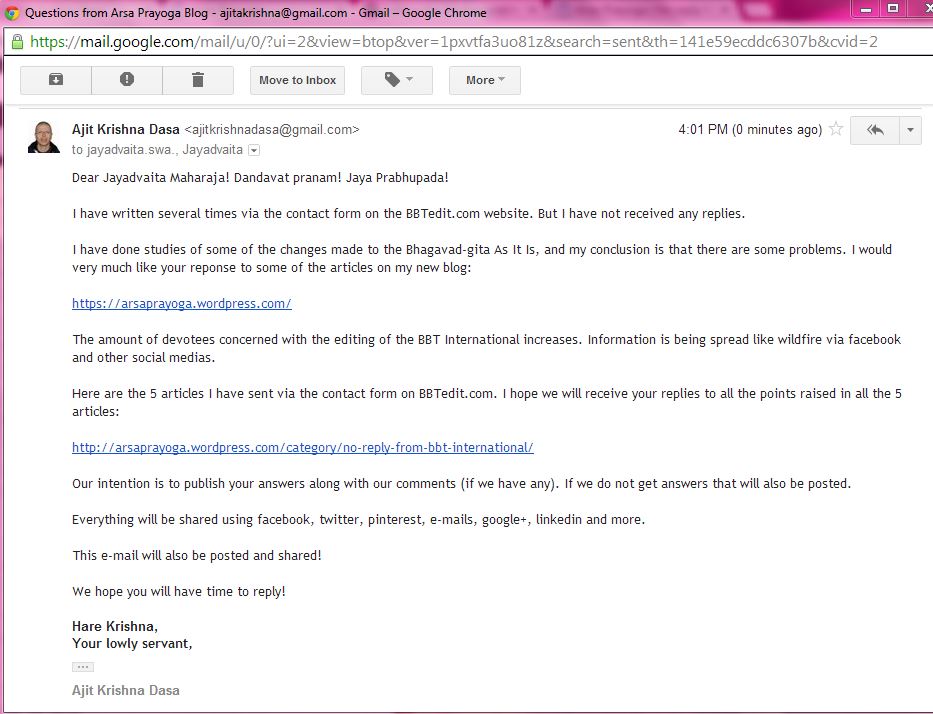
Letter to Jayadvaita Swami (23rd Oct. 2013)

letter-to-jayadvaita-swami-1Click to enlarge picture!

Dear Jayadvaita Maharaja! Dandavat pranam! Jaya Prabhupada!

I have written several times via the contact form on the BBTedit.com website. But I have not received any replies.

I have done studies of some of the changes made to the Bhagavad-gita As It Is, and my conclusion is that there are some problems. I would very much like your reponse to some of the articles on my new blog:

https://arsaprayoga.wordpress.com/

The amount of devotees concerned with the editing of the BBT International increases. Information is being spread like wildfire via facebook and other social medias.

Here are the 5 articles I have sent via the contact form on BBTedit.com. I hope we will receive your replies to all the points raised in all the 5 articles:

https://arsaprayoga.wordpress.com/category/no-reply-from-bbt-international/

Our intention is to publish your answers along with our comments (if we have any). If we do not get answers that will also be posted.

Everything will be shared using facebook, twitter, pinterest, e-mails, google+, linkedin and more.

This e-mail will also be posted and shared!

We hope you will have time to reply!

Hare Krishna
​Your lowly servant,
Ajit Krishna Dasa

“Phalanx” in Bg. 1.2 and Bg. 1.11 (Jayadvaita Swami’s double standard)

Help us by “sharing” and “liking” this post!

Back-To-Godhead-Jayadvaita-Swami

The text below was sent to the BBT International through their website (http://www.bbtedit.com/contact) and to Jayadvaita Swami and Dravida Prabhu’s personal e-mails (jswami@pamho.net, jayadvaita.swami@pamho.net, dravida108@gmail.com) the 7th Feb. 2014. We asked them to comment on the points raised.

So far we have not received any reply.

Regarding the word “Phalanx” in Bg. 1.2 Jayadvaita Swami writes on the BBT International’s website:

“In the old edition, the idea of a specific military formation (vyudham) is omitted.”

So we see that Jayadvaita Swami feels free to not only override Prabhupada’s editorial decisions regarding Bg. 1.2, namely to omit “military phalanx”, but also to unnecesarrily add the word “formation” instead of “phalanx” (Prabhupada often used the word phalanx. We find it many times in books like Bhagavad-gita, Krishna Book, Nectar of Devotion, Caitanya Caritamrta, and also in lectures, conversations, earlier essays and poems).

Jayadvaita Swami continues:

“In the new edition, I revised “phalanx” to “military formation” because a phalanx (originally) is a particular type of formation peculiar to ancient Greek warfare. Greek columns on the Battlefield of Kuruksetra didn’t seem right. Hence the revision.”

Then why did Jayadvaita Swami not remove the word “phalanx” from Bg. 1.11?

“All of you must now give full support to Grandfather Bhisma, as you stand at your respective strategic points of entrance into the phalanx of the army.” (Bg, 1.11, BBT International 1983 edition)

“Phalanx” is also found in the purports to Bg. 1.3 and Bg. 1.11 in BBT International’s 1983 edition.

Something doesn’t make sense!

In retrospect: “Phalanx” has come to refer to any military formation, so perhaps I should have been less picky. But at any rate, the new translation gets in the idea that the old one left out.”

So will Jayadvaita Swami again add the word phalanx to Bg. 1.2? Or will he remove it from Bg. 1.11 and add “formation”? Changing back and forth – again and again and again…ad infinitum?

Is that what Prabhupada expected from his editors? Is this how the world comes to respect Prabhupada’s books and ISKCON?

Not back to the “original manuscript” (Bg. 1.2)

Help us by “sharing” and “liking” this post!

This article was sent to the BBT International the 22nd Oct. 2013. We asked them to comment on the points raised. So far we have not received any reply.

Read these quotes carefully:

“As you know, and as we kept in mind while doing the work, Srila Prabhupada staunchly opposed needless changes.” (Jayadvaita Swami’s Letter to Amogha Lila 1986)

“Comparing each verse in the book with the text of the manuscript, I made only those changes that to me seemed worthwhile. I tried to be conservative and not make needless changes.”
(Jayadvaita’s letter to senior devotees, October 25, 1982)

From the so called “original manuscript”:

bg-1-2-manuscript

From the original and by Prabhupada approved/authorized 1972 edition of Prabhupada’s Bhagavad-gita As It Is:

bg-1-2-1972

From the BBT International’s 1983 posthumously edited Bhagavad-gita As It Is:

bg-1-2-1983

“PHALANX” – JAYADVAITA SWAMI’S DOUBLE STANDARD

Jayadvaita Swami attempts to justify his changes in this way:

“In the old edition, the idea of a specific military formation (vyudham) is omitted. In the new edition, I revised “phalanx” to “military formation” because a phalanx (originally) is a particular type of formation peculiar to ancient Greek warfare. Greek columns on the Battlefield of Kuruksetra didn’t seem right. Hence the revision. In retrospect: “Phalanx” has come to refer to any military formation, so perhaps I should have been less picky. But at any rate, the new translation gets in the idea that the old one left out.

We see that Jayadvaita Swami feels free to not only override Prabhupada’s editorial decisions regarding Bg. 1.2, namely to omit “military phalanx”, but also to unnecesarrily add the word “formation” instead of “phalanx” (a word Prabhupada often used).

Bg, 1.11 (BBT International 1983 edition):

“All of you must now give full support to Grandfather Bhisma, as you stand at your respective strategic points of entrance into the phalanx of the army.”

According to Jayadvaita Swami: in Bg. 1.2 “phalanx” didn’t seem right on Kuruksetra, because it’s a Greek word peculiar to ancient Greek warfare. But in Bg. 1.11 Jayadvaita Swami did not remove “phalanx”.

What are we to make of it?

Jayadvaita Swami admits that he might have been a little too “picky” regarding the word “phalanx”. This means he is not completely satisfied with his own work.  Maybe we will have a new edition of Bg. 1.2 in his next printing? And what about Bg. 1.11? Change-change back-change-change back? Is that what Prabhupada wanted?

Jayadvaita Swami said he tried not to make needless changes, but only those worthwhile. But which of the changes here are really worthwhile? Which are really needed? None of them! Bg. 1.2 is just fine the way it is in the original 1972 edition.

“BEGAN TO SPEAK”

Jayadvaita Swami continues:

“Srila Prabhupada typically said “began to speak” or “began to say” when the meaning is simply “spoke” or “said.” Such a phrase as “began to speak” is more apt when followed by something like “but was cut off” or “but changed his mind and fell silent.” In later books, the BBT editors routinely trimmed off the “began to.”

The expression “began to speak” is not wrong, and as we can see below Prabhupada did not object to it in Bg. 1.2, but re-confirmed it. Therefore the change is needless and not at all worthwhile. The editors might have trimmed the phrase off in other books, but these books were then approved by Prabhupada. Bg. 1.2 was approved with the phrase “began to speak”. Prabhupada did not approve the 1983 edition.

The shocking fact is that Jayadvaita Swami’s underlying technique is to attempt to mind-read Prabhupada after his physical disappearance and use his mind-reading “discoveries” about Prabhupada’s desires in relation to his books to change them posthumously. I don’t think even the devotees in favor of the changes have the fantasy to imagine that this is an editing methodology actively used by the BBT International.

The fallacy of going back to the so called original manuscript is covered here. But apart from that, what does it even mean to postulate that you are changing back to the manuscript, when there are so many instances where you concoct phrases that Prabhupada never used in relation to the verses under discussion?

Let us see how Prabhupada dealt with Bg. 1.2:

Pradyumna: (leads chanting, etc.)

sanjaya uvaca
drstva tu pandavanikam
vyudham duryodhanas tada
acaryam upasangamya
raja vacanam abravit
[Bg. 1.2]

Translation: “Sanjaya said: O King, after looking over the army gathered by the sons of Pandu, King Duryodhana went to his teacher and began to speak the following words:”

Prabhupada: So Dhrtarastra inquired from Sanjaya, kim akurvata: “After my sons and my brother’s sons assembled together for fighting, what did they do?”

Prabhupada continues without objecting to the words “began to speak. In fact a little later in the same lecture Prabhupada says:

“Raja vacanam abravit [Bg. 1.2]. Then he began to speak, to inform Dronacarya.”

(Bhagavad-gita 1.2-3, London, July 9, 1973)

So in this lecture Prabhupada heard the verse, and did not object to to words “gathered” and “began to speak”.  In fact he re-translated the words “raja vacanam abravit” to “began to speak” – the very same words he used in his draft (so called original manuscripts) and which he had approved in his 1972 edition of Bhagavad-gita As It Is.

From a room conversation:

Aksayananda: Acaryam upasangamya raja vacanam abravit [Bg. 1.2].
Prabhupada: Yes. What is the translation?
Aksayananda: “Sanjaya said, ‘Oh king after looking over the army gathered by the sons of Pandu, King Duryodhana went to his teacher and began to speak the following words.’ ”
Prabhupada: Aiye. [break] Caitanya Mahaprabhu’s mission is to preach. So you join us.

(Room Conversation on New York court case, November 2, 1976, Vrindavana)

Prabhupada continues speaking with no objection to the verse as it was read to him.

The comparison of Bg. 1.2 in the original 1972 edition and BBT Internationals 1983 posthumously edition version is an axample of everything Prabhupada’s editors should NOT do:

  • They changed what was approved by Prabhupada (namely “gathered” and “began to speak”)
  • They added what Prabhupada approved left out (namely “military”)
  • then added something Prabhupada didn’t write (namely “formation” instead of “phalanx” and “spoke” instead of “began to speak”).

Jayadvaita Swami is not at all being conservative in his editing. He is by nature an extreme liberal, since he feels free to rely on a New Age methodology, namely using his feelings and “intuition” to mind-read Prabhupada. Jayadvaita Swami is actively using this liberal New Age methodology to add, substract, concoct and change words in Prabhupada original and authorized books.

Jayadvaita undoes Prabhupada’s work on Gita Manuscript

Help us by “sharing” and “liking” this post!

By Madhudvisa Dasa in 2010 (originally posted on bookchanges.com)

ISKCON now distributes a Bhagavad-gita that contains more than 5,000 unauthorized changes. Srila Prabhupada gave all his classes from his original Bhagavad-gita As It Is and read from this book personally on a daily basis and listened to his disciples read from it, and commented on the philosophical points as they read. With the exception of a couple of obvious typographical errors, Prabhupada never at any point of time ordered that his Bhagavad-gita be changed. He most certainly did not authorize the production of a revised and enlarged edition of his book.

Jayadvaita Swami agrees that Srila Prabhupada did not ask him or anyone else to “revise and enlarge” his Bhagavad-gita As It Is. So how did it happen? Where did the authority come from for ISKCON’s current “Revised and Enlarged” edition? It seems just after Srila Prabhupada left our material vision, Jayadvaita thought it was a good idea to revise and enlarge Prabhupada’s Gita, so he did it.

“Comparing each verse in the book with the text of the manuscript, I made only those changes that to me seemed worthwhile. I tried to be conservative and not make needless changes.”
(Jayadvaita’s letter to senior devotees, October 25, 1982)

And what is his “authority” for this you may ask? As he said in the letter to senior devotees, “the text of the manuscript.” “I have made it closer to the original manuscript.”

And what is this so-called “original manuscript”? You can see it here.

This is not a manuscript at all. It is the first draft of the book. No author intends that the first draft of his book be published. He appoints an editor and together they work on the book to produce the manuscript which will ultimately be submitted to the publishers. In this case,  Prabhupada wrote the first draft and then worked with Hayagriva and other editors to prepare the manuscript for hisBhagavad-gita As It Is, which was ultimately presented to Macmillan & Co. for printing.

Imagine you write the first draft of a book and appoint an editor. You work with your editor on a daily basis for months until together you produce a manuscript you are happy with and your book is published. Your book becomes a worldwide best seller and you are very happy with it. It is a spiritual book and by reading it many of the readers have life-changing experiences. They also become very attached to your book. Your book is praised by scholars worldwide with rave reviews. Then many years later, after you have left your body, somebody finds the first draft of your book and decides to “correct” your published book based on your first draft. Of course you were never intending to publish this first draft. That is why you spent so much time and energy working with your editor on that first draft to transform it into a manuscript you actually wanted to present to the publishers. How angry would you be with this fool who wants to undo your work and your editors’ work by going back to the first draft?

Jayadvaita Swami, by going back to the first draft, is eliminating so many corrections and so much work that Srila Prabhupada personally did on his book with Hayagriva and his other editors. This is a great disservice to Srila Prabhupada.

The Swami is insisting that his version of the history of the editing of Srila Prabhupada’s Bhagavad-gita As It Is is correct. And what is his version of the history? He has turned to “smoke and mirrors” to try and bewilder the devotees into believing a false history. In the “history according to Jayadvaita’s imagination”, Srila Prabhupada only typed and dictated the first draft of his Bhagavad-gita As It Is and handed it over to his editors and did not work with his editors on the book. In this way he claims the first draft that he has is authoritative and he is justified in changing the printed book if he can find something different in the first draft.

On his website he debunks “The myth that Srila Prabhupada and Hayagriva together carefully reviewed the completed text of Bhagavad-gita As It Is“. He does this by debunking a statement by Govinda dasi, who saw Srila Prabhupada and Hayagriva working together on editing Prabhupada’s books in 1968 in Los Angeles. Prabhupada and Hayagriva were actually working together on editingSrimad-Bhagavatam at that time. And according to Jayadvaita, that “proves” that Prabhupada and Hayagriva did not work together on editing the Gita. Strange logic, but we are expected to believe the Swami anyhow.

In a recent blog post [“Book Changes: History Really Does Back the BBT“] Jayadvaita continues to try and distort and change the history:

“And so the image of Srila Prabhupada sitting with Hayagriva in December of 1968 carefully going over every verse of Bhagavad-gita As It Is, seeing to the finishing touches, is a persistent image of something that never took place. That’s the truth. Here’s the timeline. See for yourself.” (Jayadvaita Swami)

Then he goes on to present many quotes from Srila Prabhupada that are supposed to prove that Srila Prabhupada did not work with his editors on the Bhagavad-gita As It Is at all. However, Krishna slipped one quote into his article that completely blows his cover:

December 14, 1967: Srila Prabhupada writes Rayarama, “I have already sent you the purports of each and every sloka that you sent me for correction. . . . As soon as you finish the Gitopanisadbusiness and the matter is handed over to the Macmillan Co. we begin on the Bhagavatam work without delay.”

Here Jayadvaita is letting us know that Rayarama, while he was editing Bhagavad-gita, was in constant contact with Srila Prabhupada and was asking many questions about the editing, which Srila Prabhupada was answering. “I have already sent you the purports of each and every sloka that you sent me for correction.” So even with Rayarama’s editing he was asking Prabhupada many questions and Prabhupada was sending him many corrections to his “first draft”. None of these corrections by Srila Prabhupada are present in what Jayadvaita refers to as “the original manuscript.” This alone completely destroys any justification for using this document as any sort of authority, as it does not include the many corrections that Srila Prabhupada made to it while Rayarama was working on editing his Bhagavad-gita.

The real world is quite different from Jayadvaita’s imaginary world. Even though the Swami constantly says, “It’s not true!” Srila Prabhupada and Hayagriva did work together for almost three months in 1967 editing Bhagavad-gita As It Is, during this period Hayagriva Prabhu was consulting Srila Prabhupada daily on almost every verse in the Bhagavad-gita As It Is. It’s not a myth, it’s history, and this history completely destroys any justification at all for changing Prabhupada’s Gita based on Prabhupada’s first draft of the book (or the “original manuscript”, as the Swami calls it).

If you ask Jayadvaita about this he will lie and tell you: “It could not have happened. Prabhupada and Hayagriva were never living together. It’s an Internet myth…” All lies and deception, unfortunately. It is frightening to think that such a deceptive, dishonest character has been given full authority to change anything at all he wants to change in Prabhupada’s books without any system of checks and balances at all. He can change anything, print the changed books without even disclosing what he has changed. And he smiles and says, “You just have to accept it…”

The proof that Srila Prabhupada and Hayagriva worked together daily editing Bhagavad-gita for almost three months in 1967 can be found in Hayagriva Prabhu’s wonderful book, “The Hare Krishna Explosion”:

The_Hare_Krishna_Explosion-cover

January 17, 1967: Prabhupada arrives in San Francisco from New York. Hayagriva Prabhu is there to meet him. Prabhupada is still translating Bhagavad-gita and Hayagriva is there with him:

“Swamiji continues translating Bhagavad-gita. He is so eager to print it that we begin negotiations with a local printer. Prices are very high. In New York, Brahmananda continues his pursuit of publishers.”

So Hayagriva is negotiating on Srila Prabhupada’s behalf with a local printer to print Prabhupada’sBhagavad-gita As It Is. Finishing his translation of Bhagavad-gita As It Is, working with Hayagriva Prabhu to edit it and getting it printed are clearly the most important projects on Srila Prabhupada’s agenda at this time.

Hayagriva is still in San Francisco on January 29th, two weeks later, for the big concert featuring the Grateful Dead.

Hayagriva is still with Srila Prabhupada in San Francisco in February:

“The days of February are beautiful with perfect temperatures in the seventies, fog rolling off early, skies very blue and clear, sun falling bright and sharp on the lush foliage of Golden Gate Park. The park encloses the largest variety of plant and tree life to be found in any one spot on earth. We are at a loss to identify plants for Swamiji.”

Hayagriva has settled down in the ISKCON San Francisco temple (a storefront near Golden Gate Park) and he is working there:

“I rent an electric typewriter, set it up in the back temple room, and continue typing up stencils forBack To Godhead, writing and editing [Bhagavad-gita] while Harsharani sends people after food, and cooks noon prasadam.”

Hayagriva is the only devotee living in the San Francisco temple and is the “Temple Commander”:

“Being the only person living in the temple proper, and one of the senior devotees besides, I’m naturally looked to as the temple commander, a role I often find myself regretting.”

All this time Hayagriva is living with Srila Prabhupada and his main service is editing Bhagavad-gita:

“Apart from kirtans, I find myself spending many sunny hours in the park, walking past the tennis courts to large, quiet bowers surrounded with hybiscus and eucalyptus. And at times I sit in the shade beneath the white and pink rhododendrons and edit Bhagavad-gita. After editing, I sometimes visit the museum and stroll through the replica eighteenth century gardens, chanting my daily rounds while perusing the curlicues of rococo art.”

Hayagriva is still in San Francisco together with Srila Prabhupada on February 27th. This is now six weeks in the personal association of Srila Prabhupada, working with him editing his Bhagavad-gita As It Is.

He is still there with Srila Prabhupada in March:

“Golden Gate Park is redolent with March flowers. The morning fog disperses early, and the days are cloudless and blue. Thousands continue to flock to San Francisco from the midwest and east, and our Sunday kirtans attract big crowds… On Tuesday evenings, we go to the beach with Swamiji and hold unforgettable Pacific Ocean sunset kirtans. Sitting on the sand, we watch the tide roll in, or chant and wait for the sun to dip below the horizon. After chanting, we roast potatoes and smear them with melted butter. Swamiji eats with us, sitting on a big log. And after potatoes, we roast marshmallows, and red apples stuffed with raisins and brown sugar.”

All throughout this time (now over two months) Hayagriva is working editing Prabhupada’s Bhagavad-gita As It Is, consulting Srila Prabhupada on almost every verse:

“Although I write on the Lord Chaitanya play through the spring days, my primary service is helping Swamiji with Bhagavad-gita. He continues translating, hurrying to complete the manuscript but still annotating each verse thoroughly in his purports. Daily, I consult him to make certain that the translation of each verse precisely coincides with the meaning he wants to relate. “Edit for force and clarity,” he tells me. “By Krishna’s grace, you are a qualified English professor. You know how grammatical mistakes will discredit us with scholars. I want them to appreciate this Bhagavad-gita as the definitive edition. All the others try to take credit away from Krishna.”

“I am swamped with editing. Since much of the text is equivocal due to grammar, I find myself consulting Swamiji on nearly every verse. It seems that in Sanskrit, Hindi, and Bengali, phrase is tacked onto phrase until the original subject is lost.”

March 21: Hayagriva is still in San Francisco working daily with Srila Prabhupada on editingBhagavad-gita As It Is… So far this is almost nine weeks constantly with Srila Prabhupada…

April 9:

“Swamiji leaves for the airport. Before entering the car, he stops, cane in hand, and gives a long look at the little storefront temple. It is a look that says a great deal. Gurudas snaps a photo at that very instant. ‘That’s a farewell look,’ I think to myself.”

So Srila Prabhupada and Hayagriva worked together on editing the Bhagavad-gita daily during the almost three months while Hayagriva Prabhu was living with him in the San Francisco temple, from Janurary 17, 1967 until April 9, 1967.

Jayadvaita Swami [desperately]: “IT JUST DID NOT HAPPEN!!!”

The history is the history. Srila Prabhupada worked on the first draft of Bhagavad-gita As It Isextensively with both Hayagriva Prabhu and Rayarama Prabhu. In the three months Hayagriva went through practically every verse with Srila Prabhupada and Prabhupada also sent many corrections to Rayarama Prabhu later on.

At that time Macmillan were only able to print 400 pages, so Rayarama abridged Prabhupada’sBhagavad-gita As It Is. Prabhupada was not happy with this and wanted to publish the complete edition. Hayagriva was again called on by Srila Prabhupada for producing the manuscript, which was submitted to Macmillan for the publication of the complete 1,000 page edition in 1972. At this time there were at least exchanges of letters between Srila Prabhupada and Hayagriva and Prabhupada was still giving him many instructions related to the editing and answering the questions he had in regard to the editing.

So Jayadvaita’s “history” that Srila Prabhupada did not work with his disciples on editing Bhagavad-gita is nothing more than smoke and mirrors. It is a dishonest attempt to mislead the devotees and cover-up the real history.

The authoritative edition of Srila Prabhupada’s Bhagavad-gita As It Is is the final published 1972 “Complete Edition.” Not the first draft that Jayadvaita calls the “manuscript.” Srila Prabhupada spent considerable time, energy and effort working with his editors Hayagriva Prabhu and Rayarama Prabhu to take his first draft to the real manuscript — the manuscript which was submitted for publishing to MacMillan.

Changes to the final published book cannot be justified by referring to the first draft. This is a great mistake.

People are not so foolish. The truth is the truth. Eventually Jayadvaita’s smoke and mirrors will stop working and the blind followers will wake up and see the truth.

Chant Hare Krishna and be happy!

Your servant,
Madhudvisa dasa