A Letter on Book Changes

Help us by “liking” and “sharing” this post!

govinda-dasi

By Govinda Dasi (ACBSP)

Srila Prabhupada often said “Krishna has written these books.” So tell me, how can a conditioned soul improve on what Krishna has said or written??

Dear Yashoda Dulal Prabhu,

Pamho. Yes, the BBT always gives that one worn-out example of cattle, and of course the other one, planet of the trees. Yes, those are typos, mistakes. They fail to mention the other four thousand and nine hundred and ninety eight changes they made!

And had these two errors been corrected, along with any misspelled words, etc. there would have been no cause for alarm–or for a million dollar lawsuit with bbt defending the edited version–one which they lost in the courts. That court case is the only reason that now the world has an option to read Prabhupada’s original words. But the 5000 changes that were made, and changing the “writer’s voice” was unwarranted and factually criminal.

In a meeting at Honolulu temple some years back, Jayadvaita M. actually stated, “Oh, those (original) books were horrible!” Those “horrible” original books, filled with Srila Prabhupada’s divine mercy, made thousands of devotees in the ’70s. More books were distributed then than now.

It seems you believe the propaganda that Hayagriva was never around Prabhupada much, and there were many editors etc. What can I say? This is simply not true. I knew Hayagriva from the time I joined Prabhupada in San Francisco, January of 1967. Hayagriva was there, and was already editing the Gita, and spending hours every day with Srila Prabhupada going over every verse!

And later, just before the first Gita was printed, in late 1968, Hayagriva LIVED with us in Los Angeles. (I was Prabhupada’s secretary for the whole year of 1968 and part of 1969) Daily they would spend hours in Prabhupada’s room, going over every inch of the final edits. I am an eye witness to this.

At this time, I even did the cover drawing for the first MacMillan Gita (the purple one) with Prabhupada guiding me, literally over my shoulder, watching the drawing develop. The purple Gita cut out a lot of that meticulous work done by Srila Prabhupada and Hayagriva; Macmillan wanted to save money, to make it smaller. So they greatly edited Prabhupada’s manuscript, and he was unhappy with it, but accepted it as “a blind uncle.”

But at his first opportunity, he printed his manuscript in total, the Original Gita, the one with Jadurany’s reddish battlefield painting on the cover. Srila Prabhupada was extremely happy with that Gita–he finally got his carefully nurtured manuscript into print! He was overjoyed!

The “Edited Edition”, with the blue battlefield cover, done by Parikshit das, with Krishna carrying a whip rather than his Panchajanya (conch) as directed by Srila Prabhupada, was done AFTER Srila Prabhupada’s departure from this world. Both the editing and the cover were done after his departure, yet they inserted his preface and signature of 1971–as if, with 5000 changes, it was the same book! How unethical!

Most of Prabhupada’s disciples did not even know this editing mischief was going on; they were grieving the loss of Srila Prabhupada from this world. Only later, when the dust had settled, did many of us learn of this travesty.

So I really do know what happened in those days. I even met with MacMillan in New York prior to the printing.

Jayadvaita M. had not even become a devotee in early 1967, so how would he know?? He says many things that are not in keeping with what really happened, since he was not there; perhaps he is relying on hearsay, I don’t know. Neither was Jayadvaita M. in Los Angeles in late 1968 when Hayagriva lived with us for weeks on end, completing the editing work.

Most of what the bbt says in this regard is based on fairy tales, hearsay, and perhaps some personal ambition as well. I do not know how they can skew things in this way and still sleep at night.

But what I do know is that Srila Prabhupada wanted NO FURTHER CHANGES TO HIS BOOKS. HE EXPRESSED THIS ON MANY OCCASIONS. A little research can easily prove this point.

Arsha-Prayoga Part III – The Case Against Changing Prabhupada’s Books

Help us by “liking” and “sharing” this post!

sp-sitting-books

By Locanananda Dasa  (originally posted on his blog)

While planning to print the unabridged version of the Bhagavad-gita, Srila Prabhupada often referred to it as the revised and enlarged edition. When the BBT published its unauthorized adulterated Gita years later, they would henceforward refer to the 1972 printing as the original edition while calling theirs the revised and enlarged edition. This appears to be a subtle act of deception meant to validate the irreverent practice of changing Srila Prabhupada’s Books.

Continue reading

Arsha Prayoga Part II

Help us by “liking” and “sharing” this post!

srila-prabhupada-reading-his-own-books

By Locanananda Dasa (originally posted on his blog)

Srila Prabhupada’s desire was to see his books translated into all of the major languages of the world. By 1970, numerous centers had opened in countries outside of the United States and translation work had begun in Germany, France, Canada, South America and Japan. When the German devotees undertook the translation of the Srimad Bhagavatam, they discovered what they thought were grammatical discrepancies in the original English. The translators reasoned that if their spiritual master could publish his books with flaws included, then their own translation work could also contain mistakes and no harm would be done. In a very strongly-worded letter, Srila Prabhupada chastised his disciples for thinking they could imitate their spiritual master and explained that to avoid this offense, they must follow the principle of arsha prayoga.

One should not see mistakes in the books written by his spiritual master, nor should one think he is able take the same liberties taken by him. His Divine Grace warned his disciples that only if they were able to spread Krishna consciousness all over the world as he had done could discrepancies in their translation work be overlooked, otherwise not.

“So far your telling me that some devotees consider that because there may be some grammatical discrepancies in my Srimad Bhagavatam, First Canto, then they may also be allowed to translate with errors accepted, that is just like imitating Raslila. When you do all other things like Krishna, then you can do Raslila. So if these other writers can do like me and spread Krishna consciousness all over the world by becoming big Vedic scholars, then they can do.

“If one is too big, there is no mistake. Arsha prayoga means there may be discrepancies but it is all right. Just like Shakespeare, sometimes there are odd usages of language, but he is accepted as authority. I have explained all these things in my preface to First Canto.” (Letter to Mandali Bhadra dated 1-20-72 )

Srila Prabhupada wrote, “If one is too big, there is no mistake,” so when the BBT [Bhaktivedanta Book Trust International, Inc.—not the authentic Bhaktivedanta Book Trust established by Srila Prabhupada] decided that his books were full of mistakes and had to be re-edited, they made Srila Prabhupada look very small, and that is their great offense.

Sometimes, the editors try to justify their actions by claiming that scholars would have found fault in our books had they not been revised. The many, many letters Srila Prabhupada received from world-renowned scholars that glorified his phenomenal literary output contradict this false propaganda. The academic community was astounded by the magnitude of his undertaking and showed its appreciation for the exactness with which he translated and the profound devotion he expressed in his Bhaktivedanta purports. We have chosen one such letter which exemplifies to what extent Srila Prabhupada’s extraordinary efforts were acknowledged by the educated class of men. We advise the reader to keep in mind that these comments refer to the original BBT printing of his books.

Excerpted from a letter written by Sri R. Subrahmanyam, M.A., Deputy Research Director of the National Parliament of the Central Government of India:

“To teach this science of God to people everywhere and to aid them in their progress and development towards the real goal of life, Srimad Bhagavatam is most eminently fitted. In fact, this great ancient work of Vyasa will fill this need of the modern times, for it is a cultural presentation for the re-spiritualization of the entire human society. His Divine Grace, Srila A.C. Bhaktivedanta Swami Prabhupada, the founder-acarya of the ISKCON movement, has taken upon himself, in addition to his ceaseless travels and other multifarious activities in the service of the Lord, the stupendous task of translating this Sanskrit work into English in about sixty volumes for the welfare and happiness of mankind.

“So far, eighteen volumes of this most beautiful literature on God have been brought out by ISKCON, and the rest are under preparation. Needless to say that in keeping with the excellence of their other publications, the publishers have seen to it that the printing, get-up, and pictures in these volumes are also of the highest quality, as though to serve as an ornament to the divine contents of the books.

“This is a rare opportunity for people and leaders of every country, race and community in the world to know and understand the glorious science of God and work for their perfection.”

We challenge the BBT managers and their editors to produce a single letter from any recognized scholar agreeing with them that Srila Prabhupada’s original books were full of mistakes and had to be revised for his message to be properly understood. Since their purpose in making these revisions was to impress scholars, we hereby challenge them to come forward and produce evidence that there are indeed scholars who approve of the thousands of changes they made to Srila Prabhupada’s books.

Another argument presented to support the BBT’s questionable editorial policy was that their editors, by dint of their many additional years of experience, had become more qualified than Srila Prabhupada’s earlier staff of editors, and this had supposedly earned them the right to review all of the books after Srila Prabhupada’s disappearance and make whatever changes they thought were necessary. In the late 1960′s, Hayagriva had similarly offered to redo some of Rayarama’s editorial work, thinking himself more academically qualified than his godbrother, but Srila Prabhupada did not approve of his proposal. Although Hayagriva was an accomplished professor of English at Ohio State University, contrary to his opinion (and that of today’s BBT managers), Srila Prabhupada affirmed that academic credentials are not the primary qualification to edit transcendental literature. In his reply to Hayagriva, he wrote:

“Rayarama may not be as qualified as you are, but his one qualification that he is fully surrendered to Krishna and his spiritual master is the first class recommendation for his editing any one of our literatures, because editing of Vedic literatures not depend on academic education.” (Letter to Hayagriva dated 1-15-68 )

It is evident from his letter that Srila Prabhupada considered his early editors to be fully competent because they were depending upon Krishna and the spiritual master to give them the ability to perform their service. His Divine Grace was very satisfied with the quality of their work and, to show his appreciation, he later wrote to Hayagriva, “I want your company always for editing my writings very nicely.” As far as we have been able to ascertain, he never contemplated having anyone redo the work of his editors.

It is also a fact that Srila Prabhupada’s involvement in the preparation of his books went far beyond his original dictation, although the BBT’s propaganda would lead one to believe that his participation ended there. The truth is that in order to guarantee a very high standard of presentation, Srila Prabhupada personally supervised all proofreading and editorial work and did not allow any significant changes to be made in the text of his books without his approval. It is customary that once a writer accepts an edited draft of his book, it immediately supersedes an unedited draft. When the BBT editors decided to work again from Srila Prabhupada’s original manuscripts, they were, in effect, rejecting the proofreading and editorial work that Srila Prabhupada himself had overseen. This is not how one shows appreciation for the spiritual master’s endeavor to publish his books, or for the service offered to him by others.

Arsa-Prayoga Blog on Twitter

Please help us by “liking” and “sharing”!

You can now follow us on Twitter!

twitter-logo

Arsa-Prayoga Blog

BBTI MYTH: Hayagriva’s memory failed him

By Ajit Krishna Dasa

Did Hayagriva Prabhu’s memory fail him when he said that he was working closely with Srila Prabhupada in the spring of 1967?

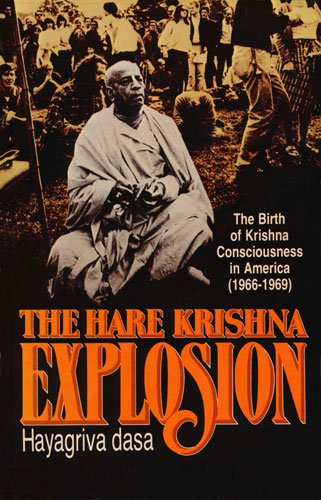
Fra Hayagriva Dasa’s The Hare Krishna Explosion:

“Daily, I consult him [Prabhupada] to make certain that the translation of each verse precisely coincides with the meaning he wants to relate.”

The_Hare_Krishna_Explosion-cover

On BBT International’s website it is stated:

“Hayagriva does speak of consulting Srila Prabhupada “daily” throughout the spring of ’67. But Hayagriva’s memory must have been tricking him: In the time he speaks of, he was in San Francisco, Srila Prabhupada in New York.“

How did Jayadvaita Swami reach this particular conclusion? No matter how I analyze the situation, I reach the conclusion that Hayagriva’s explanation holds true.  I could be wrong, so if anyone has some input, I am all ears.

Let’s look at history :

We know that Prabhupada was in San Fransisco where Hayagriva was also from 19th of January 1967 until April 9th 1967. This can be seen by looking at Prabhupada’s letters. Hayagriva wrote in his book The Hare Krishna Explosion that Prabhupada arrived in San Francisco the 19th of January 1967, and that is also precisely the day when the first letter from Prabhupada is sent from San Fransisco. Hayagriva also wrote that Prabhupada took off from San Francisco April 9th, and the last letter Prabhupada sent from San Fransisco is sent 7th of April. The first letter he sent from New York, where he left to from San Fransisco, was sent 10th of April.

Regarding spring, a short search on the internet shows that spring in San Francisco lies in the months of March, April and May. From Hayagriva’s book we know that the period in which he was very busy editing the Bhagavad-gita As It Is under Prabhupada’s personal supervision, and where he consults Prabhupada daily about the verses to ensure that they accurately convey what Prabhupada wants, took place between March 1st and March 21st 1967.

So there are no inconsistencies in Hayagriva’s memory when he says that he and Prabhupada cooperated in the spring of 1967. Nor is there anything at all hindering that this cooperation took place throughout the complete period of time when Prabhupada was in San Fransisco which is 82 days. Taking Prabhupada’s eagerness to send the Bhagavad-gita As It Is to the press, it would not at all be unimaginable that he was very involved in the editing of the book in these 82 days. Actually, who can believe anything else? One can do a lot of work in 82 days. Especially when you only need 2-4 hours of sleep every night.

Who knows the details of what was going on there? No one really knows the precise extend to which Prabhupada was involved in the process of editing. But in one period he was, according to his cheif editor Hayagriva Dasa, daily consulted with nearly every verse to make certain that the translation precisely coincided with the meaning he wanted to relate. Therefore the thousands of changes done by the BBT International to the verses and purports of the 1972 edition are for the most part based only on guesswork.

This is clearly an unsafe, irresponsible and unacceptable editing protocol.

If my calculation are correct – and I think they are – then the BBT International and Jayadvaita Swami ought to either correct or remove their mistaken calculation from their respective websites. If I am wrong, then I would like to see my calculation countered by another analysis done by the BBT International and/or Jayadvaita Swami.

Will they do any of these things? Or will they just let their analysis stay on their websites, even if they are wrong? Time will tell.

Is Jayadvaita Swami still good?

Help us by “liking” and “sharing” this post!

By Ajit Krishna Dasa

BBT International and their supporters often attempt to justify the changes made to Prabhupada books by Jayadvaita Swami by pointing out that Prabhupada a couple if times spoke highly of his editing work.

This article will show that these statements by Prabhupada can’t be construed to mean that Jayadvaita Swami editing work after Prabhupada’s disappearance is pleasing to Prabhupada.

From BBT International’s website:

“Of course, regarding Jayadvaita Swami, the BBT’s chief editor, Srila Prabhupada wrote, “Concerning the editing of Jayadvaita Prabhu, whatever he does is approved by me. I have confidence in him.” (letter to Radhavallabha, 7 September 1976)

BBT International and their supporters often speak about this quote from Prabhupada as if it was some kind of blessing from Prabhupada that makes Jayadvaita Swami and his editing infallible even to this very day. This, of course, makes no sense and even Jayadvaita Swami himself admits that he sometimes commits mistakes in his editing. One example of this is his changing “Visnu Form” into the “Visnu platform”:

visnu-platform

(Click to enlarge picture)

So it’s obvious that we can’t take the statement “…whatever he does is approved by me” too literal. In order to be continuously approved by Prabhupada Jayadvaita Swami need to continuously meet certain criteria set forth by Prabhupada and sastra in regard to editing protocol. If it can be argued in any way that the editing policy of BBT International compromises the transcendental potency of Prabhupada’s books, or if Jayadvaita Swami becomes an atheist or a mayavadi or falls down and or if he somehow goes against the direct instructions of Prabhupada in his editing proces, then we must conclude that his editing is unauthorized and must be stopped. He can then no longer be “approved”.

This blog and several other websites have for years been showing that there is no evidence to support even the slightest change in Prabhupada’s books. It has been shown how Jayadvaita Swami does not at all perform his editing work according to the accepted protocol set forth by Prabhupada (“NO CHANGES”), sastra (arsa-prayoga) and even academic scholars. We have shown how he is actually sabotaging the books – however well-intentioned he may be.

So even though Prabhupada spoke highly of Jayadvaita Swami’s editing 40 years ago it does not make Jayadvaita Swami infallible, and it does not mean that he can just do whatever he likes to Prabhupada books.

The other quote that BBT International and their supporter often refer to is this:

From BBT International’s website:

“And in the conversation where Srila Prabhupada complained so strongly about “rascals editors,” Srila Prabhupada said about Jayadvaita, “He is good.””

So 40 years ago Prabhupada said about Jayadvaita Swami that he was “good”. Does it then follow logically or experientally that he is still “good”? Obviously not! There are several examples of Prabhupada at one point praising some of his disciple, and then at a later point criticized them severely.

Prahlada-Nrsimha Prabhu has written a very nice article about this (published on bookchanges.com):

Just because Srila Prabhupada at one point said someone was a good man, does that mean that they are one now? Srila Prabhupada liked many devotees at one point and at that point put them in positions of power and authority and praised them, but later on down the road he changed his opinion about them and/or they went astray or deviated to one degree or another. So although at one point Prabhupada approved of someone and complimented them, that does not mean that from that point on they are bona-fide no matter what they do. Here are a few examples to further examine this point.

One Prabhupada disciple did HUGE service for Prabhupada, pushing on the book distribution mission (probably) more than any other Prabhupada disciple in ISKCON’s history, and was pretty much running ISKCON at one point. But later he changed the basic rules of the four regulative principles to three. Does that mean because he had so many thousands of disciples, and at one point was so dear to Srila Prabhupada that Prabhupada even commented on how he was so intelligent and empowered, that now we should all only have three regulative principles instead of four and continue to follow this devotee?

There were so many big, big devotees that Srila Prabhupada personally gave sannyasa to but later on Srila Prabhupada became so fed up with their deviations that he said that they should give up those positions as sannyasi! Srila Prabhupada even said “This should be strictly outlawed, no more sannyasis….there will be no sannyasi anymore.”

(Room Conversation — January 7, 1977, Bombay)

Srila Prabhupada established the GBC as the ultimate managing authority for all ISKCON. But at one point Srila Prabhupada totally disbanded the whole of the GBC within ISKCON due to their deviations! So simply because at one point in time Srila Prabhupada appointed them to power and trusted them, does that give them permanent power? No! At any time anyone can lose their position and power and deviate or go astray and at that point one is no longer authorized and empowered.

I feel the most relevant example is from the concluding words of the Sri Caitanya-caritamrta, dated November 10, 1974

“Now, by the grace of Sri Caitanya Mahaprabhu and his Divine Grace Bhaktisiddhanta Sarasvati Thakura, it is finished. In this connection I have to thank my American disciples, especially Sriman Pradyumna dasa Adhikari, Sriman Nitai dasa Adhikari, Sriman Jayadvaita dasa Brahmacari and many other boys and girls who are sincerely helping me in writing, editing and publishing all these literatures.”

But then on February 27, 1977 in Mayapura India Srila Prabhupada says “Nitai, he’s a rascal.”

Unfortunately there are so many examples I could mention, but in order to not depress/and embarrass all of us unnecessarily in this article I will stop here.

In conclusion, we have shown how the above two claims by the BBT International about Jayadvaita Swami being “good” and his work being “approved” by Prabhupada can’t be used to justify the changes he has made to Prabhupada’s books. And that they can’t be used as a guarantee that Jayadvaita Swami has not comitted mistakes himself or that he has pleased Prabhupada by his work.

“Rascal Editors” (Prabhupada Conversations, June 22, 1977, Vrindavana)

Help us by “liking” and “sharing” this post!

Read the complete conversation here.

Original and authorized 1969 Sri Isopanisad (audio book)

Help us by “liking” and “sharing” this post!

Prabhupada became extremely concerned when he was informed that his own BBT had changed his Sri Isopanisad and he wanted it published again “the original way”. However, this instruction was never followed.

But here is the original version in audio and as ebook for FREE from krishnapath.org:

Sri_Isopanisad_original

FREE ORIGINAL AND AUTHORIZED SRI ISOPANISAD AUDIO AND EBOOK

“The next printing should be again to the original way.”

Yasoda-nandana: Sometimes they appeal that “We can make better English,” so they change like that, just like in the case of Isopanisad. There are over a hundred changes. So where is the need? Your words are sufficient. The potency is there. When they change, it is something else.

Svarupa Damodara: That’s actually a very dangerous mentality.

Yasoda-nandana: What is it going to be in five years? It’s going to be a different book.

Prabhupada: So you… What you are going… It is very serious situation. You write one letter that “Why you have made so many changes?” And whom to write? Who will care? All rascals are there. Write to Satsvarupa that “This is the position. They are doing anything and everything at their whim. The next printing should be again to the original way.”

(S.P. Conversation, “Rascal Editors,”June 22, 1977, Vrndavana)

Lord Ramacandra removed from Bhagavad-gita, As It Is (10.31 purport)

Help us by “liking” and “sharing” this post!

This article was sent to the BBT International the 17th Oct. 2013. We asked them to comment on the points raised. So far we have not received any reply.

By Ajit Krishna Dasa
rama-nama

Changes have been made to the purport of verse 10.31 in Prabhupada’s Bhagavad-gita:

Here is a complete comparison of BG. 10.31 in Prabhupada’s 1972-edition and BBT International’s 1983 edition:

Continue reading

Arsha Prayoga And Shakespeare (I)

Help us by “liking” and “sharing” this post!

By Locanananda Dasa (originally posted on his blog)

shakespear

The question as to whether the writings of the acarya may or may not be revised by his disciples after his disappearance is answered by the rule of “arsa prayoga”.

This principle states that one should not see mistakes in what the spiritual master has written or think that his writings may be changed to make them more effective or politically correct. To preserve his teachings in their originally published form is the way by which the acarya is honored, and to do otherwise is to dishonor him. That is the rule of “arsa prayoga”, a principle that devoted followers of a bona fide spiritual master must adhere to without deviation.

The rationale for changing Srila Prabhupada’s books was based on a series of false arguments, many of which were defeated by Srila Prabhupada himself, as this article will show. To justify their actions, the BBT editors created the illusion that Srila Prabhupada’s books were defective and in need of extensive editing even though they knew His Divine Grace had never authorized anyone to revise his books after his disappearance. Subsequent to his departure, they conveniently overlooked the principle of “arsa prayoga” and proceeded to do exactly what vaisnava tradition strictly prohibits.

It was by the distribution of transcendental literature that Srila Prabhupada hoped to introduce Krishna consciousness to people everywhere. For those who saw the movement spread from city to city and from country to country, it was clear that the original version of Srila Prabhupada’s books was full of spiritual potency and did not require to be changed in any way for his words to act upon the hearts of the conditioned souls. Srila Prabhupada himself never doubted that his books would bring about a revolution in consciousness and induce people throughout the world to take shelter of the Supreme Personality of Godhead. His transcendental vision was revealed in the following letters, all of which refer to the original version of his books.

“I am glad to learn that you are having nice success in placing my books in the libraries and in schools and colleges…. I am sure that this will revolutionize the thinking of the thoughtful men of your country as well as the students and professors, and the ultimate end will be to save the world from the clutches of material illusory activities which is now causing havoc everywhere.” (Letter to Karandhara dated 9-13-70)

“If we introduce these books in all of the bookstores, schools, colleges, libraries and everyone’s home, our religion will be the only religion in the world very soon.” (Letter to Krishna Bamini dated 1-4-72)

“We have got a great mission to fulfill, and these books and magazines are the torchbearers of Truth which can save the world.” (Letter to Ksirodakasayi dated 1-3-72)

Srila Prabhupada’s books, then, should be thought of as a permanent legacy meant to be shared and enjoyed by generations of devotees everywhere. His purpose in writing was to reestablish religious principles and, ultimately, to revive every conditioned soul’s dormant love of God. These transcendental literatures were Srila Prabhupada’s gift to the world and proof of his empowerment by Krishna. Judging from the statements made above, His Divine Grace seemed totally convinced that the books he had published, if distributed widely enough, would deliver the entire world from the darkness of ignorance. Therefore, there was no reason to believe that, to fulfill his mission, his books would have to undergo another round of editing, what to speak of the complete overhaul concocted by the BBT editors.

Our guideline in Krishna consciousness is that the only duty of the disciple is to faithfully execute the order of the bona fide spiritual master. If a disagreement arises over how to best serve the guru, the issue can generally be resolved by following whatever course of action the spiritual master had specifically recommended in his direct instructions to his disciples. In a room conversation that took place in Paris in 1976, Srila Prabhupada elaborated on this point, and his explanation soundly defeats virtually all of the arguments presented in favor of changing his books.

Excerpt from a room conversation taking place in Paris, France on August 5, 1976

Hari-sauri: Sometimes there’s some discrepancy, two parties, that may both want to serve but they have different ways, different ideas how to execute the same order, so there may be some disagreement.

Srila Prabhupada: Service means you must take order from the master. Otherwise, it is mental concoction. Actually the servant requests, “How can I serve you?” So when the master orders, “You serve me like this,” then you do that, that is service. And if you manufacture your service, that is not service. That is your sense gratification. Yasya prasadad bhagavat-prasadah. You have to see how he is pleased. Now if he wants a glass of water and if you bring a nice glass of milk, you can say, “Milk is better than water. You take it.” That is not service. He wants water, you give him water. Don’t manufacture better thing.

After Srila Prabhupada’s disappearance, and without his consent, the BBT editors took it upon themselves to re-edit his books, making thousands of unnecessary changes in an attempt to improve their wording and style. But, as Srila Prabhupada stated above, without his order, their service was a concoction. They were offering him milk when he had asked for water. He wanted them to follow the rule of “arsa prayoga”, but they decided to manufacture a better thing. So, according to the spiritual master, their editing was not service at all, but sense gratification.

Srila Prabhupada often insisted that he did not want his disciples to spend a great deal of time on editing work. He was also not very concerned with literary style. On one occasion, His Divine Grace said,

“We are not meant for presenting any literary masterpieces.”

and in the following letter, he gave further instruction to his book production staff with regard to their editorial and proofreading services:

“We have to do things now very dexterously, simply we have to see that in our book there is no spelling or grammatical mistake. We do not mind for any good style, our style is Hare Krishna, but still, we should not present a shabby thing. Although Krishna literatures are so nice that, even if they are presented in broken and irregular ways, such literatures are welcomed, read and respected by bona fide devotees.” (Letter to Satsvarupa dated 1-9-70)

Unless the BBT trustees felt that Srila Prabhupada’s books had been shabbily presented in the past, they had no right to tamper with them. While it is not our philosophy to print errors, it should be remembered that spiritual subject matter is transcendental to all mundane considerations and remains potent despite mistakes in grammar, spelling, etc.

As soon as Srila Prabhupada was satisfied with the standard of presentation of his books, he adamantly warned the BBT staff that further changes should not be made. He said it would be considered an offense for them to even think there were mistakes in his books. When it was brought to Srila Prabhupada’s attention in 1977 that significant changes had been made to his books without his approval, he instructed the directors of the BBT that their next printing should be again to the original way. The editors were well aware how averse Srila Prabhupada was to making changes, especially once a book had been published. How, then, could they act so boldly against his wishes, daring to change everything, and so soon after his physical departure? If Srila Prabhupada ever spoke of making improvements, he was referring to the quality of the printing only and was not suggesting that changes be made in the text of his books. When Srila Prabhupada first examined the 1972 MacMillan Gita, for example, he said it did not meet our vaisnava standard. He was disappointed with the quality of the paper, the binding, the color work and so on. These are the things he wanted improved. As far as the text was concerned, he said that nothing should be added or subtracted.