The “Rascal Editors” Conversation – Then and Now

Śrīla Prabhupāda on Unauthorized Editing and Post-Samādhi Changes
By Ajit Krishna Dasa

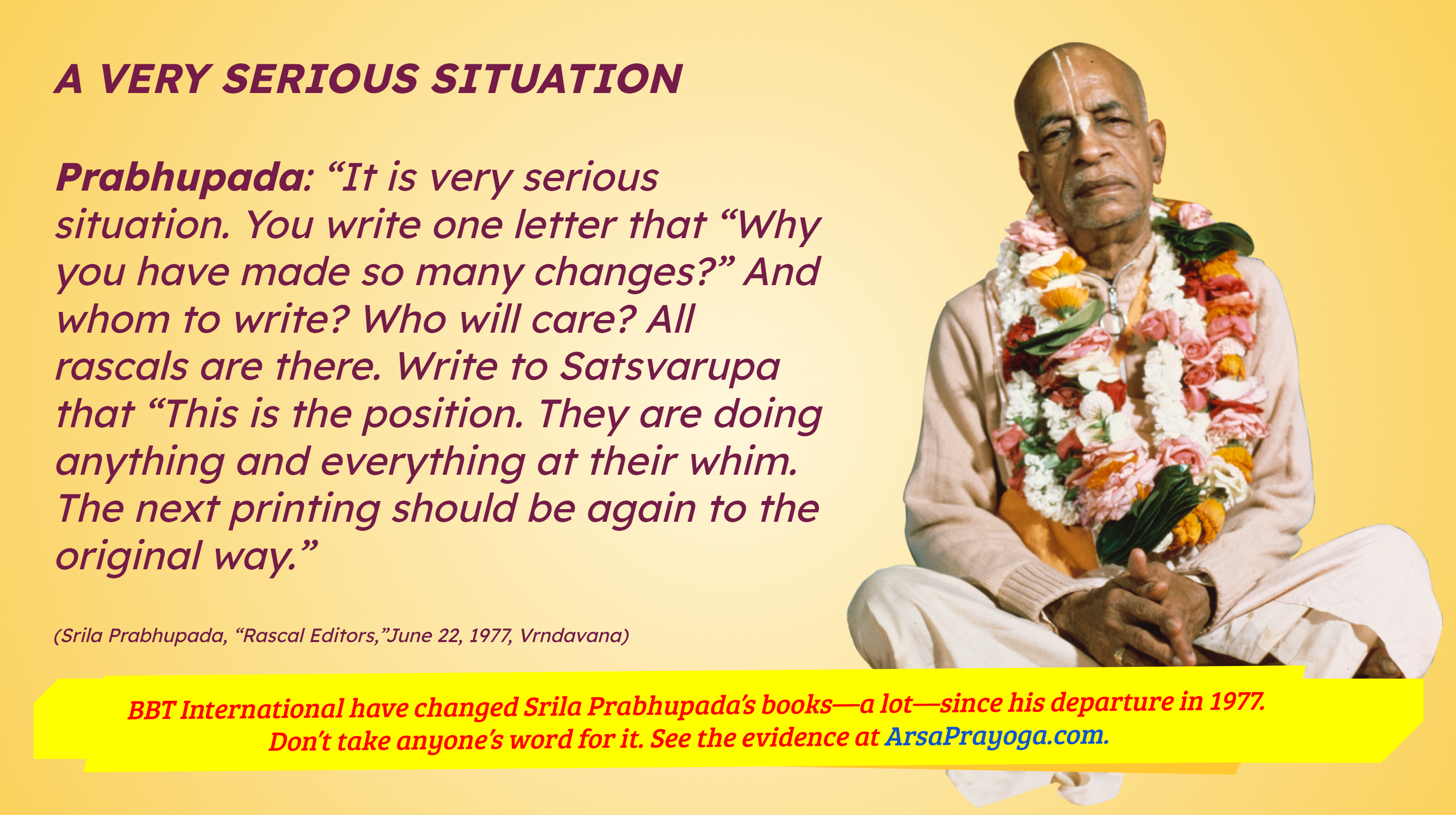
Discussions about post-samādhi editing of Śrīla Prabhupāda’s books often assume that the real problem began after 1977. But Śrīla Prabhupāda himself tells a different story. In the well-known “Rascal Editors” conversation dated June 22, 1977, in Vṛndāvana, he describes a situation already unfolding — one marked by unauthorized editing, loss of control, lack of accountability, and the impossibility of verification.

Far from being historically irrelevant, these remarks reveal a structural problem — one that makes post-samādhi editing not only questionable, but fundamentally illegitimate.

Editing Without Control — Already in 1977

Śrīla Prabhupāda states:

“It is starting. What can I do? […] They make changes, such changes… So how to check this? How to stop this?”

This is a critical admission. Prabhupāda is not predicting a future danger; he is describing a present reality. Editorial changes were already occurring, and he openly acknowledges that he lacks the practical ability to stop them.

This point alone carries enormous weight. If the author himself — alive, present, accessible, and formally in charge — could not effectively control editorial activity, then any claim that editorial control somehow improved after his departure is untenable. The conditions for restraint were already weakening; after samādhi, they could only deteriorate further.

The Defining Issue: Absence of Authority

Prabhupāda continues:

“…they are doing without any authority […] Very serious feature.”

Here the issue is precisely identified. The problem is not accidental error, linguistic awkwardness, or the need for stylistic polish. The problem is unauthorized action.

This distinction is crucial when discussing posthumous changes to Prabhupāda’s books. Appeals to “clarification,” “restoration,” or “philosophical consistency” are irrelevant if no authority exists to sanction such changes. In a Vaiṣṇava framework — especially under the principle of ārṣa-prayoga — authority does not arise from competence, intention, or institutional position. It must be explicitly granted.

Without authority, even a well-intended edit is illegitimate.

“Jayadvaita Is Good” — A Misused Argument

At this point, defenders of post-samādhi editing often introduce the following exchange:

Tamāla Kṛṣṇa: Your original work that you’re doing now, that is edited by Jayadvaita. That’s the first editing.
Prabhupāda: He is good.
Tamāla Kṛṣṇa: He is good. But then, after they print the books, they’re going over. So when they reprint…
Prabhupāda: So how to check this? How to stop this?
Tamāla Kṛṣṇa: They should not make any changes without consulting Jayadvaita.

From this, it is claimed that later editorial changes are justified because Jayadvaita Swami was trusted by Śrīla Prabhupāda.

This argument fails on several levels.

First, Prabhupāda’s approval of Jayadvaita was contextual and temporal. He approved Jayadvaita’s editing at that time, under his supervision, and within a defined scope. Nothing in this exchange grants blanket, indefinite, post-samādhi editorial authority.

Second, Prabhupāda himself explicitly rejected the idea that past approval guarantees present legitimacy. He repeatedly warned against exactly this kind of reasoning.

Śrīla Prabhupāda explains the logical fallacy involved:

“This is nagna-mātṛkā-nyāya. We change according to the circumstances. You cannot say that this must remain like this.”
(Morning Walk, May 5, 1973, Los Angeles)

In Nyāya logic, this fallacy assumes that because something was valid in the past, it must retain the same status indefinitely — regardless of changed circumstances. Prabhupāda explicitly rejected this mode of reasoning.

Trust Is Conditional — and Can Be Violated

Prabhupāda further clarifies that trust is never unconditional:

“I have given you charge… but you can misuse at any moment, because you have got independence. At that time your position is different.”
(Morning Walk, June 3, 1976, Los Angeles)

And he states even more plainly:

“Phalena paricīyate […] Present consideration is the judgement.”
(Morning Walk, October 8, 1972, Berkeley)

In other words, a person must be evaluated by present actions, not past reputation. Previous trust does not immunize later conduct.

This principle applies directly here. Whatever confidence Prabhupāda had in Jayadvaita’s editing during his presence cannot be mechanically transferred to a radically different situation: post-samādhi editing, without authorial oversight, involving substantive changes to published works.

Evidence of Breach: Changes in Style, Mood, and Philosophy

This is not a theoretical concern. Post-samādhi editions exhibit clear and documentable changes that go far beyond spelling or grammar. These include alterations to:

  • Śrīla Prabhupāda’s personally typewritten Sanskrit translations
  • Śrīla Prabhupāda’s spoken, forceful, non-academic style
  • the mood and devotional tone of passages
  • the philosophical framing and emphasis
  • the balance between direct instruction and interpretive explanation
  • and, in some cases, the theological perspective itself

Style, tone, and mood are not cosmetic. They are integral to meaning and pedagogy. To alter them without authority is to alter the work — and doing so after the author’s departure violates the trust placed in any editor.

Original manuscripts, first editions, and contemporaneous recordings therefore function only as witnesses to what Śrīla Prabhupāda authorized and published — not as licenses to revise his words post-samādhi.

Then and Now: Structural Parallels

The situation Prabhupāda describes in 1977 and the situation surrounding post-samādhi editing share the same defining features:

  • Editorial changes occurring without explicit authorization
  • Inability to verify or supervise those changes
  • Absence of a final, corrective authority
  • Institutional normalization of editorial discretion
  • Appeals to past trust rather than present evidence

The difference is not one of kind, but of degree. What was beginning in 1977 became entrenched after Prabhupāda’s departure.

The Unavoidable Conclusion

Śrīla Prabhupāda’s own words establish the following facts:

  1. Unauthorized editing was already occurring during his presence.
  2. He could not effectively stop it.
  3. He could not reliably check or verify it.
  4. He explicitly warned against relying on past trust as permanent validation.

From this, the conclusion follows with clarity:

Post-samādhi editing of Śrīla Prabhupāda’s books lacks authority, lacks verification, and reproduces precisely the dangers he himself identified.

That Jayadvaita Swami was trusted then does not settle the question now. Trust is conditional, circumstances change, and actions must be judged in the present.

Where authority is absent and trust has been objectively violated, restraint is not extremism — it is fidelity.

Video: Bhagavad-gita As It Is – Change to Cover Art

“The original Bhagavad-gītā As It Is, published during Śrīla Prabhupāda’s lifetime, features Krishna and Arjuna in the midst of the Kurukṣetra battlefield. Krishna, serene yet commanding, drives the chariot; Arjuna, bow in hand, reaches for an arrow, ready to act. The scene is dynamic, radiant, and filled with purpose. It embodies the Gītā’s central message — divine action under Krishna’s direction.

In contrast, the later BBT International cover replaces this vivid scene with a sepia-toned, static composition. Krishna and Arjuna sit quietly, the battlefield emptied of movement and power. The tone is reflective rather than transcendental, subdued rather than triumphant.”

See the video for full story:

Bhagavad-gītā As It Is — Change of Cover Art

By Ajit Krishna Dasa

Bhagavad-gītā As It Is — Change of Cover Art

Description

The original Bhagavad-gītā As It Is, published during Śrīla Prabhupāda’s lifetime, features Krishna and Arjuna in the midst of the Kurukṣetra battlefield. Krishna, serene yet commanding, drives the chariot; Arjuna, bow in hand, reaches for an arrow, ready to act. The scene is dynamic, radiant, and filled with purpose. It embodies the Gītā’s central message — divine action under Krishna’s direction.

In contrast, the later BBT International cover replaces this vivid scene with a sepia-toned, static composition. Krishna and Arjuna sit quietly, the battlefield emptied of movement and power. The tone is reflective rather than transcendental, subdued rather than triumphant.

Type of change

Visual substitution — replacement of the original dynamic battlefield scene with a subdued, neutral reinterpretation.

Category

Philosophical change.

Commentary

The original cover: divine engagement and fearless surrender

Śrīla Prabhupāda’s approved cover proclaims the philosophy of the Gītā through imagery. Arjuna acts under Krishna’s order — his bow raised, but his heart surrendered. This is yoga in motion — not escapism, but spiritual courage.

The colors are rich, the composition alive. The scene radiates energy and conviction. It declares that Krishna consciousness is not an abstraction but a living call to act under divine direction. Śrīla Prabhupāda’s purpose was to awaken the world, and the cover reflects that sense of urgency and truth.

The viewer can feel the śakti — the divine energy of the moment when the soul, guided by Krishna, takes up its duty. This was not designed as decoration; it was preaching in paint.

The new cover: aesthetic calm and philosophical retreat

The later BBT International design strips that vitality away. Krishna and Arjuna now appear passive, framed in a gentle sepia hue. The dynamic exchange of surrender and command is replaced with composure and stillness. The mood has shifted from revelation and spiritual revolution to respectability.

This change did not happen by accident. The likely reason was discomfort — the fear that Arjuna with a drawn bow might look too “militant,” that the world might see the Gītā as a book of conflict. To avoid misunderstanding, they drained the image of its conviction. But by doing so, they did exactly what Prabhupāda warned against: they compromised the message to fit modern taste.

The result is art that pleases the world but fails to challenge it. The battlefield has become a conversation; surrender has become suggestion.

The original showed Krishna leading; the new shows Krishna posing. The first commands reverence; the second invites indifference.

From message to impression

The original cover invited readers into Krishna’s presence. The new one invites them into neutrality. The first preaches; the second performs. The first says, “Here is God leading His devotee.” The second says, “Here is a peaceful scene from an ancient text.”

This is not refinement — it is retreat. The battlefield of the soul has been turned into a soft philosophical setting, safe for polite society but stripped of its divine tension.

When sacred power is replaced by compositional balance, the Gītā stops being a living revelation and becomes a cultural artifact.

Conclusion

Śrīla Prabhupāda’s original cover was both spiritually bold and visually beautiful — suitable for any setting because it carried truth without apology. The replacement, though visually refined, removes the transcendental urgency and courage that the Gītā was meant to awaken.

To replace revelation with restraint is not service but revision.
And that quiet reduction — the removal of vitality, immediacy, and surrender — is the violation of the principle of arsa-prayoga.

Image Notes:

Left — Original 1972 cover approved by Śrīla Prabhupāda. Krishna and Arjuna in divine motion on the battlefield of Kurukṣetra, embodying surrender and duty under Krishna’s order.

Right — Later BBT International edition. A static, sepia reinterpretation that replaces transcendental engagement with polite serenity.

Krishna – No Longer the Perfection of Yoga – Revisited

By Ajit Krishna Dasa

Arsa-Prayoga.com – Revisited is the title of an upcoming ebook that continues the work begun here on arsaprayoga.com. It re-examines the changes made to Śrīla Prabhupāda’s original books from new angles and explains why each alteration is significant.

Each example will also be posted here on arsaprayoga.com.

Today we are revisiting:

Krishna – No Longer the Perfection of Yoga

Description

The original cover of The Perfection of Yoga, published during Śrīla Prabhupāda’s presence, depicts Lord Krishna instructing Arjuna on the battlefield of Kurukṣetra. The newer version replaces this sacred scene with a modern, abstract image: a silhouetted yoga figure against a cosmic background, accompanied by planetary symbols and a hummingbird.

Type of change

Visual substitution — replacement of the original painting with a completely different concept.

Category

Philosophical change.

Commentary

The original cover: revelation and surrender

The first edition’s painting is not just devotional art — it is theology in color. It captures the divine dialogue of the Bhagavad-gītā: the Supreme Lord imparting transcendental knowledge to the bewildered soul. Krishna’s gesture expresses both compassion and authority, while Arjuna’s posture shows humility and surrender.

This image teaches before one even opens the book. It tells the reader: “Here is yoga in its highest form — the union between the soul and Krishna through surrender and service.” The visual message aligns perfectly with Śrīla Prabhupāda’s text, where yoga culminates not in physical postures or impersonal meditation, but in bhakti-yoga, devotion to the Supreme Personality of Godhead.

The new cover: abstraction and self-centered spirituality

The new cover shifts the entire philosophical mood. The central figure is no longer Arjuna receiving revelation but a lone silhouette performing an asana — an emblem of modern yoga culture. The background, with its planets, abstract lights, and hovering bird, suggests cosmic energy and mysticism rather than divine personality.

The focus has moved from Krishna to the individual practitioner. The very idea of “perfection” is reframed — from surrender to the Supreme to self-realization through posture and mental discipline. The new imagery reflects the psychology of self-help and the commercial yoga industry rather than the theology of bhakti.

The consequence: from tattva to marketing

This shift is not cosmetic. It mirrors the broader editorial problem: once Krishna is removed from the center — visually or textually — everything else changes. The meaning of yoga becomes sentimental and speculative.

Where the original cover anchored the reader in tattva (spiritual truth), the new one drifts toward māyā-vāda aesthetics — the impersonal mood of “energy,” “light,” and “universal consciousness.” It exchanges humility for abstraction, devotion for design.

Śrīla Prabhupāda’s original books were meant to preach, not to conform. The old cover declared the eternal truth of Krishna consciousness; the new one markets a diluted idea of spirituality.

In short: the original cover preaches; the new cover advertises.

And that change — from revelation to representation, from śabda-pramāṇa (divine authority) to manuṣya-pramāṇa (human taste) — is the violating of the principle of arsa-prayoga.

Krishna – No Longer the Perfection of Yoga

By Gaura Krishna Dasa

Here is an interesting example of what editing can lead to: a present-day cover printed by BBT International and a photo of what the book originally looked like. Krishna is no longer depicted as the perfection of yoga – asanas are.

Prabhupada:

“And the covers, if possible, should always be the same for each respective book regardless of what language it may be printed in.” (Letter to Jadurani, Bombay, January 3, 1975)

New Video Series on the Book Changes

We are gradually producing videos on the book changes. Check our playlist at Youtube, and remember to subscribe for new videos.

Kindly share the videos on social media – especially on Facebook.

Thanks for watching and helping Srila Prabhupada.

Book Changes – Playlist

Open Letter to Sivarama Swami

Screen Shot 2015-11-13 at 19.52.49

This below e-mail was sent to Sivarama Swami through the e-mail address (asksrs@gmail.com) provided on this website. I hope that the devotees in charge of receiving the e-mails will forward the e-mail to Maharaja. In the meantime I will look for another e-mail address of his.

Dear Sivarama Swami. Dandavat pranama. Jaya Srila Prabhupada.

I apologize if answering this letter becomes a burden on your many other responsibilities.

Recently I heard a podcast from your website where you respond to a few questions about the changes made to Srila Prabhupada’s books.

I have a few comments and points I find important in relation to your response, and I hope you will find the time to answer each of them.

This is an open letter, so it will also be posted online.

The letter is attached to this e-mail, but you can also find it here:

Open Letter to Sivarama Swami

Thank you very much.​
Your servant,
Ajit Krishna Dasa

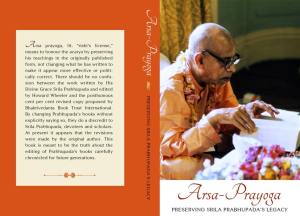
E-BOOK: Arsa-Prayoga: Preserving Srila Prabhupada’s Legacy

Almost 400 pages about the changes made to Srila Prabhupada’s books.

Arsa-Prayoga Book

Click picture to visit website

From the back cover:

“Arsa prayoga, lit. “rishi’s license,” means to honour the acarya by preserving his teachings in the originally published form, not changing what he has written to make it appear more effective or politically correct. There should be no confusion between the work written by His Divine Grace Srila Prabhupada and edited by Howard Wheeler and the posthumous cent per cent revised copy proposed by Bhaktivedanta Book Trust International. By changing Prabhupada’s books without explicitly saying so, they do a discredit to Srila Prabhupada, devotees and scholars. At present it appears that the revisions were made by the original author. This book is meant to be the truth about the editing of Prabhupada’s books carefully chronicled for future generations.”

Get the book on Amazon.

E-BOOK: Blazing Edits

blazing-edits

Click to download the book

Aug 20, 2015 — CANADA (SUN) —  We invite you to download a copy of Blazing Edits, an e-book collection of segments written by Bhakta Torben Nielsen on the topic of the changes to Srila Prabhupada’s Bhagavad-gita As It Is. This series has been an ongoing publication on Sampradaya Sun and www.arsaprayoga.com.

This e-book was made in a cooperative effort by Bhakta Torben Nielsen (Author), Bhakta Max Køngerskov (Design and Layout), Ajit Krishna dasa (Idea), and the Sampradaya Sun (Publisher). The book will periodically be updated with new segments.

DOWNLOAD LATEST VERSION

Blazing Edits (16 okt. 2015)

Who Is Bhakta Torben?

Bhakta Torben Nielsen, a devotee from Denmark associated with the Hare Krishna movement, is known for his outspoken stance on various issues within ISKCON, particularly the changes made to Srila Prabhupada’s books after his passing.

His critiques have focused on what he sees as deviations from the original teachings and intentions of Prabhupada, ISKCON’s founder. In his view, the editorial alterations—such as revisions and edits to Prabhupada’s texts—compromise the authenticity of the teachings and pose a serious concern for the integrity of the movement.

Nielsen’s writings delve into the nature and extent of these changes, raising questions about their justification and impact. For him, the issue is not merely about preserving the original words on the page; it is a matter of safeguarding the spiritual legacy that Srila Prabhupada intended to leave behind.

The controversy over book changes reflects broader systemic issues within ISKCON, such as centralized authority and fidelity to the founder’s instructions. These concerns, along with others about the governance and direction of ISKCON, were extensively explored in Nielsen’s many articles.

Later he had his work compiled into the above eBook titled Blazing Edits, which addresses the controversial changes made to Srila Prabhupada’s books and advocates for preserving the original teachings without alteration. Through this work, Nielsen aims to shed light on what he and other concerned devotees see as a crucial challenge facing the Hare Krishna movement: the need to preserve Prabhupada’s teachings in their authentic form.

Note on Bhakta Torben Nielsen

Bhakta Torben was originally initiated by Harikesha Swami. When Harikesha later fell from his position, Torben chose to reject him as his guru and discontinued using the spiritual name he had received. This decision reflects Torben’s lifelong commitment to sincerity, integrity, and fidelity to Śrīla Prabhupāda above institutional considerations.

E-book: Srila Prabhupada: The Transcendental Art Master

Screen Shot 2015-08-22 at 10.13.51

Click to download the book

Govinda Dasi relates how Srila Prabhupada instructed her and other young devotee artists to paint devotional paintings, how he minutely supervised their work and how unfortunate it is that most of these authorized paintings have been removed from Srila Prabhupada’s books.

Download the book here: Srila Prabhupada: The Transcendental Art Master (by Govinda Dasi, ACBSP)