From Dhyana to Sankhya: Prabhupada’s Vision for Chapter 6

By Ajit Krishna Dasa

Srila Prabhupada’s decision to title Chapter 6 of the Bhagavad Gita As It Is “Sankhya Yoga” stands as a distinctive and deliberate choice, diverging from the more common “Dhyana Yoga” favored by traditional acharyas, modern scholars, and Western translators. This title, unique in the history of widely recognized Gita commentaries, reflects his mission to present the text through the lens of Gaudiya Vaishnavism while reintroducing the theistic Sankhya philosophy of Kapila Muni, the divine son of Devahuti from the Srimad Bhagavatam. Far from a mere editorial quirk, Prabhupada’s naming can be seen as a strategic reclamation of the term “Sankhya,” serving as an implicit attack on the atheistic Sankhya school and aligning the chapter’s teachings with Krishna consciousness. This choice makes sense when viewed through the philosophical content of Chapter 6, its integration of Sankhya and Yoga, and Prabhupada’s broader purpose of countering materialistic philosophies.

Philosophical Foundations: Theistic Sankhya and Its Contrast with Atheism

Sankhya philosophy, one of the six classical schools of Indian thought, fundamentally distinguishes between purusha (the eternal, conscious soul) and prakriti (temporary, unconscious matter), aiming for liberation through analytical knowledge. However, two versions of Sankhya exist: the atheistic, classical Sankhya, often attributed to a sage Kapila, which denies a supreme God and posits multiple purushas liberated through intellectual discernment alone, and the theistic Sankhya of Kapila Muni, an incarnation of Vishnu, as detailed in Srimad Bhagavatam (Canto 3, Chapters 24–33). The latter integrates this dualistic framework with devotion to Krishna, the Supreme Purusha, as the source and controller of all existence.

Srila Prabhupada consistently champions the theistic Sankhya of the Bhagavatam’s Kapila, critiquing the atheistic version as incomplete. In his purport to Gita 2.39, he describes Sankhya as the analytical study of soul and matter but ties it to Krishna’s authority, while in Srimad Bhagavatam 1.2.30, he credits Kapila (the Vishnu avatar) with creating Sankhya to dispel material illusion, implying the atheistic school is a corruption. By titling Chapter 6 “Sankhya Yoga,” Prabhupada reclaims the term from its godless connotation, positioning it as a Krishna-centric science of self-realization. This choice serves as an attack on atheistic Sankhya by asserting that true Sankhya—unlike its materialistic distortion—culminates in devotion to the Supreme Personality of Godhead, not mere intellectual isolation.

Chapter 6’s Content: A Blend of Sankhya Philosophy and Yogic Practice

Chapter 6 of the Gita, while renowned for its meditative instructions (e.g., 6.11–14: sitting steadily, focusing on the self or Krishna), contains philosophical elements that resonate with Sankhya, justifying Prabhupada’s title. Verses like 6.5–6 (“One must deliver himself with the help of his mind… the mind is the friend or enemy”) echo Sankhya’s view of the mind as a product of prakriti that binds or liberates the purusha depending on its mastery. Similarly, 6.1–4 emphasize detachment from sense objects and fruitive results, mirroring Sankhya’s goal of disentangling the soul from material nature. The description of the yogi’s transcendent state in 6.20–23—realizing the self’s distinction from matter through “transcendental senses”—further aligns with Sankhya’s liberation through discriminative knowledge.

Prabhupada’s “Sankhya Yoga” title broadens the chapter’s scope beyond meditation (dhyana) to include this analytical foundation, reflecting the theistic Sankhya of Kapila, where understanding the soul’s eternality leads to Krishna (Srimad Bhagavatam 3.25.18). Unlike “Dhyana Yoga,” which narrows the focus to meditative practice, “Sankhya Yoga” encapsulates the integration of knowledge (Sankhya) and discipline (Yoga), culminating in devotion (6.47: “The highest yogi thinks of Me constantly”). By highlighting these Sankhya elements, Prabhupada challenges atheistic Sankhya’s endpoint—self-isolation without God—replacing it with a theistic synthesis that directs the practitioner to Krishna, thus undermining the atheistic school’s philosophical legitimacy.

Historical Context: Sankhya and Yoga’s Traditional Connection

The tendency in Indian tradition to connect Sankhya and Yoga as complementary systems supports Prabhupada’s titling. Historically, Sankhya provides the metaphysical blueprint (distinguishing purusha from prakriti), while Yoga, particularly Patanjali’s Ashtanga Yoga, offers the practical path, with dhyana (meditation, the seventh limb) as a key stage. The Gita itself reflects this synergy: Chapter 2 introduces Sankhya’s analytical wisdom (2.39), and Chapter 6 blends it with yogic practice. Prabhupada’s “Sankhya Yoga” title leverages this tradition, but adapts it to Vaishnavism by rooting it in Kapila’s theistic Sankhya, not the atheistic version that Patanjali’s Yoga partially accommodates (via Ishvara, Yoga Sutras 1.23).

This historical pairing bolsters Prabhupada’s attack on atheistic Sankhya. By invoking “Sankhya” in a yogic context, he reasserts its original spiritual purpose—lost in the godless classical school—and aligns it with the Gita’s theistic narrative, where Krishna is the ultimate goal (Gita 15.17–18). This reclamation serves as a polemic, subtly exposing atheistic Sankhya’s inadequacy compared to its devotional counterpart.

Prabhupada’s Strategic Intent: Attacking Atheistic Sankhya and Inspiring Exploration of the Bhagavatam

Prabhupada’s mission was to counter materialistic and impersonal philosophies, including atheistic Sankhya, which he saw as a distortion of Vedic truth. His critiques in purports—e.g., dismissing atheistic Sankhya as “dry speculation” (Gita 7.4, purport)—reveal his intent to restore its theistic essence. Naming Chapter 6 “Sankhya Yoga” is a deliberate strike against this distortion for several reasons:

  1. Reclamation of Terminology: By using “Sankhya,” a term familiar to scholars and practitioners, Prabhupada confronts its atheistic association head-on. He redefines it through Kapila’s lens, where analytical knowledge serves bhakti, not godless liberation, thus challenging the classical school’s authority.
  2. Philosophical Superiority: The chapter’s content—integrating self-realization with devotion—demonstrates that theistic Sankhya surpasses atheistic Sankhya. Verses like 6.29–30 (“He who sees Me everywhere”) elevate Sankhya’s dualism into a Krishna-centric unity, exposing the atheistic version’s limitation in stopping at individual purusha without recognizing the Supreme Purusha.
  3. Educational Polemic: Prabhupada’s global audience included Westerners and Indians influenced by secular interpretations of Sankhya. Titling Chapter 6 “Sankhya Yoga” educates them that true Sankhya aligns with Krishna consciousness, countering scholarly narratives equating Sankhya with atheism and reinforcing the Gita’s theistic intent “as it is.”
  4. Parampara’s Authority: By tying the title to Kapila of the Bhagavatam, Prabhupada roots it in disciplic succession, contrasting it with speculative atheistic Sankhya. This asserts the Vedic authenticity of his interpretation, undermining the classical school’s standalone credibility.
  5. Inspiring Engagement with the Srimad Bhagavatam: Beyond attacking atheistic Sankhya, Prabhupada’s use of “Sankhya Yoga” also aimed to inspire readers to explore the Srimad Bhagavatam, which he considered the “ripe fruit of the Vedic tree” (Srimad Bhagavatam 1.1.3, purport) and the ultimate scripture for Krishna consciousness. By linking Chapter 6 to Kapila’s theistic Sankhya—detailed in Bhagavatam Canto 3, Chapters 24–33—he creates a bridge to this text, where Kapila’s teachings expand on the Gita’s principles with a devotional focus (e.g., Bhagavatam 3.25.18). In purports like Gita 6.13–14, he references Kapila’s meditation on Vishnu (Bhagavatam 3.28.8–11), subtly encouraging readers to delve into the Bhagavatam for a deeper understanding of both Kapila’s Sankhya but also of the Srimad-Bhagavatam itself. For his audience—many unfamiliar with this scripture—the title “Sankhya Yoga” plants a seed of curiosity about Kapila’s full discourse, reinforcing the Bhagavatam’s role as the natural next step after the Gita and enhancing his mission to elevate global devotion through the parampara’s treasures.

Uniqueness and Justification

No major traditional acharya (e.g., Shankaracharya, Ramanujacharya, Madhvacharya) or modern translator (e.g., Sivananda, Chinmayananda) titles Chapter 6 “Sankhya Yoga”—they typically use “Dhyana Yoga” or variants, reserving “Sankhya Yoga” for Chapter 2. Prabhupada’s divergence is a bold innovation, justified by Chapter 6’s Sankhya-like elements and his mission. While “Dhyana Yoga” fits the chapter’s meditative focus, “Sankhya Yoga” captures its broader philosophical depth, aligning with his view of Kapila’s system as both knowledge and practice directed toward Krishna.

Conclusion: A Sensible and Strategic Choice

Srila Prabhupada’s “Sankhya Yoga” title for Chapter 6 makes profound sense as a reflection of its content—merging Sankhya’s analytical insights with Yoga’s meditative discipline—and his intent to advance Gaudiya Vaishnavism. It serves as a strategic attack on atheistic Sankhya by reintroducing Kapila’s theistic version, challenging its godless conclusions, and redirecting its principles toward Krishna. This choice not only highlights the chapter’s philosophical richness but also fulfills Prabhupada’s mission to present the Gita as a devotional text, countering materialistic distortions and establishing Krishna consciousness as the ultimate synthesis of Vedic wisdom. In this light, “Sankhya Yoga” is not just a title—it’s a declaration of theistic triumph over atheism, rooted in scripture and tradition.

For a definitive proof that Srila Prabhupada wanted Chapter Six of his Bhagavad-gita As It Is to be named Sankhya-Yoga, please see this article.

Satsvarupa Dasa Goswami’s Public Statement about Bhagavad-gita As It Is

By Garuda Dasa (Graham M. Schweig)

Someone alerted me to this publically available statement that Satsvarupa Das Goswami wrote:

Bhagavad-gita Editing”

“I received a letter from a disciple who told me he prefers reading the first edition of the Bhagavad-gita edited by Hayagriva. He thinks there are too many changes in the second edition edited by Jayadvaita. But I do not agree with this point of view. Jayadvaita and Dravida published a booklet, Responsible Publishing. There they demonstrated the many omissions Hayagriva made from Prabhupada’s original manuscripts. Jayadvaita restored the original material by Prabhupada and did responsible editing of his English. Prabhupada had implicit faith in Jayadvaita Maharaja and kept him as his editor for Srimad-Bhagavatam. He said that Jayadvaita’s editing should not be changed. Now Garuda Prabhu has written an entire book championing the editing version of Hayagriva and criticizing the second edition edited by Jayadvaita. I do not agree with Garuda Prabhu on this topic. My followers should feel confident to read the second edition published by the BBT, edited by Jayadvaita Maharaja, and not the earlier edition done by Hayagriva.”

Several interest points I’d like you to consider:

The first edition of the Bhagavad-gītā As It Is was authored by Śrīla Prabhupāda. It is not the Hayagriva edition. There were others besides Hayagravia who worked on it at the time, including Jayadvaita.

Whether one finds Prabhupāda’s authorized authored edition or the second heavily revised (corrupted) edition preferable or not is beside the point. Which one did Prabhupāda actually author and authorize for sure? The answer is obvious. Which one is questionable? The answer is obvious.

Satsvarupa says he does not agree with Garuda Prabhu on the topic of posthumous editing if it means correcting Jayadvaita’s work. On what basis? He’s read Dravida’s and Jayadvaita’s rationalization for editing, but he’s never read a word of my work on the subject. His decision is not being made from a rational mind but out of loyalty to Jayadvaita. Moreover, is Satsvarupa being loyal to Prabhupāda?

Satsvarupa says, “Now Garuda Prabhu has written an entire book championing the editing version of Hayagriva.” First of all, there is no “editing version of Hayagriva.” Secondly, I’ve not written an entire book “championing” anything. But I hope I’m always championing Prabhupāda himself. Is that so distasteful to Satsvaraupa?

Isn’t Satsvarupa making a foregone conclusion here by telling his followers to read Jayadvaita’s edition? But he says more . . . he’s telling his followers NOT to read Prabhupāda’s original authorized edition! And calling it the “earlier edition done by Hayagriva”! Does he foget that Hayagriva, Jayadvaita, and others worked UNDER Prabhupāda? Does he not realize that Dravida and Jayadvaita have been working OVER Prabhupāda since his departure?

Just throwing these points out to all of you.

Tomorrow is Vyāsa Pūjā for our beloved Śrīla Prabhupāda, the original world teacher of Krishna bhakti. How can we honor him in the best way? By following his instructions, instructions not filtered through the limited brains of Jayadvaita, Satsvarupa, Dravida, mine, or anyone else’s. Let us not try to better Prabhupāda as Jayadviata has been attempting to do. Let us try to better ourselves in our relationship wtih Prabhupāda!

On this Vyāsa Pūjā, let us all receive the gifts Prabhupāda has given us graciously, and reciprocate Prabhupāda’s loving gifts by preserving, absorbing, and sharing his teachings.

Dāso ‘smi premni,

Garuḍa Dāsa

ISKCON Censorship in Action

At ISKCON Mayapur a devotee, Jitavrata Dasa, was publicly humiliated for speaking the truth about the book changes. He was asked to stop his vyasa puja offering.

Read the complete vyasa-puja offering below (the part that Jitavrata Prabhu was not able to speak has been marked with bold).

Nama Om Vishnu padaya Krishna prestaya bhutale
Srimate Bhaktivedanta swamin iti namine
namas te Sarasvate deve Gauravani pracarine
nirvisesa sunyavadi pascatya desa tarine

Dear Srila Prabhupada ,

please accept my humble obeisances unto your worshipable Lotus Feet.

You brilliantly shine as the most glorious servant of your Lordship Sri Sri Radha Madhava.

As time goes by, and as ignorance is dispelled, you are appreciated as the most important personality in our movement ,most definitely because you are the founder acharya under whose guidance everyone must abide in order to understand the instructions of the disciplic succession that are within your books.

You are without a doubt the most merciful guru to empower even today whoever takes shelter of your instructions. We all feel very fortunate to be under the shelter at your Lotus feet. They are guiding us back to Godhead beyond the shadow of a doubt.
It is only because of you that we can find the potency to continue your great mission of bringing immortal happiness to the entire world. Your greatest joy is to see your books distributed far and wide, because your books unlock the doors to the treasure house of pure Love of Krishna.

As time goes by, your Divine presence is becoming more intensely felt because we realize that it is only by your mercy that this movement is carrying on. You are everyone’s well wisher and your spiritual attributes are unfathomable.

As ISKCON is your body, you want to see it flourish and grow beyond material limits, in great spiritual happiness and health for all the generations to come. So many nice devotees have joined your movement and are very much eager to serve at your Lotus Feet with great joy.

Please give us the intelligence to not change the bonafide process that you are giving us, as to avoid causing you so many troubles. It was first given by Krishna and has worked wonders millions of years ago, it is still now working so many wonders and will continue to work wonders in the milleniums to come.

As you are the spirit maintaining ISKCON thru sickness and health, please give us the intelligence to understand the supreme importance of protecting all the original English versions of your books that you have personally approved and rendered thereby eternal.
You have compiled these books with great endeavor, choosing each word and sentence very carefully under the full guidance of Lord Krishna sitting next to you. Your very specific combination of words acts like a powerful mantra to cut thru the illusory energy of Maya and revive our remembrance of Krishna

By changing these word arrangements thinking to know English better than you is the greatest offense as it removes the bonafide value of your writings. You taught us that 5 things permits Kali’s influence to infiltrate our consciousness. Meat eating, intoxication, gambling, illicit sex and if all four are absent then Kali is allowed to reside where there is hording of gold. Our biggest protection is the chanting of a minimum of 16 rounds every day, and keeping the association of the devotees. These simple instructions if carefully practiced will protect us from down falls.

You told Rameswara your BBT Trustee that your greatest fear was that after your departure, bonafide instructions will be taken out of your books and non bonafide things will be introduced, that is why you strictly forbade any book changes and you really made this instruction very clear to him. Unfortunately Rameswara left after a series of unfortunate events and even though these instructions were left in writing when Rameswara was interviewed for the production of your Lilamrta, that interview was never utilized and simply sat in the archives forgotten for over 30 years. As the enemy is invisible but its influence can be seen. Kali has infiltrated somehow or other,maybe someone is hording some gold or breaking the principles who really knows, but somehow Kali has found a way to modify your books, making it look seemingly harmless, claiming the changes will be closer to what you really meant , but Kali has in fact opened wide the doors for future changes. Next Kali will make us believe that watering down the philosophy will greatly increase our membership among those who are especially angry that you are just too strict and conservative with your principles, so better make a few compromises, where is the harm? And then Kali will tell us next that there is no need to chant Jaya Prabhupada , it is not necessary . Kali’s goal is to really minimize your importance and gradually take you out of the picture .Kali says” no no a little book change that is alright,where is the harm we are making the books better, Prabhupada didn’t know how to speak english we are just helping him out especially since now we even know sanskrit better than him”. Is this why you emphatically stressed no book changes,as you could foresee these attacks from the fox like Kali?

Rameswara Prabhu , has witnessed first hand your reactions over some changes the press was planning for your books. He was coming of course to get your approval as you always personally directed every details of your books publications. He saw how very angry you were when presented with so called book changes for the seemingly better, and that was the most frightening experience Rameswara ever had to see you this angry ,he felt very similar to what Hiranyakasipu felt when he saw Lord Nrisimhadeva. Hiranyakasipu was actually so scared that he fought the Lord with his eyes closed. You repeatedly told Rameswara that you do not want your books changed. You also told Hayagriva your editor in 1972 that you had approved all the verses in the Bhagavad Gita and that there was no need to change any of them, that once approved they are eternal. Rameswara carefully noted down all the details of these super heavy lessons and in 1979 he gave a long interview for the Lilamrta describing everything that happened . He had never seen anyone so angry, There were also many others who were involved with the press like Radhaballava das , Bali Mardana, your BBT artists and various editors who received your clear instructions about not changing your books except for the few absolutely needed corrections. When we finished the Chaitanya Caritamrta marathon in 75, Rameswara told you afterwards that in the subsequent printing the finished paintings would replace the unfinished ones. You said no, no book changes, but Prabhupada he said we are just putting the finished paintings in , they are the same paintings .but three times you forbade him to do so, because you wanted to stress and emphasize that no matter how good the reasons seems to be, you did not want your books changed, once approved they are eternal.

But now we see that so many changes have been made, your very clear instructions on this matter have been forgotten in the archives for more than 30 years and as they are now seeing the light of the day we are faced with the difficult task of undoing this blunder, difficult because Kali has brainwashed us and anyone who criticizes these changes is shown the door . Kali ‘s might is right and devotees are scared to talk about this ,because they don’t want to be kicked out of ISKCON. So what to do?
We want to correct these transgressions from your orders so that we may qualify to be the recipients of your full mercy .

This is why we pray at your lotus feet to please give us the intelligence to understand how you are too monumentally big for anyone to correct your books . What you wrote was already approved by you, and you did not want it changed in any ways. Please give ISKCON at large the spiritual intelligence to understand this principle of arsa- prayoga. I do not see how we can get your mercy while keeping you in an angry mood over the changing of your books, this is the most serious offense to think that we can touch your writings. Please consider our ignorance and we beg you to please enlighten those who do not see the evil in these activities. Your books are worshipable deities being non different than Bhagavan Sri Krishna and we know them to contain all of your devotional ecstasies. In the first Canto of Srimad Bhagavatam , Chapter five, the verse of text eleven says: On the other hand, that literature which is full of descriptions of the transcendental glories of the name, fame, forms, pastimes , etc. , of the unlimited Supreme Lord is a different creation, full of transcendental words directed toward bringing about a revolution in the impious lives of this world’s misdirected civilization. Such transcendental literatures, even though imperfectly composed, are heard, sung and accepted by purified men who are thoroughly honest. The original English version of your books are the seed mantra to all worldwide translations of your books, the ultimate reference in authenticity, that anyone could refer to. What will scholars think when they find out your books were tampered with, they will refuse to study the bogus ones.

No outside influence can stop your ISKCON, but to allow from within that your books may be modified is non different than killing you. You said that you live eternally in your books, but if they are modified then they are no longer your books, Kali has found a way of silencing you by playing the changing game to suit its evil purposes while still presently hiding behind your good name.Do we need to form a Ksatriya force to keep this Kali at bay? Please Srila Prabhupada give us the intelligence to see clearly, guide us on the right path, and inspire your BBT to print all your original versions once again. But I see hope in the horizon , happy days are returning because of your Jayapataka Swami who is getting his visa extended for his visit on this earth, all by the mercy of Lord Nrisimhadeva and by the mercy of his disciples, so that he may finish your big plans for Mayapur. Rameswara your great book distribution general is coming back to hopefully retire in Mayapur. Please illuminate their hearts with your full splendor and please kick Kali far away. Allow us to remain very close to you Srila Prabhupada , let your instruction of no book changes be known in ISKCON at large. Let the truth of your instructions shine. Let us all work united under you, under your unchangeable immortal instructions.

Jaya Sri Sri Radha Madhava,
Jaya Supremely powerful Lord Nrisimhadeva,
Jaya O most merciful Sri Sri Panca tattva,
Jaya o most magnanimous Srila Prabhupada!

Your worthless dog
Jitavrata das


Kripamoya Dasa Fails to Justify the Book Changes

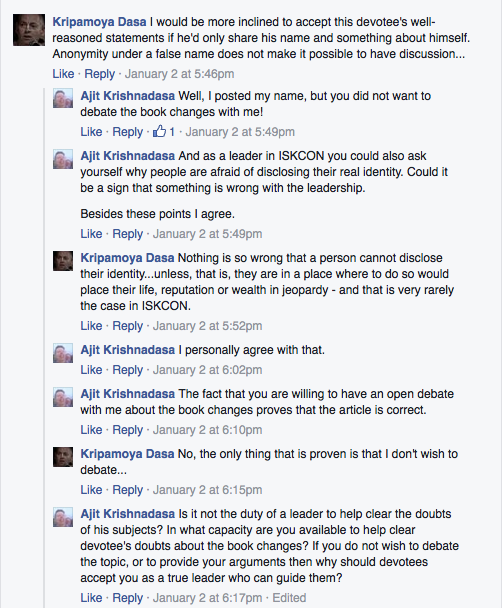
I had a few exchanges with Kripamoya Prabhu (ACBSP & GBC) on Facebook. The exchange speaks for itself. I did not leave anything out.

Here we go:

Screen Shot 2016-07-09 at 23.28.51

Screen Shot 2016-07-09 at 23.29.04

Kripamoya Prabhu did not respond.

Later, in another exchange, Kripamoya Prabhu stated that he could not accept a devotee’s criticism of ISKCON, because the devotee posted anonymously. I responded by referring to the above exchange where I posted non-anonymously, but where he, Kripamoya Prabhu, still did not respond.

Screen Shot 2016-07-09 at 23.22.43

Screen Shot 2016-07-10 at 03.30.21

To some of the above comments Kripamoya Prabhu also responded:

Screen Shot 2016-07-09 at 23.23.47

Kripamoya Prabhu did not respond.

Foreign Translations – No Problem

By Ajit Krishna Dasa

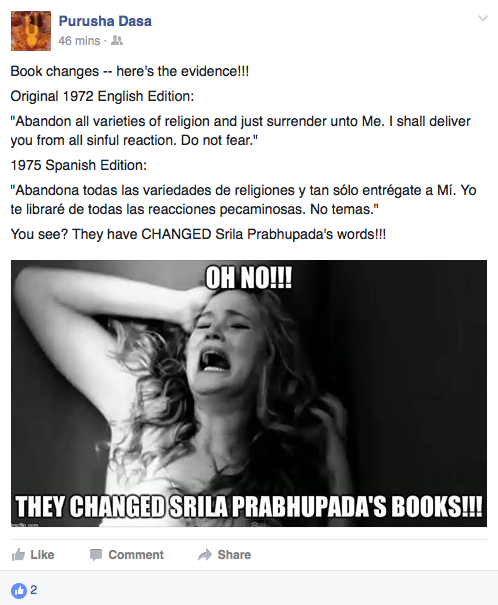
A devotee, Purusha Dasa, is mocking those who are against the book changes. Check the picture:

Screen Shot 2016-06-14 at 18.09.50

My answer:

Purusha Dasa is presenting a false analogy. Let me explain:

Translations into foreign languages presents no problem for those against changes to Srila Prabhupada’s books.

Why?

Because such translations do not present themselves as the original words of Srila Prabhupada. Instead they present themselves as foreign translations of Srila Prabhupada’s words, and everyone knows that such translations come with some problems. But you can always check the foreign translations against the original English editions.

On the other hand, the unauthorized, changed books from BBT International present themselves as Srila Prabhupada’s original words, even though they are not. And BBT International wants to eliminate the original editions so that any comparison between the originals and the changed editions is impossible.

Now that is a problem.

Open Letter to Sivarama Swami

Screen Shot 2015-11-13 at 19.52.49

This below e-mail was sent to Sivarama Swami through the e-mail address (asksrs@gmail.com) provided on this website. I hope that the devotees in charge of receiving the e-mails will forward the e-mail to Maharaja. In the meantime I will look for another e-mail address of his.

Dear Sivarama Swami. Dandavat pranama. Jaya Srila Prabhupada.

I apologize if answering this letter becomes a burden on your many other responsibilities.

Recently I heard a podcast from your website where you respond to a few questions about the changes made to Srila Prabhupada’s books.

I have a few comments and points I find important in relation to your response, and I hope you will find the time to answer each of them.

This is an open letter, so it will also be posted online.

The letter is attached to this e-mail, but you can also find it here:

Open Letter to Sivarama Swami

Thank you very much.​
Your servant,
Ajit Krishna Dasa

E-Book: ISKCON’s Changes to Srila Prabhupada’s Bg. and PQPA

Click to download the book

Click to download the book

ISKCON’s Changes to Srila Prabhupada’s Bhagavad-gita As It Is and Perfect Questions, Perfect Answers (by Madhudvisa Dasa).

Perhaps the first book on the book changes. So old it was made with a typewriter. Definitely of both present day and historical value. It contains a lot of good evidence against the changes, good arguments and historical documentation (like mails).

Download the book here: ISKCON’s Changes to Srila Prabhupada’s Bhagavad-gita As It Is and Perfect Questions, Perfect Answers (by Madhudvisa Dasa).

Radhanath Swami on the book changes (leaked e-mail)

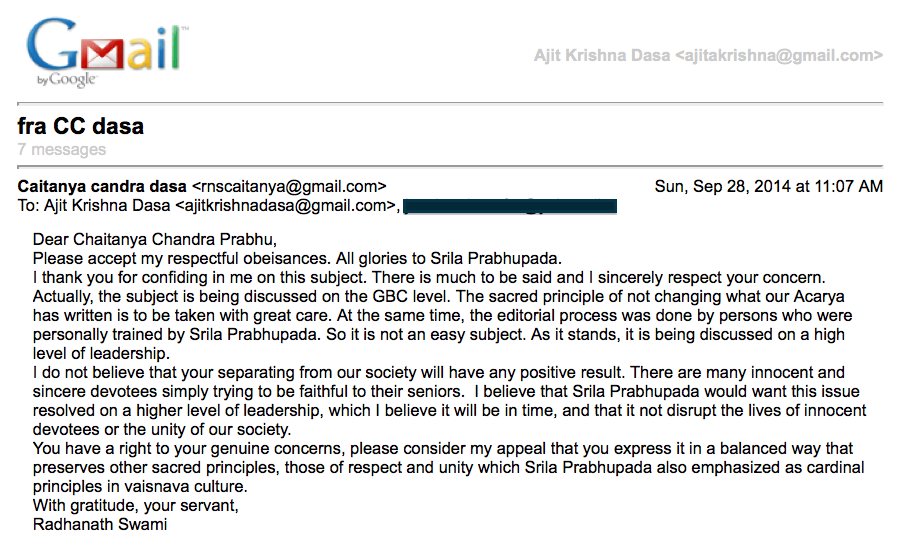
In September 2014 Radhanath Swami sent the below e-mail to one of his Danish disciples, Caitanya Candra Dasa:
Screen Shot 2015-03-29 at 10.03.33

Here is the text in digital format:

“Dear Chaitanya Chandra Prabhu,
Please accept my respectful obeisances. All glories to Srila Prabhupada.
I thank you for confiding in me on this subject. There is much to be said and I sincerely respect your concern. Actually, the subject is being discussed on the GBC level. The sacred principle of not changing what our Acarya has written is to be taken with great care. At the same time, the editorial process was done by persons who were personally trained by Srila Prabhupada. So it is not an easy subject. As it stands, it is being discussed on a high level of leadership.
I do not believe that your separating from our society will have any positive result. There are many innocent and sincere devotees simply trying to be faithful to their seniors. I believe that Srila Prabhupada would want this issue resolved on a higher level of leadership, which I believe it will be in time, and that it not disrupt the lives of innocent devotees or the unity of our society.
You have a right to your genuine concerns, please consider my appeal that you express it in a balanced way that preserves other sacred principles, those of respect and unity which Srila Prabhupada also emphasized as cardinal principles in vaisnava culture.
With gratitude, your servant, Radhanath Swami

An analysis:

We can see that Radhanath Swami is an intelligent diplomat.

RS: “I thank you for confiding in me on this subject.”

Radhanath Swami tries to maintain a relationship of trust. He makes it seem as if he appreciates Caitanya Candra Dasa’s questions, and invites him to open up his heart.

RS: “There is much to be said…”

This could make it seem as if Radhanath Swami has some special knowledge about the book changes, and as if it is a great mystery (secret knowledge) that requires deep and intense study, sadhana and special association to understand. But what Radhanath Swami is really saying, I guess, is that he does not know much about this matter, and that he is not going to speak much about it – neither to Caitanya Candra Dasa nor publicly.

RS: “…and I sincerely respect your concern.”

Radhanath Swami makes it seem as if he truly shares Caitanya Candra Dasa’s concerns. He speaks as if they are on the same side – that of genuine concern. But Radhanath Swami’s statement is trivial, for who does not care for Srila Prabhupada’s books? Everyone will say they care. Everyone will say that the editing should be done in a way that pleases Srila Prabhupada. But notice that Radhanath Swami does not disclose his own personal opinion. He really says nothing at all.

RS: “Actually, the subject is being discussed on the GBC level. The sacred principle of not changing what our Acarya has written is to be taken with great care. At the same time, the editorial process was done by persons who were personally trained by Srila Prabhupada. So it is not an easy subject. As it stands, it is being discussed on a high level of leadership.”

Here we again see Radhanath Swami’s diplomatic skills at work. He is indirectly saying that Caitanya Candra Dasa should not care much about it because it is being taken care of “on a high level of leadership”. Radhanath Swami says: “Do not worry! The GBC will handle it! Go back to sleep!”

But we all know what “a high level of leadership” in ISKCON means! It means incompetent devotees creating new problems while trying to solve already existing problems caused by themselves.

And what is the proof that the GBC are talking about this? It was not mentioned in the GBC resolutions of 2015. Maybe Radhanath Swami is misinformed or twisting the truth trying to buy time. Or maybe there is really a committee of around 3 members who are all pro-change who speaks about the book changes 2 hours per year trying to figure out how to close the mouths of the protesters.

Why should we accept Radhanath Swami’s “assurance” that the GBC is handling this issue? For all we know he could be lying. He presents no proof.

Radhanath Swami tries to balance things out by acknowledging that it is important not to change the words of our Acarya. But at the same time, he says, we should remember that those who did the changes were personally trained by Srila Prabhupada. Radhanath Swami uses the same diplomatic skills as Duryodhana on the battlefield first glorifying Drona and then Bhisma. He is saying to Caitanya Candra Dasa: “You are good, and they are also good! Therefore it is all very complicated and can only be solved at GBC level! Please go back to sleep!”

RS: “So it is not an easy subject.”

It really does not take much of a brain to see that Jayadvaita Swami and BBTI have violated the arsa-prayoga big time. But either Radhanath Swami will not write this online, or he is in denial or simply does not know much about what has been done to Srila Prabhupada’s books.

What we do know is that he is diplomatic, and that he is not going to risk his own prestige and position by speaking about the book changes online or publicly.

Factually, by his silence Radhanath Swami is accepting the changes made to Srila Prabhupada’s books by the BBTI, and by encouraging his disciples to also stay silent, he is also encouraging them to accept the changes.

RS: “There are many innocent and sincere devotees simply trying to be faithful to their seniors. I believe that Srila Prabhupada would want this issue resolved on a higher level of leadership, which I believe it will be in time, and that it not disrupt the lives of innocent devotees or the unity of our society.”

Radhanath Swami seems to have failed to understand that the so-called “higher level of leadership” in ISKCON has had more that 30 years to resolve this very simple issue. But they have continuously made the situation worse. Instead of stopping all editing while investigating the matter thoroughly they have allowed BBTI to continue editing many of Srila Prabhupada’s books.

We have absolutely no reason to believe or trust that the BBTI or GBC are capable of solving this issue on their own. And since they will not listen we have to challenge them to answer publicly. There is no other way. It is their own fault that this subject is being debated publicly.

And to claim that it is dangerous for new devotees to hear of such controversial topic is simply foolish. Our first concern in spiritual life is to make sure that the scriptures we read are bona fide. This is ABC and all new devotees are taught this in the temples, and it is written in all of Srila Prabhupada’s small introductory books. So if there is any doubt about the authenticity of the books, then all devotees need to know.

The funny thing is that we know for sure that the original books are bona fide and have the power to deliver us. But we are not sure if the changed editions have that potency. As a guru Radhanath Swami ought to have at least the amount of intelligence to understand that we must stop printing the changed books until we know for sure which editions are bona fide. Better safe than sorry.

But Radhanath Swami has never stepped forward to ask the BBTI to stop their editing while the matter is being investigated.

Instead Radhanath Swami suggests that we leave this crucial matter to incompetent “high level leaders”, while we sleep our way back to Godhead. Are these foolish instructions on the book changes really coming from a bona fide spiritual master?

RS: “You have a right to your genuine concerns, please consider my appeal that you express it in a balanced way that preserves other sacred principles, those of respect and unity which Srila Prabhupada also emphasized as cardinal principles in vaisnava culture.

With gratitude, your servant, Radhanath Swami”

Radhanath Swami tries to close the correspondence in a mood of friendship. He has said something and at the same time nothing. Radhanath Swami prefers that Caitanya Candra Dasa keeps quiet about this matter and leaves it to the “high level leaders”. At the same time Radhanath Swami knows that Caitanya Candra Dasa might not want to keep his mouth shut, so he implores him to speak in a balanced way if he speaks about it.

At no point did Radhanath Swami state his own opinion about the book changes, and he did not help Caitanya Candra Dasa understand this most important issue. If Radhanath Swami really was a bona fide guru, then he should easily be able and willing to clear the doubts of his disciples on this matter. But it seems he cannot do that. Or maybe he choses to let his disciples stay in the darkness of ignorance in order not to get himself into trouble.

This is not how a guru works. A guru is not a diplomat. A guru is straight forward. A guru want to help his disciples. He wants to save them from ignorance and the offences of violating the arsa-prayoga principle.

Some of our local ISKCON authorities in Denmark have tried to impress upon the Danish devotees that Caitanya Candra Dasa is violating his guru’s instructions by speaking about the book changes. But we can see this is false. Radhanath Swami says that Caitanya Candra Dasa has the right to be concerned about the book changes, and he does not prohibit Caitanya Candra Dasa from speaking publicly about the book changes – for whatever reason.
PROOF POSITIVE: AN APPEAL TO JAYADVAITA SWAMI FOR CLARIFICATION (PART 2)

Screen Shot 2014-07-26 at 19.25.48

BY: THE ASSEMBLED DEVOTEES

Jul 25, 2014 — GLOBAL (SUN) —

No Opportunity for Questions?

In the 2003 Honolulu conversation cited in the first installment of Proof Positive, Jayadvaita Swami stated:

“there was no opportunity to like send Prabhupada back and forth, like sending him the second chapter and getting it back and asking questions; it just didn’t happen.”

In the 15 months prior to Srila Prabhupada approving the 1972 Bhagavad-gita blue-print/galleyproof, Jayadvaita wrote to His Divine Grace on six different occasions regarding book production. Srila Prabhupada replied each time, often with detailed explanations and instructions. Though the statements found in some of these letters (see below) refer to books other than Bhagavad-gita, they are still a definitive indication that Srila Prabhupada had made himself available for final proofreading, questions on editing, and other details of book production, and that he already was communicating and interacting with Jayadvaita on such matters.

And, as indicated below, Srila Prabhupada also went to New York and spent approximately 14 days there in July and August of 1971. The record shows that Jayadvaita had plenty of opportunity to send Prabhupada the Bhagavad-gita blue-prints, manuscripts and queries, as well as to meet personally with His Divine Grace. Srila Prabhupada also made a standing offer directly to Jayadvaita in a meeting in Boston in 1969 regarding publishing of the unabridged Gita:

Jayadvaita: [referring to the “original” manuscript] Some of it has been edited by Rayarama, but you can see around it and go to the original behind it.

Srila Prabhupada: So whatever is lacking, you ask me. I will supply you.

Why, then, did Jayadvaita Swami state there was no opportunity, and why didn’t he ask his questions when he had the chance?

(Emphasis is added in the following letters and some have been abbreviated):

Letter to Jayadvaita- Bombay, March 17, 1971:

“My Dear Jayadvaita, Please accept my blessings. I am in due receipt of your letter dated 21st February, 1971 and noted the contents carefully. I do not know what may have happened to the letter dated 9th January, 1971, but I have not received it.

Regarding your questions:

12:12: The ultimate point is to come to the stage of loving Krsna and all other indirect processes are subsidiary….

14:27: Impersonal Brahman is the constitutional position of ultimate happiness because without coming to the brahma-bhutah platform and remaining engaged in the activities of brahman nobody can be joyful….

I have dictated the missing purports from Chapter IX and they are set enclosed herewith. So far changing the working of verse or purport of 12:12 discussed before, it may remain as it is.”

Letter to Jayadvaita- Los Angeles, July 3, 1971:

“My Dear Jayadvaita, Please accept my blessings. I am in due receipt of your letter dated 30th June, 1971 and have noted the contents carefully. Your report on the progress of Srimad-Bhagavatam, first four cantos, is very much encouraging, so continue this work very seriously. I have again begun translating work and have so far sent Satsvarupa Prabhu three tapes from 4th Canto, 8th chapter, and will be sending many more.”

Letter to Jayadvaita- Los Angeles, July 13, 1971:

“I am in due receipt of your letter dated 10th July, 1971 and have noted the contents. Also I have received the laid-out sheets for tapes no. 1 & 2 and they are very well done. Thank you very much. I was so much pleased to see that already the tapes were edited and laid out and this is encouraging me to translate more and more. You can give Ch. 8 of S.B. canto 4 the title “Dhruva Maharaja enters the forest to meet the Lord”.

…Very soon I am coming to N.Y. and we can discuss further on these matters.

Letter to Jayadvaita- Calcutta, February 18, 1972:

“My Dear Jayadvaita, Please accept my blessings. I beg to acknowledge receipt of your letter of February 5, 1972, and have noted the contents. Yes, because no one else can do them, I shall do the sanskrit synonyms. You simply send me now the manuscripts as required by you, and I shall send back either dictaphone tapes or tape-recorder cassettes.”

Letter to Jayadvaita- Calcutta, March 5, 1972:

“My dear Jayadvaita, Please accept my blessings. I have also received your letter along with Bali Mardan’s….As I have informed, Pradyumna and Syamasundara will be sending you regularly completed transcriptions of my translation work by post, that will avoid the high cost of sending tapes, which besides are very expensive and may be lost easily in mail, and because I am here if they have questions I can answer and make the final proofreading, and this will expedite everything. One thing, now you say the date for printing by MacMillan Co. is set for August 1st, but last time you said June 1st, so I am wondering how long this delaying business shall go on?”

Letter to Jayadvaita- Los Angeles, May 28, 1972:

“My Dear Jayadvaita, Please accept my blessings. I have received your letter dated May 26th, 1972, along with the blue-print copies of Bhagavad-gita As It Is from MacMillan Company. It is very nice. So I shall be looking forward to seeing the entire manuscript and book sometime around first July, 1972.”

In summary, Srila Prabhupada stated:

“So whatever is lacking, you ask me. I will supply you.”
(1969 meeting in Boston)

“Very soon I am coming to N.Y. and we can discuss further on these matters.”
(he then spends 2 weeks in New York)

“if they have questions I can answer and make the final proofreading”

“I have received your letter dated May 26th, 1972, along with the blue-print copies of Bhagavad-gita As It Is from MacMillan Company. It is very nice. So I shall be looking forward to seeing the entire manuscript and book sometime around first July, 1972.”

In total, Jayadvaita corresponded with His Divine Grace on six different occasions between February 1971 and May 1972.

Jayadvaita Swami stated:

“there was no opportunity to like send Prabhupada back and forth, like sending him the second chapter and getting it back and asking questions; it just didn’t happen.”

Confidential E-mails From Ramesvara Leaked (Dec. 2014)

Just recently three confidential e-mails were leaked and posted on facebook. They reveal what Ramesvara Prabhu thinks about the changes made the Srila Prabhupada’s Bhagavad-gita, the editing policies of the BBTI and they shed light on what happened when the GBC and BBT trustees “reviewed” the 83 Gita. ramesvara1 Below are some quotes that will rock the boat, but please visit the website at the end of this article to see all three e-mails in their entirety and thus get the full picture. Quotes From confidential email no. 1:

“The problem with the “Responsible Publishing” paper is that it is simply not the entire body of instruction, and it‘s critics point out that it is one-sided and obviously leaves out many of Prabhupada’s cautionary instructions against unnecessary change,”

[…]

“That analysis with Dravida Prabhu left me with my deepest concern: if the changes didn’t have substantial merit but were made anyway, then regardless of the justification of “making it better” the door, the “change disease” as Srila Prabhupada called it, had been dangerously opened for anything to happen in the future after we are all long gone.”

[…]

“The Lilamrita interviews I found tell of Srila Prabhupada’s direct instructions regarding the size of the books, the artwork to be kept in the books, etc. – things that have already been changed so many times in the past 20 years, without understanding of Prabhupada’s orders, that it makes the “official” opening of this “change” door more ominous for the future, in ways we can’t even imagine.”

[…]

“…an absolute position has to be reached so that before we die, we know that within the BBT and ISKCON there could never again be one single change, for any reason, ever made to Srila Prabhupada’s books.”

From confidential e-mail no. 2:

“The “Responsible Publishing” (RP) paper has either a significant misleading or a significant historical inaccuracy. There are sites which claim to list more than 5,000 changes. Certainly there were thousands of changes. The RP paper states that every change to the translations was reviewed and approved by the Trustees, leading ISKCON devotees, the CBC, etc. Later the RP cites or implies in its endorsements that all the changes were approved. Of course, NO ONE other than the editors ever saw back in 1981 or 1982 ALL the changes.”

[…]

“I have always admitted that my great failure as a trustee was not carefully reading every proposed change, and instead, relying on the endorsement of Hridayananda and Satsvarupa- along with Jayadvaita.”

[…]

“I know that in talking years ago with others on that committee, that they also admitted performing only a cursory review of the proposed changes,…”

[…]

“No one back then did their job or acted with full responsibility for what they were endorsing. l assure you that NO ONE on that Committee ever even asked to see all the changes, and we would have been astounded to have learned in 1981 or 1982 that there were thousands, maybe more than 5,000 changes. I lazily assumed that the work done on manuscripts as close to the original as possible was the only thing that mattered. I failed to consider all the other Prabhupada instructions, the ramifications for making changes if they didn’t ultimately change the meaning; the effect of changes that in some cases loses the flavor of the Gita we had been studying for 10 years, and most importantly, that breaks the etiquette of changing a Sampradaya Acaraya’s books after His disappearance and opens the “change door” for possible future other changes over the decades and centuries to come. The RP paper implies that the changes were carefully reviewed and approved throughout the leadership of the BBT, GBC and ISKCON. I am certain that by interviewing all the leaders of that time, we would find most guilty of the same mistake that i made. It is true to state that the leaders of ISKCON at the time endorsed the changes. However, it is overtly misleading to state or suggest that the leaders actually performed a careful review. And getting back to the fact that there are thousands of changes, no leader, including the BBT Trustees, was ever shown every single change. No one! That is the sad historical fact…”

From confidential e-mail no. 3:

“I find it embarrassing that on the site BBTEdit.com, in the section about editing posthumously, the only quote to support touching the works of a departed Acarya is that Srila Jiva Goswami was working posthumously on Bhakti Rasamrita Sindhu. Seriously – how can any living entity compare themselves to Sri Jiva Goswami, or think because he touched the work of Sri Rupa Gosvami, therefore an editor in the lower stages of bhakti, not yet fully situated in the perfected stages of bhava (what to Speak of prema) can touch and change the words of a departed Sampradaya Acarya. Not a good example in my lowly View – it begs the question of What our editors think of themselves and their level of Krsna Consciousness. Oh well…”

Please find all the three e-mails in their entirety here: http://jayasrikrishna.weebly.com (PDF and Word). You can also see and download the e-mails here as PDF and Word.