Is Jayadvaita Swami still good?

Help us by “liking” and “sharing” this post!

By Ajit Krishna Dasa

BBT International and their supporters often attempt to justify the changes made to Prabhupada books by Jayadvaita Swami by pointing out that Prabhupada a couple if times spoke highly of his editing work.

This article will show that these statements by Prabhupada can’t be construed to mean that Jayadvaita Swami editing work after Prabhupada’s disappearance is pleasing to Prabhupada.

From BBT International’s website:

“Of course, regarding Jayadvaita Swami, the BBT’s chief editor, Srila Prabhupada wrote, “Concerning the editing of Jayadvaita Prabhu, whatever he does is approved by me. I have confidence in him.” (letter to Radhavallabha, 7 September 1976)

BBT International and their supporters often speak about this quote from Prabhupada as if it was some kind of blessing from Prabhupada that makes Jayadvaita Swami and his editing infallible even to this very day. This, of course, makes no sense and even Jayadvaita Swami himself admits that he sometimes commits mistakes in his editing. One example of this is his changing “Visnu Form” into the “Visnu platform”:

visnu-platform

(Click to enlarge picture)

So it’s obvious that we can’t take the statement “…whatever he does is approved by me” too literal. In order to be continuously approved by Prabhupada Jayadvaita Swami need to continuously meet certain criteria set forth by Prabhupada and sastra in regard to editing protocol. If it can be argued in any way that the editing policy of BBT International compromises the transcendental potency of Prabhupada’s books, or if Jayadvaita Swami becomes an atheist or a mayavadi or falls down and or if he somehow goes against the direct instructions of Prabhupada in his editing proces, then we must conclude that his editing is unauthorized and must be stopped. He can then no longer be “approved”.

This blog and several other websites have for years been showing that there is no evidence to support even the slightest change in Prabhupada’s books. It has been shown how Jayadvaita Swami does not at all perform his editing work according to the accepted protocol set forth by Prabhupada (“NO CHANGES”), sastra (arsa-prayoga) and even academic scholars. We have shown how he is actually sabotaging the books – however well-intentioned he may be.

So even though Prabhupada spoke highly of Jayadvaita Swami’s editing 40 years ago it does not make Jayadvaita Swami infallible, and it does not mean that he can just do whatever he likes to Prabhupada books.

The other quote that BBT International and their supporter often refer to is this:

From BBT International’s website:

“And in the conversation where Srila Prabhupada complained so strongly about “rascals editors,” Srila Prabhupada said about Jayadvaita, “He is good.””

So 40 years ago Prabhupada said about Jayadvaita Swami that he was “good”. Does it then follow logically or experientally that he is still “good”? Obviously not! There are several examples of Prabhupada at one point praising some of his disciple, and then at a later point criticized them severely.

Prahlada-Nrsimha Prabhu has written a very nice article about this (published on bookchanges.com):

Just because Srila Prabhupada at one point said someone was a good man, does that mean that they are one now? Srila Prabhupada liked many devotees at one point and at that point put them in positions of power and authority and praised them, but later on down the road he changed his opinion about them and/or they went astray or deviated to one degree or another. So although at one point Prabhupada approved of someone and complimented them, that does not mean that from that point on they are bona-fide no matter what they do. Here are a few examples to further examine this point.

One Prabhupada disciple did HUGE service for Prabhupada, pushing on the book distribution mission (probably) more than any other Prabhupada disciple in ISKCON’s history, and was pretty much running ISKCON at one point. But later he changed the basic rules of the four regulative principles to three. Does that mean because he had so many thousands of disciples, and at one point was so dear to Srila Prabhupada that Prabhupada even commented on how he was so intelligent and empowered, that now we should all only have three regulative principles instead of four and continue to follow this devotee?

There were so many big, big devotees that Srila Prabhupada personally gave sannyasa to but later on Srila Prabhupada became so fed up with their deviations that he said that they should give up those positions as sannyasi! Srila Prabhupada even said “This should be strictly outlawed, no more sannyasis….there will be no sannyasi anymore.”

(Room Conversation — January 7, 1977, Bombay)

Srila Prabhupada established the GBC as the ultimate managing authority for all ISKCON. But at one point Srila Prabhupada totally disbanded the whole of the GBC within ISKCON due to their deviations! So simply because at one point in time Srila Prabhupada appointed them to power and trusted them, does that give them permanent power? No! At any time anyone can lose their position and power and deviate or go astray and at that point one is no longer authorized and empowered.

I feel the most relevant example is from the concluding words of the Sri Caitanya-caritamrta, dated November 10, 1974

“Now, by the grace of Sri Caitanya Mahaprabhu and his Divine Grace Bhaktisiddhanta Sarasvati Thakura, it is finished. In this connection I have to thank my American disciples, especially Sriman Pradyumna dasa Adhikari, Sriman Nitai dasa Adhikari, Sriman Jayadvaita dasa Brahmacari and many other boys and girls who are sincerely helping me in writing, editing and publishing all these literatures.”

But then on February 27, 1977 in Mayapura India Srila Prabhupada says “Nitai, he’s a rascal.”

Unfortunately there are so many examples I could mention, but in order to not depress/and embarrass all of us unnecessarily in this article I will stop here.

In conclusion, we have shown how the above two claims by the BBT International about Jayadvaita Swami being “good” and his work being “approved” by Prabhupada can’t be used to justify the changes he has made to Prabhupada’s books. And that they can’t be used as a guarantee that Jayadvaita Swami has not comitted mistakes himself or that he has pleased Prabhupada by his work.

“Rascal Editors” (Prabhupada Conversations, June 22, 1977, Vrindavana)

Help us by “liking” and “sharing” this post!

Read the complete conversation here.

Original and authorized 1969 Sri Isopanisad (audio book)

Help us by “liking” and “sharing” this post!

Prabhupada became extremely concerned when he was informed that his own BBT had changed his Sri Isopanisad and he wanted it published again “the original way”. However, this instruction was never followed.

But here is the original version in audio and as ebook for FREE from krishnapath.org:

Sri_Isopanisad_original

FREE ORIGINAL AND AUTHORIZED SRI ISOPANISAD AUDIO AND EBOOK

“The next printing should be again to the original way.”

Yasoda-nandana: Sometimes they appeal that “We can make better English,” so they change like that, just like in the case of Isopanisad. There are over a hundred changes. So where is the need? Your words are sufficient. The potency is there. When they change, it is something else.

Svarupa Damodara: That’s actually a very dangerous mentality.

Yasoda-nandana: What is it going to be in five years? It’s going to be a different book.

Prabhupada: So you… What you are going… It is very serious situation. You write one letter that “Why you have made so many changes?” And whom to write? Who will care? All rascals are there. Write to Satsvarupa that “This is the position. They are doing anything and everything at their whim. The next printing should be again to the original way.”

(S.P. Conversation, “Rascal Editors,”June 22, 1977, Vrndavana)

Lord Ramacandra removed from Bhagavad-gita, As It Is (10.31 purport)

Help us by “liking” and “sharing” this post!

This article was sent to the BBT International the 17th Oct. 2013. We asked them to comment on the points raised. So far we have not received any reply.

By Ajit Krishna Dasa
rama-nama

Changes have been made to the purport of verse 10.31 in Prabhupada’s Bhagavad-gita:

Here is a complete comparison of BG. 10.31 in Prabhupada’s 1972-edition and BBT International’s 1983 edition:

Continue reading

Cover Up

Help us by “liking” and “sharing” this post!

By Bhakta Torben Nielsen

(This was originally posted in the Sampradaya Sun.)

bg-cover-original

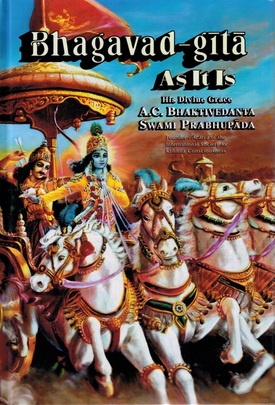
Here in Denmark we have a “new” version of Srila Prabhupada’s Bhagavad-gita As It Is (supposedly), coming up. One of the editors, Jahnu/Jahnudvipa prabhu, publicized his suggestion for a front cover (pictured below). As everyone can see, by comparison, it is different, in so many ways, from Prabhupada’s Bhagavad-gita As It Is. This is a local example, but from research on the Internet, it is easily seen how widespread this corruption is.

Srila Prabhupada:

“And the covers, if possible, should always be the same for each respective book regardless of what language it may be printed in.” (Letter to Jadurani, Bombay, January 3, 1975)

“Regarding Bhagavad-gita, enlarged edition, the picture approved by me to Jadurani is all right.” (Letter to: Satsvarupa – Los Angeles 31 July, 1970)

A subsequent “debate” on editor Jahnu’s suggestion of a Bhagavad-gita cover was quickly censored, including Jahnu’s picture. The topic was banned, as there is a stricture on that facebook forum (Krishna.dk) not to bring up “institutional”, “controversial” or “negative” material.

The idiotic irony is that bringing up the topic is “controversial” and forbidden – but DOING these things, changing the books, is fine.

jahnus-cover-bg-1

Jahnu’s Suggested Bhagavad-gita cover

______________________________________________

A few comments from Ajit Krishna Dasa (not featured in the post at Sampradaya Sun)

It is truly astonishing to see the amount of mistakes on this suggested cover:

  • Bhagavad-gita is wrongly spelled with capital “G” in “gita. It is supposed to be a small “g”.

Prabhupada says:

“Regarding the listing of the Bhagavad-gita in the religion catalog of MacMillan, they have spelled it Bhagavid Gita and not Bhagavad-gita As It Is. I do not know why they should commit such mistake, I hope that this will not hamper the sales. Please point out this discrepancy to Mr. Wade.” (Letter to Brahmananda, Los Angeles, 19 December, 1968)

  • Over the “i” and the “a” there should be a line. That could be excused if this is not the final version, and the sanskrit diacritics will be added later.
  • On the original it says “As It Is”. In Jahnu’s this is changed to only capital letters “SOM DEN ER”.
  • On the original books it says “His Divine grace”. On Jahnu’s we find “Sri Srimad A.C…”
  • Regarding the artwork itself. Prabhupada was happy about the front cover of his 1972 edition. He approved it. He never asked for it to be changed at any point. The original cover is shining, it gives the impression of heroism, chivalry and fighting for the right cause. The colors on Jahnu’s cover is dark, boring and depressing. Prabhupada said that if a painting should be changed it should be the exact same scene, but made better (read more about this here). On Jahnu’s cover we find a different scene, and the dark and depressing colors certainly does’nt make it better.

I find it truly astonishing how a BBT International editor like Jahnu, who has been working for BBTI for more than 20 years, doesn’t know or care about the clear instructions from Srila Prabhupada regarding front covers, artwork and text-editing. The amount of speculation Jahnu puts into his cover is amazing.

Ramesvara Dasa speaks about his 1979 interview

Help us by “liking” and “sharing” this post!

Ramesvara Prabhu writes about the recently discovered interview with him from 1979-1980 made for the Prabhupada Lilamrta:

Ramesvara-sharp-memory-tiff

And:

ramesvara-editing-facebook-tiff

If Ramesvara Prabhu have not already given the above information to the BBT International we hope he will do so soon. How can we change paintings that Prabhupada personally designed?

Here is the text:

“Hare Krsna. Please accept my humble obeisances. All glories to Srila Prabhupada! I was very surprised to discover that the full unedited transcript of my Prabhupada Lilamrita memory interviews in 1979-1980 survived and were discovered during a visit to the Bhaktivedanta Archives in 2012. These recollections were given when my memory of Srila Prabhupada was fresh and sharp. Kindly excuse any deficiencies in this recounting. I beg to remain your aspiring servant, ramesvara dasa” (Facebook update from Robert Grant (Ramesvara Dasa) 09.07.2013)

and…

“Dear Respected Prabhus, Pamho, AGTSP!
The total body of instructions given by Srila Prabhupada about editing his divine books go far beyond these few recollections. I would draw your attention however to Srila Prabhupada’s selection of art paintings published in his books. What many may not know is that His Divine Grace, planned, and in many cases personally designed the paintings in The Krsna Books and the Bhagavad Gita As It Is, even going as far as sometime sending a line drawing sketch of his own to the artists. Under his divine direction, and being empowered by him, devotional artistic abilities were awakened in his artists. Being thus empowered by his order, they produced 63 paintings for the Krsna Books in one year, and more than 50 paintings for Bhagavad Gita As It Is in one year. The full story of Srila Prabhupada creating ISKCON Press and getting this divine production out of literally a handful of surrendered artist disciples is a true miracle, as amazing as any other marathon in ISKCON history! Your aspiring servant, Ramesvara dasa” (Facebook comment from Robert Grant (Ramesvara Dasa) 09.07.2013)

“They are ruining my books”

Help us by “liking” and “sharing” this post!

Ramesvara interview

A very, very important document has just become public. It is a 300+ page transcript of a 1979 interview with Ramesvara Dasa (manager of the Bhaktivedanta Book Trust when Prabhupada was with us). Ramesvara Dasa was the person directly in charge of printing Srila Prabhupada’s books.

In this interview Ramesvara Dasa is giving a completely honest account of Srila Prabhupada’s instructions to him in regard to not changing his books and on many other points also.

This is perhaps the most important document that has come to light in ISKCON since 1977.

You can download and read the PDF file of the interview by clicking on:

Ramesvara-interview-1979

Please read it…

Here are some of the important instructions on responsible publishing given by Prabhupada to Ramesvara Dasa:

Ramesvara Dasa:

“And also at that Mayapur meeting of 1976 we had had meetings with Prabhupada about the Bhagavatam. We prepared for that Mayapur festival a color board which showed all the volumes of the Bhagavatam drawn in for each Canto what the color would be. And Srila Prabhupada approved the color scheme for the Srimad-Bhagavatam for all the reprints. But he warned us emphatically that this must be the very very last change that is ever to be made in the Srimad-Bhagavatam.

“Prabhupada at that time approved the new design for the Krsna Book trilogy and then he approved the standardization in terms of lettering and so on for the Bhagavatams and he approved the new color board. That is what the 12 Cantos are going to look like. Prabhupada was very happy to see that we had made a plan. But then he got very grave and said, “Now, this is the final plan, this is the final approved standard, there can never be any more changes.” He was emphatic, he was insistent, and he pounded it into our heads.

“What about the incorrect grammar? “Prabhupada’s reply, “You cannot change one comma, not even a comma, not even a punctuation mark, that is the etiquette.” So that was just another one of those super heavy instructions that the etiquette in dealing with a great acarya’s books is that whatever he has done it’s eternal and it can never be changed. And I believe that all of this was part of Prabhupada’s training us . He wanted to train people who would be entrusted with his books.

“…you can get a first hand understanding of how intense Prabhupada was and how concerned he was that in the future no one ever be allowed to make changes in his books. This was more than just a preoccupation with Prabhupada. This was a, you could call this a transcendental phobia, that the entire movement would without any shadow of a doubt be completely wasted and all the work and effort of all the devotees that Prabhupada was directly as well as his own efforts would all be ultimately lost if his books we re changed. That was his attitude. He expressed that attitude very clearly in 1974 in that conversation and in that letter you’ll see the statements Prabhupada made about how everything will be ruined if his books are changed.

“With the BBT, the size of the books, the type of art in the books and so on, on principle Prabhupada would not allow changes even if the change was an improvement. Just to teach that principle of don’t change.”

“Prabhupada just explained how everyone’s a rascal for daring to touch anything in his books. The greatest anxiety he has is that after he’s gone we will add things to his books that are bogus, we will take things out that are bona fide, we will make changes in his books and the whole work for 10,000 years, his plan Prabhupada was working on, it will all be spoiled by us because of our tendency to change. And Prabhupada gave an example that the disease to do things differently is so inherent in the Americans that for the sake of doing things differently we would walk on our hands rather than our feet.”

Don’t you dare change the picture on my book! I have deliberate ly chosen the picture of Visnu because I want this book to be attracting the Mayavadis and impersonalists. So that was the first direct instruction that I had received from Prabhupada which gave me an understanding o f how much he would meditate on every facet of his books. The art, the size, the pictures, who the market was. And I began to realize Prabhupada is very much on top of his book design and publishing.”

If you put anything bogus in my book , this is my greatest fear that you will ruin my book and the whole book will be ruined because of you!

“The first of many experiences I’ve had with Prabhupada literally drilling me , pounding it into my head that you’re never allowed to change anything in his books. He trained me so intensely on this point. Even when the changes make sense he wouldn’t let me change. Just to train me.”

Ramesvara-interview-1979

The definitive english edition of Bhagavad-gita

Help us by “liking” and “sharing” this post!

By Ajit Krishna Dasa

This is the back cover of the Bhagavad-gita As It Is (Third printing, 1973)

BG bagside-tiff

Meriam-Webster Dictionary:

1de·fin·i·tive
adjective \di-ˈfi-nə-tiv\

Definition of DEFINITIVE

1 : serving to provide a final solution or to end a situation <a definitive victory>
2 : authoritative and apparently exhaustive <a definitive edition>
3
a : serving to define or specify precisely <definitive laws>
b : serving as a perfect example : quintessential <a definitive bourgeois>
4 : fully differentiated or developed <a definitive organ>

(http://www.merriam-webster.com/dictionary/definitive)

Prabhupada:

Prabhupada: He has mistaken in so many ways. (Sanskrit) Just like our… Not Pradyumna. If somebody has boils all over the body, then where it will be operated? Better kill this body. (laughing) So he has got so many boils, this Hegel and Segel, all, because they are speculators. They have no definite knowledge. Speculators cannot have definite knowledge. Therefore our Professor Dimmock has said, “Here is definite definition of Gītā.” What is that? Just see. Then it is so. He has appreciated it. You cannot see, of the…
Devotee: They only put two lines of what he said in there. He says this…
Prabhupāda: Yes. That is his word.
Devotee: Oh.
Prabhupada: Read it all.
Devotee: “Definitive English edition of Bhagavad-gītā. By bringing us a new and living interpretation of the text already known to many, A.C. Bhaktivedanta Swami Prabhupāda has increased our own understanding manyfold.”
Prabhupada: That is a definite, not vague, speculative. That is the difference between my translation and others. Therefore I have given the name “As It Is.” So we will be no spoke or speculation. As soon as you speculate, you are rejected. Therefore others are seeing some danger that “This Bhaktivedanta’s…, this Bhagavad-gita As It Is accepted, then where we are?”

(http://prabhupadabooks.com/classes/philosophy/hayagriva/george_wilhelm_friedrich_hegel – May 1976)

And

Prabhupada: Therefore rascal. (laughter) Therefore rascal. We definitely know Krishna, the origin of everything. That is definite, not “It may be.” We don’t say “Krishna may be.” No. Definitely. Krishnas tu bhagavan svayam [SB 1.3.28]. Here is Bhagavan. Here is God. That is definite. Therefore our professor…
Hamsaduta: Svarupa Damodara?
Prabhupada: No, no. Who has written foreword to my Bhagavad-gita?
Harikesa: Dimmock.
Prabhupada: Dimmock. “Here is definitive…”
Hamsaduta: Version.
Nitai: “Definitive edition.”
Prabhupada: “Definitive edition.” That is the credit. Not “may be.” No “maybe,” sir. That is rascaldom.

(http://prabhupadabooks.com/conversations/1975/nov/morning_walk/new_delhi/november/26/1975)

Prabhupada never asked that his gita be re-edited. On the contrary, in May 1976 Prabhupada still referred to his gita as “the definitive edition” comparing it to other translations of lesser importance. During the four years from 1972 to 1976 he could have changed it if he had wanted to. But he still considered his translations and purports as they appeared at that particular time (May 1976) to serve as the final solution, the end of all editions, the authoritative, the exhaustive, the defining, the precise, the perfect example, the fully differentiated and developed edition of the Bhagavad-gita EVER published in recent times. Nothing indicates that Prabhupada ever changed his mind about this.

But to many devotee’s amazement the BBT International seemed not to agree with Prabhupada! Because in 1983 (six years after Prabhupada’s physical disappearance) the BBT International deleted the foreword by Professor Dimmock wherein he says that Prabhupada’s Bhagavad-gita As It Is, 1972 edition, is the “definitive edition“. They also in some (if not all) of their many publications of their changed 1983 edition – deleted the sentence “The definitive english edition of Bhagavad-gita” from the back cover. And they exchanged pictures and paintings and made 5000+ changes, additions and deletions in the translations and purports of the book.

Why?

Covers should be the same regardless of language

Help us by “liking” and “sharing” this post!

The text below was sent to the BBT International through their website (http://www.bbtedit.com/contact) and to Jayadvaita Swami and Dravida Prabhu’s personal e-mails (jswami@pamho.net, jayadvaita.swami@pamho.net, dravida108@gmail.com) the 7th Feb. 2014. We asked them to comment on the points raised.

So far we have not received any reply.

By Ajit Krishna Dasa

Prabhupada:

“And the covers, if possible, should always be the same for each respective book regardless of what language it may be printed in.” (Letter to Jadurani, Bombay, January 3, 1975)

But what has happened after Prabhupada’s physical departure? The new Bhagavad-gita looks very different! Now there are many different covers on the market. There are even many different covers for the English edition(s), and also for other editions in their particular language.

Here you can read more about the changes to the pictures, paintings and covers in Prabhupada’s Bhagavad-gita, As It Is:

Click to access _changes.pdf

Starting with the original front cover here are some of the many different covers used to present Bhagavad-gita, As It Is. Continue reading

Prabhupada did the proofreading of the entire Bhagavad-gita As It Is

By Ajit Krishna Dasa

Brahmananda Prabhu as quoted in ”Srila Prabhupada Lilamrta”:

“Macmillan Company was publishing Bhagavad-gita, and Prabhupada himself was publishing Teachings of Lord Caitanya through Dai Nippon in Japan. Because Brahmananda had contacted the editors at Macmillan Company, Prabhupada credited him with the success of the Gita’s being published by such a famous company. Brahmananda was also Prabhupada’s man for dealing with Dai Nippon. Both books were on tight printing schedules, and Brahmananda had to return quickly to New York with the corrected proofs.

Brahmananda: “I came up to show Prabhupada the galley proofs for both Teachings of Lord Caitanya and Bhagavad-gita, As It Is. I just happened to have both galley proofs that had arrived. So it was a wonderful thing to bring these galley proofs to Prabhupada for checking. I was there only for a few days, maybe a weekend or so. Prabhupada personally read through the entire galleys and made notations in his own hand. He did the proofreading of the galleys. Everything was done by Srila Prabhupada. It was a very personal kind of thing. Of course, that gave Prabhupada great pleasure because he wanted his books published, and we had started to do it. So Prabhupada took great pleasure in proofreading those galleys. And he handed them to me, and it was very wonderful.” (SPL 7-4: A Summer in Montreal, 1968 / http://vedabase.com/en/spl/7/4)

prabhupada-gita-smiling

For those who are not familiar with the term “galley proofs” here is a definition from wikipedia:

“In printing and publishing, proofs are the preliminary versions of publications meant for review by authors, editors, and proofreaders, often with extra wide margins. Galley proofs may be uncut and unbound, or in some cases electronic. They are created for proofreading and copyediting purposes, but may be used for promotional and review purposes also.”

These memories from Brahmananda Prabhu informs us that Prabhupada read through the complete Bhagavad-gita, As It Is before it was sent to be printed in late 1968. This means that Prabhupada read through all 700 verses and their purports.

An interesting point in this regard – which serves as an example of unauthorized editing – is that the word ”coward” was in verse 2.35, and that the word ”brimming” was in verse 2.1 both in the 1968-edition and the 1972-edition. But still the BBT International took the liberty to remove and change these words on their own initiative in their 1983-edition. Prabhupada saw and approved these two words. He did not change them to ”insignificant” og ”full of tears” respectively, even though he had from 1968-1972 to do so if that was what he wanted. Even after 1972 he could have ordered them changed. But just like with all others words and sentences in his Bhagavad-gita As It Is (except 2-3 instances) he did not give any order to change them. And therefore we also do not have the right to do it.