New video with Ramesvara Prabhu from “Prabhupada Memories” about the book changes

Help us by “liking” and “sharing” this post!


Question to Jayadvaita Swami: What would Prabhupada say to you?

Help us by “liking” and “sharing” this post!

This letter was sent to Jayadvaita Swami the 6th Dec. 2013:

Dear Jayadvaita Swami! Dandavat pranam! Jaya Srila Prabhupada!

Some weeks have passed since our last e-mail exchange. I hope  you are in the process of answering the questions I linked to in my first two e-mails to you? Otherwise they are here:

E-mail 1: https://arsaprayoga.wordpress.com/2013/10/23/letter-to-jayadvaita-swami-23rd-oct-2013/

E-mail 2: https://arsaprayoga.wordpress.com/2013/10/28/e-mail-exchange-between-jayadvaita-swami-and-ajit-krishna-dasa/

These are questions that thousands of devotee’s around the world would like to see answered as soon as possible.

While awaiting your promised answers, I am constantly researching the changes made to Prabhupada’s books. Recently I saw this video posted on BBT International’s website:

Direct link: https://www.youtube.com/watch?v=IlqbnzzL_28

In the video you say:

”I went back and re-edited especially the translations in the first canto. Especially the first perhaps three chapters where I thought their were a lot of short comings. And I typed up all the translations – after I finished all the work, I typed up all the translations in one manuscript and put them in an envelope, and Prabhupada was coming to New York where I was at the time. Prabhupada came, and I put all the translations in an envelope, and I wrote a cover letter explaning what I have done, and asking him whether it was okay. And then I brought it up to Prabhupada’s quarters at 55th Street in New York–the New York temple—with the idea that I would leave them with his secretary and come back later. But Prabhupada was right there, and so he…I offered obeisances, and he had me, you know: ”What do you do in here?” ”What have you come for?” Not in those words, but, you know, he inquired was I was doing. And I explained that I had come to deliver this. So Prabhupada had me start reading right in his presence. And I began, I read the first verse, the second verse, the third verse. I went through a few verses, and Prabhupada stopped me. Prabhupada was listening very carefully, he stopped me. ”So what you have done?” And I said: ”Well, Srila Prabhupada, I have edited to try to bring it closer to what you originally said.” Prabhupada said: ”What I have said?” I said: ”Yes, Srila Prabhupada!” Then Prabhupada: ”Then it is alright!”, and that was it. ”Then it is alright!” ”What I have said?”, ”Then it is alright!”

 A few points about this story:

1. Your story is merely anecdotal evidence which is considered a rather unreliable and dubious support of a  claim. No one is really able to investigate the truthvalue of your story. To use anecdotal evidence as the foundation for changing the books that are supposed to guide mankind the next ten thousands years will surely create doubt about the authority of the changed books.

As Srila Prabhupada said about such stories:

“Just like in our ISKCON there are so many false things: “Prabhupada said this, Prabhupada said that.””
(Srila Prabhupada Letter, 7/11/1972)

“They misunderstand me. Unless it is there from me in writing, there are so many things that “Prabhupada said.”” (Srila Prabhupada Letter, 2/9/1975)

And as you yourself say:

“If Srila Prabhupada didn’t clearly and definitely say it, and if it first came up after 1977 whatever it is, don’t trust it. Rule of Thumb.” (Diksa-Diksa, Where the Rtvik People are Wrong,  p. 85, Jayadvaita Swami)

You started circulating your story after the book changing controversy started, and there is no evidence to support that it is true. Therefore, “…don’t trust it. Rule of Thumb.”

Skærmbillede 2013-12-06 kl. 20.59.15

2. You seem to conclude that since Prabhupada approved the verses that you brought him, then he also approved that you could change all his books using the same method – even after his disappearance. But this is an unwarranted extrapolation, because you extrapolate far beyond the range of available data, namely from one single instance of editing to more or less all future instances of editing. But from your story no justification for such an extrapolation can be found. The only conclusion to be deduced (if your anecdote is at all true) is that what you did to the very specific verses you brought Prabhupada was okay.  No more, no less.

3. If your anecdote is true, then Prabhupada told you that if you had made the text closer to what Prabhupada originally said, then it was okay.

However, in my previous e-mails to you I have referred to articles where it is clearly documented that you have:

  • Deleted many of Prabhupada’s own chosen words and sentences (even those also found in his ”original manuscript”)
  • Added your own words and sentences (which means they are also not to be found in the ”original manuscript”)
  • Changed Prabhupada’s own personally typewritten sanskrit translations.

The article ”The Duty of the Finger” demonstrates all these types of changes made to Prabhupada’s Bhagavad-gita As It Is:

https://arsaprayoga.wordpress.com/2013/10/24/enjoying-the-self-within-or-the-duty-of-the-finger-bg-4-38/

Now, I think most devotees around the world would like to know what you think Prabhupada would have said if you had told him:

”Well, Srila Prabhupada, in my editing I have deleted some of your own chosen words and sentences! And I have also invented some completely new words and sentences and put them in where I felt they would do a good job! And since we at the BBT are now ”accomplished sanskrit scholars” we have gone through some of your own typewritten sanskrit translations and changed them.”

What do you, honestly, think Prabhupada would have answered? Then try to extrapolate that answer to the changes you have made to Prabhupada’s Bhagavad-gita As It Is.

Your servant, Ajit Krishna Dasa

TAKING CREDIT WHERE CREDIT’S DUE (By Rupanuga das, ACBSP)

Help us by “liking” and “sharing” this post!

By Rupanuga das, ACBSP

rupanuga

The revised and enlarged edition of the Bhagavad-gita As It Is (BGAII), as published by the Bhaktivedanta Book Trust (BBT) 1983, disregards the academic community’s protocols or standards governing the revised editions of the books. According to the guidelines now widely accepted and practiced by publishers and academicians, the names of editors and co-authors of such newly revised editions are to be included along with dates. This distinguishes such a 2nd edition from a publication which is only a second printing of an author’s original first edition.

A controversy was created because Srila Prabhupada, the author, was not present to consult with or personally authorize a re-edit of the book, which was first published as an unabridged, “complete edition” in 1972 by the Macmillan Company. From 1972 until 1977, the year Srila Prabhupada passed away, the book had been constantly studied by his disciples, widely distributed to the public and often favorably reviewed. During this time there were no proposals from anyone, nor an explicit authorization from Srila Prabhupada to revise the book then or in the future.

The editors of the 1983, 2nd edition, attempt to circumvent their lack of direct or explicit authorization from Srila Prabhupada by assuming and asserting that his authorization was implicit in his verbal and written approval of Jayadvaita Brahmachari’s editorial work — although during Srila Prabhupada’s time there was no expectation that Jayadvaita or anyone else would be extensively re-editing the BGAII in the future. Srila Prabhupada had noted only a few, easily rectified changes to be made in the book. Had a proposal been made to him in 1977 (the sixth year of its publication) for an extensive revision, it wouldn’t be very hard to imagine the strength of his refusal. There would be nothing equivocal about it, especially in the light of his remarks during his now famous “rascal editor” discussion recorded June 22, 1977 in Vrindavan, just five months before his disappearance.

In fact, it was Srila Prabhupada himself who created an issue about changes then being made to his books without his permission and the possibility of it happening in the future. He wanted his disciples to resolve the issue during his presence. There was no controversy, or two sides to the issue; it was a major problem to be solved and a future disaster to be avoided. Actually, since 1975 Srila Prabhupada had been giving periodical hints, guidelines and instructions along these lines to his BBT Trustee and production manager in Los Angeles and the artists as well. Unfortunately, such information was not carefully compiled, passed on or seriously implemented after Srila Prabhupada’s disappearance. Without such important guidelines in place, editors and trustees have gradually filled the gap with policies and standards which have become controversial, especially regarding the editing of books and paintings published during Srila Prabhupada’s lifetime.  (See The Change Disease and Windows to the Spiritual Sky).

Since an extensive revision of the BGAII was actually published in 1983, there has been and will continue to be a disagreement about it amongst Srila Prabhupada’s followers and admirers. But what is to be avoided, and what Srila Prabhupada wanted to avoid, is controversy about his books amongst the general public, especially the scholars, educators, librarians, et. al. Opinions from intelligent people regarding his books were important to Srila Prabhupada and should not be minimized as only the complicated prejudices and speculations of so-called “non-devotees”. With this in mind, the ongoing controversy may be examined here a bit more from the viewpoint of academia, at the same time keeping out in front the main objective of propagating, perpetuating and protecting Srila Prabhupada’s teachings.

According to the current Chicago Manual of Style, if 20% of a first edition has been revised, it becomes a second edition — not just a second printing — requiring the date and names of the editors. Additionally, to quote from the Modern Language Association’s Manual and Guide to Scholarly Publishing: “The publisher when planning a new edition of the work, may obtain revisions from a third party expert if the author refuses to make them or disagrees about their necessity… the contract… should provide that the original author and the revising author be given separate credits.” Of course the BBT editors assert that they were not new authors of the book, but merely bringing it closer to the original author’s words as referenced in available fragmental recordings or transcripts. The predominating difference is, obviously, that Srila Prabhupada was not present to consult with or agree or disagree. Nevertheless, whatever lends more weight to a closure or sealing of the book from further editing is in order. Following the prevailing academic protocols in the next printing would set a precedent signaling more finality than the present practice of editorial anonymity.

As is the cases of the Bible and Koran, over time sectarian scriptures are extensively revised. In the case of the Bhagavad-gita, there are already dozens of them in different languages, all edited according to various authors’ and editors’ preferences and personal philosophies of life. Unlike the Bible and Koran, the Bhagavad-gita truly presented as it is by Srila Prabhupada is universal, which makes it even more subject to spectacular speculations. Interestingly, although the Bible has gone through many variations, or versions, the King James version is the most widely accepted as authoritative.

Similarly, it is imperative that the BGAII remains center stage as the most complete, definitive version. In this connection, it would be naive to assume that in one or two hundred years BBT editors could not fall prey to the change disease, perhaps in response to social or cultural demands. Therefore, a permanent sealing or closing of further editing of the BGAII must be attempted, even though the extensive revision of that book is already a strong precedent. Besides, it won’t be long according to present copyright law, about forty-five years, when the BGAII will be in the “public domain”. By that time it must be considered to be the most authoritative, above all other renditions. Ultimately, the BGAII is designed and destined to be the most universally accepted scripture in the world. Translated from the English, it was printed in numerous languages during Srila Prabhupada’s time. The English edition remains the most important because English is fast becoming the equivalent of the world’s second language. In any country, especially amongst the more educated, people are fluent in English.

Initially, the BBT’s 1983 edition included the phrase “revised and enlarged” in place of “complete edition” originally found beneath the title on the face page of the first or 1972 edition. Also the “Note On the 2nd Edition” was previously included in the revised edition, wherein the editors took credit for their work and explained their qualifications and purposes in rendering the revision, although they remained anonymous. But the editing continues, and the above items were edited out in later printings. The later printings also omitted Professor Dimock’s Forward, although the same literary reviews as well as Srila Prabhupada’s 1971 signature at the end of his Preface are carried over from the original 1972 edition to subsequent 1983 versions. Almost all of the illustrations from that 1st edition have been gradually eliminated or replaced and there are many changes and additions to the original text throughout the book. In other words, there is no doubt the 2nd edition meets the academic criteria for being genuinely designated as a new edition.

A reader of that revised edition might notice that there is no endorsement or acknowledgement by the original author, which is often found in such a scholarly publication. But such a reader would have no way of learning that the author, Srila Prabhupada, had passed away in 1977, since there is no such indication in a section “about the author”, or other biographical information. The original first edition reviews from “some of the world’s leading scholars” are reprinted in the second edition, explaining the special significance of the book and the outstanding qualifications of the author, as if he were still present and endorsing the revised edition.

Be that as it may, Srila Prabhupada’s present pristine reputation as authoritative author must be preserved. As he cautioned in Vrindavan on July 17, 1977, four months before his disappearance: “And people are recognizing that I am great. Don’t make me small.” Now, with Srila Prabhupada-vani in the shape of the Bhagavad-gita As It Is, we are blessed with the most definitive single volume of essential spiritual knowledge published in the West since the invention of the printing press. And Srila Prabhupada has proven to be the greatest world-wide exponent of Krsna consciousness. Actually, Srila Prabhupada is already famous all over the universe, as documented by the visitation of Lord Brahma and Narada Muni, both of whom came to attend evening aratis when Radha-Londonisvara were installed in 1969. This has been confirmed by Sriman Padmalocana das, who was instructed by His Divine Grace to make two small vyasasanas for the altar in anticipation of their continuing visits. It remains the task of his followers to assure His Divine Grace’s spotless fame spreads here on Earth.

The Bhaktivedanta Book Trust is named after Srila Prabhupada because it is responsible to present his unalloyed teachings to the world. As the BBT continues to claim not only to be the bona fide publishers of Srila Prabhupada’s books but of books by other genuine Vaisnava authors as well, they will come under closer scrutiny from professionals and general readers alike. So the standards set by the publishing and academic communities should be taken seriously and followed, because Srila Prabhupada was always concerned that his books be respected in learned circles as up to standard.

Considering the current editors’ obvious confidence and conviction in their ongoing work, their somewhat mysterious policy of anonymity appears unnecessary, even contradictory. Yet, by following the standard etiquette or protocols widely in practice as mentioned hereinbefore, any apparent mystery is solved. Such an endorsement would be similar to acknowledgements found in the previous publications listed below:

1. Mukunda-Mala-Stotra, subtitled The Prayers of King Kulasekhara, published by the BBT in 1992, 157 pages, under Srila Prabhupada’s name “And His Disciples”.

2. Narada-Bhakti-Sutra, subtitled The Secrets of Transcendental Love, published by the BBT in 1991 and 1997, 213 pages, 10,000 copies. Authored by His Divine Grace “And His Disciples”.

3. The last Cantos, 10th, 11th and 12th, of the BBT’s Srimad Bhagavatam, authored “by disciples of” His Divine Grace. The names of the editors are listed following the face page.

4. The Bhagavad-gita As It Is, the Macmillan Company abridged edition of 1968, with Preface by Rayarama Brahmacary (Raymond Marais), designated as the editor.

The last example was personally approved by Srila Prabhupada. (Please note the quotation from Rayarama’s Preface at the end of this essay). So the precedent is there for Srila Prabhupada’s disciples to acknowledge when their input is integrated into his books, sometimes as editors, sometimes as authors, but always as assistants or subordinates. Because no disciple, no matter how advanced, can be a hidden co-author with Srila Prabhupada. Such equality is not possible.

Presently the Movement continues to be chronicled by a number of parties, especially as more and more information becomes available on the Internet. According to Statcounter.com, a large web traffic analysis company, there are over two and a half billion Internet users worldwide, 70% of whom use the Net everyday, representing a 566% increase from 2000 to 2013. So far, as an author, Srila Prabhupada has personally escaped serious criticism and his reputation remains intact. However, every precaution can be followed to maintain the continuous good reputation of Srila Prabhupada-vani, especially his books. We look forward to the day when Srila Prabhupada will be so famous that people will clamour for his books. No doubt the BBT should have that expectation, as it’s influence and recognition increases as a respected publishing house. Reputation is important. The reputation of the Macmillan Company, both in the US and England and its endorsement of Srila Prabhupada’s BGAII was a major selling point, especially for the BBT Library Party and the college preaching programs.

So it is imperative that any dispute over the authenticity of books published by the BBT or its licensee, Krsna Books, Inc. (KBI), not be in public doubt. One certain way to help the reputation of the BBT as an authentic publishing house, as well as quell some devotee criticism, would be to comply with protocols recognized by the academic community, such as those outlined in the Modern Language Association (MLA) Manual and Guide to Scholarly Publishing and the Chicago Manual of Style. In this connection, we are again reminded how Srila Prabhupada was always concerned about how his books were to be viewed by the scholarly community. The protocols currently in customary practice, as mentioned herein, are not at all contrary to Srila Prabhupada’s publishing policies. This is demonstrated, for example, by his approval of Rayarama’s credentials as the bona fide editor of the abridged BGAII. Indeed that publication, along with the Preface by Rayarama, was reprinted by the BBT in 2002. This example, as well as the others, suggests that the editors take credit for their work. There is no need to continue the anonymity.

As far as ISKCON members are concerned, the editors are confident that most of them will choose to read the revised edition. The general public deserves the same option; in other words, to be informed that the second edition is a different one from the first. The editors should also be confident that the general public will also prefer a new, revised and enlarged edition. Otherwise, does not continued anonymity imply the editors’ lack of such confidence, leading them to appear surreptitious, like hidden co-authors? Of course, when it comes to Srila Prabhupada’s books, no one has a right to an extensive anonymous editing of a completed manuscript, anymore than Rayarama did when he extensively abridged the original manuscript for publication in 1968.

Unlike the examples herein of disciples finishing something which Srila Prabhupada had started, the 1983 BGAII is a thorough re-editing of a book Srila Prabhupada considered completed during his lifetime. He acknowledged only some errors and no one proposed anything more. Therefore, the editors of the revised 2nd edition are obligated to take credit where credit is due.

Controversies can take on a life of their own and both the 1st and 2nd editions of the BGAII are going on. But there is a difference. The first edition, still in print, clearly states it to be licensed by the Bhaktivedanta Book Trust and “is a reproduction of the book first published by Collier Books and the Macmillan Company in 1972”. This statement meets the standard protocols. Whereas the 1983 edition is now identified merely as a current printing of a “2nd edition”, without noting it to be revised (or enlarged), yet still includes the 1972 copyright of the 1st edition. There is no mention of the editors who did the revision or that there ever was one. This is not at all standard procedure and should include the normal protocols in the next printing. Besides protocols there are copyright laws also. Compliance will avoid any potential for Srila Prabhupada as an author, or his books to be marginalized, sidelined, or mixed up with categories of mundane books of dubious value.

Afterall, the people in general are the true beneficiaries of this Movement and the preliminary benediction from Srila Prabhupada has been the Bhagavad-gita As It Is, his most widely printed, distributed, reviewed, read and quoted book. And come what may in this hell-bent world — enchanted by electronics and manipulated by corporate cyber-space cadets– fortunately, one needs only some daylight or candlelight to read Srila Prabhupada’s transcendental books!

It won’t be long before Srila Prabhupada’s Bhagavad-gita will be in the public domain. Well before that happens, we want Srila Prabhupada to be recognized as the only truly authentic authorized translator and commentator. Hare Krsna.

Bhagavad-gita_thanks

Danish BBTI editors covers the greatness of Bhagavad-gita and Prabhupada

Please help us by “liking” and “sharing” this post!

In Denmark we, unfortunately, just got a translation of the unauthorized 1983 BBTI edition of Bhagavad-gita As It Is.

On its back cover we find these words (translated from Danish):

“Bhagavad-gita, India’s great book of wisdom, is a 5.000 years old dialogue between two friends about life’s big questions. This Danish translation includes the original text with the explanations by Srila Prabhupada, the 20. Century’s great exponent of Bhagavad-gita’s philosophy.” (http://www.harekrishna.dk/wp-content/PDF/2013/Nyt_fra_HK_11_2013.pdf – scroll to the end)

Contrast this to the glorification of Prabhupada found on the original cover (which the Danish editors of the BBT International–Lalitanath Dasa and Jahnu Das–have deleted from Prabhupada’s Bhagavad-gita As It Is.)

Skærmbillede 2013-11-13 kl. 16.38.45

Take note of the following:

1. That the Bhagavad-gita is “…a dialogue between two friends about life’s big questions”.

This drags the Bhagavad-gita down to regular “armchair philosophy”. What comes to mind when hearing that “two friends are conversing about life’s big questions”? For me, it’s not even the debating of two skilled philosophers that come to mind. More likely it is the dry, mental speculations of two buddies looking at the stars while out fishing one night!

2. “This Danish translation includes the original text with the explanations by Srila Prabhupada,…”

It would be too nice to call this a lie. The 1983 edition certainly features a lot of things not to be found in the original text. Corrections to Prabhupada’s Sanskrit translations have been done. Words, sentences, verses, paragraphs, paintings have been removed, added and changed by the hidden co-authors from BBT International. This is all documented here:

https://arsaprayoga.wordpress.com/category/no-reply-from-bbt-international/

3 “…Srila Prabhupada, the 20. Century’s great exponent of Bhagavad-gita’s philosophy.”

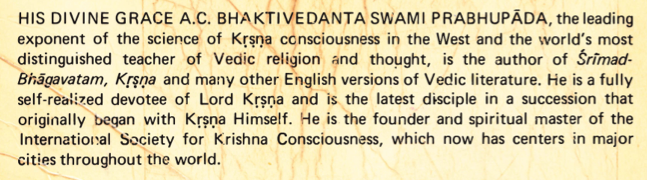
Here Prabhupada is described as “the great exponent”. Contrast this to the original Bhagavad-gita where it is said that Prabhupada is “the leading exponent of Krishna consciousness”. That he is “the world most distinguished teacher of Vedic religion and thought,…”, and that he is a “self-realized devotee of Krishna”.

It’s hard to fathom why the BBT International and their Danish editors are covering up the greatness of both the Bhagavad-gita and Prabhupada. An explanation is needed!

In previous post we have described how the cover art on the new Danish Bhagavad-gita is unauthorized:

https://arsaprayoga.wordpress.com/2013/09/09/cover-up/

“The duty of the finger” (Bg. 4.38)

Help us by “liking” and “sharing” this post!

This article was sent to the BBT International through their website (http://www.bbtedit.com/contact) and to Jayadvaita Swami’s personal e-mails (jswami@pamho.net and jayadvaita.swami@pamho.net) the 24th Oct. 2013. We asked them to comment on the points raised.

So far we have not received any reply.

1383179_412872895502777_881195929_n

By Bhakta Torben and Ajit Krishna Dasa

Srila Prabhupada’s Bhagavad-gita 4.38, original 1972 edition:

Skærmbillede 2013-10-24 kl. 14.27.12

Jayadvaita Swami’s version (BBT International, 1983 edition):

Skærmbillede 2013-10-24 kl. 14.28.19

The sentence,

“And one who has achieved this enjoys the self within himself in due course of time.”

is changed to:

“And one who has become accomplished in the practice of devotional service enjoys this knowledge within himself in due course of time.”

This change is both needless and alters the meaning.

It is NEEDLESS because Prabhupada has not asked for it.

It alters the meaning, as the words “enjoys the self” is erased and replaced with “enjoys this knowledge”.

And the words “has achieved this” are substituted with “has become accomplished in the practise of devotional service”.

Furthermore the words “are culminated” in the end of the purport are NEEDLESSLY changed to “culminate”.

So there are NEEDLESS changes BOTH in the translation and in the purport.

Usually all this is explained away with something from the “original manuscript”. But on BBT International’s website we find no information about this change.

The “original manuscript” sounds like this:

Skærmbillede 2013-10-24 kl. 11.27.55

So AGAIN the “original manuscript” is seen to be closer to the 1972 original Bhagavad-gita than Jayadvaita Maharaj’s version.

On top of that, in the word-for-word translation the word “na – never” is changed to “na – nothing” and “svayam-itself” is changed to “svayam-himself”. Prabhupada personally did ALL the type-writing for the first six chapters of the so called “original manuscript”. In the “original manuscript” Prabhupada’s translation of “na” was “never” (Na-never) and his translation of “svayam” was “itself” (svayam-itself):

Skærmbillede 2013-10-24 kl. 14.13.44

So BBT International have CHANGED PRABHUPADA’S SANSKRIT TRANSLATION as it was PERSONALLY WRITTEN BY HIM, on his type writer. Prabhupada was very concerned with better knowing disciples that had become “learned” in sanskrit:

“…a little learning is dangerous, especially for the Westerners. I am practically seeing that as soon as they begin to learn a little Sanskrit immediately they feel that they have become more than their guru and then the policy is kill guru and be killed himself.” (from a letter to Dixit das on 18 Sep 1976)

Prabhupada gave this lecture from Bg. 4.38 and did not mention anything about changing anything:

Madhudvisa: Verse thirty-eight: “In this world there is nothing so sublime and pure as transcendental knowledge. Such knowledge is the mature fruit of all mysticism and one who achieved this enjoys the self within himself in due course of time [Bg. 4.38].”

Prabhupada: Yes. Knowledge: “I am part and parcel of Krishna, or God. My duty as part and parcel is to serve Krishna.” Just like this finger is the part and parcel of my body. The duty of the part and parcel is to serve.
(Bhagavad-gita 4.34-39, Los Angeles, January 12, 1969)

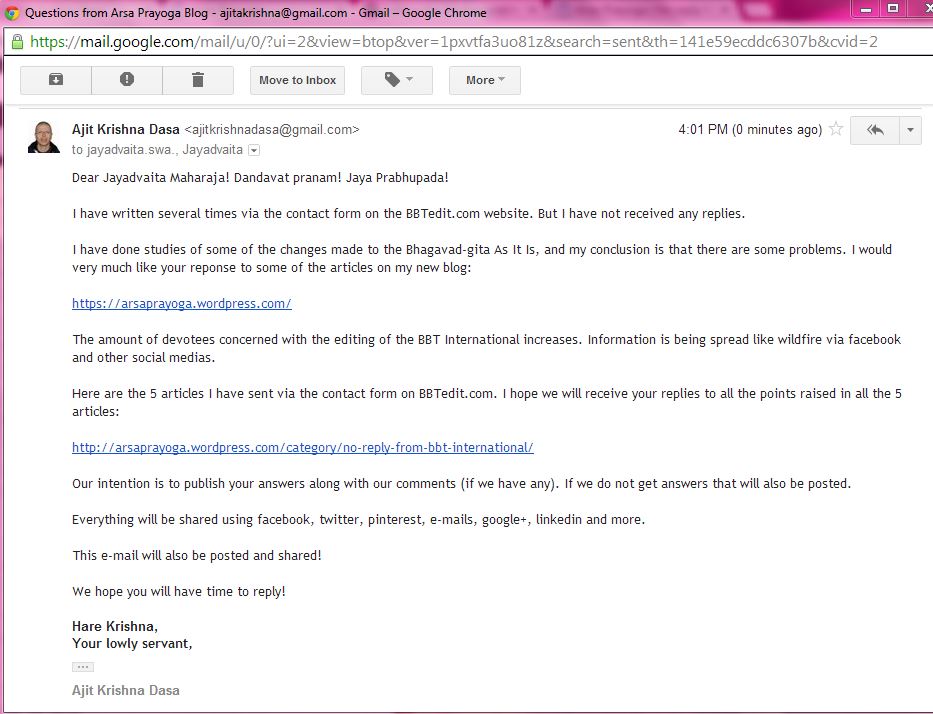
Letter to Jayadvaita Swami (23rd Oct. 2013)

letter-to-jayadvaita-swami-1Click to enlarge picture!

Dear Jayadvaita Maharaja! Dandavat pranam! Jaya Prabhupada!

I have written several times via the contact form on the BBTedit.com website. But I have not received any replies.

I have done studies of some of the changes made to the Bhagavad-gita As It Is, and my conclusion is that there are some problems. I would very much like your reponse to some of the articles on my new blog:

https://arsaprayoga.wordpress.com/

The amount of devotees concerned with the editing of the BBT International increases. Information is being spread like wildfire via facebook and other social medias.

Here are the 5 articles I have sent via the contact form on BBTedit.com. I hope we will receive your replies to all the points raised in all the 5 articles:

https://arsaprayoga.wordpress.com/category/no-reply-from-bbt-international/

Our intention is to publish your answers along with our comments (if we have any). If we do not get answers that will also be posted.

Everything will be shared using facebook, twitter, pinterest, e-mails, google+, linkedin and more.

This e-mail will also be posted and shared!

We hope you will have time to reply!

Hare Krishna
​Your lowly servant,
Ajit Krishna Dasa

“Phalanx” in Bg. 1.2 and Bg. 1.11 (Jayadvaita Swami’s double standard)

Help us by “sharing” and “liking” this post!

Back-To-Godhead-Jayadvaita-Swami

The text below was sent to the BBT International through their website (http://www.bbtedit.com/contact) and to Jayadvaita Swami and Dravida Prabhu’s personal e-mails (jswami@pamho.net, jayadvaita.swami@pamho.net, dravida108@gmail.com) the 7th Feb. 2014. We asked them to comment on the points raised.

So far we have not received any reply.

Regarding the word “Phalanx” in Bg. 1.2 Jayadvaita Swami writes on the BBT International’s website:

“In the old edition, the idea of a specific military formation (vyudham) is omitted.”

So we see that Jayadvaita Swami feels free to not only override Prabhupada’s editorial decisions regarding Bg. 1.2, namely to omit “military phalanx”, but also to unnecesarrily add the word “formation” instead of “phalanx” (Prabhupada often used the word phalanx. We find it many times in books like Bhagavad-gita, Krishna Book, Nectar of Devotion, Caitanya Caritamrta, and also in lectures, conversations, earlier essays and poems).

Jayadvaita Swami continues:

“In the new edition, I revised “phalanx” to “military formation” because a phalanx (originally) is a particular type of formation peculiar to ancient Greek warfare. Greek columns on the Battlefield of Kuruksetra didn’t seem right. Hence the revision.”

Then why did Jayadvaita Swami not remove the word “phalanx” from Bg. 1.11?

“All of you must now give full support to Grandfather Bhisma, as you stand at your respective strategic points of entrance into the phalanx of the army.” (Bg, 1.11, BBT International 1983 edition)

“Phalanx” is also found in the purports to Bg. 1.3 and Bg. 1.11 in BBT International’s 1983 edition.

Something doesn’t make sense!

In retrospect: “Phalanx” has come to refer to any military formation, so perhaps I should have been less picky. But at any rate, the new translation gets in the idea that the old one left out.”

So will Jayadvaita Swami again add the word phalanx to Bg. 1.2? Or will he remove it from Bg. 1.11 and add “formation”? Changing back and forth – again and again and again…ad infinitum?

Is that what Prabhupada expected from his editors? Is this how the world comes to respect Prabhupada’s books and ISKCON?

Not back to the “original manuscript” (Bg. 1.2)

Help us by “sharing” and “liking” this post!

This article was sent to the BBT International the 22nd Oct. 2013. We asked them to comment on the points raised. So far we have not received any reply.

Read these quotes carefully:

“As you know, and as we kept in mind while doing the work, Srila Prabhupada staunchly opposed needless changes.” (Jayadvaita Swami’s Letter to Amogha Lila 1986)

“Comparing each verse in the book with the text of the manuscript, I made only those changes that to me seemed worthwhile. I tried to be conservative and not make needless changes.”
(Jayadvaita’s letter to senior devotees, October 25, 1982)

From the so called “original manuscript”:

bg-1-2-manuscript

From the original and by Prabhupada approved/authorized 1972 edition of Prabhupada’s Bhagavad-gita As It Is:

bg-1-2-1972

From the BBT International’s 1983 posthumously edited Bhagavad-gita As It Is:

bg-1-2-1983

“PHALANX” – JAYADVAITA SWAMI’S DOUBLE STANDARD

Jayadvaita Swami attempts to justify his changes in this way:

“In the old edition, the idea of a specific military formation (vyudham) is omitted. In the new edition, I revised “phalanx” to “military formation” because a phalanx (originally) is a particular type of formation peculiar to ancient Greek warfare. Greek columns on the Battlefield of Kuruksetra didn’t seem right. Hence the revision. In retrospect: “Phalanx” has come to refer to any military formation, so perhaps I should have been less picky. But at any rate, the new translation gets in the idea that the old one left out.

We see that Jayadvaita Swami feels free to not only override Prabhupada’s editorial decisions regarding Bg. 1.2, namely to omit “military phalanx”, but also to unnecesarrily add the word “formation” instead of “phalanx” (a word Prabhupada often used).

Bg, 1.11 (BBT International 1983 edition):

“All of you must now give full support to Grandfather Bhisma, as you stand at your respective strategic points of entrance into the phalanx of the army.”

According to Jayadvaita Swami: in Bg. 1.2 “phalanx” didn’t seem right on Kuruksetra, because it’s a Greek word peculiar to ancient Greek warfare. But in Bg. 1.11 Jayadvaita Swami did not remove “phalanx”.

What are we to make of it?

Jayadvaita Swami admits that he might have been a little too “picky” regarding the word “phalanx”. This means he is not completely satisfied with his own work.  Maybe we will have a new edition of Bg. 1.2 in his next printing? And what about Bg. 1.11? Change-change back-change-change back? Is that what Prabhupada wanted?

Jayadvaita Swami said he tried not to make needless changes, but only those worthwhile. But which of the changes here are really worthwhile? Which are really needed? None of them! Bg. 1.2 is just fine the way it is in the original 1972 edition.

“BEGAN TO SPEAK”

Jayadvaita Swami continues:

“Srila Prabhupada typically said “began to speak” or “began to say” when the meaning is simply “spoke” or “said.” Such a phrase as “began to speak” is more apt when followed by something like “but was cut off” or “but changed his mind and fell silent.” In later books, the BBT editors routinely trimmed off the “began to.”

The expression “began to speak” is not wrong, and as we can see below Prabhupada did not object to it in Bg. 1.2, but re-confirmed it. Therefore the change is needless and not at all worthwhile. The editors might have trimmed the phrase off in other books, but these books were then approved by Prabhupada. Bg. 1.2 was approved with the phrase “began to speak”. Prabhupada did not approve the 1983 edition.

The shocking fact is that Jayadvaita Swami’s underlying technique is to attempt to mind-read Prabhupada after his physical disappearance and use his mind-reading “discoveries” about Prabhupada’s desires in relation to his books to change them posthumously. I don’t think even the devotees in favor of the changes have the fantasy to imagine that this is an editing methodology actively used by the BBT International.

The fallacy of going back to the so called original manuscript is covered here. But apart from that, what does it even mean to postulate that you are changing back to the manuscript, when there are so many instances where you concoct phrases that Prabhupada never used in relation to the verses under discussion?

Let us see how Prabhupada dealt with Bg. 1.2:

Pradyumna: (leads chanting, etc.)

sanjaya uvaca
drstva tu pandavanikam
vyudham duryodhanas tada
acaryam upasangamya
raja vacanam abravit
[Bg. 1.2]

Translation: “Sanjaya said: O King, after looking over the army gathered by the sons of Pandu, King Duryodhana went to his teacher and began to speak the following words:”

Prabhupada: So Dhrtarastra inquired from Sanjaya, kim akurvata: “After my sons and my brother’s sons assembled together for fighting, what did they do?”

Prabhupada continues without objecting to the words “began to speak. In fact a little later in the same lecture Prabhupada says:

“Raja vacanam abravit [Bg. 1.2]. Then he began to speak, to inform Dronacarya.”

(Bhagavad-gita 1.2-3, London, July 9, 1973)

So in this lecture Prabhupada heard the verse, and did not object to to words “gathered” and “began to speak”.  In fact he re-translated the words “raja vacanam abravit” to “began to speak” – the very same words he used in his draft (so called original manuscripts) and which he had approved in his 1972 edition of Bhagavad-gita As It Is.

From a room conversation:

Aksayananda: Acaryam upasangamya raja vacanam abravit [Bg. 1.2].
Prabhupada: Yes. What is the translation?
Aksayananda: “Sanjaya said, ‘Oh king after looking over the army gathered by the sons of Pandu, King Duryodhana went to his teacher and began to speak the following words.’ ”
Prabhupada: Aiye. [break] Caitanya Mahaprabhu’s mission is to preach. So you join us.

(Room Conversation on New York court case, November 2, 1976, Vrindavana)

Prabhupada continues speaking with no objection to the verse as it was read to him.

The comparison of Bg. 1.2 in the original 1972 edition and BBT Internationals 1983 posthumously edition version is an axample of everything Prabhupada’s editors should NOT do:

  • They changed what was approved by Prabhupada (namely “gathered” and “began to speak”)
  • They added what Prabhupada approved left out (namely “military”)
  • then added something Prabhupada didn’t write (namely “formation” instead of “phalanx” and “spoke” instead of “began to speak”).

Jayadvaita Swami is not at all being conservative in his editing. He is by nature an extreme liberal, since he feels free to rely on a New Age methodology, namely using his feelings and “intuition” to mind-read Prabhupada. Jayadvaita Swami is actively using this liberal New Age methodology to add, substract, concoct and change words in Prabhupada original and authorized books.

Gita Cover-Up or Buyer Beware!

Help us by sharing and liking this post!

By Rupanuga Dasa (ACBSP) (Posted from the Sampradaya Sun)

Interested parties should be made aware that the BBT editors of Srila Prabhupada’s Bhagavad-gita As It Is have continued editing their own new (2010) paperback edition of their 1983 “revised and enlarged” version. They have removed the notice “Revised and Enlarged” from the face page and left only “Second Edition.” The phrase “with the original Sanskrit text, Roman transliteration, English equivalents, translation and elaborate purports” has been omitted. So now, after all the omissions, the face page reads simply “Bhagavad-Gita As It Is, Second Edition, by His Divine Grace A.C. Bhaktivedanta Swami Prabhupada.”

Consequently, there is no indication for the prospective buyer that the book is actually a revised version of the original; rather it is made to appear to be simply a re-printing of the original—by the same author! The BBT editors, remaining incognito, continue to plagiarize Srila Prabhupada’s name and fame to lend credibility to their in fact re-written version of the Bhagavad-Gita As It Is, originally designated as the “Complete Edition” by Srila Prabhupada himself.

On the back cover, once again the editors omit an important phrase in the description of Srila Prabhupada as “the leading exponent of the science of Krsna consciousness in the West and the world’s most distinguished teacher of Vedic religion and thought…” And they add a curious sentence in conclusion, which really reflects their own clandestine position: “Thus, unlike other editions of the Gita, his conveys Lord Krsna’s profound message as it is—without the slightest taint of adulteration or personally motivated change.” This is so reminiscent of that well-known story of the man on the second floor of his house hearing a noise downstairs and calling out, “Who’s there?” revealing the actual position, a voice from below answers emphatically, “Oh, I’m not stealing! I’m not stealing!”

Or the time when devotees told Srila Prabhupada about a newspaper article claiming that a space probe to Mars had sent back photographic images that so closely resembled the terrain in Arizona. Srila Prabhupada said the scientists involved were themselves in Arizona, simply revealing their own minds, reflecting their surroundings.

Similarly, these editors, perhaps smarting from unending legitimate criticism, have inadvertently revealed their own position: “Oh no, we have edited responsibly, without the slightest taint of adulteration or personally motivated change!” But they continue to commit what Srila Prabhupada described in the purport Srimad Bhagavatam 3.4.26:

“Although one may be well versed in transcendental science, one should be careful about the offense of maryada-vyatikrama, impertinently surpassing a greater personality.”

The impertinence knows no bounds, because BBT editing has become a co-authoring of Srila Prabhupada’s books. Buyer beware! Milk still looks like milk even when containing poison.

bcdebat-long2009 Hardback

gita102010 Paperback

The Change Disease and Windows to the Spiritual Sky

Help us by sharing and liking this post!

Skærmbillede 2013-10-11 kl. 10.00.12

44 deleted color plates

By Rupanuga Dasa (originally posted on the Sampradaya Sun)

When Srila Prabhupada signed the final version of the Macmillan contract for his Complete Edition of the Bhagavad-gita As It Is published in 1972, it included certain additions he made in the following section of that contract:

Competitive Material
XII. During the term of this agreement the Author shall not publish or permit the publication of any material written in whole or in part by him that is derived from or competitive to the Work or the rights herein granted without the prior written consent of the publisher. [Then Srila Prabhupada added]: except for Back-to-Godhead Magazine, and any present or future works using the Work as reference, as well as the 48 pages of illustrations for which the Author reserves the right to publish for any purpose he may determine.

Srila Prabhupada made other notations also, including his right as Author to translate into foreign languages if the publisher failed to do so within 18 months. He then signed as the Author. The contract was dated March 6, 1972 and countersigned by the ISKCON representative, “Rupanuga das Adhikary”.

That new Gita was to prove big and heavy and only so many could be crammed into a bookbag, but people were to become immediately attracted to the gorgeous, colorful paintings; besides, where could they find such a book with so many color illustrations, and for how much? It was Srila Prabhupada’s transcendent genius to conceive of such a way to reveal to people the deepest philosophy and the highest truths comprehensible to human beings. No other volume of supposed philosophical content could compare to that Gita, decorated as it was with paintings allowing a view of the Spiritual Sky. Along with Prasadam, those paintings were Srila Prabhupada’s secret weapons.

Continue reading