From Dhyana to Sankhya: Prabhupada’s Vision for Chapter 6

By Ajit Krishna Dasa

Srila Prabhupada’s decision to title Chapter 6 of the Bhagavad Gita As It Is “Sankhya Yoga” stands as a distinctive and deliberate choice, diverging from the more common “Dhyana Yoga” favored by traditional acharyas, modern scholars, and Western translators. This title, unique in the history of widely recognized Gita commentaries, reflects his mission to present the text through the lens of Gaudiya Vaishnavism while reintroducing the theistic Sankhya philosophy of Kapila Muni, the divine son of Devahuti from the Srimad Bhagavatam. Far from a mere editorial quirk, Prabhupada’s naming can be seen as a strategic reclamation of the term “Sankhya,” serving as an implicit attack on the atheistic Sankhya school and aligning the chapter’s teachings with Krishna consciousness. This choice makes sense when viewed through the philosophical content of Chapter 6, its integration of Sankhya and Yoga, and Prabhupada’s broader purpose of countering materialistic philosophies.

Philosophical Foundations: Theistic Sankhya and Its Contrast with Atheism

Sankhya philosophy, one of the six classical schools of Indian thought, fundamentally distinguishes between purusha (the eternal, conscious soul) and prakriti (temporary, unconscious matter), aiming for liberation through analytical knowledge. However, two versions of Sankhya exist: the atheistic, classical Sankhya, often attributed to a sage Kapila, which denies a supreme God and posits multiple purushas liberated through intellectual discernment alone, and the theistic Sankhya of Kapila Muni, an incarnation of Vishnu, as detailed in Srimad Bhagavatam (Canto 3, Chapters 24–33). The latter integrates this dualistic framework with devotion to Krishna, the Supreme Purusha, as the source and controller of all existence.

Srila Prabhupada consistently champions the theistic Sankhya of the Bhagavatam’s Kapila, critiquing the atheistic version as incomplete. In his purport to Gita 2.39, he describes Sankhya as the analytical study of soul and matter but ties it to Krishna’s authority, while in Srimad Bhagavatam 1.2.30, he credits Kapila (the Vishnu avatar) with creating Sankhya to dispel material illusion, implying the atheistic school is a corruption. By titling Chapter 6 “Sankhya Yoga,” Prabhupada reclaims the term from its godless connotation, positioning it as a Krishna-centric science of self-realization. This choice serves as an attack on atheistic Sankhya by asserting that true Sankhya—unlike its materialistic distortion—culminates in devotion to the Supreme Personality of Godhead, not mere intellectual isolation.

Chapter 6’s Content: A Blend of Sankhya Philosophy and Yogic Practice

Chapter 6 of the Gita, while renowned for its meditative instructions (e.g., 6.11–14: sitting steadily, focusing on the self or Krishna), contains philosophical elements that resonate with Sankhya, justifying Prabhupada’s title. Verses like 6.5–6 (“One must deliver himself with the help of his mind… the mind is the friend or enemy”) echo Sankhya’s view of the mind as a product of prakriti that binds or liberates the purusha depending on its mastery. Similarly, 6.1–4 emphasize detachment from sense objects and fruitive results, mirroring Sankhya’s goal of disentangling the soul from material nature. The description of the yogi’s transcendent state in 6.20–23—realizing the self’s distinction from matter through “transcendental senses”—further aligns with Sankhya’s liberation through discriminative knowledge.

Prabhupada’s “Sankhya Yoga” title broadens the chapter’s scope beyond meditation (dhyana) to include this analytical foundation, reflecting the theistic Sankhya of Kapila, where understanding the soul’s eternality leads to Krishna (Srimad Bhagavatam 3.25.18). Unlike “Dhyana Yoga,” which narrows the focus to meditative practice, “Sankhya Yoga” encapsulates the integration of knowledge (Sankhya) and discipline (Yoga), culminating in devotion (6.47: “The highest yogi thinks of Me constantly”). By highlighting these Sankhya elements, Prabhupada challenges atheistic Sankhya’s endpoint—self-isolation without God—replacing it with a theistic synthesis that directs the practitioner to Krishna, thus undermining the atheistic school’s philosophical legitimacy.

Historical Context: Sankhya and Yoga’s Traditional Connection

The tendency in Indian tradition to connect Sankhya and Yoga as complementary systems supports Prabhupada’s titling. Historically, Sankhya provides the metaphysical blueprint (distinguishing purusha from prakriti), while Yoga, particularly Patanjali’s Ashtanga Yoga, offers the practical path, with dhyana (meditation, the seventh limb) as a key stage. The Gita itself reflects this synergy: Chapter 2 introduces Sankhya’s analytical wisdom (2.39), and Chapter 6 blends it with yogic practice. Prabhupada’s “Sankhya Yoga” title leverages this tradition, but adapts it to Vaishnavism by rooting it in Kapila’s theistic Sankhya, not the atheistic version that Patanjali’s Yoga partially accommodates (via Ishvara, Yoga Sutras 1.23).

This historical pairing bolsters Prabhupada’s attack on atheistic Sankhya. By invoking “Sankhya” in a yogic context, he reasserts its original spiritual purpose—lost in the godless classical school—and aligns it with the Gita’s theistic narrative, where Krishna is the ultimate goal (Gita 15.17–18). This reclamation serves as a polemic, subtly exposing atheistic Sankhya’s inadequacy compared to its devotional counterpart.

Prabhupada’s Strategic Intent: Attacking Atheistic Sankhya and Inspiring Exploration of the Bhagavatam

Prabhupada’s mission was to counter materialistic and impersonal philosophies, including atheistic Sankhya, which he saw as a distortion of Vedic truth. His critiques in purports—e.g., dismissing atheistic Sankhya as “dry speculation” (Gita 7.4, purport)—reveal his intent to restore its theistic essence. Naming Chapter 6 “Sankhya Yoga” is a deliberate strike against this distortion for several reasons:

  1. Reclamation of Terminology: By using “Sankhya,” a term familiar to scholars and practitioners, Prabhupada confronts its atheistic association head-on. He redefines it through Kapila’s lens, where analytical knowledge serves bhakti, not godless liberation, thus challenging the classical school’s authority.
  2. Philosophical Superiority: The chapter’s content—integrating self-realization with devotion—demonstrates that theistic Sankhya surpasses atheistic Sankhya. Verses like 6.29–30 (“He who sees Me everywhere”) elevate Sankhya’s dualism into a Krishna-centric unity, exposing the atheistic version’s limitation in stopping at individual purusha without recognizing the Supreme Purusha.
  3. Educational Polemic: Prabhupada’s global audience included Westerners and Indians influenced by secular interpretations of Sankhya. Titling Chapter 6 “Sankhya Yoga” educates them that true Sankhya aligns with Krishna consciousness, countering scholarly narratives equating Sankhya with atheism and reinforcing the Gita’s theistic intent “as it is.”
  4. Parampara’s Authority: By tying the title to Kapila of the Bhagavatam, Prabhupada roots it in disciplic succession, contrasting it with speculative atheistic Sankhya. This asserts the Vedic authenticity of his interpretation, undermining the classical school’s standalone credibility.
  5. Inspiring Engagement with the Srimad Bhagavatam: Beyond attacking atheistic Sankhya, Prabhupada’s use of “Sankhya Yoga” also aimed to inspire readers to explore the Srimad Bhagavatam, which he considered the “ripe fruit of the Vedic tree” (Srimad Bhagavatam 1.1.3, purport) and the ultimate scripture for Krishna consciousness. By linking Chapter 6 to Kapila’s theistic Sankhya—detailed in Bhagavatam Canto 3, Chapters 24–33—he creates a bridge to this text, where Kapila’s teachings expand on the Gita’s principles with a devotional focus (e.g., Bhagavatam 3.25.18). In purports like Gita 6.13–14, he references Kapila’s meditation on Vishnu (Bhagavatam 3.28.8–11), subtly encouraging readers to delve into the Bhagavatam for a deeper understanding of both Kapila’s Sankhya but also of the Srimad-Bhagavatam itself. For his audience—many unfamiliar with this scripture—the title “Sankhya Yoga” plants a seed of curiosity about Kapila’s full discourse, reinforcing the Bhagavatam’s role as the natural next step after the Gita and enhancing his mission to elevate global devotion through the parampara’s treasures.

Uniqueness and Justification

No major traditional acharya (e.g., Shankaracharya, Ramanujacharya, Madhvacharya) or modern translator (e.g., Sivananda, Chinmayananda) titles Chapter 6 “Sankhya Yoga”—they typically use “Dhyana Yoga” or variants, reserving “Sankhya Yoga” for Chapter 2. Prabhupada’s divergence is a bold innovation, justified by Chapter 6’s Sankhya-like elements and his mission. While “Dhyana Yoga” fits the chapter’s meditative focus, “Sankhya Yoga” captures its broader philosophical depth, aligning with his view of Kapila’s system as both knowledge and practice directed toward Krishna.

Conclusion: A Sensible and Strategic Choice

Srila Prabhupada’s “Sankhya Yoga” title for Chapter 6 makes profound sense as a reflection of its content—merging Sankhya’s analytical insights with Yoga’s meditative discipline—and his intent to advance Gaudiya Vaishnavism. It serves as a strategic attack on atheistic Sankhya by reintroducing Kapila’s theistic version, challenging its godless conclusions, and redirecting its principles toward Krishna. This choice not only highlights the chapter’s philosophical richness but also fulfills Prabhupada’s mission to present the Gita as a devotional text, countering materialistic distortions and establishing Krishna consciousness as the ultimate synthesis of Vedic wisdom. In this light, “Sankhya Yoga” is not just a title—it’s a declaration of theistic triumph over atheism, rooted in scripture and tradition.

For a definitive proof that Srila Prabhupada wanted Chapter Six of his Bhagavad-gita As It Is to be named Sankhya-Yoga, please see this article.

“Enter Blazing” – Jayadvaita Swami Commits a Grammatical Error (Bg. 11.28)

universal-formThe Universal Form

Bhakta Torben Nielsen recently made me aware of this change to Bg. 11.28:

Original and authorized 1972-edition:

“As the rivers flow into the sea, so all these great warriors enter Your blazing mouths and perish.”

BBT International’s edited 1983 edition:

“As the many waves of the rivers flow into the ocean, so do all these great warriors enter blazing into Your mouths.”

So-called original manuscript:

There is no verse for 11.28 as the page is missing. But verse 30 mentions the words “blazing mouths”.

This is a very interesting change, because it is of a grammatical nature:

  • In Srila Prabhupada’s original 1972 edition the adjective “blazing” describes the plural noun “mouths”.
  • In BBT International’s 1983 edition the adjective “blazing” describes the plural noun “warriors”.

So which translation is grammatically correct – Srila Prabhupada’s or Jayadvaita Swami’s?

The context

Here we have the verses from Bg. 11.28-30 (original edition):

“As the rivers flow into the sea, so all these great warriors enter Your blazing mouths and perish.” (Bg. 11.28)

“I see all people rushing with full speed into Your mouths as moths dash into a blazing fire.” (Bg. 11.29)

“O Visnu, I see You devouring all people in Your flaming mouths and covering the universe with Your immeasurable rays. Scorching the worlds, You are manifest.” (Bg. 11.30)

We see that Srila Prabhupada describes the mouths of the universal form as “blazing” (Bg. 11.28) and “flaming” (Bg. 11.30), and compares them to a “blazing fire” (Bg. 11.29). There is no “original manuscript” available for Bg. 11.28-29, but the “original manuscript” for Bg. 11.30 also says “blazing mouths”, as mentioned above.

Screen Shot 2015-03-13 at 11.49.21

Plate 31

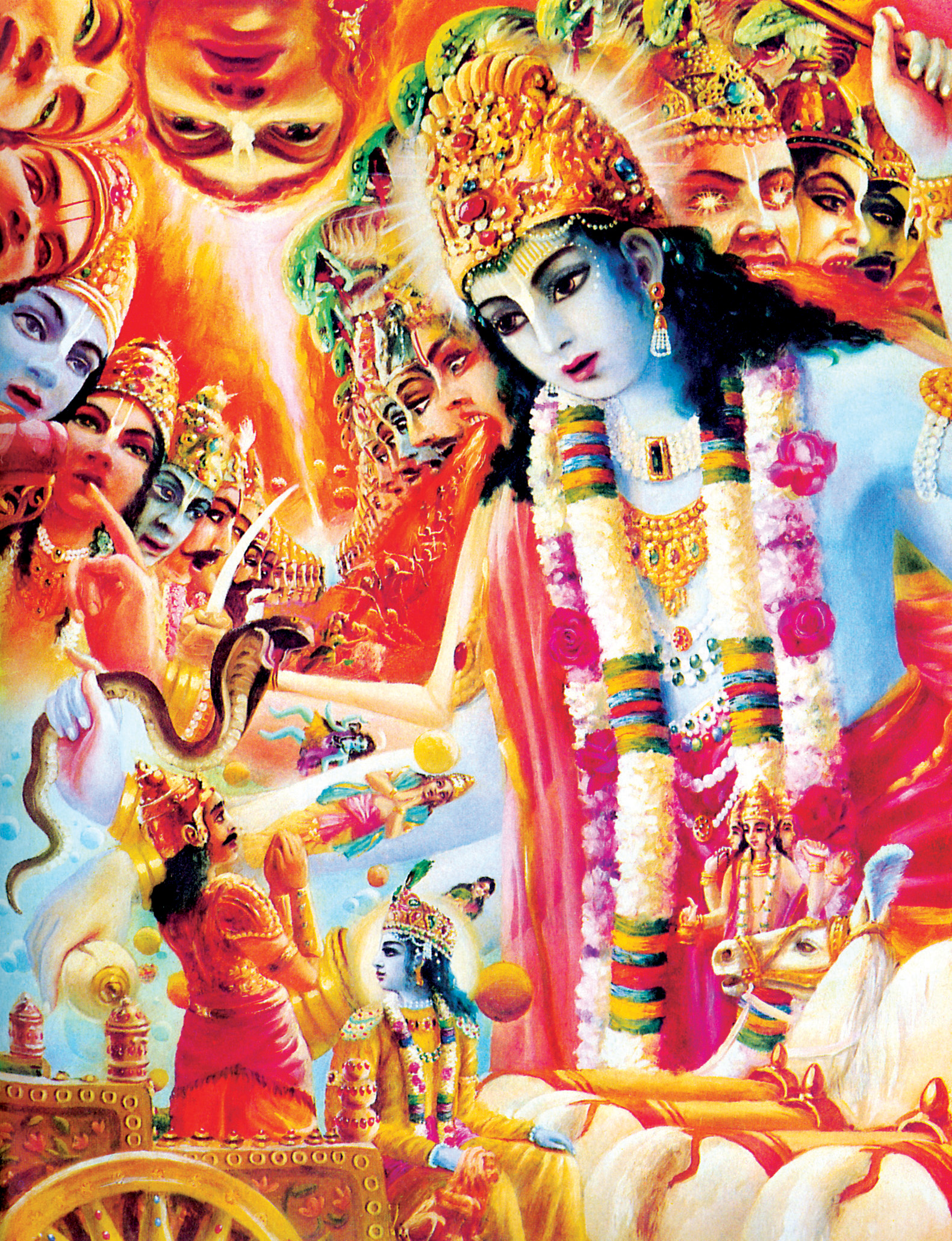
The painting above this article is Plate 31 from the Bhagavad-gita As It Is. Just like all other paintings in the book it was approved by Srila Prabhupada. On the painting we clearly see that the warriors are entering into the blazing mouths of The Universal Form – just like we are told that they are in the Bg. 11.28, 1972 edition.

Srila Prabhupada’s desire

Based on the above, there is no doubt at all that Srila Prabhupada wanted to use the adjective “blazing” to describe the mouths of the universal form. He never meant to say that the great warriors were “blazing”.

What does the previous acaryas say about Bg. 11.28? (as translated on bhagavad-gita.org)

Sridhara Swami’s commentary:

“As unlimited currents of water helplessly flow in innumerable rivers and are propelled from multiple channels into the ocean, the mighty warriors of the Kaurava and Pandava armies are seen to be helplessly propelled into the flaming, gnashing mouths of the visvarupa or divine universal form of Lord Krishna.” ()

Kesava Kasmiri’s commentary:

“How helplessly do the mighty warriors of the Kaurava and Pandava armies enter into the flaming mouths of Lord Krishna’s visvarupa or divine universal form? As helplessly as unlimited currents of water from innumerable rivers are propelled into entering the ocean.”

In his translations of Visvanath Cakravarti Thakura and Baladeva Vidyabhusana’s Bhagavad-gita commentaries Bhanu Swami also translates Bg. 11.28 as follows:

“As many swift currents of rivers flow towards the sea, so these heroes of the world enter Your flaming mouths.”

The sanskrit

Gaura Krishna Dasa, a student of sanskrit, sent me the following analysis of the sanskrit grammar:

Regarding the change in the translation of Bhagavad gita 11.28.

The word “abhivijvalanti” is in the 1972 edition taken as what in grammar is called a verbal adjective or a participle. A participle is basically a derivative from a verb but belonging in the group of adjectives. This particular participle is a participle in present tense, active voice for parasmaipada verbs. It is in neuter gender, plural number and in the accusative case which clearly indicates that it relates to “vaktraani” which is also in neuter gender, plural number and accusative case.

Sridhara Swami, Visvanath Cakravati Thakur and Baladeva Vidyabhusana have the same grammatical conclusion of this word as a participle and therefore in relation to “vaktraani” attributively, “blazing mouths”.

The “anti” ending in “abhivijvalanti” could preliminarily appear as a finite verb 3rd person in the plural number and present tense related to “nara-loka-viira” (the kings of human society), but this conclusion is in the least very strange. It would, if accepted, be a distortion of historical facts and it must be concluded faulty because this sentense already has a finite verb namely “visanti” meaning entering. So if we for the sake of example maintain “abhivijvalanti” as a finite verb, as it is done in the 1983 edition it would translate “as the many waves of the rivers flow into the ocean, so all these great warriors enter and blaze your mouth”, since “abhivijvalanti” can also not be taken as an adverb describing “visanti” attributively.

Conclusion:

“abhivijvalanti” must be taken as a participle – as done by the previous acaryas and the original 1972 edition – and not a verb as done in the 1983 edition.

Conclusion

The evidence against Jayadvaita Swami’s change is overwhelming:

1. Srila Prabhupada is very clear in his original Gita and his manuscripts – the mouths are blazing. Not the warriors.

2. Srila Prabhupada follows the previous acaryas who says that the mouths are blazing (flaming, gnashing).

3 The painting depicting this event (Plate 31 in the Bhagavad-gita As It Is) shows that it is the mouths of The Universal Form that are blazing.

4. According to sanskrit grammer it is the “mouths” that are “blazing”. Not the “warriors”.

Even if both translations could be correct (which they cannot), there would still be no justification – based on the above analysis – to change Srila Prabhupada’s translation of the verse.

It would not be possible to do this without overriding his own editorial decisions and thus violating the arsa-prayoga principle.

Please see additional evidence here.

Not “Closer to Prabhupada” (Bg. 18.2)

Jayadvaita Swami and BBTI’s claim to fame:

Screen Shot 2014-09-04 at 21.27.05

Let us (again) take a look at this claim.

Bhagavad-gita As It Is Text 18.2:

Original and authorized 1972 edition of Bhagavad-gita As It Is: 

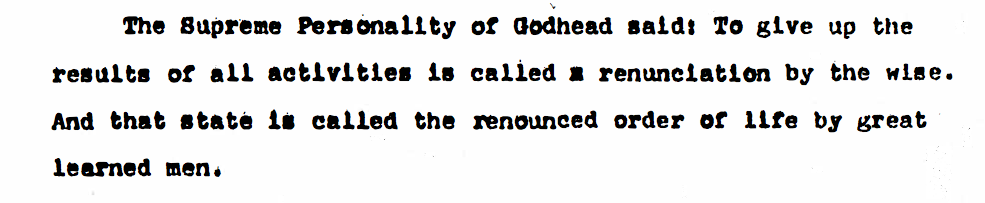
“The Supreme Lord said, To give up the results of all activities is called renunciation [tyaga] by the wise. And that state is called the renounced order of life [sannyäsa] by great learned men.”

BBTI’s unauthorized 1983 edition of Bhagavad-gita As It Is:

“The Supreme Personality of Godhead said: The giving up of activities that are based on material desire is what great learned men call the renounced order of life [sannyasa]. And giving up the results of all activities is what the wise call renunciation [tyaga].”

“Original Manuscript”:

Screen Shot 2014-08-30 at 14.23.28 

This is NOT an example of Jayadvaita Swami bringing us “Closer to Prabhupada!” On the contrary, he has (again) taken the Bhagavad-gita As It Is further away from Srila Prabhupada. In other words, we are not reading Srila Prabhupada. We are reading what the hidden co-author, Jayadvaita Swami, wrote.

Their claim to fame is a falsehood.

Small Word, Big Difference (Bg. 12.2 p.)

sp_dictating_p

BY: BHAKTA TORBEN (From Sampradaya Sun)

Aug 11, 2014 — DENMARK (SUN) —

An essential esoteric point is lost in this speculative edit:

“For one in such Krsna consciousness there are no material activities because everything is done BY Krsna.”
(Bhagavad-gita As It Is, Original 1972 Macmillan 12.2 purport)

“For one in such Krsna consciousness there are no material activities because everything is done BY Krishna.”
(Original manuscript)

Screen Shot 2014-08-09 at 20.47.25

“For one in such Krishna consciousness there are no material activities because everything is done FOR Krishna.”
(The changed Bhagavad-gita by Jayadvaita Swami)

This video clip with the Prabhupada-disciple Bhagavat prabhu further illustrates the point:

“When I sit here to write, Krsna comes personally. He dictates to me what to write. I take dictation from Krsna and I write these books.” ~ HDG Srila Prabhupada
(As told by Bhagavat das)

There is also this popular quote:

Guru Das: “Prabhupada, you’re laughing at your own books.”

Prabhupada: “I did not write these books, Krsna wrote them!”

The “Book Changes” Conflict (Parasurama Dasa)

Parasurama_leading_kirtan_in_Oslo

BY: PARASURAM DAS (From Sampradaya Sun)

Aug 05, 2014 — UK (SUN) — We arrived in Scandanavia for the Rathayatra tour (7 Rathayatra festivals). The first words I heard from a local devotee were “thank you for defending Srila Prabhupada’s original books”. Then I noticed devotees wearing T-shirts promoting BBT printing. Yep, we have a conflict.

In this age of Kali there are few things we can agree on. At least we all agree on the Mahamantra being chanted, and we used to be able to agree on the purity of the books. It was an argument that set us above other “religions” who had watered down their books. But now we are in danger of disunity again over something that could have been avoided. Even the famous barking dog video revolved around the book changes.

All the deviations in our history had one thing in common: the concept that Srila Prabhupada was inaccessible or insufficient. Zonal Acharyas, Gopi Bhava Club, Narayana Maharaj, Hinduism, etc. Some groups still remaining within ISKCON still believe that Srila Prabhupada’s books are not Sabda Brahman. Not one word nor one full stop should be changed. Srila Prabhupada taught us this principle:

“So unless one is self-realized, there is practically no use writing about Krsna. This transcendental writing does not depend on material education. It depends on the spiritual realization. You’ll find, therefore, in the comments of Bhagavatam by different acaryas, even there are some discrepancies, they are accepted as asat-patha. It should remain as it is.” (Lecture, Vrindavana, March 31,1976)

It was Krishna’s arrangement that Jayadvaita Swami and Dravida prabhu made so many mistakes and unnecessary changes, as it has highlighted our offence of seeing Srila Prabhupada’s books in a relative way. Even though Srila Prabhupada said that discrepancies should remain unchanged the BBT ignore this, and even worse, make changes when there is no discrepancy. There are many cases where the manuscript and the original edition are in agreement, and with perfectly good grammar. One example is the many times that “owner of the body” has been changed to “knower of the body”. The BBT conveniently avoids talking about this.

Proof Positive: An Appeal to Jayadvaita Swami for Clarification (Part 1)

Screen Shot 2014-07-26 at 19.25.48

BY: THE ASSEMBLED DEVOTEES

Jul 22, 2014 — GLOBAL (SUN) — Let us first offer our obeisances to our Spiritual Master, His Divine Grace A. C. Bhaktivedanta Swami Prabhupada.

om ajnana-timirandhasya jnananjana-salakaya
caksur unmilitam yena tasmai sri-gurave namah
Also, let us extend our respects to H.H. Jayadvaita Swami. We pray he will understand the concerns expressed in this essay and not construe our presentation as something other than a quest for truth.

In a conversation with Govinda dasi in 2003 (see Appendix A), H.H. Jayadvaita Swami repeatedly denied that Srila Prabhupada saw the galley proofs for his 1972 MacMillan edition of Bhagavad-Gita, indicating there were mistakes Prabhupada would not have allowed, implying this is why the book needed re-editing.

Jayadvaita Swami stated:

“He [Srila Prabhupada] never saw the proofs in 1972.”

“No he did not.”

“Prabhupada didn’t see the galley proofs of the 1972 edition.”

“But he didn’t see the galley proofs for the 1972 one…”

“there was no opportunity to like send Prabhupada back and forth, like sending him the second chapter and getting it back and asking questions; it just didn’t happen.”

“I could tell you that some of the verses that some of the BBT staff questioned, Prabhupada would never have approved. I can say with confidence, Prabhupada would never have approved.”

“And the unabridged edition he really didn’t see in its preparation for its, um, pre-publication stages”

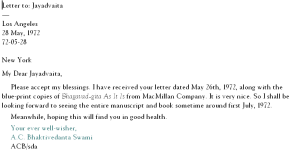
The above statements appear to be in stark contradiction to the following letter from Srila Prabhupada to Jayadvaita found in the Bhaktivedanta Vedabase (Prabhupada regularly referred to galley proofs as “blue-prints” – see Appendix B).

SP Letter to Jayadvaita- Los Angeles, May 28, 1972:

“My Dear Jayadvaita, Please accept my blessings. I have received your letter dated May 26th, 1972, along with the blue-print copies of Bhagavad-gita As It Is from MacMillan Company. It is very nice. So I shall be looking forward to seeing the entire manuscript and book sometime around first July, 1972.”

After receiving the blue-print copies, Srila Prabhupada states “it is very nice”, gives no indication that he found any mistakes, and expresses anticipation to see the completed book. It would oppose reason to argue that the above letter does not indicate Srila Prabhupada’s approval of the blue-prints/galley proofs. In absence of evidence to the contrary, the May 28th letter proves that not only did Srila Prabhupada see and approve the blue-prints/galley proofs but that Jayadvaita himself sent them to His Divine Grace.

The printing of Bhagavd-gita As It Is in 1972 was to be the very first publication of Srila Prabhupada’s unabridged version of the book and it was about to be printed by a world-renowned publishing house. This was a very important event and a very significant milestone in Srila Prabhupada’s literary corpus—presumably something a disciple involved at responsible levels of the book production process would not take lightly or easily forget. Taking all these factors into consideration, is it unreasonable to wonder how Jayadvaita Swami not only forgot he had sent Prabhupada the blue-prints, but also forgot Prabhupada personally acknowledged receipt of them and had indeed approved them? In addition, it seems Jayadvaita Swami never came across the digital copy of the above letter in the Bhaktivedanta Vedabase during his otherwise scrupulous research regarding BBT editing.

As disciples of Srila Prabhupada, we feel duty bound to petition Jayadvaita Swami to explain these discrepancies to the Vaisnava community. At the same time we caution our readers notto rush to judgment without allowing Jayadvaita Swami a chance to respond. We concede that there may have been extenuating circumstances that we are yet unaware of. Perhaps Jayadvaita Swami has letters from Srila Prabhupada that never made it to the Bhaktivedanta Archives or other evidence that could shed light on this issue. If so, we hope he will share them with the assembled devotees and uproot our reasonable doubts. Under the circumstances, we trust he will understand why we would consider physical evidence much more compelling than personal recollection. When all the evidence is presented, if our assessments prove wrong, an apology on our part would certainly be warranted.

We conditioned souls have four defects. Our senses are imperfect, we fall prey to illusion, make mistakes and have a tendency to cheat. From the evidence available thus far, one would conclude that Jayadvaita Swami is also a victim of the four defects. Even if we assume the alleged error was an honest mistake, it is nonetheless, a grave mistake and it could cast doubt on his credibility as an impartial editor of the sanctified words of our Spiritual Master. It may even raise the greater question: Is it appropriate for any conditioned soul to edit the books of an empowered and fully realized nitya-siddha devotee after their departure andwithout their express approval or direct oversight?

Jayadvaita Swami Letter to Amogha Lila, quoted in Responsible Publishing:

“To my knowledge, Srila Prabhupada never asked us to re-edit the book” [1972 MacMillan edition of Bhagavad-gita As It Is]

Appendix A

Conversation between Govinda dasi and Jayadvaita Swami – Honolulu, Jan 19, 2003(emphasis is added):

Jayadvaita Maharaja: …It differs in uh, [inaudible] uh, in addition to that, of course, Prabhupada did see the galley proofs in 1968 of the abridged edition. He never saw the proofs in 1972. He wasn’t involved at any stage of the production, except, um, mainly for expressing impatience at how slow it was being turned out—a slowness for which I was partly responsible. Um, but he didn’t go over, didn’t go over the manuscript…

Govinda dasi: Srila Prabhupada didn’t see the galley proofs?

Jayadvaita Maharaja: No, he did not. [inaudible] Prabhupada didn’t see the galley proofs of the 1972 edition. But he did see the galley proofs, and we have galley proofs with Prabhupada’s handwriting and directions, just in very few places, for the original edition. But he didn’t see the galley proofs for the 1972 one…

Govinda dasi: There must be some preliminary, something that he went over, if he didn’t see the final galley proofs.

Jayadvaita Maharaja: Not that I remember.

Govinda dasi: Then he had to have… I mean, I…

Jayadvaita Maharaja: As far as I remember, he didn’t. He was just… the main thing that he was asking was, “Where is it? I’ve been hearing, ‘Just now coming, just now coming;’ I’ve been hearing that for some time now—where is the book?” The main thing that we were hearing from Prabhupada was, “Where is it?” And, um, Prabhupada at that time was already traveling extensively, um, around the world, and, uh, there was just none of this, there was no opportunity to like send Prabhupada back and forth, like sending him the second chapter and getting it back and asking questions; it just didn’t happen.

Govinda dasi: Hayagriva was living with Srila Prabhupada in ’68, and they were going over things, and that was after this book [the abridged edition] was printed. So that must have been for the ’72 one.

Jayadvaita Maharaja: He may have, for some brief time, spent some time with Prabhupada. It’s possible. Um, but the final product was certainly not, um, something that Prabhupada, um, you know, pored over the original, he just didn’t have, couldn’t possibly have the… I could tell you that some of the verses that some of the BBT staff questioned, Prabhupada would never have approved. I can say with confidence, Prabhupada would never have approved. Some of the very few verses that we had issues with, there’s no question in my mind that Prabhupada didn’t see them.

Later in the same conversation:

Jayadvaita Maharaja: Just all I really wanted to do is contribute to the history of the Gita and say that, um, what Prabhupada saw and signed off on, um, in 1968, was the abridged edition. And the unabridged edition he really didn’t see in its preparation for its, um, pre-publication stages, except perhaps there were some meetings at some point, you were there to…

SP Letter to Jayadvaita- Los Angeles, May 28, 1972:

“My Dear Jayadvaita, Please accept my blessings. I have received your letter dated May 26th, 1972, along with the blue-print copies of Bhagavad-gita As It Is from MacMillan Company. It is very nice. So I shall be looking forward to seeing the entire manuscript and book sometime around first July, 1972.”

Appendix B

The following letters show:

Srila Prabhupada regularly referred to galley proofs as blueprints
was consistent in his oversight of the editing
was meticulous in his scrutiny regarding errors

Letter to Pradyumna- Los Angeles, April 20, 1970:

“Please accept my blessings. I have just received the blueprint copy of KRSNA, the Reservoir of Pleasure and I have begun to read it through. But I notice that there are some points you should correct before the final printing.”

Letter to Brahmananda- Los Angeles, April 20, 1970:

“P.S. There are some editorial mistakes in the blueprint of The Topmost yoga.”

Letter to Brahmananda- Los Angeles, April 22, 1970:

“Please accept my blessings. Regarding the Topmost Yoga, in the blueprint there are many mistakes. I am pointing out some of them as follows:”

Letter to Brahmananda- Los Angeles, June 2, 1970:

“I have received the blueprint from Uddhava and I have already corrected 180 pages and sent it to Boston, and the balance will be sent tomorrow.”

Letter to Brahmananda- Los Angeles, June 19, 1970:

“Regarding Bhagavatam printing, I have received the blueprint copy of 1st chapter, 2nd Canto, and it is very nicely done. The style is to the standard of my previous books.”

Letter to Uddhava – Los Angeles, July 11, 1970:

“Please accept my blessings. I beg to thank you for your letter dated 6th July, 1970, along with the blueprint copy of the Lord in the Heart. Thank you very much. It is alright to go ahead with the printing of this second chapter. I have approved all the questionable points noted by Pradyumna, so it is alright.”

Letter to Uddhava- Los Angeles, July 14, 1970:

“Please accept my blessings. I beg to acknowledge receipt of your letter dated 12th July, 1970, along with the blueprint for the third chapter of Srimad-Bhagavatam Second Canto, entitled “Pure Devotional Service: the Change in Heart.” I have looked over the blueprint and noted a few points to be corrected, so I am sending back the blueprint to you for seeing the necessary changes as they are in the text.”

Letter to Uddhava- Los Angeles, July 24, 1970:

“Please accept my blessings. I beg to acknowledge your letter dated 20th July, 1970, along with the blueprint for chapter 4 Second Canto Srimad-Bhagavatam. I have gone through the blueprint and I am also sending the necessary Sanskrit corrections to Pradyumna. So when these corrections are made then you can print immediately.”

Based on the above letters, one might ask: If Srila Prabhupada had wanted any corrections made in the blue-prints of the ’72 Gita, would he not have stated so?
 

See the changes to Bg. 9.1

Screenshot 2014-06-21 23.45.09

 Click to enlarge the picture.

Download as PDF here:

change-to-bg-table-9.1.


BBTI is changing Srila Prabhupada’s transcripts

Changing of Srila Prabhupada’s Transcripts (from Sampradaya Sun)

BY: KRISHNA DASA

Jun 03, 2014 — USA (SUN) — It is one thing to edit a book posthumously, but what seems more egregious is the editing of a transcript of a conversation. Such editing is found in the book Journey of Self Discovery, supposedly by A.C. Bhaktivedanta Swami, which was first published in 1990 as we see from a search of the U.S. Copyright records.

That book includes a conversation between Srila Prabhupada and a Dr. S. P. Oliver, Rector of the University of Durban, in Westville, South Africa, on October 10, 1975. The book is available online through http://www.prabhupadabooks.com and the relevant page can be seen here or in the e-book on page 23, where we see that during the conversation, Srila Prabhupada asks a devotee to read some verses and purports from the Bhagavad-gita As It Is.

Then we see that the transcript uses totally text from the version of the Bhagavad-Gita As It Is that was edited and published after the departure of Srila Prabhupada. For example, during that conversation a devotee supposedly was reading the verse and purport to Bg 4.34. We can see the 1972 version and the later “Revised and Enlarged” version side by side.

It is not possible that a devotee with Srila Prabhupada in 1975 was able to read the version of the Bhagavad-gita that did not exist until the 1980s.

Screenshot 2014-06-07 16.38.25

This conversation took place in 1975, and the verse quoted was from the 1972 editionof Bhagavad-gita As It Is. But here we find that the verse has been changed by the BBTI to fit the 1983 edition.

At that time your position is different! (BBTI’s main argument defeated)

sp-painting1

BY: BHAKTA TORBEN (From Sampradaya Sun)

Apr 18, 2014 — DENMARK (SUN) — The common arguments from the so-called BBT, “BBTI”:

“And in the conversation where Srila Prabhupada complained so strongly about “rascals editors,” Srila Prabhupada said about Jayadvaita, “He is good.”

“Of course, regarding Jayadvaita Swami, the BBT’s chief editor, Srila Prabhupada wrote, “Concerning the editing of Jayadvaita Prabhu, whatever he does is approved by me. I have confidence in him.” (letter to Radhavallabha, 7 September 1976)

(From BBT International’s website)

NOW LISTEN PLEASE:

Prabhupada: I have given you charge of this BBT, millions of dollars you are dealing, but it is not for your misuse. As soon as you misuse, that is your responsibility.

Ramesvara: Yes, but he says but still, you’ll know that I’m going to misuse it.

Prabhupada: No. That Krsna knows, when something charge is given. But because you are independent, I know that “Ramesvara is very good boy; let him be in charge.” But you can misuse at any moment, because you have got independence. You can misuse at any moment. At that time your position is different.

>>> Ref. VedaBase => Morning Walk — June 3, 1976, Los Angeles

(Morning Walk — June 3, 1976, Los Angeles)

This very important snippet is from a missing audio exchange, from a not properly (actually cutout) transcribed morning walk conversation. (That´s another issue in itself).

So the conclusion MUST be that the above two arguments for the continued post-samadhi editing of Jayadvaita Swami & Co. are CONDITIONAL. They are NOT absolute green lights from Srila Prabhupada to Jayadvaita Maharaj, at all.

ys. Bhakta Torben, Denmark.

Jayadvaita Swami’s “Then it is alright” argument defeated

On BBT International’s website we find this video:

Direct link: https://www.youtube.com/watch?v=IlqbnzzL_28

In the video Jayadvaita Swami says:

”I went back and re-edited especially the translations in the first canto. Especially the first perhaps three chapters where I thought their were a lot of short comings. And I typed up all the translations – after I finished all the work, I typed up all the translations in one manuscript and put them in an envelope, and Prabhupada was coming to New York where I was at the time. Prabhupada came, and I put all the translations in an envelope, and I wrote a cover letter explaning what I have done, and asking him whether it was okay. And then I brought it up to Prabhupada’s quarters at 55th Street in New York–the New York temple—with the idea that I would leave them with his secretary and come back later. But Prabhupada was right there, and so he…I offered obeisances, and he had me, you know: ”What do you do in here?” ”What have you come for?” Not in those words, but, you know, he inquired was I was doing. And I explained that I had come to deliver this. So Prabhupada had me start reading right in his presence. And I began, I read the first verse, the second verse, the third verse. I went through a few verses, and Prabhupada stopped me. Prabhupada was listening very carefully, he stopped me. ”So what you have done?” And I said: ”Well, Srila Prabhupada, I have edited to try to bring it closer to what you originally said.” Prabhupada said: ”What I have said?” I said: ”Yes, Srila Prabhupada!” Then Prabhupada: ”Then it is alright!”, and that was it. ”Then it is alright!” ”What I have said?”, ”Then it is alright!”

 A few points about this story:

1. Jayadvaita Swami’s story is merely anecdotal evidence which is considered a rather unreliable and dubious support of a  claim. No one is really able to investigate the truth value of his story. To use anecdotal evidence as the foundation for changing the books that are supposed to guide mankind the next ten thousands years will surely create doubt about the authority of the changed books.

As Srila Prabhupada said about such stories:

“Just like in our ISKCON there are so many false things: “Prabhupada said this, Prabhupada said that.””
(Srila Prabhupada Letter, 7/11/1972)

“They misunderstand me. Unless it is there from me in writing, there are so many things that “Prabhupada said.”” (Srila Prabhupada Letter, 2/9/1975)

And as Jayadvaita Swami says:

“If Srila Prabhupada didn’t clearly and definitely say it, and if it first came up after 1977 whatever it is, don’t trust it. Rule of Thumb.” (Diksa-Diksa, Where the Rtvik People are Wrong,  p. 85, Jayadvaita Swami)

Jayadvaita Swami started circulating his story after the book changing controversy started, and there is no evidence to support that it is true. Therefore, “…don’t trust it. Rule of Thumb.”

Skærmbillede 2013-12-06 kl. 20.59.15

2. Jayadvaita Swami seems to conclude that since Prabhupada approved the verses that he brought him, then he also approved that he could change all his books using the same method – even after his disappearance. But this is an unwarranted extrapolation, because Jayadvaita Swami extrapolate far beyond the range of available data, namely from one single instance of editing to more or less all future instances of editing. But from his story no justification for such an extrapolation can be found. The only conclusion to be deduced (if the anecdote is at all true) is that what Jayadvaita Swami did to the very specific verses he brought Prabhupada was okay.  No more, no less.

3. If Jayadvaita Swami’s anecdote is true, then Prabhupada told him that if he had made the text closer to what Prabhupada originally said, then it was okay.

However, in my previous articles to Jayadvaita Swami I have referred to articles where it is clearly documented that he has:

  • Deleted many of Prabhupada’s own chosen words and sentences (even those also found in his ”original manuscript”)
  • Added his own words and sentences (which means they are also not to be found in the ”original manuscript”)
  • Changed Prabhupada’s own personally typewritten sanskrit translations.

The article ”The Duty of the Finger” demonstrates all these types of changes made to Prabhupada’s Bhagavad-gita As It Is:

https://arsaprayoga.wordpress.com/2013/10/24/enjoying-the-self-within-or-the-duty-of-the-finger-bg-4-38/

Now, I think most devotees around the world would like to know what Jayadvaita Swami thinks Prabhupada would have said if he had told him:

”Well, Srila Prabhupada, in my editing I have deleted some of your own chosen words and sentences! And I have also invented some completely new words and sentences and put them in where I felt they would do a good job! And since we at the BBT International are now ”accomplished sanskrit scholars” we have gone through some of your own typewritten sanskrit translations and changed them also.”

What do we, honestly, think Prabhupada would have answered? Then try to extrapolate that answer to the changes Jayadvaita Swami has made to Prabhupada’s Bhagavad-gita As It Is.