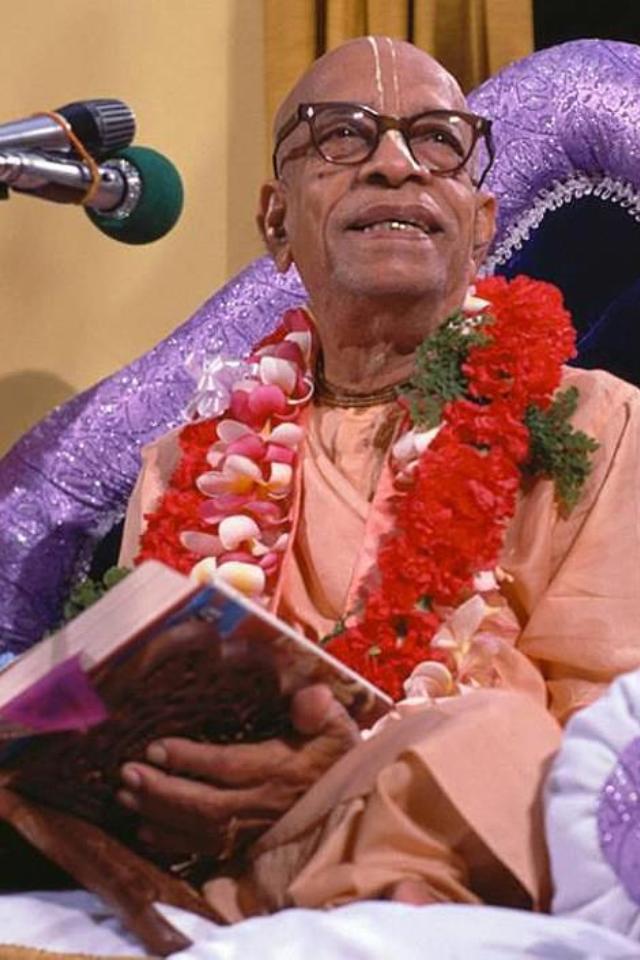
The definitive english edition of Bhagavad-gita

Help us by “liking” and “sharing” this post!

By Ajit Krishna Dasa

This is the back cover of the Bhagavad-gita As It Is (Third printing, 1973)

BG bagside-tiff

Meriam-Webster Dictionary:

1de·fin·i·tive
adjective \di-ˈfi-nə-tiv\

Definition of DEFINITIVE

1 : serving to provide a final solution or to end a situation <a definitive victory>
2 : authoritative and apparently exhaustive <a definitive edition>
3
a : serving to define or specify precisely <definitive laws>
b : serving as a perfect example : quintessential <a definitive bourgeois>
4 : fully differentiated or developed <a definitive organ>

(http://www.merriam-webster.com/dictionary/definitive)

Prabhupada:

Prabhupada: He has mistaken in so many ways. (Sanskrit) Just like our… Not Pradyumna. If somebody has boils all over the body, then where it will be operated? Better kill this body. (laughing) So he has got so many boils, this Hegel and Segel, all, because they are speculators. They have no definite knowledge. Speculators cannot have definite knowledge. Therefore our Professor Dimmock has said, “Here is definite definition of Gītā.” What is that? Just see. Then it is so. He has appreciated it. You cannot see, of the…
Devotee: They only put two lines of what he said in there. He says this…
Prabhupāda: Yes. That is his word.
Devotee: Oh.
Prabhupada: Read it all.
Devotee: “Definitive English edition of Bhagavad-gītā. By bringing us a new and living interpretation of the text already known to many, A.C. Bhaktivedanta Swami Prabhupāda has increased our own understanding manyfold.”
Prabhupada: That is a definite, not vague, speculative. That is the difference between my translation and others. Therefore I have given the name “As It Is.” So we will be no spoke or speculation. As soon as you speculate, you are rejected. Therefore others are seeing some danger that “This Bhaktivedanta’s…, this Bhagavad-gita As It Is accepted, then where we are?”

(http://prabhupadabooks.com/classes/philosophy/hayagriva/george_wilhelm_friedrich_hegel – May 1976)

And

Prabhupada: Therefore rascal. (laughter) Therefore rascal. We definitely know Krishna, the origin of everything. That is definite, not “It may be.” We don’t say “Krishna may be.” No. Definitely. Krishnas tu bhagavan svayam [SB 1.3.28]. Here is Bhagavan. Here is God. That is definite. Therefore our professor…
Hamsaduta: Svarupa Damodara?
Prabhupada: No, no. Who has written foreword to my Bhagavad-gita?
Harikesa: Dimmock.
Prabhupada: Dimmock. “Here is definitive…”
Hamsaduta: Version.
Nitai: “Definitive edition.”
Prabhupada: “Definitive edition.” That is the credit. Not “may be.” No “maybe,” sir. That is rascaldom.

(http://prabhupadabooks.com/conversations/1975/nov/morning_walk/new_delhi/november/26/1975)

Prabhupada never asked that his gita be re-edited. On the contrary, in May 1976 Prabhupada still referred to his gita as “the definitive edition” comparing it to other translations of lesser importance. During the four years from 1972 to 1976 he could have changed it if he had wanted to. But he still considered his translations and purports as they appeared at that particular time (May 1976) to serve as the final solution, the end of all editions, the authoritative, the exhaustive, the defining, the precise, the perfect example, the fully differentiated and developed edition of the Bhagavad-gita EVER published in recent times. Nothing indicates that Prabhupada ever changed his mind about this.

But to many devotee’s amazement the BBT International seemed not to agree with Prabhupada! Because in 1983 (six years after Prabhupada’s physical disappearance) the BBT International deleted the foreword by Professor Dimmock wherein he says that Prabhupada’s Bhagavad-gita As It Is, 1972 edition, is the “definitive edition“. They also in some (if not all) of their many publications of their changed 1983 edition – deleted the sentence “The definitive english edition of Bhagavad-gita” from the back cover. And they exchanged pictures and paintings and made 5000+ changes, additions and deletions in the translations and purports of the book.

Why?

A relevant question

Help us by “liking” and “sharing” this post!

By Bhakta Torben Nielsen

prab-rupaPrabhupada at Rupa Goswami’s Samadhi (©Bhaktivedanta Book Trust)

Rupa Goswami says in Nectar of Instruction, text 6:

“Being situated in his original Kṛṣṇa conscious position, a pure devotee does not identify with the body. Such a devotee should not be seen from a materialistic point of view. Indeed, one should overlook a devotee’s having a body born in a low family, a body with a bad complexion, a deformed body, or a diseased or infirm body. According to ordinary vision, such imperfections may seem prominent in the body of a pure devotee, but despite such seeming defects, the body of a pure devotee cannot be polluted. It is exactly like the waters of the Ganges, which sometimes during the rainy season are full of bubbles, foam and mud. The Ganges waters do not become polluted. Those who are advanced in spiritual understanding will bathe in the Ganges without considering the condition of the water.”

(So is Srila Prabhupada’s Bhagavad-gita As It Is not as purifying as the Ganges?! And should we, taking Rupa Goswami’s instructions above to heart, find any faults in it?!)

Greetings from Denmark,
Hare Krishna.

Bhakta Torben Nielsen

Covers should be the same regardless of language

Help us by “liking” and “sharing” this post!

The text below was sent to the BBT International through their website (http://www.bbtedit.com/contact) and to Jayadvaita Swami and Dravida Prabhu’s personal e-mails (jswami@pamho.net, jayadvaita.swami@pamho.net, dravida108@gmail.com) the 7th Feb. 2014. We asked them to comment on the points raised.

So far we have not received any reply.

By Ajit Krishna Dasa

Prabhupada:

“And the covers, if possible, should always be the same for each respective book regardless of what language it may be printed in.” (Letter to Jadurani, Bombay, January 3, 1975)

But what has happened after Prabhupada’s physical departure? The new Bhagavad-gita looks very different! Now there are many different covers on the market. There are even many different covers for the English edition(s), and also for other editions in their particular language.

Here you can read more about the changes to the pictures, paintings and covers in Prabhupada’s Bhagavad-gita, As It Is:

Click to access _changes.pdf

Starting with the original front cover here are some of the many different covers used to present Bhagavad-gita, As It Is. Continue reading

Prabhupada did the proofreading of the entire Bhagavad-gita As It Is

By Ajit Krishna Dasa

Brahmananda Prabhu as quoted in ”Srila Prabhupada Lilamrta”:

“Macmillan Company was publishing Bhagavad-gita, and Prabhupada himself was publishing Teachings of Lord Caitanya through Dai Nippon in Japan. Because Brahmananda had contacted the editors at Macmillan Company, Prabhupada credited him with the success of the Gita’s being published by such a famous company. Brahmananda was also Prabhupada’s man for dealing with Dai Nippon. Both books were on tight printing schedules, and Brahmananda had to return quickly to New York with the corrected proofs.

Brahmananda: “I came up to show Prabhupada the galley proofs for both Teachings of Lord Caitanya and Bhagavad-gita, As It Is. I just happened to have both galley proofs that had arrived. So it was a wonderful thing to bring these galley proofs to Prabhupada for checking. I was there only for a few days, maybe a weekend or so. Prabhupada personally read through the entire galleys and made notations in his own hand. He did the proofreading of the galleys. Everything was done by Srila Prabhupada. It was a very personal kind of thing. Of course, that gave Prabhupada great pleasure because he wanted his books published, and we had started to do it. So Prabhupada took great pleasure in proofreading those galleys. And he handed them to me, and it was very wonderful.” (SPL 7-4: A Summer in Montreal, 1968 / http://vedabase.com/en/spl/7/4)

prabhupada-gita-smiling

For those who are not familiar with the term “galley proofs” here is a definition from wikipedia:

“In printing and publishing, proofs are the preliminary versions of publications meant for review by authors, editors, and proofreaders, often with extra wide margins. Galley proofs may be uncut and unbound, or in some cases electronic. They are created for proofreading and copyediting purposes, but may be used for promotional and review purposes also.”

These memories from Brahmananda Prabhu informs us that Prabhupada read through the complete Bhagavad-gita, As It Is before it was sent to be printed in late 1968. This means that Prabhupada read through all 700 verses and their purports.

An interesting point in this regard – which serves as an example of unauthorized editing – is that the word ”coward” was in verse 2.35, and that the word ”brimming” was in verse 2.1 both in the 1968-edition and the 1972-edition. But still the BBT International took the liberty to remove and change these words on their own initiative in their 1983-edition. Prabhupada saw and approved these two words. He did not change them to ”insignificant” og ”full of tears” respectively, even though he had from 1968-1972 to do so if that was what he wanted. Even after 1972 he could have ordered them changed. But just like with all others words and sentences in his Bhagavad-gita As It Is (except 2-3 instances) he did not give any order to change them. And therefore we also do not have the right to do it.

Removing “eternal” from Bhagavad-gita As It Is (2.30)

This article was sent to the BBT International the 20th Oct. 2013. We asked them to comment on the points raised. So far we have not received any reply.

By Ajit Krishna Dasa

Bg 2.30 – original and authorized 1972-edition:

“O descendant of Bharata, he who dwells in the body is eternal and can never be slain. Therefore you need not grieve for any creature.”

Bg 2.30 – unauthorized 1983 BBT International edition:

“O descendant of Bharata, he who dwells in the body can never be slain. Therefore you need not grieve for any living being.”

Why has the word “eternal” been removed? What does Prabhupada say? Here are something from his lectures:

“O descendant of Bharata, he who dwells in the body is eternal and can never be slain. Therefore you need not grieve for any creature.”

Prabhupada: Dehi nityam avadhyo ‘yam dehe sarvasya bharata. Dehe, dehe means body, within the body. This topic began, dehino ‘smin yatha dehe kaumaram yauvanam jara. Deha, dehi. Dehi means one who possesses the body. Just like guni. Asthate in prata. The grammatical. Guna, in, deha, in, in prata. Dehin sabda. So the nominative case of dehin sabda is dehi. Dehi nityam, eternal. In so many ways, Krsna has explained. Nityam, eternal. Indestructible, immutable. It does not take birth, it does not die, it is always, constantly the same. Na hanyate hanyamane sarire. In this way, again he says nityam, eternal. (730831BG.LON)

Another lecture:

Devotee: 30: “O descendant of Bharata, he who dwells in the body is eternal and can never be slain. Therefore you need not grieve for any creature [Bg. 2.30].”

Prabhupada: Now, after putting forward all definitions and arguments from different angles of vision, of different philosophers, thesis, now Krsna concludes, “My dear Arjuna, take it for certain that the soul within is eternal.”

>>> Ref. VedaBase => Bhagavad-gita 2.27-38 — Los Angeles, December 11, 1968

Even in Srimad Bhagavatam Prabhupada writes that BG 2.30 confirm the eternality of the soul:

“The living entity is unborn and eternal, and as confirmed in the Bhagavad-gita (2.30),…”

>>> Ref. VedaBase => SB 2.7.49

Then why take “eternal” out the of the Bhagavad-gita As It Is?

BBTI attempts to give this justification:

“The words “is eternal” (First Edition) do not appear in Srila Prabhupada’s original manuscript. The word nityam here means “eternally” — or, as Srila Prabhupada gives it, “always.” It modifies avadhyah. Thus, “always unfit for being slain.” Putting that negatively, as the original editor chose to do, the “always” becomes “never” — “he can never be slain.”

>>> Ref. VedaBase => GRV: 2.31: “Editing varnasrama-dharma out of the books?

There a quite some problems with this proposed justification:

  • We do not know what Hayagriva Prabhu and Prabhupada agreed upon while carefully working together on the Bhagavad-gita. Prabhupada might have wanted the word “eternal” to be there. We do not know and therefore we can’t change anything. Why? Because we can’t change in Prabhupada’s books based on “maybe”, “perhaps”, “I think” etc.) This “principle of caution” ought to implemented in ALL editing work.
  • Prabhupada himself used the word “nityam” in lectures and said that meant that the soul is eternal. In one of the above lectures Prabhupada even says that “Krsna concludes, “My dear Arjuna, take it for certain that the soul within is eternal.” So Krishna says in BG 2.30 that the soul is eternal. But BBT International thinks otherwise and overrides Prabhupada’s own words and corrects his sanskrit. Prabhupada was very concerned with better knowing disciples that had become “learned” in sanskrit:

“…a little learning is dangerous, especially for the Westerners. I am practically seeing that as soon as they begin to learn a little Sanskrit immediately they feel that they have become more than their guru and then the policy is kill guru and be killed himself.” (from a letter to Dixit das on 18 Sep 1976)

  • The result of these changes and their proposed justification will make it seem – for new devotees and scholars – that Prabhupada’s sanskrit was not good enough. Imagine that a new bhakta or bhaktin heard or read one of the above lectures by Prabhupada were he says that nityam in BG 2.30 means the soul is eternal. And then the new bhakta or bhaktin later reads that this is actually not correct sanskrit, and now the BBT International has corrected it by removing it from the translation. What kind of impression will this new bhakta or bhaktin get of Prabhupada and his knowledge of sanskrit? Will it increase their respect for him? Of course not! What will it say about the way we honor the acaryas in our sampradaya? Is this arsa-prayoga – to respect the authoritative sages?

Debate with Kancana-valli Devi Dasi on the book changes

This debate was posted on the Sampradaya Sun Dec. 15 2012 : http://www.harekrsna.com/sun/editorials/12-12/editorials9486.htm

Exchange with the BBT’s Kancana-valli dd

BY: SUN STAFF

Dec 15, 2012 — CANADA (SUN) — Following is a recent exchange between Ajit Krishna dasa and the BBT’s Kancana-valli devi dasi regarding changes to Srila Prabhupada’s books. The thread of discussion began with this inquiry from Ajit Krishna dasa on November 25, 2012:

Continue reading

“Rascal Editors”

This is a key conversation in relation to the editing and publishing of Prabhupada’s books. Many points from it have been debated, and many future posts on this blog will no doubt refer and discuss points from it. So here we bring the complete conversation as a reference.

Prabhupada: Where are others?
Tamala Krsna: Shall I get other people? Satadhanya Maharaja? (long pause)
Prabhupada: That… Find this verse, munayah sadhu prsto ‘ham… [SB 1.2.5].
Tamala Krsna: There’s no index. It’s not a new Bhagavatam. There’s no index in this Bhagavatam. Munayah sadhu…? “The Effects of Kali-yuga” chapter? Is that the verse, about the effects of Kali-yuga? No. (background talking, looking for verse)
munayah sadhu prsto ‘ham
bhavadbhir loka-mangalam
yat krtah krsna-samprasno
yenatma suprasidati
[SB 1.2.5]
“munayah — of the sages; sadhu — this is relevant; prstah — questioned; aham…”
Prabhupada: No? What is that? Sadhu? What is that? Munayah?
Tamala Krsna: Says, “sadhu — this is relevant.”
Prabhupada: Relevant?
Tamala Krsna: That’s what it’s translated as, “this is relevant.” May be a mistake.
Devotee (1): It’s a mistake.
Prabhupada: Munayah?
Tamala Krsna: “Munayah — of the sages; sadhu — this is relevant…”
Prabhupada: The nonsense, they are… They are correcting my trans… Rascal. Who has done this? Munayah is addressing all these munis. Continue reading

Krishna helped me write it!

Prabhupāda: And it was not possible for me to digest. (laughs) Somebody else helped me to… I am a layman. I do not know.

Tamāla Kṛṣṇa: How did you write it?

Prabhupāda: That somebody, Kṛṣṇa, helped me. That He manufactured.

Yaśodānandana: And these mountains, they extend to the beaches. “It is considered, according to the Bhāga…”

Prabhupāda: When I was writing, I was praying Kṛṣṇa that “I do not actually accommodate all this knowledge. Please help me.” Yes. That’s all right.

Room Conversation, June 18, 1977, Vṛndāvana

Unfortunately BBT International are now altering Krishna’s words as He chose to have them revealed through Srila Prabhupada and Srila Prabhupada’s personally chosen helpers!

Response to Niscala Devi Dasi on the book changes

My response to an article by Niscala Devi Dasi posted on oneiskcon.com:

http://www.oneiskcon.com/the-actual-changes-to-srila-prabhupadas-books-and-his-standards/#comment-655

As Govinda Dasi Mataji says posthumous editing must be done according to a specific protocol. It needs to be stated on the book that is was posthumously edited, by whom, what was edited, and the date.

The problem with the new gita is that it not only lacks these informations, but it also has Prabhupada’s signature as if it was his original version, even though he never asked for this new edition nor approved it.

Editing something in Prabhupada’s books can only be done if the following is verified:

1. The change must not violate the principle of arsa-prayoga.

2. The change must be done

  • on the basis of a direct order, or
  • the change must be shown to be permitted, and/or
  • approved after it is done.

3. The change must not be needless (Prabhupada did not want needless changes)

4. We must be 100% sure (there must absolutely no doubt) that Prabhupada wanted this specific change (a principle of caution must be observed).

We know the proper protocol for posthumous editing never has been followed by BTT International. In addition to this: Can anyone present just one change in Prabhupada’s books made posthumously that does not violate at least of the above points? Continue reading

GOVINDA DASI SPEAKS OUT: WE MUST PRESERVE SRILA PRABHUPADA’S ORIGINAL UNCHANGED BOOKS

Govinda dasi’s revolutionary speech at Prabhupada Festival 2013, Los Angeles, Ca, New Dvaraka Dham, in which she speaks out on the vital importance of not changing even one word of Srila Prabhupada’s Books. Supported by His Grace Shyamasundar Prabhu.

Govinda Dasi mentions the newly surfaced 1979 interview with Ramesvara Prabhu which reveals many instruction from Prabhupada about how he wanted his books preserved. You can read the complete interview here.