Definitely Not Back to “the original manuscript”

Help us by “liking” and “sharing” this post

Hand with scissors cutting book

By Krishna Dasa (Originally posted on the Sampradaya Sun)

Recently Ajit Krsna dasa posted an interesting article showing how the BBT replaced the word “owner” with “knower” in the translation to Bhagavad-gita 13.3. He pointed out that this change was not closer to the manuscript. Further examination reveals that this is just the tip of the iceberg. Four times in the purport to this verse the word “owner” has been replaced with “knower”. On all four occasions the manuscript reads “owner”. So the old edition and the manuscript are in agreement, and the new edition is different.

The same change has been made in the translation to Bhagavad-gita 13.35.

1972 edition:

“One who knowingly sees this difference between the body and the owner of the body and can understand the process of liberation from this bondage, also attains to the supreme goal.”

New edition:

“Those who see with eyes of knowledge the difference between the body and theknower of the body, and can also understand the process of liberation from bondage in material nature, attain to the supreme goal.”

Once again the manuscript reads “owner” and not “knower”, so it supports the old edition. Furthermore, in the word-for-word translations to Bg 13.35, Srila Prabhupada translates “ksetrajnayoh” as “of the proprietor of the body”. “Proprietor” is synonymous with “owner”, which is further reason not to change “owner” to “knower”. It was clearly Srila Prabhupada’s choice of words.

Surely when the 1972 edition and the manuscript are in agreement there is NO reason to make changes. Perhaps the BBT prefers to translate “ksetra-jna” as “knower of the body” instead of “owner of the body” because the Sanskrit word “jna” means “knower”. But we don’t want the BBT’s extra input, we want transparency. Generally the BBT justify changes by saying they are closer to the “original manuscript”. In this case however that is not the case.

Istagosthi about book changes, January 2003 in Honolulu, Hawaii (Part1)

Help us by “liking” and “sharing” this post!

Govinda dasi in Honolulu on Jan 26, 2003 (Originally posted on adi-vani.org)
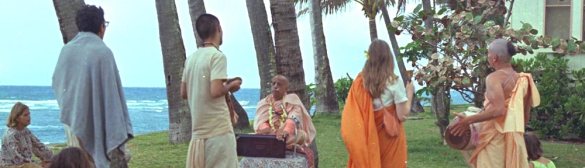
hawaii-govinda-dasiPrabhupada in Hawaii with Govinda Dasi and other devotees

Govinda dasi:  When we had the meetings here [Honolulu Temple], one of the things that Jayadvaita Maharaja said was that they [the BBT trustees] did not ever prevent devotees from printing the books. But we had a letter from Dhanistha dasi, she’s an old book distributor. I don’t know her personally, but she wrote a letter saying that she had approached, she called Jayadvaita in 1996 or 95, to print the books, 5,000, she had the money to do it, and she approached in as simple and stupid a way as possible, just like “Please, just for sentiment,” and so forth, and she was refused.

There’s some reason going on, that they don’t want Srila Prabhupada’s books. You have these books available, but the BBT newsletter in the temple lobby states clearly that the temples cannot buy from Krishna Books Inc.

Devotee: They can buy them from the BBT, but at higher prices than the changed books. But just for the record, where there’s a will, there’s a way.

Govinda dasi: OK, I’ll just go over the notes from the meetings. As you know, we had a series of meetings with Jayadvaita Maharaja: two meetings, actually. And one of the things that we had to make very clear is that this is not a personal issue—that we don’t like Jayadvaita’s writing, or we don’t like his editing work. That really isn’t the issue at all. It’s nothow the books were edited; it’s the fact that they were edited.

The issue is not—and of course, he took it a bit personally but I think he did understand eventually that that wasn’t our point—that we think he’s a great writer, and he should write and edit many books—but not Srila Prabhupada’s books. They should be left as they are. So that’s the main issue, actually, the main issue.

He feels that the 1972 edition is not in keeping with manuscript, which he only has access to, and is not available to anyone else that he knows about. And that’s just not the issue. The issue is that when you write something, even if you have an original manuscript—I’m a writer, and I may have three [versions] in the trash before I print something—but whatever I sign my name to and I print, that is the final edition. That’s what I approve for the world to see. And that’s really the issue here.

Srila Prabhupada approved of his Gita. He not only approved of it; he spent ten years lecturing from it. Every verse of the Bhagavad-gita, except for a few verses in the First Chapter, Srila Prabhupada spoke on over a period of ten years. He had ample opportunity to say, “Change this, change this, change this.” But he only requested a couple of changes. There was ‘cattle raising’ he wanted changed to ‘cow protection,’ and I believe there was one other, dhyana-yoga or something like that. Those were very small changes.

Bhaktisiddhartha Prabhu: He wrote that book twice, because the original Bhagavad-gitamanuscript was stolen during his household life. It must have said exactly what he wanted it to say, because he wrote it twice.

Govinda dasi: It was mysteriously, that was before, in the early times. Personally, being a writer and an artist, it has always amazed me that somebody could start over from scratch. I think about that sometimes, when I start getting discouraged with some work. Srila Prabhupada started over from scratch: no Xerox copy, no computer. That’s dedication. So anyway, he knew what he was doing.

And somehow or other, anyway the issue is that you can’t change books post-disappearance or posthumously. And as we discussed, Keli, Satyahit’s wife, did a lot of research on the word ‘bowdlerizing.’ Bowdler was a fellow that lived in the 16th century or 18th century—it was after Shakespeare—and he was the fellow that changed all the books. The original meaning was expurgated, meaning that he went over Shakespeare’s books, and he changed any passages for English schoolgirls, if they had any risqué parts, he took them out. So when a book is changed posthumously, among the scholarly community it’s called bowdlerizing. It’s sort of like bastardizing, it has that connotation. I have information from a Ph.D., Hari-kanta, she sent me an email stating that it has a bad connotation.

And also Dr. John Trimble, the professor of English that I took a course from in 1998. I was unaware in 1998 that the books had been bowdlerized, because I had my own set. I’m like so may other Srila Prabhupada disciples sitting at home with their own sets of books. But unknown to me, my spiritual master’s books had all been completely changed. So when I was in Texas, I went out and got myself a Gita at the local temple. And I opened it up, and I said, “What the hell happened to this book!?” [laughter] Excuse me; I was in Texas. It didn’t even sound anything like Srila Prabhupada’s Gita. So I went to Professor Trimble, and he explained that it had been bowdlerized. And so, Dr. Trimble was the first person to tell me this word; I’d never heard of it before.

So Keli contacted him, and Dr. Trimble wrote a letter back, which is a very interesting letter. Bear in mind that Dr. Trimble wrote Writing With Style. There’s not a writer on earth that doesn’t have this book. There are two [main reference books for writers]—Elements of Style, by Strunk and White, and Writing With Style.

Devotee: Without getting into that debate, because then we could be here for quite some time… I don’t want to get into that debate, because by going into that debate, I am violating Srila Prabhupada’s order not to change one word. Srila Prabhupada didn’t care… In other words, to say that we haven’t changed the philosophy… well, we were told that about so many things. To say that “We haven’t changed the philosophy, so that’s alright,” is really a slap in the face to Srila Prabhupada, who specifically said, “Don’t change it.” So what part about, ‘Don’t change it,’ or the word ‘no,’ don’t they understand? In other words, you can come up with all kinds of rationalizations—‘it’s closer to the manuscript,’ ‘we didn’t change the meaning’—you can go on and on. But we have our spiritual master pounding his desk, saying, “Don’t change one word; this is your American disease.” And even now, there’s a discussion that we should start taking out some of the passages that are not politically correct.

So in other words, you may come up with so many disingenuous arguments—‘Well, it doesn’t change the meaning,’ or ‘It’s closer to the original manuscript’—and this is only 25 years after Srila Prabhupada is gone that this has come to pass, that all the books have been changed. What’s going to happen in another 25 years, another 25 years, another 25 years? We will be just like the Christian Bible! Whatever an institution decides is politically correct or economically viable will then become the standard. So we’re going, “No! No changes. That’s what Srila Prabhupada said, that’s what the scholarly community says, and that’s what thesastra says.” So we don’t even want to go into the manuscript (which of course, nobody is allowed to see), and we don’t need to go into whether they changed the meaning or not. I just come back to, “What part about ‘no’ don’t you understand?”

Satyahit Prabhu: Jayadvaita Swami said that the intention for the future is to write new booksadapted from Srila Prabhupada’s teaching. In other words, their plan is not to go on distributing Srila Prabhupada’s books but to adapt the philosophy and write new ones.

Devotee: In other words, “We don’t like this, we’ll take out this, we’ll change this, we’ll do that.” So, people can do as they like, just don’t put Srila Prabhupada’s name on it. Srila Prabhupada didn’t write it, Srila Prabhupada didn’t authorize it, Srila Prabhupada didn’t approve it; don’t put his name on it. Put your name on it, and go get your own scholarly reviews, and go get your own devotees to distribute them. As for us, what Srila Prabhupada did is good enough for me, it’s good enough for all the other acaryas, it’s good enough for all the Vaisnava sampradayas on the planet—I’m personally going to stick with that. And if somebody wants to do something different, be my guest. I just don’t want to be there when the Yamadutas show up.

Govinda dasi: Bowdlerizing is what happened to the Bible, and Bowdler was responsible for a great deal of what happened to the Bible. I’m not an authority on this, but Keli, Satyahit’s wife, has done a great deal of research on this, and the changes to the Bible—there were many of them made—basically, it’s been bowdlerized.

Now, this is from a PhD named Dr. Holly Ogren, regarding the definition and usage of the word ‘bowdlerizing:’ “Generally, the word has a negative connotation for the person doing the bowdlerizing. If you can access the Oxford Dictionary, you can find more information to support this position.”

Now hear what Dr. Trimble has to say. Keli wrote Dr. Trimble:

Dear Professor Trimble,

You don’t know me, but I’m a friend of a former student of yours, Bonnie McElroy [Govinda dasi]. She and I are both members of the International Society for Krishna Consciousness. The principal editor of our spiritual master’s books is here in Hawaii promoting his editorial changes, which many of our members are very unhappy with. Bonnie remembers a conversation she had with you a few years ago about bowdlerizing, and after reading Dr. Bowdler’s Legacy: a History of Expurgated Books in England and America by Noel Perrin, I realized that this is what the editors of our spiritual master’s books have been doing. Their rationalization and plea is to correct the grammar and English—supposedly to make it more acceptable to the scholarly community. They have gone farther by changing the meaning through subtle word jugglery. The reason I have written is to ask you, ‘What is the scholarly response to posthumous editing, especially of religious texts?’ Our community is meeting with the editor tomorrow; could you please write me. It would be good to know your response for further discussion.

Dr. Trimble’s reply:

Dear Carol,

Regularizing the spelling and grammar is one thing; “improving” the meaning is another, especially when such changes aren’t expressly acknowledged. I think the editor should be challenged. At the very least, he should have to justify every “improvement” that isn’t strictly grammatical. The burden of proof is on him, not on you.

Hope this helps,
John Trimble

Now this is from a scholar, the best writer; he wrote the legal encyclopedia. So this guy knows his stuff. So this argument, that ‘We’ve made it more acceptable to the scholarly community,’ just doesn’t fly.

Devotee: I was at a meeting at the LA temple with a number of senior devotees—and one devotee was putting forth the idea, “Well what about the scholars?” Another devotee  said, “So what if there are a couple of scholars that think this or that; the whole Vaisnava community is in an uproar about it; I think maybe we should worry about that first.”

The second thing I always like to point out is that 99.99% of all our glorious scholarly reviews are done from the original authorized and approved version, and I don’t that we have more than a handful that are done from the new version. In other words, all of our scholarly reviews—of which there are hundreds—are done from authorized and approved versions, and not from the new ‘better for scholars’ version.

Govinda dasi: So really, the issue is not how he changed the books; it’s the fact that they are changed. Also, that the concept of bowdlerizing is a Western concept; it’s a scholarly concept. But there’s another concept that has a Sanskrit name: it’s arsha prayoga. It means ‘respect for the spiritual master’s words.’ That you respect them—if he says that the sky is pink and white polka-dotted, then it’s pink and white polka-dotted—that’s how it is with the disciple. There are so many stories like that in the Vedas, where the guru tests the disciple in this way. So basically, we have to have respect for Srila Prabhupada’s words. He saw, later on, he saw the American disease. I’ve got so many things that are written about the American disease of changing things. [See for example, letter 74-11-24 to Bhakta das]

Satyahit Prabhu: That reminds me of something Jayadvaita Maharaha said, that Srila Prabhupada authorized him to go ahead and make any changes he wanted…

Govinda dasi: Jayadvaita Maharaja seems to believe that he has a carte blanche, open-ended permission that ‘you can change all my books’ from Srila Prabhupada. I do not know where he has gotten this, because it is not written anywhere, and it contradicts…

Devotee: There is one letter, authorizing him to do some editorial work while Srila Prabhupada was here on the planet. It wasn’t a carte blanche for ever and ever, and as far as I know it was in regard to a certain title only for certain editorial work

Devotee: Because Srila Prabhupada authorized and approved it and as she just said, it’s calledarsha prayoga: that the respect for what the spiritual master authorized and approved is such that he tells the disciple, “That’s a snake,” and the disciple sees a rope, he goes, “That’s a snake.” And if he goes later, “That’s a rope,” then the disciple goes, “Oh, it’s a rope.” So we print them as they are, and later on we intend to print little addendums showing some minor corrections. And if they had done this, nobody would object. Just like you were saying, Srila Prabhupada wanted ‘cow protection’ not ‘cattle raising.’ So the solution is to start printing Srila Prabhupada’s authorized and approved books, and if you have a problem with something, put it down somewhere else, or put it in a footnote, put it in an addendum. Print the manuscript that it originally came from, if you want to be so close to the original manuscript, and say, “This is the original manuscript, but this is what Srila Prabhupada authorized and approved. And as Govinda dasi was explaining to me, it wasn’t just that Hayagriva was an English professor and one of Srila Prabhupada’s original disciples, but Srila Prabhupada spent two years with him going over the manuscript.

Govinda dasi: Before Jayadvaita joined the movement in May of 1968, Hayagriva had already been working with Srila Prabhupada on the Bhagavad-gita for two years already. I lived with Srila Prabhupada and Hayagriva in Los Angeles. They worked for hours every day. This is before Jayadvaita joined the movement. And so why—the Gita is a song: the Song of God. It’s poetic, beautiful, in Sanskrit it’s actually poetry. Why would Krsna out of the blue send an English professor, a PhD in English, who happens to be a poet, who happens to have the writing style of a Merton and Thoreau, and all of the early transcendental poets? That was an accident, right? He just happened to send in 1966. Havagriva is not the issue. We’re not saying that Haygriva is a pure devotee. That’s not the issue; the issue is that Krsna was sending Srila Prabhupada whatever he needed to do his work. And He sent him a very qualified man to do this editing.

I take one example: “The Blessed Lord said.” It’s been changed to “The Supreme Personality of Godhead said.” This is not something that we want to quarrel about. The Supreme Personality of Godhead, the Blessed Lord… but how do we know that Srila Prabhupada and his editor didn’t sit down and discuss this point, and decide on “the Blessed Lord said?” We don’t know that because we weren’t there, and actually, Jayadvaita wasn’t there. It was something that was going on already. Jayadvaita joined in Boston on 1968, like May or a couple of months before. We were in Boston at that time. Gourasundara and Srila Prabhupada and I were staying in Boston for a month in May of 1968, about the time he joined and was working for the press.

One day Srila Prabhupada called me in to his room in Boston. He had a Back to Godhead in his hand. He was livid. He said, “Look at this! Look what they have done!” He showed me. I was like, “OK, what did they do?” The Back to Godhead had—and I’ve still got this Back to Godhead—it had a picture of Srila Prabhupada, black and white, and a big statement: “This man has changed the world.” He was very upset. He said, “This, this is the beginning of falldown. To consider, to refer to the spiritual master as a man shows that the consciousness of the disciple does not see the spiritual master correctly. Call them!” So Rayarama was brought on the carpet.

My point here is that this was the mood at the press at the time Jayadvaita Maharaja joined. He was a new devotee. Satsvarupa was the president, Rayarama was the editor of Back to Godhead; Srila Prabhupada later removed him, and I don’t know the exact history on that, but he did not agree with Rayarama’s point of view on the spiritual master or on how Back to Godhead should look. There was an issue with skull on the cover. Srila Prabhupada was like, “A skull on the cover? Pictures of Krsna should be through Back to Godhead! Not skulls!”

So Srila Prabhupada was very on-target about what he wanted. He could see how the consciousness was moving in any disciple. I can remember so many instances. I was really angry about something one day, and he said to Gourasundara, “Govinda dasi is fighting a war.” He could read your mind, from 3,000 miles away, from Krsna-loka away. How about right now? As if we don’t believe he’s sitting right here listening to this discussion. We do. He’s right here, and he’s very happy that we’re defending his books.

My concern is this: I just got a Back to Godhead magazine, and it showed a big party in Poland with over 100,000 people: a big festival. 93,000 plates of prasadam distributed. And it had a picture of the book table, and on the book table was not Srila Prabhupada’s Gitas; on the book table was the changed version. And what we have to realize, as Srila Prabhupada’s disciples, is that Srila Prabhupada’s books have almost been lost. Twenty years they’ve been practically out of print. They’ve almost been lost. How serious is this? This is very serious. Probably the most important thing we can do with our lives is to reinstate his books. I believe that historians are going to look at this era, because you know history and historians have a way of bringing things out. All religions have a very rocky beginning, I have been told by scholars. I’m not a scholar myself. But when they look at this era, there’s no way that the political turmoil and all of the strange things that have happened since Srila Prabhupada left can be hidden; there’s just no way. They’re going to look at this era as being the Dark Ages, or like the Vatican Inquisitions, or an era where they fed the Christians to the lions, or—what did they do to Saint Thomas, crucify him upside down? They’re going to look at this era with great suspicion. My concern is, will they know by that time which one is the original Bhagavad-gita? Will they actually know? If this million-dollar lawsuit had not been won, and these books not put back into print, the world would not have Srila Prabhupada’s Bhagavad-gita fifty years from now. That is basically the truth, and that’s a very serious thing.

Govinda dasi: One time, I was illustrating—and this is how closely Srila Prabhupada worked with his writers and artists. I was illustrating those early paintings in the Prahlad books. It was very simple, this was in the early days when we were first devotees. I had only been a devotee for a couple of months, so I really didn’t know very much—not that I know very much now, but I mean I really didn’t know. We didn’t even have a Gita in those days, guys. There weren’t any books, only the three volumes of Srimad-Bhagavatam that Srila Prabhupada had brought from India. And we read those; but there’s a picture where Prahlad is boiled in oil. And so there are all these demons that go and stick him, and Srila Prabhupada described all those demons. So I would draw each picture and then go and show it to him. Just like he would talk with Hayagriva about each change in his manuscript. So in the course of this particular drawing, he told me how each of these demons looked. And I had never seen a demon, so I didn’t know. So I looked at some comic books, and got some ideas, they had some tails and some horns, and I kind of made some demons up s best I could. And I took it in and showed it to him, and he said, “Yes, that’s very good. There are such demons in jungles in Africa and South America, like that.” And I said, “What?” I was, after all, college educated, I was in my fourth year of college when I joined Srila Prabhupada, left abruptly—never have regretted that decision. So I thought I knew everything that existed in the world, because that’s what they told me in college, you know, biology, anthropology and all that. So I said, “I didn’t know that!” In other words, he had said that there were such demons in the world, and I didn’t know that. He looked at me and said, “There are many things you do not know.”

And I think we underestimate; the problem with the movement, with our whole ISKCON, is not really realizing who Srila Prabhupada is, and underestimating who he is. This is the bottom line; this is why these books have been edited. This is why all these things have happened in the way that they’ve happened. And I think in the future, Srila Prabhupada will be recognized more for who he is. Already we have since 1996, when Srila Prabhupada re-entered the society in the form of the Centennial, I think that people appreciate him more. Those of you who lived through the 1978-86 eleven guru days know what I’m talking about. And that’s a separate subject; I don’t want to get into it, I want to stick to the books. But I have a couple of notes here.

One of the things is that Srila Prabhupada accepted his books in 1972 as transcendental. As I said, he lectured on every verse in the Gita. And he constantly pushed book distribution and said his books were transcendental. So Srila Prabhupada said that his books were transcendental then, and yet now these same books aren’t good enough, they’re not transcendental?

Govinda dasi: And another point is, he never actually gave authority to change his books after his departure. He specifically said, “Any changes should be seen by me.” He says many things [about the book changes], and you should read them, and they will be available on the new web site, www.adi-vani.org. And people will be able to write letters in to email@adi-vani.org. The purpose of this website is to have all the many disciples—and there are batches in Europe, batches in India and all over the world—and they’re not unified. The idea is that they will all write letters. And even if the BBT doesn’t change right now, we want to leave a broad enough band of history, a broad enough volume of work that when historians pore over this in 50 years, and we’re all dead and gone and forgotten—and all of us will be, including the biggest leaders—they will be able to see which books were Srila Prabhupada’s books, and they will be able to see what Srila Prabhupada’s original disciples had to say about the changes. This is what we’re trying to do. It’s not a political ‘right now’ thing; it’s a future thing. Other people have other ideas; this is my idea. But basically, we have to leave enough history that Srila Prabhupada’s books don’t get lost.

Because right now, even though they’re printing—they just printed 10,000 Gitas, right?—for the last 20 years, how many millions of the other Gita have been distributed? All over Poland, all over Russia, all over the whole world. So, what will the historians think? That was the originalGita. Of course, there may be three or four more versions or editions by then. So that’ll be just like the Bible. It could easily turn into the Bible, and we don’t want this to happen. So our mood here is we’re just a handful, but there are many, many Srila Prabhupada disciples, sitting in their homes with the Bhagavad-gitas, who are disgruntled and don’t have a forum to speak what they have to say. We want to give them a forum. This is our goal.

Govinda dasi: Srila Prabhupada liked the original books and paintings. For the record, there’s a lot of information that’s available to people, where Srila Prabhupada describes that, “The early paintings are full of bhakti; why did you remove them from the books?” He liked the mood. This was, and for those of you who came later, I want you to know that Srila Prabhupada oversaw every step of the production in many, many ways.

Devotee: The early paintings have a look of pastel, and the colors of Krsna’s form are so, so attractive.

Govinda dasi: They’re full of bhakti. When the spiritual master is present, he has the Midas touch. He touches anything and it’s surcharged with bhakti. He touched us, and we were infused with bhakti. Look at the stuff we did; we were 20-year-old kids, green behind the ears. It was because his energy was working through us; he was using us, we were willing warm bodies, and he guided us from within, he guided us from without, he watched over us, and he was over our shoulder. For example, that original purple Gita, I was staying with Srila Prabhupada in LA, and I drew the cover picture for it. He would come shuffling into my room and look over my shoulder while I was drawing the picture. Macmillan cut the book down; he didn’t like that. He wanted it to be with all the purports, so the next one was. So he wasn’t happy with the fact that they wanted not so much repetition.

And then so far as the Teachings of Lord Caitanya, you mentioned that earlier, because that’s going to be on the press next. That book, we did the drawings while we were living with Srila Prabhupada. Srila Prabhupada described how the drawings should look. We were very poor in those days, so we didn’t do full color; we did black-and-white drawings.

I had never been to India, and I had never been to Jagannath Puri temple. And there’s a drawing in there of Jagannath up on an altar, for those of you who have seen it. Maybe a lot of you haven’t even seen it. But Srila Prabhupada described in detail how Jagannath was up on this altar, how the room was dark—it’s dark in those big old Orissan temples—and how the pujari is sitting there and receiving the flowers. He would tell us each step of the way for these drawings. And the same way with the early paintings of Jadurani. Jadurani painted those paintings in the next room, Srila Prabhupada was living in the New York apartment, he was living in the bedroom—he did everything in this one room—and in his living room, me and Gaurasaundara and Jadurani sat and did drawings all day. He would walk in, and he would even pose for us. Sometimes he posed, he showed us how a dhoti was wrapped one day. He wrapped adhoti—an elaborate dhoti, the kind Krsna wears—and stood in a threefold posture. His favorite pose was Lord Nrsimhadeva. He would come in and roar, and you would see the whites of his eyes. [devotees: “Haribol!”] And we were just new kids—but he was actually really into Nrsimha-lila big time—but he showed us each step of the way. We can’t think that ‘We did this,’ anymore than we can think ‘Hayagriva edited this, Hayagriva did this.’

Srila Prabhupada was working through us all, and the people who came to think that ‘I am the doer’ and ‘I am doing this’—and I know a few, and they’re not around anymore. One of them was my ex-husband. Srila Prabhupada said, “He suffered from too much intelligence.” He left because he was brilliant. He thought that he knew more than his guru. Srila Prabhupada said, “He’s suffering from too much intelligence; he thinks he knows more than his guru.” He was brilliant, there’s no question; he wrote books at 21 years old. But that doesn’t cut it. Srila Prabhupada came from Krsna-loka to write some books, print some books; and the fact that they have been altered is the worst thing that could happen. Everything else will be lost in the wash, but his books… He used to say that “Even if we lose all the temples, you have my books.” But we don’t have his books. My point is, his books have been—until the past year—completely lost, except in my bookcase, and so forth. So this is a very significant thing, that he oversaw the production with the artists and the writers, and he infused the work with his own bhakti. That’s why those early writings and those early paintings are so… shining. I look at this painting, and I don’t know how I did it. I look at that one, and I don’t know…[note: Srila Prabhupada’s room in New Navadvipa is decorated with several paintings done by Govinda dasi and other artists directly under Srila Prabhupada’s supervision.] I don’t have the same mood now; I think none of us really do, as we did while Srila Prabhupada was present.

So he saw the American disease of changing things, and he talks about it in a number of different places, that “The American disease is that they will try to improve and they will change.” One time, one devotee came here, and Srila Prabhupada gave him like an hour’s instruction—I was in the room—how he should do deities. He wanted Gour-Nitai deities. And then at the end of it, he said, “My wife wants to make silk. Can we kill the silkworms?” You know, you’ve got to douse them at the end. And after he left, Srila Prabhupada was shaking his head. He said, “These American boys. Next they will be asking me if they can kill cows to make mrdangas!” Because he was disgusted with this American disease of always wanting to change things and ‘improve’ things. And he reached the point where, toward the end—and you can see around the 1976 letters in all this material that we have—he basically said, “No changes.” Because if he gave them an inch, they would take a mile. Which is why, even though there may be some so-called ‘imperfections’ that you may claim that scholars may see, it’s better not to make any changes because the temptation of a barber is to cut too much hair, and the temptation of an editor is to clip too much or to change too much.

Devotee: Just like the Caitanya-caritamrta, there’s a letter from Mathila-dhish about, obviously anyone that was there for the Caitanya-caritamrta marathon knows that the artists, one would fall asleep, another would come and try to finish it. It was a two-month marathon to produce fifteen books. So then after there was more time and energy, and money and facility, they told Srila Prabhupada, “Well we can touch them up and fix them.” Srila Prabhupada said, “No changes.” Then they tried to tell him, da-da-da-da, and Srila Prabhupada said “No changes.” And then they tried again, saying “We just want to finish it, Srila Prabhupada,” and the third time, very furious, “No changes.”

Govinda dasi: One of the points that I really want to make here is that Srila Prabhupada did oversee his work. He really did; it wasn’t like it was just going on. Even the Caitanya-caritamrta, he was on top of it every moment of the day. Srila Prabhupada got up at two in the morning, and started his translation work. His book work was the most important thing he was here to do. And he kept saying that. So he did watch over it. And things were close, like a family in 1966. They were very close in ’67, ’66, there were only a handful [of devotees], and we would sit around in Srila Prabhupada’s quarters in the evening. We were like small family in New York, and we would talk. And so he would have very close direct contact with all of us. And that contact he had with Hayagriva, he was working on the manuscripts, it wasn’t like later when you had to make an appointment to see Srila Prabhupada; you walked into his room, and in and out all day long! And he sat with you and talked with you and worked with you. This was what the Bhagavad-gita was born amongst, this was how it was edited. So Srila Prabhupada worked closely to get the books like he wanted them, and even if there were a few so-called ‘errors,’ they were still acceptable to him.

And as I said, the underlying danger here is the one, the core danger here is seeing Srila Prabhupada as an ordinary man. This is the greatest danger, and I mentioned that ad [in an early Back to Godhead magazine], and after he left in 1977, a decade of forgetfulness ensued. And in this era, many mistakes were made and many wrongs were done, and there was a confusion surrounding his whole disappearance and everything really kind of fell apart. And those of you who lived through this know that it is true. 90% of Srila Prabhupada’s disciples either left or were forced to leave. In 1996 Srila Prabhupada began to enter back into the center of ISKCON, with the Centennial, and simultaneously with the winning of the court case, his original books started coming out again, so that his work will be preserved.

So my concern is that in 50 years, what will history see? If we allow the gate to be opened for the changes, they will go on. There are already indications that they’re thinking of making other changes.

Bhaktisiddhartha Prabhu: There’s a forum on COM that discusses proposed changes to Srila Prabhupada’s books. The major theme that they’re discussing is ‘the removal of sexist and racist language.’ They’re talking about removing whole sections of Srila Prabhupada’s books.

Tejo-prakash Prabhu: Jayadvaita told us when he was here that nothing has been changed in the Srimad-Bhagavatam.

Govinda dasi: That’s not true.

Devotee: Not true.

Bhaktisiddhartha Prabhu: There are thousands of changes.

Tejo-prakash Prabhu: So where’s their credibility?

New Danish Bhagavad-gita As It Is cover against Prabhupada’s instructions

Help us by “liking” and “sharing” this post!

Recently the leading Danish editors (Lalitanath Dasa and Jahnudvipa Dasa/Jahnu Dasa) working for BBT International were made aware of this quote:

Prabhupada:

“And the covers, if possible, should always be the same for each respective book regardless of what language it may be printed in.” (Letter to Jadurani, Bombay, January 3, 1975)

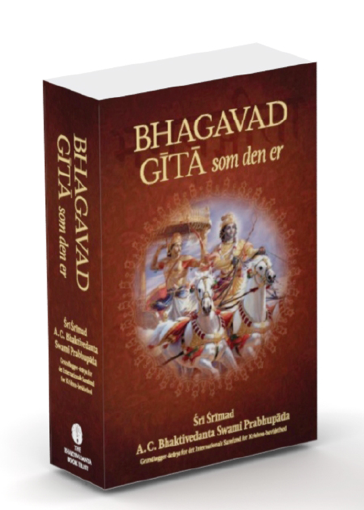
Here is the cover for Prabhupada’s original 1972 edition of his Bhagavad-gita As It Is:

Bhagavad-gita_As_It_Is-original_1972_Macmillan-cover

Prabhupada liked this cover so much that he wanted the Deities of Gita-nagari should be “Krishna and Arjuna, exactly as on the cover of the Bhagavad-gita.”:

Srila Prabhupada began to sow the seeds of inspiration in directing the future development of Gita-nagari farming community.  Prabhupada confirmed today that the presiding Deity should be Krsna and Arjuna, exactly as on the cover of the Bhagavad-gita. (Tamal Krishna Goswami’s Diary, Prabhupada’s Final Days, August 30)
I
Through their online magazine the Danish BBT(I) editors recently informed the Danish congregation that their new translation of the unauthorized BBT International 1983 Bhagavad-gita are to be published late November 2013. Despite being aware of the above desire and instruction from Srila Prabhupada the editors apparently decided to create their own, new cover–quite different from the original:

Skærmbillede 2013-10-01 kl. 10.05.00

Prabhupada:

“Service means you must take order from the master. That is service. Otherwise it is mental concoction. Actually, the servant requests, “How can I serve you?” So when the master orders, “You serve me like this,” then you do that, that is service. And if you manufacture your service, that is not service. That is your sense gratification. Yasya prasādād bhagavat-prasādaḥ. You have to see how he is pleased. Now if he wants a glass of water and if you bring a nice glass of milk, you can say milk is better than water, you take it. That is not service. He wants water, you give him water. Don’t manufacture better thing.” (Lecture, Bhagavad-gita 15.15, August 5, 1976, New Mayapur (French farm))

Not back to “the original manuscript” (BG 13.3)

Help us by “liking” and “sharing” this post!

This article was sent to the BBT International the 15th Oct. 2013. We asked them to comment on the points raised. So far we have not received any reply.

Bhagavad-gita As It Is (13.3)

The original manuscript:

bg-original-manuscript-13.3

The authorized and approved 1972 edition:

bg-original-1972-13.3

The translation from the 1972 edition was approved by Prabhupada, and we see how it follows the draft (the so called original manuscript) very nicely. But then something strange happens in the BBT International’s 1983 edition:

The BBT International’s 1983 edition:

bg-1983-edition-13.3

We can see that the BBT International have changed the word “owner” to “knower” in the second line. Why? Searching the BBT International’s website and the internet we have found no information on why this change was made.

Questions to the BBT International:

Before you changed Prabhupada’s Bhagavad-gita As It Is verse 13.3…

  • Did you know that Prabhupada approved the galley proofs / the blueprint of the Bhagavad-gita As It Is, and according to Brahmananda Das (at that time swami) Prabhupada read the complete galley proofs before approving them to be sent to MacMillan to be used for printing what became the original and authorized 1972 edition of Bhagavad-gita As It Is?
  • Did you know that Prabhupada lectured many times on BG 13.3, and that he did not object to the word “owner” in the translation? Did you know he actually reconfirmed the word “owner” by using it in these lectures?

Pusta Krsna:

ksetra-jnam capi mam viddhi
sarva-ksetresu bharata
ksetra-ksetrajnayor jnanam
yat taj jnanam matam mama

Translation: “O scion of Bharata, you should understand that I am also the knower in all bodies, and to understand this body and its owner is called knowledge. That is My opinion.”

Prabhupada: That is greatness. This is the distinction. God is great. I know about my body, you know about your body, but God knows about your body and my body and his body and every… That is greatness. (Evening Darsana — July 6, 1976, Washington, D.C.)

Hari-sauri:

ksetra-jnam capi mam viddhi
sarva-ksetresu bharata
ksetra-ksetrajnayor jnanam
yat taj jnanam matam mama
[Bg. 13.3]

Prabhupada: Ksetra-ksetrajnayor jnanam yat taj jnanam matam mama. English?

Hari-sauri: “O scion of Bharata, you should understand that I am also the knower in all bodies, and to understand this body and its owner is called knowledge. That is My opinion.”

Prabhupada: First of all knowledge means ksetra-ksetrajna. The body is the field of activity. You are acting, I am also acting, everyone is acting — according to the body. But the actor is called ksetrajna. Just like a cultivator is tilling the land, his own, and the tiller is cultivator. Similarly, this body is an analogy of this field, and we are tilling. So Krsna says that “I am also one of the tillers.” Just like the tenant and the landlord. In an apartment house, the tenant is occupier of a certain house, certain apartment, but the landlord is the owner of the whole house. So God says “I am also ksetrajna — but for all the buildings.” Everything that is there, all planets, all, everywhere. That is His all-pervasiveness. I am the proprietor of this body, owner of this body, but God is proprietor of all the bodies. In this way that is explained.” (Room Conversation with George Gullen, President of Wayne State University — June 15, 1976, Detroit)

“So people are taking this, that “I am this body.” That is ignorance. If they know, if one knows that “I am not this body; I am proprietor of this body, I’ll have to work with this body for my future,” then that is knowledge. Etad yo vetti ksetra-jna, knower, one who knows. That is the beginning of knowledge. Then Krsna says,

ksetra-jnam capi mam viddhi
sarva-ksetresu bharata
ksetra-ksetra-jnayor jnanam
yat taj jnanam matam mama
[Bg. 13.3]

Krsna is giving His opinion, the Supreme Authority, that “If you want to know, if you want to be in knowledge, this is knowledge.” What is that? “That this body, you are not this body; you are the owner of the body. And you should know also that the there is another person. As you are a person, you are owner of this body, there is another person.” Who is that? “That is I am.” Krsna says. Ksetra-jnam capi mam viddhi: “I am also owner of this body.” Actually Krsna is the owner of the body. Just like in a, in an apartment, there is the occupier and the landlord…Similarly, Krsna is the real owner of this body because Krsna has given me this body just to occupy it and work. So far. Not that I am the actual proprietor of this body.” (As the body is our field for cultivating Krsna conscious ness, so the land is our field for cultivating food…Vedic civilization means every man should produce his own food. More precise reference to be added soon)

Devotee: “O scion of Bharata, you should also understand that I am also the knower in all bodies and to understand this body and its owner is called knowledge. That is my opinion.”

Prabhupada: So Arjuna inquired from Krsna six things: ksetra, ksetrajna, prakrti, purusa, jnanam, jneyam. What is knowledge and what is the object of knowledge. (Bhagavad-gita 13.3 — Paris, August 11, 1973)

Nitai: Translation: “O scion of Bharata, you should understand that I am also the knower in all bodies, and to understand this body and its owner is called knowledge. That is My opinion.”

Prabhupada:

ksetra-jnam capi mam viddhi
sarva-ksetresu bharata
ksetra-ksetra-jnayor jnanam
yat taj jnanam matam mama
[Bg. 13.3]

Jnanam, knowledge. The Supreme Personality of Godhead Krsna is explaining about knowledge. People are being educated all over the world for advancement of knowledge. Knowledge is meant for the human being, not for the cats and dogs. Therefore, for human being, there are so many universities, schools, colleges, institutions, laws. There are so many things (indistinct) to advance knowledge is to understand “Who am I?” If I do not know who am I, then what is the meaning of my advancement of knowledge? Generally, despite so many universities all over the world, people are going on in the concept of this body, “I am this body.” “I am Indian,” “I am American,” “I am Hindu,” “I am Muslim.” So everyone is identifying himself with this material body. Then where is the advancement of knowledge? Here Krsna says, ksetra-ksetra-jnayor jnanam yad jnanam, taj jnanam matam mama. The ksetra, this body, and the owner of the body… I am not this body, I am the owner of this body. This is jnanam. (Bhagavad-gita 13.3 — Hyderabad, April 19, 1974)

  • Did you know that Prabhupada used the words “knower”, “owner”, “occupier” and “proprietor” many times for both the soul and Krishna? And many times when referring specifically to BG 13.3? And did you know that Prabhupada often translated ksetra-jna as both the “knower of the body”, “owner of the body”, “possessor of the body” and “proprietor of the body”?

“But there is another living being. He is supreme living being, Krsna. He says that “I know everything of everyone’s body.” Ksetra-jnam capi mam viddhi sarva-ksetresu bharata [Bg. 13.3]. This is the verse. Ksetra-jna means the knower of the body. You are individual knower of your body; I am knower individually of my body.” (Lecture at Boys’ School — Sydney, May 12, 1971)

“In Bhagavad-gita it is said, ksetra-jnam capi mam viddhi sarva-ksetresu bharata [Bg. 13.3]. Everything is there. The ksetra-jna means the possessor of this ksetra, body, the owner or occupier.” (Bhagavad-gita 7.3 — London, March 11, 1975)

The ksetra jna, the owner of the body, is also called the khaga, the living entity. Within the body there are two such ksetra jnas — the individual soul and the Supersoul. The individual soul is the owner of his individual body, but the Supersoul is present within the bodies of all living entities.” (SB 10.2.27)

“In another place, Krsna says this dehi or ksetra-jna, the owner of the body is there, and there is another ksetra-jna, another owner. That is Krsna. Ksetra-jnam capi mam viddhi sarva-ksetresu bharata [Bg. 13.3]. As the individual soul is there within the body, similarly, the Supersoul, Krsna, is also there.” (Bhagavad-gita 2.30 — London, August 31, 1973)

“In another place also Krsna says ksetra-jnam capi mam viddhi sarva-ksetresu bharata [Bg. 13.3]. The question of the ksetra-jna, the owner of the body and the body. In this Chapter, in the Thirteenth Chapter, it is discussed. So in that chapter Krsna says that “I am also one of the owner of the body,…”” (Bhagavad-gita 9.3 — Toronto, June 20, 1976)

“In the Bhagavad-gita Krsna says, ksetrah ksetra-jnah. Ksetra-jnam capi mam viddhi sarva-ksetresu bharata [Bg. 13.3]. Ksetra-jna means the proprietor of the ksetra, this body. Body is called ksetra. So I am proprietor.” (Srimad-Bhagavatam 3.25.4 — Bombay, November 4, 1974)

(For more references please search the Vedabase/folio for these key words in relation to BG. 13.3. There are too many examples to include them all here).

The BBT International can’t justify this change from “owner” to “knower” in BG 13.3 by referring to the so called original manuscript, Prabhupada’s desires, to faulty sanskrit translation, to meaning, to spelling or to grammar.

Then how will they justify it?

Arsha Prayoga – Part IV

Help us by “liking” and “sharing” this post!

By Locanananda Dasa (pasted from his blog)

scan131a

For those who saw the Hare Krishna movement spread from city to city and from country to country, it was clear that the original version of Srila Prabhupada’s books was full of spiritual potency and did not require to be changed in any way for his words to act upon the hearts of the conditioned souls.

The question as to whether the writings of the Acharya may or may not be revised by his disciples after his disappearance is answered by the rule of arsha-prayoga.

This principle states that one should not see mistakes in what the spiritual master has written or think that his writings may be changed to make them more effective or politically correct. To preserve his teachings in their originally published form is the way by which the Acharya is honored, and to do otherwise is to dishonor him. That is the rule of arsha-prayoga, a principle that devoted followers of a bona fide spiritual master must adhere to without deviation.

The rationale for changing Srila Prabhupada’s books was based on a series of false arguments, many of which were defeated by Srila Prabhupada himself as this article will show. To justify their actions, the BBT editors created the illusion that Srila Prabhupada’s books were defective and in need of extensive editing even though they knew His Divine Grace had never authorized anyone to revise his books after his disappearance. Subsequent to his departure, they conveniently overlooked the principle of arsha-prayoga and proceeded to do exactly what Vaishnava tradition strictly prohibits.

It was by the distribution of transcendental literature that Srila Prabhupada hoped to introduce Krishna consciousness to people everywhere. For those who saw the movement spread from city to city and from country to country, it was clear that the original version of Srila Prabhupada’s books was full of spiritual potency and did not require to be changed in any way for his words to act upon the hearts of the conditioned souls. Srila Prabhupada himself never doubted that his books would bring about a revolution in consciousness and induce people throughout the world to take shelter of the Supreme Personality of Godhead. His transcendental vision was revealed in the following letters, all of which refer to the original version of his books.

“I am glad to learn that you are having nice success in placing my books in the libraries and in schools and colleges…. I am sure that this will revolutionize the thinking of the thoughtful men of your country as well as the students and professors, and the ultimate end will be to save the world from the clutches of material illusory activities which is now causing havoc everywhere.” (Letter to Karandhara dated 9-13-70)

“If we introduce these books in all of the bookstores, schools, colleges, libraries and everyone’s home, our religion will be the only religion in the world very soon.” (Letter to Krishna Bamini dated 1-4-72)

“We have got a great mission to fulfill, and these books and magazines are the torchbearers of Truth which can save the world.” (Letter to Ksirodakasayi dated 1-3-72)
Srila Prabhupada’s books, then, should be thought of as a permanent legacy to be embraced and shared by devotees everywhere. Their purpose is to establish religious principles and enlighten human society. They were Srila Prabhupada’s gift to the world and proof of his empowerment by Krishna. There was no reason, therefore, for His Divine Grace to recommend that his books be further revised. He was of the opinion that another round of editing would not be necessary for his literatures to deliver the world from the darkest regions of ignorance.

Our guideline in Krishna consciousness is that the only duty of the disciple is to faithfully execute the order of the bona fide spiritual master. If a disagreement arises over how to best serve the guru, the issue can generally be resolved by following the course of action chalked out by the spiritual master himself through direct instructions to his followers. In a room conversation that took place in Paris in 1976, Srila Prabhupada elaborated on this point, and his explanation soundly defeats virtually all of the arguments presented in favor of changing his books.

Excerpt from a room conversation taking place in Paris, France on August 5, 1976

HARI-SAURI: Sometimes there’s some discrepancy, two parties, that may both want to serve but they have different ways, different ideas how to execute the same order, so there may be some disagreement.

PRABHUPADA: Service means you must take order from the master. Otherwise, it is mental concoction. Actually the servant requests, “How can I serve you?” So when the master orders, “You serve me like this,” then you do that, that is service. And if you manufacture your service, that is not service. That is your sense gratification. Yasya prasadad bhagavat-prasadah. You have to see how he is pleased. Now if he wants a glass of water and if you bring a nice glass of milk, you can say, “Milk is better than water. You take it.” That is not service. He wants water, you give him water. Don’t manufacture better thing.

After Srila Prabhupada’s disappearance, and without his consent, the BBT editors took it upon themselves to re-edit his books, making thousands of unnecessary changes in an attempt to improve their wording and style. But, as Srila Prabhupada stated above, without his order, their service was a concoction. They were offering him milk when he had asked for water. He wanted them to follow the rule of arsha-prayoga, but they decided to manufacture a better thing. So, according to the spiritual master, their editing was not service at all, but sense gratification.

In preparing his books for publication, Srila Prabhupada did not want a great deal of time spent on editing work. Neither was Srila Prabhupada very concerned with style. His Divine Grace once said:

“We are not meant for presenting any literary masterpieces.”

In the following letter, he carefully instructed his book production staff concerning his priorities:

“We have to do things now very dexterously, simply we have to see that in our book there is no spelling or grammatical mistake. We do not mind for any good style, our style is Hare Krishna, but still, we should not present a shabby thing. Although Krishna literatures are so nice that, even if they are presented in broken and irregular ways, such literatures are welcomed, read and respected by bona fide devotees.” (Letter to Satsvarupa dated 1-9-70)

Unless the BBT trustees felt that Srila Prabhupada’s books had been shabbily presented, they had no right to tamper with them. Of course, it is not our philosophy to print errors, but spiritual subject matter is transcendental to all mundane considerations and remains potent despite mistakes in grammar, spelling, etc. Once the presentation of his books had met Srila Prabhupada’s standard of approval, he adamantly warned the BBT staff that further changes could not be made. He said they should not even think there were mistakes in his published works.

When it was brought to Srila Prabhupada’s attention in 1977 that significant changes had been made in his books without his approval, he instructed the directors of the BBT that the next printing of his books should be again to the original way. The BBT editors knew how averse Srila Prabhupada was to making revisions in his books, especially once they had been published. How, then, despite his specific instructions, could they justify acting against his wishes and dare to change everything shortly after his physical departure?

If Srila Prabhupada ever spoke of making improvements, he was referring to the quality of the printing only and was not suggesting that changes be made in the text of his books. When Srila Prabhupada first examined the 1972 MacMillan Gita, for example, he said it did not meet our Vaishnava standard. He was disappointed with the quality of the paper, the binding, the color work and so on. These are the things he wanted improved. As far as the text was concerned, he said that nothing should be added or subtracted.

Arsha-Prayoga Part III – The Case Against Changing Prabhupada’s Books

Help us by “liking” and “sharing” this post!

sp-sitting-books

By Locanananda Dasa  (originally posted on his blog)

While planning to print the unabridged version of the Bhagavad-gita, Srila Prabhupada often referred to it as the revised and enlarged edition. When the BBT published its unauthorized adulterated Gita years later, they would henceforward refer to the 1972 printing as the original edition while calling theirs the revised and enlarged edition. This appears to be a subtle act of deception meant to validate the irreverent practice of changing Srila Prabhupada’s Books.

Continue reading

Arsha Prayoga Part II

Help us by “liking” and “sharing” this post!

srila-prabhupada-reading-his-own-books

By Locanananda Dasa (originally posted on his blog)

Srila Prabhupada’s desire was to see his books translated into all of the major languages of the world. By 1970, numerous centers had opened in countries outside of the United States and translation work had begun in Germany, France, Canada, South America and Japan. When the German devotees undertook the translation of the Srimad Bhagavatam, they discovered what they thought were grammatical discrepancies in the original English. The translators reasoned that if their spiritual master could publish his books with flaws included, then their own translation work could also contain mistakes and no harm would be done. In a very strongly-worded letter, Srila Prabhupada chastised his disciples for thinking they could imitate their spiritual master and explained that to avoid this offense, they must follow the principle of arsha prayoga.

One should not see mistakes in the books written by his spiritual master, nor should one think he is able take the same liberties taken by him. His Divine Grace warned his disciples that only if they were able to spread Krishna consciousness all over the world as he had done could discrepancies in their translation work be overlooked, otherwise not.

“So far your telling me that some devotees consider that because there may be some grammatical discrepancies in my Srimad Bhagavatam, First Canto, then they may also be allowed to translate with errors accepted, that is just like imitating Raslila. When you do all other things like Krishna, then you can do Raslila. So if these other writers can do like me and spread Krishna consciousness all over the world by becoming big Vedic scholars, then they can do.

“If one is too big, there is no mistake. Arsha prayoga means there may be discrepancies but it is all right. Just like Shakespeare, sometimes there are odd usages of language, but he is accepted as authority. I have explained all these things in my preface to First Canto.” (Letter to Mandali Bhadra dated 1-20-72 )

Srila Prabhupada wrote, “If one is too big, there is no mistake,” so when the BBT [Bhaktivedanta Book Trust International, Inc.—not the authentic Bhaktivedanta Book Trust established by Srila Prabhupada] decided that his books were full of mistakes and had to be re-edited, they made Srila Prabhupada look very small, and that is their great offense.

Sometimes, the editors try to justify their actions by claiming that scholars would have found fault in our books had they not been revised. The many, many letters Srila Prabhupada received from world-renowned scholars that glorified his phenomenal literary output contradict this false propaganda. The academic community was astounded by the magnitude of his undertaking and showed its appreciation for the exactness with which he translated and the profound devotion he expressed in his Bhaktivedanta purports. We have chosen one such letter which exemplifies to what extent Srila Prabhupada’s extraordinary efforts were acknowledged by the educated class of men. We advise the reader to keep in mind that these comments refer to the original BBT printing of his books.

Excerpted from a letter written by Sri R. Subrahmanyam, M.A., Deputy Research Director of the National Parliament of the Central Government of India:

“To teach this science of God to people everywhere and to aid them in their progress and development towards the real goal of life, Srimad Bhagavatam is most eminently fitted. In fact, this great ancient work of Vyasa will fill this need of the modern times, for it is a cultural presentation for the re-spiritualization of the entire human society. His Divine Grace, Srila A.C. Bhaktivedanta Swami Prabhupada, the founder-acarya of the ISKCON movement, has taken upon himself, in addition to his ceaseless travels and other multifarious activities in the service of the Lord, the stupendous task of translating this Sanskrit work into English in about sixty volumes for the welfare and happiness of mankind.

“So far, eighteen volumes of this most beautiful literature on God have been brought out by ISKCON, and the rest are under preparation. Needless to say that in keeping with the excellence of their other publications, the publishers have seen to it that the printing, get-up, and pictures in these volumes are also of the highest quality, as though to serve as an ornament to the divine contents of the books.

“This is a rare opportunity for people and leaders of every country, race and community in the world to know and understand the glorious science of God and work for their perfection.”

We challenge the BBT managers and their editors to produce a single letter from any recognized scholar agreeing with them that Srila Prabhupada’s original books were full of mistakes and had to be revised for his message to be properly understood. Since their purpose in making these revisions was to impress scholars, we hereby challenge them to come forward and produce evidence that there are indeed scholars who approve of the thousands of changes they made to Srila Prabhupada’s books.

Another argument presented to support the BBT’s questionable editorial policy was that their editors, by dint of their many additional years of experience, had become more qualified than Srila Prabhupada’s earlier staff of editors, and this had supposedly earned them the right to review all of the books after Srila Prabhupada’s disappearance and make whatever changes they thought were necessary. In the late 1960′s, Hayagriva had similarly offered to redo some of Rayarama’s editorial work, thinking himself more academically qualified than his godbrother, but Srila Prabhupada did not approve of his proposal. Although Hayagriva was an accomplished professor of English at Ohio State University, contrary to his opinion (and that of today’s BBT managers), Srila Prabhupada affirmed that academic credentials are not the primary qualification to edit transcendental literature. In his reply to Hayagriva, he wrote:

“Rayarama may not be as qualified as you are, but his one qualification that he is fully surrendered to Krishna and his spiritual master is the first class recommendation for his editing any one of our literatures, because editing of Vedic literatures not depend on academic education.” (Letter to Hayagriva dated 1-15-68 )

It is evident from his letter that Srila Prabhupada considered his early editors to be fully competent because they were depending upon Krishna and the spiritual master to give them the ability to perform their service. His Divine Grace was very satisfied with the quality of their work and, to show his appreciation, he later wrote to Hayagriva, “I want your company always for editing my writings very nicely.” As far as we have been able to ascertain, he never contemplated having anyone redo the work of his editors.

It is also a fact that Srila Prabhupada’s involvement in the preparation of his books went far beyond his original dictation, although the BBT’s propaganda would lead one to believe that his participation ended there. The truth is that in order to guarantee a very high standard of presentation, Srila Prabhupada personally supervised all proofreading and editorial work and did not allow any significant changes to be made in the text of his books without his approval. It is customary that once a writer accepts an edited draft of his book, it immediately supersedes an unedited draft. When the BBT editors decided to work again from Srila Prabhupada’s original manuscripts, they were, in effect, rejecting the proofreading and editorial work that Srila Prabhupada himself had overseen. This is not how one shows appreciation for the spiritual master’s endeavor to publish his books, or for the service offered to him by others.

Is Jayadvaita Swami still good?

Help us by “liking” and “sharing” this post!

By Ajit Krishna Dasa

BBT International and their supporters often attempt to justify the changes made to Prabhupada books by Jayadvaita Swami by pointing out that Prabhupada a couple if times spoke highly of his editing work.

This article will show that these statements by Prabhupada can’t be construed to mean that Jayadvaita Swami editing work after Prabhupada’s disappearance is pleasing to Prabhupada.

From BBT International’s website:

“Of course, regarding Jayadvaita Swami, the BBT’s chief editor, Srila Prabhupada wrote, “Concerning the editing of Jayadvaita Prabhu, whatever he does is approved by me. I have confidence in him.” (letter to Radhavallabha, 7 September 1976)

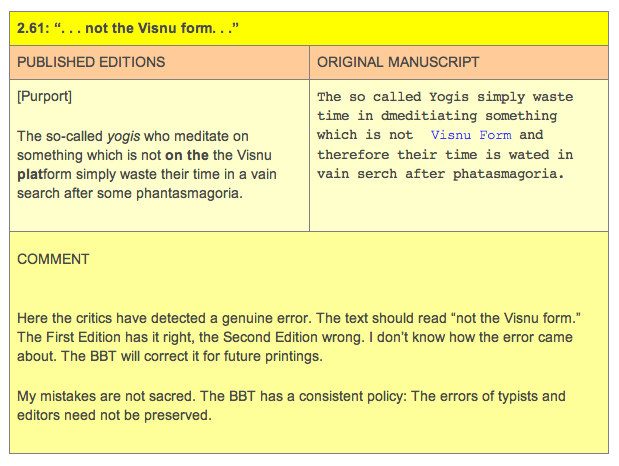
BBT International and their supporters often speak about this quote from Prabhupada as if it was some kind of blessing from Prabhupada that makes Jayadvaita Swami and his editing infallible even to this very day. This, of course, makes no sense and even Jayadvaita Swami himself admits that he sometimes commits mistakes in his editing. One example of this is his changing “Visnu Form” into the “Visnu platform”:

visnu-platform

(Click to enlarge picture)

So it’s obvious that we can’t take the statement “…whatever he does is approved by me” too literal. In order to be continuously approved by Prabhupada Jayadvaita Swami need to continuously meet certain criteria set forth by Prabhupada and sastra in regard to editing protocol. If it can be argued in any way that the editing policy of BBT International compromises the transcendental potency of Prabhupada’s books, or if Jayadvaita Swami becomes an atheist or a mayavadi or falls down and or if he somehow goes against the direct instructions of Prabhupada in his editing proces, then we must conclude that his editing is unauthorized and must be stopped. He can then no longer be “approved”.

This blog and several other websites have for years been showing that there is no evidence to support even the slightest change in Prabhupada’s books. It has been shown how Jayadvaita Swami does not at all perform his editing work according to the accepted protocol set forth by Prabhupada (“NO CHANGES”), sastra (arsa-prayoga) and even academic scholars. We have shown how he is actually sabotaging the books – however well-intentioned he may be.

So even though Prabhupada spoke highly of Jayadvaita Swami’s editing 40 years ago it does not make Jayadvaita Swami infallible, and it does not mean that he can just do whatever he likes to Prabhupada books.

The other quote that BBT International and their supporter often refer to is this:

From BBT International’s website:

“And in the conversation where Srila Prabhupada complained so strongly about “rascals editors,” Srila Prabhupada said about Jayadvaita, “He is good.””

So 40 years ago Prabhupada said about Jayadvaita Swami that he was “good”. Does it then follow logically or experientally that he is still “good”? Obviously not! There are several examples of Prabhupada at one point praising some of his disciple, and then at a later point criticized them severely.

Prahlada-Nrsimha Prabhu has written a very nice article about this (published on bookchanges.com):

Just because Srila Prabhupada at one point said someone was a good man, does that mean that they are one now? Srila Prabhupada liked many devotees at one point and at that point put them in positions of power and authority and praised them, but later on down the road he changed his opinion about them and/or they went astray or deviated to one degree or another. So although at one point Prabhupada approved of someone and complimented them, that does not mean that from that point on they are bona-fide no matter what they do. Here are a few examples to further examine this point.

One Prabhupada disciple did HUGE service for Prabhupada, pushing on the book distribution mission (probably) more than any other Prabhupada disciple in ISKCON’s history, and was pretty much running ISKCON at one point. But later he changed the basic rules of the four regulative principles to three. Does that mean because he had so many thousands of disciples, and at one point was so dear to Srila Prabhupada that Prabhupada even commented on how he was so intelligent and empowered, that now we should all only have three regulative principles instead of four and continue to follow this devotee?

There were so many big, big devotees that Srila Prabhupada personally gave sannyasa to but later on Srila Prabhupada became so fed up with their deviations that he said that they should give up those positions as sannyasi! Srila Prabhupada even said “This should be strictly outlawed, no more sannyasis….there will be no sannyasi anymore.”

(Room Conversation — January 7, 1977, Bombay)

Srila Prabhupada established the GBC as the ultimate managing authority for all ISKCON. But at one point Srila Prabhupada totally disbanded the whole of the GBC within ISKCON due to their deviations! So simply because at one point in time Srila Prabhupada appointed them to power and trusted them, does that give them permanent power? No! At any time anyone can lose their position and power and deviate or go astray and at that point one is no longer authorized and empowered.

I feel the most relevant example is from the concluding words of the Sri Caitanya-caritamrta, dated November 10, 1974

“Now, by the grace of Sri Caitanya Mahaprabhu and his Divine Grace Bhaktisiddhanta Sarasvati Thakura, it is finished. In this connection I have to thank my American disciples, especially Sriman Pradyumna dasa Adhikari, Sriman Nitai dasa Adhikari, Sriman Jayadvaita dasa Brahmacari and many other boys and girls who are sincerely helping me in writing, editing and publishing all these literatures.”

But then on February 27, 1977 in Mayapura India Srila Prabhupada says “Nitai, he’s a rascal.”

Unfortunately there are so many examples I could mention, but in order to not depress/and embarrass all of us unnecessarily in this article I will stop here.

In conclusion, we have shown how the above two claims by the BBT International about Jayadvaita Swami being “good” and his work being “approved” by Prabhupada can’t be used to justify the changes he has made to Prabhupada’s books. And that they can’t be used as a guarantee that Jayadvaita Swami has not comitted mistakes himself or that he has pleased Prabhupada by his work.

“Rascal Editors” (Prabhupada Conversations, June 22, 1977, Vrindavana)

Help us by “liking” and “sharing” this post!

Read the complete conversation here.

Original and authorized 1969 Sri Isopanisad (audio book)

Help us by “liking” and “sharing” this post!

Prabhupada became extremely concerned when he was informed that his own BBT had changed his Sri Isopanisad and he wanted it published again “the original way”. However, this instruction was never followed.

But here is the original version in audio and as ebook for FREE from krishnapath.org:

Sri_Isopanisad_original

FREE ORIGINAL AND AUTHORIZED SRI ISOPANISAD AUDIO AND EBOOK

“The next printing should be again to the original way.”

Yasoda-nandana: Sometimes they appeal that “We can make better English,” so they change like that, just like in the case of Isopanisad. There are over a hundred changes. So where is the need? Your words are sufficient. The potency is there. When they change, it is something else.

Svarupa Damodara: That’s actually a very dangerous mentality.

Yasoda-nandana: What is it going to be in five years? It’s going to be a different book.

Prabhupada: So you… What you are going… It is very serious situation. You write one letter that “Why you have made so many changes?” And whom to write? Who will care? All rascals are there. Write to Satsvarupa that “This is the position. They are doing anything and everything at their whim. The next printing should be again to the original way.”

(S.P. Conversation, “Rascal Editors,”June 22, 1977, Vrndavana)