New video with Ramesvara Prabhu from “Prabhupada Memories” about the book changes

Help us by “liking” and “sharing” this post!
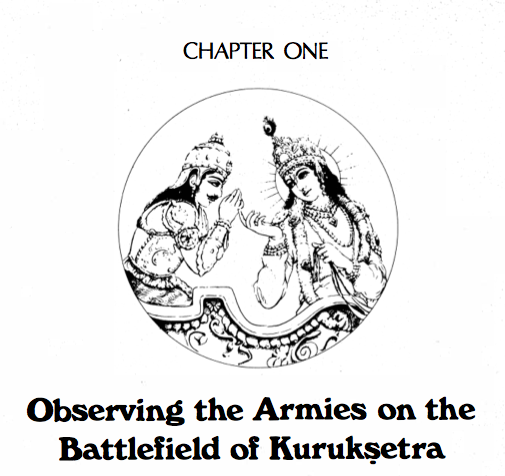
 

Everyone will welcome Srimad-Bhagavatam, even though presented with so many faults (SB 1.5.11)

Help us by “liking” and “sharing” this post!

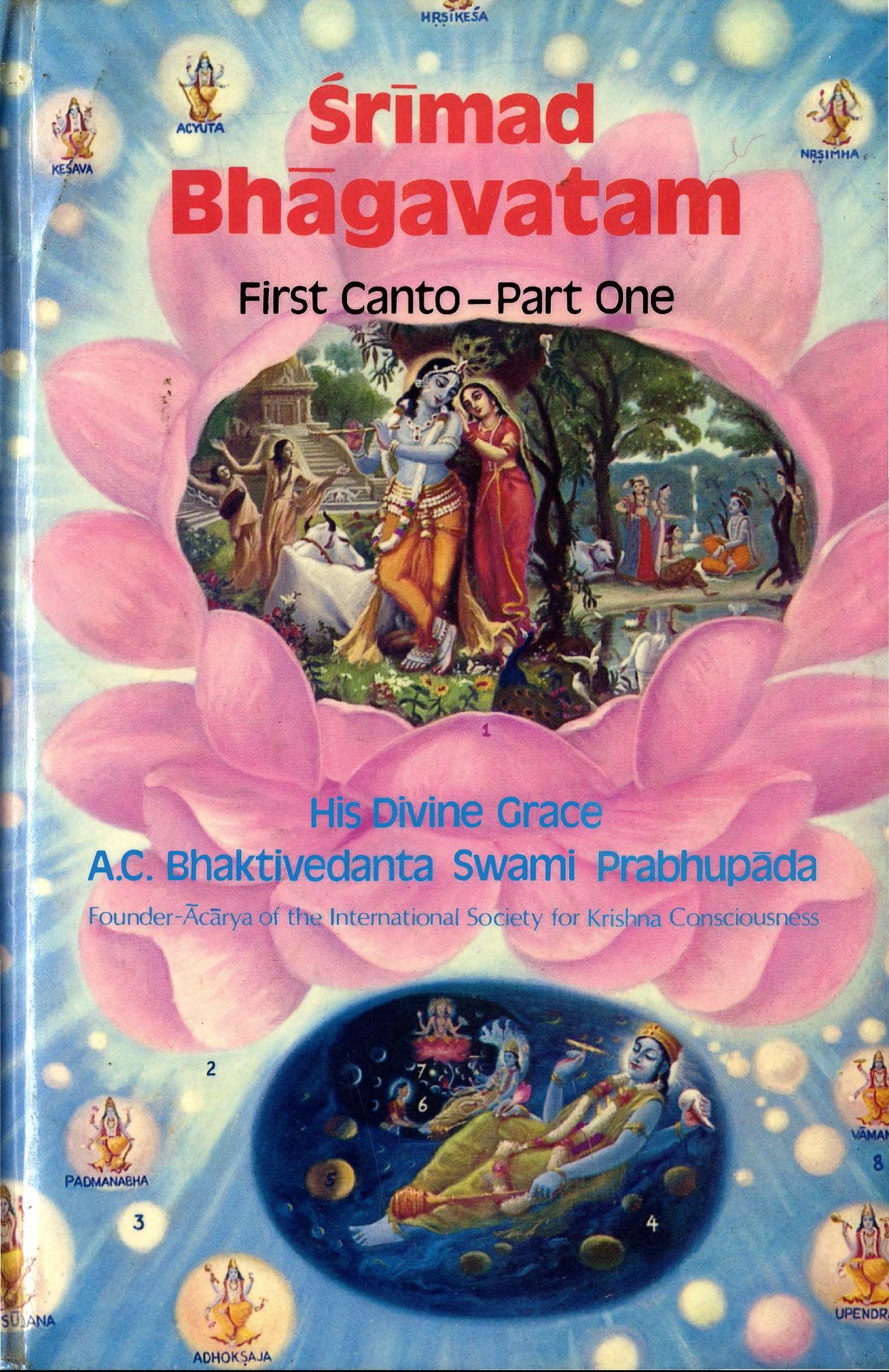
1972-original-srimad-bhagavatam-cover

tad-vāg-visargo janatāgha-viplavo
yasmin prati-ślokam abaddhavaty api
nāmāny anantasya yaśo ‘ṅkitāni yat
śṛṇvanti gāyanti gṛṇanti sādhavaḥ

SYNONYMS

tat—that; vāk—vocabulary; visargaḥ—creation; janatā—the people in general; agha—sins; viplavaḥ—revolutionary; yasmin—in which; prati-ślokam—each and every stanza; abaddhavati—irregularly composed; api—in spite of; nāmāni—transcendental names, etc.; anantasya—of the unlimited Lord; yaśaḥ—glories; aṅkitāni—depicted; yat—what; śṛṇvanti—do hear; gāyanti—do sing; gṛṇanti—do accept; sādhavaḥ—the purified men who are honest.

TRANSLATION

On the other hand, that literature which is full of descriptions of the transcendental glories of the name, fame, forms, pastimes, etc., of the unlimited Supreme Lord is a different creation, full of transcendental words directed toward bringing about a revolution in the impious lives of this world’s misdirected civilization. Such transcendental literatures, even though imperfectly composed, are heard, sung and accepted by purified men who are thoroughly honest.

PURPORT

It is a qualification of the great thinkers to pick up the best even from the worst. It is said that the intelligent man should pick up nectar from a stock of poison, should accept gold even from a filthy place, should accept a good and qualified wife even from an obscure family and should accept a good lesson even from a man or from a teacher who comes from the untouchables. These are some of the ethical instructions for everyone in every place without exception. But a saint is far above the level of an ordinary man. He is always absorbed in glorifying the Supreme Lord because by broadcasting the holy name and fame of the Supreme Lord, the polluted atmosphere of the world will change, and as a result of propagating the transcendental literatures like Śrīmad-Bhāgavatam, people will become sane in their transactions. While preparing this commentation on this particular stanza of Śrīmad-Bhāgavatam we have a crisis before us. Our neighboring friend China has attacked the border of India with a militaristic spirit. We have practically no business in the political field, yet we see that previously there were both China and India, and they both lived peacefully for centuries without ill feeling. The reason is that they lived those days in an atmosphere of God consciousness, and every country, over the surface of the world, was God-fearing, pure-hearted and simple, and there was no question of political diplomacy. There is no cause of quarrel between the two countries China and India over land which is not very suitable for habitation, and certainly there is no cause for fighting on this issue. But due to the age of quarrel, Kali, which we have discussed, there is always a chance of quarrel on slight provocation. This is due not to the issue in question, but to the polluted atmosphere of this age: systematically there is propaganda by a section of people to stop glorification of the name and fame of the Supreme Lord. Therefore, there is a great need for disseminating the message of Śrīmad-Bhāgavatam all over the world. It is the duty of every responsible Indian to broadcast the transcendental message of Śrīmad-Bhāgavatam throughout the world to do all the supermost good as well as to bring about the desired peace in the world. Because India has failed in her duty by neglecting this responsible work, there is so much quarrel and trouble all over the world. We are confident that if the transcendental message of Śrīmad-Bhāgavatam is received only by the leading men of the world, certainly there will be a change of heart, and naturally the people in general will follow them. The mass of people in general are tools in the hands of the modern politicians and leaders of the people. If there is a change of heart of the leaders only, certainly there will be a radical change in the atmosphere of the world. We know that our honest attempt to present this great literature conveying transcendental messages for reviving the God consciousness of the people in general and respiritualizing the world atmosphere is fraught with many difficulties. Our presenting this matter in adequate language, especially a foreign language, will certainly fail, and there will be so many literary discrepancies despite our honest attempt to present it in the proper way. But we are sure that with all our faults in this connection the seriousness of the subject matter will be taken into consideration, and the leaders of society will still accept this due to its being an honest attempt to glorify the Almighty God. When there is fire in a house, the inmates of the house go out to get help from the neighbors who may be foreigners, and yet without knowing the language the victims of the fire express themselves, and the neighbors understand the need, even though not expressed in the same language. The same spirit of cooperation is needed to broadcast this transcendental message of the Śrīmad-Bhāgavatam throughout the polluted atmosphere of the world. After all, it is a technical science of spiritual values, and thus we are concerned with the techniques and not with the language. If the techniques of this great literature are understood by the people of the world, there will be success.

When there are too many materialistic activities by the people in general all over the world, there is no wonder that a person or a nation attacks another person or nation on slight provocation. That is the rule of this age of Kali or quarrel. The atmosphere is already polluted with corruption of all description, and everyone knows it well. There are so many unwanted literatures full of materialistic ideas of sense gratification. In many countries there are bodies appointed by the state to detect and censor obscene literature. This means that neither the government nor the responsible leaders of the public want such literature, yet it is in the marketplace because the people want it for sense gratification. The people in general want to read (that is a natural instinct), but because their minds are polluted they want such literatures. Under the circumstances, transcendental literature like Śrīmad-Bhāgavatam will not only diminish the activities of the corrupt mind of the people in general, but also it will supply food for their hankering after reading some interesting literature. In the beginning they may not like it because one suffering from jaundice is reluctant to take sugar candy, but we should know that sugar candy is the only remedy for jaundice. Similarly, let there be systematic propaganda for popularizing reading of the Bhagavad-gītā and the Śrīmad-Bhāgavatam, which will act like sugar candy for the jaundicelike condition of sense gratification. When men have a taste for this literature, the other literatures, which are catering poison to society, will then automatically cease.

We are sure, therefore, that everyone in human society will welcome Śrīmad-Bhāgavatam, even though it is now presented with so many faults, for it is recommended by Śrī Nārada, who has very kindly appeared in this chapter. (Source: http://prabhupadabooks.com/sb/1/5/11)

In The Early Days (Govinda Dasi)

Help us by “liking” and “sharing” this post!

govinda-dasi

Govinda Dasi

A number of devotees attended the recent (January 2003) series of meetings in Hawaii on the book changes. Jayadvaita Maharaja attended the first two meetings, and Nischintya Prabhu attended the third one (Jayadvaita Maharaja was out of town). I attended all three meetings and believe that much was accomplished. Many valuable points were gleaned from these sessions – both inspiring as well as grueling. These meetings are being transcribed, and are available on adi-vani.org for those who are interested.

We held the meetings in Srila Prabhupada’s room at New Navadvipa Dham, His Divine Grace A.C. Bhaktivedanta Swami Prabhupada Memorial Tirtha (the Honolulu ISKCON temple), where Srila Prabhupada lived, worked and translated his books. His presence is very strong at our Hawaii temple. We all prayed for Srila Prabhupada’s divine presence at these meetings, and humbly requested that he inspire us to reach understandings based on his transcendental viewpoints, rather than our own limited ones. In my heart, I feel that Srila Prabhupada has urged me to speak out on this issue. I usually do not get involved in controversial matters unless the issue is of great importance. And the issue of Srila Prabhupada’s books, in my opinion, is of paramount importance. I have had many realizations and wish to share them here.

It is unreasonable to consider that Srila Prabhupada would intend to give up the results of two years of editing the book with Hayagriva and go backwards to the original manuscripts.

First, it seems that Jayadvaita Maharaja takes this matter too personally.

Continue reading

A little learning is dangerous

Help us by “liking” and “sharing” this post!sp-pointing-finger

According to Satsvarupa Goswami in his Prabhupada Lilamrita Srila Prabhupada said arsha-prayoga establishing a no change policy:

But one day while sitting in the garden with Tamala Krsna, Svarupa Damodara, and others, Srila Prabhupada became very disturbed when he detected a mistake in one of his already printed books. Tamala Krsna was reading aloud a verse from the First Canto which began, “Munayah sadhu prsto ‘ham.” Srila Prabhupada had him read the synonyms.

Tamala Krsna read: “munayah-O sages; sadhu-this is relevant; prstah-questioned… ”

“Sadhu?” asked Srila Prabhupada. Thus he uncovered a thoughtless mistake made by the Sanskrit editors. Sadhu means “devotee,” not “this is relevant.” Srila Prabhupada became very angry and denounced the “rascal Sanskrit scholars.” “A little learning,” he said “is dangerous. Immediately they think they have become big scholar, thinking, “I shall arrange!’ And then they write all nonsense.” He continued speaking about the mistake for half an hour. He was disturbed. He ordered Tamala Krsna to write at once to the BBT and stop these speculations by his disciples-changing his books in the name of editing The devotees were startled to see Prabhupada so angry; he was supposed to be peacefully relishing a Srimad-Bhagavatam reading here in his garden. Such a change was very serious, he said, because it changed the meaning. “Even if the authorized acaryas would make a mistake,” he said, “it would not be changed. This is arsa-prayoga. In this way the acaryas are honored.” (Srila Prabhupada Lilamrita, chapter 52 “I Have Done My Part”)

Arsha Prayoga Part II

Help us by “liking” and “sharing” this post!

srila-prabhupada-reading-his-own-books

By Locanananda Dasa (originally posted on his blog)

Srila Prabhupada’s desire was to see his books translated into all of the major languages of the world. By 1970, numerous centers had opened in countries outside of the United States and translation work had begun in Germany, France, Canada, South America and Japan. When the German devotees undertook the translation of the Srimad Bhagavatam, they discovered what they thought were grammatical discrepancies in the original English. The translators reasoned that if their spiritual master could publish his books with flaws included, then their own translation work could also contain mistakes and no harm would be done. In a very strongly-worded letter, Srila Prabhupada chastised his disciples for thinking they could imitate their spiritual master and explained that to avoid this offense, they must follow the principle of arsha prayoga.

One should not see mistakes in the books written by his spiritual master, nor should one think he is able take the same liberties taken by him. His Divine Grace warned his disciples that only if they were able to spread Krishna consciousness all over the world as he had done could discrepancies in their translation work be overlooked, otherwise not.

“So far your telling me that some devotees consider that because there may be some grammatical discrepancies in my Srimad Bhagavatam, First Canto, then they may also be allowed to translate with errors accepted, that is just like imitating Raslila. When you do all other things like Krishna, then you can do Raslila. So if these other writers can do like me and spread Krishna consciousness all over the world by becoming big Vedic scholars, then they can do.

“If one is too big, there is no mistake. Arsha prayoga means there may be discrepancies but it is all right. Just like Shakespeare, sometimes there are odd usages of language, but he is accepted as authority. I have explained all these things in my preface to First Canto.” (Letter to Mandali Bhadra dated 1-20-72 )

Srila Prabhupada wrote, “If one is too big, there is no mistake,” so when the BBT [Bhaktivedanta Book Trust International, Inc.—not the authentic Bhaktivedanta Book Trust established by Srila Prabhupada] decided that his books were full of mistakes and had to be re-edited, they made Srila Prabhupada look very small, and that is their great offense.

Sometimes, the editors try to justify their actions by claiming that scholars would have found fault in our books had they not been revised. The many, many letters Srila Prabhupada received from world-renowned scholars that glorified his phenomenal literary output contradict this false propaganda. The academic community was astounded by the magnitude of his undertaking and showed its appreciation for the exactness with which he translated and the profound devotion he expressed in his Bhaktivedanta purports. We have chosen one such letter which exemplifies to what extent Srila Prabhupada’s extraordinary efforts were acknowledged by the educated class of men. We advise the reader to keep in mind that these comments refer to the original BBT printing of his books.

Excerpted from a letter written by Sri R. Subrahmanyam, M.A., Deputy Research Director of the National Parliament of the Central Government of India:

“To teach this science of God to people everywhere and to aid them in their progress and development towards the real goal of life, Srimad Bhagavatam is most eminently fitted. In fact, this great ancient work of Vyasa will fill this need of the modern times, for it is a cultural presentation for the re-spiritualization of the entire human society. His Divine Grace, Srila A.C. Bhaktivedanta Swami Prabhupada, the founder-acarya of the ISKCON movement, has taken upon himself, in addition to his ceaseless travels and other multifarious activities in the service of the Lord, the stupendous task of translating this Sanskrit work into English in about sixty volumes for the welfare and happiness of mankind.

“So far, eighteen volumes of this most beautiful literature on God have been brought out by ISKCON, and the rest are under preparation. Needless to say that in keeping with the excellence of their other publications, the publishers have seen to it that the printing, get-up, and pictures in these volumes are also of the highest quality, as though to serve as an ornament to the divine contents of the books.

“This is a rare opportunity for people and leaders of every country, race and community in the world to know and understand the glorious science of God and work for their perfection.”

We challenge the BBT managers and their editors to produce a single letter from any recognized scholar agreeing with them that Srila Prabhupada’s original books were full of mistakes and had to be revised for his message to be properly understood. Since their purpose in making these revisions was to impress scholars, we hereby challenge them to come forward and produce evidence that there are indeed scholars who approve of the thousands of changes they made to Srila Prabhupada’s books.

Another argument presented to support the BBT’s questionable editorial policy was that their editors, by dint of their many additional years of experience, had become more qualified than Srila Prabhupada’s earlier staff of editors, and this had supposedly earned them the right to review all of the books after Srila Prabhupada’s disappearance and make whatever changes they thought were necessary. In the late 1960′s, Hayagriva had similarly offered to redo some of Rayarama’s editorial work, thinking himself more academically qualified than his godbrother, but Srila Prabhupada did not approve of his proposal. Although Hayagriva was an accomplished professor of English at Ohio State University, contrary to his opinion (and that of today’s BBT managers), Srila Prabhupada affirmed that academic credentials are not the primary qualification to edit transcendental literature. In his reply to Hayagriva, he wrote:

“Rayarama may not be as qualified as you are, but his one qualification that he is fully surrendered to Krishna and his spiritual master is the first class recommendation for his editing any one of our literatures, because editing of Vedic literatures not depend on academic education.” (Letter to Hayagriva dated 1-15-68 )

It is evident from his letter that Srila Prabhupada considered his early editors to be fully competent because they were depending upon Krishna and the spiritual master to give them the ability to perform their service. His Divine Grace was very satisfied with the quality of their work and, to show his appreciation, he later wrote to Hayagriva, “I want your company always for editing my writings very nicely.” As far as we have been able to ascertain, he never contemplated having anyone redo the work of his editors.

It is also a fact that Srila Prabhupada’s involvement in the preparation of his books went far beyond his original dictation, although the BBT’s propaganda would lead one to believe that his participation ended there. The truth is that in order to guarantee a very high standard of presentation, Srila Prabhupada personally supervised all proofreading and editorial work and did not allow any significant changes to be made in the text of his books without his approval. It is customary that once a writer accepts an edited draft of his book, it immediately supersedes an unedited draft. When the BBT editors decided to work again from Srila Prabhupada’s original manuscripts, they were, in effect, rejecting the proofreading and editorial work that Srila Prabhupada himself had overseen. This is not how one shows appreciation for the spiritual master’s endeavor to publish his books, or for the service offered to him by others.

Arsha Prayoga Part (I) – Resistance To Change

Help us by “liking” and “sharing” this post!

By Locanananda Prabhu (originally posted on his blog)

ct45-0541

Let me first offer my prostrated obeisances unto the lotus feet of that supreme swan-like devotee of the Lord, our spiritual master, His Divine Grace A.C. Bhaktivedanta Swami Prabhupada, by whose mercy the fallen souls of Kali Yuga may taste the sweetness of the narrations of the pastimes of the Lord and His pure devotees. As the bonafide representative of Sri Vyasadeva, he composed a mountain of transcendental literature to enlighten the entire human society, explaining even the most confidential truths regarding vaisnava philosophy.

His Divine Grace Srila Prabhupada displayed all of the symptoms of an empowered jiva soul, working tirelessly to distribute the transcendental message of love of Godhead throughout the world. It is therefore the duty of his followers to preserve the legacy and protect the honor of such a great spiritual personality whose every moment was dedicated to the spreading of Krishna consciousness.

To guarantee that his teachings would not be forgotten in the oblivion of time, Srila Prabhupada created the Bhaktivedanta Book Trust and, assisted by his disciples, he astounded the academic community with his literary output. What follows is a brief account of Srila Prabhupada’s struggle with the BBT staff to keep the final version of his books intact by resisting what he called the “American disease” of always wanting to change things. As will be seen from the letters and conversations cited in this article, Srila Prabhupada would finally insist on an “absolutely no change” policy based on the principle of “arsa prayoga”.

That unwanted changes were being made to his books came to his attention as early as 1975, and it quickly became a pressing matter. In a letter to the production manager of the Bhaktivedanta Book Trust, Srila Prabhupada expressed his alarm that changes he had not approved were appearing in print.

“I will have to see personally what are the mistakes in the synonyms and also how you intend to correct them. I was not satisfied with the corrections that were made before. I saw some changes which I did not approve. Nitai may correct whatever mistakes are there, but the corrected material must be sent to me for final approval.” (Letter to Radha-vallabha dasa dated 1-5-76)

Srila Prabhupada never gave anyone carte blanche to make revisions in his books. This letter confirms that any changes to his books would require his personal approval before being printed.

A few months later, the issue of change was raised again by Radha-vallabha dasa regarding the text of several volumes of the Srimad Bhagavatam which were soon to be reprinted. Srila Prabhupada advised him, “There is no need for corrections for the First and Second Cantos. Whatever is there is all right.” (Letter of 5-4-76) Seeing how persistent his BBT managers were to implement change in the text and presentation of his books, His Divine Grace wrote again to Radha-vallabha dasa in August, 1976, this time more firmly:

“Do not try to change anything without my permission.”

Srila Prabhupada consistently stated that he did not want anything to be changed unnecessarily. Any changes they thought would be an improvement in the text would require his written authorization.

The most serious violation of this instruction actually came years later, after Srila Prabhupada’s disappearance, when BBT personnel decided to print a new version of the Bhagavad-gita. It is a well known fact that His Divine Grace never authorized anyone to re-edit the Bhagavad-gita As It Is. If Srila Prabhupada ever intended to make changes in the Gita, the ideal opportunity for him to say so came in a room conversation that took place on February 24, 1977 in Mayapur. On that occasion, Radha-vallabha dasa was describing how the upcoming printing of the Bhagavad-gita was going to require so much paper that it would take seventy-six train cars to transport it (1.5 million copies). Srila Prabhupada absolutely did not suggest making any corrections before this largest printing ever of the Bhagavad-gita As It Is. In fact, and to the contrary, in a discussion that took place three days later, he established a definitive “no change” policy that he wanted applied henceforward to all of his books. The tendency to want to make corrections was now a very serious problem, and Srila Prabhupada dealt with it.

The transcribed conversation of February 27, 1977 presented below clearly indicates that Srila Prabhupada would never have approved of anyone changing the final edited version of his writings, even after his disappearance. In this exchange, His Divine Grace states that for a disciple to see mistakes in his production-ready finished manuscripts was a bad habit that had to be given up. Even though the one correction his disciple Jagannatha dasa wanted to propose would not have changed the wording of the verse, Srila Prabhupada warned that to make any change whatsoever was “strictly forbidden”. As a servant of his spiritual master, Radha-vallabha dasa was obliged to accept Srila Prabhupada’s instruction that the text should be left exactly as is and that making corrections should never be contemplated.

To further enlighten his disciple, Srila Prabhupada explained the rule of “arsa prayoga”, that whatever the acharya has given, it should be accepted. The tendency to think oneself sufficiently qualified to correct one’s authority is not only a breach of vaisnava etiquette, but is an offense in the service of the spiritual master.

If one continues to see mistakes that he thinks need to be corrected, Srila Prabhupada says, “He is the mistake.” Due to his incomplete understanding, Radha-vallabha dasa reasoned, “So if we think there is some mistake, we should just forget about it.” Srila Prabhupada corrects him again, saying that one should not even think his authority has made a mistake. His opinion was that since Jagannatha dasa tended to see mistakes in the writings of the acharya, he was an irresponsible man who could not be relied upon. Srila Prabhupada then made his final point, that our true purpose is not served by becoming so-called scholars able to find errors in the books of the spiritual master, but by becoming advanced in devotion to Krishna. Radha-vallabha dasa finally got the point, that Srila Prabhupada was establishing the rule of “no corrections anywhere” once a book was submitted to his department for publication.

prabhupada-admiring-book

Srila Prabhupada was assigning to the BBT trustees the duty of safeguarding his books from being changed in the slightest by anyone who had not been specifically ordered to do so.

The principle of “arsa prayoga” was again referred to on June 22, 1977 when Srila Prabhupada was in Vrndavana, India. In the middle of a reading of the Srimad Bhagavatam, Srila Prabhupada objected when he heard the synonym that was given for the word “sadhu”. The word-for-word translation said, “it is relevant,” but Srila Prabhupada said, “No. ‘Sadhu’ means ‘devotee’.” The editors had changed his translation, and he found this unacceptable. He spoke as though he had been betrayed by a dangerous element within his movement. His authority was being minimized by his own disciples to whom he had entrusted his most lasting contribution: his books. A number of devotees present voiced their objection to the production staff’s practice of deleting entire sections from certain books, and they mentioned discrepancies they had found in the Sanskrit to English translations. Literally hundreds of changes had already been made in the text of Srila Prabhupada’s books from one printing to the next and the devotees testified that the potency was not the same.

Srila Prabhupada asked for suggestions from his senior men to resolve this dilemma and they offered their advice. After hearing various proposals, Srila Prabhupada’s conclusion was that, “The next printing should be again to the original way.” He then ordered his secretary to contact the GBC man he wanted to entrust this matter to in Los Angeles where the press was located. “So you bring this to Satsvarupa. They cannot change anything.”

Drawing from these letters and conversations, we can gain some insight into Srila Prabhupada’s struggle to keep his books as they were. One should rightly conclude that he would never have approved of the wholesale changes that were made by the BBT editors after his disappearance. He would have expected the BBT trustees to resist on his behalf. The unnecessary and unauthorized changes in the Bhagavad-gita alone number more than seven hundred, so where is Srila Prabhupada’s signed approval for such changes to be made? And where are the rave reviews of the revised edition from scholars and professors praising the editors for having improved the original version of the Gita published by their spiritual master? We do not expect to see any testimonials from these mundane personalities glorifying the “revised and enlarged” edition of the Gita. After all, which scholar would approve of having his own writings altered after his physical demise?

The adulteration of Srila Prabhupada’s Bhagavad-gita As It Is was the first major milestone in the BBT’s refusal to follow the rule of arsa prayoga (the unholy practice of dishonoring the acharya), a program which reached its zenith when they declared in court that Srila Prabhupada was simply a writer hired by ISKCON to compile the Vedic classics. We do not know what kind of apology can be made by the BBT’s editors and trustees at this point, but it is our humble opinion that the best way to make amends for past transgressions would be to accept Srila Prabhupada’s instruction that “the next printing should be again to the original way.”