


By Ajit Krishna Dasa
In a lecture, Śrīla Prabhupāda says that Sanātana Gosvāmī and Rūpa Gosvāmī were “exterminated from society.” For some readers, this immediately creates a difficulty. Since “exterminate” is commonly associated with killing, it may appear that the word is being used incorrectly. On that basis, one may conclude that he must have meant something like “excommunicated.”
This reaction is understandable, but it rests on a quick assumption: that the modern, narrow meaning of a word is the only valid one. Before arriving at such a conclusion, a more careful approach is to give the speaker the benefit of the doubt and examine the context.
When we do so, the meaning becomes clear from Śrīla Prabhupāda’s own explanation:
“So this Sanātana Gosvāmī and Rūpa Gosvāmī… They were exterminated from the society. What is the extermination of society? He will never be invited.
Nobody will offer his daughter to their family… So if one is exterminated, oh, it is very difficult to get his daughter married. Nobody will accept. That was their condition.”
Here, A. C. Bhaktivedanta Swami Prabhupada defines the term himself. “Extermination” refers to complete social exclusion—loss of association, honor, and standing within society.
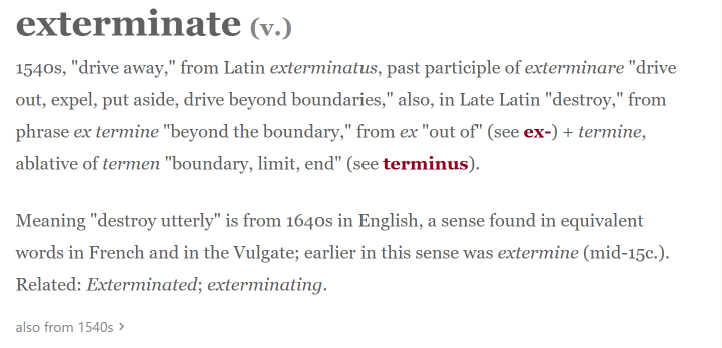
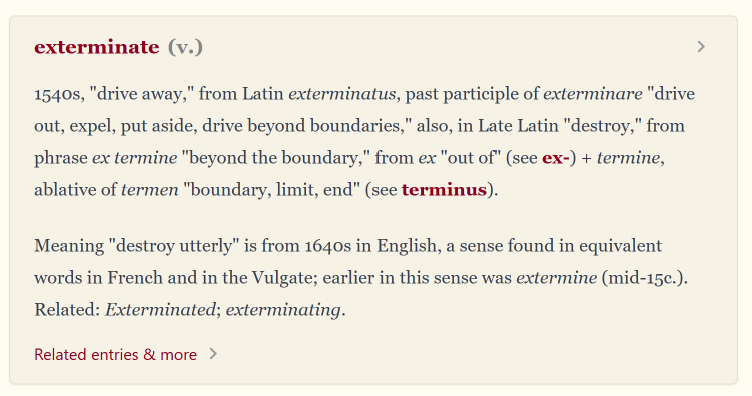
Moreover, the word itself supports this usage. Historically, “exterminate” means to drive out beyond a boundary—to remove completely. Only later did it acquire the more specific sense of physical destruction. The broader meaning therefore fully accommodates Śrīla Prabhupāda’s usage.
Seen in this light, the issue is not that the word is wrong, but that a modern assumption about its meaning is too limited.
A similar pattern can be observed in editorial decisions made by Jayadvaita Swami. In the purport to Bhagavad-gītā 13.1–2, the original 1972 edition reads:
“Sometimes we understand that I am happy, I am mad, I am a woman, I am a dog, I am a cat…”
In the posthumous edition, “mad” was replaced with “a man,” based on the judgment that the original wording was incorrect or nonsensical.
Yet when Śrīla Prabhupāda’s broader usage is considered, the phrase “I am happy, I am mad” is not only meaningful but philosophically precise. Throughout his teachings, happiness and madness function as contrasting epistemic states—clarity versus illusion. The conditioned soul identifies with both and mistakes them for the self. The original wording therefore fits the context of Chapter 13, which analyzes the distinction between the knower and the known, including mental conditions.
In both cases, the same tendency appears: a word is judged according to a narrow or immediate understanding, and a conclusion is drawn without sufficient attention to context, historical meaning, or the speaker’s own usage.
This highlights an important principle. Fidelity to Śrīla Prabhupāda’s words requires more than preserving the text. It requires a disciplined approach to interpretation. Before assuming error, we must give the benefit of the doubt, examine the context, and consider how he consistently uses language across his teachings.
If we fail to do so, we risk not only misunderstanding his words, but also attributing confusion or mistake to the ācārya where none exists.
To honor Śrīla Prabhupāda properly, we must therefore begin with humility in interpretation. By allowing his own explanations, his broader usage, and the historical range of language to guide our understanding, we remain faithful not only to his words, but to the meaning he intended to convey.


You must be logged in to post a comment.