Earlier Drafts Are Not Final Authority

Why the “Original Manuscripts” Cannot Overrule Śrīla Prabhupāda’s Approved Bhagavad-gītā As It Is

By Ajit Krishna Dasa

One of the central arguments used to justify the posthumous revision of Śrīla Prabhupāda’s Bhagavad-gītā As It Is is that the revised edition brings the book closer to the “original manuscripts.” At first hearing, this may sound reasonable. If an earlier manuscript contains wording different from the published edition, some may assume that the earlier wording must be closer to Śrīla Prabhupāda’s own intention.

But that assumption is not sound.

The so-called “original manuscripts” cannot simply be treated as a single, faultless, final, authorially approved text. They are textual witnesses from different stages of production. Some materials are typed pages. Some are transcriptions from tapes. Some are retyped manuscripts. Some had already passed through earlier editorial handling. In some cases, earlier sources were no longer available.

Jayādvaita Swami himself has acknowledged that “original manuscripts” means different things in different sections of the Gītā. For the first five or six chapters, the term refers to manuscripts apparently typed by Śrīla Prabhupāda himself. For the middle six chapters, it refers to original transcriptions of his tapes. For the last chapters, it refers to old retyped manuscripts from which the 1972 Macmillan edition was produced. He further states that the retyped manuscripts for the last six chapters were copied from original transcriptions “on which much editing had already been done,” and that the original transcriptions themselves were apparently lost before 1972 [Jayādvaita Swami, “About this conference and about the manuscripts,” Bhagavad-gītā Revisions Explained, Part 2].

Therefore, the central question cannot merely be, “What does an earlier manuscript say?” The real question is: “What did Śrīla Prabhupāda approve, authorize, publish, use, lecture from, and give to the world?”

Earlier textual material may be historically useful. It may help scholars understand how the book developed. It may illuminate editorial decisions. It may reveal possible problems in the production history. But it cannot automatically overrule an edition Śrīla Prabhupāda approved during his manifest presence.

Manuscripts Are Witnesses, Not Masters

A manuscript is not the same thing as final authorial intention. A draft may contain wording the author later rejected. It may preserve an incomplete stage of thought or presentation. It may include transcription errors. It may contain phrasing that was later improved in consultation with an editor. It may reflect a stage before the author’s final approval.

This is especially important in the case of Bhagavad-gītā As It Is, because Śrīla Prabhupāda’s book went through a real process of dictation, typing, editing, proofreading, printing, and approval. The earlier manuscript layer was not the final public act of the author. The approved published editions were.

A manuscript may testify. It may illuminate. It may raise questions. But it cannot rule over the author-approved published book.

To say that a reading is “closer to the manuscript” does not necessarily mean that it is closer to Śrīla Prabhupāda. It may only mean that it is closer to an earlier draft, a transcription, an unfinished reading, or a wording that was later superseded. This distinction is essential.

Dictation and Transcription Were Not Faultless Processes

Many of Śrīla Prabhupāda’s books were dictated on a Grundig dictating machine. This allowed him to produce a vast amount of transcendental literature, but it also created practical problems. Jayādvaita Swami acknowledges that this method meant Śrīla Prabhupāda had less opportunity to review and revise his words, that he sometimes spoke passages twice, and that he had to depend on the accuracy of transcribers [Jayādvaita Swami, “Editing the Unchangeable Truth”].

Jayādvaita Swami further admits that, especially in the early years, transcription accuracy was poor. The transcribers were not deeply familiar with Śrīla Prabhupāda’s philosophy, had difficulty with his Bengali accent, and were unfamiliar with many Sanskrit words and quotations. He also notes that the dictation machine itself could clip words or delete them when Śrīla Prabhupāda started, stopped, or reviewed his dictation [Jayādvaita Swami, “Editing the Unchangeable Truth”].

The result was that transcriptions sometimes contained gaps, omissions, phonetic approximations, and wrong guesses. According to Jayādvaita Swami, this was especially true for Bhagavad-gītā As It Is and, to a lesser extent, Kṛṣṇa Book [Jayādvaita Swami, “Editing the Unchangeable Truth”].

This is decisive. A transcription is not automatically identical with Śrīla Prabhupāda’s words. It may contain his words, but it may also contain the transcriber’s misunderstanding of his words. It may contain missing Sanskrit, guessed phrasing, clipped words, incomplete quotations, or damaged readings. Therefore, such materials must be handled with caution. They cannot be treated as a faultless court of appeal over an approved published edition.

The 1968 Macmillan Translations Were Approved for Continued Use

The 1968 abridged edition of Bhagavad-gītā As It Is is highly important in this discussion. It was not the complete form Śrīla Prabhupāda ultimately wanted, but its verse translations had authorial weight. Śrīla Prabhupāda did not treat them as a defective layer to be discarded whenever an earlier draft differed from them.

This becomes clear in a discussion with the BTG staff in Boston on December 24, 1969. Hayagrīva specifically raised the question of the Macmillan translations. He said that the translations themselves had been “somewhat changed” in Bhagavad-gītā As It Is as it came out from Macmillan, and he asked Śrīla Prabhupāda whether he liked those translations. Śrīla Prabhupāda replied: “Whichever is better, you think. That’s all. You can follow this Macmillan.” Hayagrīva then said, “They’re good. I think they’re very good.” Śrīla Prabhupāda answered: “Yes. You can follow that translation. Simply synonyms he can add, transliterations.” When Hayagrīva added that all the purports could be included and nothing deleted, Śrīla Prabhupāda approved: “That’s all right” [Discussion with BTG Staff, December 24, 1969, Boston; cited in Arsa Prayoga and Salt in the Caranamrita].

This is an important piece of evidence. Śrīla Prabhupāda was not unaware that the Macmillan translations had been changed from earlier drafts. Hayagrīva explicitly told him so. Śrīla Prabhupāda had the opportunity to reject those translations, to order a return to the earlier manuscript readings, or to insist that the translations be reworked from the draft. He did not do so. Instead, he said, “You can follow this Macmillan” and “You can follow that translation.”

This has direct bearing on readings such as “The Blessed Lord.” Śrīla Prabhupāda had every opportunity to replace “The Blessed Lord” with “The Supreme Personality of Godhead” when the complete edition was being prepared. He did not. On the contrary, when the Macmillan translations were raised directly, he approved following them. Therefore, where the 1968 Macmillan translations differ from earlier drafts, those earlier drafts cannot simply be treated as more authoritative.

The significance is not that the 1968 abridged edition was the final complete form of the Gītā. It was not. Śrīla Prabhupāda wanted the complete edition with all verses, synonyms, transliterations, translations, and purports. But the conversation shows that the Macmillan translations themselves were not to be automatically discarded. They were acceptable for continued use in the expanded edition.

Therefore, if an earlier draft contradicts the 1968 Macmillan translation, the draft does not automatically overrule the published wording. The published wording had passed into an author-approved process. To change it after Śrīla Prabhupāda’s departure requires clear authorization from Śrīla Prabhupāda. Merely pointing to an earlier draft is not enough.

This also sharpens the argument against the posthumous revision. If Śrīla Prabhupāda knowingly allowed the Macmillan translations to be followed in the preparation of the complete edition, then later editors cannot claim that a return to earlier drafts is automatically a return to Śrīla Prabhupāda. In some cases, it may be a move away from what Śrīla Prabhupāda approved.

Hayagrīva’s Work Cannot Be Dismissed as Unauthorized Interference

The posthumous revision argument often depends on treating Hayagrīva’s editorial work as an obstacle between us and Śrīla Prabhupāda. But this is too simplistic. Śrīla Prabhupāda engaged Hayagrīva as an editor. He accepted his service. Hayagrīva was not a later posthumous reviser reconstructing the author’s intention after his departure. He worked during Śrīla Prabhupāda’s manifest presence.

There is evidence that Hayagrīva worked closely with Śrīla Prabhupāda over a substantial period. Govinda Dāsī states that in 1966, 1967, and 1968 Hayagrīva spent many hours alone with Śrīla Prabhupāda discussing the editing work, and that they went over the verses extensively [Govinda Dāsī, Honolulu iṣṭagoṣṭhī, January 2003; cited in Arsa Prayoga].

Govinda Dāsī also argues that it is unreasonable to think Śrīla Prabhupāda would intend to give up the results of extensive editing work with Hayagrīva and go backward to earlier drafts. She notes that there were many working drafts in various stages of editing, and that Jayādvaita Swami confirmed in the second Hawaii iṣṭagoṣṭhī that “there is no one original manuscript” [Govinda Dāsī, cited in Arsa Prayoga].

This is exactly why caution is required. If a later editor goes back to an earlier draft, he may think he is removing Hayagrīva’s influence. But he may in fact be removing wording that Śrīla Prabhupāda accepted, discussed, approved, or preferred. He may be undoing Śrīla Prabhupāda’s own editorial decisions.

The fact that we cannot know every detail of the discussions between Śrīla Prabhupāda and Hayagrīva does not give later editors freedom to reconstruct the book. It gives them a reason to refrain.

The 1972 Complete Edition Has Final Published Authority

The 1972 Macmillan edition is the complete edition of Bhagavad-gītā As It Is that Śrīla Prabhupāda gave to the world. In his preface, Śrīla Prabhupāda explains that the earlier published edition had been cut short, and that the complete edition was being presented in its original form with full paramparā explanation [A. C. Bhaktivedanta Swami Prabhupāda, Preface to Bhagavad-gītā As It Is, 1972].

This makes the 1972 edition central. It was not merely another stage in an unfinished process. It was the completed published edition. It was printed during Śrīla Prabhupāda’s manifest presence. He used it, lectured from it, ordered it read and distributed, and allowed it to stand.

There is also testimony that Śrīla Prabhupāda approved the galley proofs or blueprint connected with the 1972 edition. The Arsa Prayoga compilation cites Brahmānanda’s recollection that Śrīla Prabhupāda personally read through the galleys, made notations in his own hand, and did the proofreading before the book was sent for printing [“Galley Proofs,” in Arsa Prayoga].

The 1972 edition should therefore stand as the standard complete edition of Śrīla Prabhupāda’s Bhagavad-gītā As It Is. Earlier drafts cannot overrule it merely because they are earlier. Earlier does not mean final. Earlier does not mean approved. Earlier does not mean closer to Śrīla Prabhupāda’s intention.

Clear Instruction, Not Editorial Confidence

The decisive principle is this: only clear instruction from Śrīla Prabhupāda can form the basis for changing anything in his published books.

It is not enough that a later editor believes he has found a mistake. It is not enough that a manuscript contains a different reading. It is not enough that a later scholar or devotee thinks the text would be clearer, smoother, more accurate, or closer to a draft. Such judgments may be discussed in scholarly notes, but they do not create authority to alter Śrīla Prabhupāda’s book.

Śrīla Prabhupāda’s own instructions on ārṣa-prayoga point strongly toward preservation. In the well-known exchange with Rādhā-vallabha Dāsa, Śrīla Prabhupāda says that the tendency to correct is “very bad,” that “whatever authority has done, even there is mistake, it should be accepted,” and that one should not become “more learned than the authority” [Room Conversation, February 27, 1977; cited in Arsa Prayoga].

The relevant standard is not editorial confidence. The relevant standard is authorization.

The Missing Authorization

A posthumously revised edition cannot be accepted merely because later editors believe their changes are improvements, corrections, or restorations from earlier manuscripts. The decisive question is whether Śrīla Prabhupāda clearly authorized such posthumous changes to his published book.

There is no such evidence.

There is evidence that Śrīla Prabhupāda engaged editors during his manifest presence. There is evidence that he wanted spelling, grammar, Sanskrit names, and presentation handled properly under his supervision. There is evidence that he approved published editions during his lifetime. But there is no clear instruction from Śrīla Prabhupāda authorizing later editors, after his departure, to reconstruct Bhagavad-gītā As It Is from earlier drafts and manuscripts, alter thousands of readings, and then present the result as his own book.

This point is strengthened by the exchange in which Vyāpaka Dāsa asks Jayādvaita Swami whether he has explicit instructions from Śrīla Prabhupāda authorizing him to make post-samādhi changes to his books. Jayādvaita Swami’s answer is recorded as “No” [Published e-mail correspondence between Jayādvaita Swami and Vyāpaka Dāsa, cited in Arsa Prayoga].

That absence is decisive. Without clear authorization, the work must remain as the ācārya gave it.

Even the Manuscript Argument Is Not Followed Consistently

Even if, for the sake of argument, one were to grant the revisers permission to consult earlier drafts and manuscripts, the posthumous revision would still face a serious internal problem: the revisers do not consistently follow the manuscript evidence.

The justification repeatedly offered is that the revised edition brings the text closer to what Śrīla Prabhupāda originally wrote or said. But in many cases the changes do not simply restore manuscript readings. Critics have documented instances where the BBTI deleted Śrīla Prabhupāda’s own chosen words and sentences, even where those words are also found in the so-called “original manuscript”; added words and sentences not found in the manuscript; changed Śrīla Prabhupāda’s personally typewritten Sanskrit translations; and made unnecessary changes of syntax [No Reply From BBTI, Introduction].

This is decisive for the internal critique. The issue is not merely that the manuscripts are uncertain. The issue is that even the appeal to manuscripts is applied selectively. If the manuscript agrees with the 1972 edition but the editor still changes the text, then the editor is no longer restoring the manuscript. He is substituting his own judgment.

A clear example is Bhagavad-gītā 9.1. In both Śrīla Prabhupāda’s draft, described by critics as the so-called original manuscript, and in the authorized 1972 Macmillan edition, the verse reads: “I shall impart to you this most secret wisdom, knowing which you shall be relieved of the miseries of material existence.” In the BBTI’s posthumously edited 1983 edition, this was changed to: “I shall impart to you this most confidential knowledge and realization, knowing which you shall be relieved of the miseries of material existence” [Ajit Krishna Dasa, “‘Secret Wisdom’ Deleted from Bhagavad-gita As It Is (Bg. 9.1),” in Salt in the Caranamrita].

This is not a restoration from the manuscript. The manuscript and the 1972 edition agree in preserving “this most secret wisdom,” while the revised edition replaces it with “this most confidential knowledge and realization.” Therefore, the change moves away not only from the 1972 edition but also from the very manuscript standard invoked to justify the revision.

This example is especially significant because the change is not merely cosmetic. “Secret wisdom” carries a particular theological and devotional weight. It suggests revealed, hidden, spiritually potent truth given by the Lord to a qualified devotee. “Confidential knowledge and realization” may sound respectable, but it shifts the texture of the expression. It replaces Śrīla Prabhupāda’s concise and spiritually charged phrase with a more explanatory formulation. Whether one personally likes the new wording is beside the point. The question is whether Śrīla Prabhupāda authorized the change. He did not. And even the manuscript argument does not support it.

Another example discussed in the Arsa-Prayoga material concerns Bhagavad-gītā 4.38. The article argues that the 1983 revision changes “one who has achieved this” to “one who has become accomplished in the practice of devotional service,” and changes “enjoys the self within himself” to “enjoys this knowledge within himself.” It then notes that the so-called “original manuscript” is closer to the 1972 edition than to Jayādvaita Swami’s revised version. The same discussion also points to changes in the word-for-word translation, where “na – never” is changed to “na – nothing,” and “svayam – itself” is changed to “svayam – himself,” even though Śrīla Prabhupāda’s own typewritten manuscript reportedly has “na – never” and “svayam – itself” [Ajit Krishna Dasa, “Enjoying the Self Within or the Duty of the Finger,” in No Reply From BBTI].

Another example concerns Bhagavad-gītā 2.61, where “Viṣṇu form” was changed to “Viṣṇu platform.” The Arsa-Prayoga article notes that this change had no basis in the so-called original manuscript and reports that Jayādvaita Swami later admitted that the change was a mistake [Arsa-Prayoga WordPress export, article on BG 2.61].

A further example concerns Bhagavad-gītā 18.50. Bhakta Torben compares the 1972 edition, the so-called manuscript, and the posthumously revised edition, and argues that phrases such as “one who has achieved this perfection” and “the stage of highest knowledge” are not found in either the 1972 edition or the draft. He concludes that such words cannot be the author’s words [Bhakta Torben, “Redundant Edit ad Nauseam,” in Blazing Edits].

This means that the revision cannot be defended merely as a return to the manuscript. It is not only manuscript restoration. It is also editorial invention, editorial preference, and editorial reconstruction. In some cases, the revisers are not going back to Śrīla Prabhupāda’s approved published text. They are not even going back to the earlier drafts. They are going somewhere else entirely: to the editor’s own judgment.

Why Going Back to Earlier Manuscripts Can Move the Book Further from Śrīla Prabhupāda

There are several reasons why returning to earlier manuscripts may move Bhagavad-gītā As It Is further away from Śrīla Prabhupāda’s intention rather than closer to it.

  1. Earlier drafts may contain wording Śrīla Prabhupāda later rejected, improved, or allowed to be improved.
  2. Earlier drafts may lack corrections made during later discussions with editors.
  3. Some manuscripts are transcriptions, and transcriptions may contain misheard words, missing words, clipped phrases, phonetic approximations, or guessed readings.
  4. Some so-called manuscripts had already passed through editorial handling before reaching their surviving form.
  5. Some original transcription sources are no longer available, making the textual history incomplete.
  6. Śrīla Prabhupāda explicitly allowed the Macmillan translations to be followed when preparing the expanded edition, even after Hayagrīva told him that those translations had been changed from earlier forms [Discussion with BTG Staff, December 24, 1969, Boston]. Therefore, earlier drafts cannot automatically overrule the 1968 Macmillan translations. 
  7. The 1968 edition was personally proofread and approved by Śrīla Prabhupāda, and therefore has greater authority than earlier drafts where they differ [Brahmānanda Dāsa, quoted in Śrīla Prabhupāda-līlāmṛta 7.4; cited in “Prabhupada Did the Proofreading of the Entire Bhagavad-gita, As It Is”].
  8. Hayagrīva worked directly with Śrīla Prabhupāda, and later editors cannot know with certainty which changes were discussed and approved [Govinda Dāsī, cited in Arsa Prayoga].
  9. The 1972 complete edition was published, approved, distributed, and used by Śrīla Prabhupāda.
  10. Reverting to earlier drafts risks undoing Śrīla Prabhupāda’s own editorial decisions.
  11. Without Śrīla Prabhupāda physically present to confirm or reject proposed changes, later editors must not assume his intention.
  12. The phrase “closer to the manuscript” does not necessarily mean “closer to Śrīla Prabhupāda.”
  13. The approved published editions have devotional, historical, and authorial authority that earlier working materials do not possess by themselves.
  14. The moment uncertain manuscript readings are allowed to replace approved published readings, the published book becomes unstable.
  15. Such a method grants later editors practical authority to reconstruct the ācārya’s words after his departure.
  16. A principle of caution requires preserving the authorized text when certainty is not available.
  17. Any genuine scholarly value in the manuscripts can be preserved through annotation without altering the main text.

This last point is essential. The existence of manuscript evidence does not require alteration of the main text. It requires transparency, careful scholarship, and humility.

Hidden Revision Is Not Honest Annotation

There is also a serious issue of transparency. A genuinely scholarly annotated edition openly tells the reader what it is. It identifies the base text. It explains the editorial method. It names the responsible editor or editors. It places variants, corrections, historical notes, and interpretive comments where the reader can see them.

The posthumously revised Bhagavad-gītā As It Is does not function in this way. The changes are not transparent to the ordinary reader. The cover does not clearly announce that the book is a posthumously revised edition of Śrīla Prabhupāda’s work. One must open the book and examine the publishing details before discovering that the text has been revised. Even then, the extent, nature, and significance of the changes are not made visible in the body of the book.

This creates a grave problem. The reader naturally assumes that the book in his hands is simply Śrīla Prabhupāda’s Bhagavad-gītā As It Is. He is not clearly informed on the cover that later editors have altered the text after Śrīla Prabhupāda’s departure. He is not shown where the changes occur. He is not given the 1968 or 1972 readings beside the revised readings. He is not given a full critical apparatus explaining what was changed, why it was changed, and on what precise authorization from Śrīla Prabhupāda it was changed.

This is not transparent scholarship. It is concealed revision.

A posthumously revised edition does not merely change the text. It presents a text shaped by later editorial judgment as if it were Śrīla Prabhupāda’s own final book. Later editorial choices are absorbed into the author’s voice, and the reader is made to receive those choices under Śrīla Prabhupāda’s name.

That is precisely why a clear distinction must be made between annotation and alteration.

Annotated Editions Are Not the Problem

This does not mean that manuscripts should be hidden or ignored. Nor does it mean that scholarship has no place. A new annotated edition, similar in principle to what Graham Schweig has proposed or modeled, can be valuable. Such an edition may present the 1972 text, discuss manuscript variants, identify historical problems, note possible typographical issues, compare readings, and explain editorial questions transparently.

This kind of work can be acceptable because it does not replace Śrīla Prabhupāda’s text with later editorial judgment. It allows readers to see the evidence. It allows scholars to study the textual history. It allows devotees to understand the production of the book more deeply. But it does not insert later conclusions into the main text as if they were certainly Śrīla Prabhupāda’s final words.

Graham Schweig’s edited volume includes the suggestion that the first printing of the 1972 edition should be restored as the standard edition, with later editorial changes and changes authorized or requested by Śrīla Prabhupāda indicated in a critical apparatus [Kenneth Rose, “On Restoring the 1972 Edition of the Bhagavad Gītā As It Is,” in Graham M. Schweig, ed., Posthumous Editing of a Great Master’s Work].

That is the correct kind of direction. Annotation is one thing. Alteration is another.

An annotated edition says: “Here is Śrīla Prabhupāda’s approved text. Here are relevant notes, variants, and explanations.”

A posthumously revised edition says, in effect: “We have changed the text according to later editorial judgment, but the changed text will still be presented to ordinary readers as Śrīla Prabhupāda’s own Bhagavad-gītā As It Is.”

The first can be valuable. The second cannot be accepted as Śrīla Prabhupāda’s authorized Bhagavad-gītā As It Is without clear instruction from Śrīla Prabhupāda. And such evidence does not exist.

The Principle of Caution

A principle of caution must be observed when absolute certainty is not available.

If we do not know whether a wording in the 1968 or 1972 edition came from Śrīla Prabhupāda’s direct preference, Hayagrīva’s suggestion accepted by Śrīla Prabhupāda, Rayarāma’s editorial work known to Śrīla Prabhupāda, or some other stage of approved correction, then we should not presume authority to reverse it.

If we do not know whether an earlier manuscript reading was discarded, superseded, improved, or corrected, we should not restore it into the main text.

If we cannot know with certainty, we must preserve what Śrīla Prabhupāda approved and gave.

The burden of proof rests entirely on the person who wants to change the text. And that proof must not merely show that an earlier manuscript says something different. It must show that Śrīla Prabhupāda clearly instructed that such a change should be made. Without such instruction, the change should not enter the main text.

The Two-Book Solution

The proper conclusion is not that all textual study should stop. Nor is it that manuscript evidence has no value. The proper conclusion is that there must be two clearly distinct kinds of books, with two clearly distinct functions.

1. The Primary Book: Śrīla Prabhupāda’s Original Bhagavad-gītā As It Is

The primary book should be Śrīla Prabhupāda’s original Bhagavad-gītā As It Is, meaning the 1972 Macmillan complete edition as he gave it. This edition should be printed and distributed without changes.

That means no later manuscript restorations, no stylistic improvements, no theological adjustments, no silent corrections, no modernization, no “closer to the manuscript” revisions, and no editorial attempts to improve what Śrīla Prabhupāda approved and gave to the world.

If there are mistakes, they remain in the main text. If there are awkward phrases, they remain. If there are questions about Sanskrit, syntax, grammar, or terminology, they remain. This is not because mistakes are desirable in themselves, but because later editors do not have authority to alter the ācārya’s approved published book without his clear instruction.

This edition should be the standard edition for worship, study, preaching, citation, translation, book distribution, and institutional use.

2. The Secondary Book: A Clearly Presented Annotated Edition

A secondary book may also be produced: a clearly labeled annotated edition.

This edition may include the original 1972 Macmillan text as its base text, but the main text must remain unchanged. Around that text, the edition may provide notes, manuscript variants, proposed corrections, historical explanations, editorial discussions, Sanskrit clarifications, and comparisons with the 1968 edition, manuscripts, lectures, or later revisions.

Such an edition must openly present itself as an annotated edition. The cover, title page, introduction, and notes must make clear that it is not replacing Śrīla Prabhupāda’s original book. It is a scholarly aid for readers who want to study the textual history and editorial questions.

This secondary edition may be useful and valuable. It may help devotees and scholars understand the history of the text. It may preserve manuscript evidence transparently. It may discuss possible mistakes without altering Śrīla Prabhupāda’s words. But all such discussion must remain outside the main text.

The original Gītā is the text. The annotated edition is a study tool.

Final Conclusion

The posthumously revised edition of Bhagavad-gītā As It Is cannot be accepted as Śrīla Prabhupāda’s authorized standard text. There is no clear instruction from Śrīla Prabhupāda authorizing later editors to reconstruct his Gītā from earlier manuscripts after his departure, make thousands of changes, and present the changed result as if it were his own final book.

The proper solution is two distinct books.

First, the primary book: the original 1972 Macmillan Bhagavad-gītā As It Is, printed exactly as Śrīla Prabhupāda gave it, without changes. This edition should remain the standard edition for distribution, study, citation, translation, preaching, and institutional use.

Second, a secondary annotated edition may be produced and clearly presented as such. This edition may contain manuscript variants, proposed corrections, editorial discussions, historical notes, and scholarly explanations. But all such material must remain outside the main text. The reader must be able to distinguish Śrīla Prabhupāda’s approved words from later editorial analysis at every point.

In this way, Śrīla Prabhupāda’s original book is preserved, while scholarship is not suppressed. The original edition remains the authority; the annotated edition serves as a transparent aid.

What must be rejected is the present model of posthumously altering the text and presenting the altered result as if it were Śrīla Prabhupāda’s own Bhagavad-gītā As It Is.

Was Srila Prabhupada Wrong When He Said Rupa and Sanatana Were “Exterminated”
By Ajit Krishna Dasa

In a lecture, Śrīla Prabhupāda says that Sanātana Gosvāmī and Rūpa Gosvāmī were “exterminated from society.” For some readers, this immediately creates a difficulty. Since “exterminate” is commonly associated with killing, it may appear that the word is being used incorrectly. On that basis, one may conclude that he must have meant something like “excommunicated.”

This reaction is understandable, but it rests on a quick assumption: that the modern, narrow meaning of a word is the only valid one. Before arriving at such a conclusion, a more careful approach is to give the speaker the benefit of the doubt and examine the context.

When we do so, the meaning becomes clear from Śrīla Prabhupāda’s own explanation:

“So this Sanātana Gosvāmī and Rūpa Gosvāmī… They were exterminated from the society. What is the extermination of society? He will never be invited.

Nobody will offer his daughter to their family… So if one is exterminated, oh, it is very difficult to get his daughter married. Nobody will accept. That was their condition.”

Here, A. C. Bhaktivedanta Swami Prabhupada defines the term himself. “Extermination” refers to complete social exclusion—loss of association, honor, and standing within society.

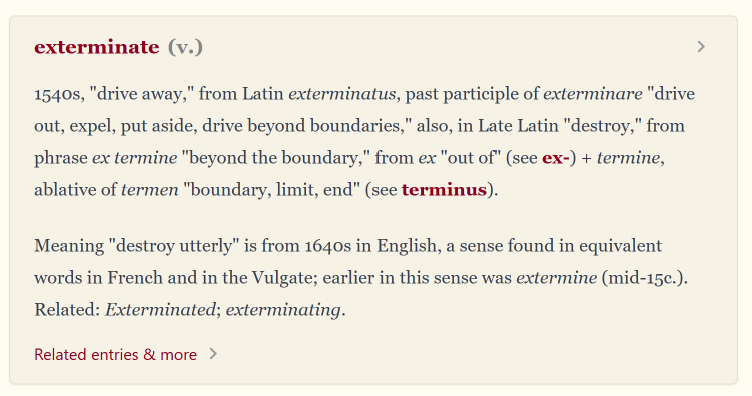
Moreover, the word itself supports this usage. Historically, “exterminate” means to drive out beyond a boundary—to remove completely. Only later did it acquire the more specific sense of physical destruction. The broader meaning therefore fully accommodates Śrīla Prabhupāda’s usage.

Seen in this light, the issue is not that the word is wrong, but that a modern assumption about its meaning is too limited.

A similar pattern can be observed in editorial decisions made by Jayadvaita Swami. In the purport to Bhagavad-gītā 13.1–2, the original 1972 edition reads:

“Sometimes we understand that I am happy, I am mad, I am a woman, I am a dog, I am a cat…”

In the posthumous edition, “mad” was replaced with “a man,” based on the judgment that the original wording was incorrect or nonsensical.

Yet when Śrīla Prabhupāda’s broader usage is considered, the phrase “I am happy, I am mad” is not only meaningful but philosophically precise. Throughout his teachings, happiness and madness function as contrasting epistemic states—clarity versus illusion. The conditioned soul identifies with both and mistakes them for the self. The original wording therefore fits the context of Chapter 13, which analyzes the distinction between the knower and the known, including mental conditions.

In both cases, the same tendency appears: a word is judged according to a narrow or immediate understanding, and a conclusion is drawn without sufficient attention to context, historical meaning, or the speaker’s own usage.

This highlights an important principle. Fidelity to Śrīla Prabhupāda’s words requires more than preserving the text. It requires a disciplined approach to interpretation. Before assuming error, we must give the benefit of the doubt, examine the context, and consider how he consistently uses language across his teachings.

If we fail to do so, we risk not only misunderstanding his words, but also attributing confusion or mistake to the ācārya where none exists.

To honor Śrīla Prabhupāda properly, we must therefore begin with humility in interpretation. By allowing his own explanations, his broader usage, and the historical range of language to guide our understanding, we remain faithful not only to his words, but to the meaning he intended to convey.

🎨 GRAND ANNOUNCEMENT 🎨THE FIRST ANNUAL “AS IT IS… BUT IMPROVED” DESIGN FESTIVAL
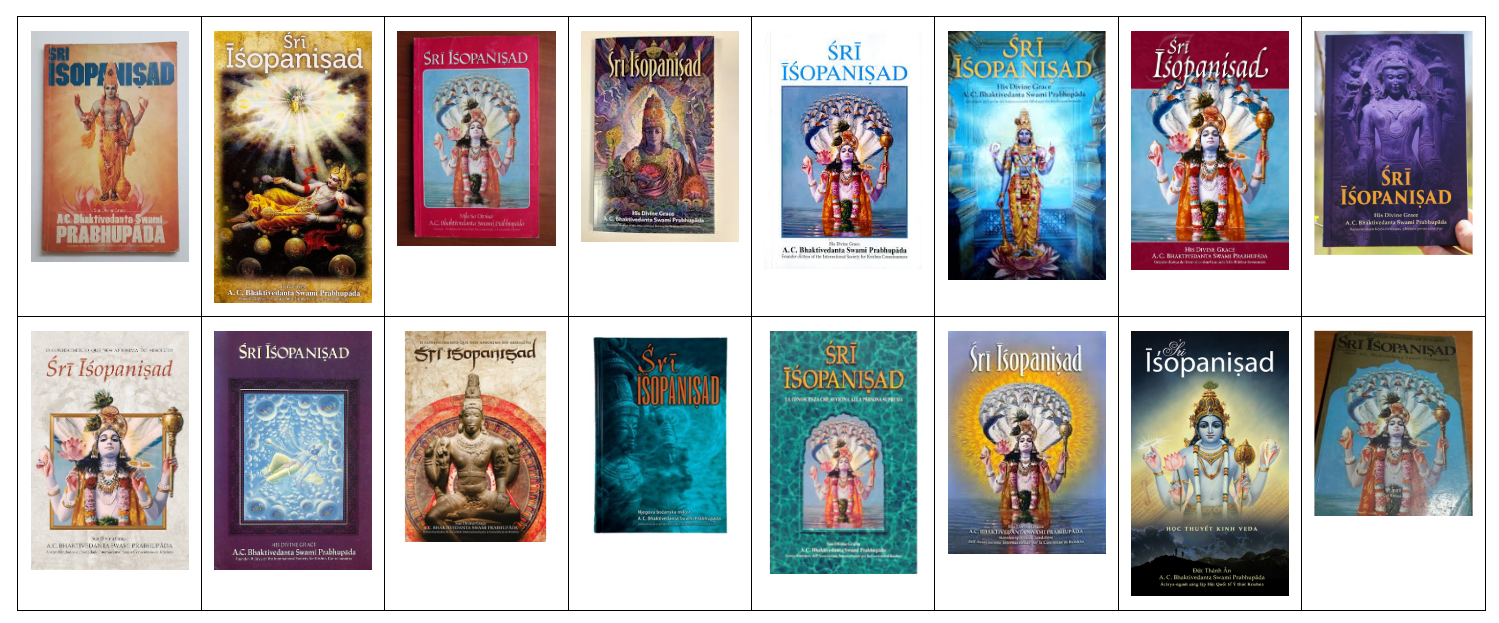
By the Change and Improve Committee

Even though we know Śrīla Prabhupāda said:

“And the covers, if possible, should always be the same for each respective book regardless of what language it may be printed in.”
(Letter to Jadurani, Bombay, January 3, 1975)

We are determined to demonstrate a higher level of understanding.

After all, when the spiritual master asks for water, he is obviously requesting milk.

And sometimes… a soy latte.

We therefore wish to show that we are not merely followers of instructions, but interpreters of deeper intentions. We aim to prove—through vibrant creativity—that we are fully qualified to adjust, refine, expand, reinterpret, and aesthetically upgrade that which was already completed.


📚 THE MISSION

Design as many distinct and innovative covers as possible for each of Śrīla Prabhupāda’s books.

Uniformity is appreciated… in principle.
Diversity is appreciated… in practice.


🎭 COMPETITION CATEGORIES

  • Golden Aura Supreme Edition
    (Minimum three halos per composition)
  • Modern Mindfulness Krishna™ Edition
    (Suitable for yoga studios and corporate retreats)
  • Epic Cinematic Bhagavad-gita Universe
    (If it doesn’t look like a movie poster, try again)
  • Children’s Joyful Vrindavan Cartoon Series
    (Smiling cows required, blinking optional)
  • Ultra-Minimalist “Spiritual but Not Religious” Edition
    (Preferably no one can tell what the book is about)
  • Heritage Classic-but-Updated-but-Still-Classic Edition
    (Subtle confusion is a plus)

🏆 JUDGING CRITERIA

Entries will be judged on:

  • Maximum departure from previous covers
  • Confidence in creative reinterpretation
  • Ability to attract entirely different audiences at once
  • Deep conviction that nothing essential has changed

Bonus points for:

  • Glow effects
  • Lens flares
  • A strong feeling that this version is finally the right one

🥇 SPECIAL AWARD

The “I Know Better Than I Heard” Trophy

Awarded to the participant who most convincingly demonstrates that:

Following instructions is good…
but improving them is better.


🧘‍♂️ PHILOSOPHICAL FOUNDATION

We humbly accept that the ācārya gave instructions.

We more humbly accept that those instructions may benefit from our refinement.

After all, tradition is living.
And living things… evolve.


📜 DISCLAIMER

Any resemblance between original instructions and current practices may be:

  • Coincidental
  • Contextual
  • Open to interpretation

🌍 FINAL WORD

Let every language have its own cover.
Let every temple have its own vision.
Let every designer express their realization.

Because truth is one…
but presentation is unlimited.


Submissions now open.
Clarity optional. Confidence required.

📬 Contact Information

Change & Improvement Committee
Chairman: Improveananda Dāsa
✉️ change@prabhupada.org

A Small Title Change with Larger Implications

Note on Title Formatting

The original title of this article distinguishes between Bhagavad-gītā and BHAGAVAD GĪTĀ. Due to the website’s automatic capitalization, this difference is not visible in the heading above. I have therefore used a simplified title there.

The actual title is:

Bhagavad-gītā As It Is or BHAGAVAD GĪTĀ AS IT IS? A Small Change with Larger Implications

By Ajit Krishna Dasa

The below is written with the help of both AI and my wife – both are adept in Sanskrit.

When comparing the original edition of Bhagavad-gītā As It Is with the posthumously edited edition, one detail on the cover stands out:

  • Original: Bhagavad-gītā As It Is
  • Edited: BHAGAVAD GĪTĀ AS IT IS

Both forms retain proper diacritics (gītā / GĪTĀ), indicating an intention to preserve correct Sanskrit pronunciation.

However, a structural change has taken place.

The Sanskrit Structure

The title Bhagavad-gītā is a compound (tatpuruṣa):

  • bhagavad — “of the Lord”
  • gītā — “song”

Together: “The Song of the Lord.”

In Sanskrit, this is a single semantic unit. The relationship between the parts is built into the compound.

The Original Presentation

In Bhagavad-gītā As It Is, the hyphen serves to preserve this structure:

  • It signals that the word is a compound
  • It maintains grammatical unity
  • It reflects a Sanskrit-informed standard of presentation

This is not merely stylistic. It is a faithful transliteration convention.

The Edited Presentation

In the edited version:

BHAGAVAD GĪTĀ AS IT IS

two things occur:

  1. The title is capitalized (a neutral typographical choice)
  2. The hyphen is removed

The removal of the hyphen results in:

  • the compound being visually split
  • the internal relationship no longer being indicated
  • a shift toward English formatting conventions

The diacritics remain, so pronunciation is preserved. But structure is not.

Does This Bring the Text Closer to Prabhupāda?

This is where the issue becomes more than typographical.

Śrīla Prabhupāda consistently emphasized careful and respectful handling of Sanskrit, including correct presentation of names and terms.

Within that context, the original form:

Bhagavad-gītā

reflects a more careful alignment with Sanskrit structure.

The edited form:

BHAGAVAD GĪTĀ

moves away from that structural precision.

So it is reasonable to say:

This change does not bring the presentation closer to Śrīla Prabhupāda’s standard, but slightly further from it.

What Does the Change Actually Signal?

Not incompetence. That’s a cheap shot.

What it more plausibly signals is:

  • a preference for modern publishing conventions
  • a move toward standardized, reader-friendly formatting
  • a subtle de-emphasis of Sanskrit structural precision

In other words, a shift in editorial priorities.

Why This Matters

On its own, this is a minor change. No philosophy is altered by a hyphen.

But in the broader discussion of:

  • original vs. edited editions
  • posthumous editorial authority
  • fidelity to the ācārya’s presentation

…even small changes become relevant indicators.

They show the direction in which editorial decisions are moving.

Conclusion

  • Bhagavad-gītā As It Is preserves both pronunciation and structure
  • BHAGAVAD GĪTĀ AS IT IS preserves pronunciation, but not structure

Therefore:

The original title is more faithful to Sanskrit and more aligned with the standard Śrīla Prabhupāda himself employed.

The difference is small.
But it is real. And it points in a clear direction.