Rebuttal of Hridayananda Dasa Goswami’s Claims on the Book Changes

Danesh Dasa posted the following on the facebook group “Hridayananda Das Goswami – Friends and Disciples”:

“Hridayananda Maharaj on the revised 2nd edition of Bhagavad-gita As It Is:

“I Support This Edition”

“Jaya Advaita Swami and Dravida Prabhu sincerely worked to restore Prabhupada’s original text, and to clear up obvious mistakes by typists. Surely Prabhupada would appreciate this. Further, no one has ever shown that these corrections altered in any way Prabhupada’s philosophical teachings. Thus I support this edition of Prabhupada’s Bhagavad-gita.””

Here is a screenshot: Screen Shot 2014-12-11 at 10.55.31

Let us take a look at each of Maharaja’s statements:

Hridayananda Dasa Goswami:

“Jaya Advaita Swami and Dravida Prabhu sincerely worked…”

Hridayananda Dasa Goswami here commits the fallacy of “begging the question” and the fallacy of “Ipse dixit / bare assertion fallacy”:

“Begging the question means “assuming the conclusion (of an argument)”, a type of circular reasoning. This is an informal fallacy where the conclusion that one is attempting to prove is included in the initial premises of an argument, often in an indirect way that conceals this fact.” (Source: http://en.wikipedia.org/wiki/Begging_the_question)

Jayadvaita Swami and Dravida Prabhu did their job sincerely only if they pleased Srila Prabhupada, and we are disagreeing about precisely that. Therefore Maharaja is “begging the question”.

Hridayananda Dasa Goswami needs to give some evidence in support for his claim. But instead of giving evidence he just states it, and this is the fallacy of “Ipse dixit / bare assertion fallacy”:

“Ipse dixit, Latin for “He, himself, said it,” is a term used to identify and describe a sort of arbitrary dogmatic statement which the speaker expects the listener to accept as valid.” (Source: http://en.wikipedia.org/wiki/Ipse_dixit)

Hridayananda Dasa Goswami:

“…to restore Prabhupada’s original text, and to clear up obvious mistakes by typists.”

Here Hridayananda Dasa Goswami commits the fallacy of “selective evidence / fallacy of incomplete evidence”:

“Cherry picking, suppressing evidence, or the fallacy of incomplete evidence is the act of pointing to individual cases or data that seem to confirm a particular position, while ignoring a significant portion of related cases or data that may contradict that position.” (Source: http://en.wikipedia.org/wiki/Cherry_picking_(fallacy))

It is correct that Jayadvaita Swami and BBTI in some cases have changed the books back to what Srila Prabhupada said in the so-called original manuscripts. But is this really a good idea? Normally your drafts end up in your trash bin. If someone took your drafts out of your trash bin and changed your essay back to what you wrote in your drafts without consulting you first, I think you would feel insulted. Here is an article that deals with this unusual idea of changing a text back to its draft:

https://arsaprayoga.com/2013/10/15/jayadvaita-undoes-prabhupadas-work-on-gita-manuscript/

What Hridayananda Dasa Goswami fails to communicate (and possibly comprehend) is the sad fact that in many cases Jayadvaita Swami and BBTI have brought Srila Prabhupada’s books further away from the so-called original texts. They have deleted Srila Prabhupada’s own chosen words and sentences and added their own. They even changed hundreds (if not thousands) of his personally typewritten sanskrit translations. And in most cases there was no reason to do it at all – other than the whimsical preferences of the editors. I have documented many instances of this sort of editing in my e-book “No Reply from BBTI” and on my website www.arsaprayoga.com (see links below).

Hridayananda Dasa Goswami:

“Surely Prabhupada would appreciate this.”

Here Hridayananda Dasa Goswami again commits the fallacy “Ipse dixit / bare assertion fallacy”.

Hridayananda Dasa Goswami:

“Further, no one has ever shown that these corrections altered in any way Prabhupada’s philosophical teachings.”

Since Hridayananda Dasa Goswami presents no evidence to back up his claim, he again commits the fallacy of “Ipse dixit / bare assertion fallacy”.

He claims that no one has been able to demonstrate that Jayadvaita Swami and BBTI have made changes to the philosophy. But by publishing the 1983 edition of the Gita it was openly declared that it is perfectly okay to violate the principle of arsa-prayoga. This is a serious philosophical deviation, and this offensive mentality is now woven into each and every page of Srila Prabhupada’s books, and everyone who reads them will be contaminated by this mentality.

Besides this, now there might only be very few philosophical mistakes made by Jayadvaita Swami and BBTI, but what about the future? If the door is not closed forever, then the changing business might go on forever, since one change justifies the next. Srila Prabhupada was afraid of this (see the famous “Rascal Editors” conversation).

We also know that Jayadvaita Swami has made his own mistakes. One example of this is his changing “Visnu Form” into the “Visnu platform” (Bg. 2.61). This seems to be a change that takes the Gita in the mayavada direction. And here is a link to an article that demonstrates how Jayadvaita Swami has changed a sentence in the Gita so it gets the opposite meaning of what Srila Prabhupada originally said:

Small Word, Big Difference (Bg. 12.2 p.)

Do we want more of these kinds of changes?

Another significant point in this regard is that Hridayananda Dasa Goswami presents an hidden premise, namely that:

All changes that are not of a philosophical nature are okay.

This hidden premise can be disproved by quoting Jayadvaita Swami and the BBTI:

“As you know, and as we kept in mind while doing the work, Srila Prabhupada staunchly opposed needless changes.” (Jayadvaita Swami, Letter to Amogha Lila, 1986)

Now, as we see Srila Prabhupada did not only disapprove of philosophical changes to his books. He also disapproved of “needless changes”. Therefore, if we can find any needless changes in the 1983 edition of the Gita, we know that Jayadvaita Swami and the BBTI have displeased Srila Prabhupada. My contention is that Jayadvaita Swami and the BBTI have made many needless changes (thousands). I have presented some of them in my e-book “No Reply from BBTI”:

https://arsaprayoga.com/2014/05/08/e-book-no-reply-from-bbti/

This e-book shows how the attempted justifications used by the BBTI fails. BBTI usually argue that:

  • We are changing Srila Prabhupada’s books back to what he actually said in his original manuscript.
  • We are making the books “Closer to Prabhupada”.
  • We are only correcting grammar, commas, capitalization etc.
  • We are only correcting the mistakes of previous editors.
  • No unnecessary changes have been made.

But the articles in the e-book documents that the BBT International have needlessly:

  • Deleted many of Srila Prabhupada’s own chosen words and sentences (even those also found in his ”original manuscript”).
  • Added their own words and sentences (which means these words and sentences are also not to be found in the ”original manuscript”).
  • Changed Srila Prabhupada’s own personally typewritten sanskrit translations.
  • Made needless change of syntax (sentence structure).

Hridayananda Dasa Goswami:

“Thus I support this edition of Prabhupada’s Bhagavad-gita.”

If Hridayananda Dasa Goswami had studied this issue carefully he would not support the 1983 edition of the Bhagavad-gita.

Some might argue that Hridayananda Dasa Goswami’s statement is not supposed to be a thorough defense of his views. That is perfectly fine – as long as we recognize that his above statement is completely useless in any kind of debate on the topic.

The interesting question is:

Will Hridayananda Dasa Goswami ever post a thorough defense of his view on this controversial topic? Or does he expect his disciples and well-wishers to blindly accept his statements without any supporting evidence?

We are many who would love to see how he will attempt to justify the editing of Jayadvaita Swami and the BBTI.

Your servant, Ajit Krishna Dasa
The “Book Changes” Conflict (Parasurama Dasa)

Parasurama_leading_kirtan_in_Oslo

BY: PARASURAM DAS (From Sampradaya Sun)

Aug 05, 2014 — UK (SUN) — We arrived in Scandanavia for the Rathayatra tour (7 Rathayatra festivals). The first words I heard from a local devotee were “thank you for defending Srila Prabhupada’s original books”. Then I noticed devotees wearing T-shirts promoting BBT printing. Yep, we have a conflict.

In this age of Kali there are few things we can agree on. At least we all agree on the Mahamantra being chanted, and we used to be able to agree on the purity of the books. It was an argument that set us above other “religions” who had watered down their books. But now we are in danger of disunity again over something that could have been avoided. Even the famous barking dog video revolved around the book changes.

All the deviations in our history had one thing in common: the concept that Srila Prabhupada was inaccessible or insufficient. Zonal Acharyas, Gopi Bhava Club, Narayana Maharaj, Hinduism, etc. Some groups still remaining within ISKCON still believe that Srila Prabhupada’s books are not Sabda Brahman. Not one word nor one full stop should be changed. Srila Prabhupada taught us this principle:

“So unless one is self-realized, there is practically no use writing about Krsna. This transcendental writing does not depend on material education. It depends on the spiritual realization. You’ll find, therefore, in the comments of Bhagavatam by different acaryas, even there are some discrepancies, they are accepted as asat-patha. It should remain as it is.” (Lecture, Vrindavana, March 31,1976)

It was Krishna’s arrangement that Jayadvaita Swami and Dravida prabhu made so many mistakes and unnecessary changes, as it has highlighted our offence of seeing Srila Prabhupada’s books in a relative way. Even though Srila Prabhupada said that discrepancies should remain unchanged the BBT ignore this, and even worse, make changes when there is no discrepancy. There are many cases where the manuscript and the original edition are in agreement, and with perfectly good grammar. One example is the many times that “owner of the body” has been changed to “knower of the body”. The BBT conveniently avoids talking about this.

Proof Positive: An Appeal to Jayadvaita Swami for Clarification (Part 1)

Screen Shot 2014-07-26 at 19.25.48

BY: THE ASSEMBLED DEVOTEES

Jul 22, 2014 — GLOBAL (SUN) — Let us first offer our obeisances to our Spiritual Master, His Divine Grace A. C. Bhaktivedanta Swami Prabhupada.

om ajnana-timirandhasya jnananjana-salakaya
caksur unmilitam yena tasmai sri-gurave namah
Also, let us extend our respects to H.H. Jayadvaita Swami. We pray he will understand the concerns expressed in this essay and not construe our presentation as something other than a quest for truth.

In a conversation with Govinda dasi in 2003 (see Appendix A), H.H. Jayadvaita Swami repeatedly denied that Srila Prabhupada saw the galley proofs for his 1972 MacMillan edition of Bhagavad-Gita, indicating there were mistakes Prabhupada would not have allowed, implying this is why the book needed re-editing.

Jayadvaita Swami stated:

“He [Srila Prabhupada] never saw the proofs in 1972.”

“No he did not.”

“Prabhupada didn’t see the galley proofs of the 1972 edition.”

“But he didn’t see the galley proofs for the 1972 one…”

“there was no opportunity to like send Prabhupada back and forth, like sending him the second chapter and getting it back and asking questions; it just didn’t happen.”

“I could tell you that some of the verses that some of the BBT staff questioned, Prabhupada would never have approved. I can say with confidence, Prabhupada would never have approved.”

“And the unabridged edition he really didn’t see in its preparation for its, um, pre-publication stages”

The above statements appear to be in stark contradiction to the following letter from Srila Prabhupada to Jayadvaita found in the Bhaktivedanta Vedabase (Prabhupada regularly referred to galley proofs as “blue-prints” – see Appendix B).

SP Letter to Jayadvaita- Los Angeles, May 28, 1972:

“My Dear Jayadvaita, Please accept my blessings. I have received your letter dated May 26th, 1972, along with the blue-print copies of Bhagavad-gita As It Is from MacMillan Company. It is very nice. So I shall be looking forward to seeing the entire manuscript and book sometime around first July, 1972.”

After receiving the blue-print copies, Srila Prabhupada states “it is very nice”, gives no indication that he found any mistakes, and expresses anticipation to see the completed book. It would oppose reason to argue that the above letter does not indicate Srila Prabhupada’s approval of the blue-prints/galley proofs. In absence of evidence to the contrary, the May 28th letter proves that not only did Srila Prabhupada see and approve the blue-prints/galley proofs but that Jayadvaita himself sent them to His Divine Grace.

The printing of Bhagavd-gita As It Is in 1972 was to be the very first publication of Srila Prabhupada’s unabridged version of the book and it was about to be printed by a world-renowned publishing house. This was a very important event and a very significant milestone in Srila Prabhupada’s literary corpus—presumably something a disciple involved at responsible levels of the book production process would not take lightly or easily forget. Taking all these factors into consideration, is it unreasonable to wonder how Jayadvaita Swami not only forgot he had sent Prabhupada the blue-prints, but also forgot Prabhupada personally acknowledged receipt of them and had indeed approved them? In addition, it seems Jayadvaita Swami never came across the digital copy of the above letter in the Bhaktivedanta Vedabase during his otherwise scrupulous research regarding BBT editing.

As disciples of Srila Prabhupada, we feel duty bound to petition Jayadvaita Swami to explain these discrepancies to the Vaisnava community. At the same time we caution our readers notto rush to judgment without allowing Jayadvaita Swami a chance to respond. We concede that there may have been extenuating circumstances that we are yet unaware of. Perhaps Jayadvaita Swami has letters from Srila Prabhupada that never made it to the Bhaktivedanta Archives or other evidence that could shed light on this issue. If so, we hope he will share them with the assembled devotees and uproot our reasonable doubts. Under the circumstances, we trust he will understand why we would consider physical evidence much more compelling than personal recollection. When all the evidence is presented, if our assessments prove wrong, an apology on our part would certainly be warranted.

We conditioned souls have four defects. Our senses are imperfect, we fall prey to illusion, make mistakes and have a tendency to cheat. From the evidence available thus far, one would conclude that Jayadvaita Swami is also a victim of the four defects. Even if we assume the alleged error was an honest mistake, it is nonetheless, a grave mistake and it could cast doubt on his credibility as an impartial editor of the sanctified words of our Spiritual Master. It may even raise the greater question: Is it appropriate for any conditioned soul to edit the books of an empowered and fully realized nitya-siddha devotee after their departure andwithout their express approval or direct oversight?

Jayadvaita Swami Letter to Amogha Lila, quoted in Responsible Publishing:

“To my knowledge, Srila Prabhupada never asked us to re-edit the book” [1972 MacMillan edition of Bhagavad-gita As It Is]

Appendix A

Conversation between Govinda dasi and Jayadvaita Swami – Honolulu, Jan 19, 2003(emphasis is added):

Jayadvaita Maharaja: …It differs in uh, [inaudible] uh, in addition to that, of course, Prabhupada did see the galley proofs in 1968 of the abridged edition. He never saw the proofs in 1972. He wasn’t involved at any stage of the production, except, um, mainly for expressing impatience at how slow it was being turned out—a slowness for which I was partly responsible. Um, but he didn’t go over, didn’t go over the manuscript…

Govinda dasi: Srila Prabhupada didn’t see the galley proofs?

Jayadvaita Maharaja: No, he did not. [inaudible] Prabhupada didn’t see the galley proofs of the 1972 edition. But he did see the galley proofs, and we have galley proofs with Prabhupada’s handwriting and directions, just in very few places, for the original edition. But he didn’t see the galley proofs for the 1972 one…

Govinda dasi: There must be some preliminary, something that he went over, if he didn’t see the final galley proofs.

Jayadvaita Maharaja: Not that I remember.

Govinda dasi: Then he had to have… I mean, I…

Jayadvaita Maharaja: As far as I remember, he didn’t. He was just… the main thing that he was asking was, “Where is it? I’ve been hearing, ‘Just now coming, just now coming;’ I’ve been hearing that for some time now—where is the book?” The main thing that we were hearing from Prabhupada was, “Where is it?” And, um, Prabhupada at that time was already traveling extensively, um, around the world, and, uh, there was just none of this, there was no opportunity to like send Prabhupada back and forth, like sending him the second chapter and getting it back and asking questions; it just didn’t happen.

Govinda dasi: Hayagriva was living with Srila Prabhupada in ’68, and they were going over things, and that was after this book [the abridged edition] was printed. So that must have been for the ’72 one.

Jayadvaita Maharaja: He may have, for some brief time, spent some time with Prabhupada. It’s possible. Um, but the final product was certainly not, um, something that Prabhupada, um, you know, pored over the original, he just didn’t have, couldn’t possibly have the… I could tell you that some of the verses that some of the BBT staff questioned, Prabhupada would never have approved. I can say with confidence, Prabhupada would never have approved. Some of the very few verses that we had issues with, there’s no question in my mind that Prabhupada didn’t see them.

Later in the same conversation:

Jayadvaita Maharaja: Just all I really wanted to do is contribute to the history of the Gita and say that, um, what Prabhupada saw and signed off on, um, in 1968, was the abridged edition. And the unabridged edition he really didn’t see in its preparation for its, um, pre-publication stages, except perhaps there were some meetings at some point, you were there to…

SP Letter to Jayadvaita- Los Angeles, May 28, 1972:

“My Dear Jayadvaita, Please accept my blessings. I have received your letter dated May 26th, 1972, along with the blue-print copies of Bhagavad-gita As It Is from MacMillan Company. It is very nice. So I shall be looking forward to seeing the entire manuscript and book sometime around first July, 1972.”

Appendix B

The following letters show:

Srila Prabhupada regularly referred to galley proofs as blueprints
was consistent in his oversight of the editing
was meticulous in his scrutiny regarding errors

Letter to Pradyumna- Los Angeles, April 20, 1970:

“Please accept my blessings. I have just received the blueprint copy of KRSNA, the Reservoir of Pleasure and I have begun to read it through. But I notice that there are some points you should correct before the final printing.”

Letter to Brahmananda- Los Angeles, April 20, 1970:

“P.S. There are some editorial mistakes in the blueprint of The Topmost yoga.”

Letter to Brahmananda- Los Angeles, April 22, 1970:

“Please accept my blessings. Regarding the Topmost Yoga, in the blueprint there are many mistakes. I am pointing out some of them as follows:”

Letter to Brahmananda- Los Angeles, June 2, 1970:

“I have received the blueprint from Uddhava and I have already corrected 180 pages and sent it to Boston, and the balance will be sent tomorrow.”

Letter to Brahmananda- Los Angeles, June 19, 1970:

“Regarding Bhagavatam printing, I have received the blueprint copy of 1st chapter, 2nd Canto, and it is very nicely done. The style is to the standard of my previous books.”

Letter to Uddhava – Los Angeles, July 11, 1970:

“Please accept my blessings. I beg to thank you for your letter dated 6th July, 1970, along with the blueprint copy of the Lord in the Heart. Thank you very much. It is alright to go ahead with the printing of this second chapter. I have approved all the questionable points noted by Pradyumna, so it is alright.”

Letter to Uddhava- Los Angeles, July 14, 1970:

“Please accept my blessings. I beg to acknowledge receipt of your letter dated 12th July, 1970, along with the blueprint for the third chapter of Srimad-Bhagavatam Second Canto, entitled “Pure Devotional Service: the Change in Heart.” I have looked over the blueprint and noted a few points to be corrected, so I am sending back the blueprint to you for seeing the necessary changes as they are in the text.”

Letter to Uddhava- Los Angeles, July 24, 1970:

“Please accept my blessings. I beg to acknowledge your letter dated 20th July, 1970, along with the blueprint for chapter 4 Second Canto Srimad-Bhagavatam. I have gone through the blueprint and I am also sending the necessary Sanskrit corrections to Pradyumna. So when these corrections are made then you can print immediately.”

Based on the above letters, one might ask: If Srila Prabhupada had wanted any corrections made in the blue-prints of the ’72 Gita, would he not have stated so?


See the changes to Bg. 9.1

Screenshot 2014-06-21 23.45.09

 Click to enlarge the picture.

Download as PDF here:

change-to-bg-table-9.1.


All changes except philosophical changes are okay?

myth-reality


MYTH:

“As long as the BBTI do not make philosophical changes, then their changes are all okay!”

REALITY:

Dear Jaya Krsna Prabhu! Dandavat pranam! Jaya Srila Prabhupada!

Our previous chat was very messy and unstructured. It was not possible for either of us to present our arguments and points in an orderly way. Therefore let us now start a debate where we focus on some concrete points. I suggest we start with your above request:

Jaya Krsna Dasa (JKD):

“Whenever possible, please share any verse you found which is  philosophically completely against what Srila Prabhupada taught because of this change. I mean only philosophical changes only, not any other type of changes”

Now, there are a few significant things about this request of yours. It has an implied premise, namely that:

“All changes that are not of a philosophical nature are okay.”

The truth of this implied premise can be disproved by quoting Jayadvaita Swami and the BBTI:

“As you know, and as we kept in mind while doing the work, Srila Prabhupada staunchly opposed needless changes.” (Jayadvaita Swami, Letter to Amogha Lila, 1986)

Now, as we see Prabhupada did not did not only disapprove of philosophical changes to his books. He also disapproved of “needless changes”. Therefore, if we can find any needless changes in his books, we know that Jayadvaita Swami and the BBTI have done something wrong. My contention is that Jayadvaita Swami and the BBTI have made many needless changes. Too many.

Here is one example:

“And the covers, if possible, should always be the same for each respective book regardless of what language it may be printed in.” (Letter to Jadurani, Bombay, January 3, 1975)

So why have the BBTI changed the covers of many of the books? This seems to be completely needless. Prabhupada loved the original cover. It was very special. It was popular. It made devotees. Why change it? We have asked the BBTI and Jayadvaita Swami why the cover was changed. But we have not received any reply.

Maybe you can answer this question, dear Jaya Krsna Dasa Prabhu?

Read more about the changes to the covers here:

Covers should be the same regardless of language

And here:

https://arsaprayoga.com/2013/12/24/prabhupadas-instructions-on-front-covers-not-honered/

So now I have:

1. Argued against your implied premise, and therefore against the validity of your question.
2. Presented positive evidence that the changes of the covers are against Srila Prabhupada’s instructions.

Now you have to:

1. Defend your implied premise, or admit that your question is invalid.
2. Argue against my points about the covers, or admit that you either cannot answer it, or that it is in fact against Srila Prabhupada’s instructions to change them.
3. Possibly present further points on the matter of the book changes.

Ajit Krishna Dasa

BBTI is changing Srila Prabhupada’s transcripts

Changing of Srila Prabhupada’s Transcripts (from Sampradaya Sun)

BY: KRISHNA DASA

Jun 03, 2014 — USA (SUN) — It is one thing to edit a book posthumously, but what seems more egregious is the editing of a transcript of a conversation. Such editing is found in the book Journey of Self Discovery, supposedly by A.C. Bhaktivedanta Swami, which was first published in 1990 as we see from a search of the U.S. Copyright records.

That book includes a conversation between Srila Prabhupada and a Dr. S. P. Oliver, Rector of the University of Durban, in Westville, South Africa, on October 10, 1975. The book is available online through http://www.prabhupadabooks.com and the relevant page can be seen here or in the e-book on page 23, where we see that during the conversation, Srila Prabhupada asks a devotee to read some verses and purports from the Bhagavad-gita As It Is.

Then we see that the transcript uses totally text from the version of the Bhagavad-Gita As It Is that was edited and published after the departure of Srila Prabhupada. For example, during that conversation a devotee supposedly was reading the verse and purport to Bg 4.34. We can see the 1972 version and the later “Revised and Enlarged” version side by side.

It is not possible that a devotee with Srila Prabhupada in 1975 was able to read the version of the Bhagavad-gita that did not exist until the 1980s.

Screenshot 2014-06-07 16.38.25

This conversation took place in 1975, and the verse quoted was from the 1972 editionof Bhagavad-gita As It Is. But here we find that the verse has been changed by the BBTI to fit the 1983 edition.

At that time your position is different! (BBTI’s main argument defeated)

sp-painting1

BY: BHAKTA TORBEN (From Sampradaya Sun)

Apr 18, 2014 — DENMARK (SUN) — The common arguments from the so-called BBT, “BBTI”:

“And in the conversation where Srila Prabhupada complained so strongly about “rascals editors,” Srila Prabhupada said about Jayadvaita, “He is good.”

“Of course, regarding Jayadvaita Swami, the BBT’s chief editor, Srila Prabhupada wrote, “Concerning the editing of Jayadvaita Prabhu, whatever he does is approved by me. I have confidence in him.” (letter to Radhavallabha, 7 September 1976)

(From BBT International’s website)

NOW LISTEN PLEASE:

Prabhupada: I have given you charge of this BBT, millions of dollars you are dealing, but it is not for your misuse. As soon as you misuse, that is your responsibility.

Ramesvara: Yes, but he says but still, you’ll know that I’m going to misuse it.

Prabhupada: No. That Krsna knows, when something charge is given. But because you are independent, I know that “Ramesvara is very good boy; let him be in charge.” But you can misuse at any moment, because you have got independence. You can misuse at any moment. At that time your position is different.

>>> Ref. VedaBase => Morning Walk — June 3, 1976, Los Angeles

(Morning Walk — June 3, 1976, Los Angeles)

This very important snippet is from a missing audio exchange, from a not properly (actually cutout) transcribed morning walk conversation. (That´s another issue in itself).

So the conclusion MUST be that the above two arguments for the continued post-samadhi editing of Jayadvaita Swami & Co. are CONDITIONAL. They are NOT absolute green lights from Srila Prabhupada to Jayadvaita Maharaj, at all.

ys. Bhakta Torben, Denmark.

Deleting “whatever” (Bg. 6.26)

Bg. 6.26:

Srila Prabhupada’s draft (so-called original manuscript):

Screenshot 2014-04-13 12.00.37

Original and authorized 1972 Macmillan edition:

“From whatever and wherever the mind wanders due to its flickering and unsteady nature, one must certainly withdraw it and bring it back under the control of the Self.”

BBT International’s posthumously edited 1983 edition:

From wherever the mind wanders due to its flickering and unsteady nature, one must certainly withdraw it and bring it back under the control of the Self.

What did Srila Prabhupada think about the verse?

Visnujana: Verse twenty-six: “From whatever and wherever the mind wanders due to its flickering and unsteady nature, one must certainly withdraw it and bring it back under the control of the Self [Bg. 6.26].”

Prabhupada: This is the process. This is yoga system. Suppose you are trying to concentrate your mind on Krsna, and your mind is diverted, going somewhere, in some cinema house. So you should withdraw, “Not there, please, here.” This is practice of yoga. Not to allow the mind to go away from Krsna. (Lecture on Bhagavad-gita 6.25-29, Los Angeles, February 18, 1969)

The words translated as “whatever and wherever” is “yataḥ yataḥ”. In the 1972 Macmillan edition the word for word looked like this:

 yataḥ-whatever; yataḥ;-wherever

In BBT International’s 1983 edition this is changed to:

yataḥ yataḥ — wherever

Unfortunately these word for word synonyms are missing for 6.26 in the so-called original manuscript. But we do find something in Srimad-Bhagavatam:

yataḥ yataḥ — from whatever and wherever; (SB 7.15.32-33)

As a side note: This verse from Srimad-Bhagavatam in about the same subject as Bg. 6.26:

While continuously staring at the tip of the nose, a learned yogi practices the breathing exercises through the technical means known as puraka, kumbhaka and recaka — controlling inhalation and exhalation and then stopping them both. In this way the yogi restricts his mind from material attachments and gives up all mental desires. As soon as the mind, being defeated by lusty desires, drifts toward feelings of sense gratification, the yogi should immediately bring it back and arrest it within the core of his heart. (SB 7.15.32-33)

Again we left with the conclusion that Jayadvaita Swami and the BBT International are not bringing Srila Prabhupada’s books “closer to Prabhupada”. They are violating Srila Prabhupada’s, sastra’s and their own stated editing guidelines by making both needless and harmful changes in Srila Prabhupada’s books.

“Secret wisdom” deleted from Bhagavad-gita As It Is (Bg. 9.1)

By Ajit Krishna Dasa

Bg. 9.1:

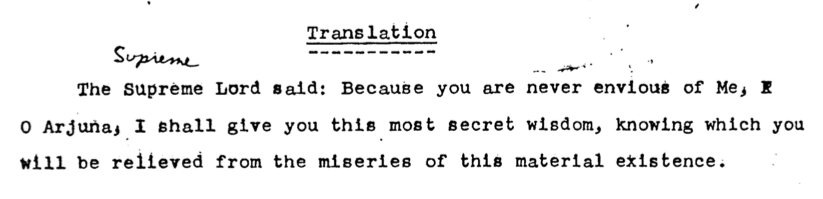
Srila Prabhupada’s draft (so-called original manuscript):

Screenshot 2014-03-29 12.53.56

Original and authorized 1972 Macmillan edition:

“The Supreme Lord said: My dear Arjuna, because you are never envious of Me, I shall impart to you this most secret wisdom, knowing which you shall be relieved of the miseries of material existence.”

BBT International’s posthumously edited 1983 edition:

“The Supreme Personality of Godhead said: My dear Arjuna, because you are never envious of Me, I shall impart to you this most confidential knowledge and realization, knowing which you shall be relieved of the miseries of material existence.”

Here we, again, see that Jayadvaita Swami’s editing often takes us further away from Srila Prabhupada. We see again and again that the BBT International’s claim to fame, namely that they are making the books “closer to Prabhupada” is false. In fact they are deliberately changing Srila Prabhupada’s own chosen words. In other words, they are violating the principle of arsa-prayoga – again and again.

How long will this be allowed to go on?

Jayadvaita Swami’s “Then it is alright” argument defeated

On BBT International’s website we find this video:

Direct link: https://www.youtube.com/watch?v=IlqbnzzL_28

In the video Jayadvaita Swami says:

”I went back and re-edited especially the translations in the first canto. Especially the first perhaps three chapters where I thought their were a lot of short comings. And I typed up all the translations – after I finished all the work, I typed up all the translations in one manuscript and put them in an envelope, and Prabhupada was coming to New York where I was at the time. Prabhupada came, and I put all the translations in an envelope, and I wrote a cover letter explaning what I have done, and asking him whether it was okay. And then I brought it up to Prabhupada’s quarters at 55th Street in New York–the New York temple—with the idea that I would leave them with his secretary and come back later. But Prabhupada was right there, and so he…I offered obeisances, and he had me, you know: ”What do you do in here?” ”What have you come for?” Not in those words, but, you know, he inquired was I was doing. And I explained that I had come to deliver this. So Prabhupada had me start reading right in his presence. And I began, I read the first verse, the second verse, the third verse. I went through a few verses, and Prabhupada stopped me. Prabhupada was listening very carefully, he stopped me. ”So what you have done?” And I said: ”Well, Srila Prabhupada, I have edited to try to bring it closer to what you originally said.” Prabhupada said: ”What I have said?” I said: ”Yes, Srila Prabhupada!” Then Prabhupada: ”Then it is alright!”, and that was it. ”Then it is alright!” ”What I have said?”, ”Then it is alright!”

 A few points about this story:

1. Jayadvaita Swami’s story is merely anecdotal evidence which is considered a rather unreliable and dubious support of a  claim. No one is really able to investigate the truth value of his story. To use anecdotal evidence as the foundation for changing the books that are supposed to guide mankind the next ten thousands years will surely create doubt about the authority of the changed books.

As Srila Prabhupada said about such stories:

“Just like in our ISKCON there are so many false things: “Prabhupada said this, Prabhupada said that.””
(Srila Prabhupada Letter, 7/11/1972)

“They misunderstand me. Unless it is there from me in writing, there are so many things that “Prabhupada said.”” (Srila Prabhupada Letter, 2/9/1975)

And as Jayadvaita Swami says:

“If Srila Prabhupada didn’t clearly and definitely say it, and if it first came up after 1977 whatever it is, don’t trust it. Rule of Thumb.” (Diksa-Diksa, Where the Rtvik People are Wrong,  p. 85, Jayadvaita Swami)

Jayadvaita Swami started circulating his story after the book changing controversy started, and there is no evidence to support that it is true. Therefore, “…don’t trust it. Rule of Thumb.”

Skærmbillede 2013-12-06 kl. 20.59.15

2. Jayadvaita Swami seems to conclude that since Prabhupada approved the verses that he brought him, then he also approved that he could change all his books using the same method – even after his disappearance. But this is an unwarranted extrapolation, because Jayadvaita Swami extrapolate far beyond the range of available data, namely from one single instance of editing to more or less all future instances of editing. But from his story no justification for such an extrapolation can be found. The only conclusion to be deduced (if the anecdote is at all true) is that what Jayadvaita Swami did to the very specific verses he brought Prabhupada was okay.  No more, no less.

3. If Jayadvaita Swami’s anecdote is true, then Prabhupada told him that if he had made the text closer to what Prabhupada originally said, then it was okay.

However, in my previous articles to Jayadvaita Swami I have referred to articles where it is clearly documented that he has:

  • Deleted many of Prabhupada’s own chosen words and sentences (even those also found in his ”original manuscript”)
  • Added his own words and sentences (which means they are also not to be found in the ”original manuscript”)
  • Changed Prabhupada’s own personally typewritten sanskrit translations.

The article ”The Duty of the Finger” demonstrates all these types of changes made to Prabhupada’s Bhagavad-gita As It Is:

https://arsaprayoga.wordpress.com/2013/10/24/enjoying-the-self-within-or-the-duty-of-the-finger-bg-4-38/

Now, I think most devotees around the world would like to know what Jayadvaita Swami thinks Prabhupada would have said if he had told him:

”Well, Srila Prabhupada, in my editing I have deleted some of your own chosen words and sentences! And I have also invented some completely new words and sentences and put them in where I felt they would do a good job! And since we at the BBT International are now ”accomplished sanskrit scholars” we have gone through some of your own typewritten sanskrit translations and changed them also.”

What do we, honestly, think Prabhupada would have answered? Then try to extrapolate that answer to the changes Jayadvaita Swami has made to Prabhupada’s Bhagavad-gita As It Is.