BBT Editorial Policy for Future Editors

The BBT International is apparently in the process of creating editorial policies for future editors i.e. editors working AFTER the present editors’ retirement.

Guidance for Future BBT Editors

Proposed BBT Editorial Policy for Future Editors

For now, we at Arsa-Prayoga are simply putting this up for everyone to see:

Hare Krishna
Please accept my obeisances. All glories to Srila Prabhupada

The BBT Global Communications team have requested our assistance in widely circulating as far as possible (in ISKCON circles) the draft of the proposed BBT editorial policy to allow for devotees to comment.

Please can you assist in this regard as this is a very important and sensitive subject.

Below is a standard cover letter you can use and attached is the draft policy

I have cc’d in Smita Krsna Prabhu and Rasika Bandhu Prabhu who are co-ordinating this communique for BBT

Your servant
Nanda Kishor das

———————

Dear Devotees

Hare Krishna

Please accept our humble obeisances. All glories to Srila Prabhupada.
Attached kindly find for your perusal and comment the BBT Editorial Policy.

Kindly send all comments by no later than 20 September 2015 to:
BBT.Global.Communications@pamho.net

The BBT directors, at their latest meeting, had an extended discussion
about Srila Prabhupada’s purport to Srimad-Bhagavatam verse 4.25.41. We will
soon send out a separate memo about that, letting you know where those
thoughts led and seeking your comments.

Yours in the service of Srila Prabhupada
BBT Global Communications

Link to the Guide for Future BBT Editors.

BBTI’s Gives Mutually Exclusive Justifications for the editing of Perfect Questions, Perfect Answers

Perfect_Questions_Perfect_Answers-cover

By Ajit Krishna Dasa

In 1993 BBT International published a new edition of Srila Prabhupada’s Perfect Questions, Perfect Answers. Madhudvisa Prabhu wrote about this:

“The original edition was more or less a transcript of the original conversation. It was edited, of course, to make the English clear and correct and to make it readable. But basically it remained a transcript of the original conversation.

The 1993 version changes all of this. The book is slashed from 99 pages to 77 pages! And the type is not even smaller! So much has been cut out. In one place four complete pages have been deleted!

All the text has been heavily edited and the whole mood of the book has been completely changed. We have not done anything below about the editing, we have just pointed out a few pieces of text (shown in bold) that have been completely deleted from the new edition.” (http://bookchanges.com/iskcon-perfect-questions-perfect-answers-book-changes/)

The BBT International has tried to justify the changes to Perfect Questions, Perfect Answers. But their attempted justifications are mutually exclusive.

BBTI’s Attempted Justification 1

“In the mid-1990s the BBT published a second edition of Perfect Questions, Perfect Answersedited by a less experienced BBT editor. Because readers of this edition pointed out numerous editorial discrepancies, the BBT directors resolved in 2002 that Dravida Dasa will review the book before its next printing. Either he will correct the discrepancies, or the BBT will revert to the first edition.” (ISKCON Communications Journal Vol. 11, Editing the Unchangeable Truth: An Overview of the Editorial History of the Books of His Divine Grace A. C. Bhaktivedanta Swami Prabhupada, 2005)

In 1996 the editing is of Perfect Questions, Perfect Answers was described by Jayadvaita Swami as follows:

Screen Shot 2015-08-03 at 13.13.04

(From Madhudvisa Dasa’s ISKCON’s Changes to Srila Prabhupada’s Bhagavad-gita As It Is and Perfect Questions, Perfect Answers)

In this letter Jayadvaita Swami mentions the name of the “less experienced editor” (Sita Devi Dasi), and he claims that her editing made the new version read “more smoothly” and made it “closer to the original transcription”. But he later had to admit that this new and less experienced editor was allowed to change the books of Srila Prabhupada without proper supervision, and that her editing was not good enough.

So this is how Jayadvaita Swami’s explanations sounded in 1996 and 2005 respectively. But a few years ago one of his colleagues posted the following on the internet:

BBTI’s Attempted Justification 2

“A report from Ranjit das, BBTI:

No good deed goes uncriticized.

The story of Perfect Questions Perfect Answers reprint

Recently someone has tried to stir up a new criticism of the BBT by pointing to the re-print (in the 1990’s) of the book Perfect Questions Perfect Answers. Some 20 pages were taken out of the book. Why?

At that time PQPA had been out of print for a long time. The devotee in charge of operations really wanted to re-print the book because he liked it so much. However there was a problem. The book was around 120 pages long. The small books that the BBT were printing at the time had been formatted into 96-page books so that the printers would give a really good price. If PQPA were printed at the 120 plus pages then most of the distributors would not buy them and distribute them because such books as Perfection of Yoga, Beyond Birth and Death, etc were cheaper.

What to do?

Our devotee in charge of operations read the book and a good section consisted of a conversation between Srila Prabhupada and an Indian gentleman who was also present at the time. So our devotee figured that this part could go because it was not really part of the conversation between Bob Cohen (now Brahmatirtha Das) and Srila Prabhupada. But this was just not enough to bring it down to the 96-page format so a few more pages were cut.

Srila Prabhupada himself authorized the same thing with the abridged Gita. This devotee simply followed the precedent. But Srila Prabhupada wanted the word to go out and so did our intrepid BBT manager. And now this is being pointed to as some kind of conspiracy. So our BBT manager, instead of being lauded for the 96 pages that were printed and distributed is criticized for the 20 pages that he did not.” (https://www.facebook.com/bbtedit/posts/10152724990094126)

Like I said, these stories are mutually exclusive. Take a look:

Screen Shot 2015-08-03 at 10.28.07

In addition to this, Madhudvisa Prabhu has documented that in fact the second edition has not just had sections and pages cut out. Quite a few individual words and sentences have been randomly removed. Here is a link to Madhudvisa Prabhu’s comparisons. Please check it out yourself.

Our questions to BBT International: What is correct here? The first or second explanation? Or a combination? Or a third or fourth explanation?

Desire for Needless Change Fulfilled (Bg, Introduction)

vancha-kalpa

Bhagavad-gita As It Is, Introduction:

Original, authorized 1972 edition: 

vāñchā-kalpatarubhyaś ca kṛpā-sindhubhya eva ca
patitānāṁ pāvanebhyo vaiṣṇavebhyo namo namaḥ

“I offer my respectful obeisances unto all the Vaiṣṇava devotees of the Lord who can fulfill the desires of everyone, just like desire trees, and who are full of compassion for the fallen souls.”

JAS It Is:

vāñchā-kalpa-tarubhyaś ca
kṛpā-sindhubhya eva ca
patitānāṁ pāvanebhyo
vaiṣṇavebhyo namo namaḥ

“I offer my respectful obeisances unto all the Vaiṣṇava devotees of the Lord. They can fulfill the desires of everyone, just like desire trees, and they are full of compassion for the fallen souls.”

Jayadvaita Swami, Letter to Amogha Lila, 1986:

“Srila Prabhupada staunchly opposed needless changes.”

Failed De-Sexing Edit Attempt (Bg. 2.23 and 2.24)

BY: BHAKTA TORBEN

May 14, 2015 — DENMARK (SUN) —

Bhagavad-gita As It Is, 2.23:

Screen Shot 2015-06-11 at 13.38.38

Original, authorized 1972 edition: 

“The soul can never be cut into pieces by any weapon, nor can he be burned by fire, nor moistened by water, nor withered by the wind.”

Manuscript: 

“The soul can never be cut into peices by any kind of weapon, neither can he be burnt by fire, nor can He be moistened by water, nor can he be dried up by the wind.”

JAS It Is: 

“The soul can never be cut to pieces by any weapon, nor burned by fire, nor moistened by water, nor withered by the wind.”

Although both the manuscript and the original says he about the soul, the JAS It is-version has, for unknown reasons, dropped the pronoun.

Paradoxically, however, ‘Jas It Is’ version in the ensuing verse, 2.24, does NOT drop the pronoun ‘he‘ for the soul:

Bhagavad-gita As It Is 2.24:

Original, authorized 1972 edition: 

“This individual soul is unbreakable and insoluble, and can be neither burned nor dried. He is everlasting, all-pervading, unchangeable, immovable and eternally the same.”

Manuscript: 

“This individual soul is unbreakable, cannot be burnt, insoluble, nondriable, everlasting, present everywhere, unchangeable, immovable and eternally the same.”

JAS It Is. 2.24:

“This individual soul is unbreakable and insoluble, and can be neither burned nor dried. He is everlasting, present everywhere, unchangeable, immovable and eternally the same.”

So the ‘JAS It Is’ edit-strategy seems to be pretty fickle. “Should we, or shouldn’t we?”

Anyway, why not just stick to the original? It is pretty clear.

In London, 1973, BOTH of the original’s verses were read aloud to Srila Prabhupada.

Superfluous and Awkward (Bg. 3.26)

BY: BHAKTA TORBEN

May 18, 2015 — DENMARK (SUN) —

Bhagavad-gita As It Is, 3.26:

Screen Shot 2015-06-10 at 12.21.52

Original, authorized 1972 edition: 

“Let not the wise disrupt the minds of the ignorant who are attached to fruitive action. They should not be encouraged to refrain from work, but to engage in work in the spirit of devotion.”

Manuscript: 

“Those who are after the fruitive results of prescribed duties may not be induced to stop work, disrupt his intelligence. Rather they should be engaged in all sorts of activities, for gradual development of Krsna consciousness.”

JAS It Is:

“So as not to disrupt the minds of ignorant men attached to the fruitive results of prescribed duties, a learned person should not induce them to stop work. Rather, by working in the spirit of devotion, he should engage them in all sorts of activities [for the gradual development of Krishna consciousness].”

The original is fine and lucid.

The ‘Jas It Is’ edition is a threefold mix of the original and the manuscript plus added stuff, i.e., the words ‘So as not to’ and ‘a learned person’ .

The bracketed sentence in the end ‘for the gradual development of Krishna consciousness’ is a pleonasm to the sentence ‘working in the spirit of devotion’, therefore superfluous and the end-result is awkward.

There is more, check it out.

King Shifted (Bg. 1.20)

BY: BHAKTA TORBEN

Jun 07, 2015 — DENMARK (SUN) —

Bhagavad-gita As It Is, 1.20:

Screen Shot 2015-06-09 at 12.38.01

Original, authorized 1972 edition: 

“O King, at that time Arjuna, the son of Pāṇḍu, who was seated in his chariot, his flag marked with Hanumān, took up his bow and prepared to shoot his arrows, looking at the sons of Dhṛtarāṣṭra. O King, Arjuna then spoke to Hṛṣīkeśa [Kṛṣṇa] these words:”

Manuscript: 

“Oh the king, at that time Arjuna the son of Pandu who was seated on the chariot with flag marked with Hanuman and while just he was about to throw his arrows taking up the bow, he said unto Lord Krsna as follows after looking on the situated sons of Dhritarastra.”

JAS It Is: 

“At that time Arjuna, the son of Pāṇḍu, seated in the chariot bearing the flag marked with Hanumān, took up his bow and prepared to shoot his arrows. O King, after looking at the sons of Dhṛtarāṣṭra drawn in military array, Arjuna then spoke to Lord Kṛṣṇa these words.”

The words ‘drawn in military array’ are an addition. They are NOT to be found in either the original or the manuscript, nor in the ‘English equivalents’.

The address ‘O King’ starting the verse in both the original and the manuscript is shifted.

The original’s text is perfectly lucid and understandable. No apparent reason to change anything.

“Enter Blazing” – Jayadvaita Swami Commits a Grammatical Error (Bg. 11.28)

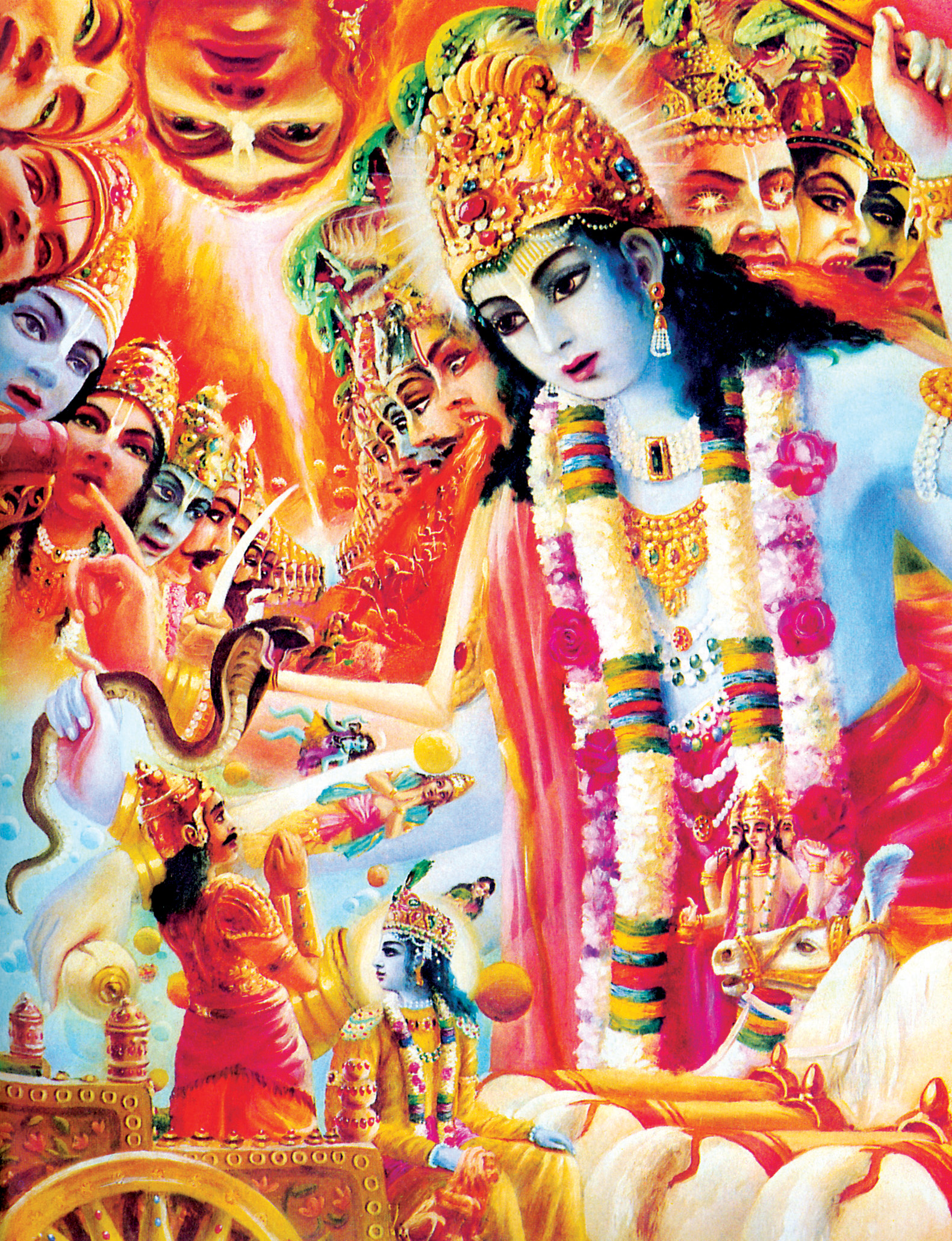
universal-formThe Universal Form

Bhakta Torben Nielsen recently made me aware of this change to Bg. 11.28:

Original and authorized 1972-edition:

“As the rivers flow into the sea, so all these great warriors enter Your blazing mouths and perish.”

BBT International’s edited 1983 edition:

“As the many waves of the rivers flow into the ocean, so do all these great warriors enter blazing into Your mouths.”

So-called original manuscript:

There is no verse for 11.28 as the page is missing. But verse 30 mentions the words “blazing mouths”.

This is a very interesting change, because it is of a grammatical nature:

  • In Srila Prabhupada’s original 1972 edition the adjective “blazing” describes the plural noun “mouths”.
  • In BBT International’s 1983 edition the adjective “blazing” describes the plural noun “warriors”.

So which translation is grammatically correct – Srila Prabhupada’s or Jayadvaita Swami’s?

The context

Here we have the verses from Bg. 11.28-30 (original edition):

“As the rivers flow into the sea, so all these great warriors enter Your blazing mouths and perish.” (Bg. 11.28)

“I see all people rushing with full speed into Your mouths as moths dash into a blazing fire.” (Bg. 11.29)

“O Visnu, I see You devouring all people in Your flaming mouths and covering the universe with Your immeasurable rays. Scorching the worlds, You are manifest.” (Bg. 11.30)

We see that Srila Prabhupada describes the mouths of the universal form as “blazing” (Bg. 11.28) and “flaming” (Bg. 11.30), and compares them to a “blazing fire” (Bg. 11.29). There is no “original manuscript” available for Bg. 11.28-29, but the “original manuscript” for Bg. 11.30 also says “blazing mouths”, as mentioned above.

Screen Shot 2015-03-13 at 11.49.21

Plate 31

The painting above this article is Plate 31 from the Bhagavad-gita As It Is. Just like all other paintings in the book it was approved by Srila Prabhupada. On the painting we clearly see that the warriors are entering into the blazing mouths of The Universal Form – just like we are told that they are in the Bg. 11.28, 1972 edition.

Srila Prabhupada’s desire

Based on the above, there is no doubt at all that Srila Prabhupada wanted to use the adjective “blazing” to describe the mouths of the universal form. He never meant to say that the great warriors were “blazing”.

What does the previous acaryas say about Bg. 11.28? (as translated on bhagavad-gita.org)

Sridhara Swami’s commentary:

“As unlimited currents of water helplessly flow in innumerable rivers and are propelled from multiple channels into the ocean, the mighty warriors of the Kaurava and Pandava armies are seen to be helplessly propelled into the flaming, gnashing mouths of the visvarupa or divine universal form of Lord Krishna.” ()

Kesava Kasmiri’s commentary:

“How helplessly do the mighty warriors of the Kaurava and Pandava armies enter into the flaming mouths of Lord Krishna’s visvarupa or divine universal form? As helplessly as unlimited currents of water from innumerable rivers are propelled into entering the ocean.”

In his translations of Visvanath Cakravarti Thakura and Baladeva Vidyabhusana’s Bhagavad-gita commentaries Bhanu Swami also translates Bg. 11.28 as follows:

“As many swift currents of rivers flow towards the sea, so these heroes of the world enter Your flaming mouths.”

The sanskrit

Gaura Krishna Dasa, a student of sanskrit, sent me the following analysis of the sanskrit grammar:

Regarding the change in the translation of Bhagavad gita 11.28.

The word “abhivijvalanti” is in the 1972 edition taken as what in grammar is called a verbal adjective or a participle. A participle is basically a derivative from a verb but belonging in the group of adjectives. This particular participle is a participle in present tense, active voice for parasmaipada verbs. It is in neuter gender, plural number and in the accusative case which clearly indicates that it relates to “vaktraani” which is also in neuter gender, plural number and accusative case.

Sridhara Swami, Visvanath Cakravati Thakur and Baladeva Vidyabhusana have the same grammatical conclusion of this word as a participle and therefore in relation to “vaktraani” attributively, “blazing mouths”.

The “anti” ending in “abhivijvalanti” could preliminarily appear as a finite verb 3rd person in the plural number and present tense related to “nara-loka-viira” (the kings of human society), but this conclusion is in the least very strange. It would, if accepted, be a distortion of historical facts and it must be concluded faulty because this sentense already has a finite verb namely “visanti” meaning entering. So if we for the sake of example maintain “abhivijvalanti” as a finite verb, as it is done in the 1983 edition it would translate “as the many waves of the rivers flow into the ocean, so all these great warriors enter and blaze your mouth”, since “abhivijvalanti” can also not be taken as an adverb describing “visanti” attributively.

Conclusion:

“abhivijvalanti” must be taken as a participle – as done by the previous acaryas and the original 1972 edition – and not a verb as done in the 1983 edition.

Conclusion

The evidence against Jayadvaita Swami’s change is overwhelming:

1. Srila Prabhupada is very clear in his original Gita and his manuscripts – the mouths are blazing. Not the warriors.

2. Srila Prabhupada follows the previous acaryas who says that the mouths are blazing (flaming, gnashing).

3 The painting depicting this event (Plate 31 in the Bhagavad-gita As It Is) shows that it is the mouths of The Universal Form that are blazing.

4. According to sanskrit grammer it is the “mouths” that are “blazing”. Not the “warriors”.

Even if both translations could be correct (which they cannot), there would still be no justification – based on the above analysis – to change Srila Prabhupada’s translation of the verse.

It would not be possible to do this without overriding his own editorial decisions and thus violating the arsa-prayoga principle.

Please see additional evidence here.

Performer Edit (Bg. 14.19)

BY: BHAKTA TORBEN

Apr 02, 2015 — DENMARK (SUN) —

Bhagavad-gita As It Is, 14.19:

Original, authorized 1972 edition:

“When you see that there is nothing beyond these modes of nature in all activities and that the Supreme Lord is transcendental to all these modes, then you can know My spiritual nature.”

Manuscript:

“When you see that there is nothing beyond these modes of Nature in all activities — and that the Supreme Lord is transcendental to this, then you can know My spiritual Nature.”

Screen Shot 2015-04-03 at 14.58.14

Jas It Is:

“When one properly sees that in all activities no other performer is at work than these modes of nature and he knows the Supreme Lord, who is transcendental to all these modes, he attains My spiritual nature.”

The Original and the manuscript agrees TO THE LETTER. Both the manuscript and the original says `You can know My spiritual nature´, whereas `Jas It Is´ says `he attains to My spiritual nature. The word-for-word says, ‘vetti’- know.

The phrase, ‘no other performer‘ is not found in the original or the manuscript.

The Holy Name Will Destroy the Book Changers

caitanya-bhagavata

CAITANYA BHAGAVATA, ADI 11.105-110:

TEXT 105

prabhu bole, — “bhakta-vakya krsnera varnana
ihate ye dosa dekhe, se-i ‘papi’ jana

TRANSLATION

“The Lord replied, “Whoever finds fault in a devotee’s description of Lord Krsna is a sinful person.”

TEXT 106

bhaktera kavitva ye-te-mate kene naya
sarvatha krsnera priti tahate niscaya

TRANSLATION

“Krsna is certainly pleased with His devotee’s poetry, even though it is imperfectly composed.”

TEXT 107

murkha bole ‘visnaya’, ‘visnave’ bole dhira
dui vakya parigraha kare krsna vira

TRANSLATION

“An uneducated person may chant visnaya, while a sober person will chant the proper form, visnave, but the Supreme Lord Krsna will accept both forms when they are chanted with devotion.”

COMMENTARY

“To Lord Krishna, a pandita expert in correct language and someone ignorant of correct language are both equal. Of the two, Krishna bestows more mercy on the one who has more enthusiasm for the service of Krishna. Krishna, the omniscient Supersoul of every living entity, is not guilty of the fault of partiality. So-called learned persons who are devoid of devotion proudly consider themselves learned as they reveal their foolishness by pointing out faults in the transcendental language of the pure devotees. The Supreme Lord and master of Sarasvati confirms the foolishness of the so-called learned offenders who are envious of the devotees at every step. Thus their pride of learning is diminished. Due to the absence of realization in the Absolute Truth, Shri Krishna Chaitanya, they belch forth mundane knowledge of sense enjoyment. This is the cause of their disease and falldown.”

TEXT 108

murkho vadati visnaya dhiro vadati visnave
ubhayos tu samam punyam bhava-grahi janardanah

TRANSLATION

“At the time of offering obeisances to Lord Visnu, a foolish person chants visnaya namah (this is improper due to faulty grammar) and a learned person chants visnave namah (this is the correct form). But both achieve equal piety by their offering of obeisances, because Lord Sri Janardana sees the sentiment of the living being, in other words, He sees the degree of devotion, or in other words, He awards the result accordingly (He does not see one’s foolishness or intelligence).”

TEXT 109

ihate ye dosa dekhe, tahara se dosa
bhaktera varnana-matra krsnera santosa

TRANSLATION

“One who finds fault with a devotee is himself at fault, for a devotee’s descriptions are meant only for the pleasure of Krsna.”

TEXT 110

ataeva tomara se premera varnana
ihate dusibeka kon sahasika jana?”

TRANSLATION

“Therefore who will dare find fault with your devotional descriptions of Krsna’s pastimes?”

CAITANYA BHAGAVATA, MADHYA, 19.209:

ye amara dasera sakrt ninda kare
mora nama kalpa-taru samhare tahare

“My wish-fulfilling holy names destroy one who blasphemes My servant.”

FROM THE COMMENTARY:

“So if gross materialists engage with pride in activities like censuring, blaspheming, and abusing the devotees from the material point of view and through mundane considerations, then the Supreme Lord destroys them.”

Note the word “censuring”. When BBT International deletes Srila Prabhupada own chosen words and sentences, then they are in effect censuring Srila Prabhupada.

(The purports are by Srila Bhaktisiddhanta Sarasvati Thakura Maharaja, translated by Bhumipati Dasa)

BBTI FORCED TO THEIR KNEES

Due to intense pressure from tens of thousands of devotees worldwide the BBTI have been forced – against their will – to again print the original edition of Srila Prabhupada’s Bhagavad-gita As It Is.

Screen Shot 2015-02-13 at 11.26.48

http://www.dandavats.com/?p=15528

But why support the BBTI, when they use the money to destroy Srila Prabhupada’s books?

Also, the original edition from BBTI is not as good quality as the one sold from Krishna Books Inc.

My recommendation: Buy your original books from http://www.krishnastore.com or any other shop that sells the original books as printed by Krishna Books Inc. (KBI).