


By Ajit Krishna Dasa (Denmark)
Śrīla Prabhupāda gave a very simple instruction:
“And the covers, if possible, should always be the same for each respective book regardless of what language it may be printed in.” (Letter to Jadurani, Bombay, January 3, 1975)
This instruction is not hard to understand. Each book should have its own recognizable cover, and that cover should remain the same, even when the book is printed in other languages. In other words, Śrī Īśopaniṣad should look like Śrī Īśopaniṣad, Bhagavad-gītā As It Is should look like Bhagavad-gītā As It Is, and so on.
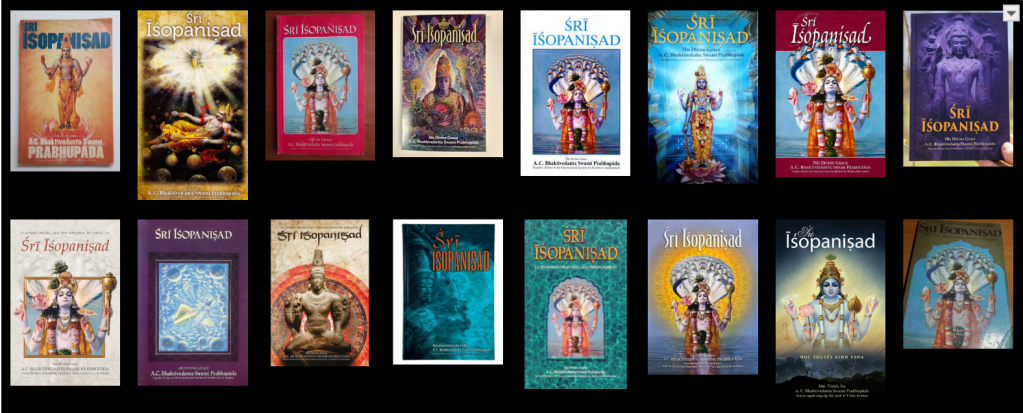
Yet when we look at the many different post-samādhi covers of Śrī Īśopaniṣad, we see something very different. Instead of one stable visual identity, we find a whole gallery of redesigns. Some covers retain elements of the original. Others give the book a completely different appearance. The result is not preservation, but fragmentation.
This may seem like a minor issue to some. After all, “it is only the cover.” But that misses the point. Śrīla Prabhupāda did not treat his books as ordinary commercial products to be endlessly repackaged according to changing tastes. His books were his life’s work, his preaching mission, and his gift to the world. Even the covers were part of that presentation.
The problem is therefore not merely artistic. It is a question of obedience, authorization, and fidelity to Śrīla Prabhupāda’s original books. If the spiritual master gives an instruction about the covers, then changing them without necessity is not improvement. It is disobedience dressed up as design.
The same problem appears with other books by Śrīla Prabhupāda. Bhagavad-gītā As It Is, Kṛṣṇa Book, Teachings of Lord Caitanya, and other works have also appeared with changing covers, changing layouts, and changing presentations. This contributes to a larger pattern: Śrīla Prabhupāda’s books are increasingly treated as editable institutional property rather than as the completed works of the Founder-Ācārya.
For those concerned with the preservation of Śrīla Prabhupāda’s original books, this matters. The issue is not nostalgia. It is not sentimental attachment to old artwork. It is about honoring the author’s will. The original BBT covers helped establish the identity of the Hare Krishna movement throughout the world. They became part of how devotees and the public recognized Śrīla Prabhupāda’s books.
A stable cover says: this is the same book, the same message, the same authorial presentation. A constantly changing cover says: this can be redesigned whenever someone thinks he has a better idea.
But Śrīla Prabhupāda already gave his idea.
The responsible course is simple: restore and preserve the original covers of Śrīla Prabhupāda’s books, and if someone wishes to add commentary or supplementary material, publish it as separate books, or as a clearly identified annotated edition, while leaving the original books unchanged. Do not blur the identity of the original books. Do not hide post-samādhi changes behind Śrīla Prabhupāda’s name. And do not replace obedience with graphic design enthusiasm.
Preserve Śrīla Prabhupāda’s original books. Preserve the original covers. Honor the Founder-Ācārya.

