”I went back and re-edited especially the translations in the first canto. Especially the first perhaps three chapters where I thought their were a lot of short comings. And I typed up all the translations – after I finished all the work, I typed up all the translations in one manuscript and put them in an envelope, and Prabhupada was coming to New York where I was at the time. Prabhupada came, and I put all the translations in an envelope, and I wrote a cover letter explaning what I have done, and asking him whether it was okay. And then I brought it up to Prabhupada’s quarters at 55th Street in New York–the New York temple—with the idea that I would leave them with his secretary and come back later. But Prabhupada was right there, and so he…I offered obeisances, and he had me, you know: ”What do you do in here?” ”What have you come for?” Not in those words, but, you know, he inquired was I was doing. And I explained that I had come to deliver this. So Prabhupada had me start reading right in his presence. And I began, I read the first verse, the second verse, the third verse. I went through a few verses, and Prabhupada stopped me. Prabhupada was listening very carefully, he stopped me. ”So what you have done?” And I said: ”Well, Srila Prabhupada, I have edited to try to bring it closer to what you originally said.” Prabhupada said: ”What I have said?” I said: ”Yes, Srila Prabhupada!” Then Prabhupada: ”Then it is alright!”, and that was it. ”Then it is alright!” ”What I have said?”, ”Then it is alright!”
A few points about this story:
1. Jayadvaita Swami’s story is merely anecdotal evidence which is considered a rather unreliable and dubious support of a claim. No one is really able to investigate the truth value of his story. To use anecdotal evidence as the foundation for changing the books that are supposed to guide mankind the next ten thousands years will surely create doubt about the authority of the changed books.
As Srila Prabhupada said about such stories:
“Just like in our ISKCON there are so many false things: “Prabhupada said this, Prabhupada said that.””
(Srila Prabhupada Letter, 7/11/1972)
“They misunderstand me. Unless it is there from me in writing, there are so many things that “Prabhupada said.”” (Srila Prabhupada Letter, 2/9/1975)
And as Jayadvaita Swami says:
“If Srila Prabhupada didn’t clearly and definitely say it, and if it first came up after 1977 whatever it is, don’t trust it. Rule of Thumb.” (Diksa-Diksa, Where the Rtvik People are Wrong, p. 85, Jayadvaita Swami)
Jayadvaita Swami started circulating his story after the book changing controversy started, and there is no evidence to support that it is true. Therefore, “…don’t trust it. Rule of Thumb.”
2. Jayadvaita Swami seems to conclude that since Prabhupada approved the verses that he brought him, then he also approved that he could change all his books using the same method – even after his disappearance. But this is an unwarranted extrapolation, because Jayadvaita Swami extrapolate far beyond the range of available data, namely from one single instance of editing to more or less all future instances of editing. But from his story no justification for such an extrapolation can be found. The only conclusion to be deduced (if the anecdote is at all true) is that what Jayadvaita Swami did to the very specific verses he brought Prabhupada was okay. No more, no less.
3. If Jayadvaita Swami’s anecdote is true, then Prabhupada told him that if he had made the text closer to what Prabhupada originally said, then it was okay.
However, in my previous articles to Jayadvaita Swami I have referred to articles where it is clearly documented that he has:
Deleted many of Prabhupada’s own chosen words and sentences (even those also found in his ”original manuscript”)
Added his own words and sentences (which means they are also not to be found in the ”original manuscript”)
Changed Prabhupada’s own personally typewritten sanskrit translations.
The article ”The Duty of the Finger” demonstrates all these types of changes made to Prabhupada’s Bhagavad-gita As It Is:
Now, I think most devotees around the world would like to know what Jayadvaita Swami thinks Prabhupada would have said if he had told him:
”Well, Srila Prabhupada, in my editing I have deleted some of your own chosen words and sentences! And I have also invented some completely new words and sentences and put them in where I felt they would do a good job! And since we at the BBT International are now ”accomplished sanskrit scholars” we have gone through some of your own typewritten sanskrit translations and changed them also.”
What do we, honestly, think Prabhupada would have answered? Then try to extrapolate that answer to the changes Jayadvaita Swami has made to Prabhupada’s Bhagavad-gita As It Is.
“As all surrender unto Me, I reward them accordingly. Everyone follows My path in all respects, O son of Pṛthā.”
Hayagriva Prabhu was true to Srila Prabhupada’s words here. Jayadvaita Swami’s 1983 version is not! Why?
There is NO explanation of why this change was made on the BBTI’s website. I wonder why, since they write:
“Want to see the actual revisions made for Bhagavad-gita As It Is, Srimad-Bhagavatam, and Teachings of Lord Caitanya? You’ve come to the right place.” (BBT International’s website)
And on Jayadvaita Swami’s “annotated scans” which are categorized under “See the changes” on BBTI’s website there is no annotations made to verse 4.11.
Regarding these “annotated scans” BBT International’s website says:
“When Jayadvaita Swami made his revisions for the second edition of Bhagavad-gita As It Is, he did them directly on a copy of the book–that is, a copy of the first edition. After the second edition was published, for many years his first-edition copy was lost. But back in roughly 2006, Dravida Dasa found it in a trunk in San Diego. More recently, that copy has been scanned and digitized. And now the BBT is putting it here online.”
Apparently not all the changes made to Srila Prabhupada’s Bhagavad-gita As It Is are to be found in this “annotated scan” that all of a sudden mysteriously re-appeared. Why do they not write that not all changes are mentioned in this “annotated scan”? Are they trying to hide some of the changes from the public?
How did Srila Prabhupada feel about verse 4.11 as it appeared in his 1972 Macmillan Bhagavad-gita As It Is:
Prabhupada: So the original verse says that “All of them as they surrender unto Me, I reward accordingly. Everyone follows my path in all respects.” This means that everyone is searching after that absolute truth. Some of them are satisfied with impersonal feature. The philosophers, jnanis, they, because they want to understand the absolute truth by dint of their imperfect knowledge.
>>> Ref. VedaBase => Bhagavad-gita 4.11-18 — Los Angeles, January 8, 1969
Prabhupada: “All of them — as they surrender unto Me — I reward accordingly. Everyone follows My path in all respects, O son of Prtha.” God is everything, and we can associate with Him according to our choice.
>>> Ref. VedaBase => Interview with the New York Times — September 2, 1972, New Vrindaban
Cyavana: Krsna says, “All of them, as they surrender, I reward accordingly.” So that means they are surrendering in different…
Prabhupada: Yes. He has not surrendered. He keeps himself separate from Krsna, and he is, artificially he shows surrender. Surrender does not mean that you reserve something for you. That is not surrender. Surrender means without reservation. That is surrender.
>>> Ref. VedaBase => Morning Walk — November 1, 1975, Nairobi
Pradyumna (leads chanting): Translation: “All of them, as they surrender unto Me, I reward accordingly. Everyone follows My path in all respects, O son of Prtha.”
Prabhupada:
ye yatha mam prapadyante
tams tathaiva bhajamy aham
mama vartmanuvartante
manusyah partha sarvasah
[Bg. 4.11]
Everyone is seeking to find out Krsna. Directly or indirectly. Krsna means the all-attractive. All-attractive. Bhagavan means the all-attractive Supreme Personality of Godhead. So indirectly or directly, everyone is seeking Krsna, the all-attractive. Ananda-mayo ‘bhyasat. The Supreme Bliss.
Nitai: “All of them — as they surrender unto Me — I reward accordingly. Everyone follows My path in all respects, O son of Prtha.”
ye yatha mam prapadyante
tams tathaiva bhajamy aham
mama vartmanuvartante
manusyah partha sarvasah
[Bg. 4.11]
We are continuing from yesterday’s subject matter, how one can become purified and go back to home, back to Godhead.
Here the second line of this verse is very important. It is said, mama vartmanuvartante manusyah partha sarvasah: “All human being is searching after Me.”
Prabhupada: This is page one-hundred-eighteen, yes.
Tamala Krsna: “All of them as they surrender unto Me, I reward accordingly. Everyone follows My path in all respects, O son of Prtha.” Purport: “Everyone is searching after Krsna in the different aspects of His manifestation. Krsna, the Supreme Personality of Godhead, is partially realized in His impersonal brahmajyoti or shining effulgence. Krsna is also partially realized as the all-pervading Supersoul dwelling within everything, even in the particles of atoms.”
Prabhupada: It [the microphone] is not fixed up right.
Tamala Krsna: “But Krsna is only fully realized by His pure devotees. Therefore, Krsna is the object of everyone’s realization, and as such anyone and everyone is satisfied according to one’s desire to have Him. One devotee may want Krsna as the supreme master, another as his personal friend, another as his son, and still another as his lover. Krsna rewards equally all the devotees in their different intensities of love for Him. In the material world the same reciprocations of feelings are there and they are equally exchanged by the Lord with the different types of worshipers. The pure devotees both here and in the transcendental abode associate with Him in person and are able to render personal service to the Lord and thus derive transcendental bliss in His loving service. As for those who are impersonalists and who want to commit spiritual suicide by annihilating the individual existence of the living entity, Krsna helps them also by absorbing them into His effulgence. Such impersonalists do not agree to accept the eternal, blissful Personality of Godhead, and consequently they cannot relish the bliss of transcendental personal service to the Lord…”
Prabhupada: Yes.
Tamala Krsna: “…and they extinguish their individuality.”
Prabhupada: God realization, there are three aspects: brahmeti paramatmeti bhagavan iti sabdyate [SB 1.2.11].
>>> Ref. VedaBase => Bhagavad-gita 4.11-18 — Los Angeles, January 8, 1969
Again we see that Jayadvaita Swami’s and BBT International’s claim to fame – namely that they are making the books “closer to Prabhupada” – is false propaganda. Many, many changes – hundreds (if not thousands) – are further away from the words that Srila Prabhupada originally wrote or dictated.
Their claim about not making needless changes is proved false by the changes to Bg. 4.11, since this change is not at all needed.
Does Jayadvaita Swami and the BBTI trustees ever ask themselves this question: If making all of these changes is our way of surrendering to Srila Prabhupada, then what will our reward be?
Recently, the ambitious corporate climber, Tamohara dasa/GBC Chairman, posted on ISKCON cheerleading website a deceptive letter addressing the devotees and the temples, where they should purchase their books. He is attempting to self-righteously clamp down on distribution of the ORIGINAL Srila Prabhupada’s Bhagavad-gita on the pretext that it is not authorized by Srila Prabhuapada’s created BBT.
Tamohara Dasa
The purpose of ‘his’ letter is based on their (GBC) need for continuation of intentional ‘dumbing down’ of naïve devotees that is unfortunately based on complete lie and deception that most of rank and file devotees are not aware of. GBC/BBTI wants to completely control and systematically undermine Srila Prabhupada created ISKCON, BBT and his real teachings which are based on pure devotional principles.
Their lie and deception is twofold;
1) Firstly, after Srila Prabhupada’s departure they fraudulently and secretly incorporated their own private BBT called BBT INTERNATIONAL, that illegally replaced Srila Prabhupada’s BBT in their attempt to usurp total control and to put a stop to distribution of original Srila Prabhupada’s books. Replacing them with their own revised editions that was mentally contrived by Jayadvaita swami.
Within this fraudulent BBT INTERNATIONAL (as per FORM TX – For a Literary Work – United States Copyright Office Registration form) Srila Prabhupada is not even mentioned. In point 2 of the form the ‘NAME OF THE AUTHOR is given as – The Bhaktivedanta Book Trust. There is no mention of Śrīla Prabhupāda as the author of the Bhagavad Gītā As It Is. Why? “
This opens up a Pandora’s Box of questions…
For example why is there any need for a “Corporation” to assist the BBT in its service?
Who authorized the establishment of the BBTi to “acts\” as an authorized agent”
Why does this ‘authorized agent’ for Śrīla Prabhupāda’s BBT now have the ‘copyrights’ for Śrīla Prabhupāda’s books?
What or who stopped the BBT from printing his Śrīla Prabhupāda’s books in their original unedited format as a natural process after Śrīla Prabhupāda entered into Samādhi?
Is there any authorization from Srila Prabhupada stipulating that his books should be edited after his entrance into Samādhi?
And if there is no authorization for editing or printing Śrīla Prabhupāda’s books, why are they doing it, especially after it is creating so much controversy amongst Śrīla Prabhupāda direct disciples?
Following is what the BBT International say is the relationship between the BBT and BBTi.
BBT? BBTI? Who’s who?
The Bhaktivedanta Book Trust (BBT) is a California religious trust that owns the copyrights to the works published by His Divine Grace A.C. Bhaktivedanta Swami Prabhupada during his lifetime.
The Bhaktivedanta Book Trust International (BBTI) is a California corporation that has acted as an authorized agent of the Bhaktivedanta Book Trust since 1988. The BBTI also owns the rights to some later works.
The BBT and BBTI work together to protect Srila Prabhupada’s rights and serve his will.
The important aspect of this subterfuge is that no one really knows what is going on… First they say that Śrīla Prabhupāda ‘owns’ the copyright of his book as per the BBT documentation but and it is a big but, what is this document where it shows the BBTi have the copyright of Śrīla Prabhupāda’s Bhagavad Gītā As It Is???
What Bhagavad Gītā are they copyrighting? Is this their way of replacing Śrīla Prabhupāda’s Gītā with their own edited version so it can be edited ad infinitum all the while leaving Śrīla Prabhupāda’s Gītā gathering dust archived somewhere?
This also begs the question how many of Śrīla Prabhupāda’s books have they done away with him as the author and placed the BBT as the author, leading the unsuspecting devotees to believe that they are reading and distributing Śrīla Prabhupāda’s books but in actual fact these are reading and distributing phony books.
I would not be surprised if in the future they openly say that these are not Śrīla Prabhupāda’s books at all, bearing in mind they ‘legally’ state that these books are ‘authored’ by the Bhaktivedanta Book Trust.
The general devotees are so dumbed down to accept anything that the BBTi does or say as gospel truth or should we say ‘emet’ truth.
Consequently, once Śrīla Prabhupāda’s ‘as it is’ stance based on the ‘absolute truth” is undermined by the subjective truths of individuals such as Jaya Advaita Swami, then his books become ‘open game’ for any future BBT corporation/board and corporate members to edit according to their own interpretations of the truth that are fashionable at the particular time, place and circumstances.
Due to this ‘interpretive methodology’ of ‘these rascal editors’ which is based on so called academically contrived secular critical analytical study of texts, they can effortlessly indoctrinate devotees into the acceptance of hermeneutic (interpreting) views, that majority of ISKCON leaders are already habituated with, and are already steering our once glorious institution into the realm of mundane religion (cheating religion) a.i. Mayavadism, Sahajiyism, Hinduism, PC-ism, Corporatism, sentimental Veganism etc…
Devotees such as Ravindra Swarup, Tamala Kṛṣṇa Goswami, Kṛishna Kestra and Hridayananda etc, being heavily influenced and attached to secular academics have basically turned Śrīla Prabhupāda’s ‘as it is’ principles which are based on the understanding that truth is ‘absolute’, into truth being more in the realm of relativistic truth or truth that is malleable according to one’s personal cultural/psycho-physical background/realization/desire/preference.
Here is one but small example of such theorizing;
“The hermeneutical circle or interpretative horizon of scripture for modern readers has exploded out into the entire range of presently available texts drawn from an ever-increasing spectrum of religious and secular traditions. Canonical works no longer enjoy the seeming autonomy they once had, nor are they impervious to scrutiny from outside readers. The top-down, “vertical” process of receiving spiritual truth from infallible scripture is now, more than ever before, faced with the pervasive presence of a multiplicity of voices that challenge the privileged position of any one of them (Taken from – Constructive Theologizing for Reform and RenewalThomas Herzig (Tamal Krishna Goswami) and Kenneth Valpey (Krishna Kshetra Das)”
2) Secondly, over the years they conjured a plethora of false rhetoric’s to justify and rationalize their big deceptive lie. However any individual, who takes the time to study the issue, will soon recognize that all their feeble excuses are based on bluffing and cheating and nothing else.
a) We are re-writing Srila Prabhupada’s books to appease Academia so we will be recipients of approval by them with a pat on the back whilst telling us “good ‘little’ boys”.
b) We are re-writing the books to make it “closer” to Srila Prabhupada`s drafted version.
Unfortunately, everything that they rationalized and justified up till now is one BIG FAT, and SMELLY LIE. I urge the readers, who are not sufficiently educated with this important matter to visit the https://arsaprayoga.wordpress.com/ to see and analyze the comprehensive evidence that completely exposes them and indentifies them for what they really are.
Since the latest groundswell of the devotees questioning and clearly exposing this BIG fraud, Jayadvaita swami is out of fear resorting to a wicked non-vaisnava behavior in order to bamboozle the naïve devotees and perhaps himself, into believing his deception.
Some time back he wrote an article “Book Changes: History Backs the BBT” lying thru his teeth in the attempt to bamboozle devotees that Hayagriva prabhu never worked together with Srila Prabhupada on Bhagavat-gita. Sadly, for him it back fired on Jayadvaita Swami, when his article was completely and chronologically refuted by Madhudvisa prabhu in article titled Jayadvaita’s Smoke and Mirrors which was a response to what appears to be a planned, conscious and intentional lie on the side of Jayadvaita swami in hope to completely erase Hayagriva pr, from the pages of ISKCON ‘real’ history, and replacing it with his own deconstructed history.
Due to the BBT’s standing on perpetual editing of Śrīla Prabhupāda’s books it has forced devotees who want to see Śrīla Prabhupāda’s original books to be printed and distributed (which is after all the stated purpose of Śrīla Prabhupāda’s BBT) they have resorted to printing his books themselves – for example KBI and in particular Jitarati Prabhu’s printing of the ‘Pocket sized Bhagavad Gītā ’ which by the way was a huge success selling out nearly all 100,000 books that they printed!
You have to pause and think about this for one moment… One Hundred Thousand (100,000) of Śrīla Prabhupāda’s original unedited books! Now this only goes to show that people want his unedited books!
Their success has so infuriated Jayadvaita swami that in his rage he began calling these books ‘rittvik’ books! Not only did he label them rittvik books he also began actively preaching to devotees not to purchase read or distribute these ‘rittvik’ books!
How pathetic is that? He is trying to say that Srila Prabhupada did not write the original books, but the evil RITTVIK`s DID IT!!!!!! ….HELP HELP HELP…save us from rittviks…and their evil “Original Srila Prabhupada” books. Come on Jayadyaita swami, how low can you go?
Naturally, when Jayadvaita swami was asked did Srila Prabhupada give him or anyone for that matter any instruction/consent to re-write his book “ad infinitum” after his departure, his answer is NO. Yet he disobediently continues with his offence to our glorious spiritual master.
WHICH MAKES ME WONDER WHO IS HE WORKING FOR, SINCE HIS ACTIONS CLEARLY AFFIRM THAT SRILA PRABHUPADA IS NOT HIS AUTHORITY AT ALL?
This is a very important point to consider especially when he would be loved rather than hated by many of his godbrothers if he spent his time and efforts to publish Śrīla Prabhupāda’s original books instead of putting our whole Vaiṣṇava society in such a hurtful and disheartening dilemma by spending not only countless hours scouring Śrīla Prabhupāda’s works to find what he perceives as an error or fault in the works of the uttama adhikāra devotee of Lord, editing those works and then publishing what he believes is the more superior/authoritive work.
While we are at it and going on the principle of establishing ‘shadow’ bodies to supersede the bodies that Śrīla Prabhupāda established, I would like to ask the GBC mouthpiece Tamohara dasa, why did they secretly and systematically privatize Srila Prabhupada’s created ISKCON, transferring the control into illegally created ‘shadow’, such as GBC of West Bengal, BBT International corporation etc, that have they own laws and by-laws and are diametrically opposed to the ones created by Srila Prabhupada. Huh, mister mouthpiece, please tell us???
However, I know that we will not hear from Tamohara nor any other GBC and BBTI corporate members (cronies), about this secret hijacking of Srila Prabhupada`s ISKCON, and its replacement with this Fraudulent ISKCON. CALLED FISKCON. We know that you want to keep this secret, because you know if the rank and file devotees wake up to how devious your agenda really is, they will have a revolution and unceremoniously kick you all out onto the curb.
Nevertheless, with time the devotees are waking up, just like is with the case of devious book changes of yours and are becoming more and more educated and enlightened with your secret plans, hence the time will come for you where you will not be able to bamboozle innocent no more and your ivory towers will come crumbling down like a deck of cards, with you in it.
Looking forward to seeing this day taking place
The main question devotees must be asking is – why are the BBT trustees relentlessly and ruthlessly pursuing this course of action? If all their efforts were placed on the printing of Śrīla Prabhupāda’s original books and making sure the Temples were distributing his books we would not be involved in such terrible controversies for all these years, wasting so much time resources and money that the BBT could use to print more books.
In this article we hope to bring to light how Srila Prabhupāda, the Acharya and Jagat Guru, has personally instructed the proper etiquette to all his followers in how to deal with seeming mistakes, or errors in the writings of an uttama-adhikārī and Acharya.
In this time of confusion and controversy, in regard to the editing of the BBTI, we humbly submit the following at the feet of all the Vaiṣṇava’s for their own contemplation and realization in spiritual life:
In the Caitanya-caritāmṛita, Madhya-līlā 9.358, Srila Prabhupāda cites his spiritual master Śrīla Bhaktisiddhānta Sarasvatī Ṭhākura, who points out that in the seventy-fourth verse of this same chapter there is an apparent error made by Kṛṣṇa dāsa, Kavirāja Gosvāmī. Srila Prabhupāda, just to teach us the principle of arsa-prayoga, [please see quotes from Srila Prabhupāda on “arsha-prayoga” at the end of this article] does not touch the words of Kṛṣṇadāsa Kaviraja Goswami, but leaves this apparent error as it is, out of respect for the transcendental book. Even though Srila Prabhupāda’s own spiritual master, the most pure and intimate confidential devotee and associate of Lord Kṛṣṇa and Sri Caitanya Mahāprabhu himself, had clearly pointed out that this is an apparent error and is apparently wrong.
Furthermore in the purport to that seventy-fourth verse, mentioned above, Srila Prabhupada mentions nothing; only at the end of the chapter, after Srila Kṛṣṇadāsa Kaviraja concludes his narration, does Srila Prabhupāda even mention the apparent mistake.
That Caitanya-caritāmṛita, Madhya-līlā 9. 358 purport is cited here for your reference:
“Śrīla Bhaktisiddhānta Sarasvatī Ṭhākura points out that in the seventy-fourth verse of this chapter it is stated that Śrī Caitanya Mahāprabhu visited the temple of Śiyālī-bhairavī, but actually at Śiyālī, Śrī Caitanya Mahāprabhu visited the temple of Śrī Bhū-varāha. Near Śiyālī and Cidambaram there is a temple known as Śrī Muṣṇam. In this temple there is a Deity of Śrī Bhū-varāha. In the jurisdiction of Cidambaram there is a district known as southern Arcot. The town of Śiyālī is in that district. There is a temple of Śrī Bhū-varāhadeva nearby, not Bhairavī-devī. This is Śrīla Bhaktisiddhānta Sarasvatī Ṭhākura’s conclusion.”
This is a very good lesson to make a clear and prominent note of how Srila Prabhupāda, the teacher by example, has chosen to edit (or rather not edit) the words of the spiritual masters or previous acharyas’ writings.
Srila Prabhupāda has every right in the world to change or edit anything, for he is Kṛṣṇa’s direct representative and the present acharya and current link to the paramparā. But, as the Acharya, he has himself stuck to the principal of arsha-prayoga and did not change it just to teach us respect, correct behavior. He does not touch this apparent “mistake,” he leaves it completely untouched, as it is.
As Srila Prabhupāda said “I have instructed everything in my books.” (Letter to: Dina Dayala, Mayapur, 25 February, 1976) So Srila Prabhupāda has also instructed us to not edit the books in his books themselves.
There are many instances of this in Srila Prabhupāda’s writings if we just look.
We will cite another place were Srila Prabhupāda left a seeming mistake as it is, even though it may be considered “wrong.”
“Ambikāvana is situated somewhere in the Gujarat province. Ambikāvana is said to be situated on the river Sarasvatī, yet we do not find any Sarasvatī River in the Gujarat province; the only river there is Savarmati. In India, all the big places of pilgrimage are situated on nice rivers like the Ganges, Yamunā, Sarasvatī, Narmadā, Godāvarī, Kāverī, etc. Ambikāvana was situated on the bank of Sarasvatī, and all the cowherd men and Nanda Mahārāja went there.” (KRSNA Book 1970 edition Volume 1 Chapter 33 / Vidyādhara Liberated and the Demon Śaṅkhāsura Killed)
In this quote from Srila Prabhupāda’s original KRSNA book, Prabhupāda mentions that although it says, “Ambikāvana is said to be situated on the river Sarasvatī, yet we do not find any Sarasvatī River in the Gujarat province…” Prabhupāda does not change the text to correct the seeming mistake.
Below is another example of something that may be considered from the scholarly or mundane viewpoint “wrong” with the text but it was left as it is out of respect for the author, adhering to the principle of arsha-prayoga.
“TRANSLATION
Thus Paramānanda Purī started for Jagannātha Purī, and Śrī Caitanya Mahāprabhu began walking toward Śrī Śaila.
PURPORT
Śrīla Bhaktisiddhānta Sarasvatī Ṭhākura remarks, “Which Śrī Śaila is being indicated by Kṛṣṇadāsa Kavirāja Gosvāmī is not clearly understood. There is no temple of Mallikārjuna in this area because the Śrī Śaila located in the district of Dhārwād cannot possibly be there. That Śrī Śaila is on the southern side of Belgaum, and the Śiva temple of Mallikārjuna is located there. (Refer to text 15 of this chapter.) It is said that on that hill Lord Śiva lived with Devī. Also, Lord Brahmā lived there with all the demigods.” (Cc Madhya 9.174)
Srila Prabhupāda’s own standards and the established Vedic principal of arsha-prayoga that he gave to us are not being followed by the BBTI editors headed by Jayavaita Swami and Dravida. On the contrary, the exact opposite is being done, causing Srila Prabhupāda’s once authorized and respected writings to be lost and devalued due to these unauthorized offensive changes that directly go against Srila Prabhupāda’s will and example.
Through his books, Srila Prabhupāda is always instructing us and guiding us in the deep mellows of transcendental mood/rasa. If we disregard this guidance our minds and service will be of improper mellows, rasābhāsa, and not pure bhakti, and will thus not be acceptable by Kṛṣṇa.
Srila Prabhupāda further explains this fact in the Purport of the Caitanya-caritāmṛita Madhya 10.113 and 114 as follows:
“By overlapping mellows (rasābhāsa) one eventually becomes a prākṛta-sahajiyā and takes everything to be very easy. One may also become a member of the bāula community and gradually become attracted to material activities. Śrī Caitanya Mahāprabhu therefore has advised us to avoid bhakti-siddhānta-viruddha and rasābhāsa. In this way the devotee can remain pure and free from falldowns. Everyone should try to remain aloof from bhakti-siddhānta-viruddha and rasābhāsa.”
Furthermore Srila Prabhupāda drives this point home in the very next purport in an effort to make this explicitly clear to his followers. Unfortunately, today, almost forty years later, we are still not getting it:
“Pure devotees of the Lord do not accept impure principles. Impure devotees accept rasābhāsa, or overlapping, contradictory mellows, and other principles opposed to the bhakti path. The followers of such impure principles are never accepted as pure devotees. There are many parties following the path of rasābhāsa, and the followers are sometimes adored by ordinary men. Those who adopt the conclusions of rasābhāsa and bhakti-siddhānta-viruddha are never accepted as devotees of Śrī Caitanya Mahāprabhu. Svarūpa Dāmodara Gosvāmī never approved such followers as Gauḍīya Vaiṣṇavas, nor did he allow them even to meet the Supreme Lord, Śrī Caitanya Mahāprabhu.” (Caitanya-caritāmṛita Madhya 10.114)
The few references quoted in this short article are by no means at all a comprehensive list of these types of instances. A full book could be written on this topic alone, listing the numerous occasions of such instructions given by Srila Prabhupada. Here we are citing only a few that we have recently noticed in our own personal reading of His Divine Grace’s books for the purpose of this article.
So what to do about the seeming discrepancies that a critical editor may find in Srila Prabhupāda’s books?
As for me I do not know for I am just a simple second generation devotee. But as a follower of His Divine Grace A.C. Bhaktivadanta Swami Prabhupāda I have no other recourse but to have fidelity to him and take his example as the standard and adhere to that. What else can we do?
To conclude let me leave the thoughtful reader of this article with these important words Srila Prabhupada has given in his Nectar of Instruction, verse six, last paragraph where he warns us not to correct the Acharya or spiritual master: “It is also an offense to consider an empowered Vaiṣṇava an object of disciplinary action. It is offensive to try to give him advice or to correct him… The spiritual master must not be subjected to the advice of a disciple”
Please watch this short video where two of Srila Prabhupāda’s most senior disciples recall Prabhupāda’s direct personal instructions on editing and the standards and mood he wanted to be followed.
———————
Prabhupāda: The system is: whatever authority has done, even there is mistake, it should be accepted.
Radha-vallabha: Oh.
Prabhupāda: Arsha prayoga. That is ha… He should not become more learned than the authority. That is very bad habit….
Prabhupāda: Why finish it? Whatever is done is done. No more….
Radha-vallabha: Well, now that this system of no corrections anywhere, that makes it very simple. Then he can’t do anything. I don’t think he wants to, either. It makes it more simple for him. It makes him very uncomfortable.
Prabhupāda: No corrections.
(Conversation with Italian Woman with Translator – February 28, 1977, Mayapura)
[Note: in the Vedabase the transcriber, not being familiar enough with Sanskrit, did not transcribe the word arsha prayoga correctly so it is misspelled, but for the purpose of this article we have corrected it above]
“So unless one is self-realized, there is practically no use writing about Krsna. This transcendental writing does not depend on material education. It depends on the spiritual realization. You’ll find, therefore, in the comments of Bhagavatam by different acaryas, even there are some discrepancies, they are accepted as Arsha-prayoga. It should remain as it is.”
(Srimad-Bhagavatam 7.5.23-24 – Vrndavana, March 31, 1976)
[Note: Again, in the Vedabase, the transcriber, not being familiar enough with Sanskrit did not transcribe this word correctly so it was misspelled originally]
Learn how the conditioned soul can gradually progress from his state of ignorance to pure spiritual bliss.
From Chapter One of the book:
Actually we are all spirit souls and are intended to associate with God in the spiritual sky where there are innumerable spiritual planets and innumerable spiritual living entities. However, those who are not fit to live in that spiritual world are sent to his material world. This very idea is expressed by Milton in Paradise Lost. Although spirit soul, we have voluntarily accepted this material body and by accepting it have also accepted the threefold miseries of material nature. Exactly when we accepted it and how we accepted it cannot be traced out. No one can trace out the history of when the conditioned soul first began accepting these material bodies.
At present Darwin’s theory of the evolution of organic matter is very prominent in institutions of higher learning, but there is information given in the Padma Purana and other authoritative scriptures of the living entities’ spiritual evolution from one bodily form to another. This Purana informs us that species amongst plants and vegetables alone. At present everyone is giving stress to Darwin’s theory, but in Vedic literature there is immense information about the different species. Darwin expresses the opinion that the species are evolving from lower forms of life, but this is not the whole truth. The soul may progress from lower forms to higher forms, but in the beginning of creation all species were created by Sri Krishna, as indicated in Bhagavad-gita.
sarva-bhutani kaunteya
prakrtim yan ti mamikam
kalpa-ksaye punas tani
kalpadau visrjamy aham
“O son of Kunti, at the end of the millennium every material manifestation enters unto My nature, and at the beginning of another millennium, by My potency I again create. The whole cosmic order is under Me. By My will is it manifested again and again, and by My will is it annihilated at the end.” (Bg. 9.7,8)
All of these living entities are subject to the threefold miseries, including those miseries pertaining to the body and mind. Animals cannot understand that they are suffering, but human beings can. One who does not know that he is suffering is in animal consciousness. Animals may be standing behind a fence to be slaughtered, but they do not understand this. As human beings, we should be cognizant that we are suffering the pains of birth, old age, disease and death and should be inquisitive to know how to avoid these miseries. We have been suffering from the beginning of our birth when as a baby we were tightly placed for nine months in the womb of a mother. After birth, suffering continues; although a mother may take much care for her child, the baby still cries. Why? Because he is suffering. Either a bug is biting, or there is a pain in the stomach or some other malady. Whatever the case, the suffering goes on. The child also suffers when he is forced to go to school when he does not want to. The child does not want to study, but the teacher gives him tasks anyway. If we carefully anlyze our lives, we will find that they are full of suffering. Generally speaking, conditioned souls are not very intelligent, and therefore they go on suffering without ever inquiring why. We should understand, however, that this suffering is there, and if there is a remedy we must take advantage of it.
“Even in the poetic compositions of such great poets as Bhavabhuti, Jayadeva and Kalidasa there are many examples of faults. Such mistakes should be considered negligible. One should see only how such poets have displayed their poetic power.” (Caitanya Caritamrta, Adi-Lila, Ch. 16, Texts 101-102)
“In explaining the glories of the Lord, inexperienced men may compose poetry with many faults, but because it contains glorification of the Lord, great personalities read it, hear it and chant it.” Despite its minute literary discrepancies, one must study poetry on the merit of its subject matter. According to Vaisnava philosophy, any literature that glorifies the Lord, whether properly written or not, is first class. There need be no other considerations. The poetic compositions of Bhavabhuti, or Srikantha, include Malati-madhava, Uttara-carita, Vira-carita and many other similar Sanskrit dramas. This great poet was born during the time of Bhojaraja as the son of Nilakantha, a brahmana. Kalidasa flourished during the time of Maharaja Vikramaditya, and he became the state poet. He composed some thirty or forty Sanskrit dramas, including Kumara-sambhava, Abhijnana-sakuntala and Megha-duta. His drama Raghu-vamsa is especially famous. We have already described Jayadeva in Chapter Thirteen of this Adi-lila.
ISKCON published a new version of His Divine Grace A.C. Bhaktivedanta Swami Prabhupada’s book, Perfect Questions, Perfect Answers in 1993. It is a transcript of a conversation which took place in Mayapur, West Bengal, in 1972 with a Peace-Corps worker, Bob Cohen.
Please read these changes completely as they give a very good insight into the types of things ISKCON and the BBT are deleting from Srila Prabhupada’s books. They have their own agenda and they want to change the philosophy that is presented in Srila Prabhupada’s books and by carefully studying the changes they are making you can gradually understand their demoniac agenda….
The original edition was more or less a transcript of the original conversation. It was edited, of course, to make the English clear and correct and to make it readable. But basically it remained a transcript of the original conversation.
The 1993 version changes all of this. The book is slashed from 99 pages to 77 pages! And the type is not even smaller! So much has been cut out. In one place four complete pages have been deleted!
All the text has been heavily edited and the whole mood of the book has been completely changed. We have not done anything below about the editing, we have just pointed out a few pieces of text (shown in bold) that have been completely deleted from the new edition.
Plain Text – Text from original book (may be edited in new edition) Bold – Original text completely deleted from new edition
“Miracles are For the Ignorant”? Chapter 1, Page 5: Bob: Let me repeat what you said this morning–that was interesting. I asked about miracles, and you said that only a fool would believe in miracles because–let us say you are a child and an adult lifts this table. That’s a miracle. Or you’re a chemist and you combine acid and base and you make smoke, an explosion or whatever. To somebody ignorant, that’s a miracle. But for everything there is a process, and so when you see a miracle, it’s just ignorance of the process. So that only a fool would believe in miracles, and–you correct me if I say wrong…
Srila Prabhupada: Yes, yes.
Bob: You said when Jesus came the people then were somewhat more ignorant and needed miracles as aid. I wasn’t sure if that’s quite what you said.
Srila Prabhupada: Yes, yes. Miracles are for the ignorant.
Bob: I had asked this in relation to all the miracle men you hear about in India.
Srila Prabhupada: Krsna is the highest miracle man.
Bob: Yes.
Srila Prabhupada: That is stated by Kunti…
“Our Knowledge Is Perfect”? Chapter 1, Page 10:
Srila Prabhupada: Yes. Our knowledge is perfect. If I say that heat is the energy of Krsna, you cannot deny it, because it is not your energy.
Deleting Verse Translations Chapter 3, Page 21:
[“After attaining Me, the great souls, who are yogis in devotion, never return to this temporary world, which is full of miseries, because they have attained the highest perfection.”]Chapter 3, Page 26:
“By the mercy of the spiritual master one is benedicted by the mercy of Krsna.”Chapter 3, Page 26: “Without the grace of the spiritual master one cannot make any advancement.”Chapter 3, Page 27:
If you displease him, then you are nowhere. Therefore we worship the guru.saksad-dharitvena samasta-sastrair
uktas tatha bhavyata eva sadbhih kintu prabhor yah priya eva tasya
vande guroh sri-caranaravindam
[“The spiritual master is to be honored as much as the Supreme Lord because of his being the most confidential servitor of the Lord. This is acknowledged by all revealed scriptures and is followed by all authorities. Therefore I offer my respectful obeisances unto the lotus feet of such a spiritual master, who is a bona fide representative of Lord Krsna.”]
The guru should be accepted as God. That is the injunction of all sastra.
“Chanting Hare Krishna is a Yogic Process”? Chapter 3, Page 25: Bob: Is chanting Hare Krsna such a yogic process?
Srila Prabhupada: Yes, it is also a yogic process.
What Is the Difficulty? Chapter 3, Page 28:
Srila Prabhupada: Yes, He is the original spiritual master because He was accepted as spiritual master by Arjuna. So what is the difficulty? Sisyas te ‘ham sadhi mam tvam prapannam. Arjuna told the Lord, “I am Your disciple, and a soul surrendered unto You. Please instruct me.” So unless He is a spiritual master how does Arjuna become His disciple? He is the original guru. Tene brahma hrda ya adi-kavaye: “It is He only who first imparted Vedic knowledge unto the heart of Brahma, the first created being.” Therefore He is the original guru.
“My Krishna”? Chapter 5, Page 39: Bob: Mine?
Srila Prabhupada: Yes. Mine. My Krsna.
Bob: Ah.
Srila Prabhupada: Krsna is mine. Krsna is mine.
Bob: Yes.
“That is not Service–That is Business” Chapter 5, Page 39: An Indian gentleman: Srila Prabhupada, I have one question. What is the status of service minus devotion? Srila Prabhupada: Hm-m? That is not service, that is business. [Everyone laughs.] For example, here in Mayapur we have employed a contractor. That is not service–that is business. Is it not? Sometimes they will advertise, “Our customers are our masters.” Is it not? But in spite of the flowery language–”Our customers are our masters”–this is business, because nobody is a qualified customer unless he pays. But service is not like that. Service–Caitanya Mahaprabhu prays to Krsna:yatha tatha va vidadhatu lampato mat-prana-nathas tu sa eva naparah“You do whatever You like, but still You are my worshipable Lord.” That is service. “I don’t ask any return from You.” That is service. When you expect some return, that is business.
“So Better Not to Teach…”? Chapter 5, Page 41: Bob: So, what are the things that I may do? When I go back, I must–
Srila Prabhupada: When do you go back?
Bob: I’ll be going back to Chaibasa to do my work there, and…
Srila Prabhupada: What is there in Chaibasa?
Bob: That is where I do my teaching. I live there.
Srila Prabhupada: So better not to teach–because you do not know what to teach.
Bob: [Laughs] I’ll be going–I don’t like this teaching so much, and I’ll be returning to America in May, but while I’m here, this is my agreement for staying in India.
“Following the Principles”? Chapter 5, Page 42:
Srila Prabhupada: If you are serious, you can keep yourself pure anywhere. It doesn’t matter whether you stay in America or India. But you must know how to keep yourself purified. That’s all. Bob: You mean by following these principles?
Srila Prabhupada: Yes. I went to America, for instance, but either in America or India, I am the same man.
Sicknesss… Chapter 5, Page 53:
Bob: But when someone is removed from karmic influence…
Srila Prabhupada: Yes?
Bob: … does he still get sick?
Srila Prabhupada: No. Even if he gets sick, that is very temporary. For instance, this fan is moving. If you disconnect the electric power, then the fan will move for a moment. That movement is not due to the electric current. That is force–what is it called, physically, this force?
Syamasundara: Momentum.
That is Perfection… Chapter 5, Page 53:
Srila Prabhupada: A perfected soul is one who engages twenty-four hours a day in Krsna consciousness. That is perfection. That is a transcendental position. Perfection means to engage in one’s original consciousness. That is perfection. That is stated in Bhagavad-gita:
That is in the Bible… Chapter 5, Page 58:
Srila Prabhupada: He said–that is in the Bible–that he took all the sinful reactions of the people and sacrificed his life. But these Christian people have made it a law for Christ to suffer while they do all nonsense.
Questions and Answers Chapter 5, Page 64: Srila Prabhupada: And the time?
Syamasundara: Six o’clock.
Srila Prabhupada: Questions and answers are required. They are beneficial to all.
Bob: I still have a question on the prasada.
Srila Prabhupada: Suta Gosvami says:munayah sadhu prsto ‘ham
bhavadbhir loka-mangalam
yat krtah krsna-samprasno
yenatma suprasidati [“O sages, I have been justly questioned by you. Your questions are worthy because they relate to Lord Krsna and so are relevant to the world’s welfare. Only questions of this sort are capable of completely satisfying the self.”] Krsna-samprasnah, that is very good. When you discuss and hear, that is loka-mangalam, auspicious for everyone. Both the questions and the answers.
Bob: I still do not understand so much about prasada. But if you like I’ll think about it and ask you again tomorrow.
Srila Prabhupada: Prasada is always prasada. But because we are not elevated sufficiently, therefore we do not like some prasada.
“Independence & We are Always Controlled by Maya or Krishna”? (4 PAGES!!) Chapter 9, Page 89: Barbara: And chanting–what does chanting do?
Srila Prabhupada: That you can ask these boys [the devotees]. They will explain.
Bob: If Krsna controls everything, how does Krsna control a nondevotee?
Srila Prabhupada: By maya. Just as the government controls everything. A kingdom is controlled by the king’s departments.
Bob: And how does Krsna control a devotee?
Srila Prabhupada: Just as you control your beloved. For example, if you have a beloved child, you control him for his benefit. If he is going to touch fire, you will immediately tell him, “No, no, my dear child. Don’t touch it.” So a Krsna conscious person, a devotee, is never misled, because Krsna is always guiding him, whereas those who are not Krsna conscious are in the charge of maya, and maya will do the needful, as you have seen.
Bob: Is it preset, when we’re born, the time that we’ll die?
Srila Prabhupada: What?
Bob: Is the time that I’m going to die, and others are going to die, preset before we are born? When I’m born, do I have a certain given life span?
Srila Prabhupada: Yes.
A devotee: And he cannot change that?
Srila Prabhupada: No, he cannot change it, but Krsna can change it.
Devotee: If he commits suicide, is that also preset?
Srila Prabhupada: Not preset. That you can do because you have a little independence. It is not natural to commit suicide; it is unnatural. So because we have independence, we can go from nature to “un-nature.” A prisoner cannot go out of the prison house naturally, but somehow or other he arranges to jump over the wall and goes away. Then he becomes a criminal for further imprisonment. Naturally, the prisoner cannot go out of the prison house, but if somehow or other he manages to escape, that means he becomes again a criminal. He will be arrested again, and his term of imprisonment will be increased, or he will be punished more. So, naturally we cannot violate destiny. But if we do it, then we will suffer. But our destiny can be changed by Krsna when we are Krsna conscious. We do not do it, but Krsna will do it. Krsna says: aham tvam sarva-papebhyo moksayisyami: “I shall give you protection.” That change takes place for my protection.There are two stages–nondevotee and devotee. The nondevotee is under the control of material nature, and the devotee is under the direct control of Krsna. In the office of a big man, an executive of a big company, there are many employees, and they are controlled by different departmental superintendents. But although outside of home he controls indirectly, the same man at home is controlling his children directly. But he is always a controller. Similarly, God is the controller always. When one becomes a devotee, he is controlled by God; when he is a nondevotee, he is controlled by His agent, maya. But he has to be controlled. For example, every citizen of America is controlled by the government. When he is all right, the civil department controls him; when he is not all right, the criminal department controls him. But he cannot say, “I am not controlled.” That is not possible. Everyone is controlled. If somebody says, “I am not controlled,” he is not sane; he is crazy. Everyone is controlled. So either you are controlled directly by God, or you are controlled by His agency, maya. Being controlled by maya, you spoil your life; you remain in material existence one birth after another, changing your bodies. But if you choose to be controlled by God, then after this body, you go back home, back to Godhead. Then your life is successful. You cannot exist without being controlled; that is not possible. That is intelligence. And that is stated in the Bhagavad-gita. Bahunam janmanam ante jnanavan mam prapadyate: “After many births of traveling or speculation, one surrenders unto Me.” Vasudevah sarvam iti: “Krsna, You are everything. So I have come. Accept me. I am now fully surrendered unto You, and You control me. I am controlled. For so long I have been controlled by these rascals. There is no benefit. I have been controlled by my senses. So under the control of the senses I have served so-called family, society, country, nation–up to serving the dogs. But nothing has given me satisfaction. Therefore now I have good sense; I put myself under Your control. Instead of being controlled by dog, let me be controlled by God.” This is Krsna consciousness. Have you not seen how a man is controlled by a dog? In the street the dog stops, passes stool, and his master will stand and wait. Is it not? He is passing stool and urine, and the master is thinking, “I am master.” But he is being controlled. That is maya. He has become servant of the dog, but he is thinking, “I am master.” So unless one is Krsna conscious, one cannot understand. We can understand that this rascal is being controlled by his dog, but he is thinking that he is the master. We can understand. What do you think? Has he not become controlled by the dog? Bob: That is so.
Srila Prabhupada: But he is thinking, “I am the master of the dog.” A family man is controlled by his wife, his children, by his servants, by everyone, but he is thinking, “I am master.” President Nixon is thinking that he is master of his country, but he is controlled. At once he can be dismissed by the public, his servants! And he will take a position, claiming, “I will give you very good service,” and “I shall be a first-class servant.” Therefore people vote, “All right, you become president.” And he is advertising: “Reelect me! Reelect me!” That means he is a servant. But he is thinking, “I am master.” That is the position. Maya. One who is controlled by maya is thinking himself master, but he is a servant. And a devotee never thinks to himself, “I am master,” only “I am servant.” That is the difference between maya and reality. He at least knows: “I am never master. I am always a servant.” When a servant is thinking, “I am master,” that is called illusion. But when a servant thinks, “I am a servant,” that is not illusion. That is mukti, liberation. Because he is not controlled by false thoughts. Try to think about this subject matter. A devotee is never controlled by false thoughts. He knows his position. Svarupena vyavasthitih. Mukti, liberation, means to be situated in one’s own constitutional position. I am a servant. So if I know that I am a servant, that is my liberation. And if I think that I am master, that is bondage. This is the difference between conditioned life and liberated life.So these Krsna conscious devotees are always thinking that they are servants of Krsna. Therefore they are all liberated. They do not endeavor for liberation. They are already liberated because they are situated in their constitutional position. They are not artificially thinking, “I am master.” Otherwise, everyone is thinking, “I am master.” That is illusion. You cannot be master in any state of your life; you must remain a servant. That is your position. When one thinks artificially that he is master, that is his conditioned life. And when one voluntarily surrenders to the supreme master, that is his liberation. A devotee does not try for liberation separately. As soon as he surrenders to Krsna or Krsna’s representative, he is liberated.
Bob: Prabhupada, people that engage in religions, like these “Jesus freaks” and other people, claim that Jesus is guiding them. Can this be so?
The Jesus Movement? Chapter 9, Page 94:
Bob: What about the “Jesus freaks,” the young people that have joined the Jesus movement? They read the Bible very often, and they try to–
Srila Prabhupada: But violence is against the Bible’s injunctions. How can they kill if they are following the Bible?
Imitating a Powerful Man Chapter 9, page 95:
Jesus Christ is powerful; he can do everything. But we cannot imitate; we have to simply abide by his order. That is real Christianity. We cannot imitate a powerful man. That is wrong.
You See How They [the Karmis] Think? Chapter 9, Page 96:
Srila Prabhupada: Because Krsna will be pleased. Suppose you have a dog and some friends come and pat your dog. [Srila Prabhupada makes big patting motions.] You become pleased. You become pleased: “Oh, he is my good friend.” You see how they think. We see this–some friend comes and says, “My, what a nice dog you have.”
[Laughter.] [Some Indian guests enter the room.]
—
From Arsa-Prayoga Staff:
BBTI writes that this editing was done by an inexperienced editor by the name Sita Devi Dasi, and that they will edit it again (maybe they have now). This is significant because it shows us that editing assignments are given to completely inexperienced editors that work with no supervision. Nobody really knows what the truth about this is – maybe BBTI actually approved her work, but later felt forced to redo it.
It becomes increasingly difficult to trust BBTI, since we know they are lying about many other things and will not respond to some essential questions about their editing. To restore peoples faith in BBTI they need only publish the original books as they are.
This article was sent to the BBT International through their website (http://www.bbtedit.com/contact) and to Jayadvaita Swami and Dravida Prabhu’s personal e-mails (jswami@pamho.net, jayadvaita.swami@pamho.net, dravida108@gmail.com) the 7th Feb. 2014. We asked them to comment on the points raised.
I have been studying more of your changes to Srila Prabhupada’s books, and I here give links to some articles I have written about these changes. I have also given some links to older articles which I have not sent to you before.
I have to give you links, since some or all of the articles include pictures and videos which I can’t post inside these mails, and if I attach them it will be confusing.
I, and many thousands of devotees world wide, are anxiously waiting for explanations of the many changes I have asked Jayadvaita Swami about several months ago. They can be found here:
The text below was sent to the BBT International through their website (http://www.bbtedit.com/contact) and to Jayadvaita Swami and Dravida Prabhu’s personal e-mails (jswami@pamho.net, jayadvaita.swami@pamho.net, dravida108@gmail.com) the 7th Feb. 2014. We asked them to comment on the points raised.
So far we have not received any reply.
Original and authorized 1972 Macmillan edition:
“Time I am, Destroyer of the worlds, and I have come to engage all people…”
Unauthorized 1983 edition:
“Time I am, Destroyer of the worlds, and I have come here to destroy all people…”
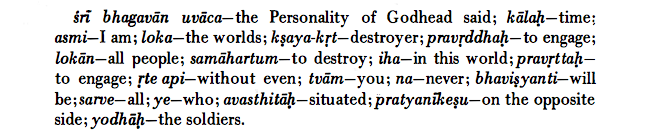
Why has Jayadvaita Swami exchanged the word “engage” with the word “destroy”? There is no explanation for this particular change on the BBTI’s website.
Sanskrit synonyms says to engage twice:
The so called original manuscript is missing for this part of the gita, so no claim can be made that this change is “closer to Prabhupada”. On the contrary it seems to be what Srila Prabhupada wanted, since he made no objections when he heard the text to verse 11.32:
Giriraja: (reads synonyms for following verse:) “Translation: The Blessed Lord said: Time I am, destroyer of the worlds, and I have come to engage all people. With the exception of you, the Pandavas, all the soldiers here on both sides will be slain.”
Dr. Patel: Shall I read further, sir, or you want to comment?
Prabhupada: Yes. The process is going on. Although we have got so many plans to save, nobody can be saved. The destination, the bhutva bhutva praliyate [Bg. 8.19], that will go on. Simply vita-raga-bhaya-krodha man-maya mam upasritah [Bg. 4.10], they will be saved. Otherwise all finished.
We would like to hear from Jayadvaita Swami and the BBT International what the explanation for this change is?






 Arsa-Prayoga
You must be logged in to post a comment.