Example of a Bona Fide Change to Srila Prabhupada’s Bhagavad-gita As It Is

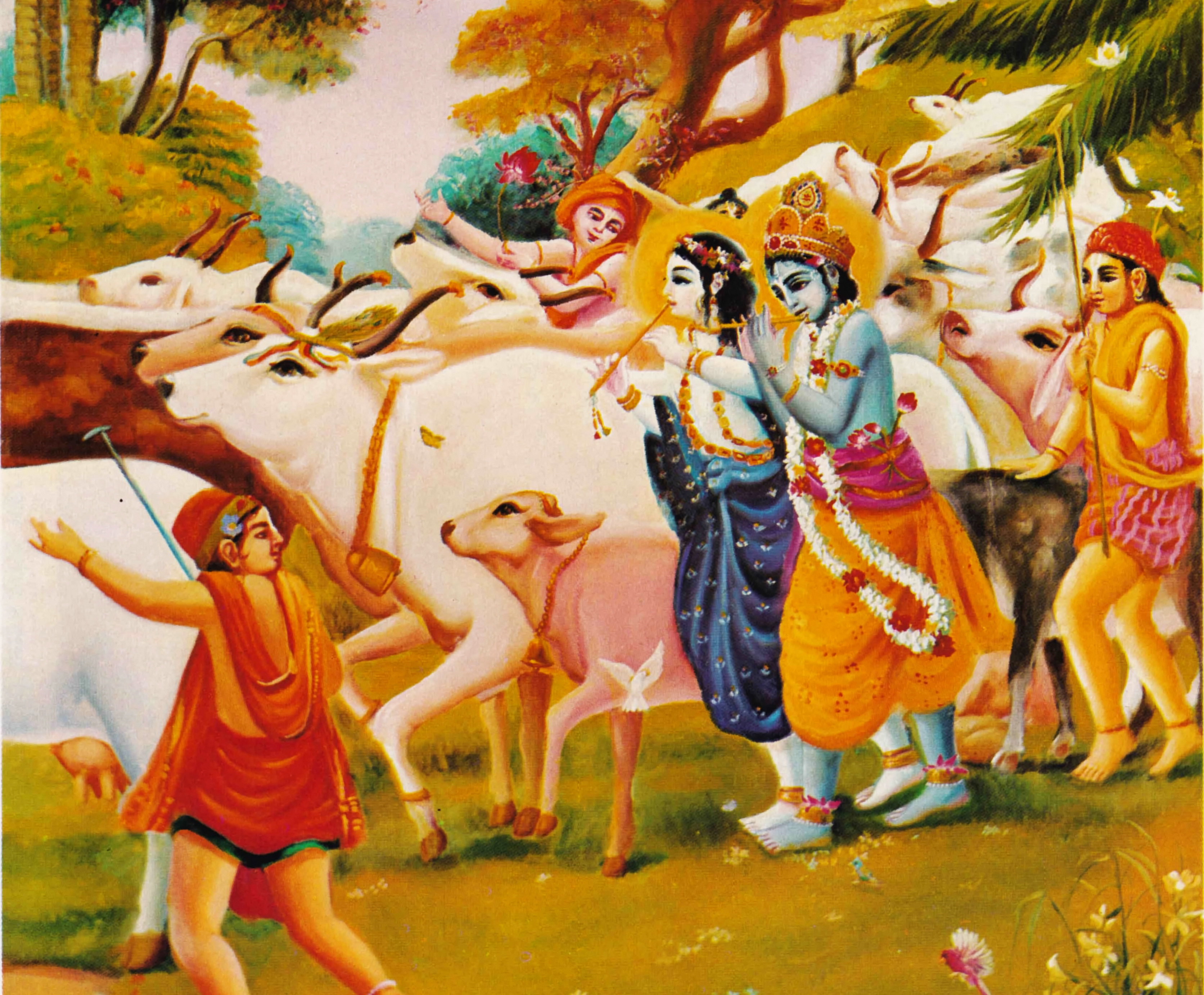
krishna-cows

This is how evidence for bona fide changes looks like:

Room Conversation with the Mayor of Evanston — July 4, 1975, Chicago:

Tamala Krsna: “Farming, cattle raising and business are the qualities…”
Prabhupada: They are not cattle raising, that was…
Tamala Krsna: Cow protection.
Prabhupada: Cow protection. It has to be corrected. It is go-raksya, go. They take it cattle-raising. I think Hayagriva has translated like this.

This change is – contrary to all the post-1977 changes – Prabhupada-approved. It first appeared in a 1976 reprint of the 1968 abridged edition of Bhagavad-gita As It Is.

DISAPPEARANCE OF ADVENT (BG. 4.8)

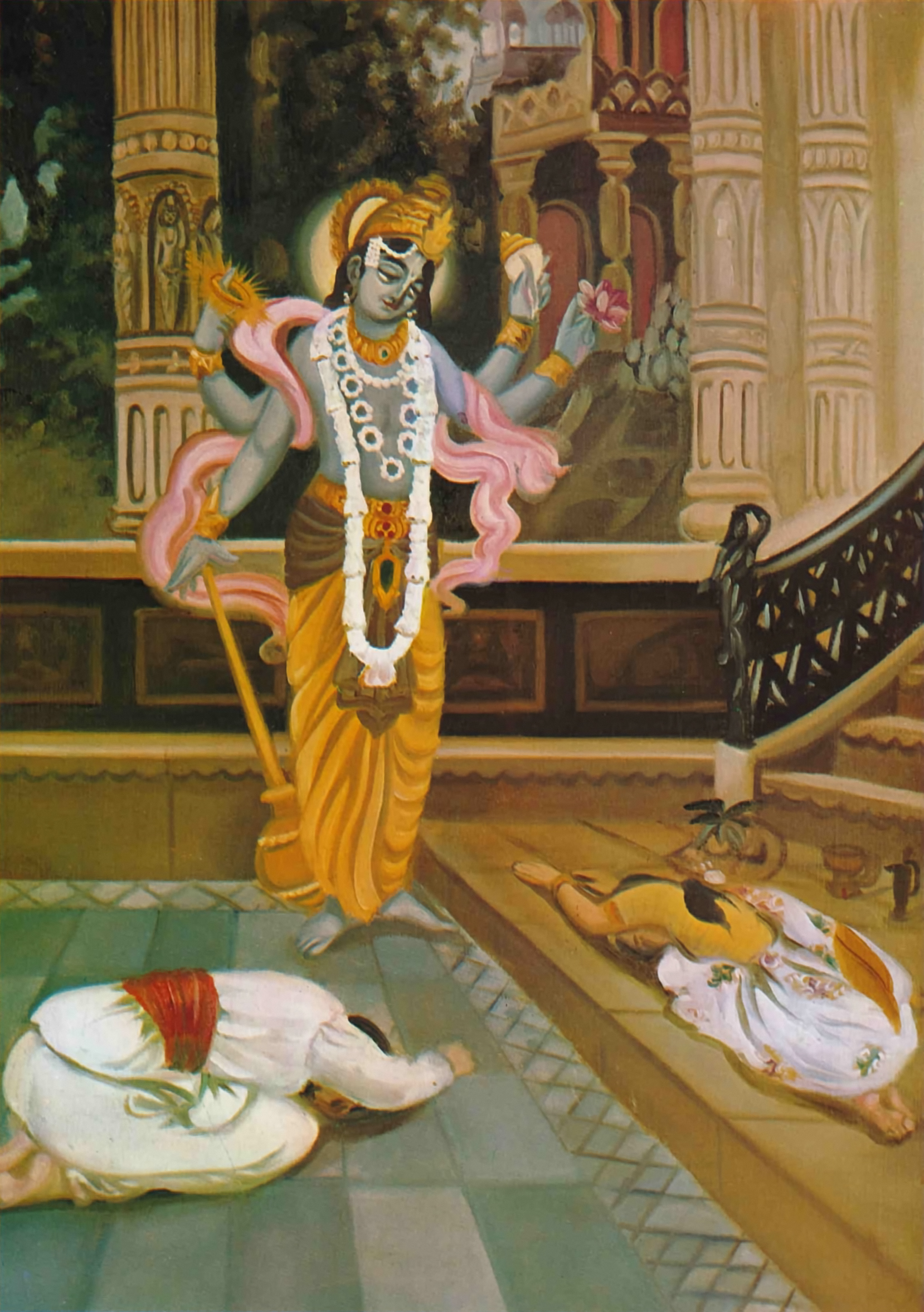
krishnas-appearance

Krishna’s appearance before Vasudava and Devaki

BY: BHAKTA TORBEN

Apr 26, 2015 — DENMARK (SUN) —

Bhagavad- gita As It Is, 4.8:

Original, authorized 1972 edition:

“In order to deliver the pious and to annihilate the miscreants, as well as to reestablish the principles of religion, I advent Myself millennium after millennium.”

Manuscript:

“In order to deliver the pious devotees, and to annihilate the miscreant non-devotees, as well as to re-establish the principles of religiosity, do I advent Myself millennium after millennium.”

JAS It Is:

“To deliver the pious and to annihilate the miscreants, as well as to reestablish the principles of religion, I Myself appear, millennium after millennium.”

_______

Additional evidence

The word “advent” is a real Prabhupada word. In his books, lectures, letters conversations etc. it appears around 200 times.

Srila Prabhupada even has the Bg. 4.8 verse read to him on a few occasions, and he does not object to its wording. Why would he, since it was his own chosen words!

Tamala Krishna: Eight: “In order to deliver the pious and to annihilate the miscreants, as well as to reestablish the principles of religion, I advent Myself millennium after millennium.”
Nine: “One who knows the transcendental nature of My appearance and activities does not upon leaving the body take his birth again in this material world, but attains My eternal abode, O Arjuna.”
Prabhupada: This is very nice. (Bhagavad-gita 4.7-10 — Los Angeles, January 6, 1969)

Nitai: (leads chanting of verse and synonyms) “In order to deliver the pious and to annihilate the miscreants, as well as to reestablish the principles of religion, I advent Myself millennium after millennium.”
Prabhupada:

paritranaya sadhunam
vinasaya ca duskrtam
dharma-samsthapanarthaya
sambhavami yuge yuge
[Bg. 4.8]

So the routine work of Krsna, the Supreme Personality of Godhead, how and when He appears. (Bhagavad-gita 4.8 — Bombay, March 28, 1974)

Srila Prabhupada using the word:

Prabhupada: He said that dharma-samsthapanarthaya sambhavami yuge yuge: “I advent to establish the principles of religion.” (Janmastami, Lord Sri Krsna’s Appearance Day Lecture — London, August 21, 1973)

Prabhupada: (chants mangalacarana prayers) His Excellency, the High Commissioner; ladies and gentlemen, I thank you very much for your coming here and participating in this ceremony, Janmastami, advent of Krsna. The subject matter I’ve been ordered to speak on is advent of Krsna. (Janmastami, Lord Sri Krsna’s Appearance Day Lecture — London, August 21, 1973)

Prabhupada: Sri Bhaktisiddhanta Sarasvati Gosvami Maharaja, my spiritual master, his advent day today. (Srila Bhaktisiddhanta Sarasvati Gosvami Prabhupada’s Appearance Day, Evening — Gorakhpur, February 15, 1971)

But I will suggest one thing — that you can organize a mass Sankirtana procession on the Advent Day of Lord Caitanya, 22 March, 1970 (Letter to Syamasundara — Los Angeles 21 February, 1970)

The Book Changes and Gitar Gan

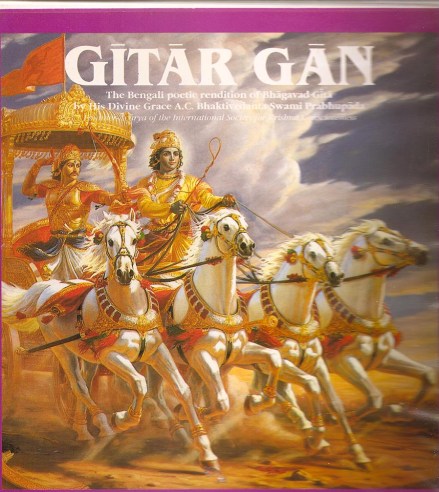
gitar-gan

The Non-Original Gitar Gan with the edited verses from the unauthorized 1983 Bhagavad-gita As It Is (I cannot find a picture of the original Gitar Gan)

By Ajit Krishna Dasa

The Gitar Gan is Srila Prabhupada’s poetic rendition of Srimad Bhagavad-gita in the Bengali language.

So far Gitar Gan has never been translated into English. Online we find a version with the original Bhagavad-gita verses added as a translations (here). On the Vedabase we find a version with BBTI’s edited verses added as translations (also available online). Both are without English word-for-word meanings.

Obviously, none of these are precise translations, since Srila Prabhupada’s Gitar Gan is a poetic rendition and not a literal translation of the Gita.

I would humbly like to submit that there is a GREAT need for a literal English translation of Gitar Gan.

Why?

Because it could be key in deepening our understanding of many of the controversial changes made to Srila Prabhupada’s Bhagavad-gita after his departure:

Bg 11.28:

Original and authorized 1972-edition:

“As the rivers flow into the sea, so all these great warriors enter Your blazing mouths and perish.”

BBT International’s edited 1983 edition:

“As the many waves of the rivers flow into the ocean, so do all these great warriors enter blazing into Your mouths.”

​Are the mouths blazing or are the warriors blazing? Gitar Gan seems to give us the answer:

jvalita tomara ei mukhe

jvalita-firing/flaming/blazing; tomara-your; ei-these; mukhe-mouth

jvalita: blazing (appears twice in the word-for-word synonyms in the Caitanya Caritamrta. Both times is it translated as “blazing”)
tomara: your (can be found 1000+ times in Caitanya Caritamrta).
ei: these (can be found 2000+ times in Caitanya Caritamrta).
mukhe: mouth/in the mouth/on the mouth/and more (found many times in Caitanya Caritamrta).

TRANSLATION: “Your blazing/firing/flaming mouths” (made with the help of several bengali speaking devotees found on facebook).

Anyone who does not agree with this translation, please give us your opinion.

Bg. 2.35​:

Is Arjuna a “coward” or is he “insignificant”?

Bg. 2.30:

Is the soul “eternal”?

Many such questions could be answered if we had an English translation of Gitar Gan.

IMPORTANT: I am not suggesting that we can change in the original Bhagavad-gita As It Is by referring to Gitar Gan. But we might be able to expose many of the needless and offensive changes made by Jayadvaita Swami.

An English translation of the Gitar Gan is therefore an urgent need.

I urge anyone who reads this to help find some qualified Bengali speaking devotees who can and will take up this important task.

Please contact me if you have idea ideas on how to procede with this project.

Your servant,
Ajit Krishna Dasa

“Enter Blazing” – Jayadvaita Swami Commits a Grammatical Error (Bg. 11.28)

universal-formThe Universal Form

Bhakta Torben Nielsen recently made me aware of this change to Bg. 11.28:

Original and authorized 1972-edition:

“As the rivers flow into the sea, so all these great warriors enter Your blazing mouths and perish.”

BBT International’s edited 1983 edition:

“As the many waves of the rivers flow into the ocean, so do all these great warriors enter blazing into Your mouths.”

So-called original manuscript:

There is no verse for 11.28 as the page is missing. But verse 30 mentions the words “blazing mouths”.

This is a very interesting change, because it is of a grammatical nature:

  • In Srila Prabhupada’s original 1972 edition the adjective “blazing” describes the plural noun “mouths”.
  • In BBT International’s 1983 edition the adjective “blazing” describes the plural noun “warriors”.

So which translation is grammatically correct – Srila Prabhupada’s or Jayadvaita Swami’s?

The context

Here we have the verses from Bg. 11.28-30 (original edition):

“As the rivers flow into the sea, so all these great warriors enter Your blazing mouths and perish.” (Bg. 11.28)

“I see all people rushing with full speed into Your mouths as moths dash into a blazing fire.” (Bg. 11.29)

“O Visnu, I see You devouring all people in Your flaming mouths and covering the universe with Your immeasurable rays. Scorching the worlds, You are manifest.” (Bg. 11.30)

We see that Srila Prabhupada describes the mouths of the universal form as “blazing” (Bg. 11.28) and “flaming” (Bg. 11.30), and compares them to a “blazing fire” (Bg. 11.29). There is no “original manuscript” available for Bg. 11.28-29, but the “original manuscript” for Bg. 11.30 also says “blazing mouths”, as mentioned above.

Screen Shot 2015-03-13 at 11.49.21

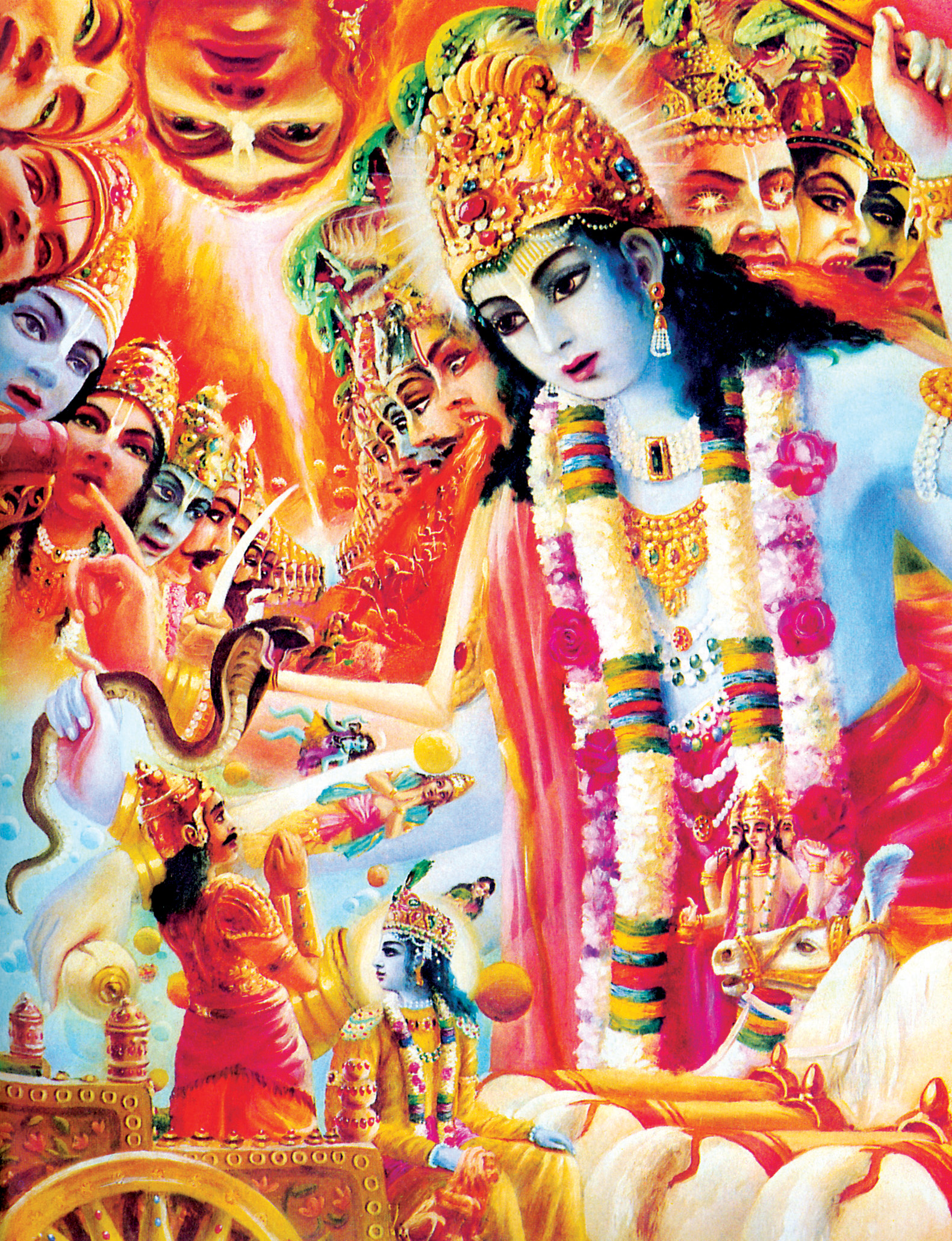
Plate 31

The painting above this article is Plate 31 from the Bhagavad-gita As It Is. Just like all other paintings in the book it was approved by Srila Prabhupada. On the painting we clearly see that the warriors are entering into the blazing mouths of The Universal Form – just like we are told that they are in the Bg. 11.28, 1972 edition.

Srila Prabhupada’s desire

Based on the above, there is no doubt at all that Srila Prabhupada wanted to use the adjective “blazing” to describe the mouths of the universal form. He never meant to say that the great warriors were “blazing”.

What does the previous acaryas say about Bg. 11.28? (as translated on bhagavad-gita.org)

Sridhara Swami’s commentary:

“As unlimited currents of water helplessly flow in innumerable rivers and are propelled from multiple channels into the ocean, the mighty warriors of the Kaurava and Pandava armies are seen to be helplessly propelled into the flaming, gnashing mouths of the visvarupa or divine universal form of Lord Krishna.” ()

Kesava Kasmiri’s commentary:

“How helplessly do the mighty warriors of the Kaurava and Pandava armies enter into the flaming mouths of Lord Krishna’s visvarupa or divine universal form? As helplessly as unlimited currents of water from innumerable rivers are propelled into entering the ocean.”

In his translations of Visvanath Cakravarti Thakura and Baladeva Vidyabhusana’s Bhagavad-gita commentaries Bhanu Swami also translates Bg. 11.28 as follows:

“As many swift currents of rivers flow towards the sea, so these heroes of the world enter Your flaming mouths.”

The sanskrit

Gaura Krishna Dasa, a student of sanskrit, sent me the following analysis of the sanskrit grammar:

Regarding the change in the translation of Bhagavad gita 11.28.

The word “abhivijvalanti” is in the 1972 edition taken as what in grammar is called a verbal adjective or a participle. A participle is basically a derivative from a verb but belonging in the group of adjectives. This particular participle is a participle in present tense, active voice for parasmaipada verbs. It is in neuter gender, plural number and in the accusative case which clearly indicates that it relates to “vaktraani” which is also in neuter gender, plural number and accusative case.

Sridhara Swami, Visvanath Cakravati Thakur and Baladeva Vidyabhusana have the same grammatical conclusion of this word as a participle and therefore in relation to “vaktraani” attributively, “blazing mouths”.

The “anti” ending in “abhivijvalanti” could preliminarily appear as a finite verb 3rd person in the plural number and present tense related to “nara-loka-viira” (the kings of human society), but this conclusion is in the least very strange. It would, if accepted, be a distortion of historical facts and it must be concluded faulty because this sentense already has a finite verb namely “visanti” meaning entering. So if we for the sake of example maintain “abhivijvalanti” as a finite verb, as it is done in the 1983 edition it would translate “as the many waves of the rivers flow into the ocean, so all these great warriors enter and blaze your mouth”, since “abhivijvalanti” can also not be taken as an adverb describing “visanti” attributively.

Conclusion:

“abhivijvalanti” must be taken as a participle – as done by the previous acaryas and the original 1972 edition – and not a verb as done in the 1983 edition.

Conclusion

The evidence against Jayadvaita Swami’s change is overwhelming:

1. Srila Prabhupada is very clear in his original Gita and his manuscripts – the mouths are blazing. Not the warriors.

2. Srila Prabhupada follows the previous acaryas who says that the mouths are blazing (flaming, gnashing).

3 The painting depicting this event (Plate 31 in the Bhagavad-gita As It Is) shows that it is the mouths of The Universal Form that are blazing.

4. According to sanskrit grammer it is the “mouths” that are “blazing”. Not the “warriors”.

Even if both translations could be correct (which they cannot), there would still be no justification – based on the above analysis – to change Srila Prabhupada’s translation of the verse.

It would not be possible to do this without overriding his own editorial decisions and thus violating the arsa-prayoga principle.

Please see additional evidence here.

Bhaktisiddhanta Sarasvati: “Consider only the spirit”

Bhaktisiddhanta Sarasvati Thakura Maharaja, Sree Sajjani-Toshani, The Harmonist, June 1927, No.1:

“The kind indulgence of the reader is solicited to overlook shortcomings inseparable from the employment of a foreign language and consider only the spirit irrespective of the defective garb in which she might be clothed”

the-harmonist

Performer Edit (Bg. 14.19)

BY: BHAKTA TORBEN

Apr 02, 2015 — DENMARK (SUN) —

Bhagavad-gita As It Is, 14.19:

Original, authorized 1972 edition:

“When you see that there is nothing beyond these modes of nature in all activities and that the Supreme Lord is transcendental to all these modes, then you can know My spiritual nature.”

Manuscript:

“When you see that there is nothing beyond these modes of Nature in all activities — and that the Supreme Lord is transcendental to this, then you can know My spiritual Nature.”

Screen Shot 2015-04-03 at 14.58.14

Jas It Is:

“When one properly sees that in all activities no other performer is at work than these modes of nature and he knows the Supreme Lord, who is transcendental to all these modes, he attains My spiritual nature.”

The Original and the manuscript agrees TO THE LETTER. Both the manuscript and the original says `You can know My spiritual nature´, whereas `Jas It Is´ says `he attains to My spiritual nature. The word-for-word says, ‘vetti’- know.

The phrase, ‘no other performer‘ is not found in the original or the manuscript.

Radhanath Swami on the book changes (leaked e-mail)

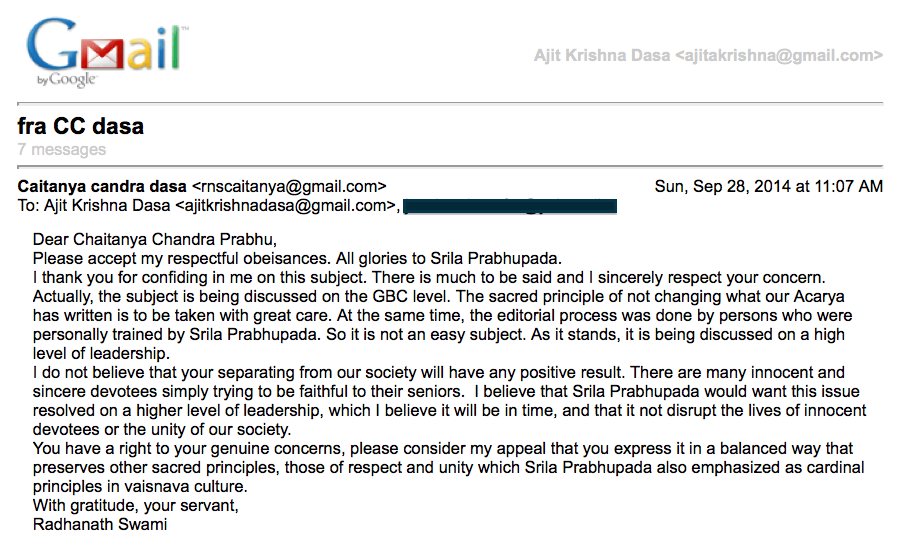
In September 2014 Radhanath Swami sent the below e-mail to one of his Danish disciples, Caitanya Candra Dasa:

Screen Shot 2015-03-29 at 10.03.33

Here is the text in digital format:

“Dear Chaitanya Chandra Prabhu,
Please accept my respectful obeisances. All glories to Srila Prabhupada.
I thank you for confiding in me on this subject. There is much to be said and I sincerely respect your concern. Actually, the subject is being discussed on the GBC level. The sacred principle of not changing what our Acarya has written is to be taken with great care. At the same time, the editorial process was done by persons who were personally trained by Srila Prabhupada. So it is not an easy subject. As it stands, it is being discussed on a high level of leadership.
I do not believe that your separating from our society will have any positive result. There are many innocent and sincere devotees simply trying to be faithful to their seniors. I believe that Srila Prabhupada would want this issue resolved on a higher level of leadership, which I believe it will be in time, and that it not disrupt the lives of innocent devotees or the unity of our society.
You have a right to your genuine concerns, please consider my appeal that you express it in a balanced way that preserves other sacred principles, those of respect and unity which Srila Prabhupada also emphasized as cardinal principles in vaisnava culture.
With gratitude, your servant, Radhanath Swami

An analysis:

We can see that Radhanath Swami is an intelligent diplomat.

RS: “I thank you for confiding in me on this subject.”

Radhanath Swami tries to maintain a relationship of trust. He makes it seem as if he appreciates Caitanya Candra Dasa’s questions, and invites him to open up his heart.

RS: “There is much to be said…”

This could make it seem as if Radhanath Swami has some special knowledge about the book changes, and as if it is a great mystery (secret knowledge) that requires deep and intense study, sadhana and special association to understand. But what Radhanath Swami is really saying, I guess, is that he does not know much about this matter, and that he is not going to speak much about it – neither to Caitanya Candra Dasa nor publicly.

RS: “…and I sincerely respect your concern.”

Radhanath Swami makes it seem as if he truly shares Caitanya Candra Dasa’s concerns. He speaks as if they are on the same side – that of genuine concern. But Radhanath Swami’s statement is trivial, for who does not care for Srila Prabhupada’s books? Everyone will say they care. Everyone will say that the editing should be done in a way that pleases Srila Prabhupada. But notice that Radhanath Swami does not disclose his own personal opinion. He really says nothing at all.

RS: “Actually, the subject is being discussed on the GBC level. The sacred principle of not changing what our Acarya has written is to be taken with great care. At the same time, the editorial process was done by persons who were personally trained by Srila Prabhupada. So it is not an easy subject. As it stands, it is being discussed on a high level of leadership.”

Here we again see Radhanath Swami’s diplomatic skills at work. He is indirectly saying that Caitanya Candra Dasa should not care much about it because it is being taken care of “on a high level of leadership”. Radhanath Swami says: “Do not worry! The GBC will handle it! Go back to sleep!”

But we all know what “a high level of leadership” in ISKCON means! It means incompetent devotees creating new problems while trying to solve already existing problems caused by themselves.

And what is the proof that the GBC are talking about this? It was not mentioned in the GBC resolutions of 2015. Maybe Radhanath Swami is misinformed or twisting the truth trying to buy time. Or maybe there is really a committee of around 3 members who are all pro-change who speaks about the book changes 2 hours per year trying to figure out how to close the mouths of the protesters.

Why should we accept Radhanath Swami’s “assurance” that the GBC is handling this issue? For all we know he could be lying. He presents no proof.

Radhanath Swami tries to balance things out by acknowledging that it is important not to change the words of our Acarya. But at the same time, he says, we should remember that those who did the changes were personally trained by Srila Prabhupada. Radhanath Swami uses the same diplomatic skills as Duryodhana on the battlefield first glorifying Drona and then Bhisma. He is saying to Caitanya Candra Dasa: “You are good, and they are also good! Therefore it is all very complicated and can only be solved at GBC level! Please go back to sleep!”

RS: “So it is not an easy subject.”

It really does not take much of a brain to see that Jayadvaita Swami and BBTI have violated the arsa-prayoga big time. But either Radhanath Swami will not write this online, or he is in denial or simply does not know much about what has been done to Srila Prabhupada’s books.

What we do know is that he is diplomatic, and that he is not going to risk his own prestige and position by speaking about the book changes online or publicly.

Factually, by his silence Radhanath Swami is accepting the changes made to Srila Prabhupada’s books by the BBTI, and by encouraging his disciples to also stay silent, he is also encouraging them to accept the changes.

RS: “There are many innocent and sincere devotees simply trying to be faithful to their seniors. I believe that Srila Prabhupada would want this issue resolved on a higher level of leadership, which I believe it will be in time, and that it not disrupt the lives of innocent devotees or the unity of our society.”

Radhanath Swami seems to have failed to understand that the so-called “higher level of leadership” in ISKCON has had more that 30 years to resolve this very simple issue. But they have continuously made the situation worse. Instead of stopping all editing while investigating the matter thoroughly they have allowed BBTI to continue editing many of Srila Prabhupada’s books.

We have absolutely no reason to believe or trust that the BBTI or GBC are capable of solving this issue on their own. And since they will not listen we have to challenge them to answer publicly. There is no other way. It is their own fault that this subject is being debated publicly.

And to claim that it is dangerous for new devotees to hear of such controversial topic is simply foolish. Our first concern in spiritual life is to make sure that the scriptures we read are bona fide. This is ABC and all new devotees are taught this in the temples, and it is written in all of Srila Prabhupada’s small introductory books. So if there is any doubt about the authenticity of the books, then all devotees need to know.

The funny thing is that we know for sure that the original books are bona fide and have the power to deliver us. But we are not sure if the changed editions have that potency. As a guru Radhanath Swami ought to have at least the amount of intelligence to understand that we must stop printing the changed books until we know for sure which editions are bona fide. Better safe than sorry.

But Radhanath Swami has never stepped forward to ask the BBTI to stop their editing while the matter is being investigated.

Instead Radhanath Swami suggests that we leave this crucial matter to incompetent “high level leaders”, while we sleep our way back to Godhead. Are these foolish instructions on the book changes really coming from a bona fide spiritual master?

RS: “You have a right to your genuine concerns, please consider my appeal that you express it in a balanced way that preserves other sacred principles, those of respect and unity which Srila Prabhupada also emphasized as cardinal principles in vaisnava culture.

With gratitude, your servant, Radhanath Swami”

Radhanath Swami tries to close the correspondence in a mood of friendship. He has said something and at the same time nothing. Radhanath Swami prefers that Caitanya Candra Dasa keeps quiet about this matter and leaves it to the “high level leaders”. At the same time Radhanath Swami knows that Caitanya Candra Dasa might not want to keep his mouth shut, so he implores him to speak in a balanced way if he speaks about it.

At no point did Radhanath Swami state his own opinion about the book changes, and he did not help Caitanya Candra Dasa understand this most important issue. If Radhanath Swami really was a bona fide guru, then he should easily be able and willing to clear the doubts of his disciples on this matter. But it seems he cannot do that. Or maybe he choses to let his disciples stay in the darkness of ignorance in order not to get himself into trouble.

This is not how a guru works. A guru is not a diplomat. A guru is straight forward. A guru want to help his disciples. He wants to save them from ignorance and the offences of violating the arsa-prayoga principle.

Some of our local ISKCON authorities in Denmark have tried to impress upon the Danish devotees that Caitanya Candra Dasa is violating his guru’s instructions by speaking about the book changes. But we can see this is false. Radhanath Swami says that Caitanya Candra Dasa has the right to be concerned about the book changes, and he does not prohibit Caitanya Candra Dasa from speaking publicly about the book changes – for whatever reason.

RASH EDIT (Bg. 11.41-42)

BY: BHAKTA TORBEN

arjuna-prayers

Mar 11, 2015 — DENMARK (SUN) —

Bhagavad-gita As It Is, 11.41-42 

Original authorized 1972 edition:

“I have in the past addressed You as “O Krsna,” “O Yadava,” “O my friend,” without knowing Your glories. Please forgive whatever I may have done in madness or in love. I have dishonored You many times while relaxing or while lying on the same bed or eating together, sometimes alone and sometimes in front of many friends. Please excuse me for all my offenses.”

JAS It Is:

“Thinking of You as my friend, I have rashly addressed You “O Kṛṣṇa,” “O Yādava,” “O my friend,” not knowing Your glories. Please forgive whatever I may have done in madness or in love. I have dishonored You many times, jesting as we relaxed, lay on the same bed, or sat or ate together, sometimes alone and sometimes in front of many friends. O infallible one, please excuse me for all those offenses.”

Manuscript: 

“I have addressed You, O Krishna, O Yadava, O my Friend, without knowing Your Glories. Please forgive whatever I have so done, in madness or in love.” I have dishonored You many times while in relaxation, while lying on the same bed or eating together, sometimes alone, and sometimes in front of many other friends. Please excuse me for all the many offenses I have committed against You.”

The sentence ‘Thinking of You as my friend‘, the words ‘rashly ‘and ‘jesting‘ have been added in spite of these not being mentioned in either the original or the manuscript.

The Holy Name Will Destroy the Book Changers

caitanya-bhagavata

CAITANYA BHAGAVATA, ADI 11.105-110:

TEXT 105

prabhu bole, — “bhakta-vakya krsnera varnana
ihate ye dosa dekhe, se-i ‘papi’ jana

TRANSLATION

“The Lord replied, “Whoever finds fault in a devotee’s description of Lord Krsna is a sinful person.”

TEXT 106

bhaktera kavitva ye-te-mate kene naya
sarvatha krsnera priti tahate niscaya

TRANSLATION

“Krsna is certainly pleased with His devotee’s poetry, even though it is imperfectly composed.”

TEXT 107

murkha bole ‘visnaya’, ‘visnave’ bole dhira
dui vakya parigraha kare krsna vira

TRANSLATION

“An uneducated person may chant visnaya, while a sober person will chant the proper form, visnave, but the Supreme Lord Krsna will accept both forms when they are chanted with devotion.”

COMMENTARY

“To Lord Krishna, a pandita expert in correct language and someone ignorant of correct language are both equal. Of the two, Krishna bestows more mercy on the one who has more enthusiasm for the service of Krishna. Krishna, the omniscient Supersoul of every living entity, is not guilty of the fault of partiality. So-called learned persons who are devoid of devotion proudly consider themselves learned as they reveal their foolishness by pointing out faults in the transcendental language of the pure devotees. The Supreme Lord and master of Sarasvati confirms the foolishness of the so-called learned offenders who are envious of the devotees at every step. Thus their pride of learning is diminished. Due to the absence of realization in the Absolute Truth, Shri Krishna Chaitanya, they belch forth mundane knowledge of sense enjoyment. This is the cause of their disease and falldown.”

TEXT 108

murkho vadati visnaya dhiro vadati visnave
ubhayos tu samam punyam bhava-grahi janardanah

TRANSLATION

“At the time of offering obeisances to Lord Visnu, a foolish person chants visnaya namah (this is improper due to faulty grammar) and a learned person chants visnave namah (this is the correct form). But both achieve equal piety by their offering of obeisances, because Lord Sri Janardana sees the sentiment of the living being, in other words, He sees the degree of devotion, or in other words, He awards the result accordingly (He does not see one’s foolishness or intelligence).”

TEXT 109

ihate ye dosa dekhe, tahara se dosa
bhaktera varnana-matra krsnera santosa

TRANSLATION

“One who finds fault with a devotee is himself at fault, for a devotee’s descriptions are meant only for the pleasure of Krsna.”

TEXT 110

ataeva tomara se premera varnana
ihate dusibeka kon sahasika jana?”

TRANSLATION

“Therefore who will dare find fault with your devotional descriptions of Krsna’s pastimes?”

CAITANYA BHAGAVATA, MADHYA, 19.209:

ye amara dasera sakrt ninda kare
mora nama kalpa-taru samhare tahare

“My wish-fulfilling holy names destroy one who blasphemes My servant.”

FROM THE COMMENTARY:

“So if gross materialists engage with pride in activities like censuring, blaspheming, and abusing the devotees from the material point of view and through mundane considerations, then the Supreme Lord destroys them.”

Note the word “censuring”. When BBT International deletes Srila Prabhupada own chosen words and sentences, then they are in effect censuring Srila Prabhupada.

(The purports are by Srila Bhaktisiddhanta Sarasvati Thakura Maharaja, translated by Bhumipati Dasa)

BBTI FORCED TO THEIR KNEES

Due to intense pressure from tens of thousands of devotees worldwide the BBTI have been forced – against their will – to again print the original edition of Srila Prabhupada’s Bhagavad-gita As It Is.

Screen Shot 2015-02-13 at 11.26.48

http://www.dandavats.com/?p=15528

But why support the BBTI, when they use the money to destroy Srila Prabhupada’s books?

Also, the original edition from BBTI is not as good quality as the one sold from Krishna Books Inc.

My recommendation: Buy your original books from http://www.krishnastore.com or any other shop that sells the original books as printed by Krishna Books Inc. (KBI).