A very “insignificant” change (Bg. 2.35)

Help us by “liking” and “sharing” this post!

From “the original manuscript”:

Skærmbillede 2013-10-10 kl. 11.42.42

From the original, approved and authorized 1972 edition of Bhagavad-gita As It Is:

Skærmbillede 2013-10-10 kl. 12.49.59

BBT International’s 1983 edition of Bhagavad-gita As It Is:

“The great generals who have highly esteemed your name and fame will think that you have left the battlefield out of fear only, and thus they will consider you insignificant.” (Bg. 2.35)

Prabhupada and his editor, Hayagriva Prabhu, worked together on the “original manuscript” and the end result was “coward” instead of “fig”. But somehow the BBT International decided to replace “coward” with “insignificant”.

On the BBT International’s website we do not find any information about this change and why it was made. This is a significant point because Jayadvaita Swami have now published up through the 8th chapter what is claimed to be a detailed justification of all his changes. But somehow he has left this one out when going through the changes in the second chapter. Why?

In the word-for-word translation to Bg. 2.35 Prabhupada translates the word “laghavam” as “decreased in value”. But nowhere does Prabhupada translate “laghavam” as “insignificant”. When searching the Vedabase Folio we find nowhere in Prabhupada’s books, lectures, conversations, letters where he refers to Arjuna as being “insignificant” in the context of Bg. 2.35 – or any other context. So how is changing “coward” to “insignificant” going back to “the original manuscript”? And in which way is it “closer to Prabhupada”?

We also find that nowhere does Prabhupada use the word “fig” about Arjuna. But we do find plenty of places where he uses the word “coward” about Arjuna in relation to his decision not to fight, and we find lectures on Bg. 2.35 where Prabhupada didn’t object to the use of the word “coward”, and lectures where he actually reinforces the use of the word “coward” by repeating it:

Devotee: 35: “The great generals who have highly esteemed your name and fame will think that you have left the battlefield out of fear only, and thus they will consider you a coward [Bg. 2.35].” 36: “Your enemies will…”
Prabhupada: A ksatriya… It is the custom of the ksatriya that if they are wounded on the back side, he is considered a coward, but if he is wounded on the chest, he is accepted as real ksatriya. That means he has fought face to face. That is the injunction of military art in Vedic injunction. (Lecture on Bhagavad-gita 2.27-38, Los Angeles, December 11, 1968)

This particular lecture is from 1968. Prabhupada had at least three years to demand “coward” changed in the 1972 Complete Edition. He didn’t.

Pradyumna: (leads chanting, etc.)
Translation: “The great generals who have highly esteemed your name and fame will think that you have left the battlefield out of fear only, and thus they will consider you a coward.”
Prabhupada:
bhayad ranad uparatam
mamsyante tvam maha-rathah
yesam ca tvam bahu
bhutva yasyasi laghavam

…and Prabhupada continues the lecture without objecting to anything. (Bhagavad-gita 2.33-35, London, September 3, 1973)

Here are some other places where Prabhupada uses the word “coward” about Arjuna:

“When Arjuna wanted to become a nonviolent coward on the Battlefield of Kuruksetra, he was severely chastised by Lord Krsna.” (SB 1.9.26)

“So on the whole, Arjuna is illusioned — illusioned in the sense that he is forgetting his duty. He is a ksatriya, his duty is to fight; never mind the opposite party, even he is son, a ksatriya will not hesitate to kill his son even if he is inimical. Similarly, the son, if the father is inimical, he would not hesitate to kill his father. This is the stringent duty of the ksatriyas, no consideration. A ksatriya cannot consider like that. Therefore Krsna said, klaibyam: “You don’t be coward. Why you are becoming coward?” These topics are going on. Later on, Krsna will give him real spiritual instruction. This is… Ordinary talks are going on between the friend and the friend.” (Bhagavad-gita 2.4-5, London, August 5, 1973)

“My case is very serious. My duty is to fight, but I do not like to fight. Some affection, some family relationship, is deterring me to fight, making me coward. So therefore it is a very complex position. And I find that You can make a solution of this complex position. I therefore accept You as my spiritual master. And I fall down under Your lotus feet as Your disciple.” Sadhi mam prapannam. “I am surrendered. Now You kindly protect the surrendered soul.” (Bhagavad-gita 2.13, Hyderabad, November 19, 1972)

(See the Vedabase Folio for more examples)

Two arguments defeated

Some argue that “coward” and “insignificant” means practically the same in the context of Bg. 2.35, so what’s the deal? It is an insignificant change, they argue. But this makes the change needless, so why change? Jayadvaita Swami wrote:

“As you know, and as we kept in mind while doing the work, Srila Prabhupada staunchly opposed needless changes.” (Jayadvaita Swami’s Letter to Amogha Lila 1986)

Besides this obvious point the two words do not at all mean the same. The words “fig” and “coward” are both used in a derogatory meaning by Prabhupada whereas the word “insignificant” is much more neutral. Logically speaking a coward doesn’t need to be insignificant, and an insignificant person need not be a coward. So the two words can’t be synonymous.

I’ve heard a devotee claim that calling someone a “fig” is outdated, and that the BBT International decided to find a better word with a similar meaning. This is of course already defeated with the arguments against going back to the so called “original manuscript”, and the fact that “fig” and “insignificant” are far from synonymous. But additionally it would mean that the BBT International would have a double standard since they have kept the sentence “On the other hand, the forces of the Pandavas are limited, being protected by a less experienced general, Bhima, who is like a fig in the presence of Bhisma.” (Bg. 1.10 purport, the 1983 BBT International edition).

So is this really an “insignificant” change? You decide!

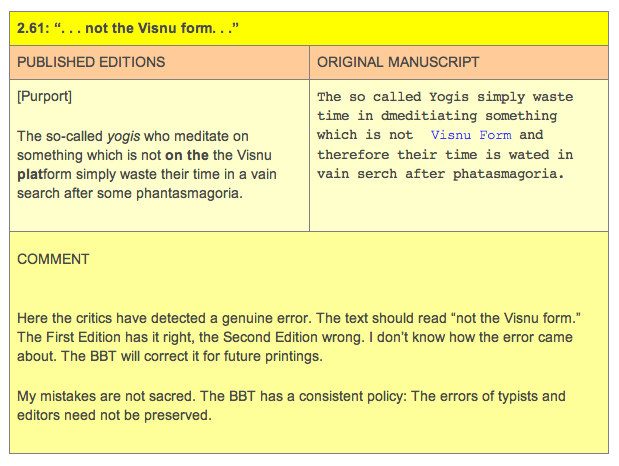
Jayadvaita Swami admits mistake in his editing (Bg. 2.61 purport)

Help us by “liking” and “sharing” this post

Bhagavad-gita 2.61 purport

The original manuscript (personally typed by Srila Prabhupada):

Skærmbillede 2013-10-09 kl. 12.14.48

The original, approved and authorized 1972 edition of Bhagavad-gita As It Is:

Skærmbillede 2013-10-09 kl. 12.23.19

Then something strange happens in the BBT Internationals 1983 edition:

“The Yoga sutra also prescribes meditation on Visnu, and not meditation on the void. The so-called yogis who meditate on something which is not on the Visnu platform simply waste their time in a vain search after some phantasmagoria. We have to be Krsna conscious…” (Bg. 2.61 purport)

As we can see BBT International has changed “Visnu form” to “Visnu platform”. This change has no basis in the so called original manuscript. Jayadvaita Swami admits on the BBT International website that he made a mistake here:

Skærmbillede 2013-10-09 kl. 10.36.49

Jayadvaita Swami writes here that he doesn’t know how the error came about. But in a Youtube video from the same website he says something else:

From the video:

“My impression was that we had that from an original manuscript. I couldn’t find the original manuscript. And the manuscripts that we have say platform, so I said “Alright, platform.” But must have been our mistake.”

So all of a sudden Jayadvaita Swami remembers what happened: a real good story of several “manuscripts”, and the real original manuscript missing.

So we have different manuscripts, and we have Jayadvaita Swami changing on the basis of his “impressions” (clearly not a recognized source of knowledge and clearly not the standard method used by editors). Jayadvaita Swami thinks that if we are missing what he has told the world is the “original manuscript”, then we just take one of the other available manuscripts, and if we happen to make a mistake, then we just reverse it next time. What is the problem?

Is this the way we to honor sacred books and help them stay authoritative in the eyes of the people of the world?

From the video:

“If someone find mistakes in our work and the work done later – reverse it! It is not sacred. It is not that Hayagriva’s mistakes were sacred and mine, mine aren’t – or my mistakes, or his mistake weren’t sacred and mine are…”

So Jayadvaita Swami is fallible, and he is able to admit his mistake in regard to “Visnu platform”. But why, then, will he not admit all the other mistakes he has made? Devotees have been documenting his mistakes for years, but he will not admit them. Why?

In the last part of the video Jayadvaita Swami says that we should apply a principle of being “as close to Prabhupada as possible.” And this is true. But what is closest to Prabhupada – is it his many earlier drafts or the final book he himself completed together with his editors and which he approved, published, called the “Complete Edition” and “Definitive Edition” and read, lectured from and distributed for years without asking for more than 2-3 mistakes corrected?

Why will Jayadvaita Swami not admit that his biggest mistake is that he bases his editing on the mistaken idea that we can change the final, approved book back to its earlier drafts (of which there are many)?

And why will he not admit that it is logically impossible to correct ALL mistakes in Prabhupada’s books without violating the arsa-prayoga principle of not correcting the acarya? A principle Prabhupada demanded that we follow.

Being close to Prabhupada can be done by honoring the arsa-prayoga principle and accepting Prabhupada’s book as he accepted them himself.

Which Danish cover is proper? (Reply to Dravinaksa Dasa)

Help us by “liking” and “sharing” this post

Skærmbillede 2013-10-01 kl. 10.05.00New Danish Bhagavad-gita cover – proper or not?

Dear Dravinaksa Prabhu! Dandavat pranam! Jaya Srila Prabhupada!

Thank you for your thoughtful reply (New Danish Bhagavad-gita Cover is Proper) to my text (New Danish Bhagavad-gita As It Is cover is against Prabhupada’s instructions) on the Sampradaya Sun.

As long as the BBT International insists on publishing their changed 1983 edition of Prabhupada’s Bhagavad-gita As It Is they must certainly start following the academic accepted protocol for posthumously edited books (mention of editor’s name, what was edited and when). In such a scenario another cover than the one appearing on Prabhupada’s original and authorized 1972 edition is certainly proper.

But as long as the BBT International publishes their unauthorized, edited Bhagavad-gita As It Is with Prabhupada’s signature as if he approved of it, but don’t write the names of the editors, what was edited and when, then the changed cover constitues another unauthorized change that ought to be exposed.

All glories to Srila Prabhupada,
Ajit Krishna Dasa

Definitely Not Back to “the original manuscript”

Help us by “liking” and “sharing” this post

Hand with scissors cutting book

By Krishna Dasa (Originally posted on the Sampradaya Sun)

Recently Ajit Krsna dasa posted an interesting article showing how the BBT replaced the word “owner” with “knower” in the translation to Bhagavad-gita 13.3. He pointed out that this change was not closer to the manuscript. Further examination reveals that this is just the tip of the iceberg. Four times in the purport to this verse the word “owner” has been replaced with “knower”. On all four occasions the manuscript reads “owner”. So the old edition and the manuscript are in agreement, and the new edition is different.

The same change has been made in the translation to Bhagavad-gita 13.35.

1972 edition:

“One who knowingly sees this difference between the body and the owner of the body and can understand the process of liberation from this bondage, also attains to the supreme goal.”

New edition:

“Those who see with eyes of knowledge the difference between the body and theknower of the body, and can also understand the process of liberation from bondage in material nature, attain to the supreme goal.”

Once again the manuscript reads “owner” and not “knower”, so it supports the old edition. Furthermore, in the word-for-word translations to Bg 13.35, Srila Prabhupada translates “ksetrajnayoh” as “of the proprietor of the body”. “Proprietor” is synonymous with “owner”, which is further reason not to change “owner” to “knower”. It was clearly Srila Prabhupada’s choice of words.

Surely when the 1972 edition and the manuscript are in agreement there is NO reason to make changes. Perhaps the BBT prefers to translate “ksetra-jna” as “knower of the body” instead of “owner of the body” because the Sanskrit word “jna” means “knower”. But we don’t want the BBT’s extra input, we want transparency. Generally the BBT justify changes by saying they are closer to the “original manuscript”. In this case however that is not the case.

Govinda dasi and Jayadvaita Swami in Honolulu on Jan 19, 2003 (Part 2)

Help us by “liking” and “sharing” this post

(Originally posted on adi-vani.org. Part 2 of 2. Read Part 1 here)

hawaii-govinda-dasi

Govinda dasi: …that in 1966, ’67 and ’68, Hayagriva spent many, many hours alone with Srila Prabhupada, discussing the different aspects of the editing work. They went over each verse extensively, and Srila Prabhupada was actually quite clear in expressing what he wanted. He, even in the case of legal matters, or something else that he might not know how things worked, he knew what he wanted. So he had an uncanny ability to see through any situation. That’s an understatement, and I’m putting that so that people can appreciate it.

So, when the later Gita was edited, the manuscript had already been gone over, how many times? We don’t really know, I don’t really believe, I mean, joined after Hayagriva. I joined in Frisco as soon as Srila Prabhupada came to Frisco, and then I went back to LA with him. I think, Javadvaita Maharaja, didn’t you say you joined in Boston in…

Jayadvaita Maharaja: New York.

Continue reading

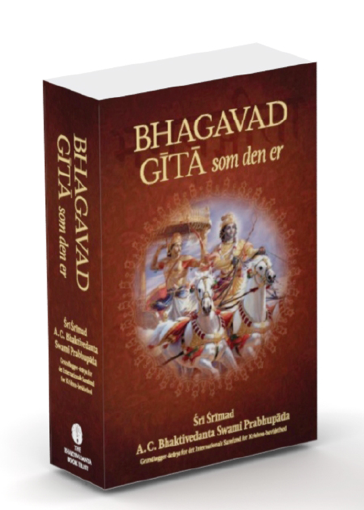
New Danish Bhagavad-gita As It Is cover against Prabhupada’s instructions

Help us by “liking” and “sharing” this post!

Recently the leading Danish editors (Lalitanath Dasa and Jahnudvipa Dasa/Jahnu Dasa) working for BBT International were made aware of this quote:

Prabhupada:

“And the covers, if possible, should always be the same for each respective book regardless of what language it may be printed in.” (Letter to Jadurani, Bombay, January 3, 1975)

Here is the cover for Prabhupada’s original 1972 edition of his Bhagavad-gita As It Is:

Bhagavad-gita_As_It_Is-original_1972_Macmillan-cover

Prabhupada liked this cover so much that he wanted the Deities of Gita-nagari should be “Krishna and Arjuna, exactly as on the cover of the Bhagavad-gita.”:

Srila Prabhupada began to sow the seeds of inspiration in directing the future development of Gita-nagari farming community.  Prabhupada confirmed today that the presiding Deity should be Krsna and Arjuna, exactly as on the cover of the Bhagavad-gita. (Tamal Krishna Goswami’s Diary, Prabhupada’s Final Days, August 30)
I
Through their online magazine the Danish BBT(I) editors recently informed the Danish congregation that their new translation of the unauthorized BBT International 1983 Bhagavad-gita are to be published late November 2013. Despite being aware of the above desire and instruction from Srila Prabhupada the editors apparently decided to create their own, new cover–quite different from the original:

Skærmbillede 2013-10-01 kl. 10.05.00

Prabhupada:

“Service means you must take order from the master. That is service. Otherwise it is mental concoction. Actually, the servant requests, “How can I serve you?” So when the master orders, “You serve me like this,” then you do that, that is service. And if you manufacture your service, that is not service. That is your sense gratification. Yasya prasādād bhagavat-prasādaḥ. You have to see how he is pleased. Now if he wants a glass of water and if you bring a nice glass of milk, you can say milk is better than water, you take it. That is not service. He wants water, you give him water. Don’t manufacture better thing.” (Lecture, Bhagavad-gita 15.15, August 5, 1976, New Mayapur (French farm))

Who’s counting? 541 verses changed

Help us by “liking” and “sharing” this post!

By Krishna Kripa Devi Dasi (ACBSP) (Originally posted on adi-vani.org.)

bg_not_equal

Original and authorized 1972 edition versus the unauthorized, changed 1983 edition

See the table below for the number changed in each chapter.

How many Bhagavad-gita As It Is verses were changed in the 1983 revised edition?  Over three-fourths of them, 77% or 541 verses were changed out of 700 total.

Srila Prabhupada’s 1972 Bhagavad-gita As It Is, published by Macmillan Company, was compared with the BBT revision, first published in 1983.  Only the verses were examined.

In 21 verses (3%), only the spelling, punctuation or capitalization was changed, and the words were left intact.  In 520 verses (74%), words were removed, rearranged, or inserted.  In Chapter 17,  93% of the verses were changed.  See the table below for the number changed in each chapter.

Bhagavad-gita As It Is Verses Changed in the BBT 1983 Revised Edition

Chapters 1 – 18:  541 verses out of 700 = 77% changed

Number of Verses Changed Per Chapter

Ch 1:   35 out of 46 = 76% changed;

Ch 2:   49 out of 72 = 68% changed;

Ch 3:   33 out of 43 = 77% changed;

Ch 4:   23 out of 42 = 55% changed;

Ch 5:   19 out of 29 = 66% changed;

Ch 6:   43 out of 47 = 91% changed;

Ch 7:   22 out of 30 = 73% changed;

Ch 8:   21 out of 28 = 75% changed;

Ch 9:   24 out of 34 = 71% changed;

Ch 10:  36 out of 42 = 86% changed;

Ch 11:  50 out of 55 = 91% changed;

Ch 12:  16 out of 20 = 80% changed;

Ch 13:  24 out of 35 = 69% changed;

Ch 14:  24 out of 27 = 89% changed;

Ch 15:  15 out of 20 = 75% changed;

Ch 16:  20 out of 24 = 83% changed;

Ch 17:  26 out of 28 = 93% changed;

Ch 18:  61 out of 78 = 78% changed

Not back to “the original manuscript” (BG 13.3)

Help us by “liking” and “sharing” this post!

This article was sent to the BBT International the 15th Oct. 2013. We asked them to comment on the points raised. So far we have not received any reply.

Bhagavad-gita As It Is (13.3)

The original manuscript:

bg-original-manuscript-13.3

The authorized and approved 1972 edition:

bg-original-1972-13.3

The translation from the 1972 edition was approved by Prabhupada, and we see how it follows the draft (the so called original manuscript) very nicely. But then something strange happens in the BBT International’s 1983 edition:

The BBT International’s 1983 edition:

bg-1983-edition-13.3

We can see that the BBT International have changed the word “owner” to “knower” in the second line. Why? Searching the BBT International’s website and the internet we have found no information on why this change was made.

Questions to the BBT International:

Before you changed Prabhupada’s Bhagavad-gita As It Is verse 13.3…

  • Did you know that Prabhupada approved the galley proofs / the blueprint of the Bhagavad-gita As It Is, and according to Brahmananda Das (at that time swami) Prabhupada read the complete galley proofs before approving them to be sent to MacMillan to be used for printing what became the original and authorized 1972 edition of Bhagavad-gita As It Is?
  • Did you know that Prabhupada lectured many times on BG 13.3, and that he did not object to the word “owner” in the translation? Did you know he actually reconfirmed the word “owner” by using it in these lectures?

Pusta Krsna:

ksetra-jnam capi mam viddhi
sarva-ksetresu bharata
ksetra-ksetrajnayor jnanam
yat taj jnanam matam mama

Translation: “O scion of Bharata, you should understand that I am also the knower in all bodies, and to understand this body and its owner is called knowledge. That is My opinion.”

Prabhupada: That is greatness. This is the distinction. God is great. I know about my body, you know about your body, but God knows about your body and my body and his body and every… That is greatness. (Evening Darsana — July 6, 1976, Washington, D.C.)

Hari-sauri:

ksetra-jnam capi mam viddhi
sarva-ksetresu bharata
ksetra-ksetrajnayor jnanam
yat taj jnanam matam mama
[Bg. 13.3]

Prabhupada: Ksetra-ksetrajnayor jnanam yat taj jnanam matam mama. English?

Hari-sauri: “O scion of Bharata, you should understand that I am also the knower in all bodies, and to understand this body and its owner is called knowledge. That is My opinion.”

Prabhupada: First of all knowledge means ksetra-ksetrajna. The body is the field of activity. You are acting, I am also acting, everyone is acting — according to the body. But the actor is called ksetrajna. Just like a cultivator is tilling the land, his own, and the tiller is cultivator. Similarly, this body is an analogy of this field, and we are tilling. So Krsna says that “I am also one of the tillers.” Just like the tenant and the landlord. In an apartment house, the tenant is occupier of a certain house, certain apartment, but the landlord is the owner of the whole house. So God says “I am also ksetrajna — but for all the buildings.” Everything that is there, all planets, all, everywhere. That is His all-pervasiveness. I am the proprietor of this body, owner of this body, but God is proprietor of all the bodies. In this way that is explained.” (Room Conversation with George Gullen, President of Wayne State University — June 15, 1976, Detroit)

“So people are taking this, that “I am this body.” That is ignorance. If they know, if one knows that “I am not this body; I am proprietor of this body, I’ll have to work with this body for my future,” then that is knowledge. Etad yo vetti ksetra-jna, knower, one who knows. That is the beginning of knowledge. Then Krsna says,

ksetra-jnam capi mam viddhi
sarva-ksetresu bharata
ksetra-ksetra-jnayor jnanam
yat taj jnanam matam mama
[Bg. 13.3]

Krsna is giving His opinion, the Supreme Authority, that “If you want to know, if you want to be in knowledge, this is knowledge.” What is that? “That this body, you are not this body; you are the owner of the body. And you should know also that the there is another person. As you are a person, you are owner of this body, there is another person.” Who is that? “That is I am.” Krsna says. Ksetra-jnam capi mam viddhi: “I am also owner of this body.” Actually Krsna is the owner of the body. Just like in a, in an apartment, there is the occupier and the landlord…Similarly, Krsna is the real owner of this body because Krsna has given me this body just to occupy it and work. So far. Not that I am the actual proprietor of this body.” (As the body is our field for cultivating Krsna conscious ness, so the land is our field for cultivating food…Vedic civilization means every man should produce his own food. More precise reference to be added soon)

Devotee: “O scion of Bharata, you should also understand that I am also the knower in all bodies and to understand this body and its owner is called knowledge. That is my opinion.”

Prabhupada: So Arjuna inquired from Krsna six things: ksetra, ksetrajna, prakrti, purusa, jnanam, jneyam. What is knowledge and what is the object of knowledge. (Bhagavad-gita 13.3 — Paris, August 11, 1973)

Nitai: Translation: “O scion of Bharata, you should understand that I am also the knower in all bodies, and to understand this body and its owner is called knowledge. That is My opinion.”

Prabhupada:

ksetra-jnam capi mam viddhi
sarva-ksetresu bharata
ksetra-ksetra-jnayor jnanam
yat taj jnanam matam mama
[Bg. 13.3]

Jnanam, knowledge. The Supreme Personality of Godhead Krsna is explaining about knowledge. People are being educated all over the world for advancement of knowledge. Knowledge is meant for the human being, not for the cats and dogs. Therefore, for human being, there are so many universities, schools, colleges, institutions, laws. There are so many things (indistinct) to advance knowledge is to understand “Who am I?” If I do not know who am I, then what is the meaning of my advancement of knowledge? Generally, despite so many universities all over the world, people are going on in the concept of this body, “I am this body.” “I am Indian,” “I am American,” “I am Hindu,” “I am Muslim.” So everyone is identifying himself with this material body. Then where is the advancement of knowledge? Here Krsna says, ksetra-ksetra-jnayor jnanam yad jnanam, taj jnanam matam mama. The ksetra, this body, and the owner of the body… I am not this body, I am the owner of this body. This is jnanam. (Bhagavad-gita 13.3 — Hyderabad, April 19, 1974)

  • Did you know that Prabhupada used the words “knower”, “owner”, “occupier” and “proprietor” many times for both the soul and Krishna? And many times when referring specifically to BG 13.3? And did you know that Prabhupada often translated ksetra-jna as both the “knower of the body”, “owner of the body”, “possessor of the body” and “proprietor of the body”?

“But there is another living being. He is supreme living being, Krsna. He says that “I know everything of everyone’s body.” Ksetra-jnam capi mam viddhi sarva-ksetresu bharata [Bg. 13.3]. This is the verse. Ksetra-jna means the knower of the body. You are individual knower of your body; I am knower individually of my body.” (Lecture at Boys’ School — Sydney, May 12, 1971)

“In Bhagavad-gita it is said, ksetra-jnam capi mam viddhi sarva-ksetresu bharata [Bg. 13.3]. Everything is there. The ksetra-jna means the possessor of this ksetra, body, the owner or occupier.” (Bhagavad-gita 7.3 — London, March 11, 1975)

The ksetra jna, the owner of the body, is also called the khaga, the living entity. Within the body there are two such ksetra jnas — the individual soul and the Supersoul. The individual soul is the owner of his individual body, but the Supersoul is present within the bodies of all living entities.” (SB 10.2.27)

“In another place, Krsna says this dehi or ksetra-jna, the owner of the body is there, and there is another ksetra-jna, another owner. That is Krsna. Ksetra-jnam capi mam viddhi sarva-ksetresu bharata [Bg. 13.3]. As the individual soul is there within the body, similarly, the Supersoul, Krsna, is also there.” (Bhagavad-gita 2.30 — London, August 31, 1973)

“In another place also Krsna says ksetra-jnam capi mam viddhi sarva-ksetresu bharata [Bg. 13.3]. The question of the ksetra-jna, the owner of the body and the body. In this Chapter, in the Thirteenth Chapter, it is discussed. So in that chapter Krsna says that “I am also one of the owner of the body,…”” (Bhagavad-gita 9.3 — Toronto, June 20, 1976)

“In the Bhagavad-gita Krsna says, ksetrah ksetra-jnah. Ksetra-jnam capi mam viddhi sarva-ksetresu bharata [Bg. 13.3]. Ksetra-jna means the proprietor of the ksetra, this body. Body is called ksetra. So I am proprietor.” (Srimad-Bhagavatam 3.25.4 — Bombay, November 4, 1974)

(For more references please search the Vedabase/folio for these key words in relation to BG. 13.3. There are too many examples to include them all here).

The BBT International can’t justify this change from “owner” to “knower” in BG 13.3 by referring to the so called original manuscript, Prabhupada’s desires, to faulty sanskrit translation, to meaning, to spelling or to grammar.

Then how will they justify it?
A little learning is dangerous

Help us by “liking” and “sharing” this post!sp-pointing-finger

According to Satsvarupa Goswami in his Prabhupada Lilamrita Srila Prabhupada said arsha-prayoga establishing a no change policy:

But one day while sitting in the garden with Tamala Krsna, Svarupa Damodara, and others, Srila Prabhupada became very disturbed when he detected a mistake in one of his already printed books. Tamala Krsna was reading aloud a verse from the First Canto which began, “Munayah sadhu prsto ‘ham.” Srila Prabhupada had him read the synonyms.

Tamala Krsna read: “munayah-O sages; sadhu-this is relevant; prstah-questioned… ”

“Sadhu?” asked Srila Prabhupada. Thus he uncovered a thoughtless mistake made by the Sanskrit editors. Sadhu means “devotee,” not “this is relevant.” Srila Prabhupada became very angry and denounced the “rascal Sanskrit scholars.” “A little learning,” he said “is dangerous. Immediately they think they have become big scholar, thinking, “I shall arrange!’ And then they write all nonsense.” He continued speaking about the mistake for half an hour. He was disturbed. He ordered Tamala Krsna to write at once to the BBT and stop these speculations by his disciples-changing his books in the name of editing The devotees were startled to see Prabhupada so angry; he was supposed to be peacefully relishing a Srimad-Bhagavatam reading here in his garden. Such a change was very serious, he said, because it changed the meaning. “Even if the authorized acaryas would make a mistake,” he said, “it would not be changed. This is arsa-prayoga. In this way the acaryas are honored.” (Srila Prabhupada Lilamrita, chapter 52 “I Have Done My Part”)

Debate with Brahmananda Das (ACBSP) about the book changes

Help us by “liking” and “sharing” this post!
Srila-Prabhupada-speaks-to-Brahmananda-on-Juhu-Beach-Bombay-290x166
Prabhupada speaks with Brahmananda
—–
The following exchange between Brahmananda Das (ACBSP) and myself took place on the Facebook profile of Palaka Dasa. I have deleted comments not related to the specific exchange between Brahmananda Prabhu and myself.

In ’72 Gita in every Text for the Sanskrit words “sri bhagavan uvaca” the Synonym is “The Supreme Personality of Godhead Said” but the Translation is “The Blessed Lord Said.” Why are the Synonym and the Translation for the same Sanskrit completely different? I think I know the answer to this but does Palaka Dasa and Ajit Krishna Dasa know?

Dear Brahmananda Prabhu! Dandavat pranam! Jaya Srila Prabhupada!

The ultimate reason it is there is because Prabhupada approved it. He and Hayagriva worked on the BG before it was printed in 68. After that Prabhupada gave lectures from it and read it. And in a conversation he approved that the verses as they were in the 68 edition could be used for the 72 edition also.Another thing is that Prabhupada would often give one word in the word-for-word and another in the translation. That is often seen in his books. That is his prerogative as author. And it gives us the possibility to see both words.

All for now,
Your humble servant,
Ajit Krishna Dasa

Here is the place where Prabhupada approves of the verses from the 68 edition being used also for the 72 edition.

Prabhupada had all the chances in the world to change “The blessed Lord” to “The Supreme Personality of Godhead”, but he didn’t. Then on what authority can we change it?

Hayagriva: I would like to see that in going over mine. I’ll have to go over it chapter by chapter. But I will compare the version I have with that version, and… I know the translations themselves, they were somewhat changed in Bhagavad-gītā As It Is as it came out in Macmillan. Did you like those translations?
Prabhupāda: Whichever is better, you think. That’s all. You can follow this Macmillan.
Hayagrīva: That was the second… They’re good. I think they’re very good.
Prabhupāda: Yes. You can follow that translation. Simply synonyms he can add, transliterations.
Hayagrīva: And we have all the purports. We can include everything. Nothing will be deleted. Everything will be in there.
Prabhupāda: That’s all right.
(Discussion with BTG Staff, December 24, 1969, Boston)

 Brahmananda Das

BTW it was not Hayagriva who was the main editor of BG; it was Rayarama, who edited BG for two periods of time. I personally took the ms. away from H. and gave it to R. on SP’s order when H. went into maya. Till this day I still recall H.’s brutal words against SP when he wanted to crack our faith in SP. “The incident of Kirtanananda and Hayagriva chapter may now be closed. We shall always pray to Krishna for their recovery and we should not seriously take their counter propaganda. I am sure they will flap for some time without any effect on our Krishna Consciousness, service. Let us go ahead with our work and everything will be all right. Most important thing at present is to deal with MacMillan Co. Regarding editing of my books it was rightly entrusted to you from the very beginning but Kirtanananda wanted that the editing should be done by Hayagriva. But I understand from your version that in some places of Gita Upanisad he (Hayagriva) has followed Swami Nikilananda who is quite unaware of Krishna Consciousness. By their present behavior it appears that Hayagriva belongs to the same feather and Krishna has saved His Gita Upanisad by transferring the whole thing into your hands. Now please do your best and hand it over to MacMillan Co. for necessary action.” SPL to Rayarama 67/11/15

 Ajit Krishna Dasa

Dear Brahmananda Prabhu! Thanks for your answer.

I think the real question is not who was the main editor behind Prabhupada’s Bhagavad-gita As It Is or what the editors said or did. The main thing is Prabhupada’s relationship to his Bhagavad-gita As It Is. We find no information, as far as I can judge, in your statements or quotes that can be used as sufficient or necessary evidence to support any posthumous changes in Prabhupada’s books. It would be nice if you could point out precisely what you think is the necessary or sufficient evidence, so that we can all see and evaluate it. You said in your first comment that you had some special knowledge about how “The Blessed Lord” came to be in the translations. Maybe you can tell us about it?

Your humble servant,
Ajit Krishna Dasa

End of exchange