To “engage” or “destroy” (Bg 11.32)

Help us by “liking” and “sharing” this post!

The text below was sent to the BBT International through their website (http://www.bbtedit.com/contact) and to Jayadvaita Swami and Dravida Prabhu’s personal e-mails (jswami@pamho.net, jayadvaita.swami@pamho.net, dravida108@gmail.com) the 7th Feb. 2014. We asked them to comment on the points raised.

So far we have not received any reply.

Original and authorized 1972 Macmillan edition:

“Time I am, Destroyer of the worlds, and I have come to engage all people…”

Unauthorized 1983 edition:

“Time I am, Destroyer of the worlds, and I have come here to destroy all people…”

Why has Jayadvaita Swami exchanged the word “engage” with the word “destroy”? There is no explanation for this particular change on the BBTI’s website.

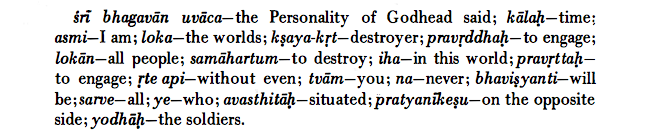
Sanskrit synonyms says to engage twice:

Screenshot 2014-02-01 12.10.43

The so called original manuscript is missing for this part of the gita, so no claim can be made that this change is “closer to Prabhupada”. On the contrary it seems to be what Srila Prabhupada wanted, since he made no objections when he heard the text to verse 11.32:

Giriraja: (reads synonyms for following verse:) “Translation: The Blessed Lord said: Time I am, destroyer of the worlds, and I have come to engage all people. With the exception of you, the Pandavas, all the soldiers here on both sides will be slain.”

Dr. Patel: Shall I read further, sir, or you want to comment?

Prabhupada: Yes. The process is going on. Although we have got so many plans to save, nobody can be saved. The destination, the bhutva bhutva praliyate [Bg. 8.19], that will go on. Simply vita-raga-bhaya-krodha man-maya mam upasritah [Bg. 4.10], they will be saved. Otherwise all finished.

We would like to hear from Jayadvaita Swami and the BBT International what the explanation for this change is?

Krishna Book Changes NOT “closer to Prabhupada”!

Help us by “liking” and “sharing” this post!

Screenshot 2014-01-24 17.07.00

Madhudvisa Prabhu has gifted us with a complete list of the changes made to Srila Prabhupada’s Krishna Book:

“The following links, one for each of the chapters in Srila Prabhupada’s “Krsna, The Supreme Personality of Godhead“, will take you to a computer generated analysis of the changes which have been made by BBT to the book.

The comparison is made between Prabhupada’s Original 1970 Krsna Book as it appeared in the Bhaktivedanta Archives Vedabase 2003 in the “Early Editions of BBT / ISKCON Press Books” section and the Krsna Book that appears in the current 2013 version of the Vedabase.”

Find the complete list of changes to the Krishna Book here.

On his website (www.bookchanges.com) he also has an article examining many of the changes made to the Krishna Book:

BBT Krsna Book Changes Analysis

The conclusion of the analysis dispels one of the most widespread myths propagated very actively by Jayadvaita Swami and the BBT International, namely that their new editions are “closer to Prabhupada”. This is not true:

“We can see that in the revision way more text has been modified NOT according to the tape recording than according to the tape recording. The system of revision is not at all understandable and seem to depend rather on the weather than on any definable principles. Every sane man would consider the revision a step back.” (Read the complete analysis here)

Changes to Prabhupada’s personally typewritten sanskrit translations (statistics for BG, Chapter One)

Help us by liking and sharing this post!

Skærmbillede 2013-12-09 kl. 22.03.15

The text below was sent to the BBT International through their website (http://www.bbtedit.com/contact) and to Jayadvaita Swami and Dravida Prabhu’s personal e-mails (jswami@pamho.net, jayadvaita.swami@pamho.net, dravida108@gmail.com) the 7th Feb. 2014. We asked them to comment on the points raised.

So far we have not received any reply. 

Some time ago (12.09.13) we presented the article “Tampering with Prabhupada’s personally typewritten sanskrit translations (BG, Chapter One)“. In that article we presented ALL changes made by the BBT International to the sanskrit synonyms for the first chapter of Bhagavad-gita As It Is. There are around 127 of these changes in the first chapter alone (if you count all changes made to one sanskrit word as only one change).

Here we are presenting some statistics by dividing the changes into different categories.

Some statistics

We have categorized the changes presented in the below PDF-file, so it is easier to see what was actually done by the BBT International.  It must be noted that some changes fall into more than one category.

There are also some subtleties in the way the categorization has been done. For example, Prabhupada used a regular typewriter and was therefore not able to write the diacritic marks. So if the diacritic marks are missing in Srila Prabhupada’s draft, but they are added in the 1972 Macmillan edition that is not counted as a change.

Srila Prabhupada started all sanskrit synonyms with capital letters in the draft. In the both the 1972 and 1983 editions they were not written with capital letters. This has not been counted amongst the changes.

Other things not counted as a change is when Srila Prabhupada, while writing his draft, obviously hit a wrong letter on his keyboard. An example of this would be “bcpmes” instead of the correct “becomes”. “O” and “p” are just besides each other on a keyboard.

I did my very best, and I tried to be as kind as I could to BBT International, but I encourage everyone to double check my work and get back to me if they think anything could have been done better.

This is how we did it:

Modifications 1: Spelling mistakes, commas, punctuation marks, dividing or connecting sanskrit words and their synonyms:

Result: 23 (17.03%)

It should be noted that no changes that had to do with spelling, commas and punctuation marks were found. Therefore all changes here have to do with dividing and/or connecting sanskrit words.

Modifications 2: Modifications according to Srila Prabhupada’s draft while the original edition does not follow Srila Prabhupada’s draft:

Result: 6 (4.44%)

Here is should be noted that four of these six changes have to do only with connecting and dividing sanskrit words. All four are similar to this (left: draft, middle: 1972 edition, right: 1983 edition):

Screenshot 2014-01-21 11.38.42The other two changes back to the draft were actual changes of English translation, though minor.

Modifications 3: Modifications not according to Srila Prabhupada’s draft while the original edition also does not follow Srila Prabhupada’s draft.

Result: 15 (11.11%)

Modifications 4: Modifications not according to Srila Prabhupada’s draft while the original edition follows Srila Prabhupada’s draft.

Result: 89 (65.92%)

Modifications 5: Modification where the word was missing from Srila Prabhupada’s draft.

Result: 2 (1.48%)

Here is the PDF with all changes for BG, Chapter One.

Responding to Dravida Prabhu’s “defense” of the book changes (Jan. 2014)

Help us by “liking” and “sharing” this post!

dravidaDravida Prabhu

By Ajit Krishna Dasa

This a a response to Dravida Prabhu’s article “The Book Changes – A Defense” (posted on the Sampradaya Sun (01.13.2014).

Basically Dravida Prabhu’s attempted defense boils down to two wellknown fallacious arguments often presented by the BBT International:

1. Prabhupada trusted Jayadvaita Swami pre Nov 14th 1977. Therefore the editing Jayadvaita Swami has done after Prabhupada’s disappearance (post Nov. 14th 1977) is also approved.

2. The books are made “closer to Prabhupada” by making them closer to the so called original manuscript (which is really only a draft).

Let us look at each of these fallacious arguments.

Continue reading

BBTI has deleted the complete foreword of Prabhupada’s Bhagavad-gita As It Is

Help us by “liking” and “sharing” this post!

The text below was sent to the BBT International through their website (http://www.bbtedit.com/contact) and to Jayadvaita Swami and Dravida Prabhu’s personal e-mails (jswami@pamho.net, jayadvaita.swami@pamho.net, dravida108@gmail.com) the 7th Feb. 2014. We asked them to comment on the points raised.

So far we have not received any reply.

Excerpt from a letter called “Please Explain, Jayadvaita Swami, Dravida Prabhu & Company” originally posted on the Sampradaya Sun.

“BY: A GROUP OF SRILA PRABHUPADA DISCIPLES & FOLLOWERS

Dear Jayadvaita Swami, Dravida Prabhu & Company, please explain why you have done the following:

(1) Why is it in the revised edition of the Bhagavad-gita, you and company have completely removed the foreword by Professor Edward Dimock that was printed in the original Macmillan version of the Bhagavad-gita As It Is which Srila Prabhupada regularly read from?

Readers, please visit the website and see the video on YouTube of Srila Prabhupada lecturing on the Bhagavad-gita.

There, in the very immediate beginning (very first few minutes) of this video, you will find Srila Prabhupada praising the foreword by Professor Edward Dimock. This particular video clip is taken from one of the 19 Double layer DVD’s produced by Nrsimhananda Prabhu and his associates at ITV. It is the particular DVD named Bhagavad Gita as It Is, with Krishna and Arjuna on the chariot, and sky background, and is in the very first part, called “Introduction”.

Srila Prabhupada is reading the foreword himself, praising it, mentioning Edward Dimock’s name, and praising Edward Dimock for a particular comment that he had made, as follows:

“Swami Bhaktivedanta comments upon the Gita from this point of view, and that is legitimate. More than that, in this translation the Western reader has the unique opportunity of seeing how a Krsna devotee interprets his own texts”

Srila Prabhupada in the video explains this particular statement by Edward Dimock, on how a Krsna devotee interprets his own texts, by explaining that just as a family member only is qualified to give the best knowledge to others about his own family, similarly, only a Krsna devotee can properly explain to others about Krsna. Srila Prabhupada appreciates this particular point made by Edward Dimock in the video.

Thus, not only has Srila Prabhupada authorized this particular foreword in the Macmillan Bhagavad-gita, but had himself read, it, and praised certain points made by the person who wrote this foreword. Yet you, Jayadvaita Swami, Dravida Prabhu & Company, have the audacity to remove this foreword completely in your revised version. The proof of how you have offended your Spiritual Master is on public video record, as those who watch will sadly but easily be able to understand this particular deviation of yourselves in either revising or omitting your Spiritual Master’s works and words by using your fertile imaginations.”

[End of excerpt]

Below there are several instances where Prabhupada shows appreciation for the foreword by Edward Dimock. Please note that Prabhupada said that this foreword will “appeal to the scholarly class”. And we see here that Prabhupada in fact used the foreword to preach to professors, scholars, cardinals and journalists. As can be seen from the below quotes Prabhupada appreciated the foreword because it underscored some of his own points about this specific edition of the Bhagavad-gita, namely the As It Is version.

But the BBT International under the leadership of Jayadvaita Swami have now removed this foreword by Professor Dimock without ever explaining why. Certainly Prabhupada never asked for its removal.

Prabhupada: That’s all. So this Bhagavad-gita, at least, should be introduced in all colleges. And Professor Dimock has recommended. Just…
Professor: Well, it is quite widely read, the Bhagavad-gita.
Prabhupada: Eh?
Professor: The Bhagavad-gita is quite widely read.
Pradyumna: This is an introduction by Professor Dimock.
Professor: Yes, I’ve seen it. I read it. But it is quite widely read, you know. I mean the translations… (Room Conversation with Sanskrit Professor, Dr. Suneson — September 5, 1973, Stockholm)

Prabhupada: That has been written by Professor Dayal, Dimock, that “Sanskrit scholars should get good opportunity, and nobody, I think, will deny Swamiji’s scholarship.” He has said that. (Room Conversation — September 21, 1973, Bombay)

Bhagavan: There are many copies of Bhagavad-gita, but the unusual happening with this version is until this was presented, there was no devotee…
Prabhupada: Professor Dimock has said very nicely.
Monsignor Verrozano: Yes, we have also many translations. Yes.
Prabhupada: You have not brought by the fruit?
Nitai: Yes, Satsvarupa Maharaja did.
Monsignor Verrozano: We have here one translation of the commentary of Professor Zehner(?) from Oxford.
Prabhupada: Here is my foreword by Professor Dimock.
Yogesvara: This is a professor from Chicago University who wrote the foreword to this edition. He makes an interesting comment.
Prabhupada: You read, read it.
Dhananjaya: Yes.
Prabhupada: Professor Dimock’s.
Cardinal Pignedoli: It’s very strange and famous. That’s the gospel.
Prabhupada: Read it.
Dhananjaya: (reading) “Swami Bhaktivedanta comments upon the Gita from this point of view. And that is legitimate.”
Prabhupada: Yes. That is legitimate.
Dhananjaya: “More than that, in this translation the Western reader has the unique opportunity of seeing how a Krsna devotee interprets his own texts. It is a Vedic…”
Cardinal Pignedoli: Yes.
Prabhupada: A Krsna devotee interpreting on Krsna, and a nondevotee interpreting on Krsna. There is far difference. (Room Conversation with Catholic Cardinal and Secretary to the Pope — May 24, 1974, Rome)

The introduction by Mr. Dimock is nice and it will appeal to the scholarly class. (Letter to: Rupanuga — Sydney 4 April, 1972)

Krishna is the source of all human cultural contributions, and His book is the most widespread read all over the world. So if you can convince this education minister that this KC Movement is cultural. One big, big Professor Dimock has given in his introduction to my Bhagavad-gita As It Is that every college student should read this book. Syamasundara. can send you a copy of his statement if you require. So if in other colleges beyond India it is so recommended, why not in India. So the education minister must advise this books should be read. This will give us example for approaching central government. There are so many things to be done. (Letter to: Giriraja — Sydney 12 April, 1972)

Speculators cannot have definite knowledge. Therefore our Professor Dimmock has said, “Here is definite definition of Gita.” What is that? Just see. Then it is so. He has appreciated it. You cannot see, of the…
Devotee: They only put two lines of what he said in there. He says this…
Prabhupada: Yes. That is his word.
Devotee: Oh.
Prabhupada: Read it all.
Devotee: “Definitive English edition of Bhagavad-gita. By bringing us a new and living interpretation of the text already known to many, A.C. Bhaktivedanta Swami Prabhupada has increased our own understanding manyfold.”
Prabhupada: That is a definite, not vague, speculative. That is the difference between my translation and others. Therefore I have given the name “As It Is.” So we will be no spoke or speculation. As soon as you speculate, you are rejected. Therefore others are seeing some danger that “This Bhaktivedanta’s…, this Bhagavad-gita As It Is accepted, then where we are?” (George Wilhelm Friedrich Hegel)

Prabhupada: “Dimmock. He has given very good appreciation. And gradually it will be printed in other languages. German, French, Spanish, Denmark, Holland…” (Conversation with Dai Nippon — April 22, 1972, Tokyo)

Prabhupada: “Somehow or other.” This is science. “Somehow or other,” “maybe,” “perhaps.” This is their science. [break] …speculation. The whole Western countries, their all knowledge simply speculation. Nothing definite. [break] …Professor Dimmock has “Definitive…” What is that translation, or something like?
Harikesa: Definitive.
Prabhupada: Definitive, then translation of Bhagavad-gita, like that. [break] (Morning Walk — June 30, 1975, Denver)

Prabhupada: Yes, yes, yes. You just read one big professor’s remark here. You see?
Faill: Yes.
Prabhupada: Professor Dimmock of Chicago University.
Faill: “A new and living interpretation.” This is you, is it?
Prabhupada: This is…? Yes.
Faill: That’s you.
Prabhupada: Yes. If you read these books and write regular articles on the basis of my talk with you, it will be actually great benefit to the public. (Room Conversation with Bill Faill (reporter) — October 8, 1975, Durban)

Pusta Krsna: In the United States… These are many letters we have, just some of them, from different professors who are actually using Prabhupada’s books, professors from respectable universities such as Harvard, Yale, Duke. Professor Dimmock, who is the leading scholar of southeastern languages at the University of Chicago, he very much appreciates Prabhupada’s books.

Prabhupada: He has written one foreword.
Pusta Krsna: So these books are being accepted as the authority, at least in America and England, so far as studies of Indian culture are concerned, philosophy, sociology. And you can see the beautiful presentation. Each Sanskrit is there, transliteration so that anyone can chant, word-for-word Sanskrit to English translation, translation in English, and then the purport, a commentary.
Prof. Olivier: That’s right. This is a good edition. Good edition.
Pusta Krsna: Professor Dimmock, he says that there are many, many translations of Bhagavad-gita, and he says that “By bringing us a new and living interpretation of a text already known to many, A.C. Bhaktivedanta Swami Prabhupada has increased our understanding manyfold.” So although it’s been prevalent in America… I know that when I was studying Humanities in college in the University of Florida, Bhagavad-gita was required. And we read one edition, but it was very much limited. Until we come in contact with Bhagavad-gita As It Is, the understanding is very much limited. But it’s not a sectarian approach. It’s purely scientific and realistic. There are many such reviews.
Prof. Olivier: Well, this is a good letter. (Room Conversation with Professor Olivier — October 10, 1975, Durban)

Prabhupada: Therefore rascal. (laughter) Therefore rascal. We definitely know Krsna, the origin of everything. That is definite, not “It may be.” We don’t say “Krsna may be.” No. Definitely. Krsnas tu bhagavan svayam [SB 1.3.28]. Here is Bhagavan. Here is God. That is definite. Therefore our professor…
Hamsaduta: Svarupa Damodara?
Prabhupada: No, no. Who has written foreword to my Bhagavad-gita?
Harikesa: Dimmock.
Prabhupada: Dimmock. “Here is definitive…”
Hamsaduta: Version.
Nitai: “Definitive edition.”
Prabhupada: “Definitive edition.” That is the credit. Not “may be.” No “maybe,” sir. That is rascaldom. (Morning Walk — November 26, 1975, New Delhi)

Prabhupada: Dimmock said that “Here is the commentation who has practiced devotion in his life.” (Morning Walk — December 17, 1975, Bombay)

Frivolous Change of Chapter-heading

Help us by “liking” and “sharing” this post!

sp1

The text below was sent to the BBT International through their website (http://www.bbtedit.com/contact) and to Jayadvaita Swami and Dravida Prabhu’s personal e-mails (jswami@pamho.net, jayadvaita.swami@pamho.net, dravida108@gmail.com) the 7th Feb. 2014. We asked them to comment on the points raised.

So far we have not received any reply.

BY: BHAKTA TORBEN (re-posted from Sampradaya Sun)

Dec 20, 2013 — DENMARK (SUN) — The sixth chapter of Srila Prabhupada’s original Bhagavad-gita is called “SANKHYA-yoga”. And Prabhupada often spoke of the sixth chapter like that. Here are a few examples:

“That is the perfection of yoga. When Krsna has advised yoga practice, sankhya-yoga… You have Bhagavad-gita? There is -SANKHYA-yoga. You’ll find in the forty-seventh verse. This is the version.”
(Room Conversation – May 10, 1969, Columbus, Ohio)

“In the Sixth Chapter He has explained the SANKHYA-yoga system and the concluding portion of the sankhya-yoga system is:

yoginam api sarvesam
mad-gatenantar-atmana
sraddhavan bhajate yo mam
sa me yuktatamo matah”
(Bhagavad-gita 6.47 – Ahmedabad, December 12, 1972)

Prabhupada’s draft [so called original manuscript. This was personally typewritten by Srila Prabhupada]:

Skærmbillede 2013-12-20 kl. 10.17.55

“How can we sit down silently and do nothing? It is not possible. Therefore, after Sri Krsna outlined the SANKHYA-yoga system in the Sixth Chapter of Bhagavad-gita,…”
(Path of Perfection 1: Yoga as Action)

“…Thus end the Bhaktivedanta purports to the Fifth Chapter of the Srimad Bhagavad-gita on the subject of karma-yoga or acting in Krsna consciousness.”

Prabhupada: All right. Then we shall… SANKHYA-yoga shall I begin today or next day? This is a new chapter, we shall begin next day. (end)”
(Bhagavad-gita 5.26-29 – Los Angeles, February 12, 1969)

“That means one who is keeping always in Krsna consciousness, “abides in Me with great faith, worshiping Me in transcendental loving service is most intimately united with Me in yoga, and is the highest of all.” This is the prime instruction of this chapter, SANKHYA-yoga, that if you want to become perfect yogi of the highest platform, then keep yourself in Krsna consciousness and you become the first-class yogi.”
(Bhagavad-gita 6.46-47 — Los Angeles, February 21, 1969)

“That is also stated in the SANKHYA-Yoga chapter of Bhagavad-gita:

yoginam api sarvesam
mad-gatenantar-atmana
sraddhavan bhajate yo mam
sa me yuktatamo matah
[Bg. 6.47]

(Bhagavad-gita 7.1 – Calcutta, January 27, 1973)

BUT BUT BUT

Jayadvaita Swami changed Bhagavad-gita So-called As It Is, which says DHYANA-yoga for the sixth chapter IN SPITE of Srila Prabhupada calling it SANKHYA-yoga in many, many places.

Question arises: This seems such a NEEDLESS change. How dare one correct Srila Prabhupada on this one?

Your servant, no ill intended,

Bhakta Torben

Here we post many more examples where Prabhupada says that the sixth chapter of Bhagavad-gita As It Is deals with sankhya-yoga:

“So we have been discussing Bhagavad-gita. In Second Chapter, the Lord has very elaborately explained the constitutional position of the living entity, and the whole first portion of the Six Chapter. The Bhagavad-gita is divided into three portions. The first six chapter, the second six chapters and the third six chapters. Actually just like this book, there are two hard covers, and in the middle there is the substance, writing. So the first six chapters, they are just like two coverings. Karma-yoga and jnana-yoga. And the middle six chapters, well-protected, that is bhakti-yoga. So at the end of the first six chapters, Krsna concludes the yoga system. In the Sixth Chapter He has explained the sankhya-yoga system and the concluding portion of the sankhya-yoga system is:

yoginam api sarvesam
mad-gatenantar-atmana
sraddhavan bhajate yo mam
sa me yuktatamo matah”
[Bg. 6.47] >>> Ref. VedaBase => Bhagavad-gita 6.47 — Ahmedabad, December 12, 1972

“Thus end the Bhaktivedanta Purports to the Sixth Chapter of the Srimad-Bhagavad-gita in the matter of Sankhya-yoga Brahma-vidya.” >>> Ref. VedaBase => Bg 6.47

“Prabhupada: Hare Krsna. Sankhya-yoga is the astanga-yoga. This sitting posture and meditation, this is called sankhya-yoga.
(69/02/16 Los Angeles, Bhagavad-gita 6.13-15)

“Lord Caitanya’s teachings are identical to those given by Lord Kapila, the original propounder of sankhya-yoga, the sankhya system of philosophy. This authorized system of yoga recommends meditation on the transcendental form of the Lord. There is no question of meditating on something void or impersonal. One can meditate on the transcendental form of Lord Visnu even without practicing involved sitting postures. Such meditation is called perfect samadhi. This perfect samadhi is verified at the end of the Sixth Chapter of the Bhagavad-gita, where Lord Krsna says, “And of all yogis, the one with great faith who always abides in Me, thinks of Me within himself, and renders transcendental loving service to Me-he is the most intimately united with Me in yoga and is the highest of all. That is My opinion.”” (Bg. 6.47) >>> Ref. VedaBase => Cc. 1975-Preface

“It is our duty to act in Krsna consciousness because we are constitutionally parts and parcels of the Supreme. The parts of the body work for the satisfaction of the entire body, not for the individual parts. The goal is the satisfaction of the complete whole. Similarly, the living entity should act for the satisfaction of the supreme whole, the Supreme Personality of Godhead, and not for his own personal satisfaction. One who can do this is the perfect sannyasi and the perfect yogi. In the first verse of the Sixth Chapter of Bhagavad-gita, the chapter dealing with sankhya-yoga, Bhagavan Sri Krsna states,

anasritah karma-phalam
karyam karma karoti yah
sa sannyasi ca yogi ca
na niragnir na cakriyah

“One who is unattached to the fruits of his work and who works as he is obligated is in the renounced order of life, and he is the true mystic, not he who lights no fire and performs no work.”” >>> Ref. VedaBase => PoP 1: Yoga as Action

“Krsna Himself does not sit down idly. All His pastimes are filled with activity. When we go to the spiritual world, we will see that Krsna is always engaged in dancing, eating, and enjoying. He does not sit down to meditate. Is there any account of the gopis meditating? Did Caitanya Mahaprabhu sit down to meditate? No, He was always dancing and chanting Hare Krsna. The spirit soul is naturally active. How can we sit down silently and do nothing? It is not possible. Therefore, after Sri Krsna outlined the sankhya-yoga system in the Sixth Chapter of Bhagavad-gita, Arjuna frankly said,

yo ‘yam yogas tvaya proktah
samyena madhusudana
etasyaham na pasyami
cancalatvat sthitim sthiram

“O Madhusudana [Krsna], the system of yoga which You have summarized appears impractical and unendurable to me, for the mind is restless and unsteady.” (Bg. 6.33) Although Arjuna was highly elevated and was Krsna’s intimate friend, he immediately refused to take up this sankhya-yoga system.” >>> Ref. VedaBase => PoP 1: Yoga as Action

In this Sixth Chapter, in which the Lord speaks of the sankhya-yoga system, He states from the very beginning that one cannot become a yogi unless one renounces the desire for sense gratification.” >>> Ref. VedaBase => PoP 2: Mastering the Mind and Senses

In this Sixth Chapter of Bhagavad-gita, the system of sankhya-yoga, which is the meditational astanga-yoga system, is emphasized.” >>> Ref. VedaBase => PoP 4: Moderation in Yoga

“Here it is clearly stated that there are many types of yogis-astanga-yogis, hatha-yogis, jnana-yogis, karma-yogis, and bhakti-yogis — and that of all the yogis, “he who always abides in Me” is said to be the greatest of all. “In Me” means in Krsna; that is, the greatest yogi is always in Krsna consciousness. Such a yogi “abides in Me with great faith, worshiping Me in transcendental loving service, is most intimately united with Me in yoga, and is the highest of all.” This is the prime instruction of this Sixth Chapter on sankhya-yoga: if one wants to attain the highest platform of yoga, one must remain in Krsna consciousness.” >>> Ref. VedaBase => PoP 8: Failure and Success in Yoga

Devotee: “These preface perfection by devotional service which alone can award peace to the human being and is the highest goal of life. Thus end the Bhaktivedanta purports to the Fifth Chapter of the Srimad Bhagavad-gita on the subject of karma-yoga or acting in Krsna consciousness.”
Prabhupada: All right. Then we shall… Sankhya-yoga shall I begin today or next day? This is a new chapter, we shall begin next day. (end) >>> Ref. VedaBase => Bhagavad-gita 5.26-29 — Los Angeles, February 12, 1969

Prabhupada: Now, here it is clearly stated that of all yogis, there are different kinds of yogis. Astanga-yogi, hatha-yogi, jnana-yogi, karma-yogi, bhakti-yogi. So bhakti-yoga is the highest platform of yoga principles. So Krsna says here, “And of all yogis.” There are different kinds of yogis. “Of all yogis he who always abides in Me,” in Krsna. Me means Krsna says “in Me.” That means one who is keeping always in Krsna consciousness, “abides in Me with great faith, worshiping Me in transcendental loving service is most intimately united with Me in yoga, and is the highest of all.” This is the prime instruction of this chapter, Sankhya-yoga, that if you want to become perfect yogi of the highest platform, then keep yourself in Krsna consciousness and you become the first-class yogi. >>> Ref. VedaBase => Bhagavad-gita 6.46-47 — Los Angeles, February 21, 1969

“If you want to learn Krsna, if you want to know Krsna, then you have to take this process. Mayy asakta-manah partha yogam. And if you practice this yoga, krsna-yoga, or bhakti-yoga, then you become the topmost of all yogis. That is also stated in the Sankhya Yoga chapter of Bhagavad-gita:

yoginam api sarvesam
mad-gatenantar-atmana
sraddhavan bhajate yo mam
sa me yuktatamo matah”
[Bg. 6.47] >>> Ref. VedaBase => Bhagavad-gita 7.1 — Calcutta, January 27, 1973

“In Europe and America the yoga principle is very popular because they think by practice of yoga, they’ll have very good health and they can use their senses very nicely. That is yoga system. The fatty woman goes to the yoga class for reduce fat. That is yoga system. You see. Somebody is going to practice yoga system for making right the liver action. You see. Here is yoga: vasudeva-para yogah. That is… Krsna also says in the Yoga chapter, Sankhya-yoga chapter, Krsna says,

yoginam api sarvesam
mad-gatenantar-atmana
sraddhavan bhajate yo mam
sa me yuktatamo matah”
[Bg. 6.47] >>> Ref. VedaBase => Srimad-Bhagavatam 1.2.28-29 — Vrndavana, November 8, 1972

“These Krsna conscious persons, people, they are also yogis, bhakti-yogis. They are the best of the yogis. As we see in the Bhagavad-gita, in the chapter in which Sankhya yoga has been explained, the conclusion is, yoginam api sarvesam: [Bg. 6.47] “Of all the yogis…” Yoginam api sarvesam mad-gatenantar-atmana: “One who is thinking within himself about Me, Krsna,” mad-gaten… sraddhavan, “with faith and love,” bhajate mam, “engaged in My devotional service,” sa me yuktatamo matah, “he is the first-class yogi. He is the first-class yogi.” >>> Ref. VedaBase => Srimad-Bhagavatam 5.5.1 — London, August 30, 1971

“Of course, those who are too much engrossed with the bodily concept of life, they have been recommended to practice the hatha-yoga system. That is also mentioned in the Srimad-Bhagavad-gita. Just like you’ll find in the “Sankhya-yoga.” This Bhagavad-gita As It Is, as we have published, page number 153, there is a statement how one should practice this transcendental meditation. Verse number thirteen and fourteen, it is said, “One should hold one’s body, neck and head erect in a straight line.” >>> Ref. VedaBase => Northeastern University Lecture — Boston, April 30, 1969

“Prabhupada: Yoginam api sarvesam: “Of all the yogis…” Yoginam api sarvesam. That is the last verse of the yoga chapter, sankhya-yoga chapter. Yoginam… When Arjuna said that “This practice of astanga-yoga is not possible for me.” >>> Ref. VedaBase => Room Conversation — December 13, 1970, Indore

“Therefore it is conclusive that so called yoga followers are simply cheated and they are wasting their time. I have already explained these points in the Sankhya yoga chapter of the Bhagavad-gita As It Is, so you read them carefully and present it, point by point, in suitable occasions.” >>> Ref. VedaBase => Letter to: Satsvarupa — Hawaii 19 March, 1969
Prabhupada on Brahma-Samhita: It should be left as is!

Help us by “liking” and “sharing” this post!

Sri_Brahma-Samhita-cover

In Brahma Samhita by Bhaktisiddhanta Sarasvati Thakura, Introduction, page xvi (page 7 in the PDF):

“…As per Srila Prabhupada’s instructions regarding the publication of this volume, Bhaktisiddhanta Sarasvati’s somewhat technical and sometimes difficult prose has been left intact and virtually untouched. Fearing that any editorial (grammatical and stylistic) tampering with Bhaktisiddhanta’s text might result in inadvertant changes in meaning, Prabhupada asked that it be left as is, and the editors of this volume have complied with his wishes…”

Ramesvara Prabhu remembers regarding that same publication og Brahma Samhita:

“What about the incorrect grammar? “Prabhupada’s reply, “You cannot change one comma, not even a comma, not even a punctuation mark, that is the etiquette.” So that was just another one of those super heavy instructions that the etiquette in dealing with a great acarya’s books is that whatever he has done it’s eternal and it can never be changed. And I believe that all of this was part of Prabhupada’s training us . He wanted to train people who would be entrusted with his books.” (Ramesvara, Interview 1979)

The Brahma-Samhita was published with only very slight editing done:

  • Typographical errors was corrected.
  • Capitalization was standardized.
  • Sanskrit terms in devanagari script appearing within the English text was transliterated.
  • Already transliterated terms have been adjusted to international standards.
  • The original devanagari text was added for each verse. It was followed by roman transliteration, and then by a word-for-word translation into English (none of these appeared in the original edition).

This very limited editing of Brahma-Samhita were made under the instructions of our Sampradaya-Acarya, Srila Prabhupada, who is a pure unalloyed devotee of the Lord. No mistakes and no offenses would be made as long as he supervised and approved the work. In addition, the editors were honest and wrote in the introduction precisely what they did to the original work. The BBT International should also be honest by letting the readers know what they did to Prabhupada Bhagavad-gita As It Is. Something like this ought to be written:

Despite the fact that Srila Prabhupada educated us in the vedic principle of arsa-prayoga that state that the words of the acarya should not be corrected, we, the editor’s, have made extensive posthumous changes and corrections to Prabhupada’s personally typewritten sanskrit translations. We have also added completely new words, sentences and paragraphs and made re-arrangement of words and sentences. Original paintings and pictures have been removed and exchanged with new ones. We have also removed the foreword and changed the cover. All editing is done without the approval of the author. We can’t guarantee that our editing is free from mistakes, or that the author would be pleased with the editing.

Prabhupada’s instructions on front covers not honored

Help us by “liking” and “sharing” this post!

5528_100788686601936_7223238_n

The text below was sent to the BBT International through their website (http://www.bbtedit.com/contact) and to Jayadvaita Swami and Dravida Prabhu’s personal e-mails (jswami@pamho.net, jayadvaita.swami@pamho.net, dravida108@gmail.com) the 7th Feb. 2014. We asked them to comment on the points raised.

So far we have not received any reply.

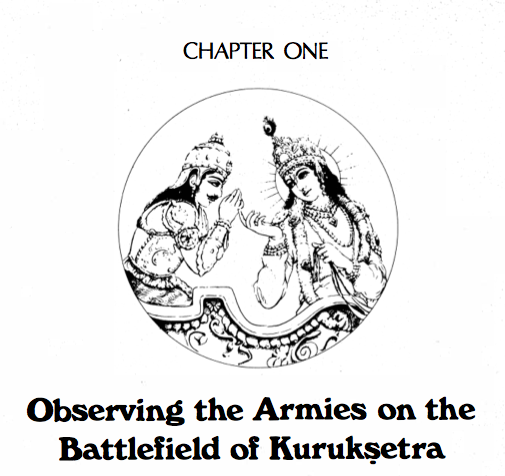
Here we see, in the background, the painting Prabhupada chose for the front cover of his Bhagavad-gita As It Is (standing yet unframed on the floor).

He was very happy about that painting, and he wished that Deities precisely resembling Krishna and Arjuna on the painting be made for the alter on the Gita-Nagari farm.

“Srila Prabhupada began to sow the seeds of inspiration in directing the future development of Gita-nagari farming community.  Prabhupada confirmed today that the presiding Deity should be Krsna and Arjuna, exactly as on the cover of the Bhagavad-gita.” (Tamal Krishna Goswami’s Diary, Prabhupada’s Final Days, August 30)

He also desired that the pictures on he covers on his books should remain the same on all their respective translations into other languages. This wish has, unfortunately, never been honored.

Prabhupada:

“And the covers, if possible, should always be the same for each respective book regardless of what language it may be printed in.” (Letter to Jadurani, Bombay, January 3, 1975)

An unfortunate local example of an unauthorized cover can be read in the links below:

DANISH BHAGAVAD-GITA AS IT IS COVER AGAINST PRABHUPADA’S INSTRUCTIONS

DANISH BBT INTERNATIONAL EDITORS COVERS THE GREATNESS OF BHAGAVAD-GITA AND PRABHUPADA

Jayadvaita Swami: There are warts on Prabhupada’s books

Help us by “liking” and “sharing” this post!

Parasurama_leading_kirtan_in_OsloParasurama Prabhu leading kirtan

Reposted from the Sampradaya Sun:

Warts on Books

BY: PARASURAM DAS

Dec 15, 2013 — UK (SUN) — Are there warts on Srila Prabhupada’s books, or are there no warts? (Warts on Books, Part 4b, 4.28) A difference of opinion (difference of understanding) has arisen- should the books be changed to fix these warts? No changes as the books are perfect? And the warts are only in the minds of the academic editors?

A strong divide has arisen in regards to the “changes” made to Srila Prabhupada’s Bhagavad-gita since 1977. I was asked recently about the difference between the two Bhagavad-gitas: “This one was written by Lord Krishna through Srila Prabhupada and the other one I am not sure.” I apologise in advance as I admit to being confused, as many of us are, and I was hoping that the audio attached may throw some light.

There is a serious concern as on Saturday 3rd May, 2013 at Bhaktivedanta Manor during class, HH Jayadvaita Maharaj was asked the 84 million dollar question: “When will there be an end to the editing, “changing”? The Definite Bhagavad-gita (Part 4a, 5.20) The answer being, when himself and Dravida prabhu leave their bodies… (Part 4a 6.57) but no guarantee of no changes even then.

Alarm bells are ringing… number of changes already made to the book and a licence to continue. Pictures changed and omitted, Mayavad philosophy inserted and only recently removed, editing out Srila Prabhupada’s unique style of language…

I believe HH Jayavaita Maharaj has overstepped the mark, creating division and uncertainty over the law books for the next 10,000 years. Then again, who am I? Not the sharpest pencil in the pack! But this topic should be addressed soon, as in the future there will be great confusion. There is another 10,000 years to go.

Concerns:

1. The ongoing editing, changing and omitting with no end in sight.
2. Creating division in our society.
3. 2.61 purport… Visnu platform added (Mayavad philosophy), only recently changed back to the way it was. Shows that the editors are capable of making serious mistakes.
4. Many places changed or omitted where Srila Prabhupada had actually given class from and had even spoken about the omitted topics.
5. A major concern is that Srila Prabhupada’s unique style of language and phrases have been replaced.

Warts on Books, Part 4a (MP3)

Warts on Books, Part 4b (MP3)

Your servant,
Parasuram das

Tampering with Prabhupada’s personally typewritten sanskrit translations (BG, Chapter One)

Please help us by “liking” and “sharing” this post!

Skærmbillede 2013-12-09 kl. 22.03.15

The text below was sent to the BBT International through their website (http://www.bbtedit.com/contact) and to Jayadvaita Swami and Dravida Prabhu’s personal e-mails (jswami@pamho.net, jayadvaita.swami@pamho.net, dravida108@gmail.com) the 7th Feb. 2014. We asked them to comment on the points raised.

So far we have not received any reply. 

By Ajit Krishna Dasa and Bhaktin Anna Nygaard

In regard to the posthumous editing of Prabhupada’s Bhagavad-gita As It Is, Jayadvaita Swami has expressed (emphasis added by Arsa-Prayoga staff):

1982:

“Comparing each verse in the book with the text of the manuscript, I made only those changes that to me seemed worthwhile. I tried to be conservative and not make needless changes.” (Jayadvaita Swami, letter to senior devotees, October 25, 1982)

1986:

“As you know, and as we kept in mind while doing the work, Srila Prabhupada staunchly opposed needless changes.” (Jayadvaita Swami, Letter to Amogha Lila, 1986)

1995:

“When Srila Prabhupada conveyed to us the conclusions of the previous acaryas, he did so perfectly, preserving and transmitting the philosophy exactly as it is, neither watering anything down, nor covering anything over, nor leaving anything out. He gave us the essence of everything.

We therefore don’t need to add anything, subtract anything, or change anything. We need only faithfully serve Srila Prabhupada’s orders, and everything will be revealed.” (Jayadvaita Swami, Sri Vyasa Puja book August 19,1995)

2009:

On BBT International’s website we find this video:

Transcription of the video:

Arsa-Prayoga is a very important principle. The editor should never have the mentality that he’s better than the author, that he has something more to contribute than the author does, that the author really doesn’t know what he is doing, but he knows what he is doing. That’s offensive! And that is…ruins everything! It is an offense to the acarya. The idea, however, that this sort of sanctity that the author’s text has, or that the words of the author have, somehow extends to the mistakes of the editors…is weird! “It’s an offense to correct the mistakes of previous editors!” Are they acaryas? Are they paramahamsas? Are they infallible? They are wonderful devotees, they did wonderful service. But they made mistakes. Understandably.”

Summing up Jayadvaita Maharaja’s standpoints from the above:

In 2009 Jayadvaita Swami admits that the principle of arsa-prayoga is very important, and that it is an offense to violate it. He admits that Prabhupada’s text has sanctity, and that the editors of Prabhupada’s books should never think they are better than Prabhupada and has more to contribute than Prabhupada.

In 1995, twelve years after Prabhupada’s disappearance, Jayadvaita Swami said that we should not add, subtract or change anything in the teachings Prabhupada has given us. Earlier, in 1982 and 1986, Jayadvaita Swami claimed that they had in mind not to make needless changes in their editing of Bhagavad-gita As It is, because Prabhupada staunchly opposed such needless changes. They only changed what they felt was worthwhile changing. However, Jayadvaita Swami further states that the sanctity that Prabhupada’s texts have do not apply to the work done by Prabhupada’s editors (he seem not to appreciate the fact that this work was later approved by Prabhupada. Does Prabhupada’s approval not have sanctity?)

In this way Jayadvaita Swami makes it seem as if he did not add, subtract or change any of Prabhupada’s direct words (except for the grammatical errors, capitalisation and commas). However, during the last three decades, we and many other devotees have observed and documented numerous needless changes made by Jayadvaita Swami to Prabhupada’s Bhagavad-gita As It Is. And in spite of Jayadvaita Swami’s own seeming interest in not adding, subtracting or changing anything in Srila Prabhupada’s teachings, the posthumously edited books contain all of these three types of edits (adding, subtracting and changing).

We will now start a series of articles documenting the changes made to the sanskrit synonyms (word for word meanings) in the first six chapters of the Bhagavad-gita As It Is. Why only the first six chapters?

According to Jayadvaita Swami the first five or six chapters of the draft (often referred to as the ”original manuscript”) to the Bhagavad-gita As It Is was personally typewritten by Srila Prabhupada himself.

Jayadvaita Swami writes on his website:

”Some books Srila Prabhupada wrote out in longhand or typed himself. These include Easy Journey to Other Planets, Sri Isopanishad, the first and second cantos of Srimad-Bhagavatam, the first five or six chapters of Bhagavad-gita As It Is,…” (Jayadvaita Swami, Editing the Unchangeable Truth, How Were the Books Written?, Reprinted from ISKCON Communications Journal, Volume 11, 2005)

If anything has sanctity, apart from the finished manuscripts that Prabhupada sent to the press for printing, it must be the words that he himself wrote on his type-writer. We would most certainly not expect to see any changes made to these. Even if they contain mistakes, these mistakes should not be corrected according to the principle of arsa-prayoga.

However, we do see significant changes made to the sanskrit translations that Prabhupada personally wrote on his type-writer. By comparing the posthumously edited 1983 edition with both the 1972 MacMillan edition and the so called “original manuscript” we see that the 1972 MacMillan edition is much closer to and faithful to Prabhupada’s original words.

This is especially interesting because Prabhupada was very concerned with better knowing disciples that had become “learned” in sanskrit:

“…a little learning is dangerous, especially for the Westerners. I am practically seeing that as soon as they begin to learn a little Sanskrit immediately they feel that they have become more than their guru and then the policy is kill guru and be killed himself.” (from a letter to Dixit das on 18 Sep 1976)

We now publish for the first time a complete list over all the changes made to Prabhupada’s personally type-written sanskrit translations. Here is the complete list for Chapter One.

PDF: bg-comparing-OM-1972-1983-ch1  

Direct link: https://www.dropbox.com/s/d9u09z5jxnwj50d/bg-comparing-OM-1972-1983-ch1.pdf