NOT CLOSER TO SRILA PRABHUPADA (BG 8.18: MERGED?)

Screen Shot 2015-02-07 at 16.47.24

MERGED?

BY: BHAKTA TORBEN

Feb 03, 2015 — DENMARK (SUN) —

Bhagavad-gita As It Is, 8.18

Authorized Original 1972: 

“When Brahma’s day is manifest, this multitude of living entities comes into being, and at the arrival of Brahma’s night they are all annihilated.”

Science of Self-realization, page 225: 

“When Brahma’s day is manifest, this multitude of living entities comes into being, and at the arrival of Brahma’s night they are all annihilated.”

JAS It Is: 

“At the beginning of Brahmā’s day, all living entities become manifest from the unmanifest state, and thereafter, when the night falls, they are merged into the unmanifest again.”

Manuscript: 

“On the manifest of the Brahma´s day, all living entities, they come into being and when there is arrival of night of Brahma everything becomes annihilated.”

Srila Prabhupada preached heavily against the mayavada concept of ‘merging’. For SURE he did not use the ‘merge’ word in this verse.

A few points from Arsa-Prayoga:

1. Science of Self-Realization was published after the departure of Srila Prabhupada. But it was made on his order. Bhagavad-gita 8.18 was, however, published in Beyond Birth and Death (published while Srila Prabhupada was here) and a Back to Godhead magazine from 1974.

2. Actually Srila Prabhupada used the word “merge” in his original and authorized Gita (like in 2.54). So the most important point here is that Jayadvaita Swami has added words (like merged, manifest, unmanifest, state, falls etc.) to Bg. 8.18 which Srila Prabhupada did not intend to be in Bg. 8.18. Jayadvaita Swami is therefore not telling the truth when he claims he has made the Gita “more faithful to Srila Prabhupada” or “closer to Prabhupada”.

Jayadvaita Swami has made a new translation of the Gita and published it in Srila Prabhupada’a name.

Srila Prabhupada preached heavily against the mayavada concept of `merging´. For SURE he did not use the `merge´ word in this verse.

Rebuttal of Hridayananda Dasa Goswami’s Claims on the Book Changes

Danesh Dasa posted the following on the facebook group “Hridayananda Das Goswami – Friends and Disciples”:

“Hridayananda Maharaj on the revised 2nd edition of Bhagavad-gita As It Is:

“I Support This Edition”

“Jaya Advaita Swami and Dravida Prabhu sincerely worked to restore Prabhupada’s original text, and to clear up obvious mistakes by typists. Surely Prabhupada would appreciate this. Further, no one has ever shown that these corrections altered in any way Prabhupada’s philosophical teachings. Thus I support this edition of Prabhupada’s Bhagavad-gita.””

Here is a screenshot: Screen Shot 2014-12-11 at 10.55.31

Let us take a look at each of Maharaja’s statements:

Hridayananda Dasa Goswami:

“Jaya Advaita Swami and Dravida Prabhu sincerely worked…”

Hridayananda Dasa Goswami here commits the fallacy of “begging the question” and the fallacy of “Ipse dixit / bare assertion fallacy”:

“Begging the question means “assuming the conclusion (of an argument)”, a type of circular reasoning. This is an informal fallacy where the conclusion that one is attempting to prove is included in the initial premises of an argument, often in an indirect way that conceals this fact.” (Source: http://en.wikipedia.org/wiki/Begging_the_question)

Jayadvaita Swami and Dravida Prabhu did their job sincerely only if they pleased Srila Prabhupada, and we are disagreeing about precisely that. Therefore Maharaja is “begging the question”.

Hridayananda Dasa Goswami needs to give some evidence in support for his claim. But instead of giving evidence he just states it, and this is the fallacy of “Ipse dixit / bare assertion fallacy”:

“Ipse dixit, Latin for “He, himself, said it,” is a term used to identify and describe a sort of arbitrary dogmatic statement which the speaker expects the listener to accept as valid.” (Source: http://en.wikipedia.org/wiki/Ipse_dixit)

Hridayananda Dasa Goswami:

“…to restore Prabhupada’s original text, and to clear up obvious mistakes by typists.”

Here Hridayananda Dasa Goswami commits the fallacy of “selective evidence / fallacy of incomplete evidence”:

“Cherry picking, suppressing evidence, or the fallacy of incomplete evidence is the act of pointing to individual cases or data that seem to confirm a particular position, while ignoring a significant portion of related cases or data that may contradict that position.” (Source: http://en.wikipedia.org/wiki/Cherry_picking_(fallacy))

It is correct that Jayadvaita Swami and BBTI in some cases have changed the books back to what Srila Prabhupada said in the so-called original manuscripts. But is this really a good idea? Normally your drafts end up in your trash bin. If someone took your drafts out of your trash bin and changed your essay back to what you wrote in your drafts without consulting you first, I think you would feel insulted. Here is an article that deals with this unusual idea of changing a text back to its draft:

https://arsaprayoga.com/2013/10/15/jayadvaita-undoes-prabhupadas-work-on-gita-manuscript/

What Hridayananda Dasa Goswami fails to communicate (and possibly comprehend) is the sad fact that in many cases Jayadvaita Swami and BBTI have brought Srila Prabhupada’s books further away from the so-called original texts. They have deleted Srila Prabhupada’s own chosen words and sentences and added their own. They even changed hundreds (if not thousands) of his personally typewritten sanskrit translations. And in most cases there was no reason to do it at all – other than the whimsical preferences of the editors. I have documented many instances of this sort of editing in my e-book “No Reply from BBTI” and on my website www.arsaprayoga.com (see links below).

Hridayananda Dasa Goswami:

“Surely Prabhupada would appreciate this.”

Here Hridayananda Dasa Goswami again commits the fallacy “Ipse dixit / bare assertion fallacy”.

Hridayananda Dasa Goswami:

“Further, no one has ever shown that these corrections altered in any way Prabhupada’s philosophical teachings.”

Since Hridayananda Dasa Goswami presents no evidence to back up his claim, he again commits the fallacy of “Ipse dixit / bare assertion fallacy”.

He claims that no one has been able to demonstrate that Jayadvaita Swami and BBTI have made changes to the philosophy. But by publishing the 1983 edition of the Gita it was openly declared that it is perfectly okay to violate the principle of arsa-prayoga. This is a serious philosophical deviation, and this offensive mentality is now woven into each and every page of Srila Prabhupada’s books, and everyone who reads them will be contaminated by this mentality.

Besides this, now there might only be very few philosophical mistakes made by Jayadvaita Swami and BBTI, but what about the future? If the door is not closed forever, then the changing business might go on forever, since one change justifies the next. Srila Prabhupada was afraid of this (see the famous “Rascal Editors” conversation).

We also know that Jayadvaita Swami has made his own mistakes. One example of this is his changing “Visnu Form” into the “Visnu platform” (Bg. 2.61). This seems to be a change that takes the Gita in the mayavada direction. And here is a link to an article that demonstrates how Jayadvaita Swami has changed a sentence in the Gita so it gets the opposite meaning of what Srila Prabhupada originally said:

Small Word, Big Difference (Bg. 12.2 p.)

Do we want more of these kinds of changes?

Another significant point in this regard is that Hridayananda Dasa Goswami presents an hidden premise, namely that:

All changes that are not of a philosophical nature are okay.

This hidden premise can be disproved by quoting Jayadvaita Swami and the BBTI:

“As you know, and as we kept in mind while doing the work, Srila Prabhupada staunchly opposed needless changes.” (Jayadvaita Swami, Letter to Amogha Lila, 1986)

Now, as we see Srila Prabhupada did not only disapprove of philosophical changes to his books. He also disapproved of “needless changes”. Therefore, if we can find any needless changes in the 1983 edition of the Gita, we know that Jayadvaita Swami and the BBTI have displeased Srila Prabhupada. My contention is that Jayadvaita Swami and the BBTI have made many needless changes (thousands). I have presented some of them in my e-book “No Reply from BBTI”:

https://arsaprayoga.com/2014/05/08/e-book-no-reply-from-bbti/

This e-book shows how the attempted justifications used by the BBTI fails. BBTI usually argue that:

  • We are changing Srila Prabhupada’s books back to what he actually said in his original manuscript.
  • We are making the books “Closer to Prabhupada”.
  • We are only correcting grammar, commas, capitalization etc.
  • We are only correcting the mistakes of previous editors.
  • No unnecessary changes have been made.

But the articles in the e-book documents that the BBT International have needlessly:

  • Deleted many of Srila Prabhupada’s own chosen words and sentences (even those also found in his ”original manuscript”).
  • Added their own words and sentences (which means these words and sentences are also not to be found in the ”original manuscript”).
  • Changed Srila Prabhupada’s own personally typewritten sanskrit translations.
  • Made needless change of syntax (sentence structure).

Hridayananda Dasa Goswami:

“Thus I support this edition of Prabhupada’s Bhagavad-gita.”

If Hridayananda Dasa Goswami had studied this issue carefully he would not support the 1983 edition of the Bhagavad-gita.

Some might argue that Hridayananda Dasa Goswami’s statement is not supposed to be a thorough defense of his views. That is perfectly fine – as long as we recognize that his above statement is completely useless in any kind of debate on the topic.

The interesting question is:

Will Hridayananda Dasa Goswami ever post a thorough defense of his view on this controversial topic? Or does he expect his disciples and well-wishers to blindly accept his statements without any supporting evidence?

We are many who would love to see how he will attempt to justify the editing of Jayadvaita Swami and the BBTI.

Your servant, Ajit Krishna Dasa

Jayadvaita Swami – the Nitpicker

By Robert Jasmin Rintoull

nitpick

“As you know, and as we kept in mind while doing the work, Srila Prabhupada staunchly opposed needless changes.” (Jayadvaita Swami, Letter to Amogha Lila, 1986)

Speaking of needless changes to Prabhupada’s Gita, I found the silliest change of all in chapter 4 vs 22

1972 Gita reads:

“He who is satisfied with gain which comes of its own accord, who is free from duality and does not envy, who is steady BOTH IN success and failure, is never entangled, although performing actions.” (Bg. 4.22, 1972 edition)

Sounds ok doesn’t it?

JAS had ONE small alteration in his 1983 version:

“He who is satisfied with gain which comes of its own accord, who is free from duality and does not envy, who is steady IN BOTH success and failure, is never entangled, although performing actions.” (Bg. 4.22, 1983 edition)

He decided that “IN BOTH” sounded more grammatically or aestethically correct than “BOTH IN”. This is what we would call a nitpicking, pedantic editor!

“As nitpicking inherently requires fastidious, meticulous attention to detail, the term has become appropriated to describe the practice of meticulously searching for minor, even trivial errors in detail (often referred to as “nits” as well), and then criticising them (see hypercriticism).” (http://en.wikipedia.org/wiki/Nitpicking)

But not only that, by this change Jayadvaita Swami changed Srila Prabhupada’s words and brought the Gita further away from Srila Prabhupada. Here is the “original manuscript”:

Screen Shot 2014-11-11 at 09.20.21(Click to enlarge)

Don’t change from this to that. That is your American disease. This is very serious that you always want to change everything. (Srila Prabhupada, Letter to Bhakta dasa, Nov 24, 1974)

Hare Krishna.

Jayadvaita Swami makes a “mad” change!

By Ajit Krishna Dasa

Original and authorized 1972 Bhagavad-gita As It Is, Text 13.1-2 purport:

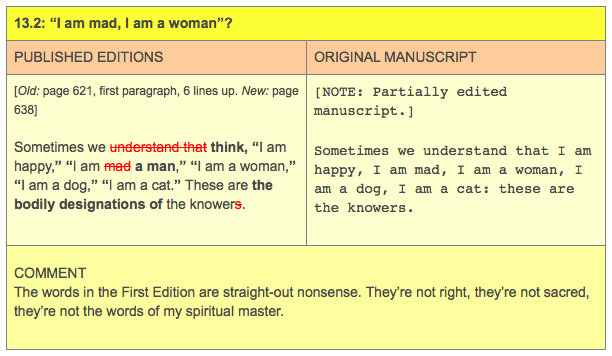
“Sometimes we understand that I am happy, I am mad, I am a woman, I am a dog, I am a cat: these are the knowers.”

BBT International’s unauthorized 1983 Bhagavad-gita As It Is, Text 13.1-2 purport:

“Sometimes we think, “I am happy,” “I am a man,” “I am a woman,” “I am a dog,” “I am a cat.” These are the bodily designations of the knower.”

Prabhupada’s “original manuscript”:

original-manuscript

The changes are:

1) “we understand” to “we think”

2) “I am mad” to “I am a man”

3) “these are the knowers” to “These are the bodily designations of the knower.”

What we see is that the original editor is true to the “original manuscript” whereas Jayadvaita Swami is not. Here we want to focus solely on the change from “I am mad” to “I am a man”.

Why has Jayadvaita Swami made this change? He gives the following attempted justification on the BBT International’s website:

Screen Shot 2014-09-26 at 06.17.54

This is not a rational justification, but only an unsubstantiated claim that the words in the original Gita are “straight-out nonsense”, “not sacred” and “not the words of Srila Prabhupada”.

Here is our challenge to Jayadvaita Swami.

First of all it is clear that the words from the 1972 edition are not nonsense. “I am happy” and “I am mad” are both states of mind that humans can identify with. Nothing wrong with that. But Jayadvaita Swami speculates that the previous transcribers must have heard wrong, and that “mad” really must have been “a man” instead. I guess his reason is that “a man” fits with “a woman”. “I am a man, I am a woman” then becomes opposites. Just like “cat” and “dog” can be taken as opposites.

But if Jayadvaita Swami was attentive while reading Srila Prabhupada’s books he would have known that Prabhupada often uses “happy” and “mad” as opposites. Even Krishna presents these two states of mind as opposites:

“The mode of goodness conditions one to happiness, passion conditions him to the fruits of action, and ignorance to madness.” (Bg. 14.9)

The mode of goodness and the mode of ignorance have opposite qualities. Krishna here mentions “happiness” and “madness” respectively.

Prabhupada also uses “happy” and “mad” as opposites in other places. Here are a few examples:

Just like a man — ordinarily we perceive — a gentleman, after working very hard, if he gets some bank balance and nice house, nice wife, and some children, he thinks, “I am very happy.” This is also maya. He thinks, “But I am happy.” What kind of maya? Pramattah tesam nidhanam pasyann api na pasyati. He is in maya, mad, illusion, pramatta. (Srimad-Bhagavatam 3.26.22, Bombay, December 31, 1974)

Don’t be very much happy when you are in happy condition of life; neither you become mad in miserable condition of life. (Srimad-Bhagavatam 3.26.47, Bombay, January 22, 1975)

You must have perfect knowledge. Then you’ll be happy. Then you’ll be peace. And if you are misguided, bewildered, mad, then how you can be happy? (Rotary Club Lecture, Ahmedabad, December 5, 1972)

So these are all mad condition. So when he turns to God… Service he must give. Nobody can say, “I’m not serving anybody.” That is not possible. You must be serving somebody. Just like you are serving government, he is serving some office, because service is our nature. So we are not happy because the service is misplaced. (Room Conversation and Interview with Ian Polsen — July 31, 1972, London)

Prabhupada: Even the father, mother is not crying. The mother’s baby dies. She cries, she becomes mad. But when the child gives up that childhood body, accept another body, she’s happy because she knows: “My son is there. (Room Conversation with Anna Conan Doyle, daughter-in-law of famous author, Sir Arthur Conan Doyle, August 10, 1973, Paris)

Pradyumna: It’s Canto Five, Chapter Five, verse number seven. “Even though one may be very learned and wise, he is mad if he does not understand that the endeavor for sense gratification is a useless waste of time. Being forgetful of his own interest, he tries to be happy in the material world, centering his interests around his home, which is based on sexual intercourse and which brings him all kinds of material miseries. In this way one is no better than a foolish animal.” (Room Conversation, February 16, 1977, Mayapur)

Because the mad son is loitering in the street without any information of the father, to bring him back before the father. That is the best. He will be happy. (Room Conversation, March 26, 1977, Bombay)

We are just like a criminal who has dirty things within his heart. He thinks, “If I get such-and-such thing, I’ll be happy.” And at the risk of his life he commits a crime. A burglar, a thief, knows that if he is captured by the police he’ll be punished, but still he goes and steals. Why? Nunam pramattah: he has become mad after sense gratification. (BTG, 1983, The Self And Its Bodies)

CONCLUSION

There is ample evidence to support the claim that the purport of the original Gita has things right. And we see how the original editor is true to Prabhupada’s “original manuscript”. Jayadvaita Swami is changing something that is absolutely perfectly correct from the point of view of grammar, spelling, composition, logic, etc., and at the same time exactly follows the ‘original manuscript’, to something else dreamt up in his mind from his imagination and speculation only. In other words, Jayadvaita Swami here shows no concern for the so-called ‘original manuscript’ and certainly no concern for Srila Prabhupada’s original and authorized 1972 Complete Edition of Bhagavad-gita As It Is.

This is not how an editor is supposed to work. To do what Jayadvaita Swami is doing here is totally unauthorized and completely destroys the authority of Prabhupada’s books.

Not “Closer to Prabhupada” (Bg. 18.2)

Jayadvaita Swami and BBTI’s claim to fame:

Screen Shot 2014-09-04 at 21.27.05

Let us (again) take a look at this claim.

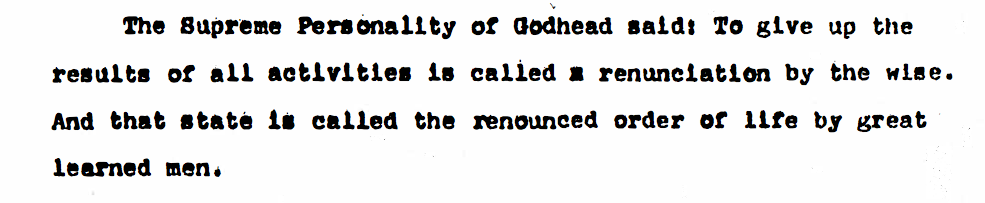
Bhagavad-gita As It Is Text 18.2:

Original and authorized 1972 edition of Bhagavad-gita As It Is: 

“The Supreme Lord said, To give up the results of all activities is called renunciation [tyaga] by the wise. And that state is called the renounced order of life [sannyäsa] by great learned men.”

BBTI’s unauthorized 1983 edition of Bhagavad-gita As It Is:

“The Supreme Personality of Godhead said: The giving up of activities that are based on material desire is what great learned men call the renounced order of life [sannyasa]. And giving up the results of all activities is what the wise call renunciation [tyaga].”

“Original Manuscript”:

Screen Shot 2014-08-30 at 14.23.28 

This is NOT an example of Jayadvaita Swami bringing us “Closer to Prabhupada!” On the contrary, he has (again) taken the Bhagavad-gita As It Is further away from Srila Prabhupada. In other words, we are not reading Srila Prabhupada. We are reading what the hidden co-author, Jayadvaita Swami, wrote.

Their claim to fame is a falsehood.

Small Word, Big Difference (Bg. 12.2 p.)

sp_dictating_p

BY: BHAKTA TORBEN (From Sampradaya Sun)

Aug 11, 2014 — DENMARK (SUN) —

An essential esoteric point is lost in this speculative edit:

“For one in such Krsna consciousness there are no material activities because everything is done BY Krsna.”
(Bhagavad-gita As It Is, Original 1972 Macmillan 12.2 purport)

“For one in such Krsna consciousness there are no material activities because everything is done BY Krishna.”
(Original manuscript)

Screen Shot 2014-08-09 at 20.47.25

“For one in such Krishna consciousness there are no material activities because everything is done FOR Krishna.”
(The changed Bhagavad-gita by Jayadvaita Swami)

This video clip with the Prabhupada-disciple Bhagavat prabhu further illustrates the point:

“When I sit here to write, Krsna comes personally. He dictates to me what to write. I take dictation from Krsna and I write these books.” ~ HDG Srila Prabhupada
(As told by Bhagavat das)

There is also this popular quote:

Guru Das: “Prabhupada, you’re laughing at your own books.”

Prabhupada: “I did not write these books, Krsna wrote them!”

Debate: Ter Kadamba Das versus Ajit Krishna Dasa

The following exchange between Ter Kadamba Das (disciple of Kadamba Kanana Swami, who is disciple of Jayadvaita Swami) and Ajit Krishna Dasa took place on facebook Tuesday 1st Juli 2014.

14324279_675617275936525_8383774334663058082_oTer Kadamba Das preaching: “Ask a Monk – Any Topic”. Well, when  asked about the book changes he deleted my questions and blocked me on facebook!

Ter Kadamba Das: For some odd reason there is still some confusion in ISKCON about book editing. I think this article should clear everything up: http://www.sivaramaswami.com/en/2010/01/02/“the-mystery-of-the-edited-books”/

And

Ter Kadamba Das: “Prabhupada has on some occasions found errors in text he personally wrote, and complained about the lack of editing.”

Ajit Krishna Dasa: Dear Ter Kadamba Prabhu! Dandavat pranam! Jaya Srila Prabhupada!

You wrote:

“Prabhupada has on some occasions found errors in text he personally wrote, and complained about the lack of editing.”

Prabhupada wanted his English edited, but to a limited degree only. Where does Prabhupada state that he wants his personally typewritten sanskrit translations edited? In the Rascal Editor conversation (1977) Prabhupada specifically became angry at changes to his sanskrit translations:

Prabhupada: The nonsense, they are… They are correcting my trans… Rascal.

In 1977 Srila Prabhupada also said they could only divide the synonyms – not change them:

Prabhupada: This of should be strictly forbidden.
Radha-vallabha: So no corrections. That makes it simple.
Prabhupada: They can divide the synonyms. That’s all.
Radha-vallabha: Synonyms. So even…
Prabhupada: That is his tendency, to correct. That’s very bad. He should not do that.
Radha-vallabha: So I’ll just forget this, then.
Prabhupada: The system is: whatever authority has done, even there is mistake, it should be accepted.
Radha-vallabha: Oh.
Prabhupada: Arsa-prayoga. That is ha… He should not become more learned than the authority. That is very bad habit….
Prabhupada: Why finish it? Whatever is done is done. No more….
Radha-vallabha: Well, now that this system of no corrections anywhere, that makes it very simple. Then he can’t do anything. I don’t think he wants to, either. It makes it more simple for him. It makes him very uncomfortable.
Prabhupada: No corrections.
(Room Conversation 27 february, 1977)

In chapter one of the 1983 edition of Bhagavad-gita there are around 130 changes to Srila Prabhupada’s own personally typewritten sanskrit translations. You can see the change here:

TAMPERING WITH PRABHUPADA’S PERSONALLY TYPEWRITTEN SANSKRIT TRANSLATIONS (BG, CHAPTER ONE):

https://arsaprayoga.wordpress.com/…/tampering-with…/

CHANGES TO PRABHUPADA’S PERSONALLY TYPEWRITTEN SANSKRIT TRANSLATIONS (STATISTICS FOR BG, CHAPTER ONE):

https://arsaprayoga.wordpress.com/…/changes-to…/

If any links are broken I shall gladly provide them.

65.92% of the changes to the sanskrit synonyms in chapter one are “Modifications not according to Srila Prabhupada’s draft while the original edition follows Srila Prabhupada’s draft.”

In light of the above statements from Srila Prabhupada, how is this justified?

Jayadvaita Swami has not only corrected mistakes. I have documented this in an e-book. Here in something from the introduction:

Many changes have been made to Srila Prabhupada’s books since his departure in 1977. As we all know this has caused a lot of controversy.

This e-book presents new evidence to the effect that the BBT International, and Jayadvaita Swami in particular, have overstepped their authority by making changes that Srila Prabhupada did not want.

The articles in this e­-book will show you that the changes to Srila Prabhupada’s books cannot be justified by arguments like

• We are changing Srila Prabhupada’s books back to what he actually said in his original manuscript.
• We are making the book “Closer to Prabhupada”.
• We are only correcting grammar, commas, capitalization etc.
• We are only correcting the mistakes of previous editors
• No unnecessary changes have been made

On the contrary, these articles will document that the BBT International have

• Deleted many of Prabhupada’s own chosen words and sentences (even those also found in his ”original manuscript”)
• Added their own words and sentences (which means these word and sentences are also not to be found in the ”original manuscript”)
• Changed Prabhupada’s own personally typewritten sanskrit translations.
• Made unnecessary change of syntax (sentence structure).

We humbly ask that you read this e‐book, and also visit the website http://www.arsaprayoga.com for much more information and many more examples of changes to Srila Prabhupada’s books.

Thank you!

The e-book can be found here.

Looking forward to your kind reply, prabhu!

Your servant,
Ajit Krishna Dasa

Ter Kadamba Das: Ajit krishna Prabhu. I deleted your comment because I find it offensive to the Vaisnavas. Jayadvaita Swami is my param guru, and I cannot allow you to use my timeline to blaspheme him. The gaudia vaisnava parampara is a siksa line, and that means we don’t just read Prabhupada’s books and then speculate on the meaning – we check with the senior devotees, the self realized souls, if we have understood correctly. You do not do that, and that makes your arguments invalid. Even worse is to take segments of letters or conversations (rather than the books themselves) in order to push our own issues. I posted an article by HH Sivarama Swami because that makes it authorized. Whatever I may come up with in my tiny brain is superfluous if I don’t check it with the self realized souls. The same goes for you. You have effectively sacrificed the association of the devotees in order to push your issue about the book editing, and I find that sad. I don’t mean to attack you, I am truly writing this in an attempt to help you, even though it may not seem so. For what it is worth, I consider you a devotee of the Lord, and I believe you are honestly trying to serve Prabhupada to the best of your ability. Hare Krishna my friend!

Ajit Krishna Dasa: Dear Ter Kadamba Prabhu! Dandavat pranam! Jaya Srila Prabhupada!

You say you find my comment offensive. If you hear blasphemy of devotees there are three things you can do. In the Nectar of Devotion it is stated:

“If someone is heard blaspheming by words, one should be so expert that he can defeat the opposing party by argument. If he is unable to defeat the opposing party, then the next step is that he should not just stand there meekly, but should give up his life. The third process is followed if he is unable to execute the above-mentioned two processes, and this is that one must leave the place and go away.” (NOD, Ch. 9, Blasphemy)

Instead of deleting my comment it would have been better service to your param guru if you had defeated my arguments.

You say I do not consult senior devotees to check my understanding. In fact I do. I have quite a network of senior devotees and friends whom I consult often, and who encourage me in my opposition against the changes to Srila Prabhupada books. I have simply chosen to listen to OTHER senior devotees than you listen to. You have used your discriminative powers and chosen your authorities, and I have used my discriminative powers and chosen mine (including my own Guru Maharaja who was against the changes to Srila Prabhupada’s books).

Our respective authorities simply contradict each other on certain points. If we want to find out who is correct regarding the book changes, and who is actually blaspheming who (am I blaspheming your param guru, or is your param guru blaspheming Srila Prabhupada?), then we have to see who’s points are backed by guru, sadhu and sastra, logic and observation.

If you had answered the points I raised in my comments, then we actually would have had a chance to settle the matter and see who of us is actually following bona fide authorities.

You claim I “take segments of letters or conversations (rather than the books themselves) in order to push our own issues.” But as I mentioned before, instead of simply deleting my comment and throwing unsubstantiated accusations it would be a better service to your param guru if you actually defended your own case with the help of guru, sadhu and satra, logic and observation.

In order to defend your case, and thus bring this exchange to a befitting level of intelligence, you need to show specifically what is wrong with the points I presented, including whatever quotes from Prabhupada I posted.

I hope you will do that, and I hope to hear from you soon.

Your humble servant,
Ajit Krishna Dasa

Ter Kadamba Das deleted both my above comments shortly after they were posted. Later he deleted the whole thread, including his own opening statement.

See the changes to Bg. 9.1

Screenshot 2014-06-21 23.45.09

 Click to enlarge the picture.

Download as PDF here:

change-to-bg-table-9.1.


BBTI is changing Srila Prabhupada’s transcripts

Changing of Srila Prabhupada’s Transcripts (from Sampradaya Sun)

BY: KRISHNA DASA

Jun 03, 2014 — USA (SUN) — It is one thing to edit a book posthumously, but what seems more egregious is the editing of a transcript of a conversation. Such editing is found in the book Journey of Self Discovery, supposedly by A.C. Bhaktivedanta Swami, which was first published in 1990 as we see from a search of the U.S. Copyright records.

That book includes a conversation between Srila Prabhupada and a Dr. S. P. Oliver, Rector of the University of Durban, in Westville, South Africa, on October 10, 1975. The book is available online through http://www.prabhupadabooks.com and the relevant page can be seen here or in the e-book on page 23, where we see that during the conversation, Srila Prabhupada asks a devotee to read some verses and purports from the Bhagavad-gita As It Is.

Then we see that the transcript uses totally text from the version of the Bhagavad-Gita As It Is that was edited and published after the departure of Srila Prabhupada. For example, during that conversation a devotee supposedly was reading the verse and purport to Bg 4.34. We can see the 1972 version and the later “Revised and Enlarged” version side by side.

It is not possible that a devotee with Srila Prabhupada in 1975 was able to read the version of the Bhagavad-gita that did not exist until the 1980s.

Screenshot 2014-06-07 16.38.25

This conversation took place in 1975, and the verse quoted was from the 1972 editionof Bhagavad-gita As It Is. But here we find that the verse has been changed by the BBTI to fit the 1983 edition.

Deleting “whatever” (Bg. 6.26)

Bg. 6.26:

Srila Prabhupada’s draft (so-called original manuscript):

Screenshot 2014-04-13 12.00.37

Original and authorized 1972 Macmillan edition:

“From whatever and wherever the mind wanders due to its flickering and unsteady nature, one must certainly withdraw it and bring it back under the control of the Self.”

BBT International’s posthumously edited 1983 edition:

From wherever the mind wanders due to its flickering and unsteady nature, one must certainly withdraw it and bring it back under the control of the Self.

What did Srila Prabhupada think about the verse?

Visnujana: Verse twenty-six: “From whatever and wherever the mind wanders due to its flickering and unsteady nature, one must certainly withdraw it and bring it back under the control of the Self [Bg. 6.26].”

Prabhupada: This is the process. This is yoga system. Suppose you are trying to concentrate your mind on Krsna, and your mind is diverted, going somewhere, in some cinema house. So you should withdraw, “Not there, please, here.” This is practice of yoga. Not to allow the mind to go away from Krsna. (Lecture on Bhagavad-gita 6.25-29, Los Angeles, February 18, 1969)

The words translated as “whatever and wherever” is “yataḥ yataḥ”. In the 1972 Macmillan edition the word for word looked like this:

 yataḥ-whatever; yataḥ;-wherever

In BBT International’s 1983 edition this is changed to:

yataḥ yataḥ — wherever

Unfortunately these word for word synonyms are missing for 6.26 in the so-called original manuscript. But we do find something in Srimad-Bhagavatam:

yataḥ yataḥ — from whatever and wherever; (SB 7.15.32-33)

As a side note: This verse from Srimad-Bhagavatam in about the same subject as Bg. 6.26:

While continuously staring at the tip of the nose, a learned yogi practices the breathing exercises through the technical means known as puraka, kumbhaka and recaka — controlling inhalation and exhalation and then stopping them both. In this way the yogi restricts his mind from material attachments and gives up all mental desires. As soon as the mind, being defeated by lusty desires, drifts toward feelings of sense gratification, the yogi should immediately bring it back and arrest it within the core of his heart. (SB 7.15.32-33)

Again we left with the conclusion that Jayadvaita Swami and the BBT International are not bringing Srila Prabhupada’s books “closer to Prabhupada”. They are violating Srila Prabhupada’s, sastra’s and their own stated editing guidelines by making both needless and harmful changes in Srila Prabhupada’s books.