Imperishable Add-on Edit (Bg. 15.1)

Plate 35 of the 1972 Edition of Bhagavad-gita As It Is.  This painting is not to be found in the 1983 Edition of the Bhagavad-gita As It Is.

Plate 35 of the 1972 Edition of Bhagavad-gita As It Is.
Not to be found in the 1983 Edition.

By Ajit Krishna Dasa

Bhagavad-gita As It Is, 15.1

Original and authorised 1972 edition:

The Blessed Lord said: There is a banyan tree which has its roots upward and its branches down and whose leaves are the Vedic hymns. One who knows this tree is the knower of the Vedas.”

The draft a.k.a. “the original manuscript”:

The Supreme Lord said: It is said that there is a banyan tree which has its roots upward and its branches down; and the Vedic hymns are its leaves. One who knows this tree is the knower of the Vedas.”

Uauthorized 1983 edition:

The Supreme Personality of Godhead said: It is said that there is an imperishable banyan tree that has its roots upward and its branches down and whose leaves are the Vedic hymns. One who knows this tree is the knower of the Vedas.”

From lectures:

Pradyumna: (Translation:) “The Blessed Lord said: There is a banyan tree which has its roots upward and its branches down and whose leaves are the Vedic hymns. One who knows this tree is the knower of the Vedas.”

Prabhupada: So this is the description of Vedic literature. Vedais ca sarvair aham eva vedyah [Bg. 15.15]. That will be described. (Srila Prabhupada, Lecture, See Spiritual Identity Everywhere,
73/10/28 Bombay, Bhagavad-gita 15.1)

Nitai dasa: Translation: The Blessed Lord said: There is a banyan tree which has its roots upward and its branches down and whose leaves are the Vedic hymns. One who knows this tree is the knower of the Vedas.

Purport: After the discussion of the importance of bhakti-yoga, one may question, “What about the Vedas?” (Srila Prabhupada, Lecture, The Purpose of Vedic Study 74/02/26 Calcutta, Bhagavad-gita 15.1)

No objections from Srila Prabhupada.

Comment

1) We here observe that Jayadvaita Swami, after scanning the authorized verse, takes the usual route to an old draft (the so-called original manuscript). An idea for which he has no proper justification.

2) He decides to change “The Blessed Lord”. Here he could have chosen to use Srila Prabhupada’s words from the draft’ translation of Bg. 15.1 which reads “The Supreme Lord said”, but he chose instead to go to the English synonyms and use “The Supreme Personality of Godhead”.

3) Next he decides to add “It is said”. This he took from the drafts’ translation of Bg. 15.1.

4) Then he decides to add an adjective to “banyan tree”. He could have gone back to the English synonyms and used the word “eternal”. But instead he took a trip to the drafts’ purport where he for some reason chose the word “imperishable” over the word “indestructible” which is also in the purport. NOTE: The word “imperishable” is omitted from the purport of both the original 1972 edition and the 1983 edition which makes his choice even more strange.

5) He then changes “which” to “that” even though “which” was both found in the draft and was grammatically perfectly fine. In other words, he found the word “that” not in the English synonyms, not in the translation and not in the purport. But in his own mind.

Hundreds of changes to Srila Prabhupada’s Gita have been documented online. And we see Jayadvaita Swami again and again randomly chose words sometimes from the manuscripts’ translations, sometimes from the English synonyms, sometimes from the purport and sometimes from his own mind.

For the most part it is very hard to find any objective and identifiable criteria for his changes. Especially for changes such as those above. And there are hundreds, if not thousands, of such changes in the Gita alone.

The Holy Bible on Book Changes

Screen Shot 2015-07-28 at 15.29.54

Thanks to Juan Manuel Ferrera we now know that:

Even in relatively “young” religions like Christianity, tampering with sacred words of prophets carry severe reactions.

Revelation 22.18

18. For I testify unto every man that heareth the words of the prophecy of this book, If any man shall add unto these things, God shall add unto him the plagues that are written in this book:

19. And if any man shall take away from the words of the book of this prophecy, God shall take away his part out of the book of life, and out of the holy city, and from the things which are written in this book.”

These are the very last words of the Bible.

One Example Out of Many Disproves Editor’s  Own Words (Bg. 13.25)

Bg. 13-25

BY: BHAKTA TORBEN

Jun 21, 2015 — DENMARK (SUN) — 

Bhagavad-gita As It Is, 13.25:

Original, authorized 1972 edition: 

That Supersoul is perceived by some through meditation, by some through the cultivation of knowledge, and by others through working without fruitive desire.”

Manuscript: 

That Supersoul is perceived by some through meditation, and by some through the cultivation of knowledge, and by others through working without fruitive desire.”

JAS It Is: 

Some perceive the Supersoul within themselves through meditation, others through the cultivation of knowledge, and still others through working without fruitive desires.”

The original 1972 standard and the so-called manuscript are completely identical. And well articulated. Still the ‘JAS It Is’ model chooses a different phrasing.

As seen many times before.

Here are some important words from the principal editor to Srila Prabhupada’ s books after His Divine Grace’ s departure. On the policy of editing:

“‘Arsa-Prayoga’ is a very important principle. The editor should never have the mentality that he is better than the author, that he has something more to contribute than the author does, that the author really doesn’t know what he is doing, but he knows what he is doing. That’ s offensive and that ruins everything. It is an offense to the acarya. The idea however that this sort of sanctity that the authors’ s has, or that the words of the author has, have, somehow extends to the mistakes of the editors is weird. It is an offense to correct the mistakes of previous editors! Are they acaryas? Are they paramahamsas? Are they infallible? They are wonderful devotees, they did wonderful service, but they made mistakes. Understandable.”

We advise the reader to ponder the gap between theoretical intent and actual action. This example is by far not an isolated case.

Uneven Edit (Bg. 2.48)

bg-2-48

BY: BHAKTA TORBEN

Jun 17, 2015 — DENMARK (SUN) —  Bhagavad-gita As It Is, 2.48:

Original, authorized 1972 edition: 

“Be steadfast in yoga, O Arjuna. Perform your duty and abandon all attachment to success or failure. Such evenness of mind is called yoga.”

Manuscript: 

“Do your prescribed duty in an equipoised condition. To do such duty without being attached to success or failure, and to remain in an equiposed condition is called Yoga.”

Read Aloud to Srila Prabhupada by Tamala Krishna in London, 1968: 

“Be steadfast in your duty, O Arjuna, and abandon all attachment to success or failure. Such evenness of mind is called yoga [Bg. 2.48].”

And immediately after Tamal Krishna’s reading of the verse Srila Prabhupada says:

“This is the explanation of yoga, evenness of mind. Yoga-samatvam ucyate. If you work for Krsna, then there is no cause of lamentation or jubilation. Jubilation is there because you are working for Krsna, but there is no cause of lamentation. Yoga-sthah kuru karmani, yogah karmasu kausalam. That is the secret of activities, how you can very diligently work at the same time you are not entangled with the actions. That is the secret. Go on.”

The word-for-word reads ‘samatvam – evenness of mind‘ (Original), but the heavily edited ‘JAS It Is’ version says in the word-for-word ‘samatvam – equanimity’.

‘JAS It Is’:

“Perform your duty equipoised, O Arjuna, abandoning all attachment to success or failure. Such equanimity is called yoga.”

Once again we observe an absolutely unnecessary change. This verse in the original 1972 edition is perfect.

There are more irregularities. Check it out.

Ramesvara Prabhu Speaks About the Paintings in Srila Prabhupada’s Books

Ramesvara Prabhu here speaks about the amazing transcendental pastime of creating the many paintings in Srila Prabhupada’s books – especially the Krishna Book.

He explains how Srila Prabhupada often gave personal instructions to each artist regarding the specific paintings they made.

Unfortunately almost all these transcendental paintings have been removed from Srila Prabhupada’s books and replaced with other paintings that were not made under Srila Prabhupada’s supervision and authorization.

Example of a Bona Fide Change to Srila Prabhupada’s Bhagavad-gita As It Is

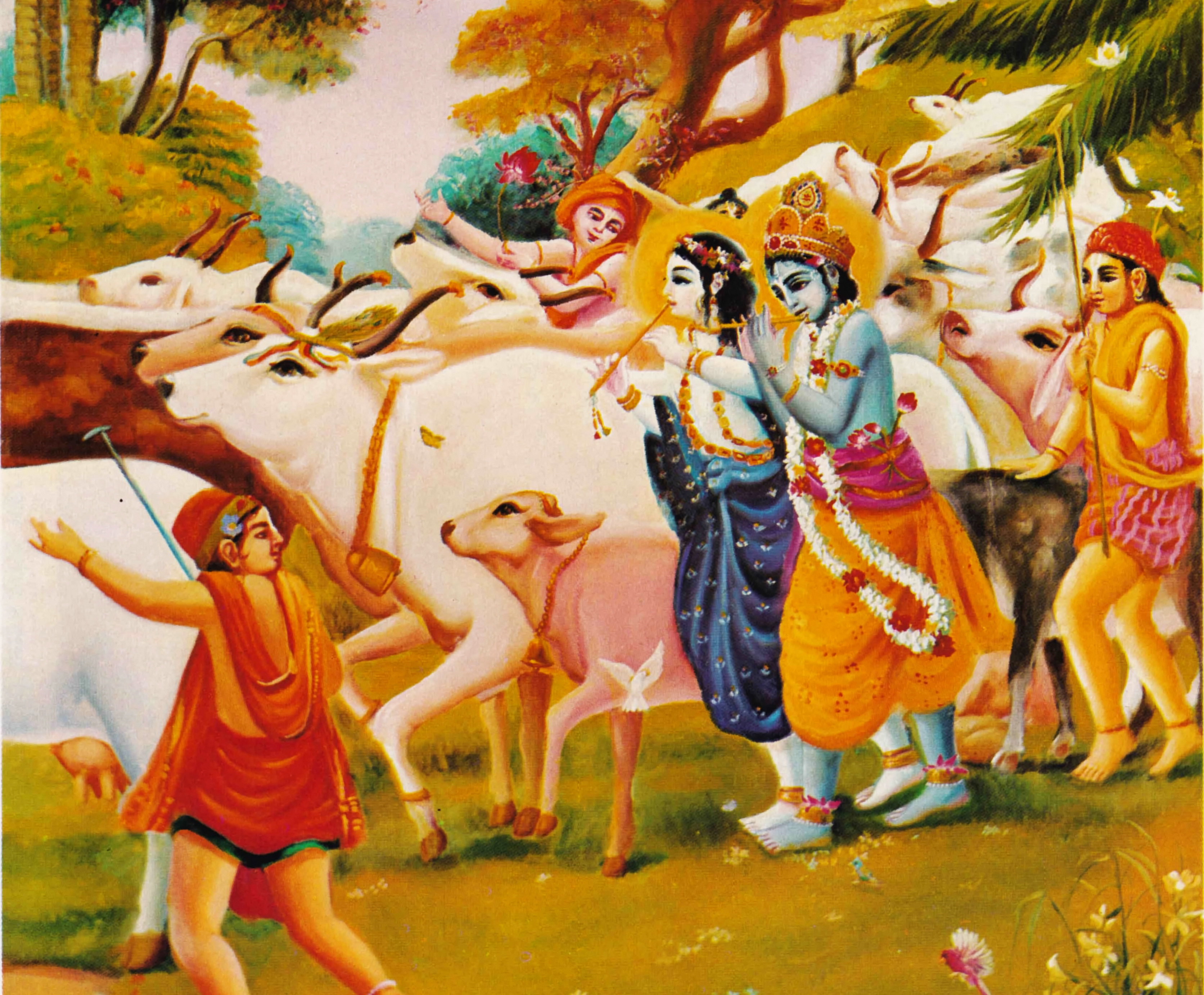
krishna-cows

This is how evidence for bona fide changes looks like:

Room Conversation with the Mayor of Evanston — July 4, 1975, Chicago:

Tamala Krsna: “Farming, cattle raising and business are the qualities…”
Prabhupada: They are not cattle raising, that was…
Tamala Krsna: Cow protection.
Prabhupada: Cow protection. It has to be corrected. It is go-raksya, go. They take it cattle-raising. I think Hayagriva has translated like this.

This change is – contrary to all the post-1977 changes – Prabhupada-approved. It first appeared in a 1976 reprint of the 1968 abridged edition of Bhagavad-gita As It Is.

“Enter Blazing” – Jayadvaita Swami Commits a Grammatical Error (Bg. 11.28)

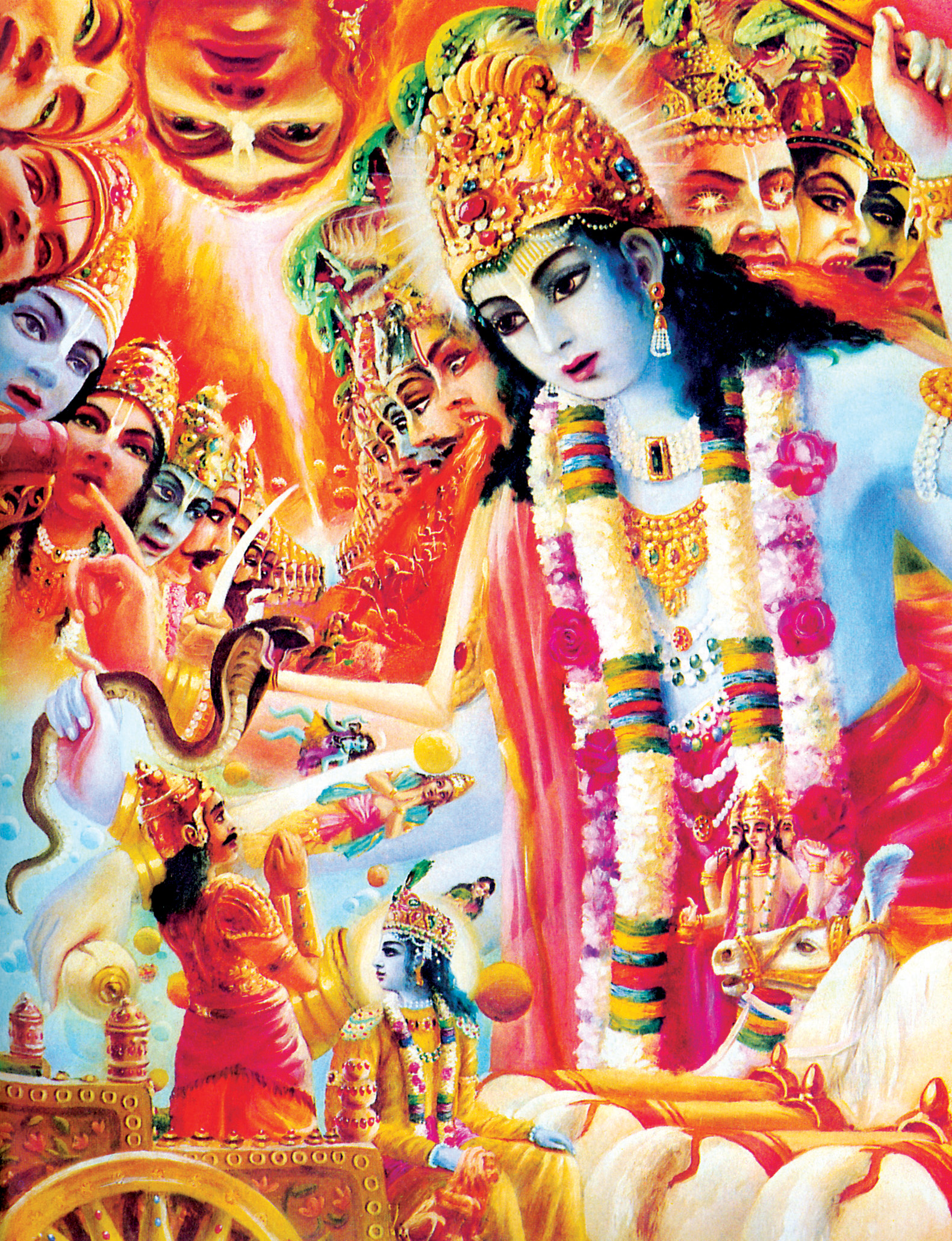
universal-formThe Universal Form

Bhakta Torben Nielsen recently made me aware of this change to Bg. 11.28:

Original and authorized 1972-edition:

“As the rivers flow into the sea, so all these great warriors enter Your blazing mouths and perish.”

BBT International’s edited 1983 edition:

“As the many waves of the rivers flow into the ocean, so do all these great warriors enter blazing into Your mouths.”

So-called original manuscript:

There is no verse for 11.28 as the page is missing. But verse 30 mentions the words “blazing mouths”.

This is a very interesting change, because it is of a grammatical nature:

  • In Srila Prabhupada’s original 1972 edition the adjective “blazing” describes the plural noun “mouths”.
  • In BBT International’s 1983 edition the adjective “blazing” describes the plural noun “warriors”.

So which translation is grammatically correct – Srila Prabhupada’s or Jayadvaita Swami’s?

The context

Here we have the verses from Bg. 11.28-30 (original edition):

“As the rivers flow into the sea, so all these great warriors enter Your blazing mouths and perish.” (Bg. 11.28)

“I see all people rushing with full speed into Your mouths as moths dash into a blazing fire.” (Bg. 11.29)

“O Visnu, I see You devouring all people in Your flaming mouths and covering the universe with Your immeasurable rays. Scorching the worlds, You are manifest.” (Bg. 11.30)

We see that Srila Prabhupada describes the mouths of the universal form as “blazing” (Bg. 11.28) and “flaming” (Bg. 11.30), and compares them to a “blazing fire” (Bg. 11.29). There is no “original manuscript” available for Bg. 11.28-29, but the “original manuscript” for Bg. 11.30 also says “blazing mouths”, as mentioned above.

Screen Shot 2015-03-13 at 11.49.21

Plate 31

The painting above this article is Plate 31 from the Bhagavad-gita As It Is. Just like all other paintings in the book it was approved by Srila Prabhupada. On the painting we clearly see that the warriors are entering into the blazing mouths of The Universal Form – just like we are told that they are in the Bg. 11.28, 1972 edition.

Srila Prabhupada’s desire

Based on the above, there is no doubt at all that Srila Prabhupada wanted to use the adjective “blazing” to describe the mouths of the universal form. He never meant to say that the great warriors were “blazing”.

What does the previous acaryas say about Bg. 11.28? (as translated on bhagavad-gita.org)

Sridhara Swami’s commentary:

“As unlimited currents of water helplessly flow in innumerable rivers and are propelled from multiple channels into the ocean, the mighty warriors of the Kaurava and Pandava armies are seen to be helplessly propelled into the flaming, gnashing mouths of the visvarupa or divine universal form of Lord Krishna.” ()

Kesava Kasmiri’s commentary:

“How helplessly do the mighty warriors of the Kaurava and Pandava armies enter into the flaming mouths of Lord Krishna’s visvarupa or divine universal form? As helplessly as unlimited currents of water from innumerable rivers are propelled into entering the ocean.”

In his translations of Visvanath Cakravarti Thakura and Baladeva Vidyabhusana’s Bhagavad-gita commentaries Bhanu Swami also translates Bg. 11.28 as follows:

“As many swift currents of rivers flow towards the sea, so these heroes of the world enter Your flaming mouths.”

The sanskrit

Gaura Krishna Dasa, a student of sanskrit, sent me the following analysis of the sanskrit grammar:

Regarding the change in the translation of Bhagavad gita 11.28.

The word “abhivijvalanti” is in the 1972 edition taken as what in grammar is called a verbal adjective or a participle. A participle is basically a derivative from a verb but belonging in the group of adjectives. This particular participle is a participle in present tense, active voice for parasmaipada verbs. It is in neuter gender, plural number and in the accusative case which clearly indicates that it relates to “vaktraani” which is also in neuter gender, plural number and accusative case.

Sridhara Swami, Visvanath Cakravati Thakur and Baladeva Vidyabhusana have the same grammatical conclusion of this word as a participle and therefore in relation to “vaktraani” attributively, “blazing mouths”.

The “anti” ending in “abhivijvalanti” could preliminarily appear as a finite verb 3rd person in the plural number and present tense related to “nara-loka-viira” (the kings of human society), but this conclusion is in the least very strange. It would, if accepted, be a distortion of historical facts and it must be concluded faulty because this sentense already has a finite verb namely “visanti” meaning entering. So if we for the sake of example maintain “abhivijvalanti” as a finite verb, as it is done in the 1983 edition it would translate “as the many waves of the rivers flow into the ocean, so all these great warriors enter and blaze your mouth”, since “abhivijvalanti” can also not be taken as an adverb describing “visanti” attributively.

Conclusion:

“abhivijvalanti” must be taken as a participle – as done by the previous acaryas and the original 1972 edition – and not a verb as done in the 1983 edition.

Conclusion

The evidence against Jayadvaita Swami’s change is overwhelming:

1. Srila Prabhupada is very clear in his original Gita and his manuscripts – the mouths are blazing. Not the warriors.

2. Srila Prabhupada follows the previous acaryas who says that the mouths are blazing (flaming, gnashing).

3 The painting depicting this event (Plate 31 in the Bhagavad-gita As It Is) shows that it is the mouths of The Universal Form that are blazing.

4. According to sanskrit grammer it is the “mouths” that are “blazing”. Not the “warriors”.

Even if both translations could be correct (which they cannot), there would still be no justification – based on the above analysis – to change Srila Prabhupada’s translation of the verse.

It would not be possible to do this without overriding his own editorial decisions and thus violating the arsa-prayoga principle.

Please see additional evidence here.

Bhaktisiddhanta Sarasvati: “Consider only the spirit”

Bhaktisiddhanta Sarasvati Thakura Maharaja, Sree Sajjani-Toshani, The Harmonist, June 1927, No.1:

“The kind indulgence of the reader is solicited to overlook shortcomings inseparable from the employment of a foreign language and consider only the spirit irrespective of the defective garb in which she might be clothed”

the-harmonist

Radhanath Swami on the book changes (leaked e-mail)

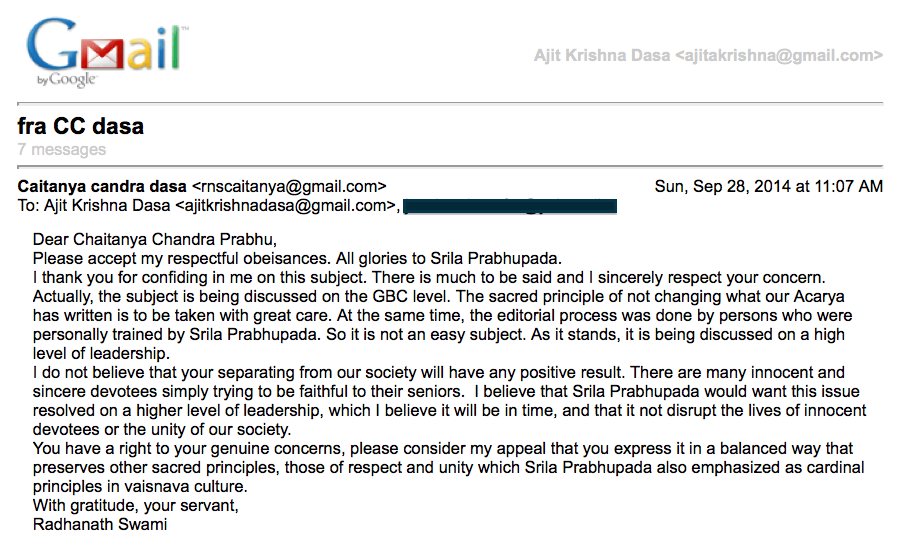
In September 2014 Radhanath Swami sent the below e-mail to one of his Danish disciples, Caitanya Candra Dasa:

Screen Shot 2015-03-29 at 10.03.33

Here is the text in digital format:

“Dear Chaitanya Chandra Prabhu,
Please accept my respectful obeisances. All glories to Srila Prabhupada.
I thank you for confiding in me on this subject. There is much to be said and I sincerely respect your concern. Actually, the subject is being discussed on the GBC level. The sacred principle of not changing what our Acarya has written is to be taken with great care. At the same time, the editorial process was done by persons who were personally trained by Srila Prabhupada. So it is not an easy subject. As it stands, it is being discussed on a high level of leadership.
I do not believe that your separating from our society will have any positive result. There are many innocent and sincere devotees simply trying to be faithful to their seniors. I believe that Srila Prabhupada would want this issue resolved on a higher level of leadership, which I believe it will be in time, and that it not disrupt the lives of innocent devotees or the unity of our society.
You have a right to your genuine concerns, please consider my appeal that you express it in a balanced way that preserves other sacred principles, those of respect and unity which Srila Prabhupada also emphasized as cardinal principles in vaisnava culture.
With gratitude, your servant, Radhanath Swami

An analysis:

We can see that Radhanath Swami is an intelligent diplomat.

RS: “I thank you for confiding in me on this subject.”

Radhanath Swami tries to maintain a relationship of trust. He makes it seem as if he appreciates Caitanya Candra Dasa’s questions, and invites him to open up his heart.

RS: “There is much to be said…”

This could make it seem as if Radhanath Swami has some special knowledge about the book changes, and as if it is a great mystery (secret knowledge) that requires deep and intense study, sadhana and special association to understand. But what Radhanath Swami is really saying, I guess, is that he does not know much about this matter, and that he is not going to speak much about it – neither to Caitanya Candra Dasa nor publicly.

RS: “…and I sincerely respect your concern.”

Radhanath Swami makes it seem as if he truly shares Caitanya Candra Dasa’s concerns. He speaks as if they are on the same side – that of genuine concern. But Radhanath Swami’s statement is trivial, for who does not care for Srila Prabhupada’s books? Everyone will say they care. Everyone will say that the editing should be done in a way that pleases Srila Prabhupada. But notice that Radhanath Swami does not disclose his own personal opinion. He really says nothing at all.

RS: “Actually, the subject is being discussed on the GBC level. The sacred principle of not changing what our Acarya has written is to be taken with great care. At the same time, the editorial process was done by persons who were personally trained by Srila Prabhupada. So it is not an easy subject. As it stands, it is being discussed on a high level of leadership.”

Here we again see Radhanath Swami’s diplomatic skills at work. He is indirectly saying that Caitanya Candra Dasa should not care much about it because it is being taken care of “on a high level of leadership”. Radhanath Swami says: “Do not worry! The GBC will handle it! Go back to sleep!”

But we all know what “a high level of leadership” in ISKCON means! It means incompetent devotees creating new problems while trying to solve already existing problems caused by themselves.

And what is the proof that the GBC are talking about this? It was not mentioned in the GBC resolutions of 2015. Maybe Radhanath Swami is misinformed or twisting the truth trying to buy time. Or maybe there is really a committee of around 3 members who are all pro-change who speaks about the book changes 2 hours per year trying to figure out how to close the mouths of the protesters.

Why should we accept Radhanath Swami’s “assurance” that the GBC is handling this issue? For all we know he could be lying. He presents no proof.

Radhanath Swami tries to balance things out by acknowledging that it is important not to change the words of our Acarya. But at the same time, he says, we should remember that those who did the changes were personally trained by Srila Prabhupada. Radhanath Swami uses the same diplomatic skills as Duryodhana on the battlefield first glorifying Drona and then Bhisma. He is saying to Caitanya Candra Dasa: “You are good, and they are also good! Therefore it is all very complicated and can only be solved at GBC level! Please go back to sleep!”

RS: “So it is not an easy subject.”

It really does not take much of a brain to see that Jayadvaita Swami and BBTI have violated the arsa-prayoga big time. But either Radhanath Swami will not write this online, or he is in denial or simply does not know much about what has been done to Srila Prabhupada’s books.

What we do know is that he is diplomatic, and that he is not going to risk his own prestige and position by speaking about the book changes online or publicly.

Factually, by his silence Radhanath Swami is accepting the changes made to Srila Prabhupada’s books by the BBTI, and by encouraging his disciples to also stay silent, he is also encouraging them to accept the changes.

RS: “There are many innocent and sincere devotees simply trying to be faithful to their seniors. I believe that Srila Prabhupada would want this issue resolved on a higher level of leadership, which I believe it will be in time, and that it not disrupt the lives of innocent devotees or the unity of our society.”

Radhanath Swami seems to have failed to understand that the so-called “higher level of leadership” in ISKCON has had more that 30 years to resolve this very simple issue. But they have continuously made the situation worse. Instead of stopping all editing while investigating the matter thoroughly they have allowed BBTI to continue editing many of Srila Prabhupada’s books.

We have absolutely no reason to believe or trust that the BBTI or GBC are capable of solving this issue on their own. And since they will not listen we have to challenge them to answer publicly. There is no other way. It is their own fault that this subject is being debated publicly.

And to claim that it is dangerous for new devotees to hear of such controversial topic is simply foolish. Our first concern in spiritual life is to make sure that the scriptures we read are bona fide. This is ABC and all new devotees are taught this in the temples, and it is written in all of Srila Prabhupada’s small introductory books. So if there is any doubt about the authenticity of the books, then all devotees need to know.

The funny thing is that we know for sure that the original books are bona fide and have the power to deliver us. But we are not sure if the changed editions have that potency. As a guru Radhanath Swami ought to have at least the amount of intelligence to understand that we must stop printing the changed books until we know for sure which editions are bona fide. Better safe than sorry.

But Radhanath Swami has never stepped forward to ask the BBTI to stop their editing while the matter is being investigated.

Instead Radhanath Swami suggests that we leave this crucial matter to incompetent “high level leaders”, while we sleep our way back to Godhead. Are these foolish instructions on the book changes really coming from a bona fide spiritual master?

RS: “You have a right to your genuine concerns, please consider my appeal that you express it in a balanced way that preserves other sacred principles, those of respect and unity which Srila Prabhupada also emphasized as cardinal principles in vaisnava culture.

With gratitude, your servant, Radhanath Swami”

Radhanath Swami tries to close the correspondence in a mood of friendship. He has said something and at the same time nothing. Radhanath Swami prefers that Caitanya Candra Dasa keeps quiet about this matter and leaves it to the “high level leaders”. At the same time Radhanath Swami knows that Caitanya Candra Dasa might not want to keep his mouth shut, so he implores him to speak in a balanced way if he speaks about it.

At no point did Radhanath Swami state his own opinion about the book changes, and he did not help Caitanya Candra Dasa understand this most important issue. If Radhanath Swami really was a bona fide guru, then he should easily be able and willing to clear the doubts of his disciples on this matter. But it seems he cannot do that. Or maybe he choses to let his disciples stay in the darkness of ignorance in order not to get himself into trouble.

This is not how a guru works. A guru is not a diplomat. A guru is straight forward. A guru want to help his disciples. He wants to save them from ignorance and the offences of violating the arsa-prayoga principle.

Some of our local ISKCON authorities in Denmark have tried to impress upon the Danish devotees that Caitanya Candra Dasa is violating his guru’s instructions by speaking about the book changes. But we can see this is false. Radhanath Swami says that Caitanya Candra Dasa has the right to be concerned about the book changes, and he does not prohibit Caitanya Candra Dasa from speaking publicly about the book changes – for whatever reason.

“THE ANGRIEST I EVER SAW PRABHUPADA GET”

(Watch and hear from 1:30)