E-Book: ISKCON’s Changes to Srila Prabhupada’s Bg. and PQPA

Click to download the book

Click to download the book

ISKCON’s Changes to Srila Prabhupada’s Bhagavad-gita As It Is and Perfect Questions, Perfect Answers (by Madhudvisa Dasa).

Perhaps the first book on the book changes. So old it was made with a typewriter. Definitely of both present day and historical value. It contains a lot of good evidence against the changes, good arguments and historical documentation (like mails).

Download the book here: ISKCON’s Changes to Srila Prabhupada’s Bhagavad-gita As It Is and Perfect Questions, Perfect Answers (by Madhudvisa Dasa).

BBT Editorial Policy for Future Editors

The BBT International is apparently in the process of creating editorial policies for future editors i.e. editors working AFTER the present editors’ retirement.

Guidance for Future BBT Editors

Proposed BBT Editorial Policy for Future Editors

For now, we at Arsa-Prayoga are simply putting this up for everyone to see:

Hare Krishna
Please accept my obeisances. All glories to Srila Prabhupada

The BBT Global Communications team have requested our assistance in widely circulating as far as possible (in ISKCON circles) the draft of the proposed BBT editorial policy to allow for devotees to comment.

Please can you assist in this regard as this is a very important and sensitive subject.

Below is a standard cover letter you can use and attached is the draft policy

I have cc’d in Smita Krsna Prabhu and Rasika Bandhu Prabhu who are co-ordinating this communique for BBT

Your servant
Nanda Kishor das

———————

Dear Devotees

Hare Krishna

Please accept our humble obeisances. All glories to Srila Prabhupada.
Attached kindly find for your perusal and comment the BBT Editorial Policy.

Kindly send all comments by no later than 20 September 2015 to:
BBT.Global.Communications@pamho.net

The BBT directors, at their latest meeting, had an extended discussion
about Srila Prabhupada’s purport to Srimad-Bhagavatam verse 4.25.41. We will
soon send out a separate memo about that, letting you know where those
thoughts led and seeking your comments.

Yours in the service of Srila Prabhupada
BBT Global Communications

Link to the Guide for Future BBT Editors.

Ramesvara Prabhu Speaks About the Paintings in Srila Prabhupada’s Books

Ramesvara Prabhu here speaks about the amazing transcendental pastime of creating the many paintings in Srila Prabhupada’s books – especially the Krishna Book.

He explains how Srila Prabhupada often gave personal instructions to each artist regarding the specific paintings they made.

Unfortunately almost all these transcendental paintings have been removed from Srila Prabhupada’s books and replaced with other paintings that were not made under Srila Prabhupada’s supervision and authorization.

“Enter Blazing” – Jayadvaita Swami Commits a Grammatical Error (Bg. 11.28)

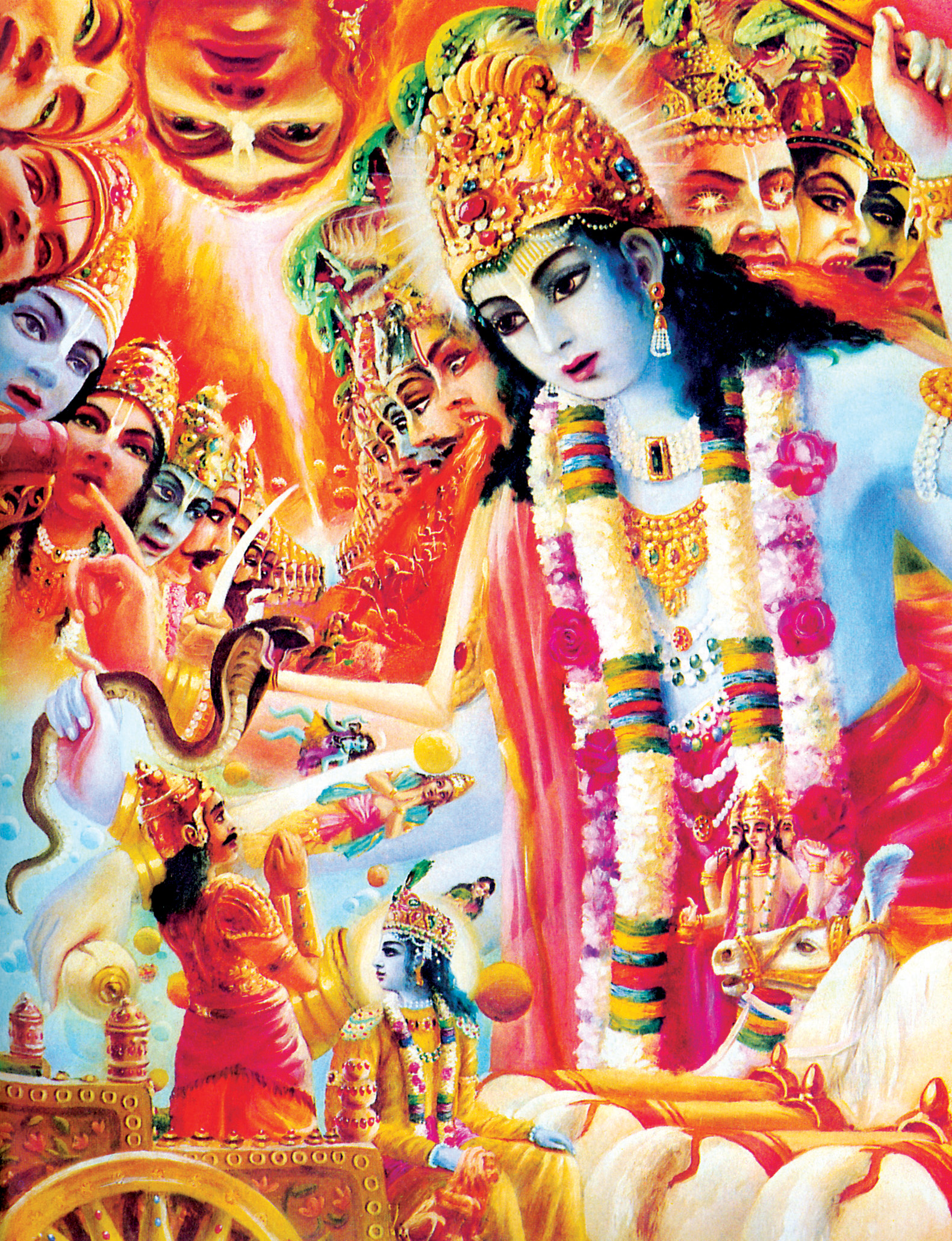
universal-formThe Universal Form

Bhakta Torben Nielsen recently made me aware of this change to Bg. 11.28:

Original and authorized 1972-edition:

“As the rivers flow into the sea, so all these great warriors enter Your blazing mouths and perish.”

BBT International’s edited 1983 edition:

“As the many waves of the rivers flow into the ocean, so do all these great warriors enter blazing into Your mouths.”

So-called original manuscript:

There is no verse for 11.28 as the page is missing. But verse 30 mentions the words “blazing mouths”.

This is a very interesting change, because it is of a grammatical nature:

  • In Srila Prabhupada’s original 1972 edition the adjective “blazing” describes the plural noun “mouths”.
  • In BBT International’s 1983 edition the adjective “blazing” describes the plural noun “warriors”.

So which translation is grammatically correct – Srila Prabhupada’s or Jayadvaita Swami’s?

The context

Here we have the verses from Bg. 11.28-30 (original edition):

“As the rivers flow into the sea, so all these great warriors enter Your blazing mouths and perish.” (Bg. 11.28)

“I see all people rushing with full speed into Your mouths as moths dash into a blazing fire.” (Bg. 11.29)

“O Visnu, I see You devouring all people in Your flaming mouths and covering the universe with Your immeasurable rays. Scorching the worlds, You are manifest.” (Bg. 11.30)

We see that Srila Prabhupada describes the mouths of the universal form as “blazing” (Bg. 11.28) and “flaming” (Bg. 11.30), and compares them to a “blazing fire” (Bg. 11.29). There is no “original manuscript” available for Bg. 11.28-29, but the “original manuscript” for Bg. 11.30 also says “blazing mouths”, as mentioned above.

Screen Shot 2015-03-13 at 11.49.21

Plate 31

The painting above this article is Plate 31 from the Bhagavad-gita As It Is. Just like all other paintings in the book it was approved by Srila Prabhupada. On the painting we clearly see that the warriors are entering into the blazing mouths of The Universal Form – just like we are told that they are in the Bg. 11.28, 1972 edition.

Srila Prabhupada’s desire

Based on the above, there is no doubt at all that Srila Prabhupada wanted to use the adjective “blazing” to describe the mouths of the universal form. He never meant to say that the great warriors were “blazing”.

What does the previous acaryas say about Bg. 11.28? (as translated on bhagavad-gita.org)

Sridhara Swami’s commentary:

“As unlimited currents of water helplessly flow in innumerable rivers and are propelled from multiple channels into the ocean, the mighty warriors of the Kaurava and Pandava armies are seen to be helplessly propelled into the flaming, gnashing mouths of the visvarupa or divine universal form of Lord Krishna.” ()

Kesava Kasmiri’s commentary:

“How helplessly do the mighty warriors of the Kaurava and Pandava armies enter into the flaming mouths of Lord Krishna’s visvarupa or divine universal form? As helplessly as unlimited currents of water from innumerable rivers are propelled into entering the ocean.”

In his translations of Visvanath Cakravarti Thakura and Baladeva Vidyabhusana’s Bhagavad-gita commentaries Bhanu Swami also translates Bg. 11.28 as follows:

“As many swift currents of rivers flow towards the sea, so these heroes of the world enter Your flaming mouths.”

The sanskrit

Gaura Krishna Dasa, a student of sanskrit, sent me the following analysis of the sanskrit grammar:

Regarding the change in the translation of Bhagavad gita 11.28.

The word “abhivijvalanti” is in the 1972 edition taken as what in grammar is called a verbal adjective or a participle. A participle is basically a derivative from a verb but belonging in the group of adjectives. This particular participle is a participle in present tense, active voice for parasmaipada verbs. It is in neuter gender, plural number and in the accusative case which clearly indicates that it relates to “vaktraani” which is also in neuter gender, plural number and accusative case.

Sridhara Swami, Visvanath Cakravati Thakur and Baladeva Vidyabhusana have the same grammatical conclusion of this word as a participle and therefore in relation to “vaktraani” attributively, “blazing mouths”.

The “anti” ending in “abhivijvalanti” could preliminarily appear as a finite verb 3rd person in the plural number and present tense related to “nara-loka-viira” (the kings of human society), but this conclusion is in the least very strange. It would, if accepted, be a distortion of historical facts and it must be concluded faulty because this sentense already has a finite verb namely “visanti” meaning entering. So if we for the sake of example maintain “abhivijvalanti” as a finite verb, as it is done in the 1983 edition it would translate “as the many waves of the rivers flow into the ocean, so all these great warriors enter and blaze your mouth”, since “abhivijvalanti” can also not be taken as an adverb describing “visanti” attributively.

Conclusion:

“abhivijvalanti” must be taken as a participle – as done by the previous acaryas and the original 1972 edition – and not a verb as done in the 1983 edition.

Conclusion

The evidence against Jayadvaita Swami’s change is overwhelming:

1. Srila Prabhupada is very clear in his original Gita and his manuscripts – the mouths are blazing. Not the warriors.

2. Srila Prabhupada follows the previous acaryas who says that the mouths are blazing (flaming, gnashing).

3 The painting depicting this event (Plate 31 in the Bhagavad-gita As It Is) shows that it is the mouths of The Universal Form that are blazing.

4. According to sanskrit grammer it is the “mouths” that are “blazing”. Not the “warriors”.

Even if both translations could be correct (which they cannot), there would still be no justification – based on the above analysis – to change Srila Prabhupada’s translation of the verse.

It would not be possible to do this without overriding his own editorial decisions and thus violating the arsa-prayoga principle.

Please see additional evidence here.

Hidden Co-Authors

Screen Shot 2015-02-13 at 11.12.53

Krsna Krpa dasi (Mary E. Corens, M.A., M.Ed. )*

Part I – Hidden Co-Authors

Misconceptions have been circulating about the authorship of His Divine Grace A.C. Bhaktivedanta Swami Prabhupada (Srila Prabhupada).  For example, it is a mistake to think that his books were written by his editors.  The facts demonstrate that Srila Prabhupada translated, wrote, edited, and published his books while using his disciples as assistants.  In contrast, the so-called editing of his books without his knowledge and consent is really rewriting by hidden co-authors.

EXTRAORDINARY AUTHOR

Srila Prabhupada is an extraordinary author unsurpassed in history because he translated, wrote, edited, published, and distributed millions of books worldwide, translated in many languages. He trained hundreds of disciples to assist him in this monumental work. Srila Prabhupada created his own publishing house, the Bhaktivedanta Book Trust (BBT). He created his own distribution system of temples, the Life Membership program, and book distributors who developed innovative methods to distribute books. He engaged millions of people in producing, distributing and receiving his transcendental books, and thus engaged them in the pure devotional service of Lord Caitanya’s movement.

Srila Prabhupada was a published author before he reached America. In India, without help, he translated, wrote, edited, published and distributed the three volumes of Srimad Bhagavatam, First Canto, the paperback Easy Journey to Other Planets, and many issues of Back to Godhead magazine. He wrote a second manuscript for the Bhagavad-gita to replace his first one which had been stolen.

Of course, he recognized his difficulties in presenting transcendental knowledge in a foreign language. In the Preface to each volume of Srimad Bhagavatam, he appealed to the readers: “I must admit my frailties in presenting Srimad Bhagavatam, but still I am hopeful of its good reception by the thinkers and leaders of society on the strength of the following statement of Srimad Bhagavatam (1.5.11): tad-vag visargo… ‘On the other hand, that literature which is full with descriptions of the transcendental glories of the name, fame, form and pastimes of the unlimited Supreme Lord is a transcendental creation meant to bring about a revolution in the impious life of a misdirected civilization. Such transcendental literatures, even though irregularly composed, are heard, sung and accepted by purified men who are thoroughly honest.’”

Once he arrived in America, he took opportunities to correct his “irregular composition.” He gave a large stack of papers, his Bhagavad-gita manuscript, to his disciple, Hayagriva das, who had a Masters degree in English. The two of them worked closely together to edit and prepare the manuscript for publication in the United States.

AMAZING SYSTEM TO WRITE AND PUBLISH

Srila Prabhupada’s published letters reveal an amazing system which he organized to accelerate his writing. He controlled every aspect from beginning to end. And he trained his disciples to assist him in various ways. He dictated translations and purports which his disciples transcribed. He corrected and edited those transcriptions which were then sent to other disciples for more editing. He edited the Sanskrit synonyms or provided them himself. He proofread manuscripts and final drafts. He gave specific instructions regarding illustrations, number of pages, size, paper, binding, covers, printing and costs. He examined the printed books to see if they had been printed properly. He noted his satisfaction and dissatisfaction. If necessary, he ordered corrections for a subsequent printing. Amazingly, he did all this work using personal meetings and regular postal mail while traveling around the world!

Srila Prabhupada wrote letters to convey his instructions and answer questions. Excerpts demonstrate his direct involvement in training and correcting his disciples’ work. He wrote his books by dictating the translations and purports which were transcribed. “I have received the transcription of tape #16. You are doing very nicely and improving your editorial capability.” (Letter to Satsvarupa, July 29, 1969) “Pradyumna and Shyamsundar will be sending you regularly completed transcriptions of my translation work by post … and because I am here, if they have questions, I can answer and make the final proofreading, and this will expedite everything.” (Letter to Jayadvaita, May 15, 1971)

His disciples had difficulty producing quality translations and Sanskrit synonyms even in later years, thereby forcing Srila Prabhupada to do the work himself. “The translations… I am not using. There is some fault. I am doing the translations… (Letter to Radhaballabha, Sept. 26, 1975) “Yes, because no one else can do them, I shall do the Sanskrit synonyms.” (Letter to Jayadvaita, Feb. 18, 1972) “From yesterday night I have begun adding the synonyms as it doesn’t save very much time to have the synonyms.” (Letter to Radhaballabha, Oct. 20, 1975) “I will have to see personally what are the mistakes in the synonyms and also how you intend to correct them. I was not satisfied with the corrections that were made before. I saw some changes which I did not approve. Nitai may correct whatever mistakes are there, but the corrected material must be sent to me for final approval.” (Letter to Radhaballabha, Jan. 5, 1976)

Synonyms were missing for 25 chapters of the Srimad Bhagavatam, so he provided them. “I have begun this work and the first tape of synonyms, tape no. 6, was sent to Pradyumna today. This work will take at least one month to complete.” (Letter to Jayadvaita, Feb. 18, 1972) Sometimes he provided the synonyms within the letter: “So far your question, the synonyms are as follows: sattvam – the mode of goodness; rajas – the mode of passion … (Letter to Jayadvaita, July 3, 1971)

Srila Prabhupada’s solution to the Sanskrit editing problems was to train his disciple, Pradyumna das. “I am very much glad that Pradyumna is now with me for teaching him correctly this Sanskrit editing work. After he has become well-trained that will be a great relief to me and it will benefit everyone by increasing the flow of our books and literatures.” (Letter to Jayadvaita, May 15, 1971)

Srila Prabhupada also trained his disciples in editing the English and preparing the manuscripts for publishers, including basic proofreading. As always, he reviewed their work and made necessary corrections. “Regarding your second point, all incarnations should be proper nouns and therefore capitalized. It does not matter whether they are Visnu-tattva or jiva-tattva, saktavesh-avatar or plenary expansion.” (Letter to Jayadvaita, July 12, 1970) “…you have got 31 only out of 33. I think some of the brackets are not counted. So if the parentheses are removed from ‘intoxication’ and ‘impotency’ and they are also counted, the total of symptoms will come to 33. Simply add commas…” (Letter to Jayadvaita, Jan. 30, 1970)

Srila Prabhupada supervised his editors; he reviewed their work, including the final manuscript. “Regarding the corrections you have sent, this kind of changes is admissible. There is no harm.” (Letter to Radhaballabha, Sept. 21, 1975) “I have received your letter dated May 26, 1972, along with the blue-print copies of Bhagavad Gita As It Is from MacMillan Company. It is very nice. So I shall be looking forward to seeing the entire manuscript and book sometime around first July, 1972.” (Letter to Jayadvaita, May 28, 1972)

Srila Prabhupada gave instructions and reviewed the art work to illustrate his books. “The sketches are all alright as they are. Please go ahead and make the paintings.” (Letter to Jadurani, Jan. 5, 1976) For Sri Caitanya-Caritamrta, he wrote, “The art paintings are very, very good. Everyone likes them, and I know they have worked especially hard…. The photographs are also wonderful. He has done nicely, the boy Bhargava.” (Letter to Radhaballabha, Sept. 26, 1975)

Other examples include the illustrations in the Seventh Canto of Srimad Bhagavatam (1st printing, 1976) which comply with his instructions. “2. There should be no effulgence around Prahlad. Hiranyakasipu should not be shown with a pipe. He was a non-smoker.… 4. To illustrate Prahlad being protected when he is thrown off the cliff, there should be a semi-visible Krishna waiting below, as if to catch.” (Letter to Radhaballabha, Feb. 3, 1976)

Srila Prabhupada determined the layout of his books and other publishing details. He wanted high quality publications. “Regarding 6th Canto, Nitai has just yesterday sent off Chapters 5, 6, 7 and 8 and next week he expects to send off Chapters 9 through 13. This will be sufficient for you to publish one volume.” (Letter to Radhaballava, Sept. 21, 1975) Regarding a decrease in the printing quality of Back to Godhead magazine, he wrote, “The color is not at all good. It is not attractive, and not as good as Dai Nippon…. The standard quality of Dai Nippon must be maintained. On what consideration is the printer being changed?… In my opinion, no one can print better than Dai Nippon. Why is the plan changed without my consent?… We cannot change the quality of printing for the matter of a little change in the price. This printing is not approved by me…. I am sending copies of this letter to all BBT Trustees for necessary action.” (Letter to Radhaballava, Sept. 22, 1974)

Srila Prabhupada was a prolific writer – he translated and wrote faster than his disciples could edit and publish. Although he was one person and they were many, they could not keep up with him. For example, he pressured his disciples for years to publish the eighteen volumes of Sri Caitanya-Caritamrta. The manuscripts were written, but the editing, illustrations, and publication progressed slowly. The first published volume appeared in 1973. A year later, another volume was published. He overcame BBT’s lethargy in 1974 by forcing the Los Angeles temple into a marathon to prepare the books. And he personally stayed there to assist the editors. By his efforts, the entire Sri Caitanya-Caritamrta was finally published in 1975.

Other books took longer. In 1972 he ordered the publication of a paperback based on recorded conversations. “I think we are just now typing up the tapes of those conversations we held in Mayapur, and we shall be publishing them as a book. It will be called Perfect Questions, Perfect Answers.” (Letter from Srila Prabhupada to Bob Cohen, June 16, 1972, reprinted in the book) Five years later, the small paperback was published and ready for distribution.

Srila Prabhupada’s system of book distribution relied on three integral parts – his temples, his book distributors, and the Life Membership program. The temples were the regional centers for book distribution. They organized the local distribution and provided all the needs for the book distributors and support persons (managers, pujaries, cooks, etc.) who lived in the temples. The temple activities were organized so that the book distributors could devote all their energies to distributing Srila Prabhupada’s books and preaching. “There is no doubt about it, to distribute books is our most important activity. The temple is a place not for eating and sleeping, but as a base from which we send out our soldiers to fight with maya. Fight with maya means to drop thousands and millions of books into the lap of the conditioned souls. Just like during war time the Bombs are raining from the sky like anything.” (Letter to Ramesvara, Aug. 3, 1973)

Srila Prabhupada devised the Life Membership Program as a scheme to publish and distribute books in India, and to expand it to America and other countries. “Here in India our program is going on very nicely. Especially we are making so many life members. That program is so important that we are getting money, supporters and distributing our literature all at the same time.” (Letter to Damodara, March 5, 1971) “…on this book distribution scheme of life membership. 50% is utilized for reprinting books and 50% is utilized for increasing the number of centers. I think the same program may be vigorously introduced in your country and that will be a great success.” (Letter to Rupanuga, Feb. 19, 1971)

ERRONEOUS MISCONCEPTIONS

It is clear that Srila Prabhupada was the author of his books, and the editors were his assistants. Also, he fully controlled the editing and publishing process. For his books, he determined the content, meaning, purpose, audience, style, illustrations, binding, paper, publication dates, etc.

So why do some, including some BBT editors, erroneously claim that Srila Prabhupada did not really write his books? Why do they mistakenly refer to “Hayagriva’s Bhagavad-gita” instead of “Srila Prabhupada’s Bhagavad-gita?” The answer is that they confuse writing with editing.

Factually, editing is not writing because editing polishes something already written. First the author writes, and then the editor edits. First, Srila Prabhupada wrote the translations and purports for Bhagavad-gita, and then Hayagriva edited them.

Writing creates the content, meaning and purpose. Editing polishes that work to make it more presentable to the readers, but editing does not change the author’s meaning and purpose. Srila Prabhupada created the transcendental content of his books. He conveyed the meaning of Krsna consciousness within the Vaisnava parampara (disciplic succession). And he imbued his books with the purpose to spread Lord Caitanya’s mercy all over the world. Srila Prabhupada’s books contain his potency to transform sincere readers into pure unalloyed devotees. To assist him, Hayagriva polished the Bhagavad-gita manuscript by correcting the irregular composition without changing Srila Prabhupada’s meaning and purpose.

Editing differs from writing because the editor suggests changes and consults with the author for approval. Hayagriva proofread the Bhagavad-gita manuscript. Proofreading is the process of finding and correcting errors in spelling, conjugation, capitalization, grammar, syntax, italics, etc. as well as conformity to the publisher’s format (font size, margins, indentations, footnotes, etc.).

Hayagriva also suggested other changes to the manuscript. Like a good editor, he discussed the changes and asked for Srila Prabhupada’s approval of them. Other disciples acting as editors followed the same approval process with other books. It is clear that Srila Prabhupada wrote his books and that Hayagriva and other disciples edited them.

Another misconception is that Srila Prabhupada’s books can be edited without his knowledge and consent. This is erroneous because, as explained above, editing requires discussions and approval from the author. And the author makes the final decisions about what is published. Therefore, no editing can occur especially after Srila Prabhupada’s disappearance (in 1977) because he is no longer available for consultation. The only exceptions would be found in his orders for specific changes to specific books. Regarding the unfinished Srimad Bhagavatam, he personally trained and assigned only Pradyumna das to finish the translations and purports.

Still another misconception is that Srila Prabhupada gave orders to change his published books after his disappearance. No evidence exists to support this claim. In fact, he gave many orders not to change his books. “Yes, there is no need for corrections for the first and second Cantos. Whatever is there is alright.” (Letter to Radhaballabha, May 4, 1976) Regarding the Bhagavad-gita manuscript prepared for the 1972 MacMillan publication, he wrote, “So far changing the working of verse or purport of 12:12 discussed before, it may remain as it is.” (Letter to Jayadvaita, March 17, 1971) Apparently Srila Prabhupada rejected Jayadvaita’s suggestions in favor of leaving the manuscript “as it is.” Yet three words in that purport were changed for the unauthorized 1983 revision. **

Those familiar with Srila Prabhupada’s management understand that he would have given important orders to change his published books to the BBT Trustees, the GBC members, and Pradyumna, his highly qualified translator. So why are there no orders from Srila Prabhupada to his important leaders? Why would he grant permission to rewrite his Bhagavad-gita to devotees who were not important leaders before his disappearance?

HIDDEN CO-AUTHORS

What is so-called editing that is independent from Srila Prabhupada’s order? Factually, it is not editing, it is rewriting of his books. The so-called editors are acting like authors. They are really co-authors because they are rewriting books written by another author, i.e., Srila Prabhupada. And, they are really hidden co-authors because they rewrite his books while hiding behind the good name of His Divine Grace A.C. Bhaktivedanta Swami Prabhupada. The hidden co-authors present their own translations and opinions hidden within Srila Prabhupada’s books.

In contrast, honest co-authors always publish their names, and sometimes they describe their individual contributions. In any case, their readers understand that two or more authors wrote the book. A famous example of co-authoring is a book about grammar and writing, The Elements of Style by William Strunk Jr. and E.B. White (Fourth edition, 2000, published by Longman Publishers). In it, White explained his role as co-author and his changes to Strunk’s original book. White also claimed credit for writing the section on style.

CHANGES TO THE BOOKS

The problem of hidden co-authors even occurred during Srila Prabhupada’s physical presence. Some disciples deviated from the honest relationship between Srila Prabhupada as author and the disciples as editors. Such persons changed his manuscripts and printed books without his permission and knowledge. After discovering these unauthorized changes, Srila Prabhupada strongly chastised the persons involved and demanded the removal of the changes. For example, during a Srimad Bhagavatam class, Nitai das read a manuscript translation which contained unauthorized changes.

Nitai: “At the time of death, Ajamila saw three awkward persons… His small child, Narayana, was playing a little distance off, and with tearful eyes and great anxiety, he called the name of his son very loudly three times, ‘Narayana, Narayana, Narayana!” (SB 6.1.28-29)
Srila Prabhupada: Is there “three times?”
Nitai: It said in the manuscript. The manuscript said “three times.”
Srila Prabhupada: Who said in the manuscript? There is no three times. Not “Narayana” three times. One time, “O Narayana,” that’s all. So did I say “three times?” No, it is not said here. You should correct it. Once, “O Narayana,” that’s all. There is no reason of calling three times. There is no mention here. Once is sufficient. (laughter) …Uccair ajuhava, very loudly, “Narayana!” Like that. That’s all. Uccair ajuhava akulendriyah. So you edited it? Not yet?
Nitai: No
Srila Prabhupada: So you should keep at least what is there. (Transcription of recorded lecture for S.B. 6.1.28-29, Philadelphia, July 13, 1975)

Despite his continual efforts to rectify and train his editors, they continued to make unauthorized changes. By June of 1977, Srila Prabhupada expressed his doubt that his leading editors would follow his order to remove over 100 changes to the Sri Isopanisad and publish it as the original (1969) printing.   He said, “It is a very serious situation. You write one letter that ‘Why you have made so many changes?’ And whom to write? Who will care? All rascals are there! Write Satsvarupa that ‘This is the position. They are doing anything and everything at their whim. The next printing should be again to the original way.”  (Conversation with with Srila Prabhupada and Yasoda-nandana, June 22, 1977)

After Srila Prabhupada’s disappearance, the hidden co-authors made major changes to Bhagavad-gita As It Is (1972 edition). A major change is the language, the writing style, of the Bhagavad-gita translations. For example, Srila Prabhupada originally published (1972 edition), Chapter 7, verse 24 as “Unintelligent men, who know Me not, think that I have assumed this form and personality. Due to their small knowledge, they do not know My higher nature, which is changeless and supreme.” In contrast, the hidden co-authors (1983 revision) rewrote the verse as “Unintelligent men, who do not know Me perfectly, think that I, the Supreme Personality of Godhead, Krsna, was impersonal before and have now assumed this personality. Due to their small knowledge, they do not know My higher nature, which is imperishable and supreme.”

The stark contrast between the two versions clearly indicates that they were written by two different authors. Srila Prabhupada wrote the original version, and the hidden co-authors wrote the later version.

Other Bhagavad-gita verses in the rewritten, 1983 edition display similar changes. The hidden co-authors substituted a lower level writing style not intended for college educated readers. Therefore, the change in writing style indicates a change in audience, the intended readers. Srila Prabhupada wrote for a college-educated, more intelligent audience; whereas, the hidden co-authors wrote for a less intelligent audience.

The co-authored Bhagavad-gita (1983 revision) is not suitable for college classrooms. But Srila Prabhupada’s plan differed: “…our propaganda should be going on for drawing attention of the educational institutions to accept our books at least in the religious courses.” (Letter to Satsvarupa, Nov. 2, 1973) “I am so glad to learn that you are having nice success in placing my books in the libraries and in schools and colleges…. I am sure that this will revolutionize the thinking of thoughtful men of your country as well as the students and the professors and the ultimate end will be to save the world from the clutches of material illusory activities which is now causing havoc everywhere.” (Letter to Karandhar, Sept. 13, 1970)

Why do the hidden co-authors claim to be better translators and commentators (purport writers) than Srila Prabhupada? What are the hidden co-authors doing when they change the philosophy and preaching plans in Srila Prabhupada’s books? What is their purpose?

The hidden co-authors usurp Srila Prabhupada’ property, his books, by making changes not authorized by him. They seize and hold his books by force without the spiritual right to do so. The hidden co-authors force changes without any order to do so. They blatantly disobey his direct order to maintain the books as originally published. They use BBT money and diplomacy to defeat opposition to their usurpation. The hidden co-authors behave like squatters who forcibly and unlawfully take over someone’s property and use it for their own purpose.

The hidden co-authors mislead the devotees and the innocent public by publishing their own opinions under Srila Prabhupada’s good name. What is their purpose? They are acting like hidden founder-acaryas because they rewrite sastra (Vedic scripture) intended for the next 9500 years. Because they reject Srila Prabhupada’s order to maintain his books as published, they freely inject their own opinions.

The proper behavior of a disciple or follower is to follow the spiritual master’s order. Srila Prabhupada explained: “Visvanatha Cakravarti Thakura has stated that the order of the spiritual master is the life and soul of the disciples. As a man cannot separate his life from his body, so a disciple cannot separate the order of the spiritual master from his life. If a disciple follows the instruction of the spiritual master in that way, he is sure to become perfect.” (Srimad Bhagavatam 3.24.13, 1974, 1st printing)

On the basis of this instruction, sincere devotees have the duty and the right to reject all co-authored changes to Srila Prabhupada’s books. We must follow Srila Prabhupada, not the hidden co-authors because he can liberate anyone who follows him.

Srila Prabhupada wrote: “Not a single person in the West became Krsna conscious before the Krsna consciousness movement was founded. But when the same Bhagavad-gita was presented as it is through the disciplic succession, the effect of spiritual realization was immediately manifested.”   (Srimad Bhagavatam, 4.22.19, 1978, 2nd printing)

By following Srila Prabhupada, we can make spiritual progress and preach Lord Caitanya’s movement all over the world. And Srila Prabhupada, through his Prabhupada-vani – his books and teachings, can take anyone back home, back to Godhead.

*The late wife of Rupanuga das, who wrote this essay anonymously in 2006 and posted it on Adi-vani

**This instruction was followed in 1972 edition. When challenged why the changes were made later in the 1983 edition, after Srila Prabhupada’s disappearance, the following reply was received.

“The story on 12:12:

I asked Srila Prabhupada whether the sequence of items mentioned in the verse (which to me seemed inconsistent with the Sanskrit) should be changed. He said no. Respecting his order, I left the verse as is.

Srila Prabhupada gave a very specific answer to a very specific question.

Someone now wants to extend Srila Prabhupada’s specific answer to make it a general order to the effect that not a word of the purport should be changed. And so the obviously erroneous “regulated principles” — a term that makes no sense — must be forever preserved, and not revised to the usual and sensible “regulative principles,” lest we stand in defiance of Srila Prabhupada’s sacred order.

This is a point of view with which I respectfully disagree.”
From Jayadvaita Swami August 25, 2011

Actually in 12:12 Srila Prabhupada is referring to the general practices or regulations of devotional service or Bhakti Yoga, not simply the “four regulative principles”.

NOT CLOSER TO SRILA PRABHUPADA (BG 8.18: MERGED?)

Screen Shot 2015-02-07 at 16.47.24

MERGED?

BY: BHAKTA TORBEN

Feb 03, 2015 — DENMARK (SUN) —

Bhagavad-gita As It Is, 8.18

Authorized Original 1972: 

“When Brahma’s day is manifest, this multitude of living entities comes into being, and at the arrival of Brahma’s night they are all annihilated.”

Science of Self-realization, page 225: 

“When Brahma’s day is manifest, this multitude of living entities comes into being, and at the arrival of Brahma’s night they are all annihilated.”

JAS It Is: 

“At the beginning of Brahmā’s day, all living entities become manifest from the unmanifest state, and thereafter, when the night falls, they are merged into the unmanifest again.”

Manuscript: 

“On the manifest of the Brahma´s day, all living entities, they come into being and when there is arrival of night of Brahma everything becomes annihilated.”

Srila Prabhupada preached heavily against the mayavada concept of ‘merging’. For SURE he did not use the ‘merge’ word in this verse.

A few points from Arsa-Prayoga:

1. Science of Self-Realization was published after the departure of Srila Prabhupada. But it was made on his order. Bhagavad-gita 8.18 was, however, published in Beyond Birth and Death (published while Srila Prabhupada was here) and a Back to Godhead magazine from 1974.

2. Actually Srila Prabhupada used the word “merge” in his original and authorized Gita (like in 2.54). So the most important point here is that Jayadvaita Swami has added words (like merged, manifest, unmanifest, state, falls etc.) to Bg. 8.18 which Srila Prabhupada did not intend to be in Bg. 8.18. Jayadvaita Swami is therefore not telling the truth when he claims he has made the Gita “more faithful to Srila Prabhupada” or “closer to Prabhupada”.

Jayadvaita Swami has made a new translation of the Gita and published it in Srila Prabhupada’a name.

Srila Prabhupada preached heavily against the mayavada concept of `merging´. For SURE he did not use the `merge´ word in this verse.

“THE ANGRIEST I EVER SAW PRABHUPADA GET”

(Watch and hear from 1:30)

PROOF POSITIVE: AN APPEAL TO JAYADVAITA SWAMI FOR CLARIFICATION (PART 2)

Screen Shot 2014-07-26 at 19.25.48

BY: THE ASSEMBLED DEVOTEES

Jul 25, 2014 — GLOBAL (SUN) —

No Opportunity for Questions?

In the 2003 Honolulu conversation cited in the first installment of Proof Positive, Jayadvaita Swami stated:

“there was no opportunity to like send Prabhupada back and forth, like sending him the second chapter and getting it back and asking questions; it just didn’t happen.”

In the 15 months prior to Srila Prabhupada approving the 1972 Bhagavad-gita blue-print/galleyproof, Jayadvaita wrote to His Divine Grace on six different occasions regarding book production. Srila Prabhupada replied each time, often with detailed explanations and instructions. Though the statements found in some of these letters (see below) refer to books other than Bhagavad-gita, they are still a definitive indication that Srila Prabhupada had made himself available for final proofreading, questions on editing, and other details of book production, and that he already was communicating and interacting with Jayadvaita on such matters.

And, as indicated below, Srila Prabhupada also went to New York and spent approximately 14 days there in July and August of 1971. The record shows that Jayadvaita had plenty of opportunity to send Prabhupada the Bhagavad-gita blue-prints, manuscripts and queries, as well as to meet personally with His Divine Grace. Srila Prabhupada also made a standing offer directly to Jayadvaita in a meeting in Boston in 1969 regarding publishing of the unabridged Gita:

Jayadvaita: [referring to the “original” manuscript] Some of it has been edited by Rayarama, but you can see around it and go to the original behind it.

Srila Prabhupada: So whatever is lacking, you ask me. I will supply you.

Why, then, did Jayadvaita Swami state there was no opportunity, and why didn’t he ask his questions when he had the chance?

(Emphasis is added in the following letters and some have been abbreviated):

Letter to Jayadvaita- Bombay, March 17, 1971:

“My Dear Jayadvaita, Please accept my blessings. I am in due receipt of your letter dated 21st February, 1971 and noted the contents carefully. I do not know what may have happened to the letter dated 9th January, 1971, but I have not received it.

Regarding your questions:

12:12: The ultimate point is to come to the stage of loving Krsna and all other indirect processes are subsidiary….

14:27: Impersonal Brahman is the constitutional position of ultimate happiness because without coming to the brahma-bhutah platform and remaining engaged in the activities of brahman nobody can be joyful….

I have dictated the missing purports from Chapter IX and they are set enclosed herewith. So far changing the working of verse or purport of 12:12 discussed before, it may remain as it is.”

Letter to Jayadvaita- Los Angeles, July 3, 1971:

“My Dear Jayadvaita, Please accept my blessings. I am in due receipt of your letter dated 30th June, 1971 and have noted the contents carefully. Your report on the progress of Srimad-Bhagavatam, first four cantos, is very much encouraging, so continue this work very seriously. I have again begun translating work and have so far sent Satsvarupa Prabhu three tapes from 4th Canto, 8th chapter, and will be sending many more.”

Letter to Jayadvaita- Los Angeles, July 13, 1971:

“I am in due receipt of your letter dated 10th July, 1971 and have noted the contents. Also I have received the laid-out sheets for tapes no. 1 & 2 and they are very well done. Thank you very much. I was so much pleased to see that already the tapes were edited and laid out and this is encouraging me to translate more and more. You can give Ch. 8 of S.B. canto 4 the title “Dhruva Maharaja enters the forest to meet the Lord”.

…Very soon I am coming to N.Y. and we can discuss further on these matters.

Letter to Jayadvaita- Calcutta, February 18, 1972:

“My Dear Jayadvaita, Please accept my blessings. I beg to acknowledge receipt of your letter of February 5, 1972, and have noted the contents. Yes, because no one else can do them, I shall do the sanskrit synonyms. You simply send me now the manuscripts as required by you, and I shall send back either dictaphone tapes or tape-recorder cassettes.”

Letter to Jayadvaita- Calcutta, March 5, 1972:

“My dear Jayadvaita, Please accept my blessings. I have also received your letter along with Bali Mardan’s….As I have informed, Pradyumna and Syamasundara will be sending you regularly completed transcriptions of my translation work by post, that will avoid the high cost of sending tapes, which besides are very expensive and may be lost easily in mail, and because I am here if they have questions I can answer and make the final proofreading, and this will expedite everything. One thing, now you say the date for printing by MacMillan Co. is set for August 1st, but last time you said June 1st, so I am wondering how long this delaying business shall go on?”

Letter to Jayadvaita- Los Angeles, May 28, 1972:

“My Dear Jayadvaita, Please accept my blessings. I have received your letter dated May 26th, 1972, along with the blue-print copies of Bhagavad-gita As It Is from MacMillan Company. It is very nice. So I shall be looking forward to seeing the entire manuscript and book sometime around first July, 1972.”

In summary, Srila Prabhupada stated:

“So whatever is lacking, you ask me. I will supply you.”
(1969 meeting in Boston)

“Very soon I am coming to N.Y. and we can discuss further on these matters.”
(he then spends 2 weeks in New York)

“if they have questions I can answer and make the final proofreading”

“I have received your letter dated May 26th, 1972, along with the blue-print copies of Bhagavad-gita As It Is from MacMillan Company. It is very nice. So I shall be looking forward to seeing the entire manuscript and book sometime around first July, 1972.”

In total, Jayadvaita corresponded with His Divine Grace on six different occasions between February 1971 and May 1972.

Jayadvaita Swami stated:

“there was no opportunity to like send Prabhupada back and forth, like sending him the second chapter and getting it back and asking questions; it just didn’t happen.”

Confidential E-mails From Ramesvara Leaked (Dec. 2014)

Just recently three confidential e-mails were leaked and posted on facebook. They reveal what Ramesvara Prabhu thinks about the changes made the Srila Prabhupada’s Bhagavad-gita, the editing policies of the BBTI and they shed light on what happened when the GBC and BBT trustees “reviewed” the 83 Gita. ramesvara1 Below are some quotes that will rock the boat, but please visit the website at the end of this article to see all three e-mails in their entirety and thus get the full picture. Quotes From confidential email no. 1:

“The problem with the “Responsible Publishing” paper is that it is simply not the entire body of instruction, and it‘s critics point out that it is one-sided and obviously leaves out many of Prabhupada’s cautionary instructions against unnecessary change,”

[…]

“That analysis with Dravida Prabhu left me with my deepest concern: if the changes didn’t have substantial merit but were made anyway, then regardless of the justification of “making it better” the door, the “change disease” as Srila Prabhupada called it, had been dangerously opened for anything to happen in the future after we are all long gone.”

[…]

“The Lilamrita interviews I found tell of Srila Prabhupada’s direct instructions regarding the size of the books, the artwork to be kept in the books, etc. – things that have already been changed so many times in the past 20 years, without understanding of Prabhupada’s orders, that it makes the “official” opening of this “change” door more ominous for the future, in ways we can’t even imagine.”

[…]

“…an absolute position has to be reached so that before we die, we know that within the BBT and ISKCON there could never again be one single change, for any reason, ever made to Srila Prabhupada’s books.”

From confidential e-mail no. 2:

“The “Responsible Publishing” (RP) paper has either a significant misleading or a significant historical inaccuracy. There are sites which claim to list more than 5,000 changes. Certainly there were thousands of changes. The RP paper states that every change to the translations was reviewed and approved by the Trustees, leading ISKCON devotees, the CBC, etc. Later the RP cites or implies in its endorsements that all the changes were approved. Of course, NO ONE other than the editors ever saw back in 1981 or 1982 ALL the changes.”

[…]

“I have always admitted that my great failure as a trustee was not carefully reading every proposed change, and instead, relying on the endorsement of Hridayananda and Satsvarupa- along with Jayadvaita.”

[…]

“I know that in talking years ago with others on that committee, that they also admitted performing only a cursory review of the proposed changes,…”

[…]

“No one back then did their job or acted with full responsibility for what they were endorsing. l assure you that NO ONE on that Committee ever even asked to see all the changes, and we would have been astounded to have learned in 1981 or 1982 that there were thousands, maybe more than 5,000 changes. I lazily assumed that the work done on manuscripts as close to the original as possible was the only thing that mattered. I failed to consider all the other Prabhupada instructions, the ramifications for making changes if they didn’t ultimately change the meaning; the effect of changes that in some cases loses the flavor of the Gita we had been studying for 10 years, and most importantly, that breaks the etiquette of changing a Sampradaya Acaraya’s books after His disappearance and opens the “change door” for possible future other changes over the decades and centuries to come. The RP paper implies that the changes were carefully reviewed and approved throughout the leadership of the BBT, GBC and ISKCON. I am certain that by interviewing all the leaders of that time, we would find most guilty of the same mistake that i made. It is true to state that the leaders of ISKCON at the time endorsed the changes. However, it is overtly misleading to state or suggest that the leaders actually performed a careful review. And getting back to the fact that there are thousands of changes, no leader, including the BBT Trustees, was ever shown every single change. No one! That is the sad historical fact…”

From confidential e-mail no. 3:

“I find it embarrassing that on the site BBTEdit.com, in the section about editing posthumously, the only quote to support touching the works of a departed Acarya is that Srila Jiva Goswami was working posthumously on Bhakti Rasamrita Sindhu. Seriously – how can any living entity compare themselves to Sri Jiva Goswami, or think because he touched the work of Sri Rupa Gosvami, therefore an editor in the lower stages of bhakti, not yet fully situated in the perfected stages of bhava (what to Speak of prema) can touch and change the words of a departed Sampradaya Acarya. Not a good example in my lowly View – it begs the question of What our editors think of themselves and their level of Krsna Consciousness. Oh well…”

Please find all the three e-mails in their entirety here: http://jayasrikrishna.weebly.com (PDF and Word). You can also see and download the e-mails here as PDF and Word.

Rebuttal of Hridayananda Dasa Goswami’s Claims on the Book Changes

Danesh Dasa posted the following on the facebook group “Hridayananda Das Goswami – Friends and Disciples”:

“Hridayananda Maharaj on the revised 2nd edition of Bhagavad-gita As It Is:

“I Support This Edition”

“Jaya Advaita Swami and Dravida Prabhu sincerely worked to restore Prabhupada’s original text, and to clear up obvious mistakes by typists. Surely Prabhupada would appreciate this. Further, no one has ever shown that these corrections altered in any way Prabhupada’s philosophical teachings. Thus I support this edition of Prabhupada’s Bhagavad-gita.””

Here is a screenshot: Screen Shot 2014-12-11 at 10.55.31

Let us take a look at each of Maharaja’s statements:

Hridayananda Dasa Goswami:

“Jaya Advaita Swami and Dravida Prabhu sincerely worked…”

Hridayananda Dasa Goswami here commits the fallacy of “begging the question” and the fallacy of “Ipse dixit / bare assertion fallacy”:

“Begging the question means “assuming the conclusion (of an argument)”, a type of circular reasoning. This is an informal fallacy where the conclusion that one is attempting to prove is included in the initial premises of an argument, often in an indirect way that conceals this fact.” (Source: http://en.wikipedia.org/wiki/Begging_the_question)

Jayadvaita Swami and Dravida Prabhu did their job sincerely only if they pleased Srila Prabhupada, and we are disagreeing about precisely that. Therefore Maharaja is “begging the question”.

Hridayananda Dasa Goswami needs to give some evidence in support for his claim. But instead of giving evidence he just states it, and this is the fallacy of “Ipse dixit / bare assertion fallacy”:

“Ipse dixit, Latin for “He, himself, said it,” is a term used to identify and describe a sort of arbitrary dogmatic statement which the speaker expects the listener to accept as valid.” (Source: http://en.wikipedia.org/wiki/Ipse_dixit)

Hridayananda Dasa Goswami:

“…to restore Prabhupada’s original text, and to clear up obvious mistakes by typists.”

Here Hridayananda Dasa Goswami commits the fallacy of “selective evidence / fallacy of incomplete evidence”:

“Cherry picking, suppressing evidence, or the fallacy of incomplete evidence is the act of pointing to individual cases or data that seem to confirm a particular position, while ignoring a significant portion of related cases or data that may contradict that position.” (Source: http://en.wikipedia.org/wiki/Cherry_picking_(fallacy))

It is correct that Jayadvaita Swami and BBTI in some cases have changed the books back to what Srila Prabhupada said in the so-called original manuscripts. But is this really a good idea? Normally your drafts end up in your trash bin. If someone took your drafts out of your trash bin and changed your essay back to what you wrote in your drafts without consulting you first, I think you would feel insulted. Here is an article that deals with this unusual idea of changing a text back to its draft:

https://arsaprayoga.com/2013/10/15/jayadvaita-undoes-prabhupadas-work-on-gita-manuscript/

What Hridayananda Dasa Goswami fails to communicate (and possibly comprehend) is the sad fact that in many cases Jayadvaita Swami and BBTI have brought Srila Prabhupada’s books further away from the so-called original texts. They have deleted Srila Prabhupada’s own chosen words and sentences and added their own. They even changed hundreds (if not thousands) of his personally typewritten sanskrit translations. And in most cases there was no reason to do it at all – other than the whimsical preferences of the editors. I have documented many instances of this sort of editing in my e-book “No Reply from BBTI” and on my website www.arsaprayoga.com (see links below).

Hridayananda Dasa Goswami:

“Surely Prabhupada would appreciate this.”

Here Hridayananda Dasa Goswami again commits the fallacy “Ipse dixit / bare assertion fallacy”.

Hridayananda Dasa Goswami:

“Further, no one has ever shown that these corrections altered in any way Prabhupada’s philosophical teachings.”

Since Hridayananda Dasa Goswami presents no evidence to back up his claim, he again commits the fallacy of “Ipse dixit / bare assertion fallacy”.

He claims that no one has been able to demonstrate that Jayadvaita Swami and BBTI have made changes to the philosophy. But by publishing the 1983 edition of the Gita it was openly declared that it is perfectly okay to violate the principle of arsa-prayoga. This is a serious philosophical deviation, and this offensive mentality is now woven into each and every page of Srila Prabhupada’s books, and everyone who reads them will be contaminated by this mentality.

Besides this, now there might only be very few philosophical mistakes made by Jayadvaita Swami and BBTI, but what about the future? If the door is not closed forever, then the changing business might go on forever, since one change justifies the next. Srila Prabhupada was afraid of this (see the famous “Rascal Editors” conversation).

We also know that Jayadvaita Swami has made his own mistakes. One example of this is his changing “Visnu Form” into the “Visnu platform” (Bg. 2.61). This seems to be a change that takes the Gita in the mayavada direction. And here is a link to an article that demonstrates how Jayadvaita Swami has changed a sentence in the Gita so it gets the opposite meaning of what Srila Prabhupada originally said:

Small Word, Big Difference (Bg. 12.2 p.)

Do we want more of these kinds of changes?

Another significant point in this regard is that Hridayananda Dasa Goswami presents an hidden premise, namely that:

All changes that are not of a philosophical nature are okay.

This hidden premise can be disproved by quoting Jayadvaita Swami and the BBTI:

“As you know, and as we kept in mind while doing the work, Srila Prabhupada staunchly opposed needless changes.” (Jayadvaita Swami, Letter to Amogha Lila, 1986)

Now, as we see Srila Prabhupada did not only disapprove of philosophical changes to his books. He also disapproved of “needless changes”. Therefore, if we can find any needless changes in the 1983 edition of the Gita, we know that Jayadvaita Swami and the BBTI have displeased Srila Prabhupada. My contention is that Jayadvaita Swami and the BBTI have made many needless changes (thousands). I have presented some of them in my e-book “No Reply from BBTI”:

https://arsaprayoga.com/2014/05/08/e-book-no-reply-from-bbti/

This e-book shows how the attempted justifications used by the BBTI fails. BBTI usually argue that:

  • We are changing Srila Prabhupada’s books back to what he actually said in his original manuscript.
  • We are making the books “Closer to Prabhupada”.
  • We are only correcting grammar, commas, capitalization etc.
  • We are only correcting the mistakes of previous editors.
  • No unnecessary changes have been made.

But the articles in the e-book documents that the BBT International have needlessly:

  • Deleted many of Srila Prabhupada’s own chosen words and sentences (even those also found in his ”original manuscript”).
  • Added their own words and sentences (which means these words and sentences are also not to be found in the ”original manuscript”).
  • Changed Srila Prabhupada’s own personally typewritten sanskrit translations.
  • Made needless change of syntax (sentence structure).

Hridayananda Dasa Goswami:

“Thus I support this edition of Prabhupada’s Bhagavad-gita.”

If Hridayananda Dasa Goswami had studied this issue carefully he would not support the 1983 edition of the Bhagavad-gita.

Some might argue that Hridayananda Dasa Goswami’s statement is not supposed to be a thorough defense of his views. That is perfectly fine – as long as we recognize that his above statement is completely useless in any kind of debate on the topic.

The interesting question is:

Will Hridayananda Dasa Goswami ever post a thorough defense of his view on this controversial topic? Or does he expect his disciples and well-wishers to blindly accept his statements without any supporting evidence?

We are many who would love to see how he will attempt to justify the editing of Jayadvaita Swami and the BBTI.

Your servant, Ajit Krishna Dasa