E-BOOK: Arsa-Prayoga: Preserving Srila Prabhupada’s Legacy

Almost 400 pages about the changes made to Srila Prabhupada’s books.

Arsa-Prayoga Book

Click picture to visit website

From the back cover:

“Arsa prayoga, lit. “rishi’s license,” means to honour the acarya by preserving his teachings in the originally published form, not changing what he has written to make it appear more effective or politically correct. There should be no confusion between the work written by His Divine Grace Srila Prabhupada and edited by Howard Wheeler and the posthumous cent per cent revised copy proposed by Bhaktivedanta Book Trust International. By changing Prabhupada’s books without explicitly saying so, they do a discredit to Srila Prabhupada, devotees and scholars. At present it appears that the revisions were made by the original author. This book is meant to be the truth about the editing of Prabhupada’s books carefully chronicled for future generations.”

Get the book on Amazon.

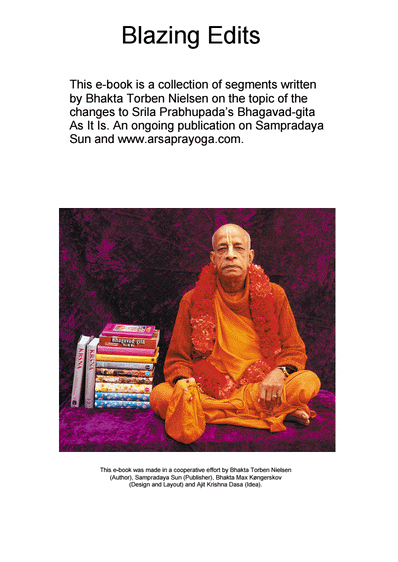
E-BOOK: Blazing Edits

blazing-edits

Click to download the book

Aug 20, 2015 — CANADA (SUN) —  We invite you to download a copy of Blazing Edits, an e-book collection of segments written by Bhakta Torben Nielsen on the topic of the changes to Srila Prabhupada’s Bhagavad-gita As It Is. This series has been an ongoing publication on Sampradaya Sun and www.arsaprayoga.com.

This e-book was made in a cooperative effort by Bhakta Torben Nielsen (Author), Bhakta Max Køngerskov (Design and Layout), Ajit Krishna dasa (Idea), and the Sampradaya Sun (Publisher). The book will periodically be updated with new segments.

DOWNLOAD LATEST VERSION

Blazing Edits (16 okt. 2015)

Who Is Bhakta Torben?

Bhakta Torben Nielsen, a devotee from Denmark associated with the Hare Krishna movement, is known for his outspoken stance on various issues within ISKCON, particularly the changes made to Srila Prabhupada’s books after his passing.

His critiques have focused on what he sees as deviations from the original teachings and intentions of Prabhupada, ISKCON’s founder. In his view, the editorial alterations—such as revisions and edits to Prabhupada’s texts—compromise the authenticity of the teachings and pose a serious concern for the integrity of the movement.

Nielsen’s writings delve into the nature and extent of these changes, raising questions about their justification and impact. For him, the issue is not merely about preserving the original words on the page; it is a matter of safeguarding the spiritual legacy that Srila Prabhupada intended to leave behind.

The controversy over book changes reflects broader systemic issues within ISKCON, such as centralized authority and fidelity to the founder’s instructions. These concerns, along with others about the governance and direction of ISKCON, were extensively explored in Nielsen’s many articles.

Later he had his work compiled into the above eBook titled Blazing Edits, which addresses the controversial changes made to Srila Prabhupada’s books and advocates for preserving the original teachings without alteration. Through this work, Nielsen aims to shed light on what he and other concerned devotees see as a crucial challenge facing the Hare Krishna movement: the need to preserve Prabhupada’s teachings in their authentic form.

Note on Bhakta Torben Nielsen

Bhakta Torben was originally initiated by Harikesha Swami. When Harikesha later fell from his position, Torben chose to reject him as his guru and discontinued using the spiritual name he had received. This decision reflects Torben’s lifelong commitment to sincerity, integrity, and fidelity to Śrīla Prabhupāda above institutional considerations.

Imperishable Add-on Edit (Bg. 15.1)

Plate 35 of the 1972 Edition of Bhagavad-gita As It Is.  This painting is not to be found in the 1983 Edition of the Bhagavad-gita As It Is.

Plate 35 of the 1972 Edition of Bhagavad-gita As It Is.
Not to be found in the 1983 Edition.

By Ajit Krishna Dasa

Bhagavad-gita As It Is, 15.1

Original and authorised 1972 edition:

The Blessed Lord said: There is a banyan tree which has its roots upward and its branches down and whose leaves are the Vedic hymns. One who knows this tree is the knower of the Vedas.”

The draft a.k.a. “the original manuscript”:

The Supreme Lord said: It is said that there is a banyan tree which has its roots upward and its branches down; and the Vedic hymns are its leaves. One who knows this tree is the knower of the Vedas.”

Uauthorized 1983 edition:

The Supreme Personality of Godhead said: It is said that there is an imperishable banyan tree that has its roots upward and its branches down and whose leaves are the Vedic hymns. One who knows this tree is the knower of the Vedas.”

From lectures:

Pradyumna: (Translation:) “The Blessed Lord said: There is a banyan tree which has its roots upward and its branches down and whose leaves are the Vedic hymns. One who knows this tree is the knower of the Vedas.”

Prabhupada: So this is the description of Vedic literature. Vedais ca sarvair aham eva vedyah [Bg. 15.15]. That will be described. (Srila Prabhupada, Lecture, See Spiritual Identity Everywhere,
73/10/28 Bombay, Bhagavad-gita 15.1)

Nitai dasa: Translation: The Blessed Lord said: There is a banyan tree which has its roots upward and its branches down and whose leaves are the Vedic hymns. One who knows this tree is the knower of the Vedas.

Purport: After the discussion of the importance of bhakti-yoga, one may question, “What about the Vedas?” (Srila Prabhupada, Lecture, The Purpose of Vedic Study 74/02/26 Calcutta, Bhagavad-gita 15.1)

No objections from Srila Prabhupada.

Comment

1) We here observe that Jayadvaita Swami, after scanning the authorized verse, takes the usual route to an old draft (the so-called original manuscript). An idea for which he has no proper justification.

2) He decides to change “The Blessed Lord”. Here he could have chosen to use Srila Prabhupada’s words from the draft’ translation of Bg. 15.1 which reads “The Supreme Lord said”, but he chose instead to go to the English synonyms and use “The Supreme Personality of Godhead”.

3) Next he decides to add “It is said”. This he took from the drafts’ translation of Bg. 15.1.

4) Then he decides to add an adjective to “banyan tree”. He could have gone back to the English synonyms and used the word “eternal”. But instead he took a trip to the drafts’ purport where he for some reason chose the word “imperishable” over the word “indestructible” which is also in the purport. NOTE: The word “imperishable” is omitted from the purport of both the original 1972 edition and the 1983 edition which makes his choice even more strange.

5) He then changes “which” to “that” even though “which” was both found in the draft and was grammatically perfectly fine. In other words, he found the word “that” not in the English synonyms, not in the translation and not in the purport. But in his own mind.

Hundreds of changes to Srila Prabhupada’s Gita have been documented online. And we see Jayadvaita Swami again and again randomly chose words sometimes from the manuscripts’ translations, sometimes from the English synonyms, sometimes from the purport and sometimes from his own mind.

For the most part it is very hard to find any objective and identifiable criteria for his changes. Especially for changes such as those above. And there are hundreds, if not thousands, of such changes in the Gita alone.

BBT Editorial Policy for Future Editors

The BBT International is apparently in the process of creating editorial policies for future editors i.e. editors working AFTER the present editors’ retirement.

Guidance for Future BBT Editors

Proposed BBT Editorial Policy for Future Editors

For now, we at Arsa-Prayoga are simply putting this up for everyone to see:

Hare Krishna
Please accept my obeisances. All glories to Srila Prabhupada

The BBT Global Communications team have requested our assistance in widely circulating as far as possible (in ISKCON circles) the draft of the proposed BBT editorial policy to allow for devotees to comment.

Please can you assist in this regard as this is a very important and sensitive subject.

Below is a standard cover letter you can use and attached is the draft policy

I have cc’d in Smita Krsna Prabhu and Rasika Bandhu Prabhu who are co-ordinating this communique for BBT

Your servant
Nanda Kishor das

———————

Dear Devotees

Hare Krishna

Please accept our humble obeisances. All glories to Srila Prabhupada.
Attached kindly find for your perusal and comment the BBT Editorial Policy.

Kindly send all comments by no later than 20 September 2015 to:
BBT.Global.Communications@pamho.net

The BBT directors, at their latest meeting, had an extended discussion
about Srila Prabhupada’s purport to Srimad-Bhagavatam verse 4.25.41. We will
soon send out a separate memo about that, letting you know where those
thoughts led and seeking your comments.

Yours in the service of Srila Prabhupada
BBT Global Communications

Link to the Guide for Future BBT Editors.

BBTI’s Gives Mutually Exclusive Justifications for the editing of Perfect Questions, Perfect Answers

Perfect_Questions_Perfect_Answers-cover

By Ajit Krishna Dasa

In 1993 BBT International published a new edition of Srila Prabhupada’s Perfect Questions, Perfect Answers. Madhudvisa Prabhu wrote about this:

“The original edition was more or less a transcript of the original conversation. It was edited, of course, to make the English clear and correct and to make it readable. But basically it remained a transcript of the original conversation.

The 1993 version changes all of this. The book is slashed from 99 pages to 77 pages! And the type is not even smaller! So much has been cut out. In one place four complete pages have been deleted!

All the text has been heavily edited and the whole mood of the book has been completely changed. We have not done anything below about the editing, we have just pointed out a few pieces of text (shown in bold) that have been completely deleted from the new edition.” (http://bookchanges.com/iskcon-perfect-questions-perfect-answers-book-changes/)

The BBT International has tried to justify the changes to Perfect Questions, Perfect Answers. But their attempted justifications are mutually exclusive.

BBTI’s Attempted Justification 1

“In the mid-1990s the BBT published a second edition of Perfect Questions, Perfect Answersedited by a less experienced BBT editor. Because readers of this edition pointed out numerous editorial discrepancies, the BBT directors resolved in 2002 that Dravida Dasa will review the book before its next printing. Either he will correct the discrepancies, or the BBT will revert to the first edition.” (ISKCON Communications Journal Vol. 11, Editing the Unchangeable Truth: An Overview of the Editorial History of the Books of His Divine Grace A. C. Bhaktivedanta Swami Prabhupada, 2005)

In 1996 the editing is of Perfect Questions, Perfect Answers was described by Jayadvaita Swami as follows:

Screen Shot 2015-08-03 at 13.13.04

(From Madhudvisa Dasa’s ISKCON’s Changes to Srila Prabhupada’s Bhagavad-gita As It Is and Perfect Questions, Perfect Answers)

In this letter Jayadvaita Swami mentions the name of the “less experienced editor” (Sita Devi Dasi), and he claims that her editing made the new version read “more smoothly” and made it “closer to the original transcription”. But he later had to admit that this new and less experienced editor was allowed to change the books of Srila Prabhupada without proper supervision, and that her editing was not good enough.

So this is how Jayadvaita Swami’s explanations sounded in 1996 and 2005 respectively. But a few years ago one of his colleagues posted the following on the internet:

BBTI’s Attempted Justification 2

“A report from Ranjit das, BBTI:

No good deed goes uncriticized.

The story of Perfect Questions Perfect Answers reprint

Recently someone has tried to stir up a new criticism of the BBT by pointing to the re-print (in the 1990’s) of the book Perfect Questions Perfect Answers. Some 20 pages were taken out of the book. Why?

At that time PQPA had been out of print for a long time. The devotee in charge of operations really wanted to re-print the book because he liked it so much. However there was a problem. The book was around 120 pages long. The small books that the BBT were printing at the time had been formatted into 96-page books so that the printers would give a really good price. If PQPA were printed at the 120 plus pages then most of the distributors would not buy them and distribute them because such books as Perfection of Yoga, Beyond Birth and Death, etc were cheaper.

What to do?

Our devotee in charge of operations read the book and a good section consisted of a conversation between Srila Prabhupada and an Indian gentleman who was also present at the time. So our devotee figured that this part could go because it was not really part of the conversation between Bob Cohen (now Brahmatirtha Das) and Srila Prabhupada. But this was just not enough to bring it down to the 96-page format so a few more pages were cut.

Srila Prabhupada himself authorized the same thing with the abridged Gita. This devotee simply followed the precedent. But Srila Prabhupada wanted the word to go out and so did our intrepid BBT manager. And now this is being pointed to as some kind of conspiracy. So our BBT manager, instead of being lauded for the 96 pages that were printed and distributed is criticized for the 20 pages that he did not.” (https://www.facebook.com/bbtedit/posts/10152724990094126)

Like I said, these stories are mutually exclusive. Take a look:

Screen Shot 2015-08-03 at 10.28.07

In addition to this, Madhudvisa Prabhu has documented that in fact the second edition has not just had sections and pages cut out. Quite a few individual words and sentences have been randomly removed. Here is a link to Madhudvisa Prabhu’s comparisons. Please check it out yourself.

Our questions to BBT International: What is correct here? The first or second explanation? Or a combination? Or a third or fourth explanation?

Uneven Edit (Bg. 2.48)

bg-2-48

BY: BHAKTA TORBEN

Jun 17, 2015 — DENMARK (SUN) —  Bhagavad-gita As It Is, 2.48:

Original, authorized 1972 edition: 

“Be steadfast in yoga, O Arjuna. Perform your duty and abandon all attachment to success or failure. Such evenness of mind is called yoga.”

Manuscript: 

“Do your prescribed duty in an equipoised condition. To do such duty without being attached to success or failure, and to remain in an equiposed condition is called Yoga.”

Read Aloud to Srila Prabhupada by Tamala Krishna in London, 1968: 

“Be steadfast in your duty, O Arjuna, and abandon all attachment to success or failure. Such evenness of mind is called yoga [Bg. 2.48].”

And immediately after Tamal Krishna’s reading of the verse Srila Prabhupada says:

“This is the explanation of yoga, evenness of mind. Yoga-samatvam ucyate. If you work for Krsna, then there is no cause of lamentation or jubilation. Jubilation is there because you are working for Krsna, but there is no cause of lamentation. Yoga-sthah kuru karmani, yogah karmasu kausalam. That is the secret of activities, how you can very diligently work at the same time you are not entangled with the actions. That is the secret. Go on.”

The word-for-word reads ‘samatvam – evenness of mind‘ (Original), but the heavily edited ‘JAS It Is’ version says in the word-for-word ‘samatvam – equanimity’.

‘JAS It Is’:

“Perform your duty equipoised, O Arjuna, abandoning all attachment to success or failure. Such equanimity is called yoga.”

Once again we observe an absolutely unnecessary change. This verse in the original 1972 edition is perfect.

There are more irregularities. Check it out.

Failed De-Sexing Edit Attempt (Bg. 2.23 and 2.24)

BY: BHAKTA TORBEN

May 14, 2015 — DENMARK (SUN) —

Bhagavad-gita As It Is, 2.23:

Screen Shot 2015-06-11 at 13.38.38

Original, authorized 1972 edition: 

“The soul can never be cut into pieces by any weapon, nor can he be burned by fire, nor moistened by water, nor withered by the wind.”

Manuscript: 

“The soul can never be cut into peices by any kind of weapon, neither can he be burnt by fire, nor can He be moistened by water, nor can he be dried up by the wind.”

JAS It Is: 

“The soul can never be cut to pieces by any weapon, nor burned by fire, nor moistened by water, nor withered by the wind.”

Although both the manuscript and the original says he about the soul, the JAS It is-version has, for unknown reasons, dropped the pronoun.

Paradoxically, however, ‘Jas It Is’ version in the ensuing verse, 2.24, does NOT drop the pronoun ‘he‘ for the soul:

Bhagavad-gita As It Is 2.24:

Original, authorized 1972 edition: 

“This individual soul is unbreakable and insoluble, and can be neither burned nor dried. He is everlasting, all-pervading, unchangeable, immovable and eternally the same.”

Manuscript: 

“This individual soul is unbreakable, cannot be burnt, insoluble, nondriable, everlasting, present everywhere, unchangeable, immovable and eternally the same.”

JAS It Is. 2.24:

“This individual soul is unbreakable and insoluble, and can be neither burned nor dried. He is everlasting, present everywhere, unchangeable, immovable and eternally the same.”

So the ‘JAS It Is’ edit-strategy seems to be pretty fickle. “Should we, or shouldn’t we?”

Anyway, why not just stick to the original? It is pretty clear.

In London, 1973, BOTH of the original’s verses were read aloud to Srila Prabhupada.

Superfluous and Awkward (Bg. 3.26)

BY: BHAKTA TORBEN

May 18, 2015 — DENMARK (SUN) —

Bhagavad-gita As It Is, 3.26:

Screen Shot 2015-06-10 at 12.21.52

Original, authorized 1972 edition: 

“Let not the wise disrupt the minds of the ignorant who are attached to fruitive action. They should not be encouraged to refrain from work, but to engage in work in the spirit of devotion.”

Manuscript: 

“Those who are after the fruitive results of prescribed duties may not be induced to stop work, disrupt his intelligence. Rather they should be engaged in all sorts of activities, for gradual development of Krsna consciousness.”

JAS It Is:

“So as not to disrupt the minds of ignorant men attached to the fruitive results of prescribed duties, a learned person should not induce them to stop work. Rather, by working in the spirit of devotion, he should engage them in all sorts of activities [for the gradual development of Krishna consciousness].”

The original is fine and lucid.

The ‘Jas It Is’ edition is a threefold mix of the original and the manuscript plus added stuff, i.e., the words ‘So as not to’ and ‘a learned person’ .

The bracketed sentence in the end ‘for the gradual development of Krishna consciousness’ is a pleonasm to the sentence ‘working in the spirit of devotion’, therefore superfluous and the end-result is awkward.

There is more, check it out.

Performer Edit (Bg. 14.19)

BY: BHAKTA TORBEN

Apr 02, 2015 — DENMARK (SUN) —

Bhagavad-gita As It Is, 14.19:

Original, authorized 1972 edition:

“When you see that there is nothing beyond these modes of nature in all activities and that the Supreme Lord is transcendental to all these modes, then you can know My spiritual nature.”

Manuscript:

“When you see that there is nothing beyond these modes of Nature in all activities — and that the Supreme Lord is transcendental to this, then you can know My spiritual Nature.”

Screen Shot 2015-04-03 at 14.58.14

Jas It Is:

“When one properly sees that in all activities no other performer is at work than these modes of nature and he knows the Supreme Lord, who is transcendental to all these modes, he attains My spiritual nature.”

The Original and the manuscript agrees TO THE LETTER. Both the manuscript and the original says `You can know My spiritual nature´, whereas `Jas It Is´ says `he attains to My spiritual nature. The word-for-word says, ‘vetti’- know.

The phrase, ‘no other performer‘ is not found in the original or the manuscript.

Radhanath Swami on the book changes (leaked e-mail)

In September 2014 Radhanath Swami sent the below e-mail to one of his Danish disciples, Caitanya Candra Dasa:

Screen Shot 2015-03-29 at 10.03.33

Here is the text in digital format:

“Dear Chaitanya Chandra Prabhu,
Please accept my respectful obeisances. All glories to Srila Prabhupada.
I thank you for confiding in me on this subject. There is much to be said and I sincerely respect your concern. Actually, the subject is being discussed on the GBC level. The sacred principle of not changing what our Acarya has written is to be taken with great care. At the same time, the editorial process was done by persons who were personally trained by Srila Prabhupada. So it is not an easy subject. As it stands, it is being discussed on a high level of leadership.
I do not believe that your separating from our society will have any positive result. There are many innocent and sincere devotees simply trying to be faithful to their seniors. I believe that Srila Prabhupada would want this issue resolved on a higher level of leadership, which I believe it will be in time, and that it not disrupt the lives of innocent devotees or the unity of our society.
You have a right to your genuine concerns, please consider my appeal that you express it in a balanced way that preserves other sacred principles, those of respect and unity which Srila Prabhupada also emphasized as cardinal principles in vaisnava culture.
With gratitude, your servant, Radhanath Swami

An analysis:

We can see that Radhanath Swami is an intelligent diplomat.

RS: “I thank you for confiding in me on this subject.”

Radhanath Swami tries to maintain a relationship of trust. He makes it seem as if he appreciates Caitanya Candra Dasa’s questions, and invites him to open up his heart.

RS: “There is much to be said…”

This could make it seem as if Radhanath Swami has some special knowledge about the book changes, and as if it is a great mystery (secret knowledge) that requires deep and intense study, sadhana and special association to understand. But what Radhanath Swami is really saying, I guess, is that he does not know much about this matter, and that he is not going to speak much about it – neither to Caitanya Candra Dasa nor publicly.

RS: “…and I sincerely respect your concern.”

Radhanath Swami makes it seem as if he truly shares Caitanya Candra Dasa’s concerns. He speaks as if they are on the same side – that of genuine concern. But Radhanath Swami’s statement is trivial, for who does not care for Srila Prabhupada’s books? Everyone will say they care. Everyone will say that the editing should be done in a way that pleases Srila Prabhupada. But notice that Radhanath Swami does not disclose his own personal opinion. He really says nothing at all.

RS: “Actually, the subject is being discussed on the GBC level. The sacred principle of not changing what our Acarya has written is to be taken with great care. At the same time, the editorial process was done by persons who were personally trained by Srila Prabhupada. So it is not an easy subject. As it stands, it is being discussed on a high level of leadership.”

Here we again see Radhanath Swami’s diplomatic skills at work. He is indirectly saying that Caitanya Candra Dasa should not care much about it because it is being taken care of “on a high level of leadership”. Radhanath Swami says: “Do not worry! The GBC will handle it! Go back to sleep!”

But we all know what “a high level of leadership” in ISKCON means! It means incompetent devotees creating new problems while trying to solve already existing problems caused by themselves.

And what is the proof that the GBC are talking about this? It was not mentioned in the GBC resolutions of 2015. Maybe Radhanath Swami is misinformed or twisting the truth trying to buy time. Or maybe there is really a committee of around 3 members who are all pro-change who speaks about the book changes 2 hours per year trying to figure out how to close the mouths of the protesters.

Why should we accept Radhanath Swami’s “assurance” that the GBC is handling this issue? For all we know he could be lying. He presents no proof.

Radhanath Swami tries to balance things out by acknowledging that it is important not to change the words of our Acarya. But at the same time, he says, we should remember that those who did the changes were personally trained by Srila Prabhupada. Radhanath Swami uses the same diplomatic skills as Duryodhana on the battlefield first glorifying Drona and then Bhisma. He is saying to Caitanya Candra Dasa: “You are good, and they are also good! Therefore it is all very complicated and can only be solved at GBC level! Please go back to sleep!”

RS: “So it is not an easy subject.”

It really does not take much of a brain to see that Jayadvaita Swami and BBTI have violated the arsa-prayoga big time. But either Radhanath Swami will not write this online, or he is in denial or simply does not know much about what has been done to Srila Prabhupada’s books.

What we do know is that he is diplomatic, and that he is not going to risk his own prestige and position by speaking about the book changes online or publicly.

Factually, by his silence Radhanath Swami is accepting the changes made to Srila Prabhupada’s books by the BBTI, and by encouraging his disciples to also stay silent, he is also encouraging them to accept the changes.

RS: “There are many innocent and sincere devotees simply trying to be faithful to their seniors. I believe that Srila Prabhupada would want this issue resolved on a higher level of leadership, which I believe it will be in time, and that it not disrupt the lives of innocent devotees or the unity of our society.”

Radhanath Swami seems to have failed to understand that the so-called “higher level of leadership” in ISKCON has had more that 30 years to resolve this very simple issue. But they have continuously made the situation worse. Instead of stopping all editing while investigating the matter thoroughly they have allowed BBTI to continue editing many of Srila Prabhupada’s books.

We have absolutely no reason to believe or trust that the BBTI or GBC are capable of solving this issue on their own. And since they will not listen we have to challenge them to answer publicly. There is no other way. It is their own fault that this subject is being debated publicly.

And to claim that it is dangerous for new devotees to hear of such controversial topic is simply foolish. Our first concern in spiritual life is to make sure that the scriptures we read are bona fide. This is ABC and all new devotees are taught this in the temples, and it is written in all of Srila Prabhupada’s small introductory books. So if there is any doubt about the authenticity of the books, then all devotees need to know.

The funny thing is that we know for sure that the original books are bona fide and have the power to deliver us. But we are not sure if the changed editions have that potency. As a guru Radhanath Swami ought to have at least the amount of intelligence to understand that we must stop printing the changed books until we know for sure which editions are bona fide. Better safe than sorry.

But Radhanath Swami has never stepped forward to ask the BBTI to stop their editing while the matter is being investigated.

Instead Radhanath Swami suggests that we leave this crucial matter to incompetent “high level leaders”, while we sleep our way back to Godhead. Are these foolish instructions on the book changes really coming from a bona fide spiritual master?

RS: “You have a right to your genuine concerns, please consider my appeal that you express it in a balanced way that preserves other sacred principles, those of respect and unity which Srila Prabhupada also emphasized as cardinal principles in vaisnava culture.

With gratitude, your servant, Radhanath Swami”

Radhanath Swami tries to close the correspondence in a mood of friendship. He has said something and at the same time nothing. Radhanath Swami prefers that Caitanya Candra Dasa keeps quiet about this matter and leaves it to the “high level leaders”. At the same time Radhanath Swami knows that Caitanya Candra Dasa might not want to keep his mouth shut, so he implores him to speak in a balanced way if he speaks about it.

At no point did Radhanath Swami state his own opinion about the book changes, and he did not help Caitanya Candra Dasa understand this most important issue. If Radhanath Swami really was a bona fide guru, then he should easily be able and willing to clear the doubts of his disciples on this matter. But it seems he cannot do that. Or maybe he choses to let his disciples stay in the darkness of ignorance in order not to get himself into trouble.

This is not how a guru works. A guru is not a diplomat. A guru is straight forward. A guru want to help his disciples. He wants to save them from ignorance and the offences of violating the arsa-prayoga principle.

Some of our local ISKCON authorities in Denmark have tried to impress upon the Danish devotees that Caitanya Candra Dasa is violating his guru’s instructions by speaking about the book changes. But we can see this is false. Radhanath Swami says that Caitanya Candra Dasa has the right to be concerned about the book changes, and he does not prohibit Caitanya Candra Dasa from speaking publicly about the book changes – for whatever reason.